
IT a 3 b 3 corrector strengths with
IT a 3, b 3 corrector strengths with large a 3, b 3 IT errors Y. Nosochkov, M. Giovannozzi Acknowledgements: S. Fartoukh, R. De Maria, A. Mereghetti, E. Todesco, and Boinc volunteers WP 2 meeting 31 July 2018
Outline § Six. Track simulations of the IT a 3 & b 3 corrector’s strengths with large a 3 & b 3 errors in the IT § Estimate of the maximum “allowed” IT a 3 & b 3 errors for the present corrector spec, based on high statistics with 600 random seeds § Evaluation of the effect of D 1 a 3 & b 3 spec errors on the IT corrector’s strengths § a 3 & b 3 corrector strength distribution in 600 seeds § Conclusions 2
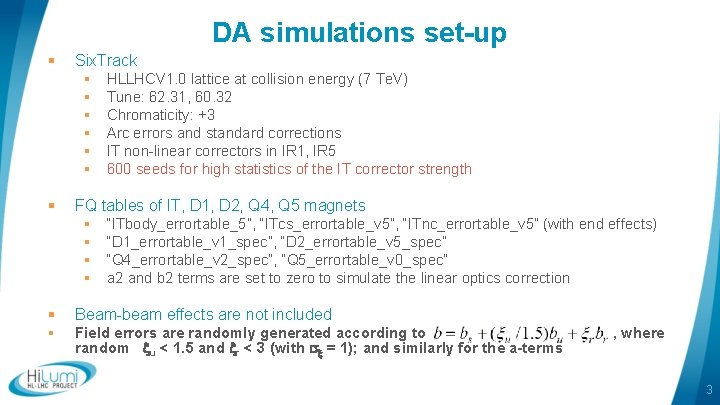
DA simulations set-up § Six. Track § HLLHCV 1. 0 lattice at collision energy (7 Te. V) § Tune: 62. 31, 60. 32 § Chromaticity: +3 § Arc errors and standard corrections § IT non-linear correctors in IR 1, IR 5 § 600 seeds for high statistics of the IT corrector strength § FQ tables of IT, D 1, D 2, Q 4, Q 5 magnets § “ITbody_errortable_5”, “ITcs_errortable_v 5”, “ITnc_errortable_v 5” (with end effects) § “D 1_errortable_v 1_spec”, “D 2_errortable_v 5_spec” § “Q 4_errortable_v 2_spec”, “Q 5_errortable_v 0_spec” § a 2 and b 2 terms are set to zero to simulate the linear optics correction § Beam-beam effects are not included § Field errors are randomly generated according to random xu < 1. 5 and xr < 3 (with sx = 1); and similarly for the a-terms , where 3

Evaluation of maximum a 3, b 3 IT corrector strengths vs IT a 3, b 3 • • • Field errors are randomly generated according to , where random Gaussian xu < 1. 5 and xr < 3 (with sx = 1); and similarly for the “a” terms According to the above formula, theoretically maximum generated error value is bmax = bu + 3*br (bs = 0) high statistics is needed to approach this value in simulations We use large number of seeds (600) to determine maximum a 3 & b 3 IT corrector strengths as a function of theoretically maximum errors a 3 max & b 3 max This method avoids ambiguity related to the dependence of four a 3 (or b 3) corrector strengths on the 24 random values of a 3 (b 3) errors in the 24 IT quadrupoles in IR 1 & IR 5 From this dependence, we can determine the maximum allowed a 3 max & b 3 max values satisfying the a 3 & b 3 corrector specifications • a 3 -> BLmax = 0. 063 Tm @ 50 mm (new nominal values are 0. 095 Tm) • b 3 -> BLmax = 0. 063 Tm @ 50 mm (new nominal values are 0. 095 Tm) Finally, we determine the maximum allowed uncertainty & random a 3 & b 3 values • a 3 u = a 3 r = a 3 max / 4 • b 3 u = b 3 r = b 3 max / 4 4
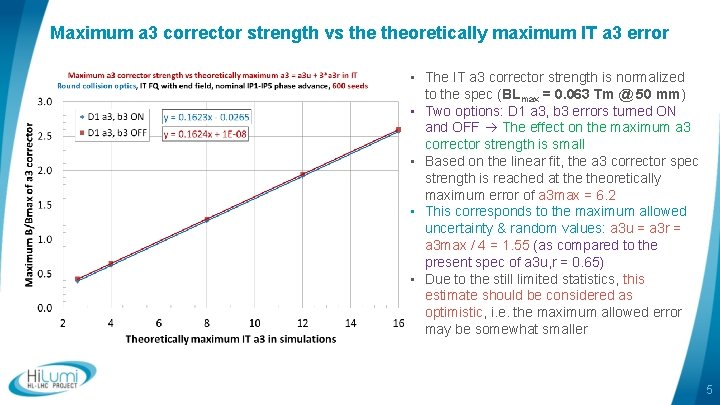
Maximum a 3 corrector strength vs theoretically maximum IT a 3 error • The IT a 3 corrector strength is normalized to the spec (BLmax = 0. 063 Tm @ 50 mm) • Two options: D 1 a 3, b 3 errors turned ON and OFF The effect on the maximum a 3 corrector strength is small • Based on the linear fit, the a 3 corrector spec strength is reached at theoretically maximum error of a 3 max = 6. 2 • This corresponds to the maximum allowed uncertainty & random values: a 3 u = a 3 r = a 3 max / 4 = 1. 55 (as compared to the present spec of a 3 u, r = 0. 65) • Due to the still limited statistics, this estimate should be considered as optimistic, i. e. the maximum allowed error may be somewhat smaller 5
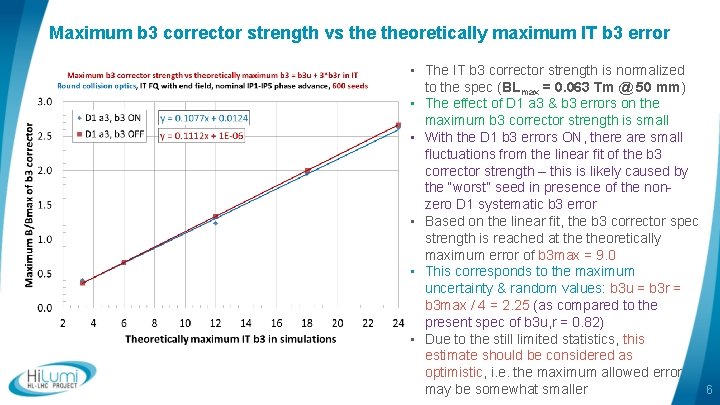
Maximum b 3 corrector strength vs theoretically maximum IT b 3 error • The IT b 3 corrector strength is normalized to the spec (BLmax = 0. 063 Tm @ 50 mm) • The effect of D 1 a 3 & b 3 errors on the maximum b 3 corrector strength is small • With the D 1 b 3 errors ON, there are small fluctuations from the linear fit of the b 3 corrector strength – this is likely caused by the “worst” seed in presence of the nonzero D 1 systematic b 3 error • Based on the linear fit, the b 3 corrector spec strength is reached at theoretically maximum error of b 3 max = 9. 0 • This corresponds to the maximum uncertainty & random values: b 3 u = b 3 r = b 3 max / 4 = 2. 25 (as compared to the present spec of b 3 u, r = 0. 82) • Due to the still limited statistics, this estimate should be considered as optimistic, i. e. the maximum allowed error 6 may be somewhat smaller
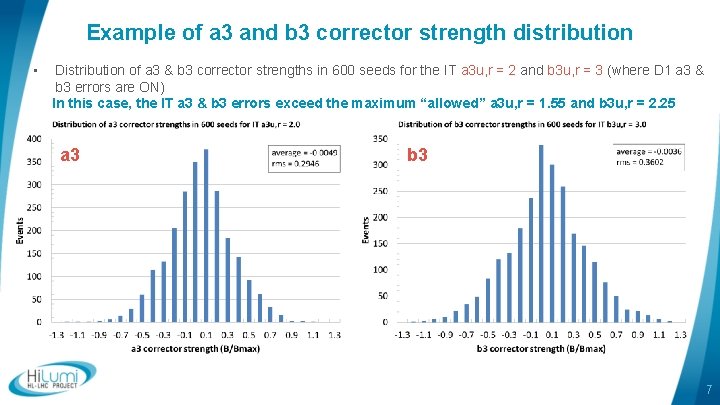
Example of a 3 and b 3 corrector strength distribution • Distribution of a 3 & b 3 corrector strengths in 600 seeds for the IT a 3 u, r = 2 and b 3 u, r = 3 (where D 1 a 3 & b 3 errors are ON) In this case, the IT a 3 & b 3 errors exceed the maximum “allowed” a 3 u, r = 1. 55 and b 3 u, r = 2. 25 a 3 b 3 7
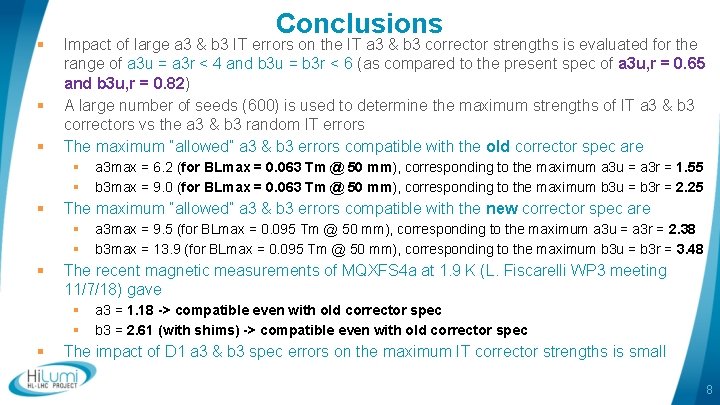
§ § § Conclusions Impact of large a 3 & b 3 IT errors on the IT a 3 & b 3 corrector strengths is evaluated for the range of a 3 u = a 3 r < 4 and b 3 u = b 3 r < 6 (as compared to the present spec of a 3 u, r = 0. 65 and b 3 u, r = 0. 82) A large number of seeds (600) is used to determine the maximum strengths of IT a 3 & b 3 correctors vs the a 3 & b 3 random IT errors The maximum “allowed” a 3 & b 3 errors compatible with the old corrector spec are § § § The maximum “allowed” a 3 & b 3 errors compatible with the new corrector spec are § § § a 3 max = 9. 5 (for BLmax = 0. 095 Tm @ 50 mm), corresponding to the maximum a 3 u = a 3 r = 2. 38 b 3 max = 13. 9 (for BLmax = 0. 095 Tm @ 50 mm), corresponding to the maximum b 3 u = b 3 r = 3. 48 The recent magnetic measurements of MQXFS 4 a at 1. 9 K (L. Fiscarelli WP 3 meeting 11/7/18) gave § § § a 3 max = 6. 2 (for BLmax = 0. 063 Tm @ 50 mm), corresponding to the maximum a 3 u = a 3 r = 1. 55 b 3 max = 9. 0 (for BLmax = 0. 063 Tm @ 50 mm), corresponding to the maximum b 3 u = b 3 r = 2. 25 a 3 = 1. 18 -> compatible even with old corrector spec b 3 = 2. 61 (with shims) -> compatible even with old corrector spec The impact of D 1 a 3 & b 3 spec errors on the maximum IT corrector strengths is small 8
- Slides: 8