
IT 691 Capstone Project Keystroke Biometric System Client
IT 691 Capstone Project Keystroke Biometric System Client: Dr. Mary Villani (SUNY Farmingdale) Instructor: Dr. Charles Tappert Team 4: Tarjani Buch Andreea Cotoranu Eric Jeskey Florin Tihon 1
Introduction • Keystroke biometric systems measure typing characteristics believed to be unique to an individual and difficult to duplicate; • A keystroke biometric identification system was developed in the Seidenberg School in 2004 and has since gone through four project iterations with different graduate student teams; • The system identifies subjects based on long-text (about 650 keystrokes) samples; 2
Project Requirements Enhance the feature extractor component of the system to output feature data in a standard format; Implement new data collection schedule and collect new data samples to support a longitudinal study on identification experiments; Rerun some of the previous experiments with new data samples; Deliver feature data to back-end teams for additional identification and authentication experiments; Update project web site 3
System Specifications • Pace University’s Utopia Server • FTP client • Java IDE (Borland’s JBuilder recommended) • Java JDK (latest version) 4
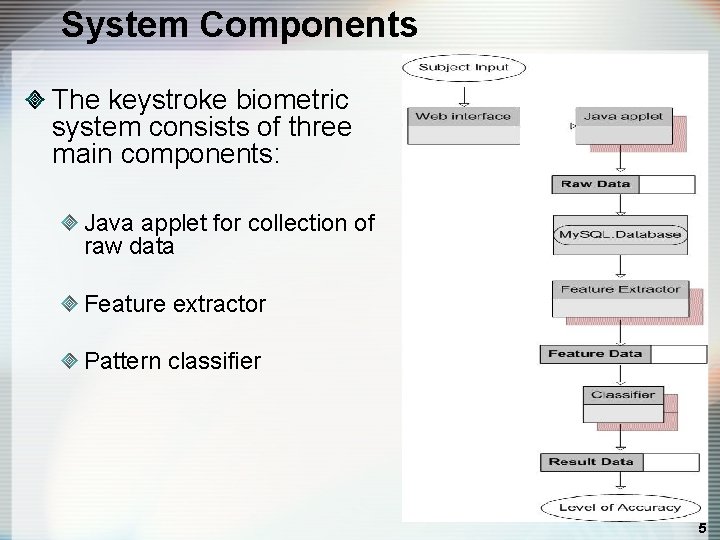
System Components The keystroke biometric system consists of three main components: Java applet for collection of raw data Feature extractor Pattern classifier 5
System Components (Contd. ) Java Applet for collection of raw data Subjects need to register in order to participate in the data collection process; There are four data entry tasks: Copy task on a Desktop Copy task on a Laptop Free text entry on a Desktop Free text entry on a Laptop 6
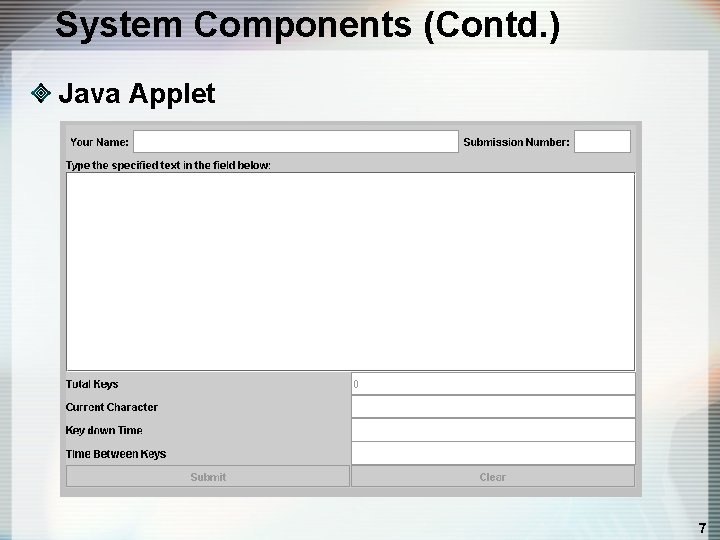
System Components (Contd. ) Java Applet 7
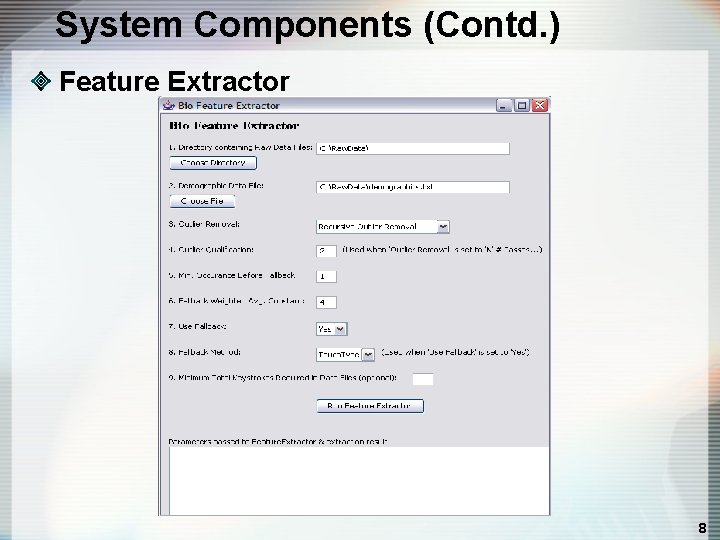
System Components (Contd. ) Feature Extractor 8
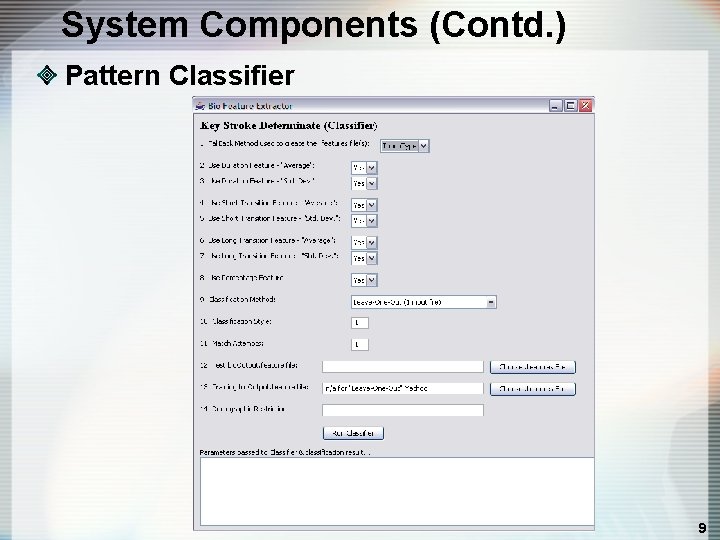
System Components (Contd. ) Pattern Classifier 9
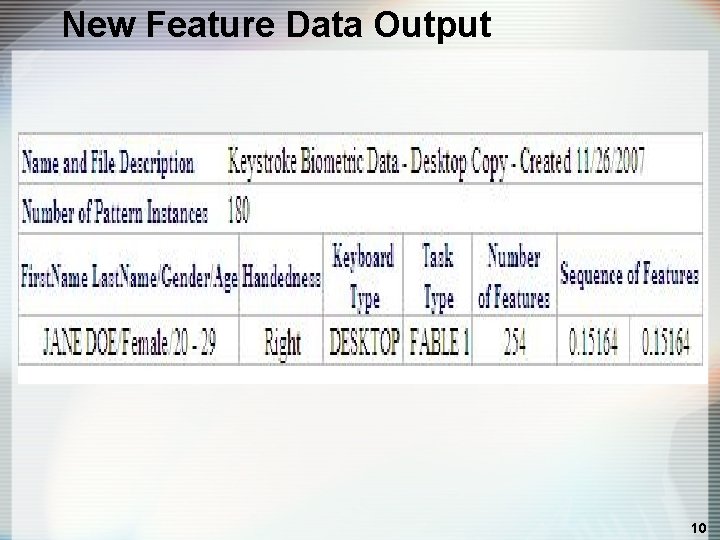
New Feature Data Output 10
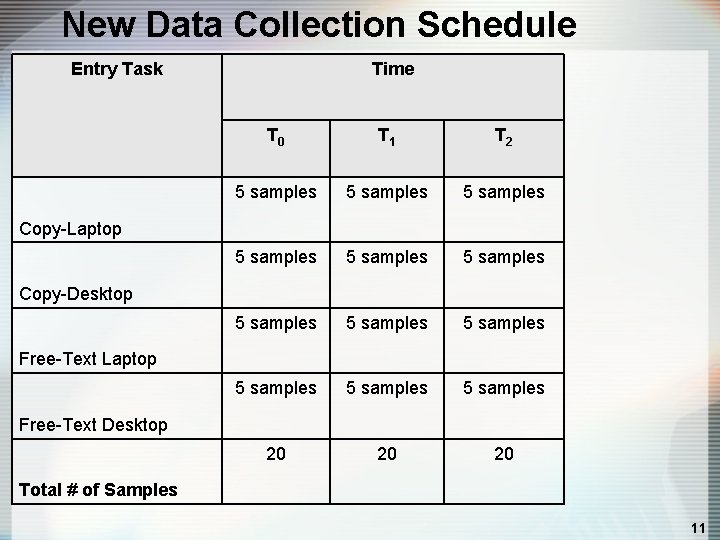
New Data Collection Schedule Entry Task Time T 0 T 1 T 2 5 samples 5 samples 5 samples 20 20 20 Copy-Laptop Copy-Desktop Free-Text Laptop Free-Text Desktop Total # of Samples 11
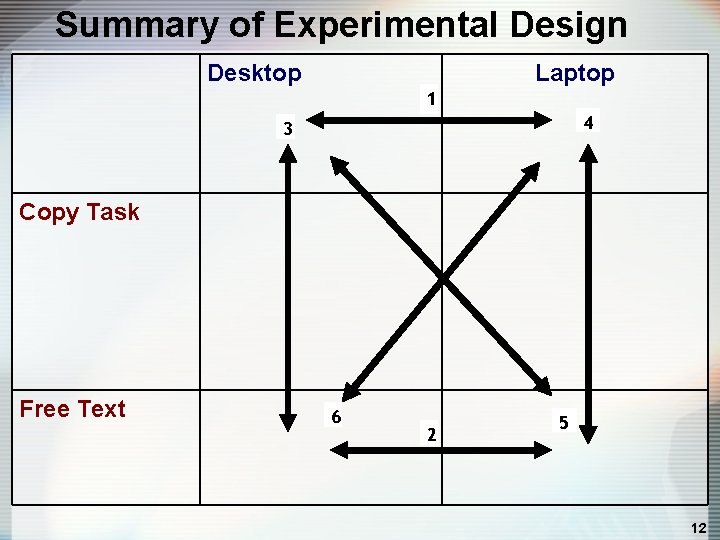
Summary of Experimental Design Desktop Laptop 1 4 3 Copy Task Free Text 6 2 5 12
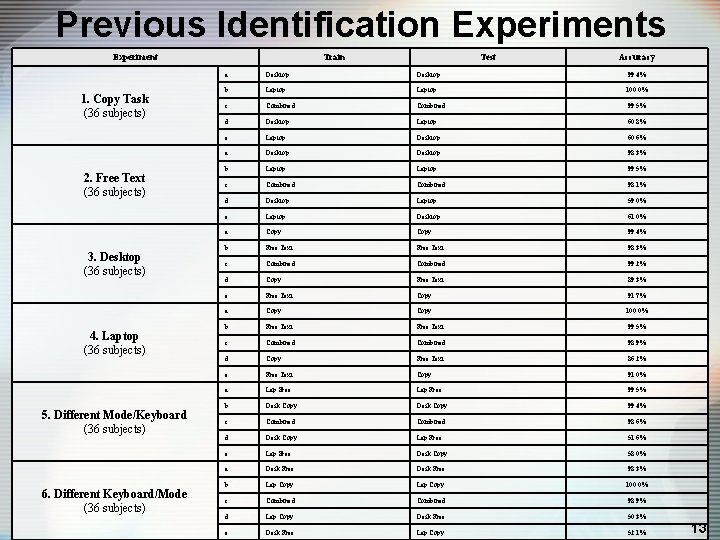
Previous Identification Experiments Experiment 1. Copy Task (36 subjects) 2. Free Text (36 subjects) 3. Desktop (36 subjects) 4. Laptop (36 subjects) 5. Different Mode/Keyboard (36 subjects) 6. Different Keyboard/Mode (36 subjects) Train Test Accuracy a Desktop 99. 4% b Laptop 100. 0% c Combined 99. 5% d Desktop Laptop 60. 8% e Laptop Desktop 60. 6% a Desktop 98. 3% b Laptop 99. 5% c Combined 98. 1% d Desktop Laptop 59. 0% e Laptop Desktop 61. 0% a Copy 99. 4% b Free Text 98. 3% c Combined 99. 2% d Copy Free Text 89. 3% e Free Text Copy 91. 7% a Copy 100. 0% b Free Text 99. 5% c Combined 98. 9% d Copy Free Text 86. 2% e Free Text Copy 91. 0% a Lap Free 99. 5% b Desk Copy 99. 4% c Combined 98. 6% d Desk Copy Lap Free 51. 6% e Lap Free Desk Copy 58. 0% a Desk Free 98. 3% b Lap Copy 100. 0% c Combined 98. 9% d Lap Copy Desk Free 50. 3% e Desk Free Lap Copy 52. 1% 13
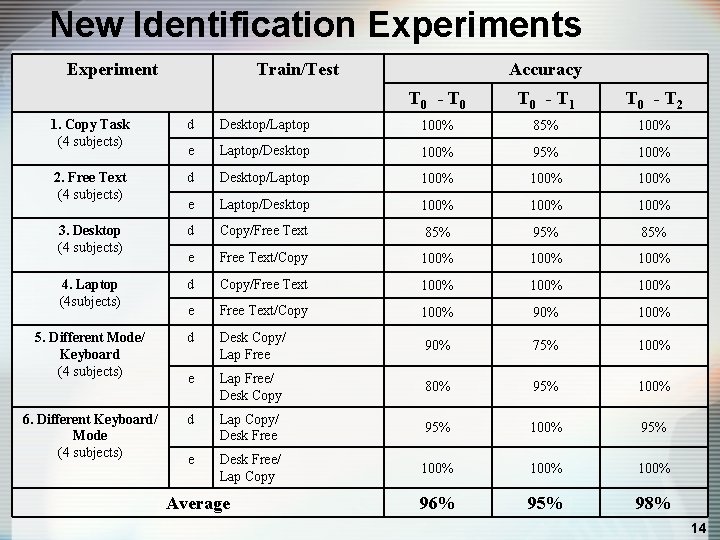
New Identification Experiments Experiment Train/Test Accuracy T 0 - T 1 T 0 - T 2 1. Copy Task (4 subjects) d Desktop/Laptop 100% 85% 100% e Laptop/Desktop 100% 95% 100% 2. Free Text (4 subjects) d Desktop/Laptop 100% e Laptop/Desktop 100% 3. Desktop (4 subjects) d Copy/Free Text 85% 95% 85% e Free Text/Copy 100% 4. Laptop (4 subjects) d Copy/Free Text 100% e Free Text/Copy 100% 90% 100% 5. Different Mode/ Keyboard (4 subjects) d Desk Copy/ Lap Free 90% 75% 100% e Lap Free/ Desk Copy 80% 95% 100% d Lap Copy/ Desk Free 95% 100% 95% e Desk Free/ Lap Copy 100% 96% 95% 98% 6. Different Keyboard/ Mode (4 subjects) Average 14
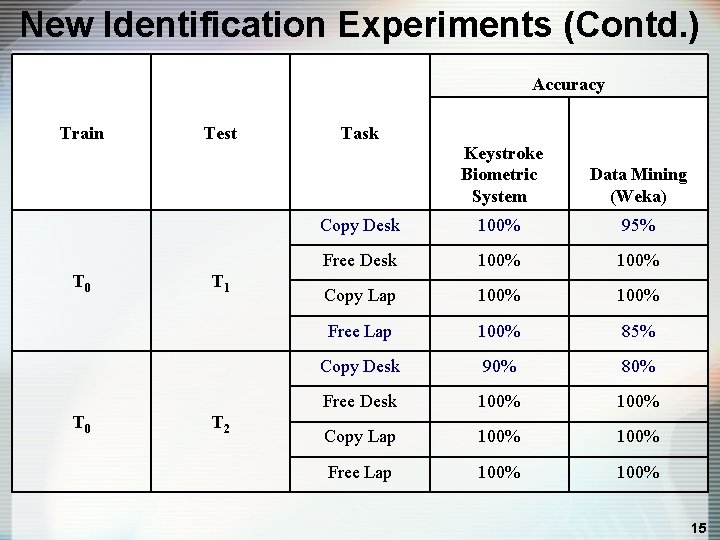
New Identification Experiments (Contd. ) Accuracy Train T 0 Test T 1 T 2 Task Keystroke Biometric System Data Mining (Weka) Copy Desk 100% 95% Free Desk 100% Copy Lap 100% Free Lap 100% 85% Copy Desk 90% 80% Free Desk 100% Copy Lap 100% Free Lap 100% 15
Summary • New experiments support previously documented accuracy findings; • New experiments show that a high level of accuracy can be maintained over time; • All experimental results are promising in that the system has the capability of solving identification problems and the potential for solving authentication problems; 16
Future Recommendations Running experiments with a larger data pool collected under the discussed conditions should provide stronger evidence relative to the success of the keystroke biometric system for identifying and eventually for authenticating subjects. It would also provide more insight into how accuracy evolves from one data collection session to another over time. 17
Communication A single face-to-face meeting with Dr. Mary Villani to get an understanding of the previous work and explore the potential for future developments Bi-weekly group meetings on IM Email communication with the stakeholders on a need basis Team Roles: Tarjani Buch – Data Collection Coordinator Andreea Cotoranu – Team Coordinator - Liaison Eric Jeskey – Architect / Designer Florin Tihon – Quality Officer / Tester 18
Deliverables/Accomplishments Technical Paper User Manual Enhanced Feature Extractor program to output feature vector in a standard format including normalization of feature values into the range 0 -1 Raw data collection with team members as test subjects at two-week intervals Interval 1: T 0 - November 3 rd 2007 Interval 2: T 1 - November 17 th 2007 Interval 3: T 2 - December 3 rd 2007 19
Keystroke Biometric System http: //utopia. csis. pace. edu/cs 691/2007 -2008/team 4/ Thank You
- Slides: 20