
ISYS 90036 Enterprise Systems Lecture 8 A Lessons
- Slides: 31
ISYS 90036 – Enterprise Systems Lecture 8 A Lessons from “Go Live” Failure at RMIT Dr. Sherah Kurnia
Outline • Feedback: – Week 7 submission and SSLC • Importance of Project Management • Project success factors • What happened at RMIT? • Explaining the problems at RMIT – Workshop Slide 2
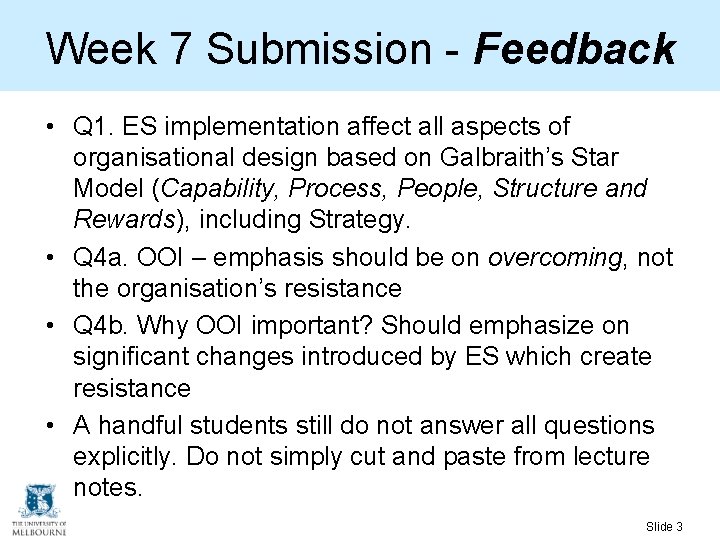
Week 7 Submission - Feedback • Q 1. ES implementation affect all aspects of organisational design based on Galbraith’s Star Model (Capability, Process, People, Structure and Rewards), including Strategy. • Q 4 a. OOI – emphasis should be on overcoming, not the organisation’s resistance • Q 4 b. Why OOI important? Should emphasize on significant changes introduced by ES which create resistance • A handful students still do not answer all questions explicitly. Do not simply cut and paste from lecture notes. Slide 3
References • Seddon, P. B. , Lessons from the Packaged Application Software “Go Live” Failures at Cambridge and RMIT Universities, 2007 • Motiwalla and Thompson (2012), Enterprise Systems for Management, 2 nd Edition, Pearson • Additional: Chen et al (2009) Managing ERP Implementation Failure: A Project Management Perspective, IEEE Transactions on Engineering Management, 56(1), Feb 2009, pp 157 -170. Slide 4
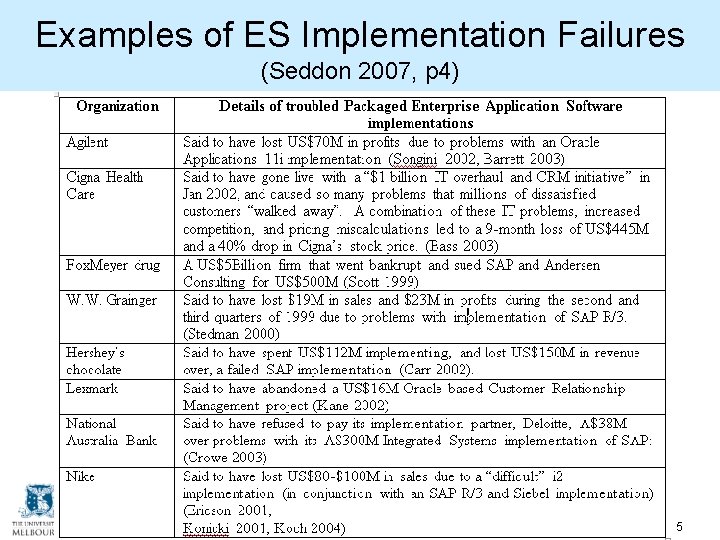
Examples of ES Implementation Failures (Seddon 2007, p 4) ISYS 20006 Shaping the Enterprise with ICT Slide 5
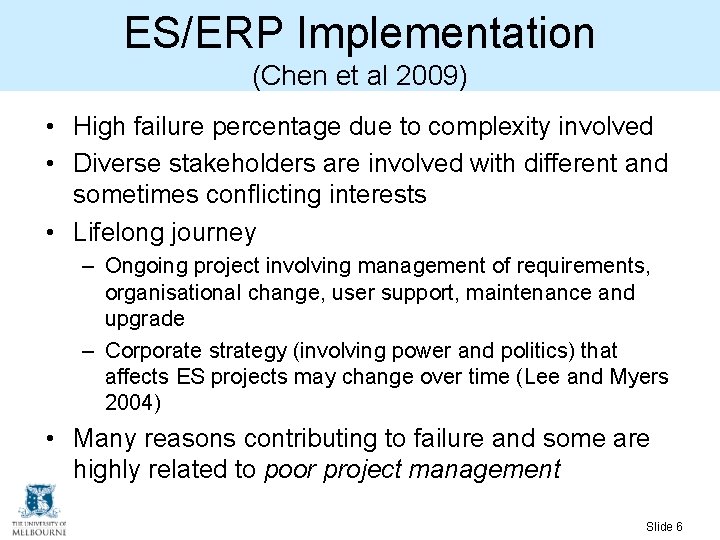
ES/ERP Implementation (Chen et al 2009) • High failure percentage due to complexity involved • Diverse stakeholders are involved with different and sometimes conflicting interests • Lifelong journey – Ongoing project involving management of requirements, organisational change, user support, maintenance and upgrade – Corporate strategy (involving power and politics) that affects ES projects may change over time (Lee and Myers 2004) • Many reasons contributing to failure and some are highly related to poor project management Slide 6
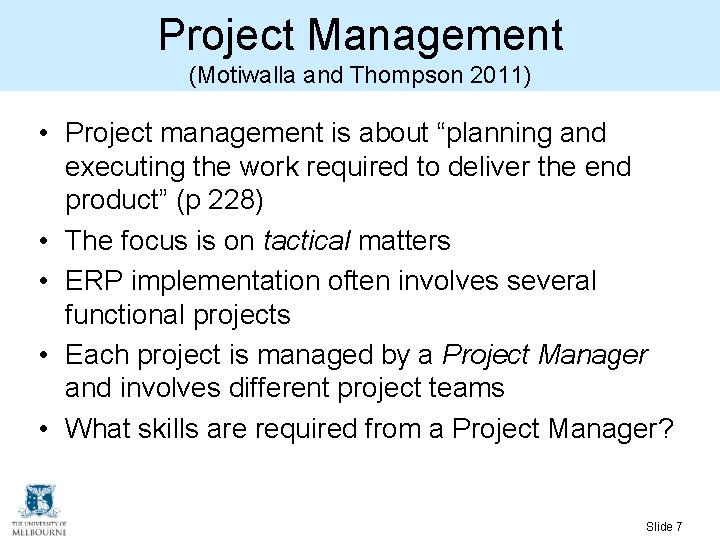
Project Management (Motiwalla and Thompson 2011) • Project management is about “planning and executing the work required to deliver the end product” (p 228) • The focus is on tactical matters • ERP implementation often involves several functional projects • Each project is managed by a Project Manager and involves different project teams • What skills are required from a Project Manager? Slide 7
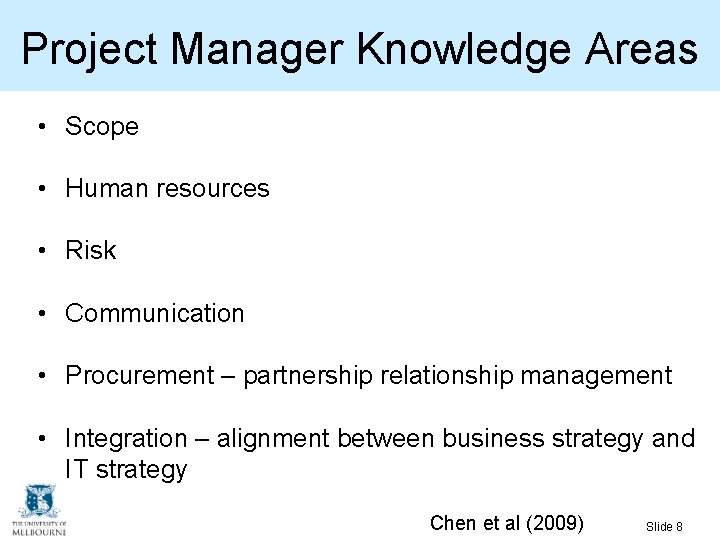
Project Manager Knowledge Areas • Scope • Human resources • Risk • Communication • Procurement – partnership relationship management • Integration – alignment between business strategy and IT strategy Chen et al (2009) Slide 8
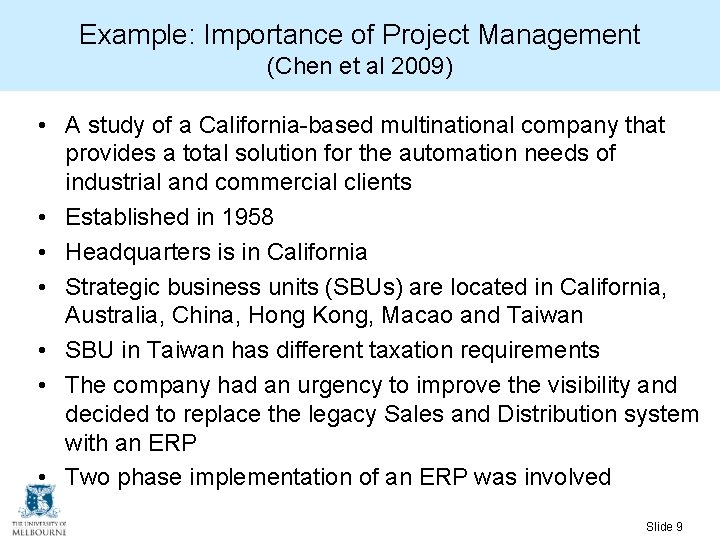
Example: Importance of Project Management (Chen et al 2009) • A study of a California-based multinational company that provides a total solution for the automation needs of industrial and commercial clients • Established in 1958 • Headquarters is in California • Strategic business units (SBUs) are located in California, Australia, China, Hong Kong, Macao and Taiwan • SBU in Taiwan has different taxation requirements • The company had an urgency to improve the visibility and decided to replace the legacy Sales and Distribution system with an ERP • Two phase implementation of an ERP was involved Slide 9
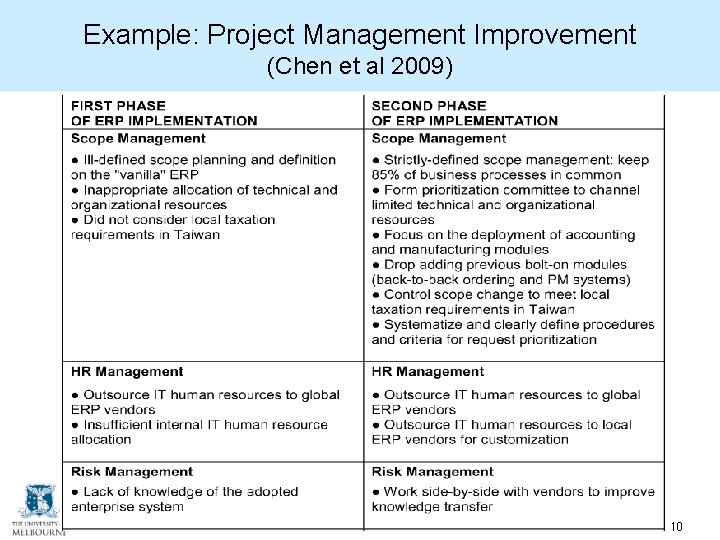
Example: Project Management Improvement (Chen et al 2009) Slide 10
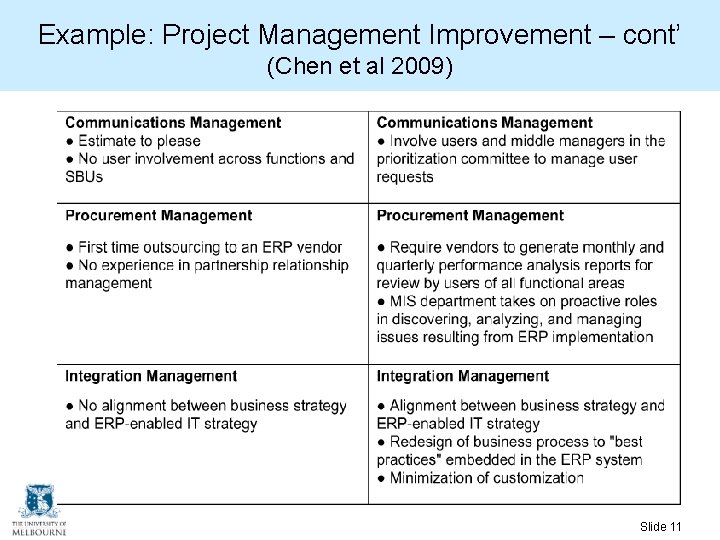
Example: Project Management Improvement – cont’ (Chen et al 2009) Slide 11
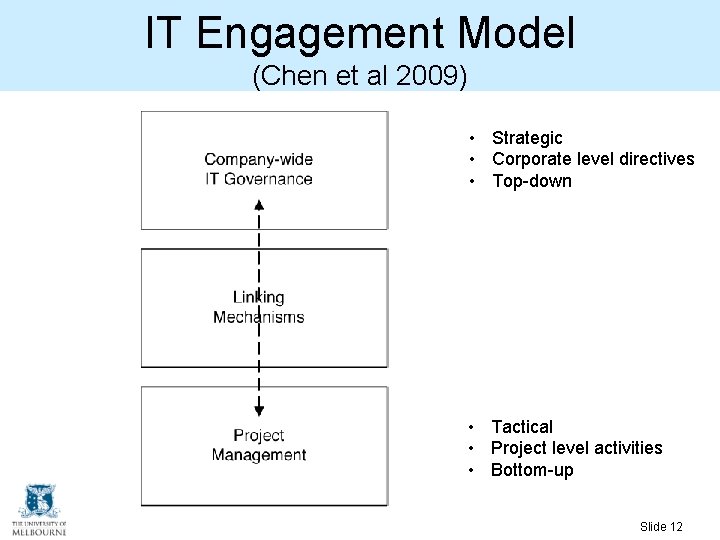
IT Engagement Model (Chen et al 2009) • Strategic • Corporate level directives • Top-down • Tactical • Project level activities • Bottom-up Slide 12
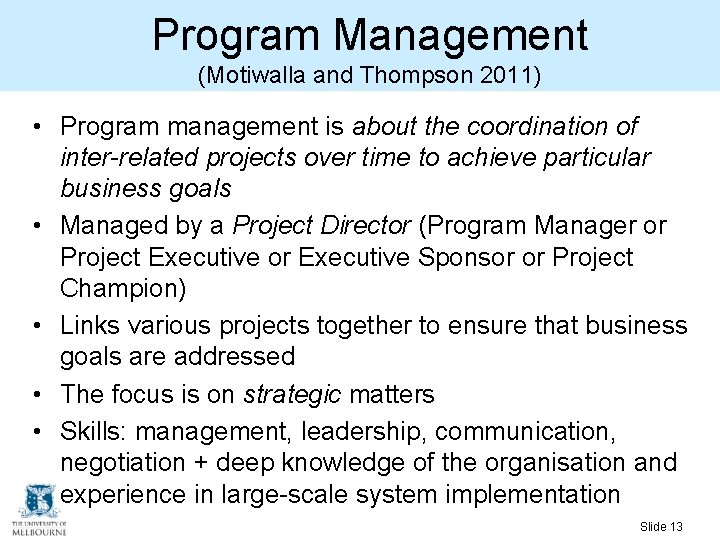
Program Management (Motiwalla and Thompson 2011) • Program management is about the coordination of inter-related projects over time to achieve particular business goals • Managed by a Project Director (Program Manager or Project Executive or Executive Sponsor or Project Champion) • Links various projects together to ensure that business goals are addressed • The focus is on strategic matters • Skills: management, leadership, communication, negotiation + deep knowledge of the organisation and experience in large-scale system implementation Slide 13
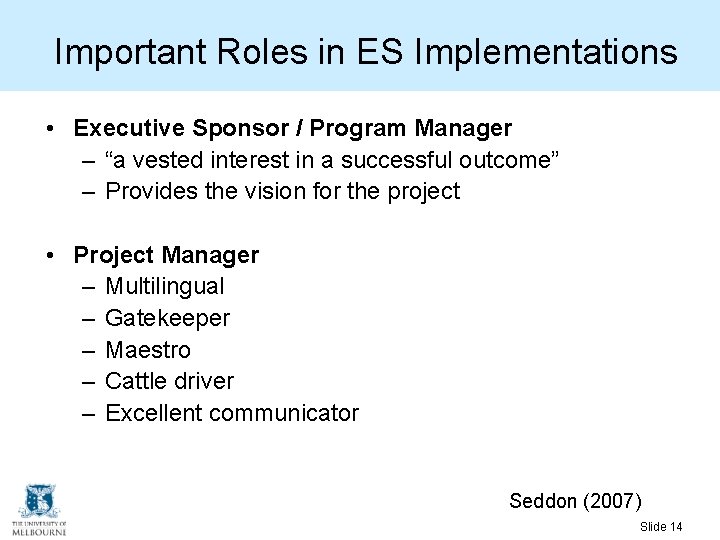
Important Roles in ES Implementations • Executive Sponsor / Program Manager – “a vested interest in a successful outcome” – Provides the vision for the project • Project Manager – Multilingual – Gatekeeper – Maestro – Cattle driver – Excellent communicator Seddon (2007) Slide 14
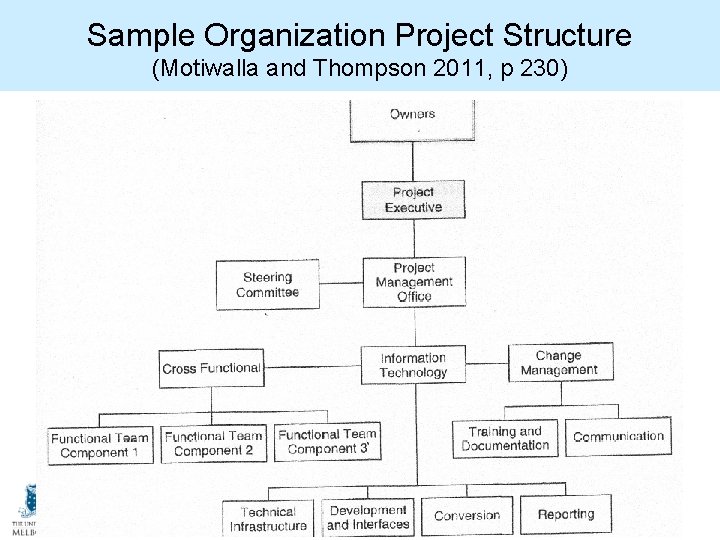
Sample Organization Project Structure (Motiwalla and Thompson 2011, p 230) Slide 15
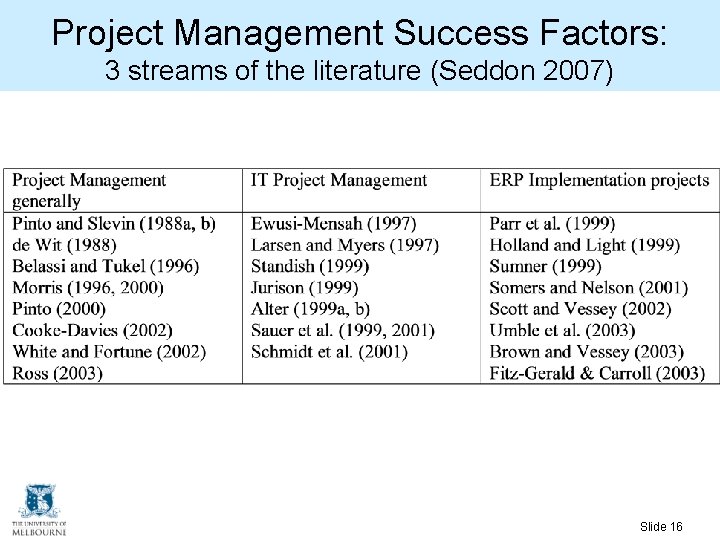
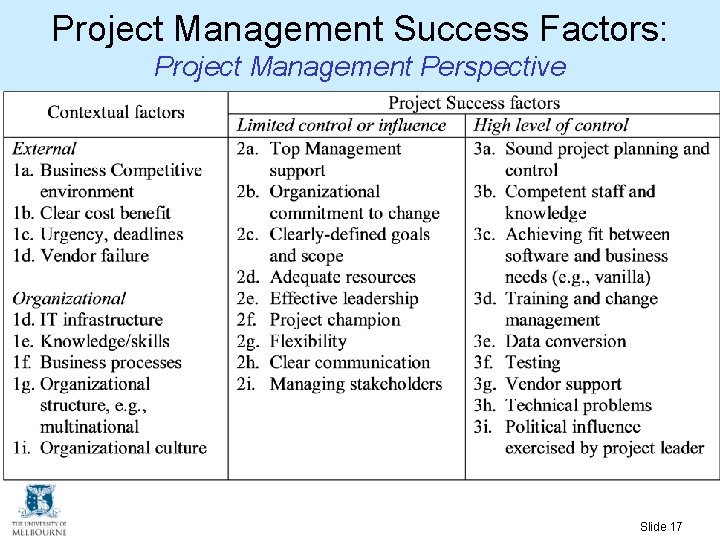
Project Management Success Factors: 3 streams of the literature (Seddon 2007) Slide 16
Project Management Success Factors: Project Management Perspective Slide 17
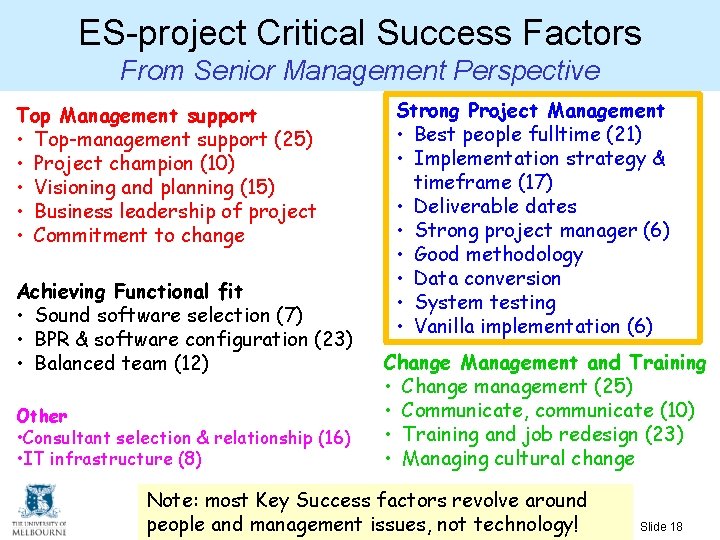
ES-project Critical Success Factors From Senior Management Perspective Top Management support • Top-management support (25) • Project champion (10) • Visioning and planning (15) • Business leadership of project • Commitment to change Achieving Functional fit • Sound software selection (7) • BPR & software configuration (23) • Balanced team (12) Other • Consultant selection & relationship (16) • IT infrastructure (8) Strong Project Management • Best people fulltime (21) • Implementation strategy & timeframe (17) • Deliverable dates • Strong project manager (6) • Good methodology • Data conversion • System testing • Vanilla implementation (6) Change Management and Training • Change management (25) • Communicate, communicate (10) • Training and job redesign (23) • Managing cultural change Note: most Key Success factors revolve around people and management issues, not technology! Slide 18
RMIT University Case Study (Seddon 2007) • “One of Australia’s leading educational institutions” • Went live with People. Soft Academic Management Systems (AMS) on 29/10/01 to replace legacy systems already in use since 1982 • Goals: to “significantly streamline the University's administrative processes, and in turn provide enormous benefits to staff and an enhanced level of service to current and potential students” (RMIT 2000). Slide 19
RMIT - “Go Live” Failure • Budget cost A$12. 6 M • Repairing the system, including the corrupted database, cost A$18 M in 2002 • Total cost after repairs was A$47 M (= 4 x budget) • The software was so highly customized that two independent consulting firms advised it would be easier to reconfigure the system afresh, rather than to try to repair the current system. (Auditor-General of Victoria, 2003) Slide 20
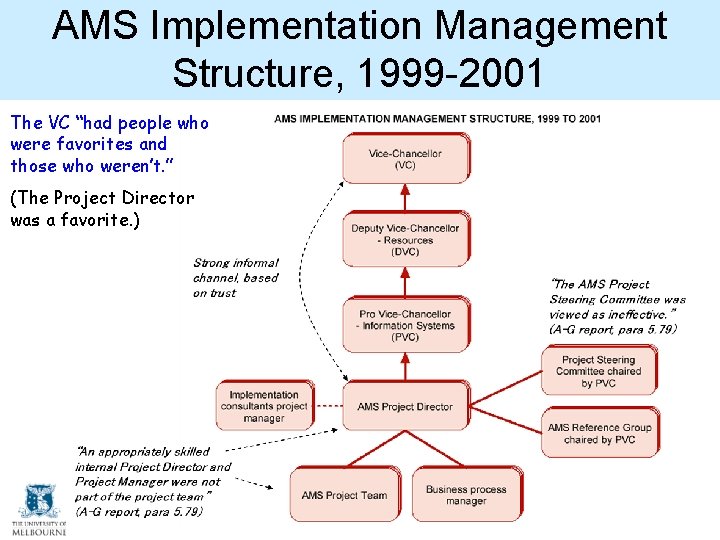
AMS Implementation Management Structure, 1999 -2001 The VC “had people who were favorites and those who weren’t. ” (The Project Director was a favorite. )
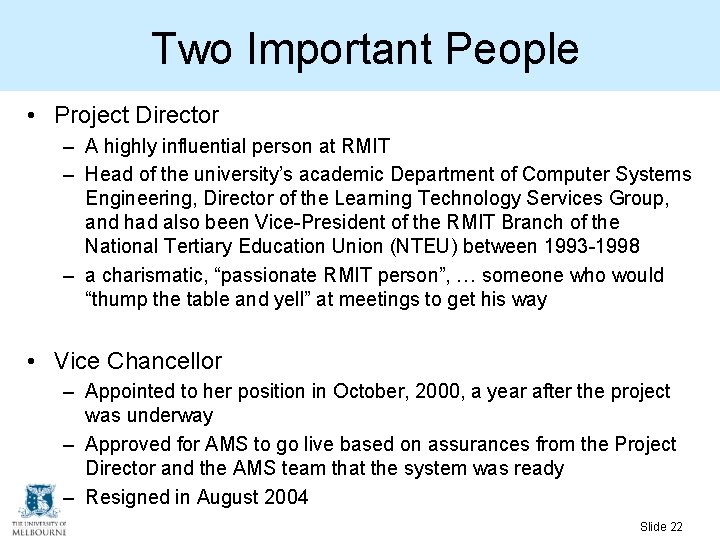
Two Important People • Project Director – A highly influential person at RMIT – Head of the university’s academic Department of Computer Systems Engineering, Director of the Learning Technology Services Group, and had also been Vice-President of the RMIT Branch of the National Tertiary Education Union (NTEU) between 1993 -1998 – a charismatic, “passionate RMIT person”, … someone who would “thump the table and yell” at meetings to get his way • Vice Chancellor – Appointed to her position in October, 2000, a year after the project was underway – Approved for AMS to go live based on assurances from the Project Director and the AMS team that the system was ready – Resigned in August 2004 Slide 22
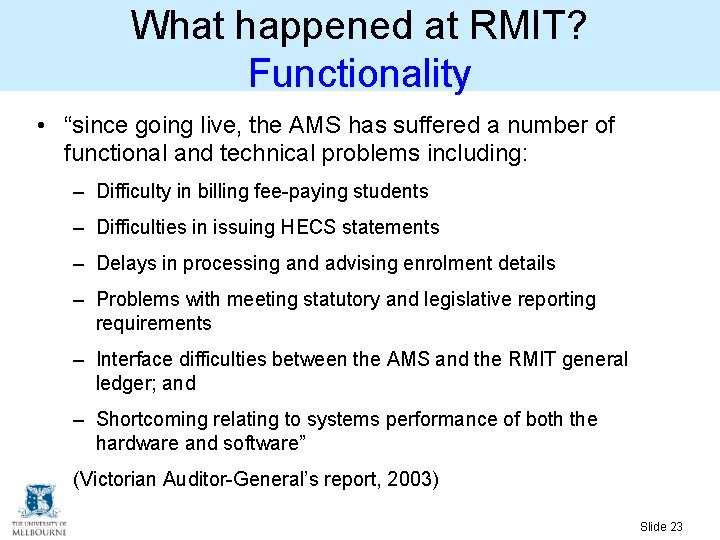
What happened at RMIT? Functionality • “since going live, the AMS has suffered a number of functional and technical problems including: – Difficulty in billing fee-paying students – Difficulties in issuing HECS statements – Delays in processing and advising enrolment details – Problems with meeting statutory and legislative reporting requirements – Interface difficulties between the AMS and the RMIT general ledger; and – Shortcoming relating to systems performance of both the hardware and software” (Victorian Auditor-General’s report, 2003) Slide 23
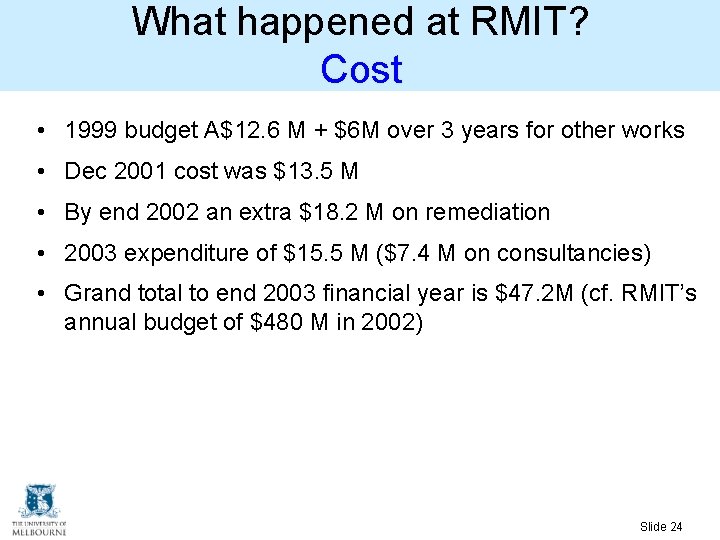
What happened at RMIT? Cost • 1999 budget A$12. 6 M + $6 M over 3 years for other works • Dec 2001 cost was $13. 5 M • By end 2002 an extra $18. 2 M on remediation • 2003 expenditure of $15. 5 M ($7. 4 M on consultancies) • Grand total to end 2003 financial year is $47. 2 M (cf. RMIT’s annual budget of $480 M in 2002) Slide 24
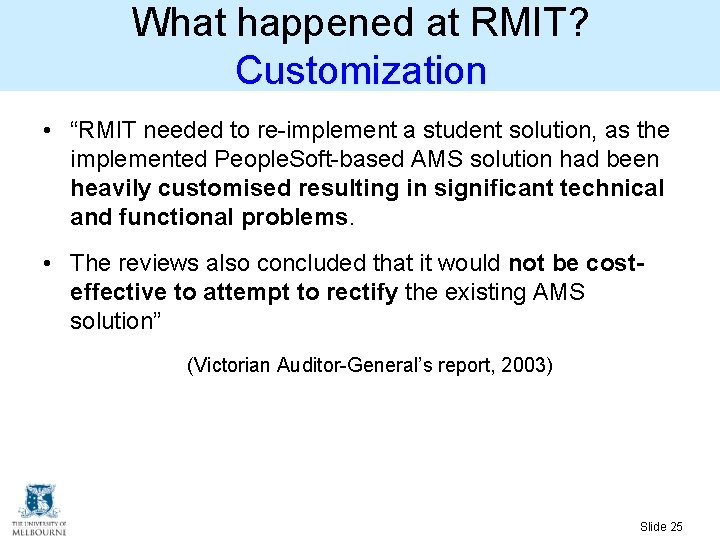
What happened at RMIT? Customization • “RMIT needed to re-implement a student solution, as the implemented People. Soft-based AMS solution had been heavily customised resulting in significant technical and functional problems. • The reviews also concluded that it would not be costeffective to attempt to rectify the existing AMS solution” (Victorian Auditor-General’s report, 2003) Slide 25
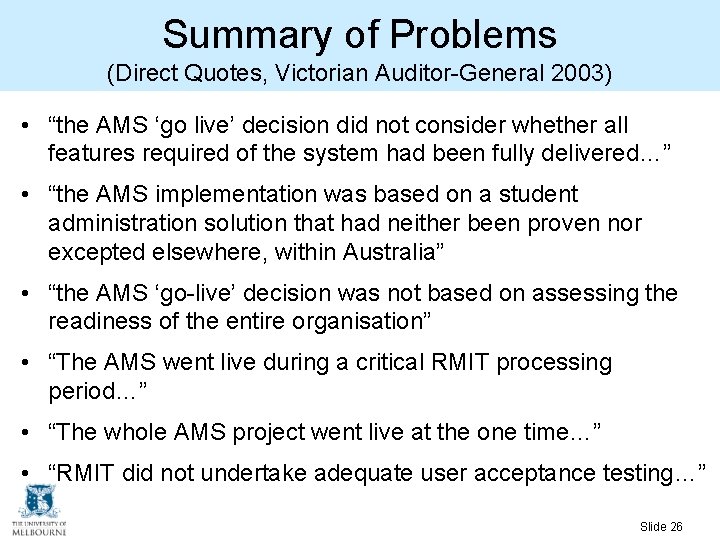
Summary of Problems (Direct Quotes, Victorian Auditor-General 2003) • “the AMS ‘go live’ decision did not consider whether all features required of the system had been fully delivered…” • “the AMS implementation was based on a student administration solution that had neither been proven nor excepted elsewhere, within Australia” • “the AMS ‘go-live’ decision was not based on assessing the readiness of the entire organisation” • “The AMS went live during a critical RMIT processing period…” • “The whole AMS project went live at the one time…” • “RMIT did not undertake adequate user acceptance testing…” Slide 26
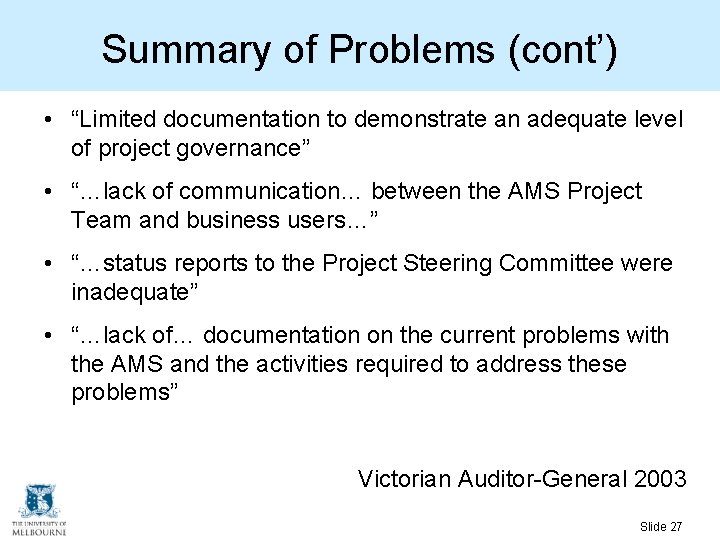
Summary of Problems (cont’) • “Limited documentation to demonstrate an adequate level of project governance” • “…lack of communication… between the AMS Project Team and business users…” • “…status reports to the Project Steering Committee were inadequate” • “…lack of… documentation on the current problems with the AMS and the activities required to address these problems” Victorian Auditor-General 2003 Slide 27
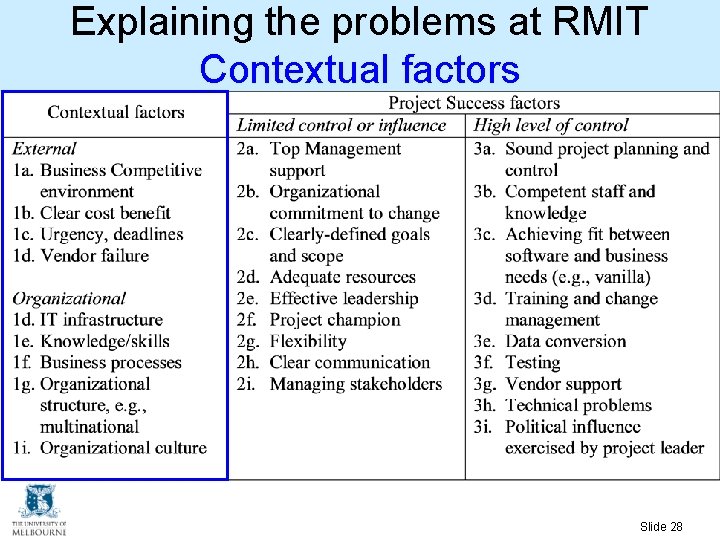
Explaining the problems at RMIT Contextual factors Slide 28
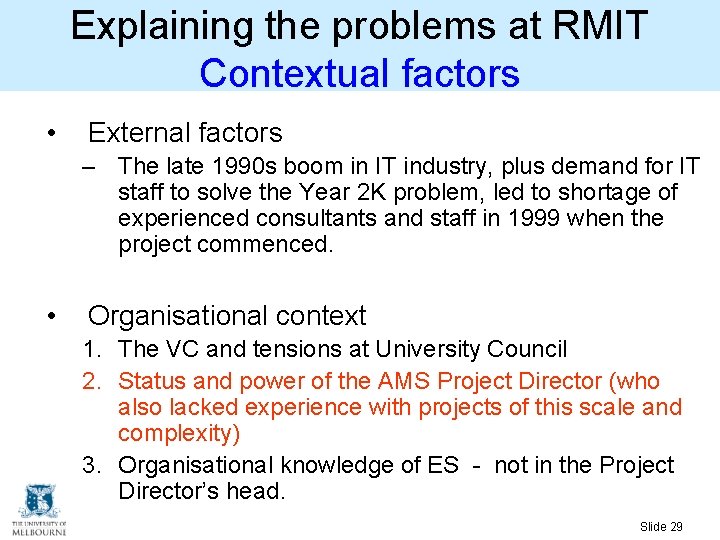
Explaining the problems at RMIT Contextual factors • External factors – The late 1990 s boom in IT industry, plus demand for IT staff to solve the Year 2 K problem, led to shortage of experienced consultants and staff in 1999 when the project commenced. • Organisational context 1. The VC and tensions at University Council 2. Status and power of the AMS Project Director (who also lacked experience with projects of this scale and complexity) 3. Organisational knowledge of ES - not in the Project Director’s head. Slide 29
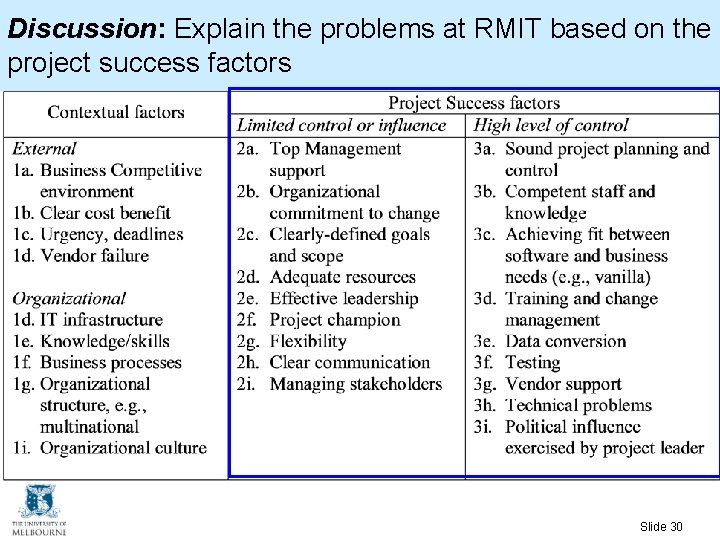
Discussion: Explain the problems at RMIT based on the project success factors Slide 30
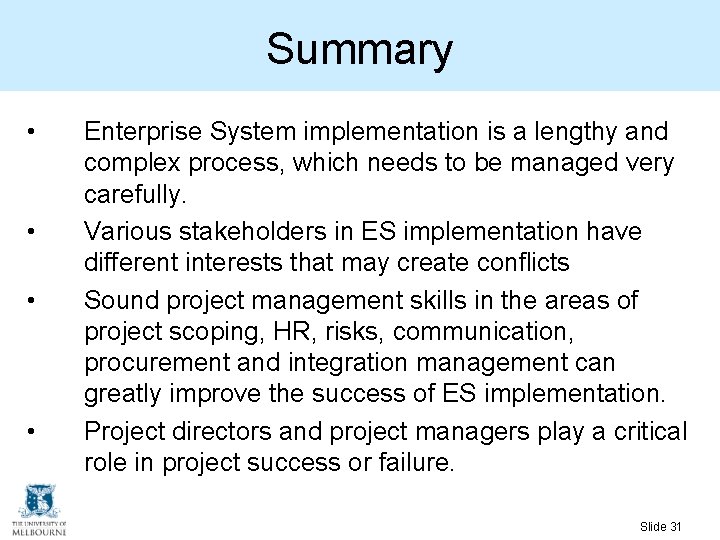
Summary • • Enterprise System implementation is a lengthy and complex process, which needs to be managed very carefully. Various stakeholders in ES implementation have different interests that may create conflicts Sound project management skills in the areas of project scoping, HR, risks, communication, procurement and integration management can greatly improve the success of ES implementation. Project directors and project managers play a critical role in project success or failure. Slide 31