
ISTQB in a Nutshell WHAT IS THE ISTQB
ISTQB® in a Nutshell
WHAT IS THE ISTQB®? • ISTQB®: International Software Testing Qualifications Board (www. istqb. org): – – – • Non-profit association Founded in 2002 Headquartered in Belgium Has its own constitution, rules and regulations Composed of volunteer international Testing Experts Responsible for the “ISTQB® Certified Tester” scheme worldwide ISTQB® is the world’s leading organization for Software Testing Certification Advancing the software testing profession 2
ISTQB® ADVANCED LEVEL SMARTSHOW • ISTQB® Smartshow introduces the ISTQB® Certification in less than 3 minutes http: //www. youtube. com/watch? v=Hr. K 1 zhqy. W 4 k 3
ISTQB® VISION “To continually improve and advance the software testing profession by: Defining and maintaining a Body of Knowledge which allows testers to be certified based on best practices, connecting the international software testing community, and encouraging research. ” 4
ISTQB® MISSION 1) 2) 3) 4) 5) We promote the value of software testing as a profession to individuals and organizations. We help software testers to be more efficient and effective in their work, through the certification of competencies. We enable testers to progress their career through a Professionals’ Code of Ethics and a multi-level certification pathway that provides them with the skills and knowledge they need to fulfil their growing responsibilities and to achieve increased professionalism. We continually advance the Testing Body of Knowledge by drawing on the best available industry practices and the most innovative research, and we make this knowledge freely available to all. We set the criteria for accrediting training providers, to ensure consistent delivery of the Body of Knowledge, worldwide. 5
ISTQB® MISSION 6) We regulate the content and coverage of exam questions, the examination process, and the issuing of certifications by official examination bodies. 7) We are committed to expanding software testing certifications around the world, by admitting member boards into the ISTQB®. These boards adhere to the constitution, bylaws, and processes defined by the ISTQB®, and participate in regular audits. 8) We nurture an open international community, committed to sharing knowledge, ideas, and innovations in software testing. 9) We foster relationships with academia, government, media, professional associations and other interested parties. 10) We provide a reference point against which the effectiveness of testing services can be evaluated, by maintaining our prominence as a respected source of knowledge in software testing. 6
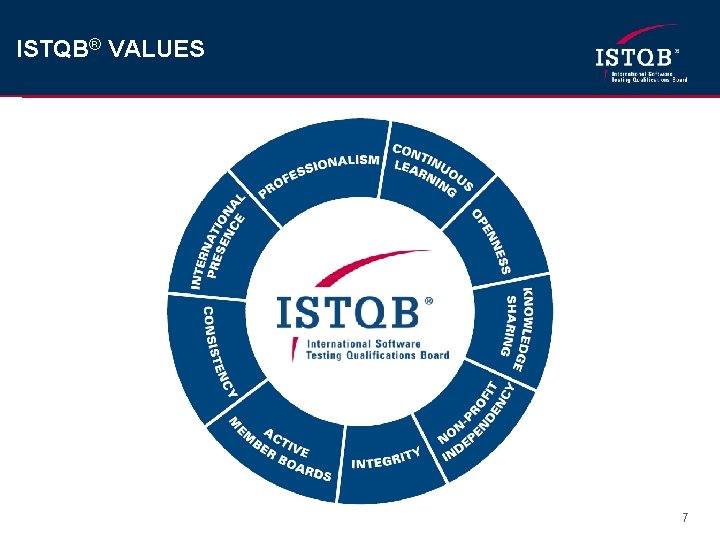
ISTQB® VALUES 7
SOFTWARE TESTING MARKET CHALLENGES Shortage of Skilled Labor • Technavio, an independent technology research and advisory company, analyzed the key challenges faced by the Global Software Testing Services market, highlighting in particular the “Shortage of Skilled Labor” • The Global Pure Play Software Testing Services market is growing rapidly, thus increasing the demand for skilled labor. However, this has created a disparity in supply and demand, as a result of which, sourcing and retaining skilled labor has become a challenge. • The shortage of availability of required skills is now becoming a major challenge for the independent software testing organizations. Since the current educational system is not geared up to the required standards and demands of the market, this challenge is expected to have a bigger impact on the market in the future. (Global Software Testing Services Market 2011 -2015, Technavio) 8
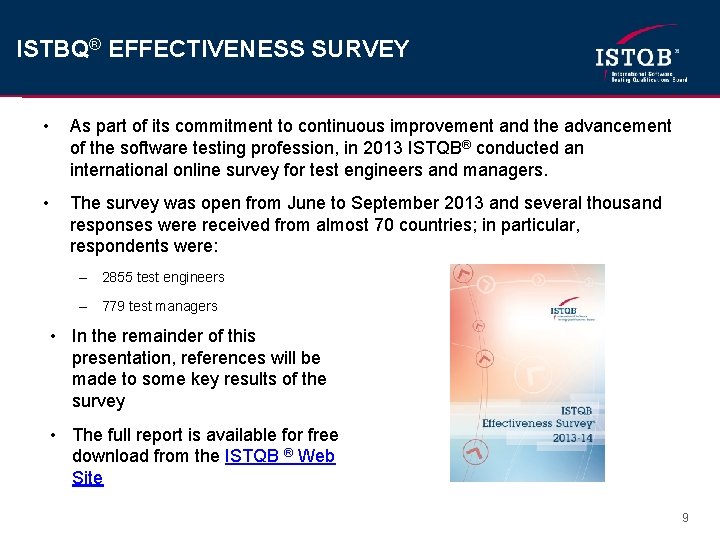
ISTBQ® EFFECTIVENESS SURVEY • As part of its commitment to continuous improvement and the advancement of the software testing profession, in 2013 ISTQB® conducted an international online survey for test engineers and managers. • The survey was open from June to September 2013 and several thousand responses were received from almost 70 countries; in particular, respondents were: – 2855 test engineers – 779 test managers • In the remainder of this presentation, references will be made to some key results of the survey • The full report is available for free download from the ISTQB ® Web Site 9
BENEFITS FOR PROFESSIONALS • International recognition of acquired competencies and skills • Authorized to use the “Certified Tester” logo (specifying the level of certification) • Whole of career path support, from Foundation to Expert level 10
BENEFITS FOR COMPANIES • ISTQB® certification can provide a competitive advantage for companies, promising a higher level of reliability of the applications being developed due to efficient and cost effective testing practices derived from the ISTQB® competencies • Consulting companies with certified staff can offer higher-level services to customers, increasing revenues and brand value • ISTQB® has defined a “Partner Program” for companies that engage a large number of certified testers 11
CONTENTS 3 Syllabi and Extensions 3. 1 General Introduction 3. 2 Foundation Level 3. 3 Agile Tester 3. 4 Advanced Level 3. 5 Expert Level 12
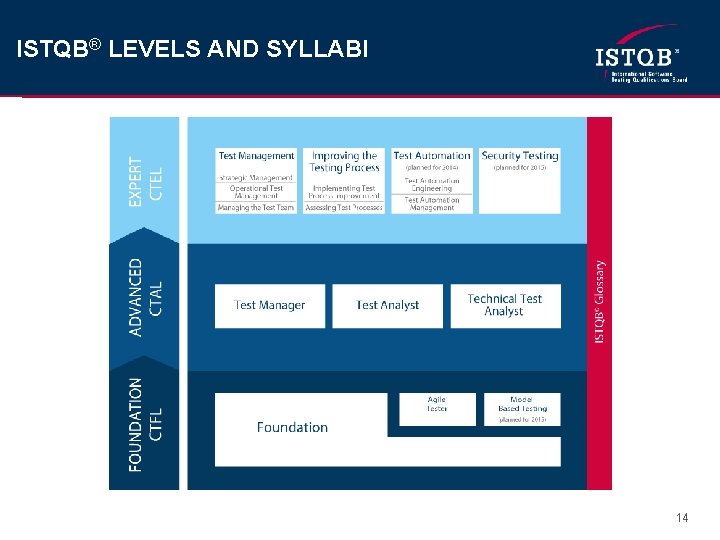
ISTQB® SYLLABI AND GLOSSARY • • ISTQB® has defined three levels of syllabi: Ø Foundation Ø Advanced (Test Manager, Test Analyst, Technical Test Analyst) Ø Expert (Improving the Testing Process, Test Management, Test Automation, Security Testing, etc. ) Syllabi are publicly available for download from the ISTQB® Website (http: //www. istqb. org/downloads. html) • Syllabi are written by testing experts and continuously reviewed and improved • Terms used in the ISTQB® syllabi are defined in the ISTQB® Glossary (http: //www. istqb. org/downloads/viewcategory/20. html) • Syllabi and Glossary are translated in many languages by the ISTQB® Member Boards; please refer to their Websites to download free-of-charge the documents translated into local languages 13
ISTQB® LEVELS AND SYLLABI 14
CONTENTS 3 Syllabi and Extensions 3. 1 General Introduction 3. 2 Foundation Level 3. 3 Agile Tester 3. 4 Advanced Level 3. 5 Expert Level 15
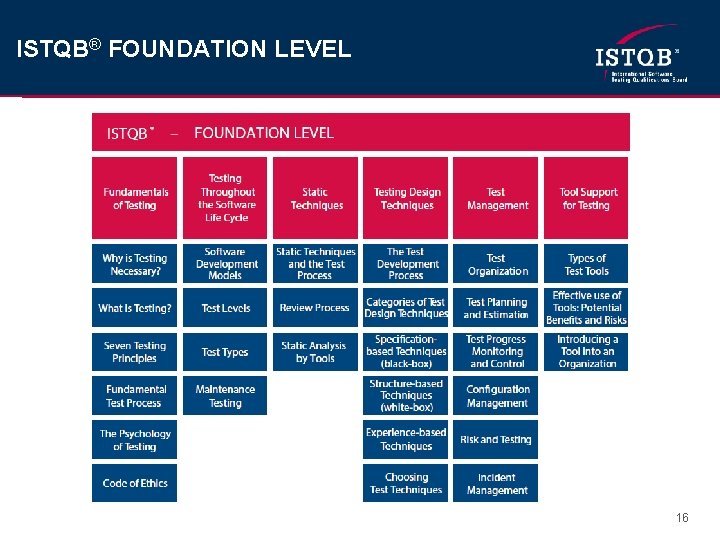
ISTQB® FOUNDATION LEVEL 16
CONTENTS 3 Syllabi and Extensions 3. 1 General Introduction 3. 2 Foundation Level 3. 3 Agile Tester 3. 4 Advanced Level 3. 5 Expert Level 17
ISTQB® EXTENSIONS • In order to satisfy the increasing demand for vertical testing competences, ISTQB® has introduced the concept of “Extension” • An “Extension” is a training and certification module focused on a specific topic, for instance: – Domain-specific testing practices – Specific Testing Techniques – Specific Testing Methods • • • The ISTQB® Foundation Level Certification is a pre-requisite The first extension is focused on “Agile Tester”, released in June 2014 MBT (Model-Based Testing) extension is also in road-map 18
THE CONTRIBUTION OF AGILE TESTERS • Agile testers should: – Collaborate in an agile team, being familiar with agile principles and practices – Adapt existing testing experience, knowledge, and best practices – Support the agile team in planning test related activities – Apply relevant test methods and techniques – Assist in test automation – Help business stakeholders define understandable and testable user stories and acceptance criteria – Work and share information with other team members • An ISTQB® Agile Tester should work effectively within an agile team and environment 19
ISTQB® FOUNDATION LEVEL AGILE TESTER 20
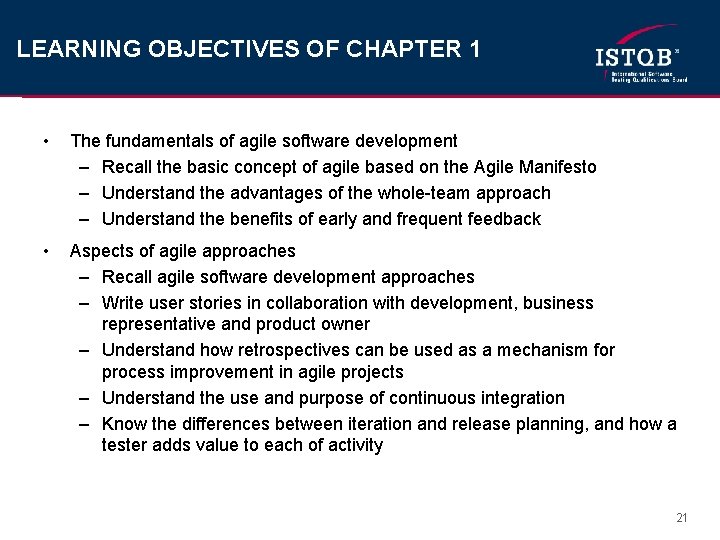
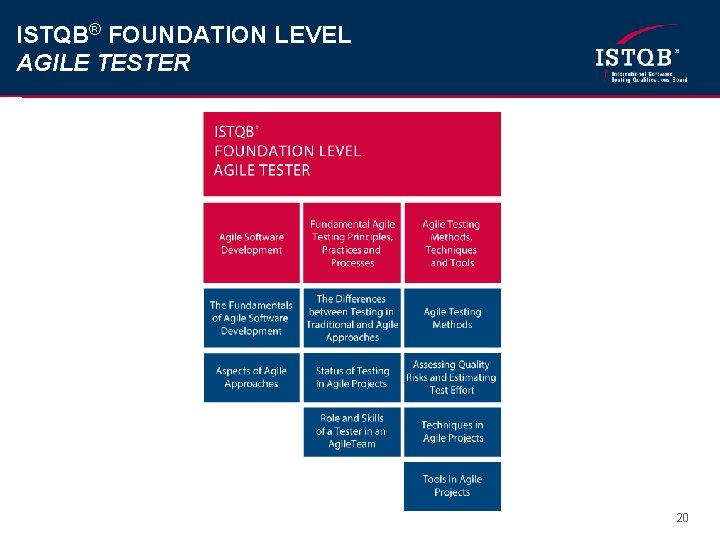
LEARNING OBJECTIVES OF CHAPTER 1 • The fundamentals of agile software development – Recall the basic concept of agile based on the Agile Manifesto – Understand the advantages of the whole-team approach – Understand the benefits of early and frequent feedback • Aspects of agile approaches – Recall agile software development approaches – Write user stories in collaboration with development, business representative and product owner – Understand how retrospectives can be used as a mechanism for process improvement in agile projects – Understand the use and purpose of continuous integration – Know the differences between iteration and release planning, and how a tester adds value to each of activity 21
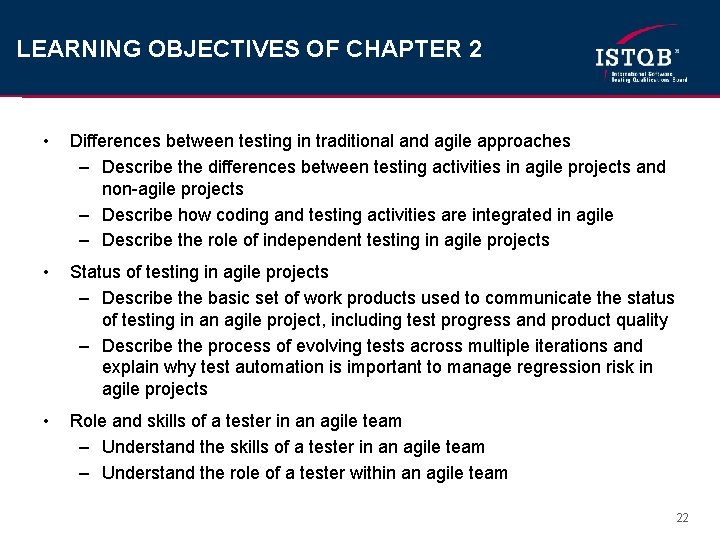
LEARNING OBJECTIVES OF CHAPTER 2 • Differences between testing in traditional and agile approaches – Describe the differences between testing activities in agile projects and non-agile projects – Describe how coding and testing activities are integrated in agile – Describe the role of independent testing in agile projects • Status of testing in agile projects – Describe the basic set of work products used to communicate the status of testing in an agile project, including test progress and product quality – Describe the process of evolving tests across multiple iterations and explain why test automation is important to manage regression risk in agile projects • Role and skills of a tester in an agile team – Understand the role of a tester within an agile team 22
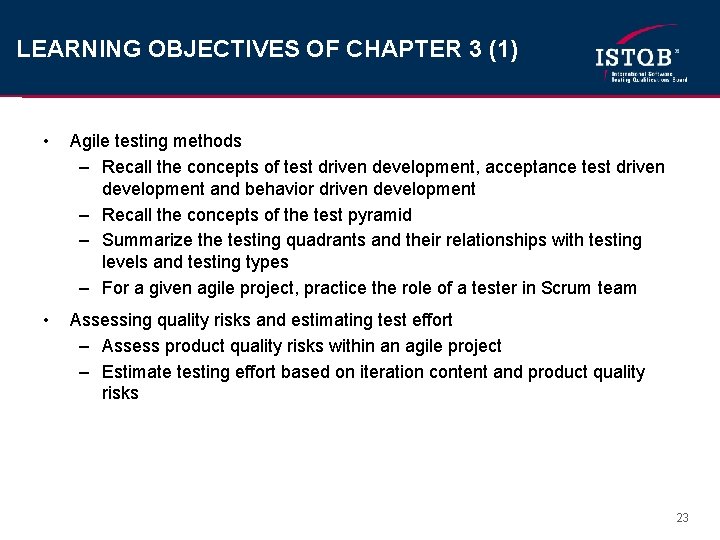
LEARNING OBJECTIVES OF CHAPTER 3 (1) • Agile testing methods – Recall the concepts of test driven development, acceptance test driven development and behavior driven development – Recall the concepts of the test pyramid – Summarize the testing quadrants and their relationships with testing levels and testing types – For a given agile project, practice the role of a tester in Scrum team • Assessing quality risks and estimating test effort – Assess product quality risks within an agile project – Estimate testing effort based on iteration content and product quality risks 23
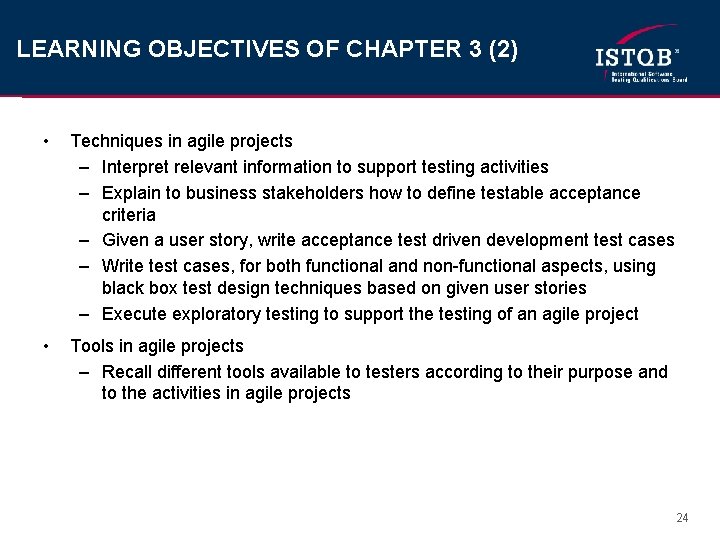
LEARNING OBJECTIVES OF CHAPTER 3 (2) • Techniques in agile projects – Interpret relevant information to support testing activities – Explain to business stakeholders how to define testable acceptance criteria – Given a user story, write acceptance test driven development test cases – Write test cases, for both functional and non-functional aspects, using black box test design techniques based on given user stories – Execute exploratory testing to support the testing of an agile project • Tools in agile projects – Recall different tools available to testers according to their purpose and to the activities in agile projects 24
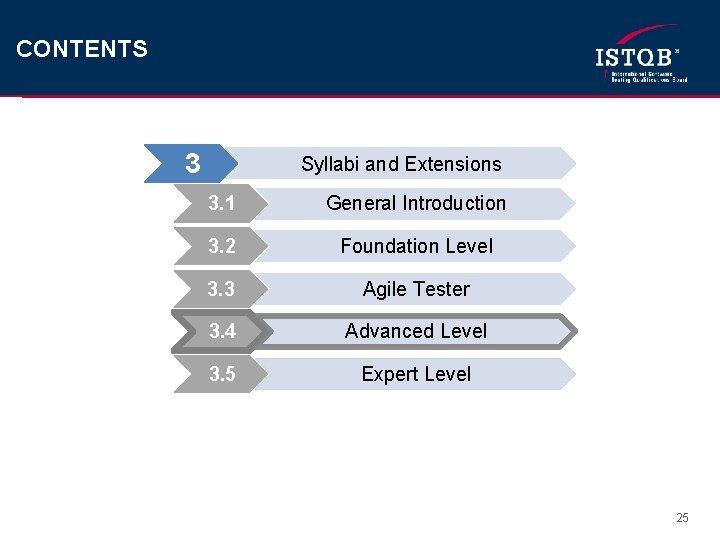
CONTENTS 3 Syllabi and Extensions 3. 1 General Introduction 3. 2 Foundation Level 3. 3 Agile Tester 3. 4 Advanced Level 3. 5 Expert Level 25
ISTQB® ADVANCED LEVEL • ISTQB® Advanced Level is composed of three independent modules: – Test Manager (AL-TM) – Test Analyst (AL-TA) – Technical Test Analyst (AL-TTA) • The ISTQB® Foundation Level Certification is a pre-requisite for all of them • When achieving all the three Advanced Modules, a “Full Advanced” certificate is issued 26
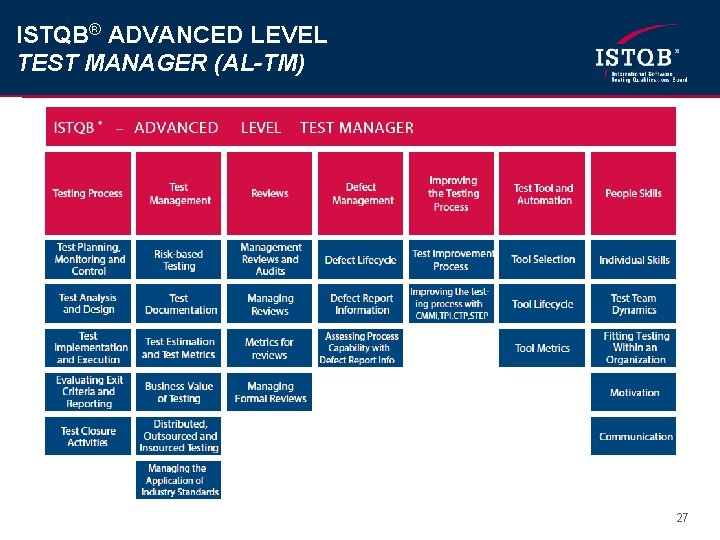
ISTQB® ADVANCED LEVEL TEST MANAGER (AL-TM) 27
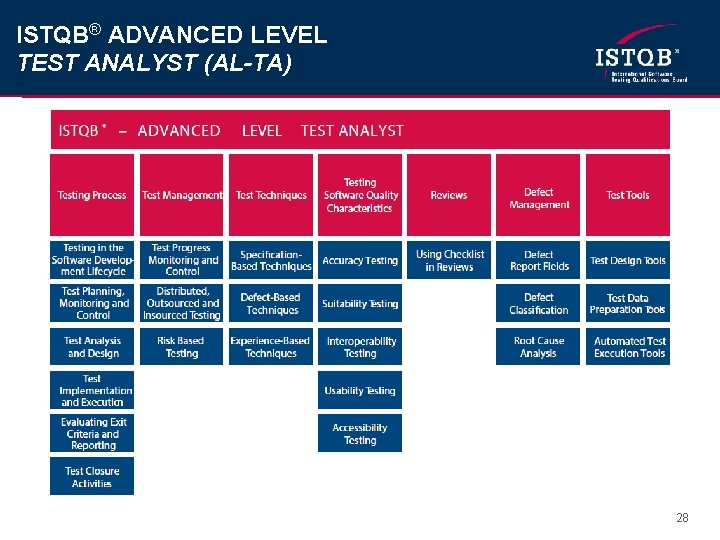
ISTQB® ADVANCED LEVEL TEST ANALYST (AL-TA) 28
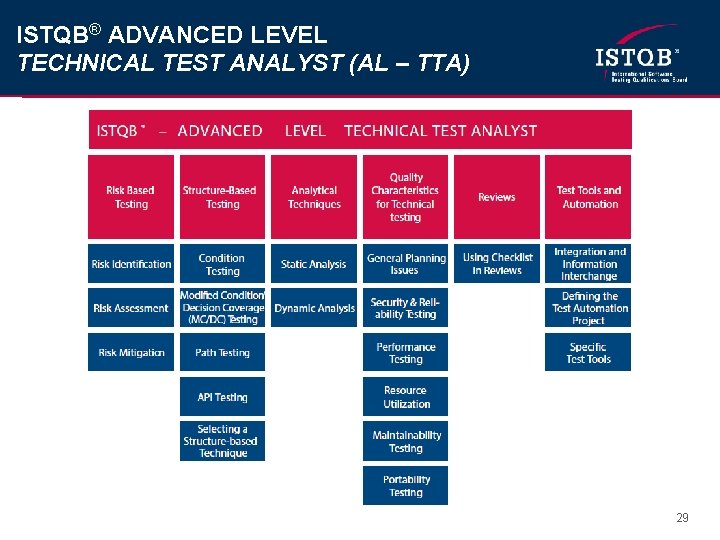
ISTQB® ADVANCED LEVEL TECHNICAL TEST ANALYST (AL – TTA) 29
CONTENTS 3 Syllabi and Extensions 3. 1 General Introduction 3. 2 Foundation Level 3. 3 Agile Tester 3. 4 Advanced Level 3. 5 Expert Level 30
ISTQB® EXPERT LEVEL • For ISTQB®, Expert really means Expert – “A person with the special skills and knowledge representing mastery of a particular testing subject. – Being an expert means possessing and displaying special skills and knowledge derived from training and experience. “ • Clearly stated expectations and business outcomes are established for each subject covered at Expert Level 31
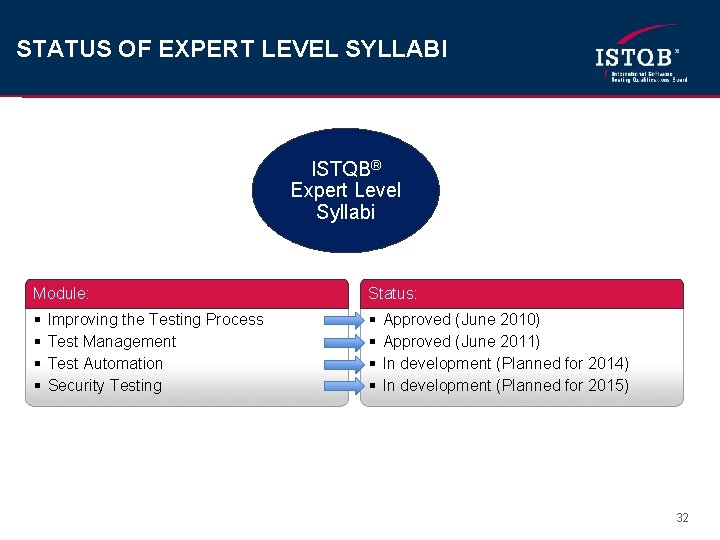
STATUS OF EXPERT LEVEL SYLLABI ISTQB® Expert Level Syllabi Module: Status: § § § § Improving the Testing Process Test Management Test Automation Security Testing Approved (June 2010) Approved (June 2011) In development (Planned for 2014) In development (Planned for 2015) 32
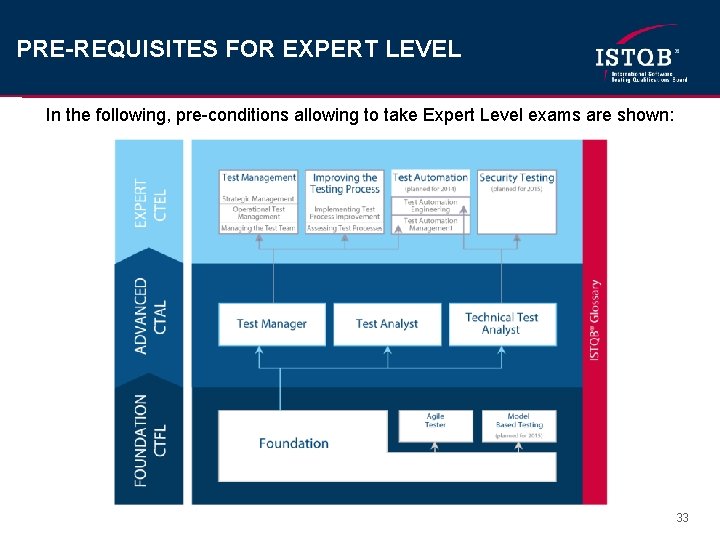
PRE-REQUISITES FOR EXPERT LEVEL In the following, pre-conditions allowing to take Expert Level exams are shown: 33
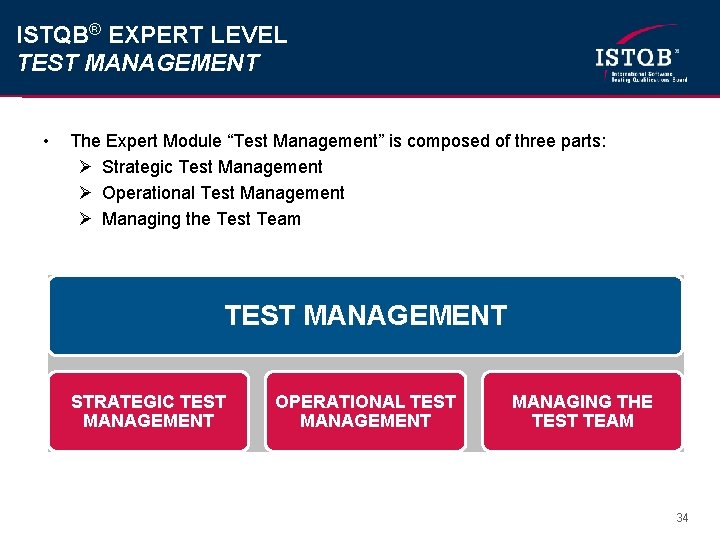
ISTQB® EXPERT LEVEL TEST MANAGEMENT • The Expert Module “Test Management” is composed of three parts: Ø Strategic Test Management Ø Operational Test Management Ø Managing the Test Team TEST MANAGEMENT STRATEGIC TEST MANAGEMENT OPERATIONAL TEST MANAGEMENT MANAGING THE TEST TEAM 34
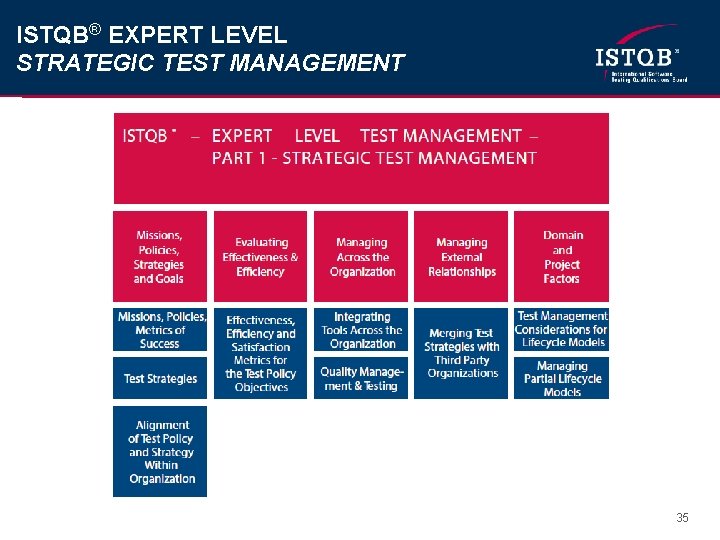
ISTQB® EXPERT LEVEL STRATEGIC TEST MANAGEMENT 35
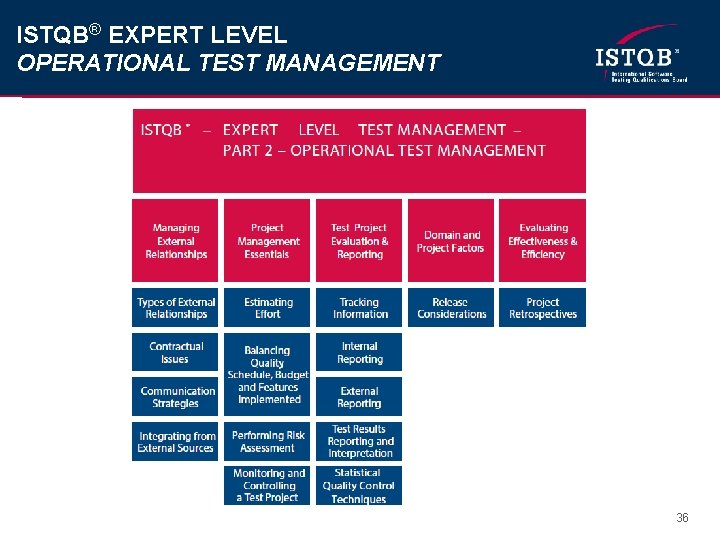
ISTQB® EXPERT LEVEL OPERATIONAL TEST MANAGEMENT 36
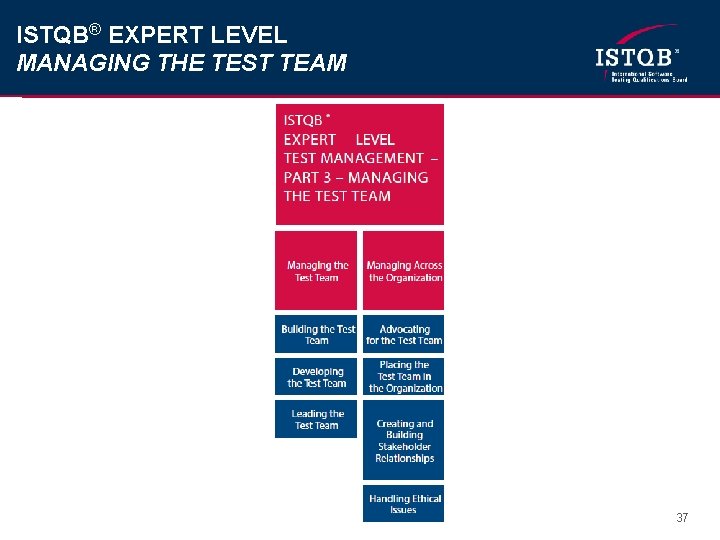
ISTQB® EXPERT LEVEL MANAGING THE TEST TEAM 37
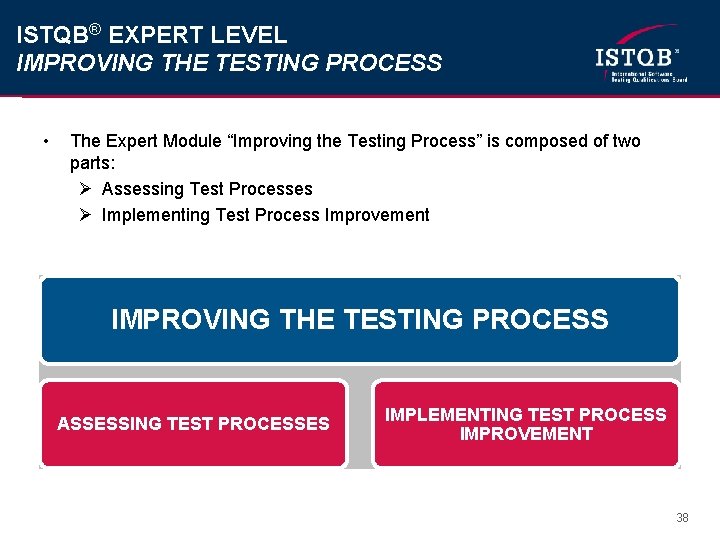
ISTQB® EXPERT LEVEL IMPROVING THE TESTING PROCESS • The Expert Module “Improving the Testing Process” is composed of two parts: Ø Assessing Test Processes Ø Implementing Test Process Improvement IMPROVING THE TESTING PROCESS ASSESSING TEST PROCESSES IMPLEMENTING TEST PROCESS IMPROVEMENT 38
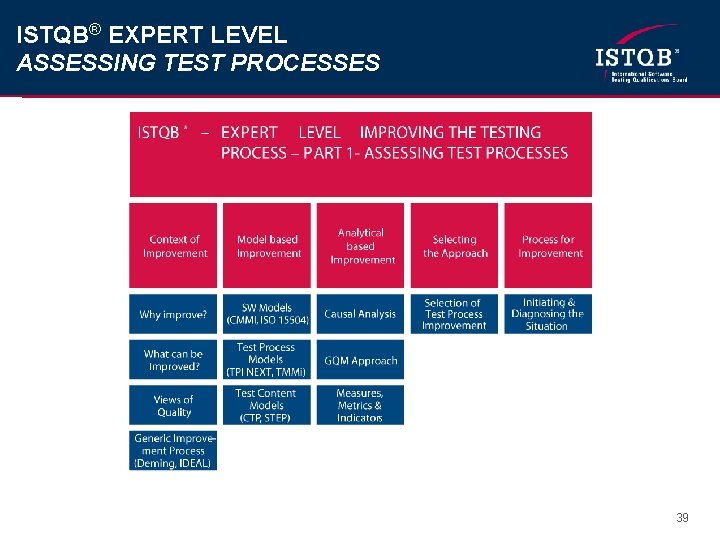
ISTQB® EXPERT LEVEL ASSESSING TEST PROCESSES 39
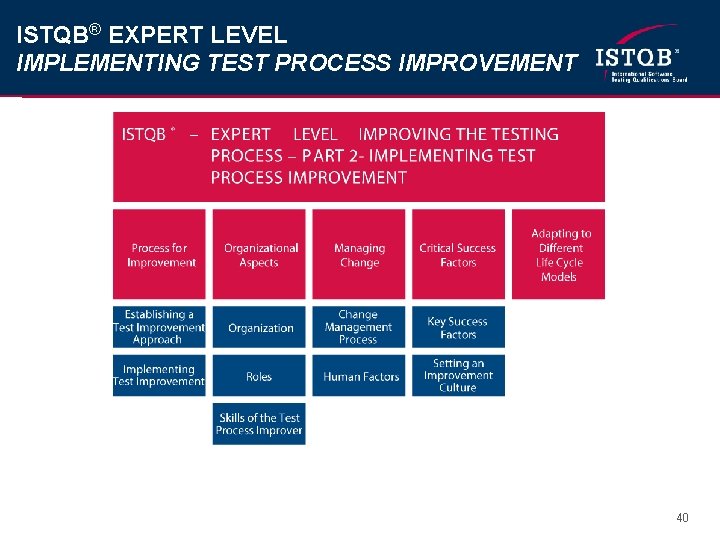
ISTQB® EXPERT LEVEL IMPLEMENTING TEST PROCESS IMPROVEMENT 40
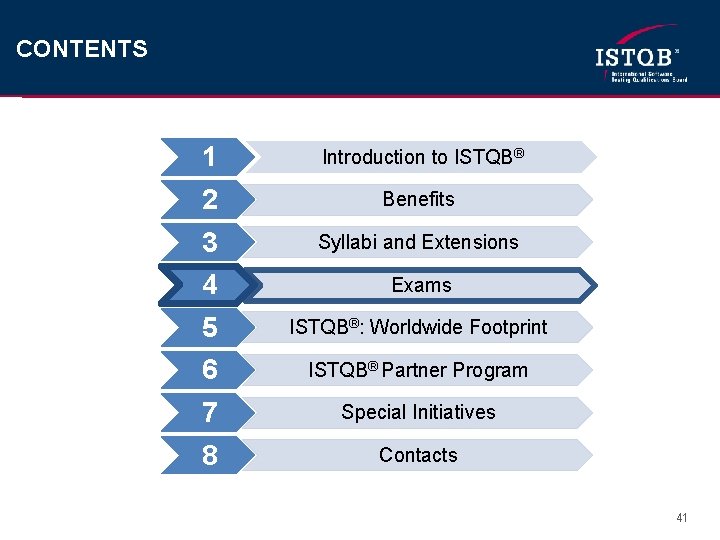
CONTENTS 1 Introduction to ISTQB® 2 Benefits 3 Syllabi and Extensions 4 Exams 5 ISTQB®: Worldwide Footprint 6 ISTQB® Partner Program 7 Special Initiatives 8 Contacts 41
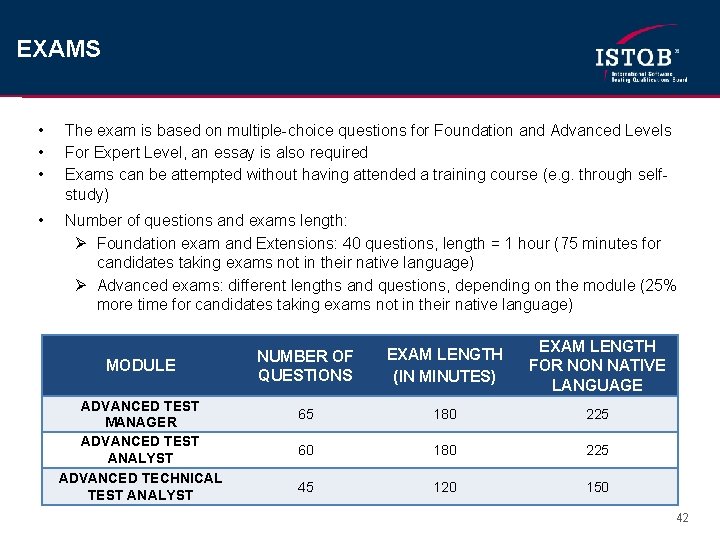
EXAMS • • • The exam is based on multiple-choice questions for Foundation and Advanced Levels For Expert Level, an essay is also required Exams can be attempted without having attended a training course (e. g. through selfstudy) • Number of questions and exams length: Ø Foundation exam and Extensions: 40 questions, length = 1 hour (75 minutes for candidates taking exams not in their native language) Ø Advanced exams: different lengths and questions, depending on the module (25% more time for candidates taking exams not in their native language) MODULE ADVANCED TEST MANAGER ADVANCED TEST ANALYST ADVANCED TECHNICAL TEST ANALYST NUMBER OF QUESTIONS EXAM LENGTH (IN MINUTES) EXAM LENGTH FOR NON NATIVE LANGUAGE 65 180 225 60 180 225 45 120 150 42
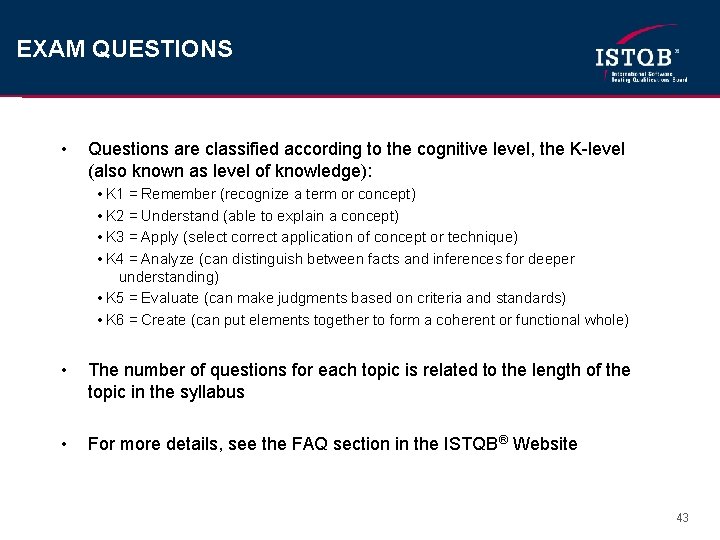
EXAM QUESTIONS • Questions are classified according to the cognitive level, the K-level (also known as level of knowledge): • K 1 = Remember (recognize a term or concept) • K 2 = Understand (able to explain a concept) • K 3 = Apply (select correct application of concept or technique) • K 4 = Analyze (can distinguish between facts and inferences for deeper understanding) • K 5 = Evaluate (can make judgments based on criteria and standards) • K 6 = Create (can put elements together to form a coherent or functional whole) • The number of questions for each topic is related to the length of the topic in the syllabus • For more details, see the FAQ section in the ISTQB® Website 43
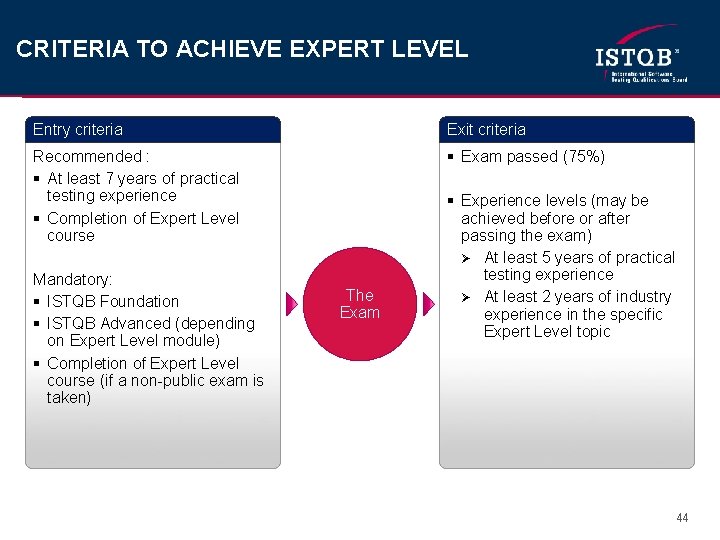
CRITERIA TO ACHIEVE EXPERT LEVEL Entry criteria Exit criteria Recommended : § At least 7 years of practical testing experience § Completion of Expert Level course § Exam passed (75%) Mandatory: § ISTQB Foundation § ISTQB Advanced (depending on Expert Level module) § Completion of Expert Level course (if a non-public exam is taken) The Exam § Experience levels (may be achieved before or after passing the exam) Ø At least 5 years of practical testing experience Ø At least 2 years of industry experience in the specific Expert Level topic 44
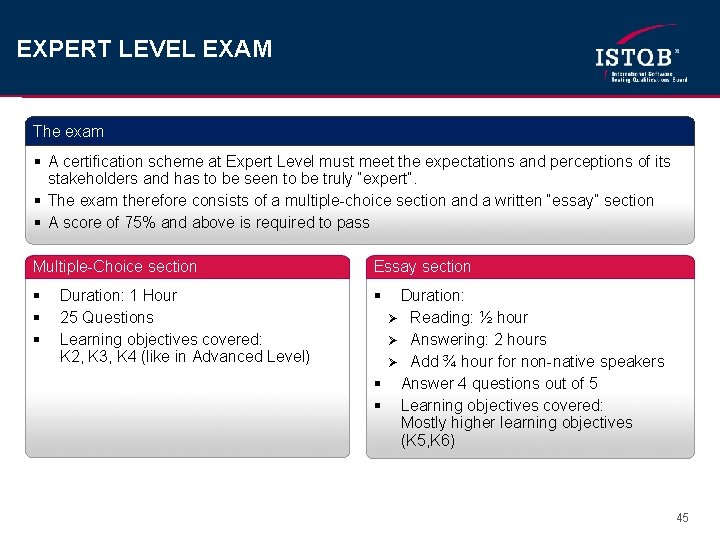
EXPERT LEVEL EXAM The exam § A certification scheme at Expert Level must meet the expectations and perceptions of its stakeholders and has to be seen to be truly “expert”. § The exam therefore consists of a multiple-choice section and a written “essay” section § A score of 75% and above is required to pass Multiple-Choice section Essay section § § Duration: 1 Hour 25 Questions Learning objectives covered: K 2, K 3, K 4 (like in Advanced Level) Duration: Ø Reading: ½ hour Ø Answering: 2 hours Ø Add ¾ hour for non-native speakers § Answer 4 questions out of 5 § Learning objectives covered: Mostly higher learning objectives (K 5, K 6) 45
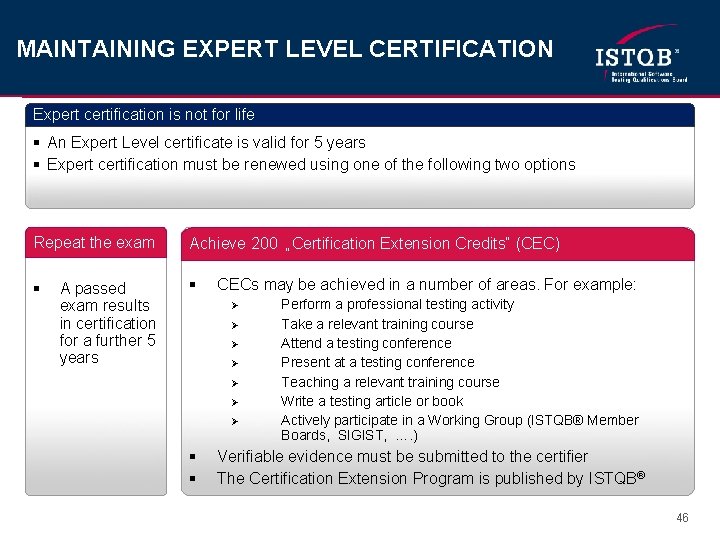
MAINTAINING EXPERT LEVEL CERTIFICATION Expert certification is not for life § An Expert Level certificate is valid for 5 years § Expert certification must be renewed using one of the following two options Repeat the exam Achieve 200 „Certification Extension Credits“ (CEC) § § A passed exam results in certification for a further 5 years CECs may be achieved in a number of areas. For example: Ø Ø Ø Ø § § Perform a professional testing activity Take a relevant training course Attend a testing conference Present at a testing conference Teaching a relevant training course Write a testing article or book Actively participate in a Working Group (ISTQB® Member Boards, SIGIST, …. ) Verifiable evidence must be submitted to the certifier The Certification Extension Program is published by ISTQB® 46
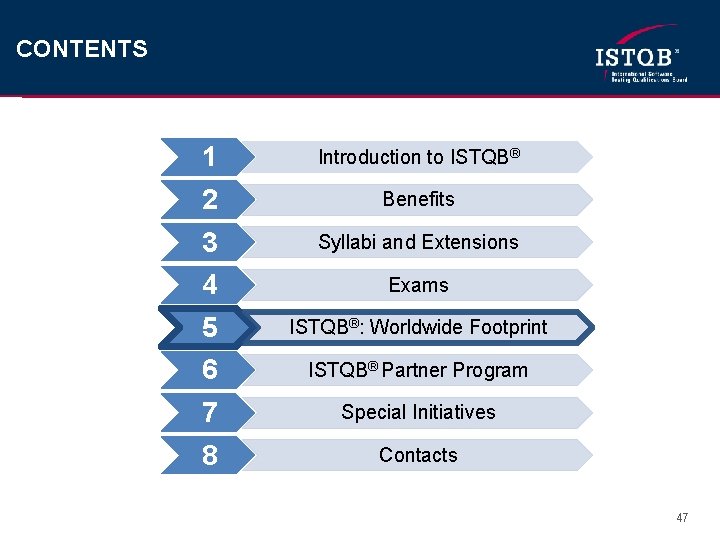
CONTENTS 1 Introduction to ISTQB® 2 Benefits 3 Syllabi and Extensions 4 Exams 5 ISTQB®: Worldwide Footprint 6 ISTQB® Partner Program 7 Special Initiatives 8 Contacts 47
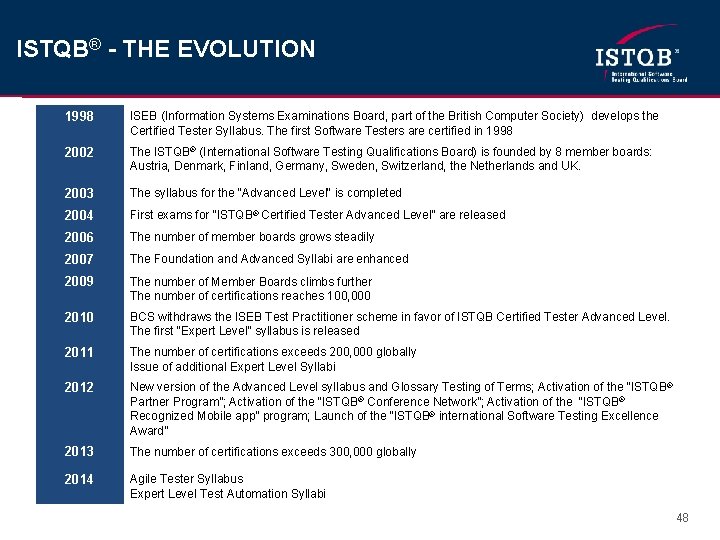
ISTQB® - THE EVOLUTION 1998 ISEB (Information Systems Examinations Board, part of the British Computer Society) develops the Certified Tester Syllabus. The first Software Testers are certified in 1998 2002 The ISTQB® (International Software Testing Qualifications Board) is founded by 8 member boards: Austria, Denmark, Finland, Germany, Sweden, Switzerland, the Netherlands and UK. 2003 The syllabus for the “Advanced Level“ is completed 2004 First exams for “ISTQB® Certified Tester Advanced Level“ are released 2006 The number of member boards grows steadily 2007 The Foundation and Advanced Syllabi are enhanced 2009 The number of Member Boards climbs further The number of certifications reaches 100, 000 2010 BCS withdraws the ISEB Test Practitioner scheme in favor of ISTQB Certified Tester Advanced Level. The first “Expert Level” syllabus is released 2011 The number of certifications exceeds 200, 000 globally Issue of additional Expert Level Syllabi 2012 New version of the Advanced Level syllabus and Glossary Testing of Terms; Activation of the “ISTQB® Partner Program”; Activation of the “ISTQB® Conference Network”; Activation of the “ISTQB® Recognized Mobile app” program; Launch of the “ISTQB® international Software Testing Excellence Award” 2013 The number of certifications exceeds 300, 000 globally 2014 Agile Tester Syllabus Expert Level Test Automation Syllabi 48
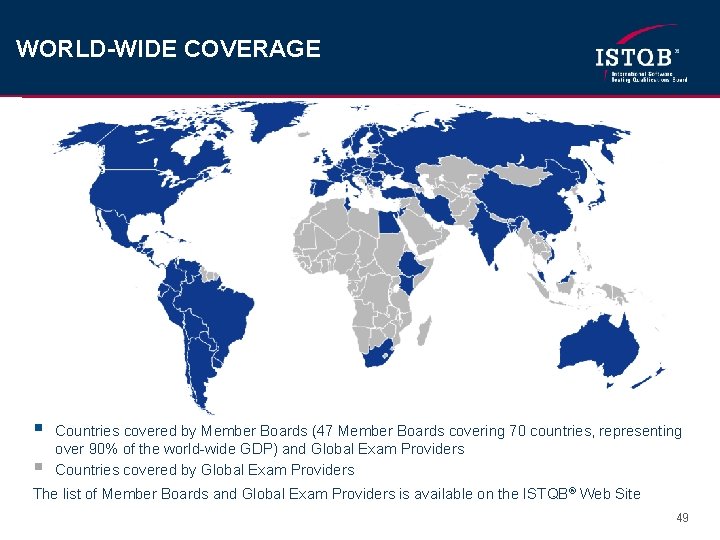
WORLD-WIDE COVERAGE § § Countries covered by Member Boards (47 Member Boards covering 70 countries, representing over 90% of the world-wide GDP) and Global Exam Providers Countries covered by Global Exam Providers The list of Member Boards and Global Exam Providers is available on the ISTQB® Web Site 49
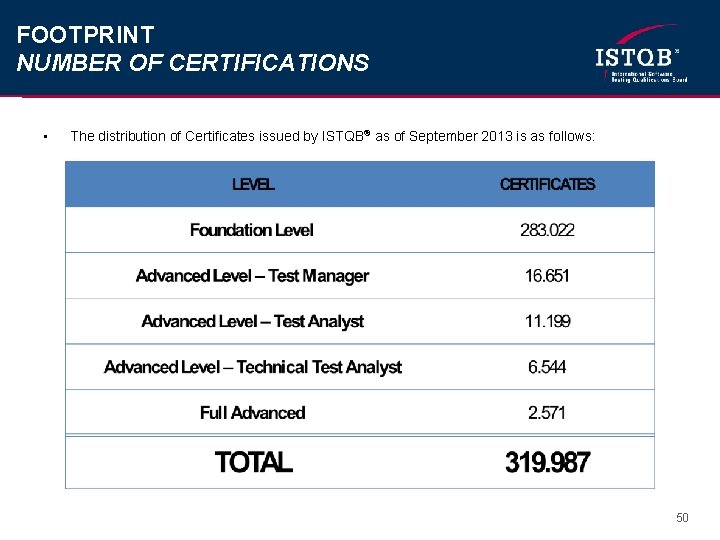
FOOTPRINT NUMBER OF CERTIFICATIONS • The distribution of Certificates issued by ISTQB® as of September 2013 is as follows: 50
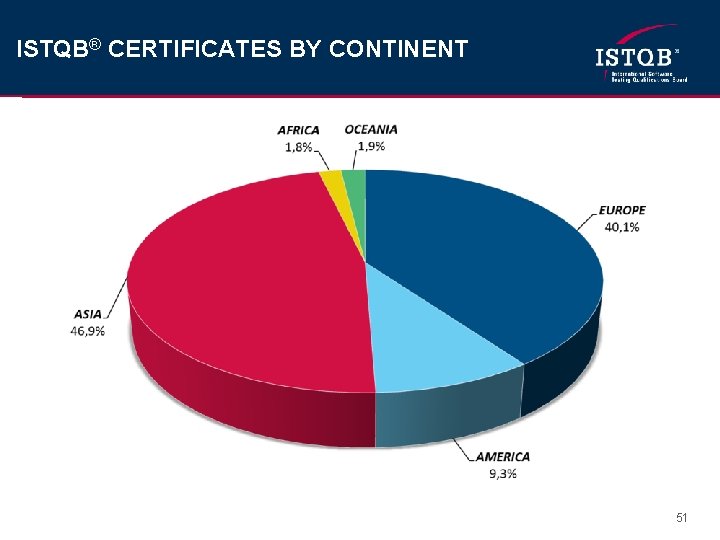
ISTQB® CERTIFICATES BY CONTINENT 51
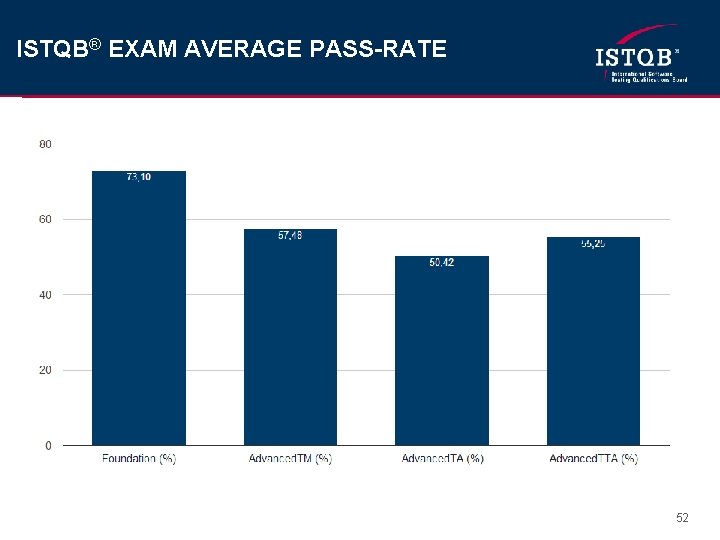
ISTQB® EXAM AVERAGE PASS-RATE 52
- Slides: 52