
IST 421 Advanced Enterprise Integration Six Sigma Concepts
- Slides: 24
IST 421 Advanced Enterprise Integration Six Sigma Concepts
Q 1. What is Six Sigma and why is it a hot topic today?
Q 1. What is Six Sigma and why is it a hot topic today? • Goal – improve quality of process outputs by identifying and removing causes of defects/efforts and minimizing variability in business processes & manufacturing • An approach used to fill gaps between what companies do (current reality) and what they would like to achieve • Uses set of quality management methods, including statistical methods
Q 1. What is Six Sigma and why is it a hot topic today? • Creates a specific infrastructure of people in org (Black Belts, Green Belts, etc. ) • Provides a structured 5 step approach to problem solving • Customer focused - everything that is done should have the customer in mind
Six Sigma Doctrine similarities to other Quality Improvement Efforts • Continuous efforts to achieve stable and predictable process results are important for business success • Business processes have characteristics that can be measured, analyzed, improved and controlled • Sustained quality improvement requires commitment from entire org, especially top management
Aspects Unique to Six Sigma • Focus on achieving measurable and quantifiable financial returns • Increased emphasis on management leadership & support • Special infrastructure of Champions, Master Black Belts, Green Belts, etc. • to lead and implement • Make decisions based on verifiable data rather than assumptions and guesswork
Q 2. What does it mean to be "Six Sigma”?
Q 2. What does it mean to be "Six Sigma”? Six Sigma at many organizations simply means a measure of quality that strives for near perfection. But the statistical implications are rooted in mathematics and statistics.
Q 3. What is the objective of Six Sigma Quality?
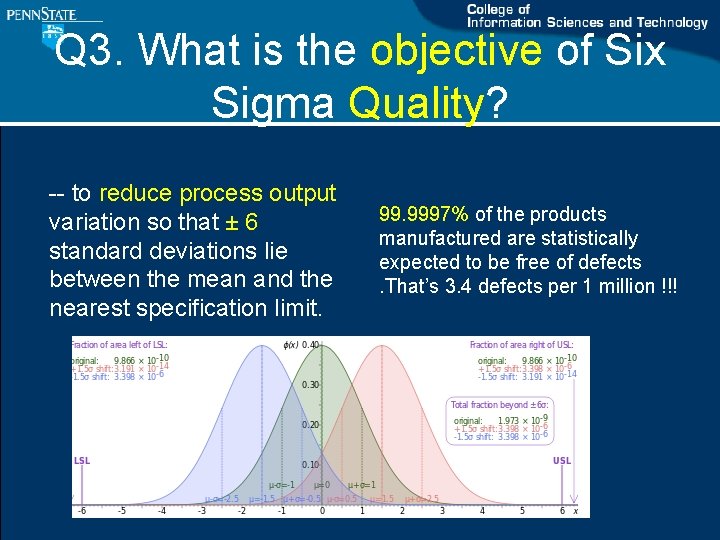
Q 3. What is the objective of Six Sigma Quality? -- to reduce process output variation so that ± 6 standard deviations lie between the mean and the nearest specification limit. 99. 9997% of the products manufactured are statistically expected to be free of defects. That’s 3. 4 defects per 1 million !!!
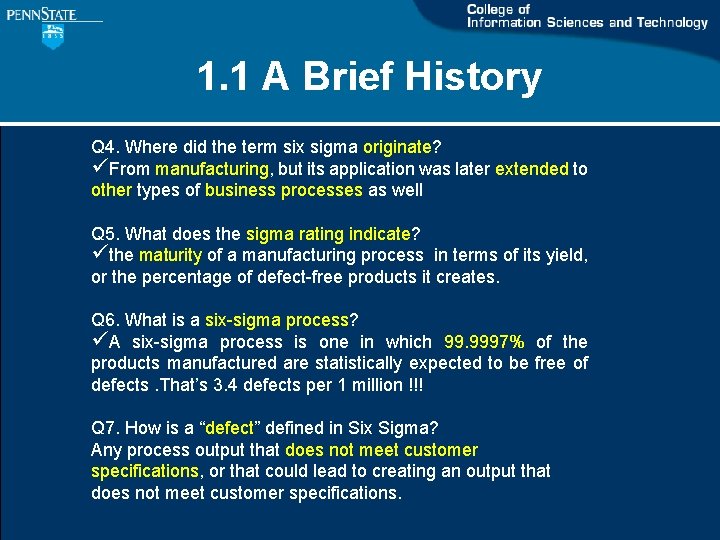
1. 1 A Brief History Q 4. Where did the term six sigma originate? üFrom manufacturing, but its application was later extended to other types of business processes as well Q 5. What does the sigma rating indicate? üthe maturity of a manufacturing process in terms of its yield, or the percentage of defect-free products it creates. Q 6. What is a six-sigma process? üA six-sigma process is one in which 99. 9997% of the products manufactured are statistically expected to be free of defects. That’s 3. 4 defects per 1 million !!! Q 7. How is a “defect” defined in Six Sigma? Any process output that does not meet customer specifications, or that could lead to creating an output that does not meet customer specifications.
1. 2 Methodologies in Six Sigma Q 8. What are the two project methodologies?
1. 2 Methodologies in Six Sigma Q 8. What are the two project methodologies? - DMAIC – for improving existing business process - DMADV – for new process designs - Each is composed of five phases.
1. 2 DMAIC Q 9. What are the five steps of the DMAIC approach? üDefine the problem including the voice of the customer and the project goals ü Measure the key aspects. ü Analyze the data and seek out root cause of the defect. üImprove or optimize the current process üControl the future state process to ensure that any deviations from target are corrected before they result in defects.
1. 2 DMADV Q 10. What are the five steps of the DMADV approach? üDefine goals that are consistent with customer demands and the enterprise strategy. üMeasure and identify product capabilities, production process capability, and risks. üAnalyze to design and evaluate alternatives üDesign details, optimize the design, and plan its verification (done through simulations üVerify the design (set up pilot runs), implement production process and hand it over to the process owner(s)
1. 3 Six Sigma tools Every organization has its own flavor of six sigma • may use tools in a variety of phases • may use additional custom developed tools and/or phases
Q 11. What is Root Cause Analysis (RCA) §An approach to identify root causes, assuring that the recommended solution provides a “cure for the illness, not just the symptoms” § an iterative process § RCA is not a single, sharply defined methodology §there are many different tools, processes, and philosophies of RCA in existence.
RCA contd. . Key questions to ask: - How will you identify root causes? - What tools will you use to identify root causes? - How will you decide which root causes to fix? - How much of the gap will be eliminated? - Is it worth continuing the project?
Q 12. What are the 5 Whys Repeatedly ask the question "Why" (five is a good rule of thumb), to peel away the layers of symptoms to get to the root cause of a problem. Very often the apparent reason for a problem will lead you to another question. You can ask the question fewer or more times than five before you find the issue related to a problem. Benefits Of The 5 Whys • • • Help identify the root cause of a problem. Determine the relationship between different root causes of a problem. One of the simplest tools; easy to complete without statistical analysis.
Q 12. What are the 5 Whys How To Complete the 5 Whys 1. Write down the specific problem. Writing the issue helps you formalize the problem and describe it completely. It also helps a team focus on the same problem. 2. Ask Why the problem happens and write the answer down below the problem. 3. If the answer you just provided doesn't identify the root cause of the problem that you wrote down in step 1, ask Why again and write that answer down. 4. Loop back to step 3 until the team is in agreement that the problem's root cause is identified. Again, this may take fewer or more times than five Whys.
Q 13. What is Business Process Mapping? § Involves defining: § what a business entity does §who is responsible §to what standard a process should be completed and §how the success of a business process can be determined. § Overarching Goal - ensure the correctness of requirements of every internal business process § Encompasses: §Business process re-engineering, §Regulatory compliance, §Activity analysis, §Service level agreement (SLA)
Q 14. What is cost-benefit analysis? • Assess the business case for a project • an approach to making economic decisions of any kind • weighing the total expected costs against the total expected benefits of one or more actions in order to choose the best or most profitable option. • Some examples of cost-benefit indicators include: • Net Present value (NPV) • Present value of Benefits (PVB) • PVC (present value of costs)
Six Sigma tools Can be used in any phase as needed. Every organization has its own flavor of six sigma and may use tools in a variety of phases and may use additional custom developed tools Microsoft Visio has templates for data/process flow charts, fishbone diagrams, and many other diagrams
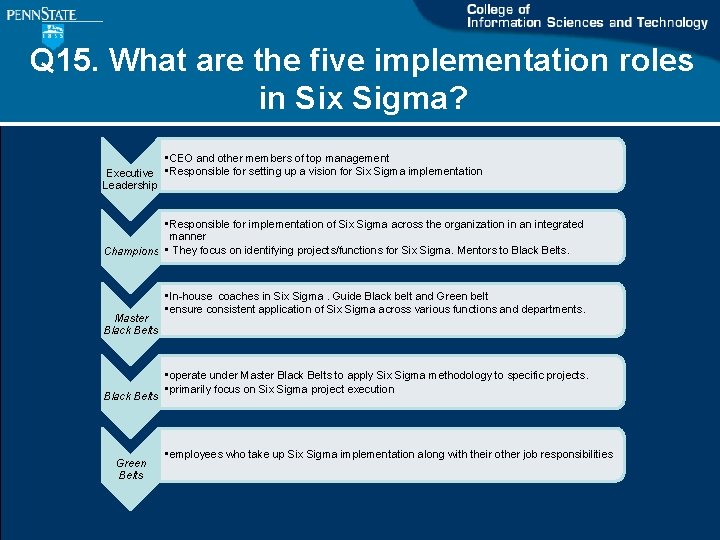
Q 15. What are the five implementation roles in Six Sigma? • CEO and other members of top management Executive • Responsible for setting up a vision for Six Sigma implementation Leadership • Responsible for implementation of Six Sigma across the organization in an integrated manner Champions • They focus on identifying projects/functions for Six Sigma. Mentors to Black Belts. Master Black Belts Green Belts • In-house coaches in Six Sigma. Guide Black belt and Green belt • ensure consistent application of Six Sigma across various functions and departments. • operate under Master Black Belts to apply Six Sigma methodology to specific projects. • primarily focus on Six Sigma project execution • employees who take up Six Sigma implementation along with their other job responsibilities