
ISSUP RELAPSE PREVENTION BEST PRACTICES TANUSHREE DAS SHUBHANGI
ISSUP RELAPSE PREVENTION: BEST PRACTICES TANUSHREE DAS SHUBHANGI TANEJA SPYM
CONTENTS OF PRESENTATION p Relapse: The Basics p Relapse Process p Precipitants of Relapse p Interventions to prevent relapse
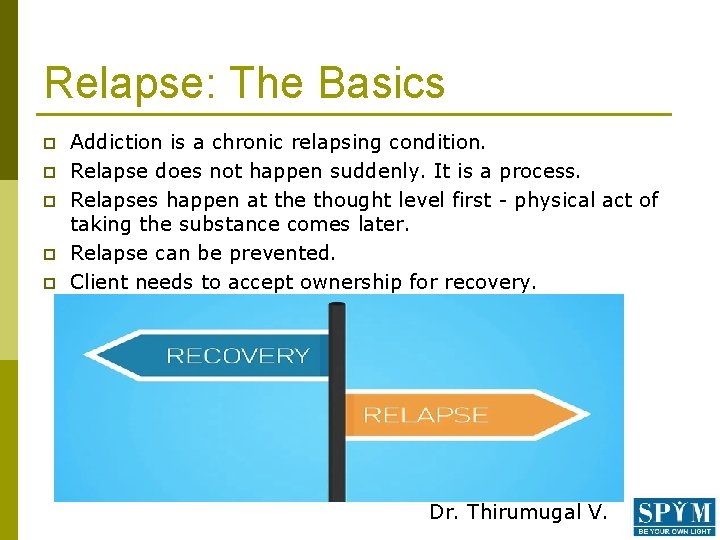
Relapse: The Basics p p p Addiction is a chronic relapsing condition. Relapse does not happen suddenly. It is a process. Relapses happen at the thought level first - physical act of taking the substance comes later. Relapse can be prevented. Client needs to accept ownership for recovery. Dr. Thirumugal V.

The Relapse Process Trigger Internal or External Craving Intense desire to use Lapse Brief, one time use Relapse Return to previous patter of use
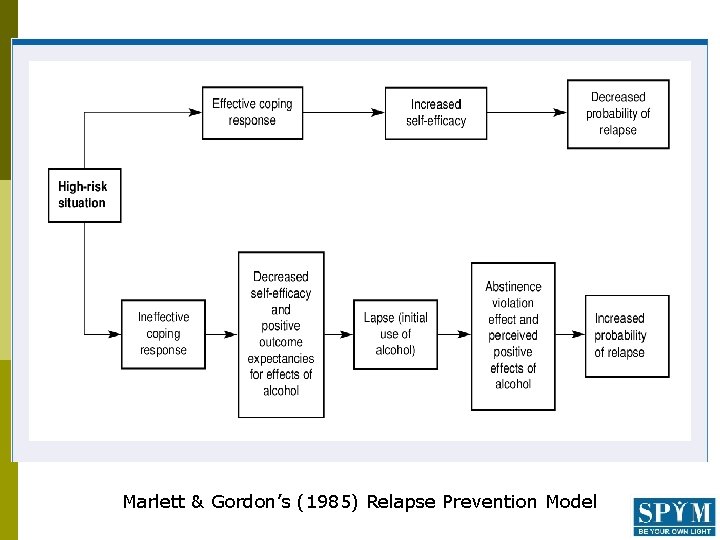
Marlett & Gordon’s (1985) Relapse Prevention Model
Precipitants of Relapse For preventing relapse in a client, one needs to understand relapse precipitants. The common relapse precipitants are: MOOD STATES • Positive mood (excessive happiness) • Negative mood (sadness, frustration) BEHAVIORAL • Impulsivity • Poor coping skills COGNITIVE • Overconfidence (self-perception of ability to cope with high-risk situations) • Faulty cognitions ENVIRONMENTAL • Peer pressure • Loneliness / no engagement • Lack of social support/ constant criticism by family • Interpersonal conflict PHYSIOLOGICAL • Craving • Chronic physical pain PSYCHIATRIC CONDITIONS • Anxiety disorder • Mood disorder • Psychoses
Interventions to Prevent Relapse p Once the detoxification is over, the main focus should be on aspect of psychosocial management and relapse prevention. The overall goal of specific intervention procedure is to teach the client to anticipate and cope with the possibility of relapse: to recognize and cope with high risk situations that may precipitate a slip, and to modify cognitions and other reactions so as to prevent a single lapse from developing into a full blown relapse. p

Interventions to Prevent Relapse A. Identifying and Handling High Risk Situations B. Learning Coping Skills C. Dealing with urges/cravings D. Refusal skills E. Dealing with faulty cognitions F. Cognitive Restructuring G. Handling Negative Mood States H. Enhancing Self-Efficacy I. Stress Management J. Having a Balanced Lifestyle K. Role of Family in Relapse Prevention L. Regular Follow-ups M. Self-help Groups
A. Identifying and Handling High Risk Situations p p High risk situations may vary from person to person. In most cases, the person is not expecting the high risk situation to occur, and/or is generally ill-prepared to cope effectively with the circumstances as they arise. Help clients monitor their behaviour and elicited about high risk situation through use of five W’s -What exactly happened? -Where were you? -Whom were you with? -When did it happen? -What made you use it? (thoughts and feelings) p
Common Situations where a Person can Develop Craving: -The sight of a bar, especially the one the person used to visit before or passing by the usual hangouts -Meeting friends with whom one was using drugs - Peer pressure - Parties - Saturday nights/ weekends - Being home alone - Having a lot of unscheduled time can lead to boredom -Family conflicts - Job or other stresses, fatigue - Negative emotions like frustration, sadness, depression -Positive emotions such as happiness, excitement, a feeling of accomplishment (desire to celebrate) p p Each warning sign needs to be linked to a set of recovery activity.
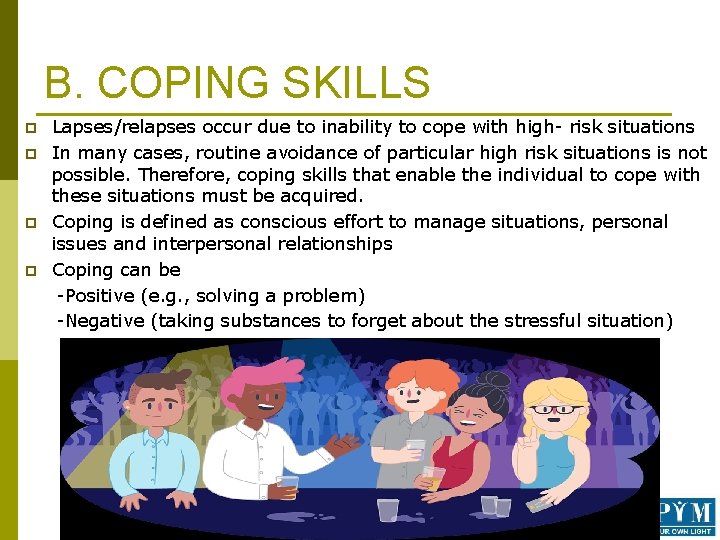
B. COPING SKILLS p p Lapses/relapses occur due to inability to cope with high- risk situations In many cases, routine avoidance of particular high risk situations is not possible. Therefore, coping skills that enable the individual to cope with these situations must be acquired. Coping is defined as conscious effort to manage situations, personal issues and interpersonal relationships Coping can be -Positive (e. g. , solving a problem) -Negative (taking substances to forget about the stressful situation)
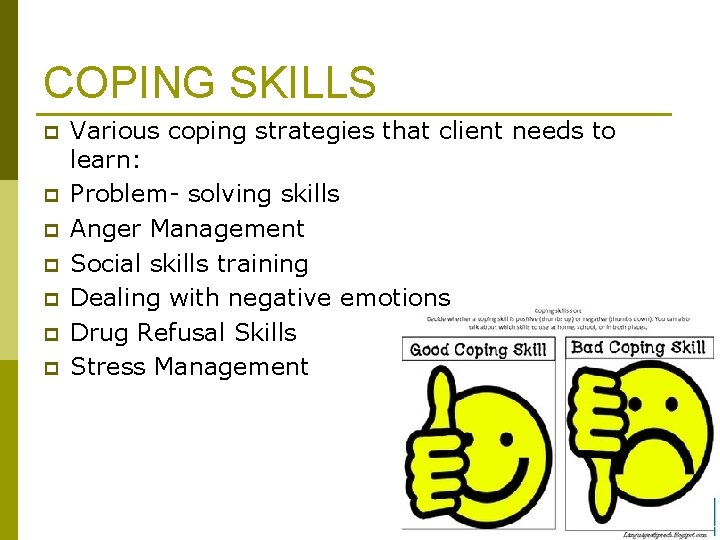
COPING SKILLS p p p p Various coping strategies that client needs to learn: Problem- solving skills Anger Management Social skills training Dealing with negative emotions Drug Refusal Skills Stress Management
C. Cravings A powerful desire for “something”-Strong memories that are linked to the effect of drugs on the mind and the body p Associated with: -Restlessness -Irritability -Thoughts/images of preferred drug of use -Difficulty concentrating on tasks p Strongly associated with lapse/relapse p
Dealing with Urges/Cravings p p p p Craving is like a wave and episodes of craving are time-limited. 5 D’s -Distract - Delay -Deep breathing -Discuss -Drink water Recall negative consequences of returning to substance use - losing one's job, broken family relationships, etc. One day at a time Check in HALT – Hunger, Anger, Loneliness , Tiredness Stimulus control techniques- encourage the client to remove all items directly associated with substance use from his/her home, office, car, e. g. alcohol bottles hidden at home, or more subtle cues such as favourite living room chair or the music the client typically listened to while unwinding in the evening with several of his/her favourite drinks. - Seek help soon after a lapse or relapse
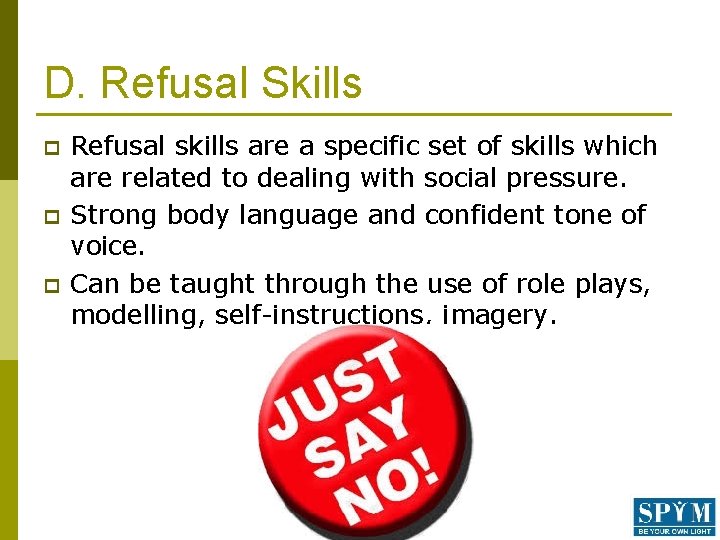
D. Refusal Skills p p p Refusal skills are a specific set of skills which are related to dealing with social pressure. Strong body language and confident tone of voice. Can be taught through the use of role plays, modelling, self-instructions, imagery.
Some Common Drug Refusal Statements p p p Saying “No thanks” and walk away. Give a reason, fact or excuse Change the subject Use humour Cold Shoulder or Ignore “I am taking medicine and I can’t drink on it. ” “I have an important engagement. ” “I have to get up early. ” “I have to work a double shift tomorrow. ” “I have a headache. ” “I was just leaving. ”
E. Dealing with faulty cognitions p p p p Dealing with faulty cognitions like overconfidence, helplessness, catastrophizing, etc. Example: “I can stay away from drugs. Nothing can tempt me. ” The consequence is - going to parties where drugs may be available, telling myself “I will go, but I’ll not drink. Recognize that this thought is a red flag and consciously tackle it. Ways of Challenging Thoughts (overconfidence as in the above situation) “What proof do I have that nothing can tempt me? ” “What happened before? ” Want/Should analysis.
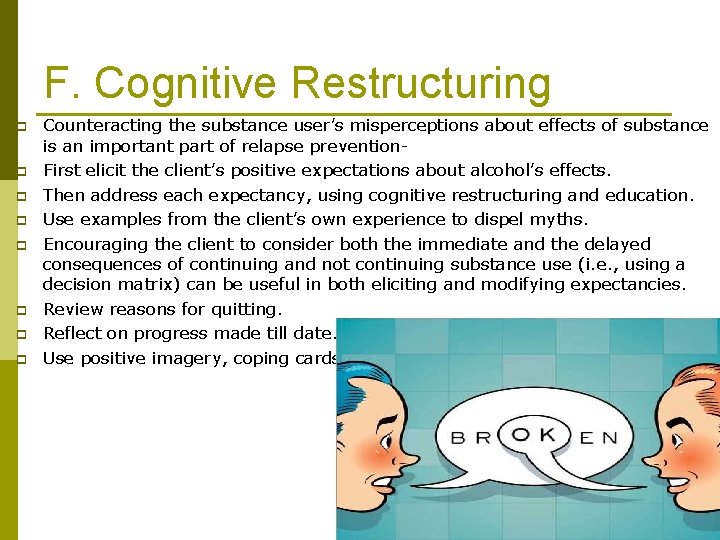
F. Cognitive Restructuring p p p p Counteracting the substance user’s misperceptions about effects of substance is an important part of relapse prevention. First elicit the client’s positive expectations about alcohol’s effects. Then address each expectancy, using cognitive restructuring and education. Use examples from the client’s own experience to dispel myths. Encouraging the client to consider both the immediate and the delayed consequences of continuing and not continuing substance use (i. e. , using a decision matrix) can be useful in both eliciting and modifying expectancies. Review reasons for quitting. Reflect on progress made till date. Use positive imagery, coping cards.
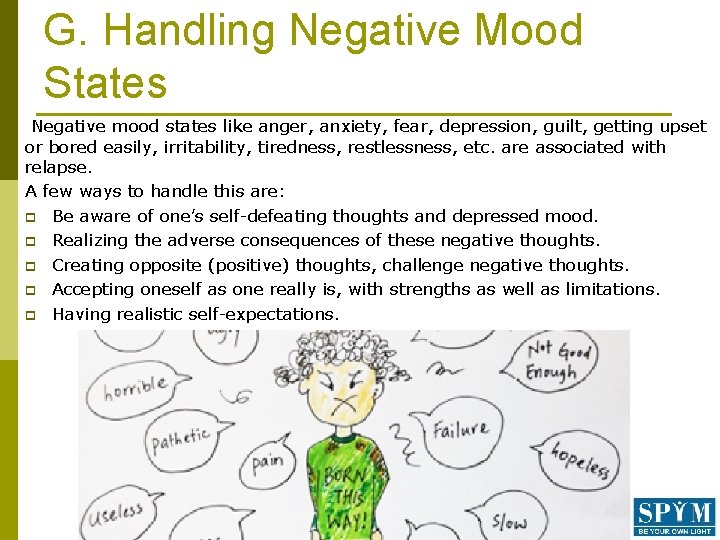
G. Handling Negative Mood States Negative mood states like anger, anxiety, fear, depression, guilt, getting upset or bored easily, irritability, tiredness, restlessness, etc. are associated with relapse. A few ways to handle this are: p Be aware of one’s self-defeating thoughts and depressed mood. p Realizing the adverse consequences of these negative thoughts. p Creating opposite (positive) thoughts, challenge negative thoughts. p Accepting oneself as one really is, with strengths as well as limitations. p Having realistic self-expectations.
Abstinence Violation Effect (AVE) Tendency of clients to attribute lapse to their own personal failure which leads feelings of guilt and shame that eventually lead to increased substance use to avoid or escape such negative feelings. p For example- “I am an idiot. I would never change and there is no use trying. ” p Prevent the lapse from turning into a relapse. p Encourage the client to seek help immediately after a lapse. p For dealing with AVE: -Make the client aware of AVE, lapse and relapse -Help client in ventilating their feelings after lapse -Help client challenge his/her thoughts -What would I say to a friend in a similar situation? -Positive thinking- “Yes, a slip happened. But I can still deal with it. ” p
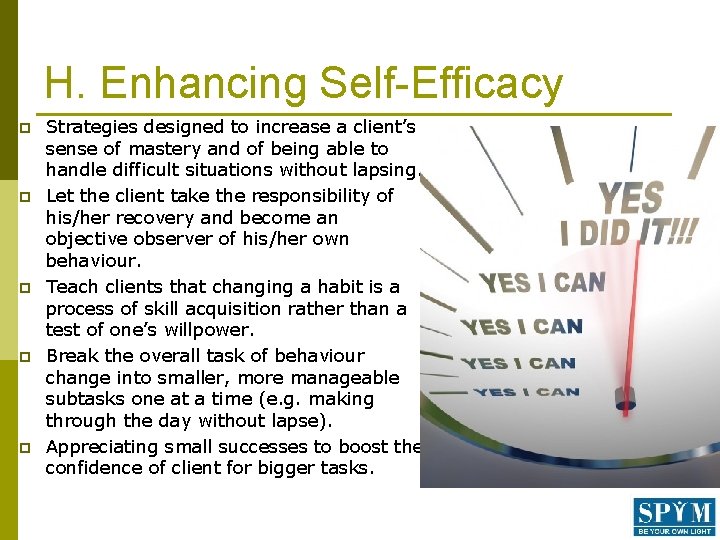
H. Enhancing Self-Efficacy p p p Strategies designed to increase a client’s sense of mastery and of being able to handle difficult situations without lapsing. Let the client take the responsibility of his/her recovery and become an objective observer of his/her own behaviour. Teach clients that changing a habit is a process of skill acquisition rather than a test of one’s willpower. Break the overall task of behaviour change into smaller, more manageable subtasks one at a time (e. g. making through the day without lapse). Appreciating small successes to boost the confidence of client for bigger tasks.
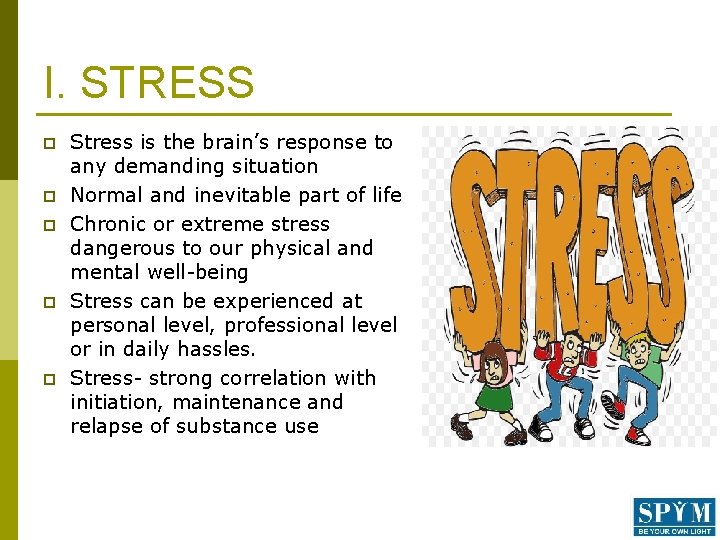
I. STRESS p p p Stress is the brain’s response to any demanding situation Normal and inevitable part of life Chronic or extreme stress dangerous to our physical and mental well-being Stress can be experienced at personal level, professional level or in daily hassles. Stress- strong correlation with initiation, maintenance and relapse of substance use
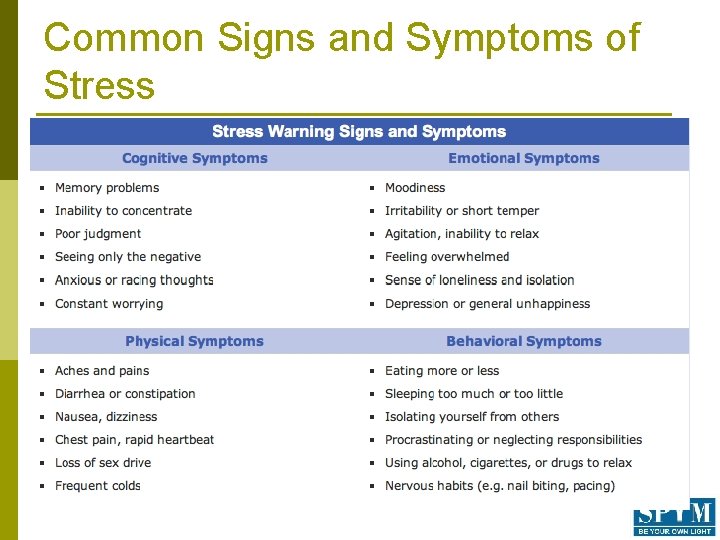
Common Signs and Symptoms of Stress
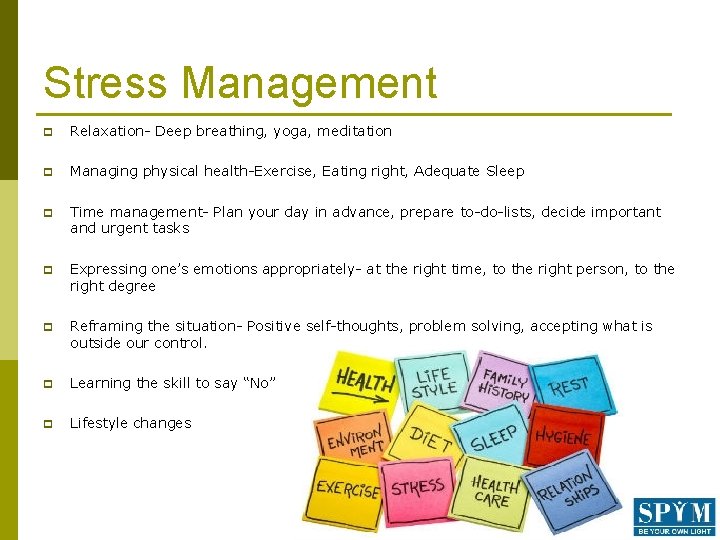
Stress Management p Relaxation- Deep breathing, yoga, meditation p Managing physical health-Exercise, Eating right, Adequate Sleep p Time management- Plan your day in advance, prepare to-do-lists, decide important and urgent tasks p Expressing one’s emotions appropriately- at the right time, to the right person, to the right degree p Reframing the situation- Positive self-thoughts, problem solving, accepting what is outside our control. p Learning the skill to say “No” p Lifestyle changes
J. Having a balanced Lifestyle Recovery is not just abstinence. Focusing on wellness and improving the overall quality of life is essential for sustained recovery. p Attitude is the key – be positive! p Have a fixed schedule for the day. Begin and end your day with prayer and/or reflection. p Believe in yourself – that you will get through your treatment, your hurdles, big or small. p Plan your time effectively. Pursue a hobby – something you have always wanted to do. Take time out for recreation. p Practice Relaxation Technique. p Be regular to job or work p Cultivate a best friend whom you can really trust. p Stay away from negative people who constantly criticize. Minimize peer influence that is adverse. p Spend time with family and children. p Take a healthy balanced diet. Follow a regular fitness regimen. p Get sufficient sleep.
K. Role of Family in Relapse Prevention p p p p p Family plays an important role in preventing relapse and helping the person remain drug free. Work with the family members on the following areas: Realize that drug dependence is a disease, and not a moral weakness or a lack of willpower. Do not argue, quarrel, justify his/her use of substance, or take up the responsibility of covering up for the consequences of substance use. Provide emotional support Reduce interpersonal conflict and stress and help the person in dealing with everyday stressors. Help overcome temptations and help identify attitudes or behaviours that might signal a relapse. Pay extra attention to his needs – nutrition, medications, health. Identify the unhealthy patterns in the family. Encourage the family members to take care of their own health and well being as well.
L. Regular Follow-ups and Aftercare Relapse prevention as described at the beginning is a process and is ongoing. Follow-ups are an essential part of relapse prevention. Focus on the following: p How he/she is handling the urges p Any physical/emotional disturbance following stoppage of substance. p Ways in which the recovering person is managing time, job, family relationships etc. p Any high risk situation he/she has faced recently and how have they coped. p How are they dealing with the triggers or relapsing cues p Aftercare services: remedial education, job skills training, vocational training, life skills training, etc. p The therapist can ask appropriate questions to understand both recovery and relapse.
M. Self-help Groups- AA, NA p p p Group of recovering persons designed to give clients alternative social support networks. Goal is to promote abstinence through lifestyle change and peer support Use the term “Fellowship” to indicate that they offer clients a sense of belonging and community that they may not have experienced outside the substance-using community. These meetings frequently discuss relapse issues. Members are encouraged to remain abstinent one day at a time-to handle cravings by choosing not to act on them today. Counsellors should encourage clients to attend these meetings.
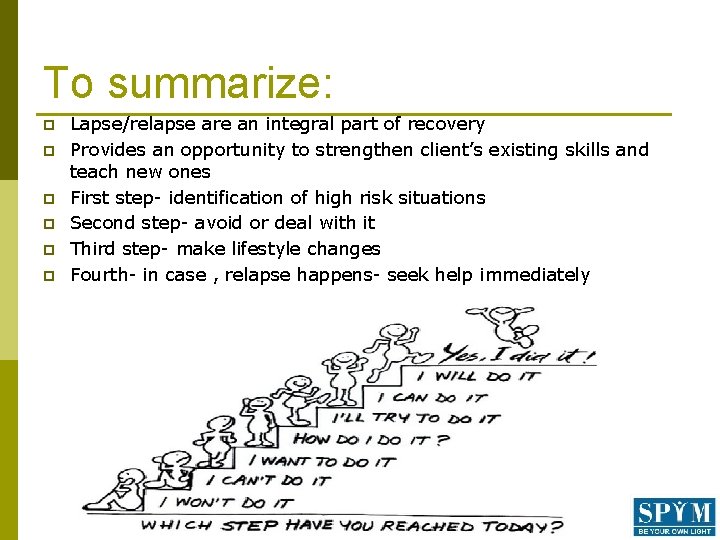
To summarize: p p p Lapse/relapse are an integral part of recovery Provides an opportunity to strengthen client’s existing skills and teach new ones First step- identification of high risk situations Second step- avoid or deal with it Third step- make lifestyle changes Fourth- in case , relapse happens- seek help immediately
FOREWARNED IS FORARMRD, and AN OUNCE OF PREVENTION IS WORTH A POUND OF CURE
Thank you!!! 31
- Slides: 31