
Issues with Web Search Engines SI 650 Information
Issues with Web Search Engines SI 650: Information Retrieval Winter 2010 School of Information University of Michigan 2010 © University of Michigan 1
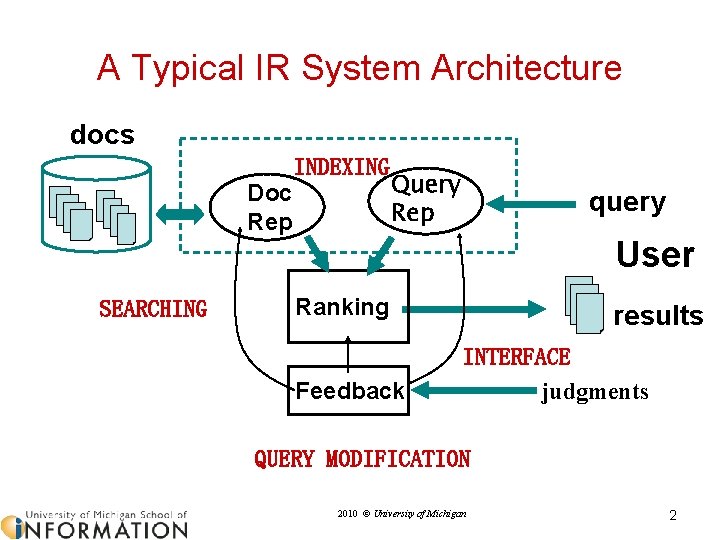
A Typical IR System Architecture docs INDEXING Doc Rep SEARCHING Query Rep query User Ranking Feedback results INTERFACE judgments QUERY MODIFICATION 2010 © University of Michigan 2
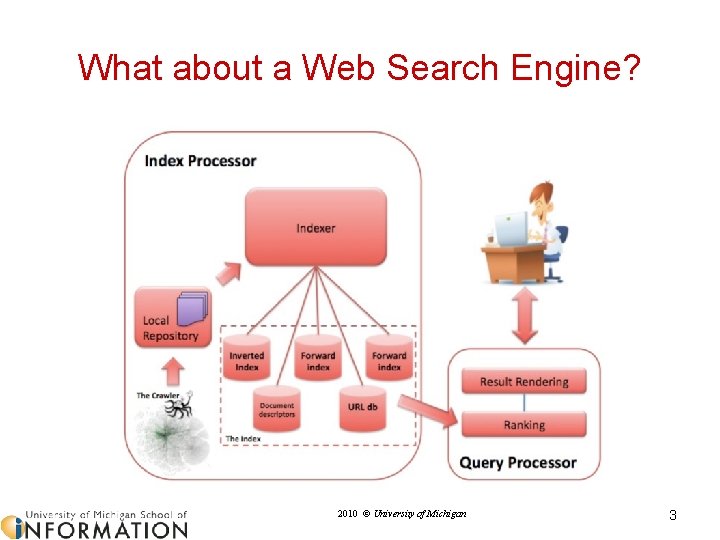
What about a Web Search Engine? 2010 © University of Michigan 3
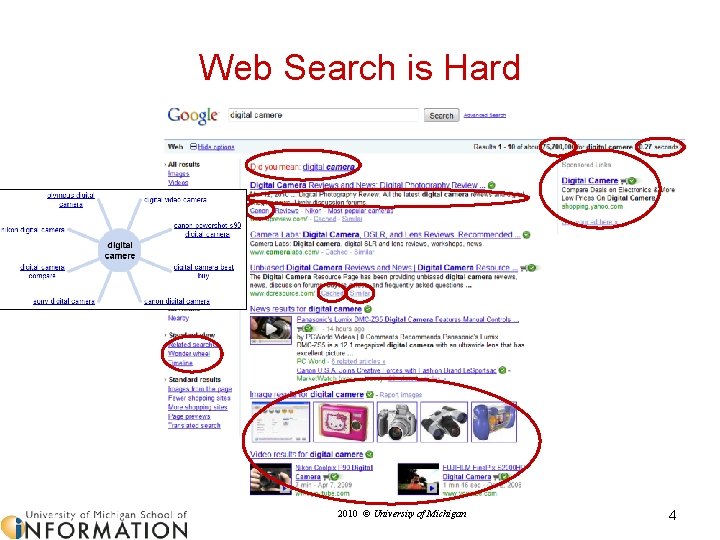
Web Search is Hard 2010 © University of Michigan 4
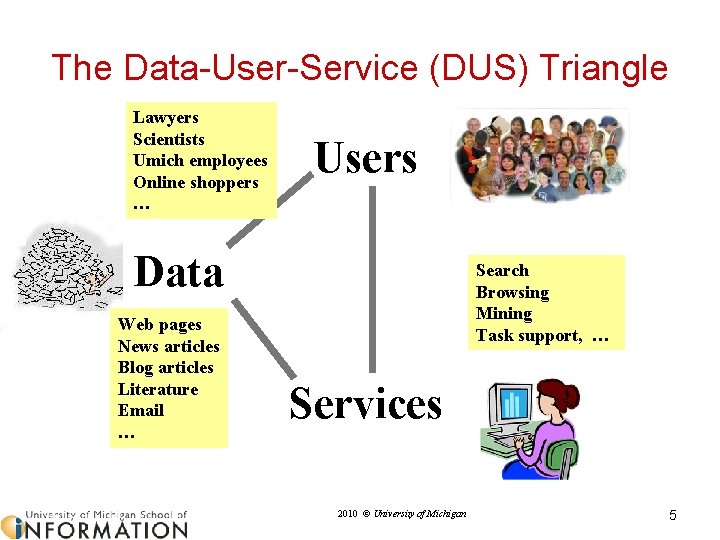
The Data-User-Service (DUS) Triangle Lawyers Scientists Umich employees Online shoppers … Users Data Web pages News articles Blog articles Literature Email … Search Browsing Mining Task support, … Services 2010 © University of Michigan 5
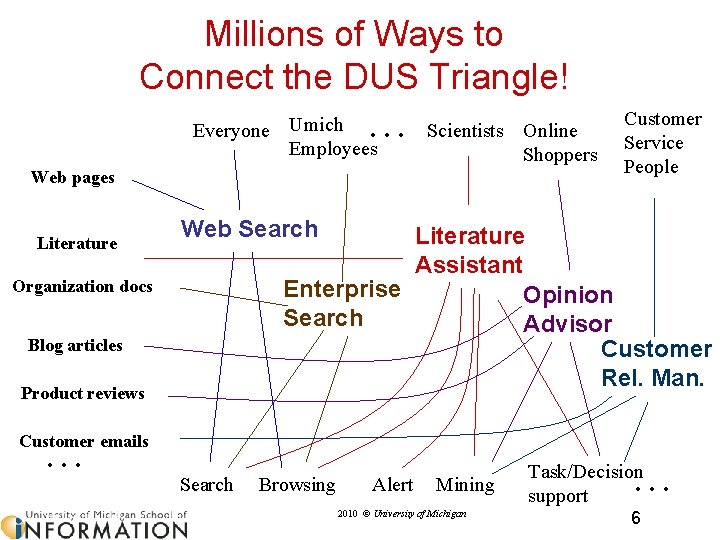
Millions of Ways to Connect the DUS Triangle! … Everyone Umich Employees Scientists Online Shoppers Web pages Literature Web Search Literature Assistant Enterprise Opinion Search Advisor Customer Rel. Man. Organization docs Blog articles Product reviews … Customer Service People Customer emails Search Browsing Alert Mining 2010 © University of Michigan … Task/Decision support 6
Indexer • Standard IR techniques are the basis – Basic indexing decisions – Indexing efficiency (space and time) – Updating • Additional challenges (in addition to scaling up) – – Recognize spams/junks Index selection – decide what to include in the index Multi-level index How to support “fast summary generation”? • Google’s contributions: – – Google file system: distributed file system Big Table: column-based database Map. Reduce: Software framework for parallel computation Hadoop: Open source implementation of Map. Reduce (used in Yahoo!) 2010 © University of Michigan 7
Redundancy Removal • Detect duplications, and remove them. • Strict duplication is easy to handle (why? ), but what about near-duplication? • 30% of web pages are near-duplicates (Broder et al 1997) – mirrors, local copies, page updates, … – spam, spider-traps, … – Crawling errors, … • How to detect near-duplicates with limited storage and fast running-time? 2010 © University of Michigan 8
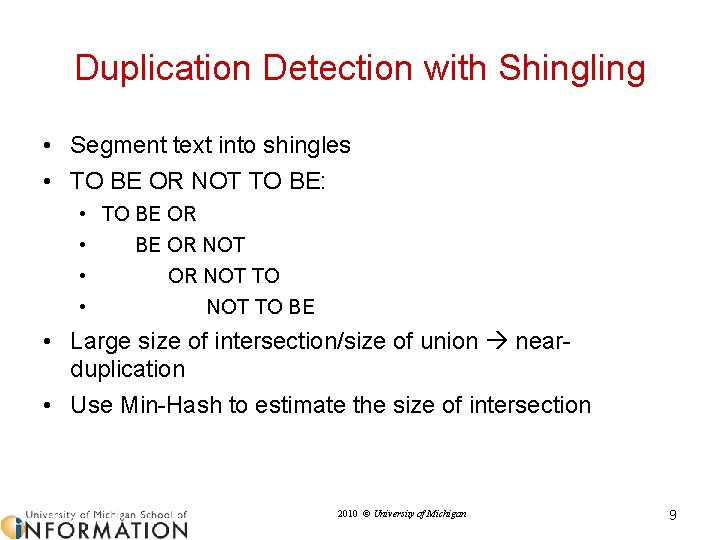
Duplication Detection with Shingling • Segment text into shingles • TO BE OR NOT TO BE: • TO BE OR • • • BE OR NOT TO BE • Large size of intersection/size of union nearduplication • Use Min-Hash to estimate the size of intersection 2010 © University of Michigan 9
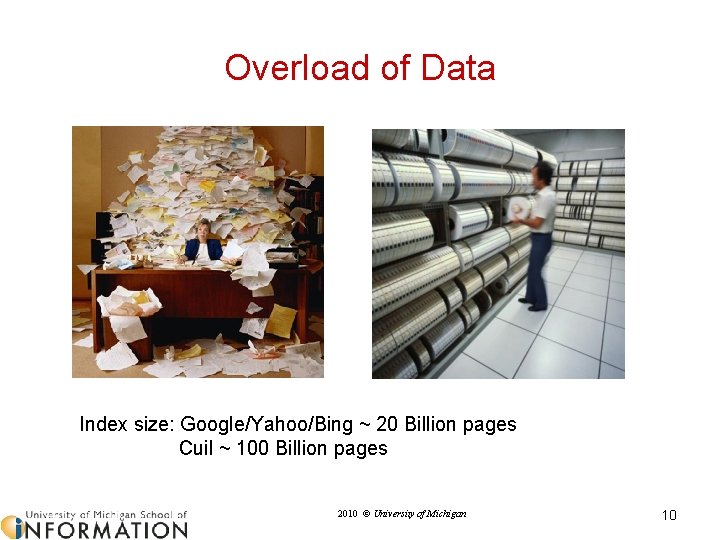
Overload of Data Index size: Google/Yahoo/Bing ~ 20 Billion pages Cuil ~ 100 Billion pages 2010 © University of Michigan 10
Map. Reduce • Provide easy but general model for programmers to use cluster resources • Hide network communication (i. e. Remote Procedure Calls) • Hide storage details, file chunks are automatically distributed and replicated • Provide transparent fault tolerance (Failed tasks are automatically rescheduled on live nodes) • High throughput and automatic load balancing (E. g. scheduling tasks on nodes that already have data) This slide and the following slides about Map. Reduce are from Behm & Shah’s presentation http: //www. ics. uci. edu/~abehm/class_reports/uci/2008 -Spring_CS 224/Behm-Shah_Page. Rank. ppt 11 2010 © University of Michigan
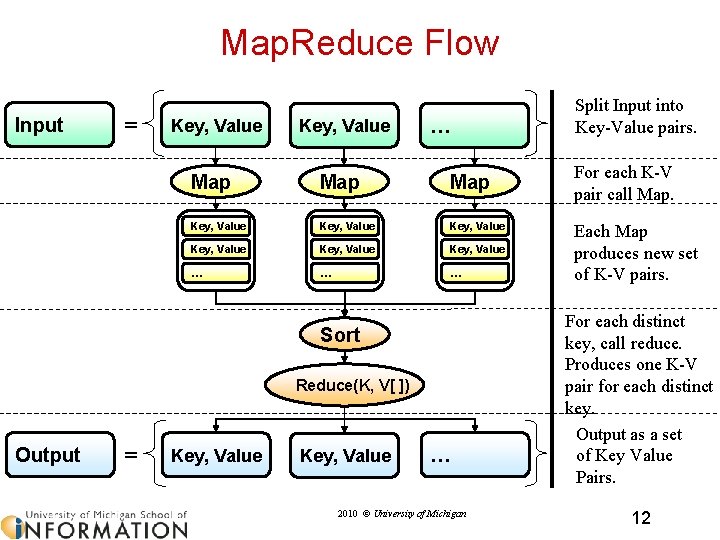
Map. Reduce Flow Input = Split Input into Key-Value pairs. … Key, Value Map Map Key, Value Key, Value … … … Sort Reduce(K, V[ ]) Output = Key, Value … 2010 © University of Michigan For each K-V pair call Map. Each Map produces new set of K-V pairs. For each distinct key, call reduce. Produces one K-V pair for each distinct key. Output as a set of Key Value Pairs. 12
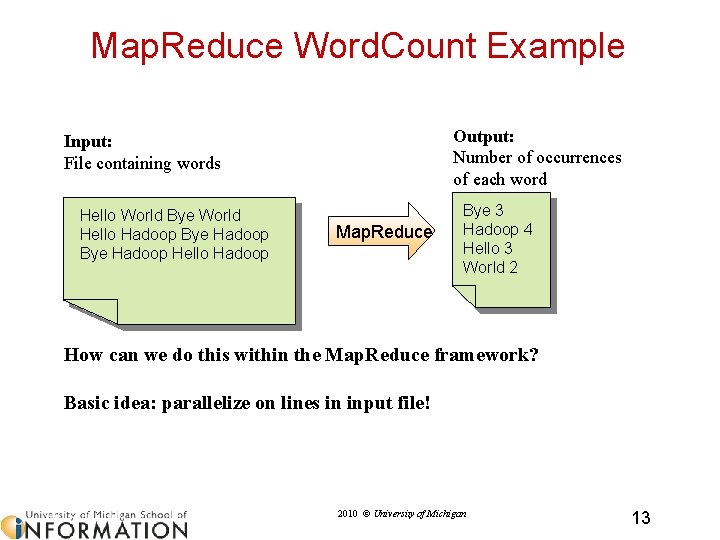
Map. Reduce Word. Count Example Output: Number of occurrences of each word Input: File containing words Hello World Bye World Hello Hadoop Bye Hadoop Hello Hadoop Map. Reduce Bye 3 Hadoop 4 Hello 3 World 2 How can we do this within the Map. Reduce framework? Basic idea: parallelize on lines in input file! 2010 © University of Michigan 13
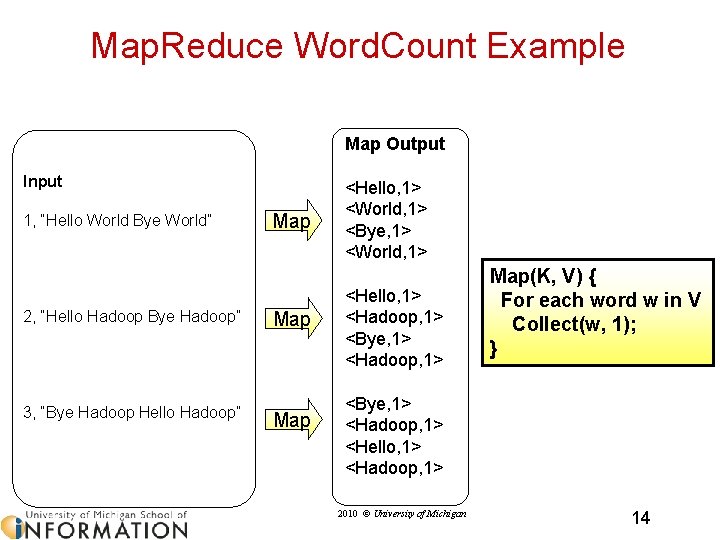
Map. Reduce Word. Count Example Map Output Input 1, “Hello World Bye World” 2, “Hello Hadoop Bye Hadoop” 3, “Bye Hadoop Hello Hadoop” Map Map <Hello, 1> <World, 1> <Bye, 1> <World, 1> <Hello, 1> <Hadoop, 1> <Bye, 1> <Hadoop, 1> Map(K, V) { For each word w in V Collect(w, 1); } <Bye, 1> <Hadoop, 1> <Hello, 1> <Hadoop, 1> 2010 © University of Michigan 14
![Map. Reduce Word. Count Example Reduce(K, V[ ]) { Int count = 0; For](http://slidetodoc.com/presentation_image_h2/68b1cc9ddc21192d35722e47d767a411/image-15.jpg "Map. Reduce Word. Count Example Reduce(K, V[ ]) { Int count = 0; For")
Map. Reduce Word. Count Example Reduce(K, V[ ]) { Int count = 0; For each v in V count += v; Collect(K, count); } Map Output <Hello, 1> <World, 1> <Bye, 1> <World, 1> <Hello, 1> <Hadoop, 1> <Bye, 1> <Hadoop, 1> <Hello, 1> <Hadoop, 1> Internal Grouping Reduce <Bye 1, 1, 1> <Hadoop 1, 1, 1, 1> Reduce Output Reduce <Hello 1, 1, 1> Reduce <World 1, 1> Reduce <Bye, 3> <Hadoop, 4> <Hello, 3> <World, 2> 2010 © University of Michigan 15
User Behaviors on Web • The better you understand me, the better you can serve me • Sample problems: – – Identifying sessions in query logs Predicting accesses to a given page (e. g. , for caching) Recognizing human vs. automated queries Recommending alternative queries, landing pages, … 2010 © University of Michigan 16
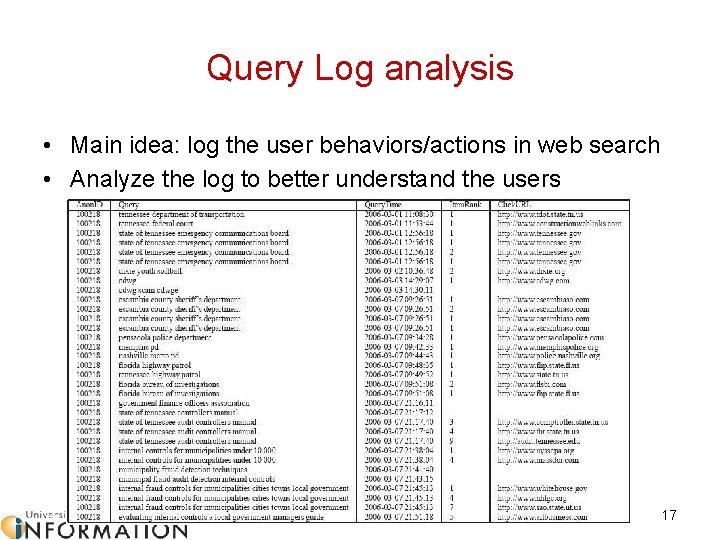
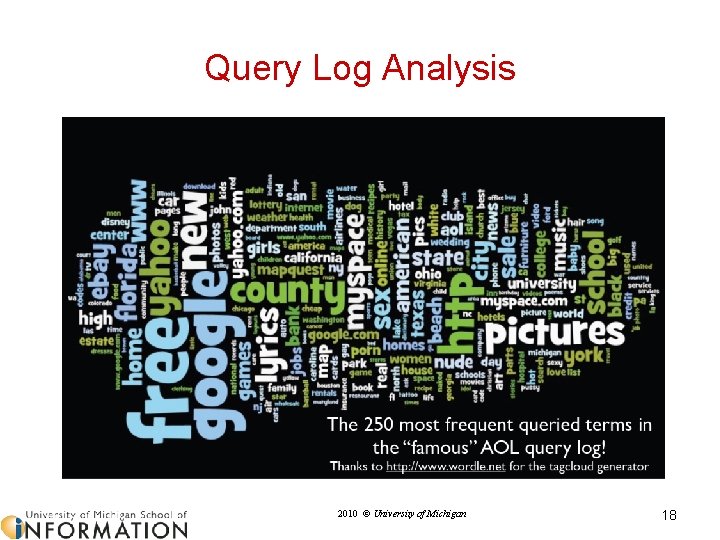
Query Log analysis • Main idea: log the user behaviors/actions in web search • Analyze the log to better understand the users 2010 © University of Michigan 17
Query Log Analysis 2010 © University of Michigan 18
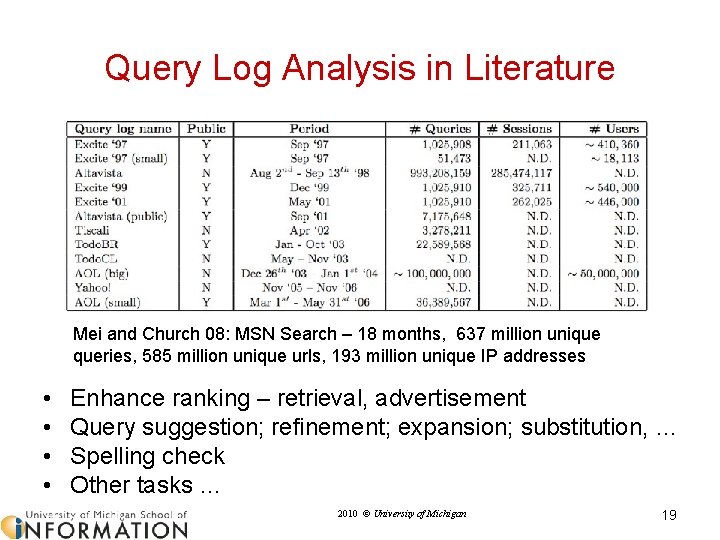
Query Log Analysis in Literature Mei and Church 08: MSN Search – 18 months, 637 million unique queries, 585 million unique urls, 193 million unique IP addresses • • Enhance ranking – retrieval, advertisement Query suggestion; refinement; expansion; substitution, … Spelling check Other tasks … 2010 © University of Michigan 19
Main Results • Average number of terms in a query is ranging from a low of 2. 2 to a high of 2. 6 • The most common number of terms in a query is 2 • The majority of users don’t refine their query – The number of users who viewed only a single page increase 29% (1997) to 51% (2001) (Excite) – 85% of users viewed only first page of search results (Alta. Vista) • 45% (2001) of queries is about Commerce, Travel, Economy, People (was 20%1997) – The queries about adult or entertainment decreased from 20% (1997) to around 7% (2001) - This slide is from Pierre Baldi 2010 © University of Michigan
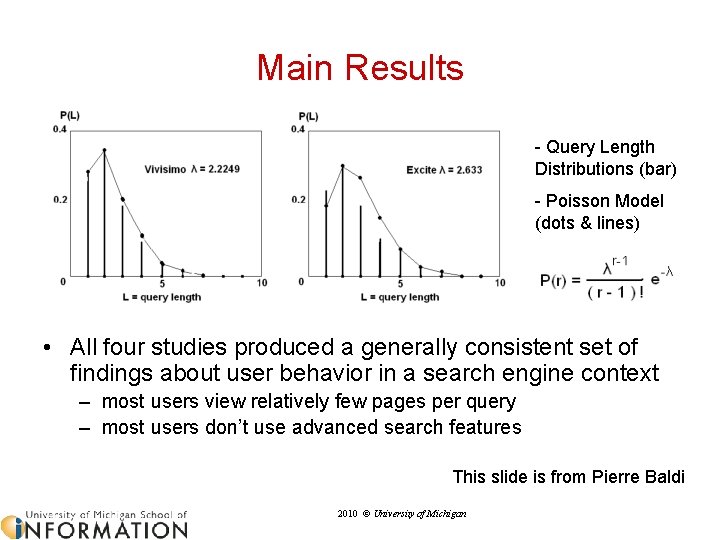
Main Results - Query Length Distributions (bar) - Poisson Model (dots & lines) • All four studies produced a generally consistent set of findings about user behavior in a search engine context – most users view relatively few pages per query – most users don’t use advanced search features This slide is from Pierre Baldi 2010 © University of Michigan
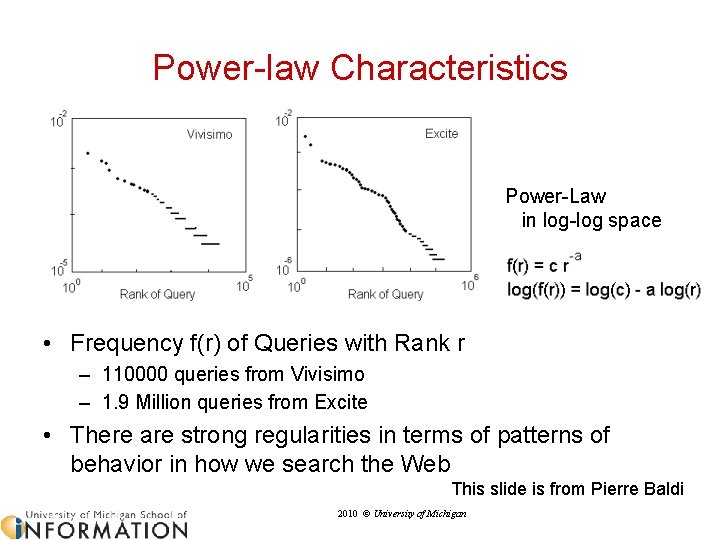
Power-law Characteristics Power-Law in log-log space • Frequency f(r) of Queries with Rank r – 110000 queries from Vivisimo – 1. 9 Million queries from Excite • There are strong regularities in terms of patterns of behavior in how we search the Web This slide is from Pierre Baldi 2010 © University of Michigan
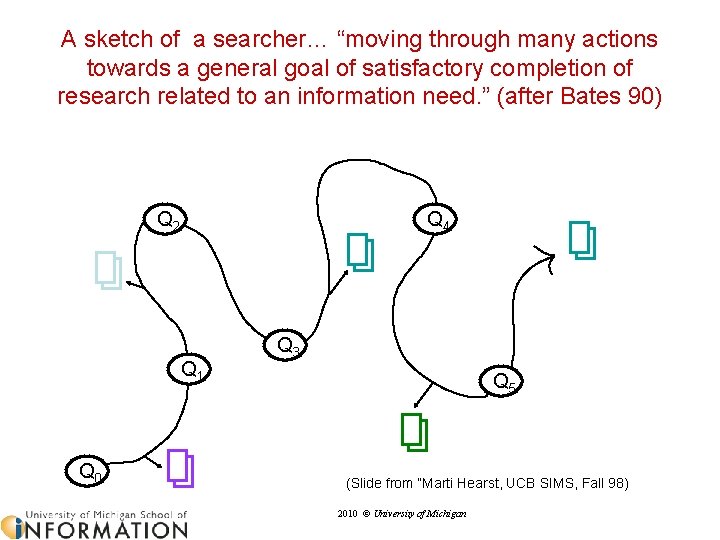
A sketch of a searcher… “moving through many actions towards a general goal of satisfactory completion of research related to an information need. ” (after Bates 90) Q 2 Q 4 Q 1 Q 0 Q 3 Q 5 (Slide from “Marti Hearst, UCB SIMS, Fall 98) 2010 © University of Michigan
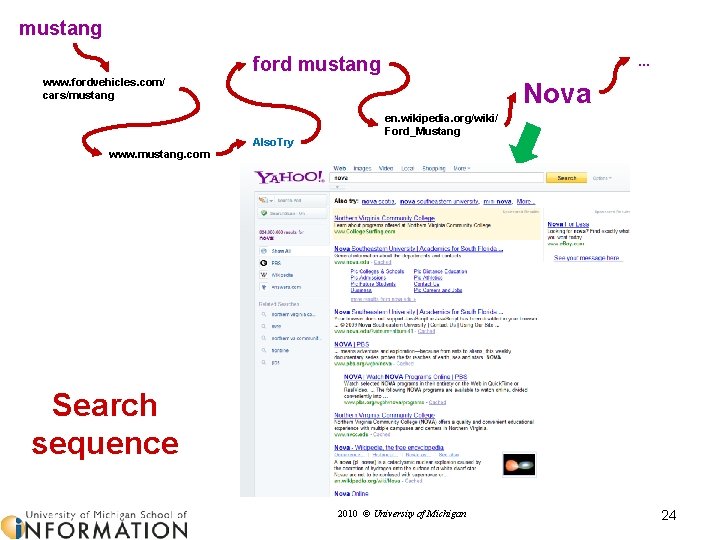
mustang … ford mustang www. fordvehicles. com/ cars/mustang www. mustang. com Nova Also. Try en. wikipedia. org/wiki/ Ford_Mustang Search sequence 2010 © University of Michigan 24
Query Session Detection • Roughly defined as queries that are submitted by the same user in a short period of time • Hypothesis: – Queries in the same session are related – Queries in the same session reflect the same mission/task, etc. – Queries in the same session reflect the “modification” relationship • How to segment query sequence into sessions? • Heuristic methods; Machine learning methods (hidden Markov models, conditional random fields, etc) 2010 © University of Michigan 25
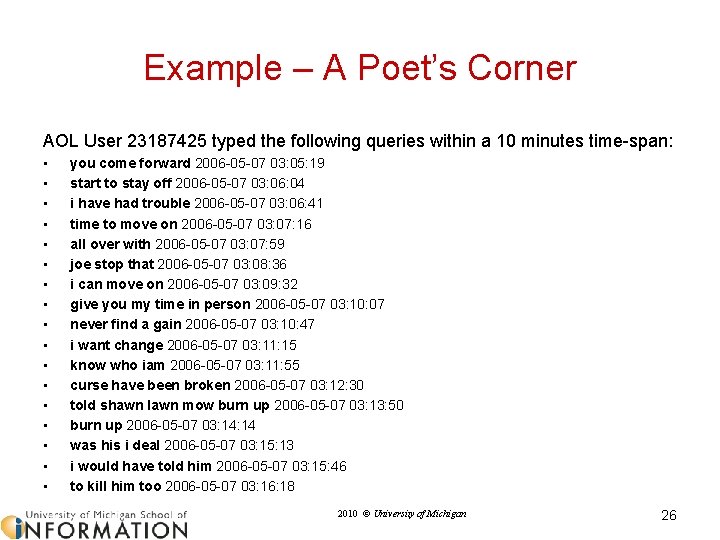
Example – A Poet’s Corner AOL User 23187425 typed the following queries within a 10 minutes time-span: • • • • • you come forward 2006 -05 -07 03: 05: 19 start to stay off 2006 -05 -07 03: 06: 04 i have had trouble 2006 -05 -07 03: 06: 41 time to move on 2006 -05 -07 03: 07: 16 all over with 2006 -05 -07 03: 07: 59 joe stop that 2006 -05 -07 03: 08: 36 i can move on 2006 -05 -07 03: 09: 32 give you my time in person 2006 -05 -07 03: 10: 07 never find a gain 2006 -05 -07 03: 10: 47 i want change 2006 -05 -07 03: 11: 15 know who iam 2006 -05 -07 03: 11: 55 curse have been broken 2006 -05 -07 03: 12: 30 told shawn lawn mow burn up 2006 -05 -07 03: 13: 50 burn up 2006 -05 -07 03: 14 was his i deal 2006 -05 -07 03: 15: 13 i would have told him 2006 -05 -07 03: 15: 46 to kill him too 2006 -05 -07 03: 16: 18 2010 © University of Michigan 26
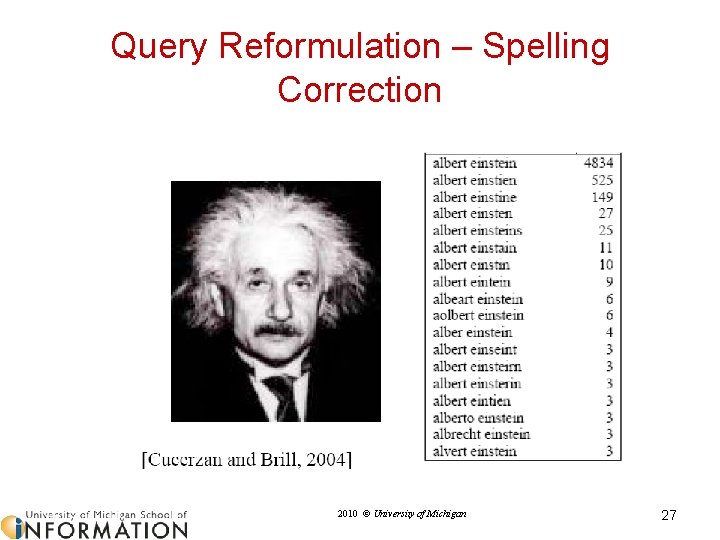
Query Reformulation – Spelling Correction 2010 © University of Michigan 27
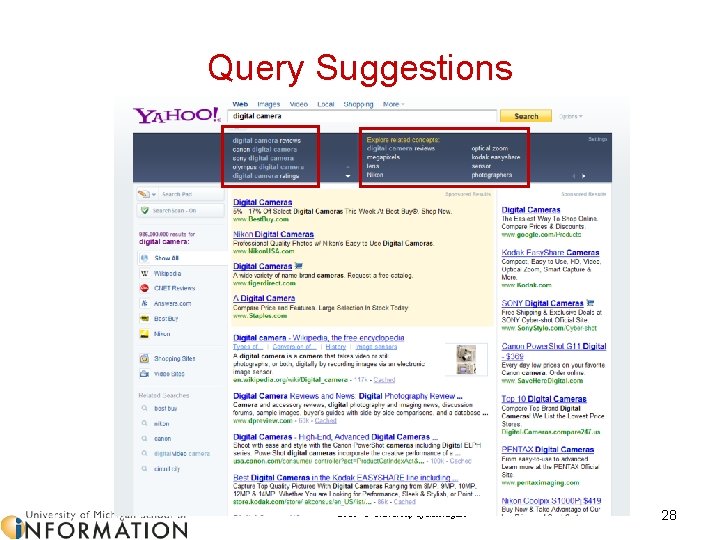
Query Suggestions 2010 © University of Michigan 28
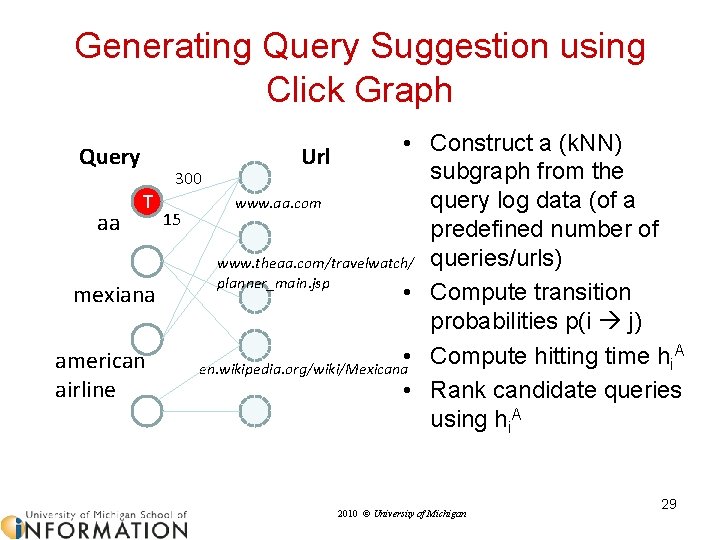
Generating Query Suggestion using Click Graph • Construct a (k. NN) Query Url subgraph from the 300 T query log data (of a www. aa. com 15 aa predefined number of www. theaa. com/travelwatch/ queries/urls) planner_main. jsp • Compute transition mexiana probabilities p(i j) A • Compute hitting time h american i en. wikipedia. org/wiki/Mexicana airline • Rank candidate queries using hi. A 2010 © University of Michigan 29
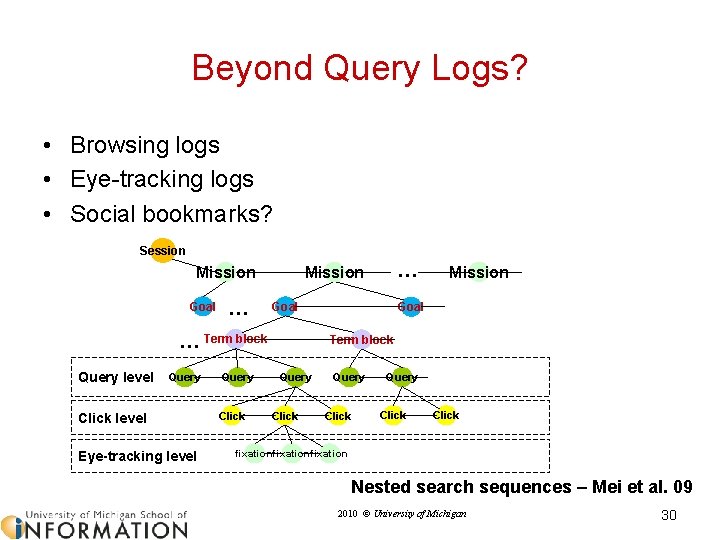
Beyond Query Logs? • Browsing logs • Eye-tracking logs • Social bookmarks? Session Mission Goal … Term block Query level Query Click level Eye-tracking level Query Click … Mission Goal Term block Query Click fixationfixation Nested search sequences – Mei et al. 09 2010 © University of Michigan 30
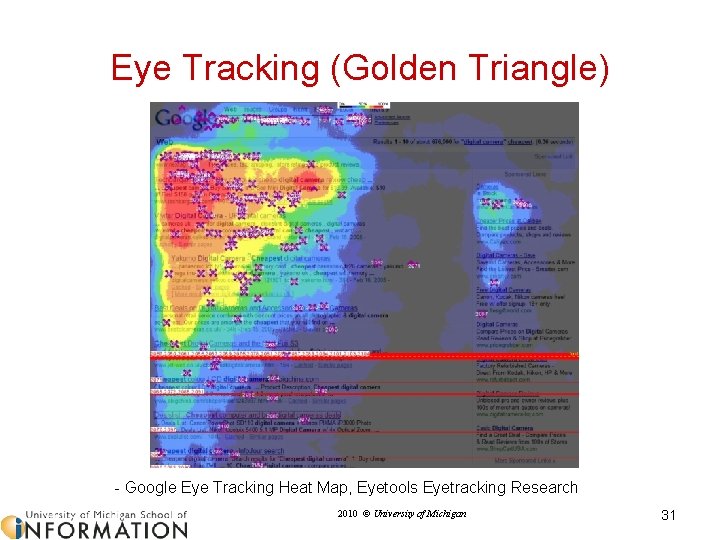
Eye Tracking (Golden Triangle) - Google Eye Tracking Heat Map, Eyetools Eyetracking Research 2010 © University of Michigan 31
Retriever • Standard IR models apply but aren’t sufficient – – Different information need (home page finding vs. topic-driven) Documents have additional information (hyperlinks, markups, URL) Information is often redundant and the quality varies a lot Server-side feedback is often not feasible • Major extensions – – – Exploiting links (anchor text, link-based scoring) Exploiting layout/markups (font, title field, etc. ) Spelling correction Spam filtering Redundancy elimination • In general, rely on machine learning to combine all kinds of features 2010 © University of Michigan 32
Learning to Rank • In a web search engine, relevance models like BM 25 is just one of the many features. How to balance the features? Tune parameters? - Machine learning! • Pointwise (e. g. , logistic regression) – Input: single documents – Output: scores or class labels • Pairwise (e. g. , Rank. SVM) – Input: document pairs – Output: partial order preference • Listwise (e. g. , Lambda. Rank) – Input: document collection – Output: ranked list of documents 2010 © University of Michigan 33
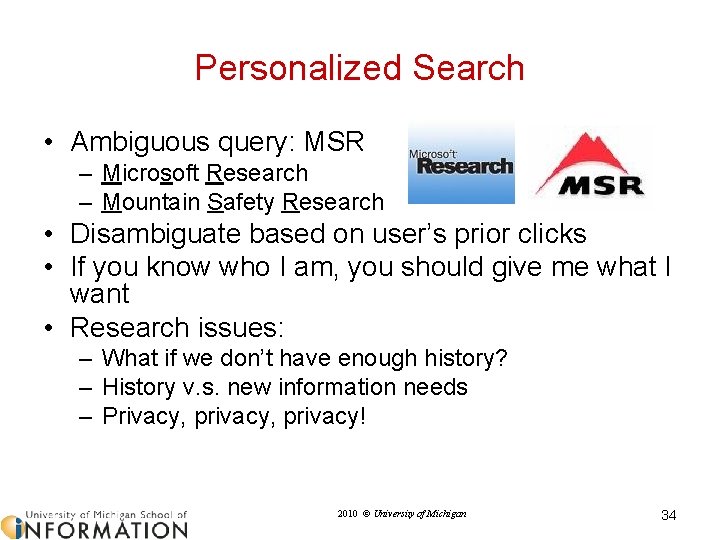
Personalized Search • Ambiguous query: MSR – Microsoft Research – Mountain Safety Research • Disambiguate based on user’s prior clicks • If you know who I am, you should give me what I want • Research issues: – What if we don’t have enough history? – History v. s. new information needs – Privacy, privacy! 2010 © University of Michigan 34
Computational Advertising • Main Challenge: – Find the "best match" between a given user in a given context and a suitable advertisement. • Examples – Context = WEB search query Sponsored search – Context = publisher page Content match, banners – Other contexts: mobile, video, newspapers, etc. 2010 © University of Michigan 35
Computational Advertising • A new scientific sub-discipline that provides the foundation for building online ad retrieval platforms – To wit: given a certain user in a certain context, find the most suitable ad • At the intersection of – – – Large scale text analysis Information retrieval Statistical modeling and machine learning Optimization Microeconomics 2010 © University of Michigan 36
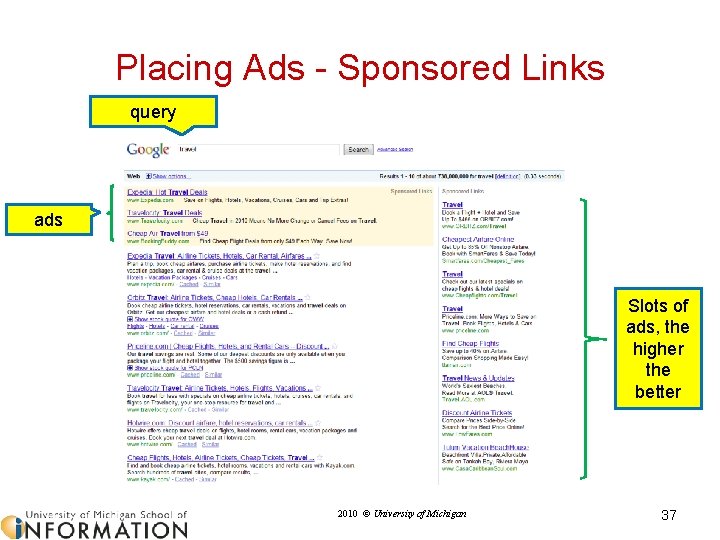
Placing Ads - Sponsored Links query ads Slots of ads, the higher the better 2010 © University of Michigan 37
Research Issues in Computational Advertising • How to price? How to charge? How to bid? How to encourage bidding? – CPM, CPC, CPT/CPA • How to evaluate? • How to order ads? What to optimize? – Revenue? – Relevance? – What else? • Exact match v. s. advanced match • Understanding the intent of queries • When to show ads, when not to show ads? 2010 © University of Michigan 38
Adversarial Information Retrieval • We looked at spamming in the context of Naïve Bayes • Let’s now consider spamming of hyperlinked IR • The main idea: artificially increase your in-degree/ pagerank, etc. • Question: How to increase your pagerank? • Link farms: groups of pages that point to each other. • Google penalizes sites that belong to link farms 2010 © University of Michigan 39
User Interfaces • Offer informative feedback • Reduce working memory load • Provide alternative interfaces for novice and expert users • Basic elements: – – Document selection Query specification Result examination Interaction support (feedback) • http: //searchuserinterfaces. com/book/ 2010 © University of Michigan 40
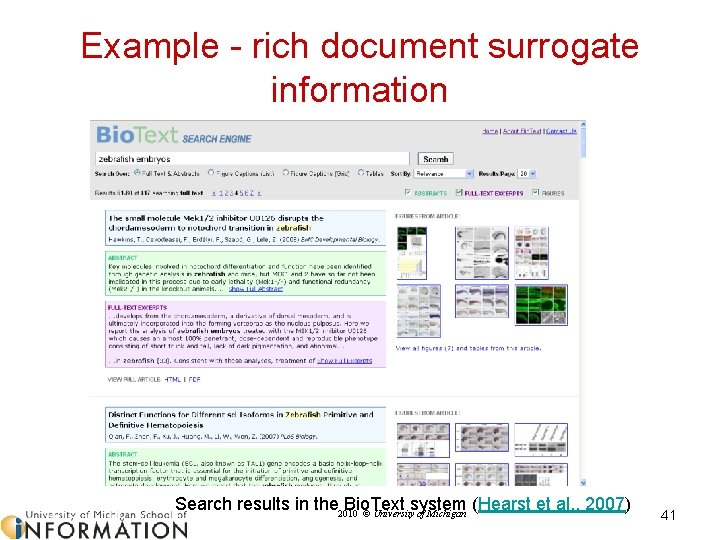
Example - rich document surrogate information Search results in the 2010 Bio. Text system (Hearst et al. , 2007) © University of Michigan 41
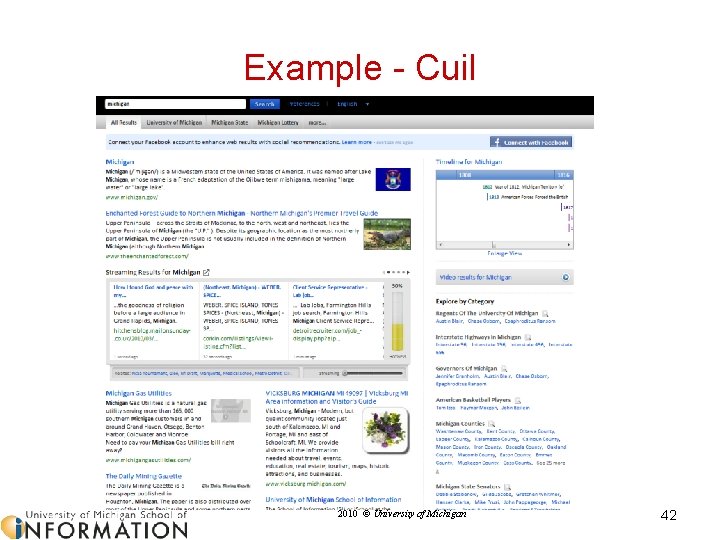
Example - Cuil 2010 © University of Michigan 42
Next Generation Search Engine? • Better support for query formulation – Allow querying from any task context – Query by examples – Automatic query generation (recommendation) • Better search accuracy – More accurate information need understanding (more personalization and context modeling) – More accurate document content understanding (more powerful content analysis) • More complex retrieval criteria – Consider multiple utility aspects of information items (e. g. , readability, quality, communication cost) – Consider collective value of information items (context-sensitive ranking) • Better result presentation – Better organization of search results to facilitate navigation – Better summarization • More effective and robust retrieval models – Automatic parameter tuning • More scalable retrieval architecture – P 2 P 2010 © University of Michigan 43
Next Generation Search Engines? • More specialized/customized – Special group of users (community engines, e. g. , Citeseer) – Personalized (better understanding of users) – Special genre/domain (better understanding of documents) • Learning over time (evolving) • Integration of search, navigation, and recommendation/filtering (full-fledged information management) • Beyond search to support tasks (e. g. , shopping) 2010 © University of Michigan 44
- Slides: 44