
Issues regarding effective use of ICT resources Module
- Slides: 13
Issues regarding effective use of ICT resources Module 3 Workshop 2
Focus Question Is ICT an opportunity or a burden? Opening Discussion: What is an information literate person?
Policy for managing information issues Many information-related issues or concerns are contentious § schools have not developed policy about such issues. n Policy provides guidance § required to ensure a consistent approach n Increasing impact of ICT integration § need for a well-articulated and understood information policy n n Key to successful policy is ownership by all stakeholders
Information Literacy “ the ability to locate, locate evaluate and effectively use the information needed for a particular purpose. Ultimately information literate people know how to learn They know how to learn because they know how information is organised, how to find information and how to use information in such a way that others can learn from them. ” (ALA Presidential Committee on Information Literacy 1989)
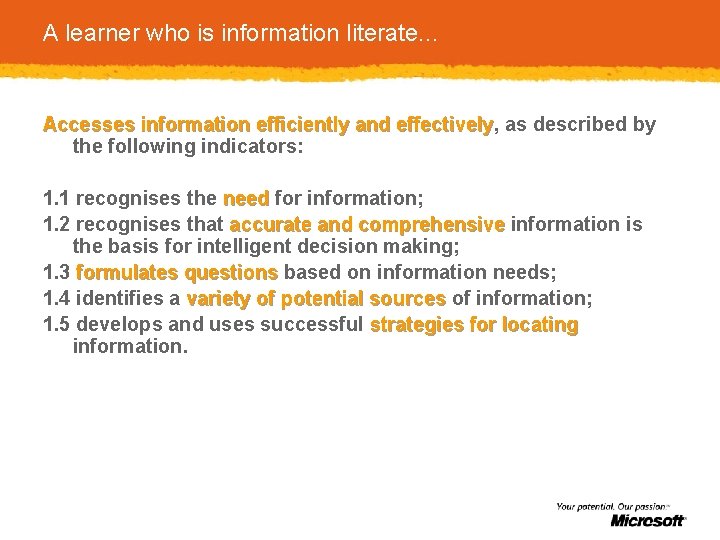
A learner who is information literate. . . Accesses information efficiently and effectively, effectively as described by the following indicators: 1. 1 recognises the need for information; 1. 2 recognises that accurate and comprehensive information is the basis for intelligent decision making; 1. 3 formulates questions based on information needs; 1. 4 identifies a variety of potential sources of information; 1. 5 develops and uses successful strategies for locating information.
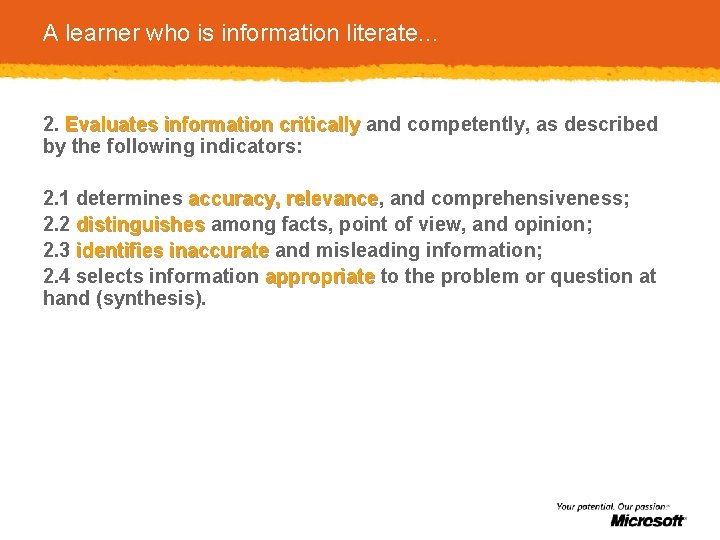
A learner who is information literate. . . 2. Evaluates information critically and competently, as described by the following indicators: 2. 1 determines accuracy, relevance and comprehensiveness; 2. 2 distinguishes among facts, point of view, and opinion; 2. 3 identifies inaccurate and misleading information; 2. 4 selects information appropriate to the problem or question at hand (synthesis).
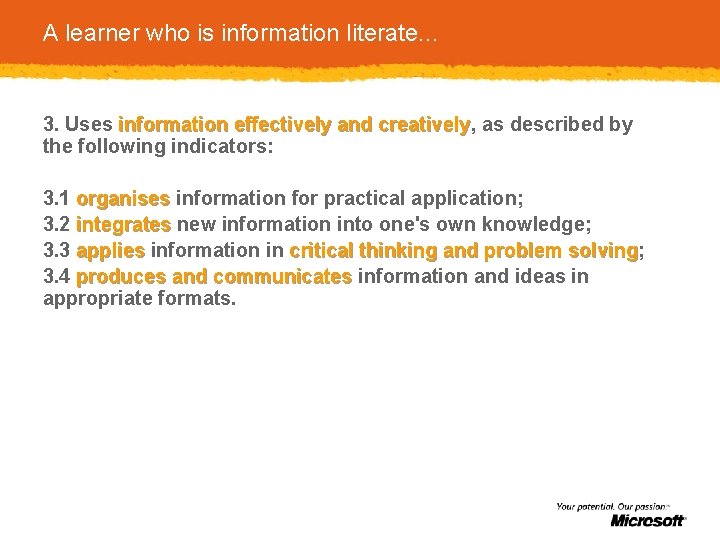
A learner who is information literate. . . 3. Uses information effectively and creatively, creatively as described by the following indicators: 3. 1 organises information for practical application; 3. 2 integrates new information into one's own knowledge; 3. 3 applies information in critical thinking and problem solving; solving 3. 4 produces and communicates information and ideas in appropriate formats.
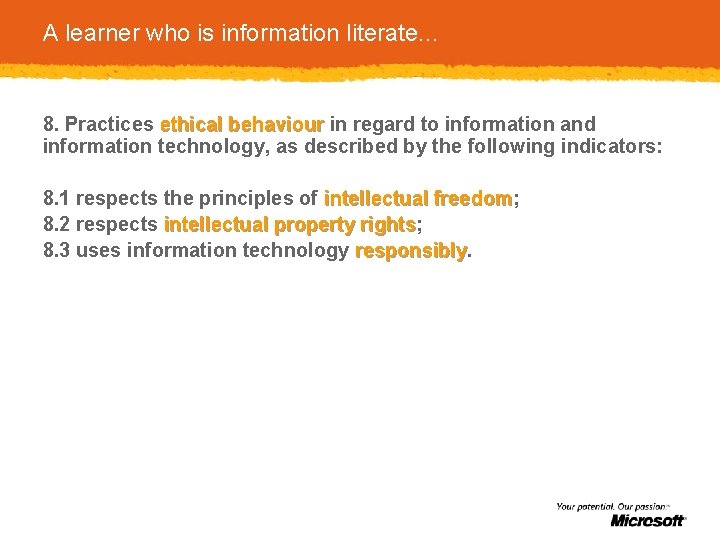
A learner who is information literate. . . 8. Practices ethical behaviour in regard to information and information technology, as described by the following indicators: 8. 1 respects the principles of intellectual freedom; freedom 8. 2 respects intellectual property rights; rights 8. 3 uses information technology responsibly
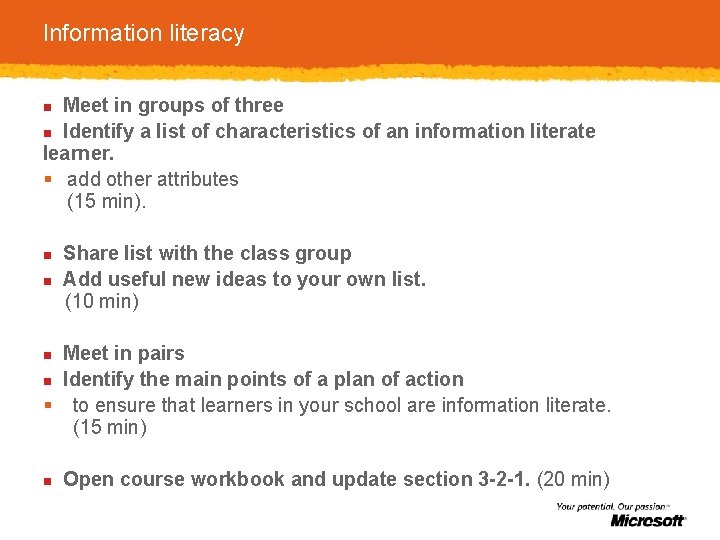
Information literacy Meet in groups of three n Identify a list of characteristics of an information literate learner. § add other attributes (15 min). n n n Share list with the class group Add useful new ideas to your own list. (10 min) Meet in pairs n Identify the main points of a plan of action § to ensure that learners in your school are information literate. (15 min) n n Open course workbook and update section 3 -2 -1. (20 min)
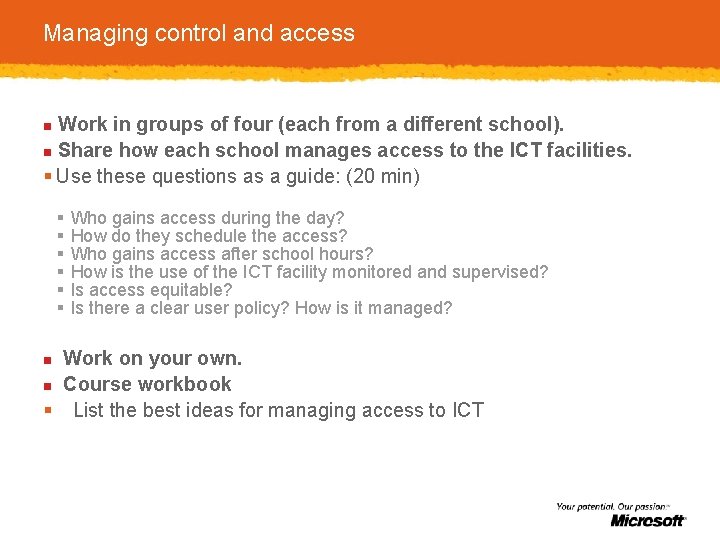
Managing control and access Work in groups of four (each from a different school). n Share how each school manages access to the ICT facilities. § Use these questions as a guide: (20 min) n § § § Who gains access during the day? How do they schedule the access? Who gains access after school hours? How is the use of the ICT facility monitored and supervised? Is access equitable? Is there a clear user policy? How is it managed? Work on your own. n Course workbook § List the best ideas for managing access to ICT n
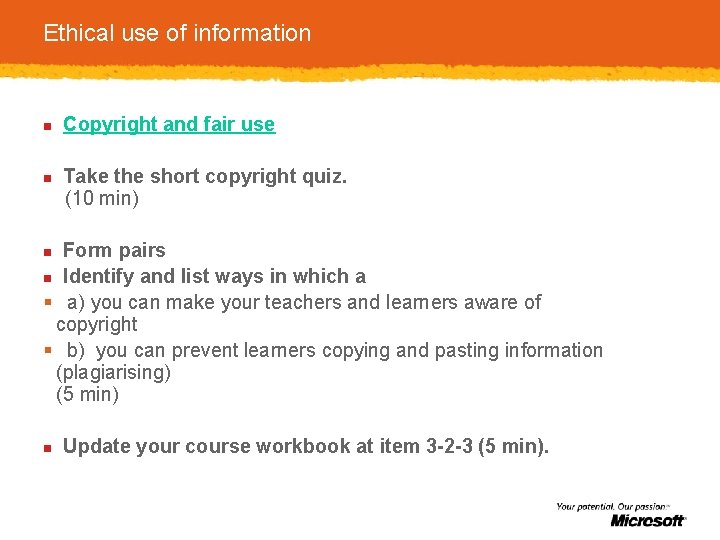
Ethical use of information n n Copyright and fair use Take the short copyright quiz. (10 min) Form pairs n Identify and list ways in which a § a) you can make your teachers and learners aware of copyright § b) you can prevent learners copying and pasting information (plagiarising) (5 min) n n Update your course workbook at item 3 -2 -3 (5 min).
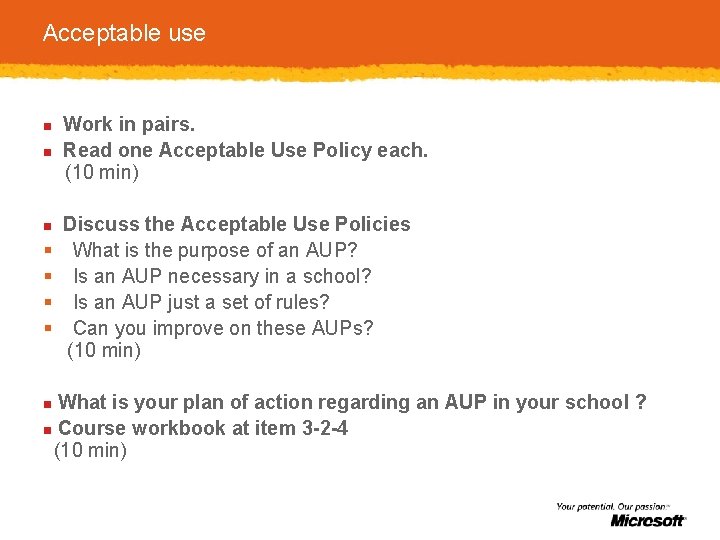
Acceptable use n n n § § Work in pairs. Read one Acceptable Use Policy each. (10 min) Discuss the Acceptable Use Policies What is the purpose of an AUP? Is an AUP necessary in a school? Is an AUP just a set of rules? Can you improve on these AUPs? (10 min) What is your plan of action regarding an AUP in your school ? n Course workbook at item 3 -2 -4 (10 min) n
Effective use of ICT n Questions to ask about effective use Work in groups of four. n Discuss what you would regard as effective use of ICT in your schools. (15 min) n Construct a list of indicators of effective use of ICT. § What would you need to see happening to know that ICT is being effectively used? (15 min) n n Update your course workbook.