
Issues of stakeholder engagement Who are the stakeholders
- Slides: 11
Issues of stakeholder engagement: Who are the stakeholders of disability and ICT related practice in post-secondary education and how can they be effectively engaged? Professor Jane Seale, Open University, UK
Aims / Buts • Orientate audience to the main aims of the Leverhulme-funded International Network on ICT, disability, post-secondary education and employment (Ed-ICT) • Provide an underpinning critical framework for the second symposium of this network in which we examine issues of stakeholder engagement
The Ed-ICT International Network / Réseau international • To explore the role that ICTs play or could play in creating barriers and mitigating disadvantages that students with disabilities in post-secondary education (PSE) experience • To examine how practices of educators and other stakeholders can craft successful and supportive relationships between learners with disabilities and ICT
The Ed-ICT International Network • Synthesise and compare the available research evidence across the five countries regarding the relationship between students with disabilities, ICTs and PSE • Construct theoretical explanations for why ICTs have not achieved the dramatic reductions in discrimination, disadvantage and exclusion hoped for • Provide new perspectives about potential future solutions regarding how PSE institutions can better use ICTs to remove the ongoing problems of disadvantage and exclusion of students with disabilities.
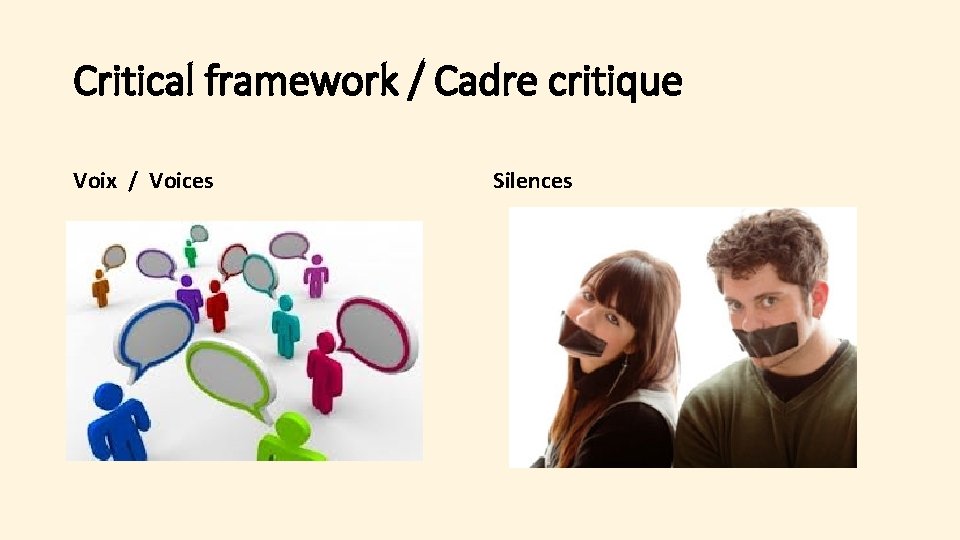
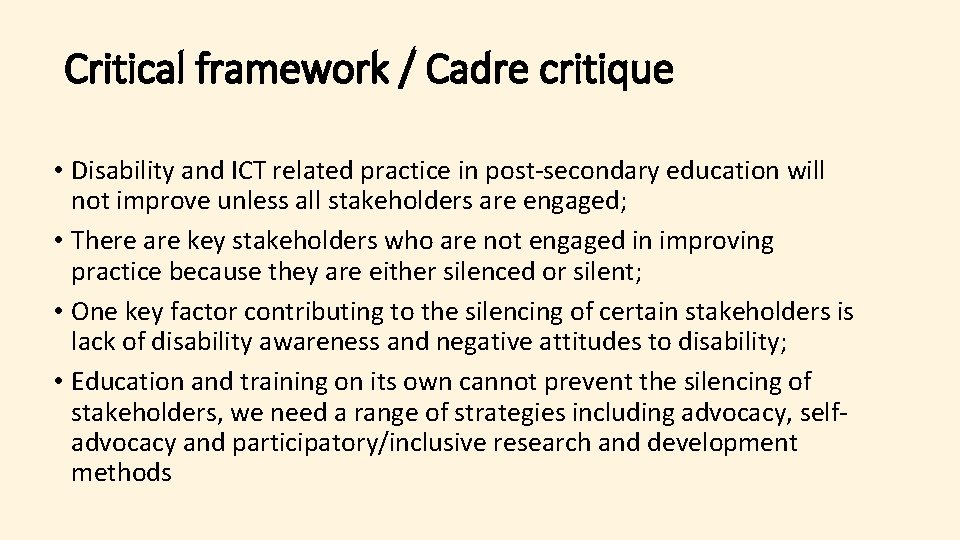
Critical framework / Cadre critique Voix / Voices Silences
Critical framework / Cadre critique • Disability and ICT related practice in post-secondary education will not improve unless all stakeholders are engaged; • There are key stakeholders who are not engaged in improving practice because they are either silenced or silent; • One key factor contributing to the silencing of certain stakeholders is lack of disability awareness and negative attitudes to disability; • Education and training on its own cannot prevent the silencing of stakeholders, we need a range of strategies including advocacy, selfadvocacy and participatory/inclusive research and development methods
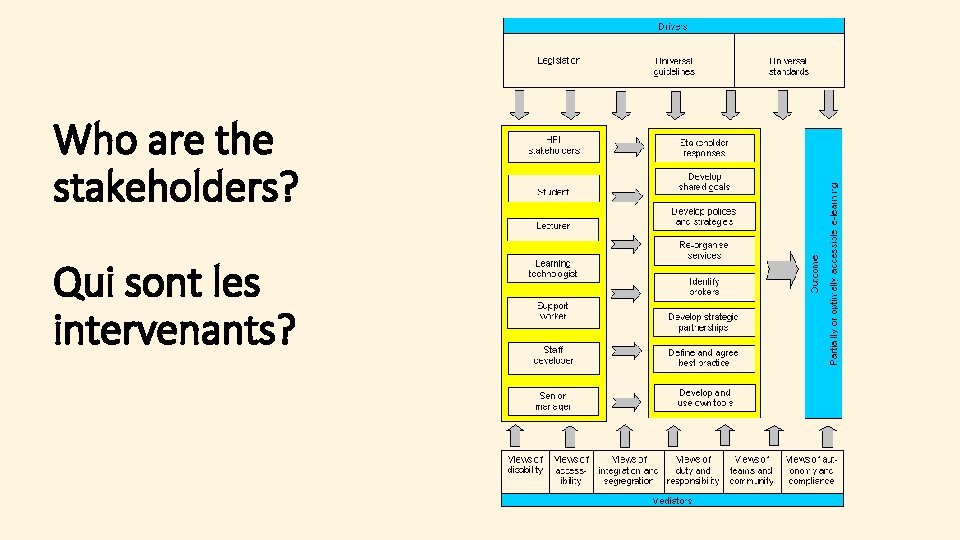
Who are the stakeholders? Qui sont les intervenants?
Which Stakeholders Voices Are Unheard? Quelles voix de parties prenantes sont ignorées? • Stakeholders external to an institution • Disabled staff within an institution • Disabled students who do not disclose • Other?
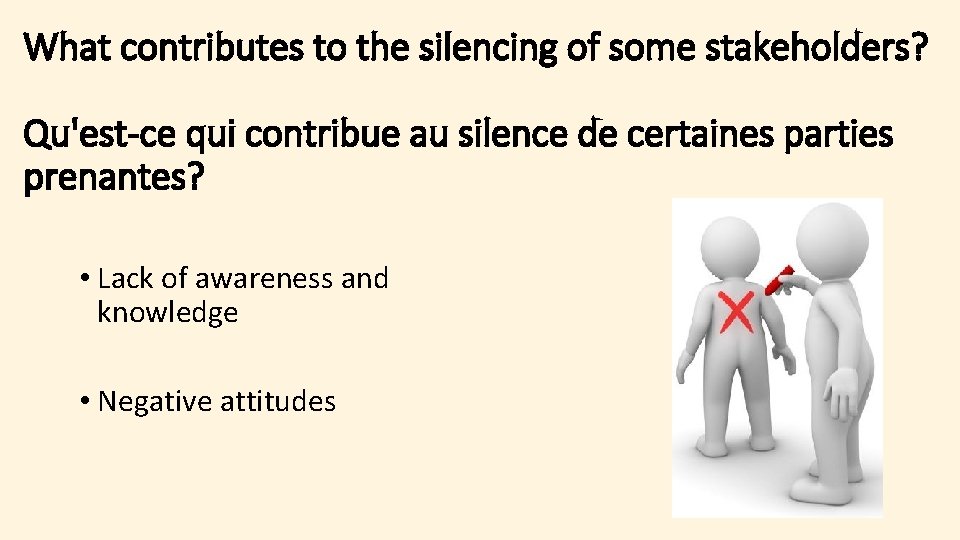
What contributes to the silencing of some stakeholders? Qu'est-ce qui contribue au silence de certaines parties prenantes? • Lack of awareness and knowledge • Negative attitudes
What can be done to amplify stakeholder voices? Que peut-on faire pour amplifier les voix des parties prenantes? • Education and Training …. But… • Advocacy … But… • Self-advocacy? • Participatory and Inclusive research?
Conclusion • We need to question those things that are ‘taken-for granted’ as truth or fact in the field in order to give voice to new possibilities and future directions in both our research and our practice.