
Issues in Foreign Language Learning through Computer Assisted
- Slides: 1
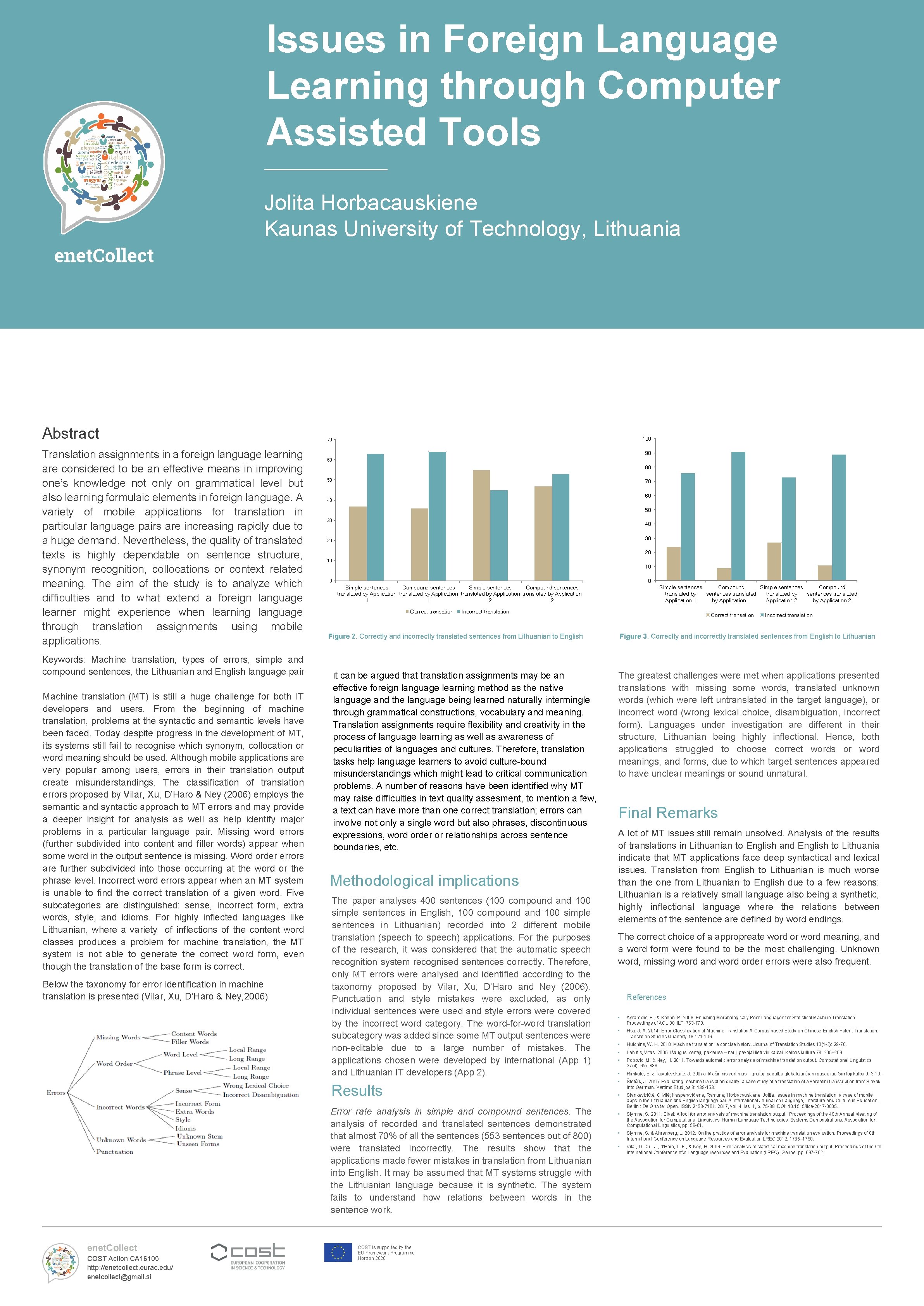
Issues in Foreign Language Learning through Computer Assisted Tools Jolita Horbacauskiene Kaunas University of Technology, Lithuania Abstract Translation assignments in a foreign language learning are considered to be an effective means in improving one’s knowledge not only on grammatical level but also learning formulaic elements in foreign language. A variety of mobile applications for translation in particular language pairs are increasing rapidly due to a huge demand. Nevertheless, the quality of translated texts is highly dependable on sentence structure, synonym recognition, collocations or context related meaning. The aim of the study is to analyze which difficulties and to what extend a foreign language learner might experience when learning language through translation assignments using mobile applications. Keywords: Machine translation, types of errors, simple and compound sentences, the Lithuanian and English language pair Machine translation (MT) is still a huge challenge for both IT developers and users. From the beginning of machine translation, problems at the syntactic and semantic levels have been faced. Today despite progress in the development of MT, its systems still fail to recognise which synonym, collocation or word meaning should be used. Although mobile applications are very popular among users, errors in their translation output create misunderstandings. The classification of translation errors proposed by Vilar, Xu, D’Haro & Ney (2006) employs the semantic and syntactic approach to MT errors and may provide a deeper insight for analysis as well as help identify major problems in a particular language pair. Missing word errors (further subdivided into content and filler words) appear when some word in the output sentence is missing. Word order errors are further subdivided into those occurring at the word or the phrase level. Incorrect word errors appear when an MT system is unable to find the correct translation of a given word. Five subcategories are distinguished: sense, incorrect form, extra words, style, and idioms. For highly inflected languages like Lithuanian, where a variety of inflections of the content word classes produces a problem for machine translation, the MT system is not able to generate the correct word form, even though the translation of the base form is correct. Below the taxonomy for error identification in machine translation is presented (Vilar, Xu, D’Haro & Ney, 2006) 100 70 90 60 80 50 70 60 40 50 30 40 30 20 20 10 10 0 0 Correct transation Incorrect translation It can be argued that translation assignments may be an effective foreign language learning method as the native language and the language being learned naturally intermingle through grammatical constructions, vocabulary and meaning. Translation assignments require flexibility and creativity in the process of language learning as well as awareness of peculiarities of languages and cultures. Therefore, translation tasks help language learners to avoid culture-bound misunderstandings which might lead to critical communication problems. A number of reasons have been identified why MT may raise difficulties in text quality assesment, to mention a few, a text can have more than one correct translation; errors can involve not only a single word but also phrases, discontinuous expressions, word order or relationships across sentence boundaries, etc. Methodological implications The paper analyses 400 sentences (100 compound and 100 simple sentences in English, 100 compound and 100 simple sentences in Lithuanian) recorded into 2 different mobile translation (speech to speech) applications. For the purposes of the research, it was considered that the automatic speech recognition system recognised sentences correctly. Therefore, only MT errors were analysed and identified according to the taxonomy proposed by Vilar, Xu, D’Haro and Ney (2006). Punctuation and style mistakes were excluded, as only individual sentences were used and style errors were covered by the incorrect word category. The word-for-word translation subcategory was added since some MT output sentences were non-editable due to a large number of mistakes. The applications chosen were developed by international (App 1) and Lithuanian IT developers (App 2). Error rate analysis in simple and compound sentences. The analysis of recorded and translated sentences demonstrated that almost 70% of all the sentences (553 sentences out of 800) were translated incorrectly. The results show that the applications made fewer mistakes in translation from Lithuanian into English. It may be assumed that MT systems struggle with the Lithuanian language because it is synthetic. The system fails to understand how relations between words in the sentence work. COST Action CA 16105 http: //enetcollect. eurac. edu/ enetcollect@gmail. si Correct transation Figure 2. Correctly and incorrectly translated sentences from Lithuanian to English Results enet. Collect Simple sentences Compound translated by sentences translated Application 1 by Application 1 Application 2 by Application 2 Simple sentences Compound sentences translated by Application 1 1 2 2 COST is supported by the EU Framework Programme Horizon 2020 Incorrect translation Figure 3. Correctly and incorrectly translated sentences from English to Lithuanian The greatest challenges were met when applications presented translations with missing some words, translated unknown words (which were left untranslated in the target language), or incorrect word (wrong lexical choice, disambiguation, incorrect form). Languages under investigation are different in their structure, Lithuanian being highly inflectional. Hence, both applications struggled to choose correct words or word meanings, and forms, due to which target sentences appeared to have unclear meanings or sound unnatural. Final Remarks A lot of MT issues still remain unsolved. Analysis of the results of translations in Lithuanian to English and English to Lithuania indicate that MT applications face deep syntactical and lexical issues. Translation from English to Lithuanian is much worse than the one from Lithuanian to English due to a few reasons: Lithuanian is a relatively small language also being a synthetic, highly inflectional language where the relations between elements of the sentence are defined by word endings. The correct choice of a appropreate word or word meaning, and a word form were found to be the most challenging. Unknown word, missing word and word order errors were also frequent. References • Avramidis, E. , & Koehn, P. 2008. Enriching Morphologically Poor Languages for Statistical Machine Translation. Proceedings of ACL 08 HLT: 763 -770. • Hsu, J. A. 2014. Error Classification of Machine Translation A Corpus-based Study on Chinese-English Patent Translation Studies Quarterly 18: 121 -136 • Hutchins, W. H. 2010. Machine translation: a concise history. Journal of Translation Studies 13(1 -2): 29 -70. • Labutis, Vitas. 2005. Išaugusi vertėjų paklausa – nauji pavojai lietuviu kalbai. Kalbos kultura 78: 205– 209. • Popović, M. & Ney, H. 2011. Towards automatic error analysis of machine translation output. Computational Linguistics 37(4): 657 -688. • Rimkutė, E. & Kovalevskaitė, J. 2007 a. Mašininis vertimas – greitoji pagalba globalėjančiam pasauliui. Gimtoji kalba 9: 3 -10. • Štefčík, J. 2015. Evaluating machine translation quality: a case study of a translation of a verbatim transcription from Slovak into Gerrman. Vertimo Studijos 8: 139 -153. • Stankevičiūtė, Gilvilė; Kasperavičienė, Ramunė; Horbačauskienė, Jolita. Issues in machine translation: a case of mobile apps in the Lithuanian and English language pair // International Journal on Language, Literature and Culture in Education. Berlin : De Gruyter Open. ISSN 2453 -7101. 2017, vol. 4, iss. 1, p. 75 -88. DOI: 10. 1515/llce-2017 -0005. • Stymne, S. 2011. Blast: A tool for error analysis of machine translation output. Proceedings of the 49 th Annual Meeting of the Association for Computational Linguistics: Human Language Technologies: Systems Demonstrations. Association for Computational Linguistics, pp. 56 -61. • Stymne, S. & Ahrenberg, L. 2012. On the practice of error analysis for machine translation evaluation. Proceedings of 8 th International Conference on Language Resources and Evaluation LREC 2012: 1785– 1790. • Vilar, D. , Xu, J. , d’Haro, L. F. , & Ney, H. 2006. Error analysis of statistical machine translation output. Proceedings of the 5 th international Conference ofn Language resources and Evaluation (LREC). Genoe, pp. 697 -702.