
Issues Common to All Teaching Styles 2 The
- Slides: 12
Issues Common to All Teaching Styles 2 The Demonstration • Mosston, M. (2002) Teaching Physical Education Fifth Edition, Pearson, San Francisco, CA, Ch. 11. ** Kizer, D, Piper, D, Sauter , W. (1984). A Practical Approach to Teaching Physical Education, Ithaca, NY, Movement Publications Inc. pp. 94 ***Weiss, M. , Ebbeck, V. , and Wiese-Bjornstal D. , (1993) Developmental and Psychological Factors Related to Children’s Observational Learning of Physical Skills, Pedriatirc Exercise Science, 5, 301 -7
*Demonstration 1. Primarily used in reproductive style Why is it inappropriate to demonstrate in the productive style? - focus of production is creation - information is new to learner, sometimes teacher and society
2. Provides the model (image of the content) 3. Reasons to demonstrate: a) image to replicate b) clarification 4. All reproductive styles use demonstration to communicate both content and behaviour expectations- the what (skill, cues) and the how 5. Learner’s role is to observe and listen
**Guidelines for Demonstrations • primarily associated with presenting movement or skills • important for “correct” performance or specific principles common to all • must be accurate and well-performed
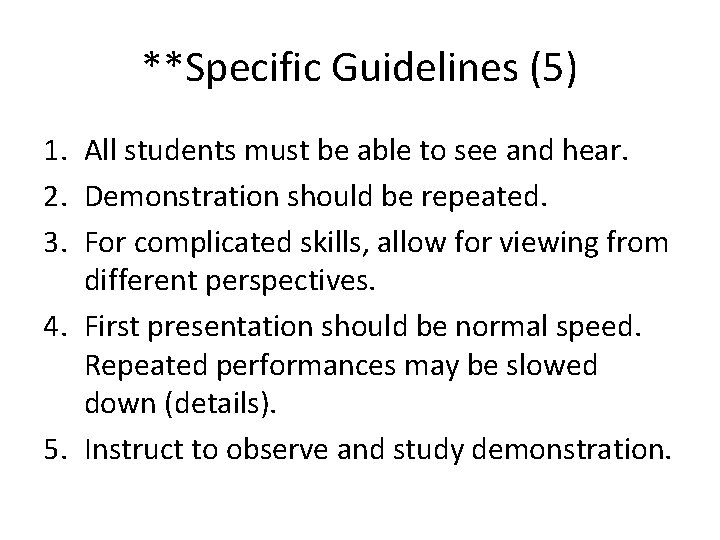
**Specific Guidelines (5) 1. All students must be able to see and hear. 2. Demonstration should be repeated. 3. For complicated skills, allow for viewing from different perspectives. 4. First presentation should be normal speed. Repeated performances may be slowed down (details). 5. Instruct to observe and study demonstration.
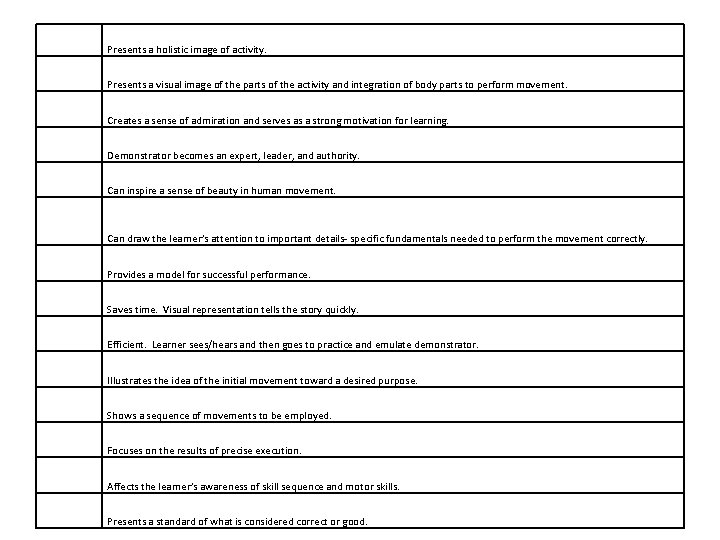
*Characteristics of a Strong Demonstration pp. 200 in text Handout
Presents a holistic image of activity. Presents a visual image of the parts of the activity and integration of body parts to perform movement. Creates a sense of admiration and serves as a strong motivation for learning. Demonstrator becomes an expert, leader, and authority. Can inspire a sense of beauty in human movement. Can draw the learner’s attention to important details- specific fundamentals needed to perform the movement correctly. Provides a model for successful performance. Saves time. Visual representation tells the story quickly. Efficient. Learner sees/hears and then goes to practice and emulate demonstrator. Illustrates the idea of the initial movement toward a desired purpose. Shows a sequence of movements to be employed. Focuses on the results of precise execution. Affects the learner’s awareness of skill sequence and motor skills. Presents a standard of what is considered correct or good.
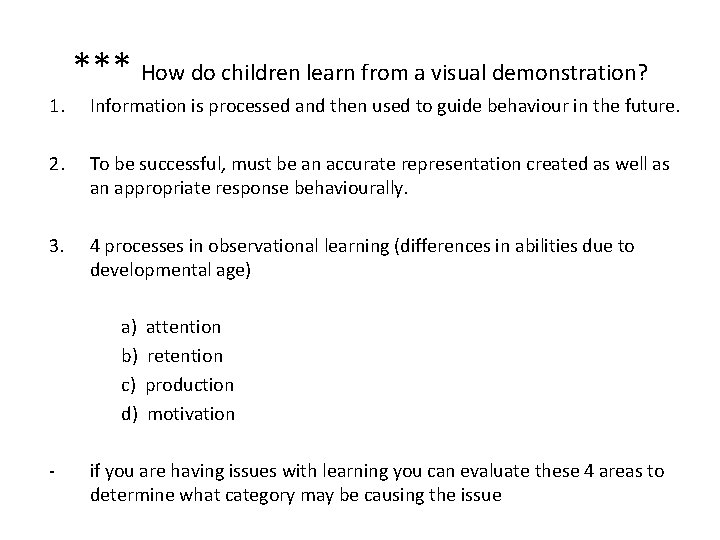
*** How do children learn from a visual demonstration? 1. Information is processed and then used to guide behaviour in the future. 2. To be successful, must be an accurate representation created as well as an appropriate response behaviourally. 3. 4 processes in observational learning (differences in abilities due to developmental age) a) b) c) d) - attention retention production motivation if you are having issues with learning you can evaluate these 4 areas to determine what category may be causing the issue
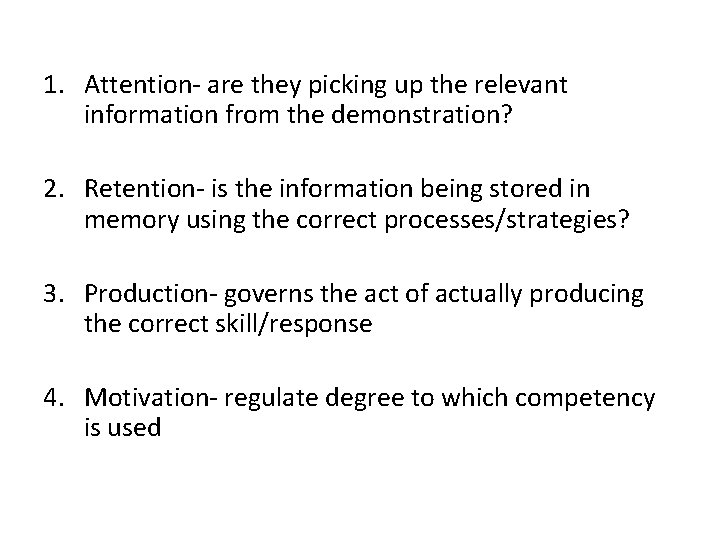
1. Attention- are they picking up the relevant information from the demonstration? 2. Retention- is the information being stored in memory using the correct processes/strategies? 3. Production- governs the act of actually producing the correct skill/response 4. Motivation- regulate degree to which competency is used
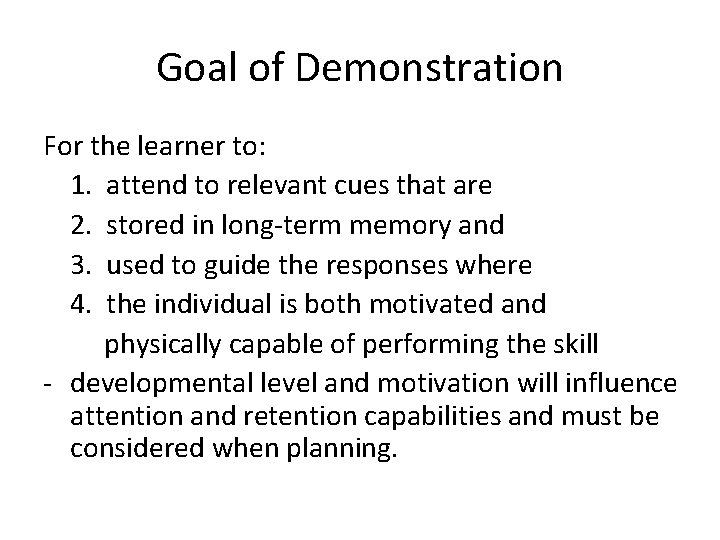
Goal of Demonstration For the learner to: 1. attend to relevant cues that are 2. stored in long-term memory and 3. used to guide the responses where 4. the individual is both motivated and physically capable of performing the skill - developmental level and motivation will influence attention and retention capabilities and must be considered when planning.
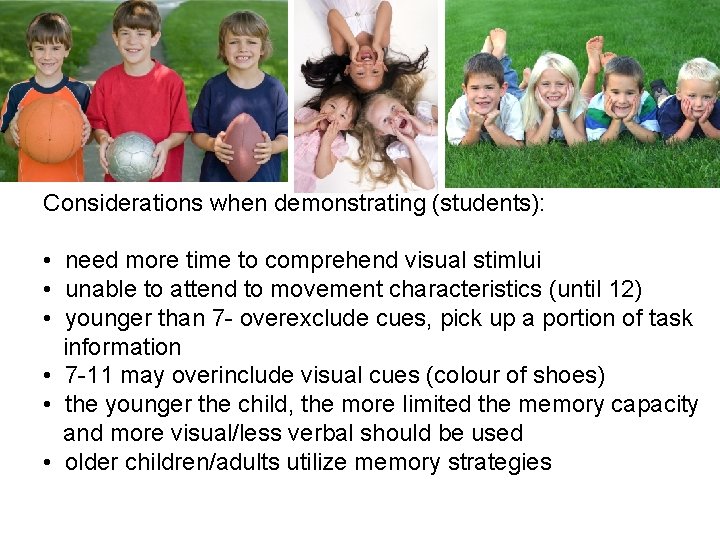
Considerations when demonstrating (students): • need more time to comprehend visual stimlui • unable to attend to movement characteristics (until 12) • younger than 7 - overexclude cues, pick up a portion of task information • 7 -11 may overinclude visual cues (colour of shoes) • the younger the child, the more limited the memory capacity and more visual/less verbal should be used • older children/adults utilize memory strategies
Challenge in teaching • Creating demonstrations which catch their attention and meet their developmental needs.