
Issues and Problems in Translation Lecture 1 What
Issues and Problems in Translation Lecture 1
What is Translation? Throughout the history of translation studies, hundreds of theorists have pointed out various kinds of definitions for translation. They defined translation from the perspectives of object, character, purpose, role, etc. The concept of translation, therefore, is constantly developing and improving. True or False?
What is Translation? According to Dictionary of Translation Studies, translation is an extraordinarily broad notion and can be comprehended in many different respects: • One may talk of translation as a process or a product, and identify such sub-types as literary translation, technical translation, SUBTITLING and MACHINE TRANSLATION; moreover, while more typically it just refers to the transfer of written texts, the term sometimes also includes INTERPRETING (Shuttleworth & Cowie, 1997, 2004, p. 181).
What is Translation? The Linguistic paradigm • Nida's definition • “The closest natural equivalent of the source-language message, first in terms of meaning and secondly in terms of style” (Nida, 1964, p. 12)
What is Translation? The Cultural paradigm • Lefevere's definition • “translation is, of course, a rewriting of an original text” (Lefevere, 1992, 2004 a, p. xii).
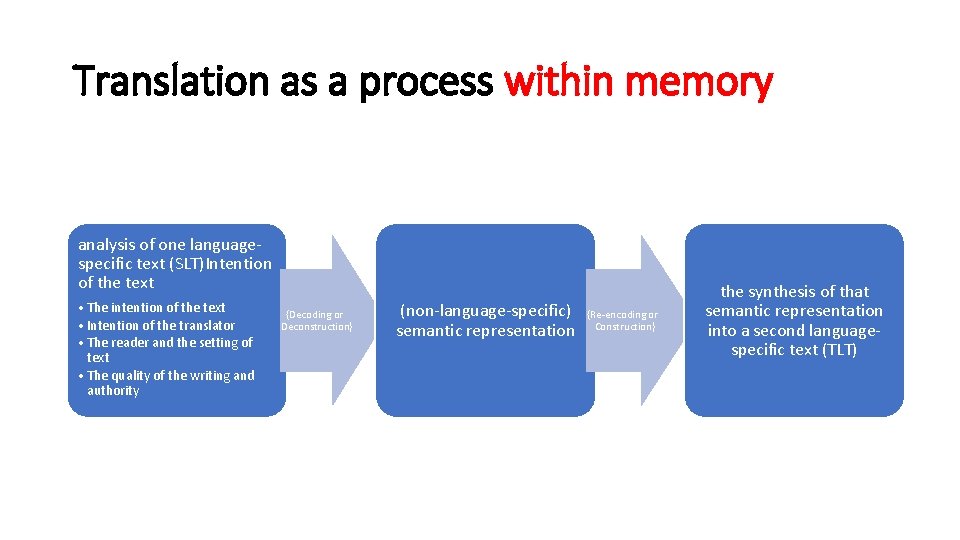
Translation as a process within memory analysis of one languagespecific text (SLT)Intention of the text • The intention of the text • Intention of the translator • The reader and the setting of text • The quality of the writing and authority {Decoding or Deconstruction} (non-language-specific) semantic representation {Re-encoding or Construction} the synthesis of that semantic representation into a second languagespecific text (TLT)

Translation process requires the following steps (the task or the role of the translator): 1. Comprehension of the source text: 1. Knowledge of the source language: 1. 2. 3. Knowing the lexicon. Knowing its syntactic rules. Knowing the text creating system. 2. knowledge of the world: 1. 2. General Knowledge. Specialized knowledge. 2. Extracting the meaning of the source text. 3. Re-expressing the meaning into the target language
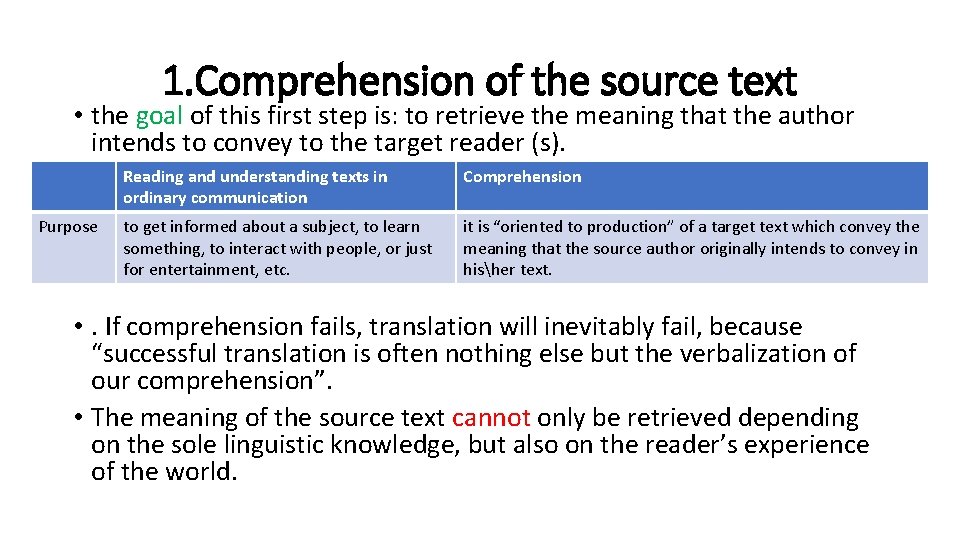
1. Comprehension of the source text • the goal of this first step is: to retrieve the meaning that the author intends to convey to the target reader (s). Purpose Reading and understanding texts in ordinary communication Comprehension to get informed about a subject, to learn something, to interact with people, or just for entertainment, etc. it is “oriented to production” of a target text which convey the meaning that the source author originally intends to convey in hisher text. • . If comprehension fails, translation will inevitably fail, because “successful translation is often nothing else but the verbalization of our comprehension”. • The meaning of the source text cannot only be retrieved depending on the sole linguistic knowledge, but also on the reader’s experience of the world.
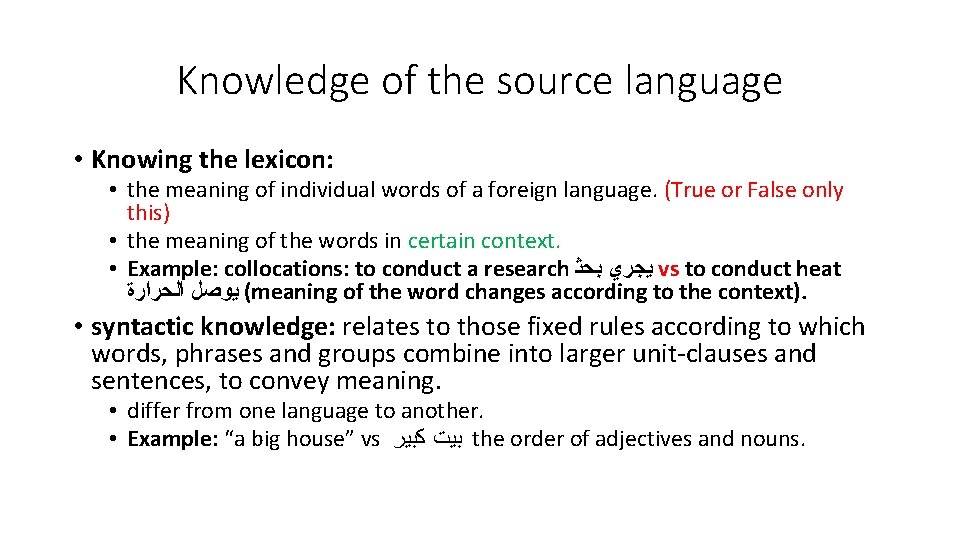
Knowledge of the source language • Knowing the lexicon: • the meaning of individual words of a foreign language. (True or False only this) • the meaning of the words in certain context. • Example: collocations: to conduct a research ﻳﺠﺮﻱ ﺑﺤﺜ vs to conduct heat ( ﻳﻮﺻﻞ ﺍﻟﺤﺮﺍﺭﺓ meaning of the word changes according to the context). • syntactic knowledge: relates to those fixed rules according to which words, phrases and groups combine into larger unit-clauses and sentences, to convey meaning. • differ from one language to another. • Example: “a big house” vs ﺑﻴﺖ ﻛﺒﻴﺮ the order of adjectives and nouns.
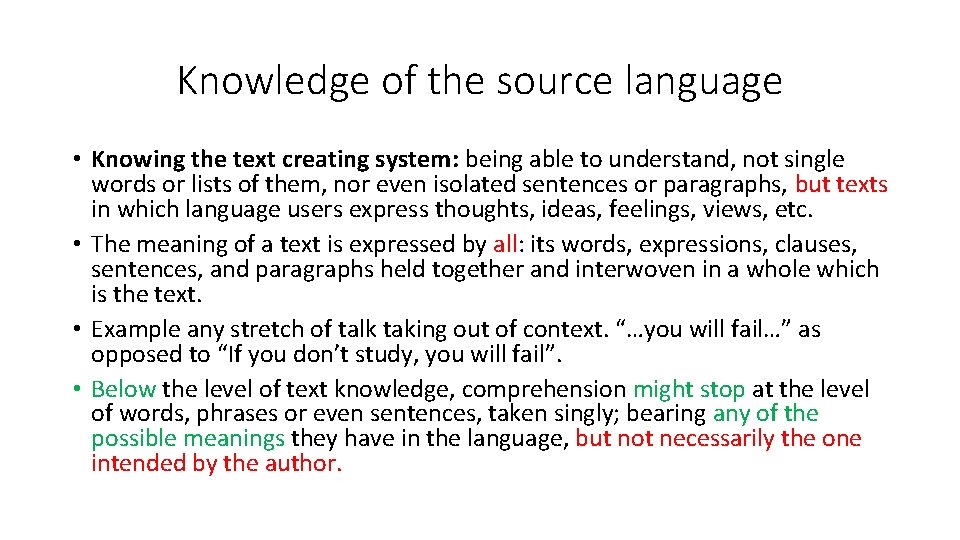
Knowledge of the source language • Knowing the text creating system: being able to understand, not single words or lists of them, nor even isolated sentences or paragraphs, but texts in which language users express thoughts, ideas, feelings, views, etc. • The meaning of a text is expressed by all: its words, expressions, clauses, sentences, and paragraphs held together and interwoven in a whole which is the text. • Example any stretch of talk taking out of context. “…you will fail…” as opposed to “If you don’t study, you will fail”. • Below the level of text knowledge, comprehension might stop at the level of words, phrases or even sentences, taken singly; bearing any of the possible meanings they have in the language, but not necessarily the one intended by the author.
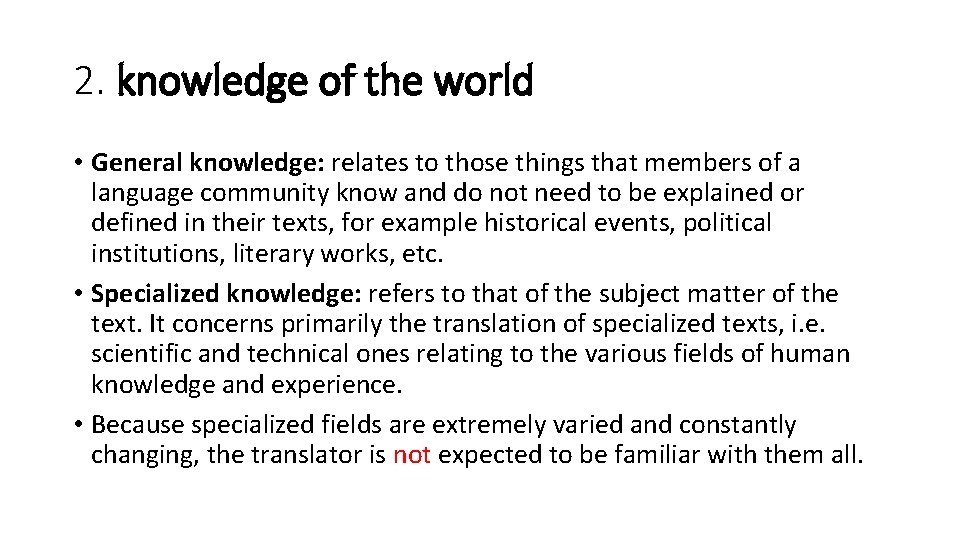
2. knowledge of the world • General knowledge: relates to those things that members of a language community know and do not need to be explained or defined in their texts, for example historical events, political institutions, literary works, etc. • Specialized knowledge: refers to that of the subject matter of the text. It concerns primarily the translation of specialized texts, i. e. scientific and technical ones relating to the various fields of human knowledge and experience. • Because specialized fields are extremely varied and constantly changing, the translator is not expected to be familiar with them all.
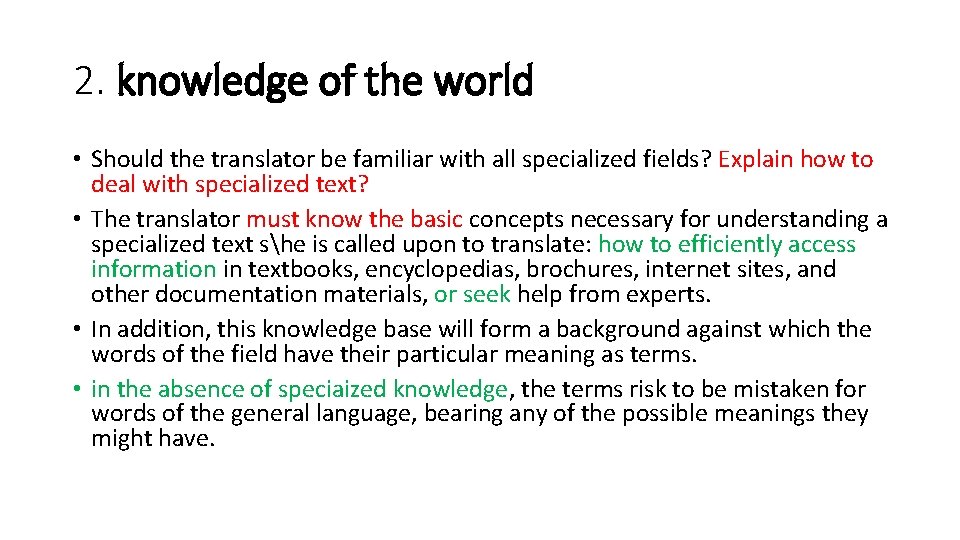
2. knowledge of the world • Should the translator be familiar with all specialized fields? Explain how to deal with specialized text? • The translator must know the basic concepts necessary for understanding a specialized text she is called upon to translate: how to efficiently access information in textbooks, encyclopedias, brochures, internet sites, and other documentation materials, or seek help from experts. • In addition, this knowledge base will form a background against which the words of the field have their particular meaning as terms. • in the absence of speciaized knowledge, the terms risk to be mistaken for words of the general language, bearing any of the possible meanings they might have.
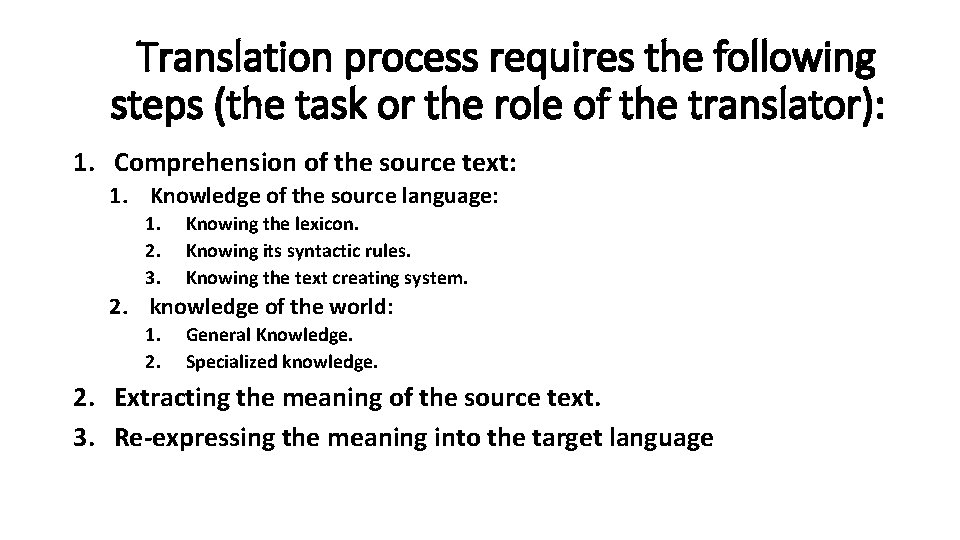
Translation process requires the following steps (the task or the role of the translator): 1. Comprehension of the source text: 1. Knowledge of the source language: 1. 2. 3. Knowing the lexicon. Knowing its syntactic rules. Knowing the text creating system. 2. knowledge of the world: 1. 2. General Knowledge. Specialized knowledge. 2. Extracting the meaning of the source text. 3. Re-expressing the meaning into the target language
2. Extracting the meaning of the source text. • This step is an intermediary one linking the two major phases of the process. • It represents the culmination point of comprehension while it constitutes the starting point for re-expressing the meaning into the target language. • In this step, after reading and analyzing the source text, the intended meaning is supposed to be dissociated from the SL form so that what remains in the mind of the translator is not the SL words, phrases or even sentences, but a mental image, or a ‘semantic representation. ’ Of what has been conveyed in the text.
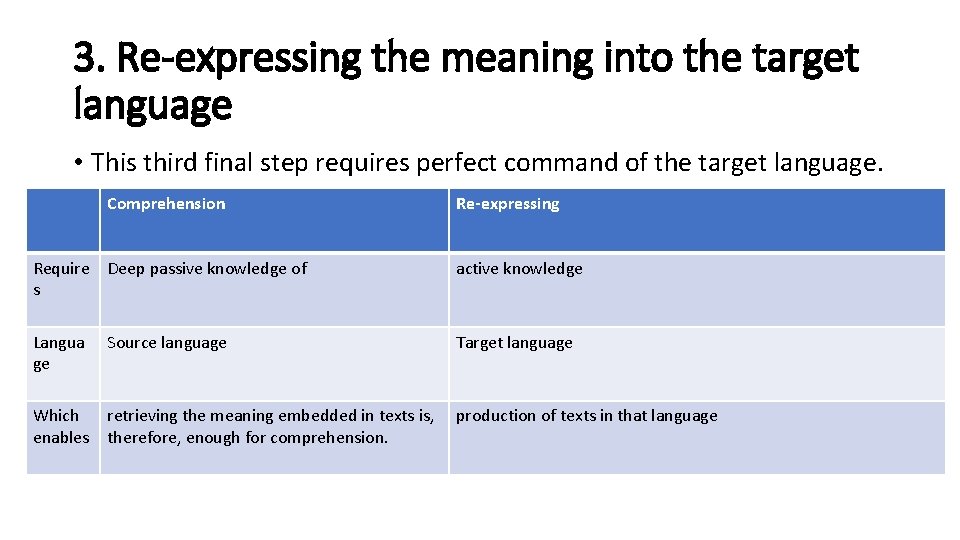
3. Re-expressing the meaning into the target language • This third final step requires perfect command of the target language. Comprehension Re-expressing Require Deep passive knowledge of s active knowledge Langua ge Target language Source language Which retrieving the meaning embedded in texts is, enables therefore, enough for comprehension. production of texts in that language
3. Re-expressing the meaning into the target language • This final step is not a matter of simply expressing the meaning into the target language, but re-expressing it. Explain: • The translator is not a ‘sovereign writer’ who expresses hisher own ideas in hisher own words and styles, she rather reformulates ‘the product of someone else’s thoughts, reasoning, priorities and objectives.
Success of translation: For the success of translation, four requirements are to be fulfilled: • Making sense. • Displaying the spirit and manner of the original. • The translated document has a natural and easy form of expression. • The translated document produces a similar response.
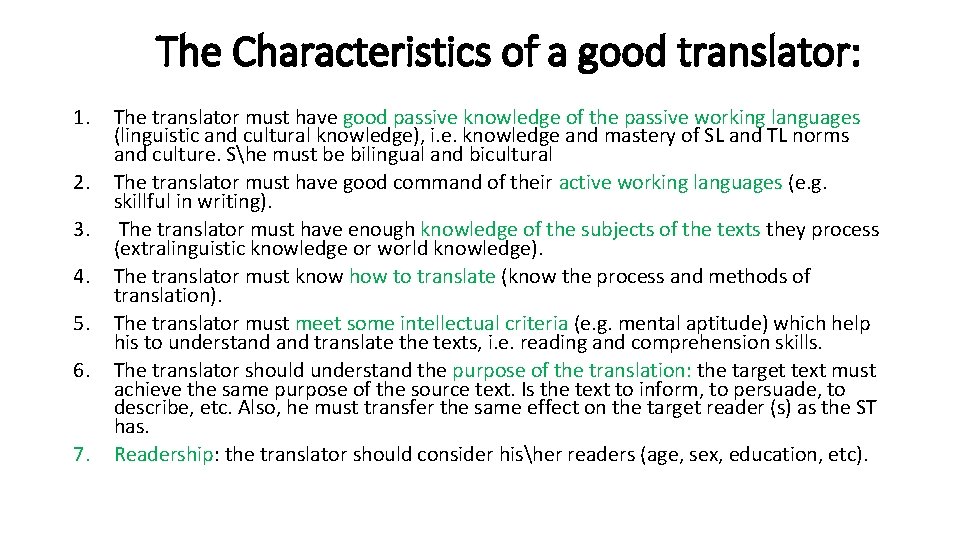
The Characteristics of a good translator: 1. 2. 3. 4. 5. 6. 7. The translator must have good passive knowledge of the passive working languages (linguistic and cultural knowledge), i. e. knowledge and mastery of SL and TL norms and culture. She must be bilingual and bicultural The translator must have good command of their active working languages (e. g. skillful in writing). The translator must have enough knowledge of the subjects of the texts they process (extralinguistic knowledge or world knowledge). The translator must know how to translate (know the process and methods of translation). The translator must meet some intellectual criteria (e. g. mental aptitude) which help his to understand translate the texts, i. e. reading and comprehension skills. The translator should understand the purpose of the translation: the target text must achieve the same purpose of the source text. Is the text to inform, to persuade, to describe, etc. Also, he must transfer the same effect on the target reader (s) as the ST has. Readership: the translator should consider hisher readers (age, sex, education, etc).
- Slides: 18