
Issue Resolution Process Project Update Client and Family

- Slides: 8
Issue Resolution Process Project Update Client and Family Leadership Committee Meeting, September 14, 2018 Brian R. Sala, Ph. D.
Goals ■ Solicit feedback on key framing questions for report outline ■ Our goal today is to re-introduce you to the project and to invite your ongoing feedback as SMEs ■ We expect to follow up in the next month with the Chair and subcommittee with a draft report 2
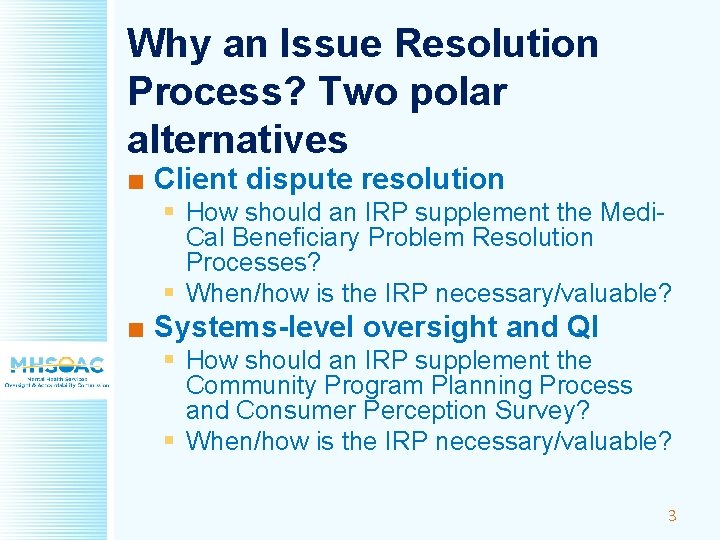
Why an Issue Resolution Process? Two polar alternatives ■ Client dispute resolution § How should an IRP supplement the Medi. Cal Beneficiary Problem Resolution Processes? § When/how is the IRP necessary/valuable? ■ Systems-level oversight and QI § How should an IRP supplement the Community Program Planning Process and Consumer Perception Survey? § When/how is the IRP necessary/valuable? 3
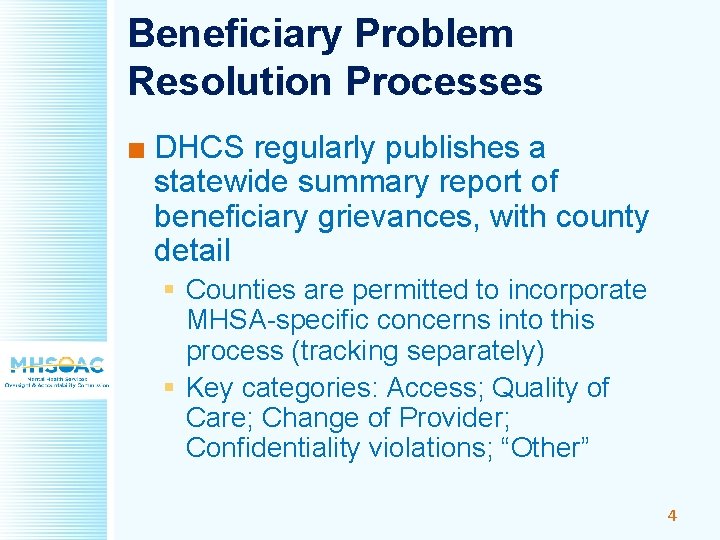
Beneficiary Problem Resolution Processes ■ DHCS regularly publishes a statewide summary report of beneficiary grievances, with county detail § Counties are permitted to incorporate MHSA-specific concerns into this process (tracking separately) § Key categories: Access; Quality of Care; Change of Provider; Confidentiality violations; “Other” 4
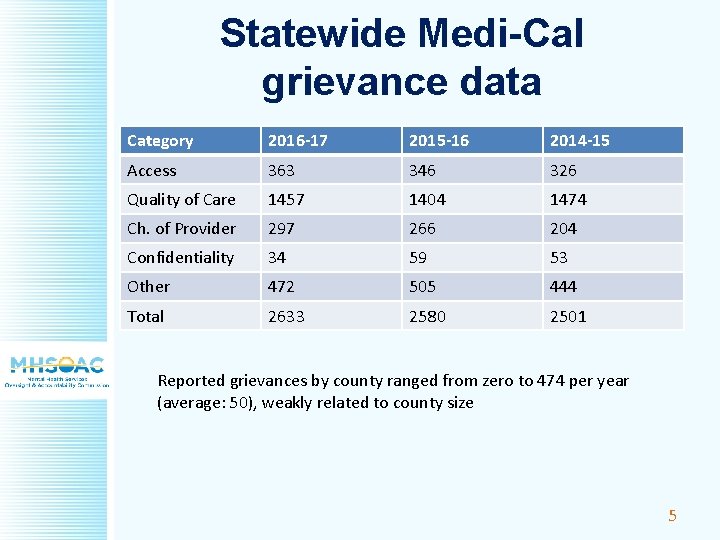
Statewide Medi-Cal grievance data Category 2016 -17 2015 -16 2014 -15 Access 363 346 326 Quality of Care 1457 1404 1474 Ch. of Provider 297 266 204 Confidentiality 34 59 53 Other 472 505 444 Total 2633 2580 2501 Reported grievances by county ranged from zero to 474 per year (average: 50), weakly related to county size 5
Methods ■ The project has held several public meetings, performed key informant interviews, and surveyed the historical literature on the IRP and literature on dispute resolution best practices 6
Preliminary findings ■ Lack of evidence of awareness § We could not identify evidence demonstrating that clients and families were generally aware of county IRPs ■ Lack of evidence of participation § Counties generally do not provide, and DHCS does not report, systematic data on utilization. § Many project participants attributed low utilization to deterrence ■ Lack of evidence of efficacy and efficiency § We could not identify evidence that local IRPs have systemic impacts. 7
Discussion ■ What is important to know about county IRPs? ■ How would we know that an IRP is successful? ■ Should the MHSOAC seek to display data on county IRPs? What data and how? ■ What recommendations should the project emphasize to DHCS? To the counties? 8