
ISSUE 1 THE MIGRATION OF THE SCOTS Examples
































- Slides: 70
ISSUE 1: THE MIGRATION OF THE SCOTS
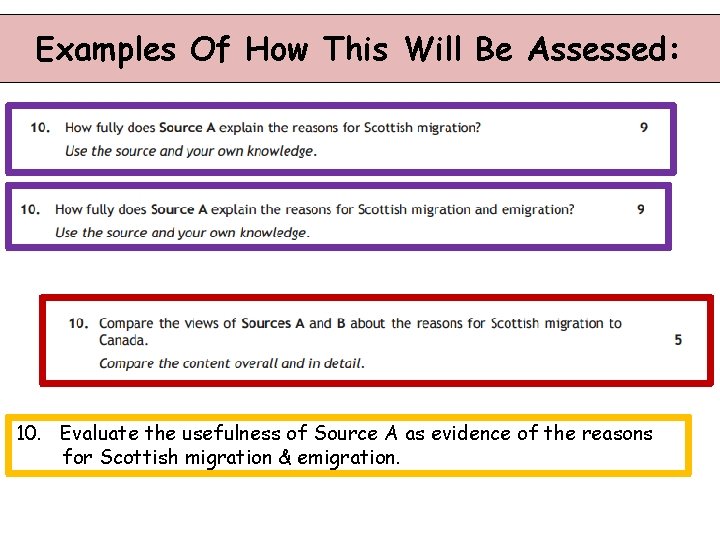
Examples Of How This Will Be Assessed: 10. Evaluate the usefulness of Source A as evidence of the reasons. for Scottish migration & emigration.
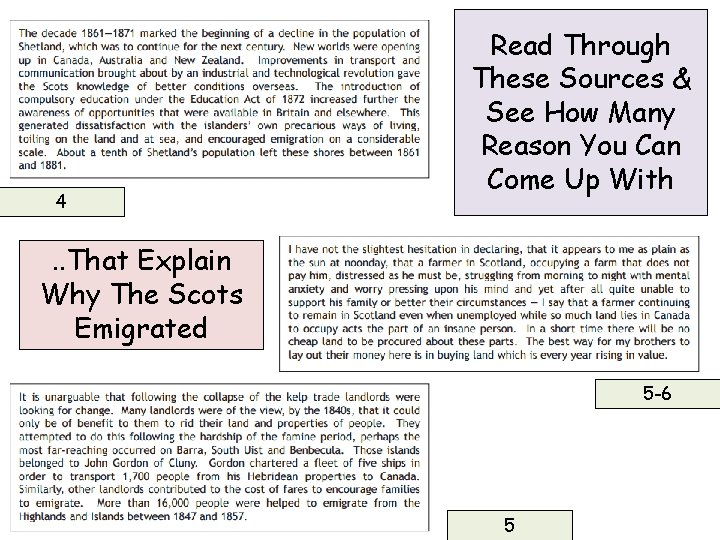
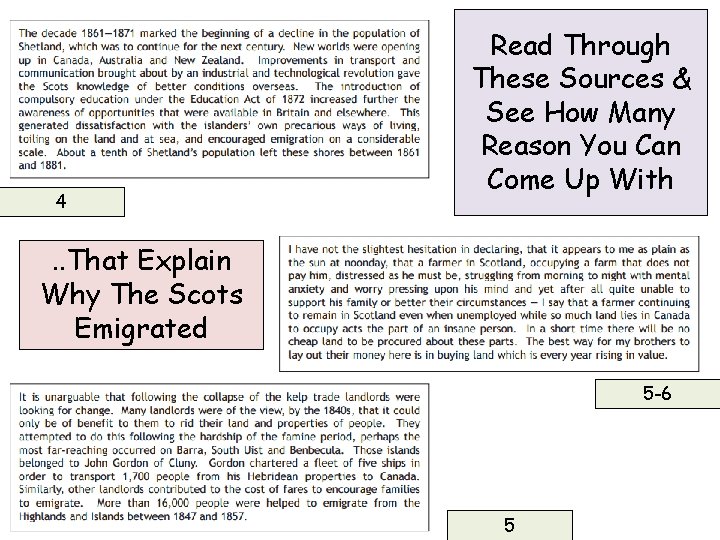
4 Read Through These Sources & See How Many Reason You Can Come Up With . . That Explain Why The Scots Emigrated 5 -6 5
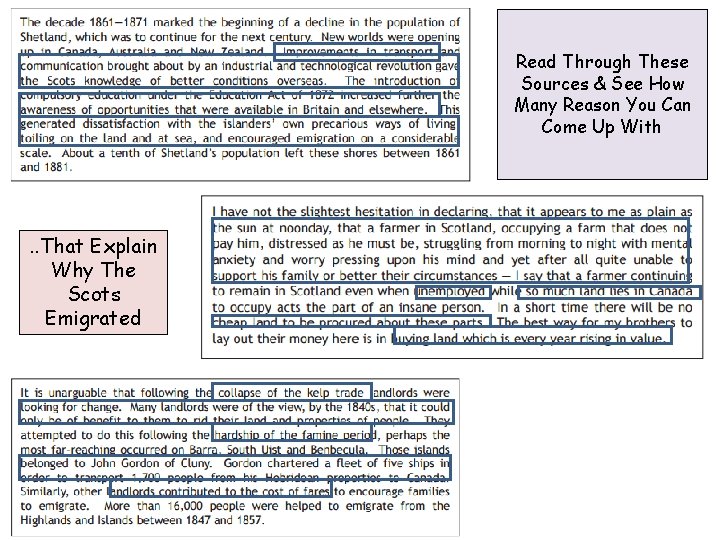
Read Through These Sources & See How Many Reason You Can Come Up With . . That Explain Why The Scots Emigrated
In this Issue we will look at 2 areas: 1. What PUSHED the Scots out AND around Scotland AND 2. What PULLED the Scots to new AND countries The Reasons For Internal Migration & Emigration Are VERY Similar/The Same 1. What PUSHED the Scots from their homes? (Internally or Overseas) (12 Facts – you will learn 7 -8)
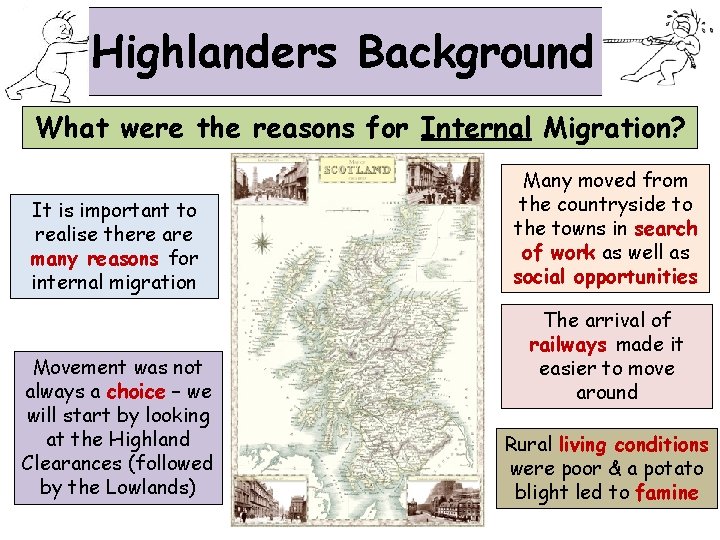
Highlanders Background What were the reasons for Internal Migration? It is important to realise there are many reasons for internal migration Movement was not always a choice – we will start by looking at the Highland Clearances (followed by the Lowlands) Many moved from the countryside to the towns in search of work as well as social opportunities The arrival of railways made it easier to move around Rural living conditions were poor & a potato blight led to famine
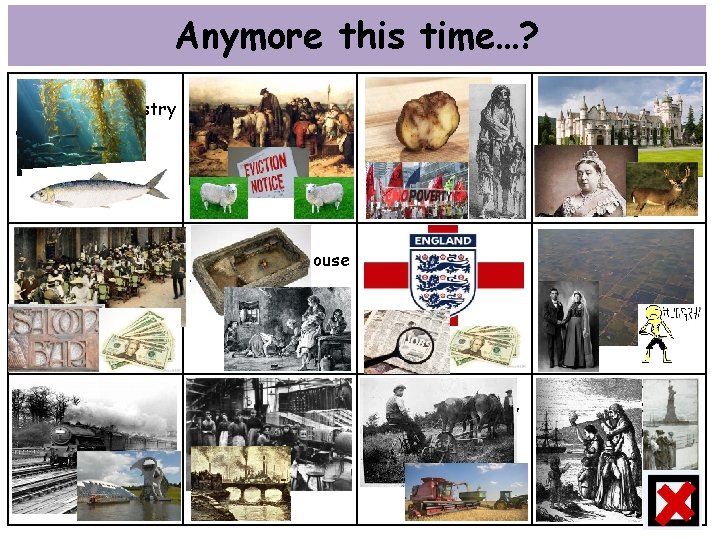
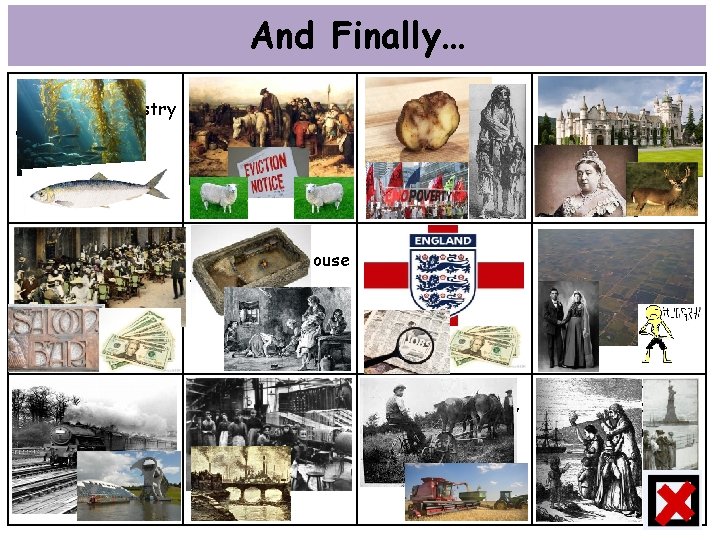
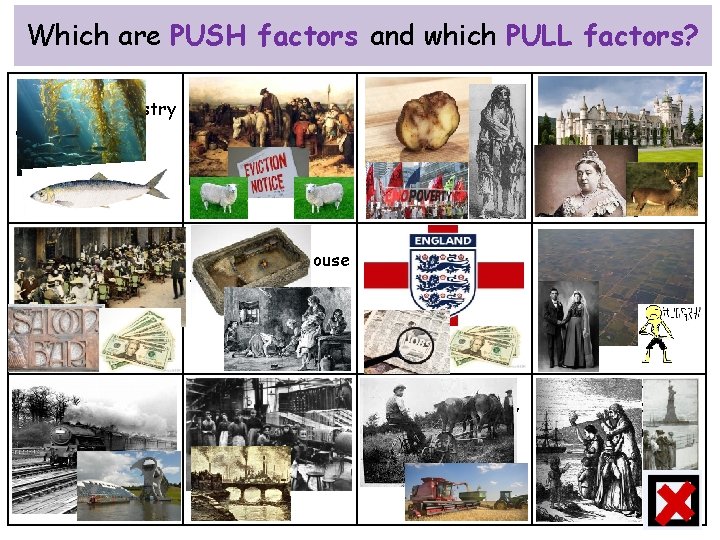
Lets See What You Know Already… Failure of the kelp & industry & Herring Highland Clearances – thrown off land to make way for sheep Potato famine – leading to malnutrition & starvation Balmoralism – tourism to the Highlands. Types of jobs required changed Social life & higher Living in wages offered in bothy/black house towns/cities – poor living conditions England offered higher wages & better opportunities in trades & professions Over population of the Highlands – land too small to make a living. Dowry Railways and cannel made moving much easier for people & goods Invention of new farming machinery = less jobs on farms Could not afford to go to USA or were too scared Industrialisation meant the towns/cities offered jobs in factories
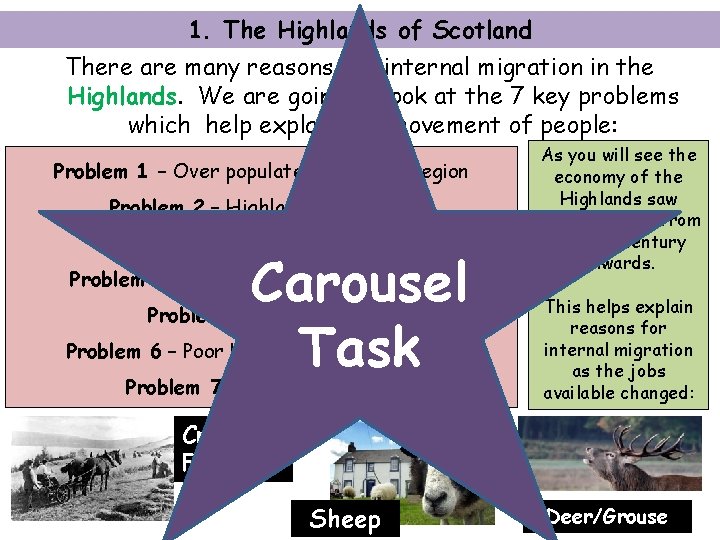
1. The Highlands of Scotland There are many reasons for internal migration in the Highlands. We are going to look at the 7 key problems which help explain the movement of people: Problem 1 – Over populated Highland Region Problem 2 – Highland Clearances Problem 3 – Poor Living Conditions Carousel Task Problem 4 – Failure of the Kelp Industry Problem 5 – Balmoralism Problem 6 – Poor Harvests/Potato Famine Problem 7 – Fishing Industry As you will see the economy of the Highlands saw great changes from the 18 th century onwards. This helps explain reasons for internal migration as the jobs available changed: Crofting Families Sheep Deer/Grouse
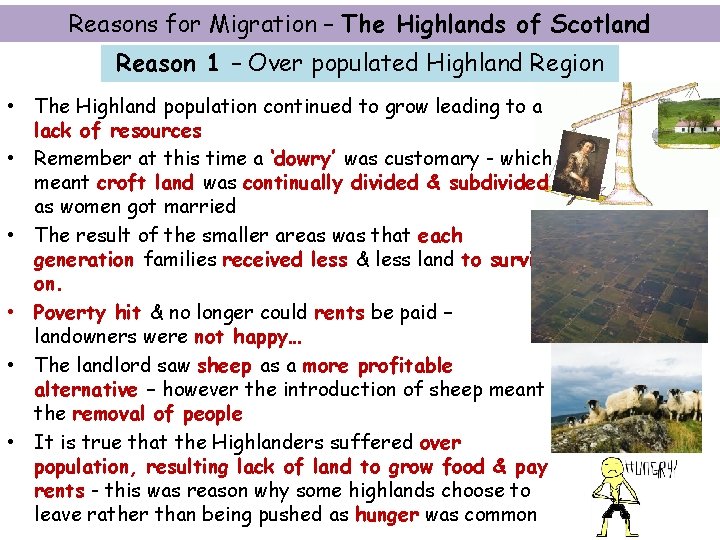
Reasons for Migration – The Highlands of Scotland Reason 1 – Over populated Highland Region • The Highland population continued to grow leading to a lack of resources • Remember at this time a ‘dowry’ was customary - which meant croft land was continually divided & subdivided as women got married • The result of the smaller areas was that each generation families received less & less land to survive on. • Poverty hit & no longer could rents be paid – landowners were not happy… • The landlord saw sheep as a more profitable alternative – however the introduction of sheep meant the removal of people • It is true that the Highlanders suffered over population, resulting lack of land to grow food & pay rents - this was reason why some highlands choose to leave rather than being pushed as hunger was common
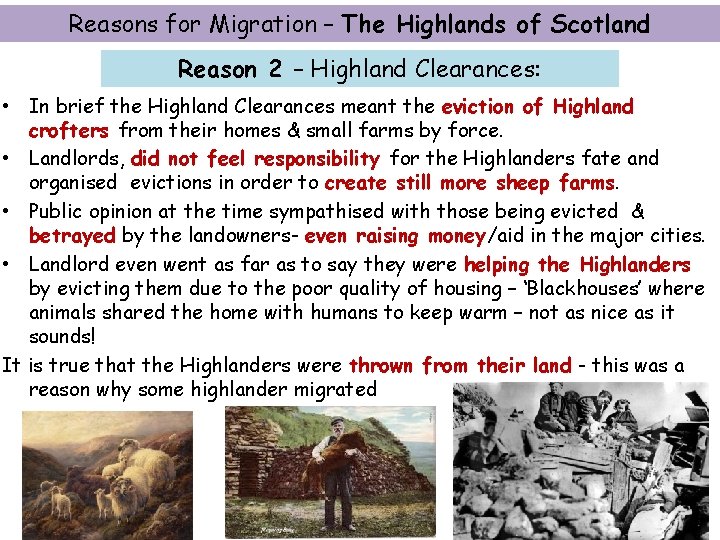
Reasons for Migration – The Highlands of Scotland Reason 2 – Highland Clearances: • In brief the Highland Clearances meant the eviction of Highland crofters from their homes & small farms by force. • Landlords, did not feel responsibility for the Highlanders fate and organised evictions in order to create still more sheep farms. • Public opinion at the time sympathised with those being evicted & betrayed by the landowners- even raising money/aid in the major cities. • Landlord even went as far as to say they were helping the Highlanders by evicting them due to the poor quality of housing – ‘Blackhouses’ where animals shared the home with humans to keep warm – not as nice as it sounds! It is true that the Highlanders were thrown from their land - this was a reason why some highlander migrated
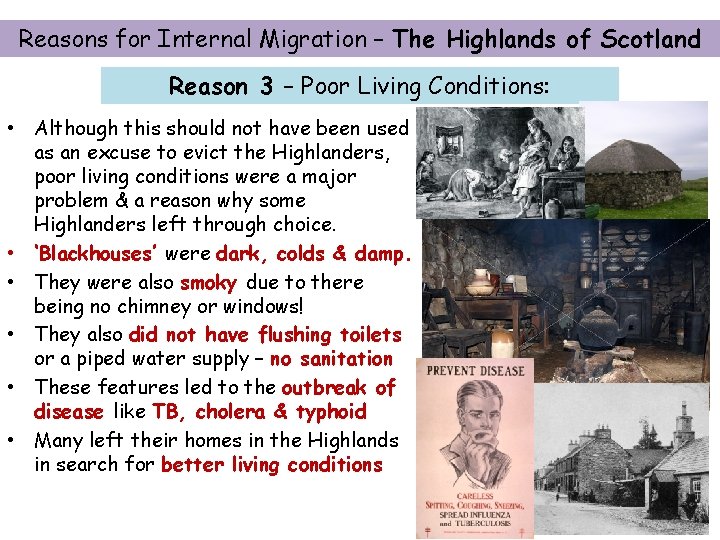
Reasons for Internal Migration – The Highlands of Scotland Reason 3 – Poor Living Conditions: • Although this should not have been used as an excuse to evict the Highlanders, poor living conditions were a major problem & a reason why some Highlanders left through choice. • ‘Blackhouses’ were dark, colds & damp. • They were also smoky due to there being no chimney or windows! • They also did not have flushing toilets or a piped water supply – no sanitation • These features led to the outbreak of disease like TB, cholera & typhoid • Many left their homes in the Highlands in search for better living conditions
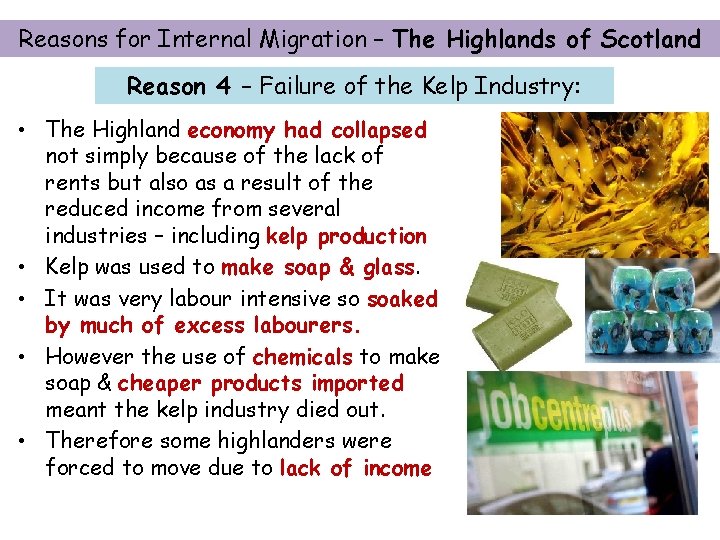
Reasons for Internal Migration – The Highlands of Scotland Reason 4 – Failure of the Kelp Industry: • The Highland economy had collapsed not simply because of the lack of rents but also as a result of the reduced income from several industries – including kelp production • Kelp was used to make soap & glass. • It was very labour intensive so soaked by much of excess labourers. • However the use of chemicals to make soap & cheaper products imported meant the kelp industry died out. • Therefore some highlanders were forced to move due to lack of income
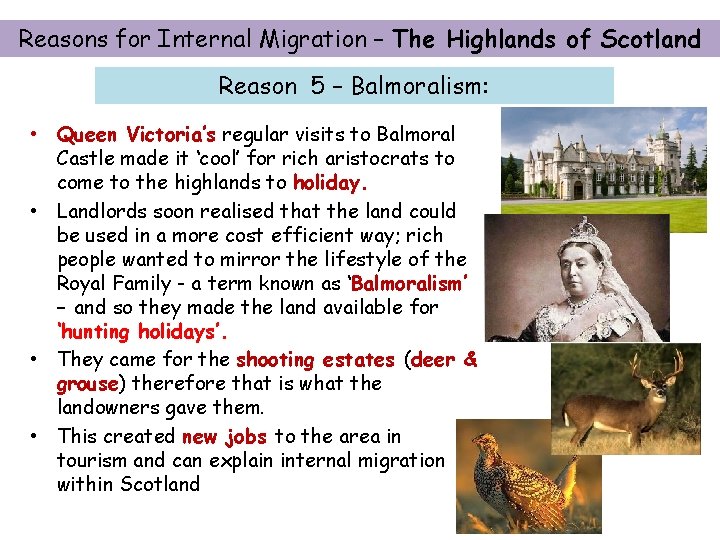
Reasons for Internal Migration – The Highlands of Scotland Reason 5 – Balmoralism: • Queen Victoria’s regular visits to Balmoral Castle made it ‘cool’ for rich aristocrats to come to the highlands to holiday. • Landlords soon realised that the land could be used in a more cost efficient way; rich people wanted to mirror the lifestyle of the Royal Family - a term known as ‘Balmoralism’ – and so they made the land available for ‘hunting holidays’. • They came for the shooting estates (deer & grouse) therefore that is what the landowners gave them. • This created new jobs to the area in tourism and can explain internal migration within Scotland
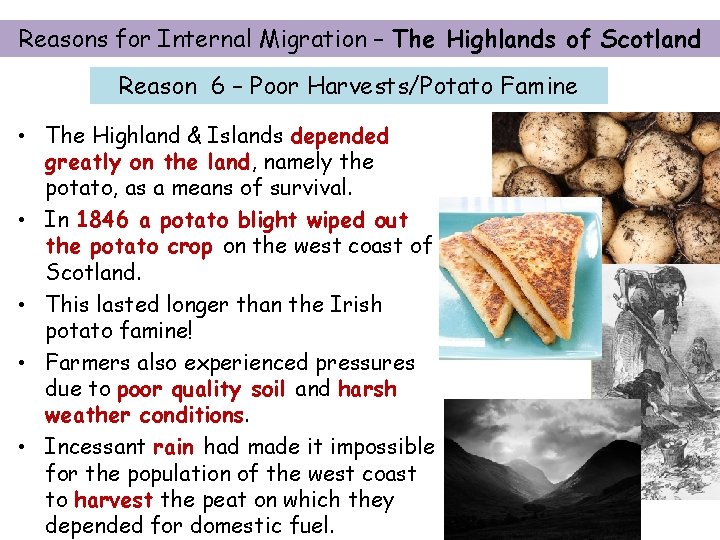
Reasons for Internal Migration – The Highlands of Scotland Reason 6 – Poor Harvests/Potato Famine • The Highland & Islands depended greatly on the land, namely the potato, as a means of survival. • In 1846 a potato blight wiped out the potato crop on the west coast of Scotland. • This lasted longer than the Irish potato famine! • Farmers also experienced pressures due to poor quality soil and harsh weather conditions. • Incessant rain had made it impossible for the population of the west coast to harvest the peat on which they depended for domestic fuel.
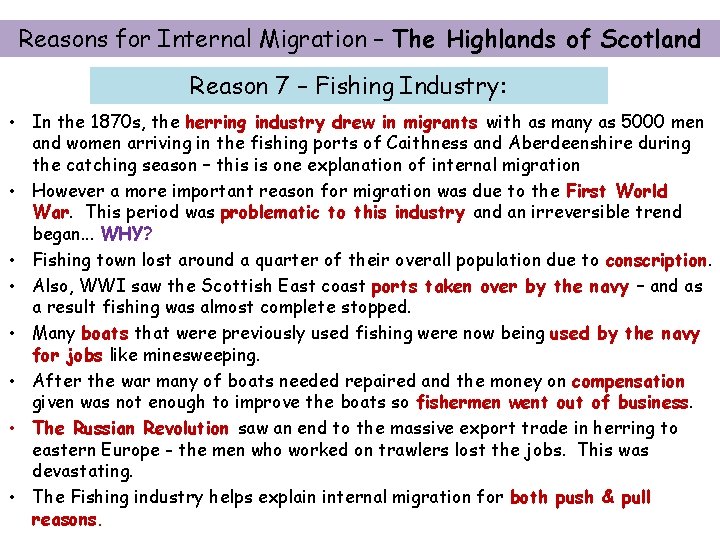
Reasons for Internal Migration – The Highlands of Scotland Reason 7 – Fishing Industry: • In the 1870 s, the herring industry drew in migrants with as many as 5000 men and women arriving in the fishing ports of Caithness and Aberdeenshire during the catching season – this is one explanation of internal migration • However a more important reason for migration was due to the First World War. This period was problematic to this industry and an irreversible trend began. . . WHY? • Fishing town lost around a quarter of their overall population due to conscription. • Also, WWI saw the Scottish East coast ports taken over by the navy – and as a result fishing was almost complete stopped. • Many boats that were previously used fishing were now being used by the navy for jobs like minesweeping. • After the war many of boats needed repaired and the money on compensation given was not enough to improve the boats so fishermen went out of business. • The Russian Revolution saw an end to the massive export trade in herring to eastern Europe - the men who worked on trawlers lost the jobs. This was devastating. • The Fishing industry helps explain internal migration for both push & pull reasons.
Thomas Faed The Last of the Clan What were the Highland Clearances?
50: 50 Welcome to Who Wants to be a Millionaire Migration & Empire Edition 15 14 13 12 11 10 9 8 7 6 5 4 3 2 1 £ 1 Million £ 500, 000 £ 250, 000 £ 125, 000 £ 64, 000 £ 32, 000 £ 16, 000 £ 8, 000 £ 4, 000 £ 2, 000 £ 1, 000 £ 500 £ 300 £ 200 £ 100
15 14 13 12 11 10 9 8 7 6 5 4 3 2 1 £ 1 Million £ 500, 000 £ 250, 000 £ 125, 000 £ 64, 000 £ 32, 000 £ 16, 000 £ 8, 000 £ 4, 000 £ 2, 000 £ 1, 000 £ 500 £ 300 £ 200 £ 100
Q 1. What is the name for a Highland farmer? 50: 50 A: Highland Farmers C: Teuchter B: Crofters D: Bankers 15 14 13 12 11 10 9 8 7 6 5 4 3 2 1 £ 1 Million £ 500, 000 £ 250, 000 £ 125, 000 £ 64, 000 £ 32, 000 £ 16, 000 £ 8, 000 £ 4, 000 £ 2, 000 £ 1, 000 £ 500 £ 300 £ 200 £ 100
15 14 13 12 11 10 9 8 7 6 5 4 3 2 1 £ 1 Million £ 500, 000 £ 250, 000 £ 125, 000 £ 64, 000 £ 32, 000 £ 16, 000 £ 8, 000 £ 4, 000 £ 2, 000 £ 1, 000 £ 500 £ 300 £ 200 £ 100
Q 2. Why were sheep introduced into the Highlands? 50: 50 A: As the crofters refused to pay rent C: the landlords didn’t like the crofters 15 14 13 12 11 10 9 8 7 6 5 4 3 2 1 £ 1 Million £ 500, 000 £ 250, 000 £ 125, 000 £ 64, 000 £ 32, 000 £ 16, 000 £ 8, 000 £ 4, 000 £ 2, 000 £ 1, 000 £ 500 £ 300 £ 200 £ 100 B: Because tourists wanted them D: As the landlords wanted to make lots of money
15 14 13 12 11 10 9 8 7 6 5 4 3 2 1 £ 1 Million £ 500, 000 £ 250, 000 £ 125, 000 £ 64, 000 £ 32, 000 £ 16, 000 £ 8, 000 £ 4, 000 £ 2, 000 £ 1, 000 £ 500 £ 300 £ 200 £ 100
Q 3. What was the land owners justification for evicting the highlanders? 50: 50 A: They were living in too poor conditions C: They were trouble 15 14 13 12 11 10 9 8 7 6 5 4 3 2 1 £ 1 Million £ 500, 000 £ 250, 000 £ 125, 000 £ 64, 000 £ 32, 000 £ 16, 000 £ 8, 000 £ 4, 000 £ 2, 000 £ 1, 000 £ 500 £ 300 £ 200 £ 100 B: Sheep were needed D: Tourists made more money
15 14 13 12 11 10 9 8 7 6 5 4 3 2 1 £ 1 Million £ 500, 000 £ 250, 000 £ 125, 000 £ 64, 000 £ 32, 000 £ 16, 000 £ 8, 000 £ 4, 000 £ 2, 000 £ 1, 000 £ 500 £ 300 £ 200 £ 100
Q 4. Why did the term ‘dowry’ lead to reduced croft sizes? 50: 50 A: Families had to give land away to new husband C: Families hated each other would not live together 15 14 13 12 11 10 9 8 7 6 5 4 3 2 1 £ 1 Million £ 500, 000 £ 250, 000 £ 125, 000 £ 64, 000 £ 32, 000 £ 16, 000 £ 8, 000 £ 4, 000 £ 2, 000 £ 1, 000 £ 500 £ 300 £ 200 £ 100 B: Families had to give land to new wife D: Land owners wanted to downsize their properties
15 14 13 12 11 10 9 8 7 6 5 4 3 2 1 £ 1 Million £ 500, 000 £ 250, 000 £ 125, 000 £ 64, 000 £ 32, 000 £ 16, 000 £ 8, 000 £ 4, 000 £ 2, 000 £ 1, 000 £ 500 £ 300 £ 200 £ 100
Q 5. What did land owners in the Highland's replace the small crofts with? 50: 50 A: Cows C: Sheep B: farmers D: Tourists 15 14 13 12 11 10 9 8 7 6 5 4 3 2 1 £ 1 Million £ 500, 000 £ 250, 000 £ 125, 000 £ 64, 000 £ 32, 000 £ 16, 000 £ 8, 000 £ 4, 000 £ 2, 000 £ 1, 000 £ 500 £ 300 £ 200 £ 100
Congratulations! You’ve Reached the £ 1, 000 Milestone!
15 14 13 12 11 10 9 8 7 6 5 4 3 2 1 £ 1 Million £ 500, 000 £ 250, 000 £ 125, 000 £ 64, 000 £ 32, 000 £ 16, 000 £ 8, 000 £ 4, 000 £ 2, 000 £ 1, 000 £ 500 £ 300 £ 200 £ 100
Q 6. What was the name of the houses that crofters stayed in? 50: 50 A: White Houses C: Farms 15 14 13 12 11 10 9 8 7 6 5 4 3 2 1 B: Black houses D: Slums £ 1 Million £ 500, 000 £ 250, 000 £ 125, 000 £ 64, 000 £ 32, 000 £ 16, 000 £ 8, 000 £ 4, 000 £ 2, 000 £ 1, 000 £ 500 £ 300 £ 200 £ 100
15 14 13 12 11 10 9 8 7 6 5 4 3 2 1 £ 1 Million £ 500, 000 £ 250, 000 £ 125, 000 £ 64, 000 £ 32, 000 £ 16, 000 £ 8, 000 £ 4, 000 £ 2, 000 £ 1, 000 £ 500 £ 300 £ 200 £ 100
Q 7. What diseases broke out due to poor sanitation? 50: 50 A: Verucas C: Whooping cough 15 14 13 12 11 10 9 8 7 6 5 4 3 2 1 £ 1 Million £ 500, 000 £ 250, 000 £ 125, 000 £ 64, 000 £ 32, 000 £ 16, 000 £ 8, 000 £ 4, 000 £ 2, 000 £ 1, 000 £ 500 £ 300 £ 200 £ 100 B: Scottish Flu D: TB, cholera & typhoid
15 14 13 12 11 10 9 8 7 6 5 4 3 2 1 £ 1 Million £ 500, 000 £ 250, 000 £ 125, 000 £ 64, 000 £ 32, 000 £ 16, 000 £ 8, 000 £ 4, 000 £ 2, 000 £ 1, 000 £ 500 £ 300 £ 200 £ 100
15 14 13 12 11 10 9 8 7 6 5 4 3 2 1 Q 8. What is kelp? 50: 50 A: Seaweed C: A type of cabbage B: disease D: A fish £ 1 Million £ 500, 000 £ 250, 000 £ 125, 000 £ 64, 000 £ 32, 000 £ 16, 000 £ 8, 000 £ 4, 000 £ 2, 000 £ 1, 000 £ 500 £ 300 £ 200 £ 100
15 14 13 12 11 10 9 8 7 6 5 4 3 2 1 £ 1 Million £ 500, 000 £ 250, 000 £ 125, 000 £ 64, 000 £ 32, 000 £ 16, 000 £ 8, 000 £ 4, 000 £ 2, 000 £ 1, 000 £ 500 £ 300 £ 200 £ 100
Q 9. What is interesting about our potato famine? 50: 50 15 14 13 12 11 10 9 8 7 6 5 4 3 2 1 £ 1 Million £ 500, 000 £ 250, 000 £ 125, 000 £ 64, 000 £ 32, 000 £ 16, 000 £ 8, 000 £ 4, 000 £ 2, 000 £ 1, 000 £ 500 £ 300 £ 200 £ 100 A: Scots lost weight as couldn’t fry chips B: It only lasted 3 weeks C: Lasted longer than in Ireland D: Never actually happened
15 14 13 12 11 10 9 8 7 6 5 4 3 2 1 £ 1 Million £ 500, 000 £ 250, 000 £ 125, 000 £ 64, 000 £ 32, 000 £ 16, 000 £ 8, 000 £ 4, 000 £ 2, 000 £ 1, 000 £ 500 £ 300 £ 200 £ 100
Q 10. Why did WWI harm the fishing industry? 50: 50 A: Soldiers refused to eat fish C: Kaiser Wilhelm ordered lots of fish 15 14 13 12 11 10 9 8 7 6 5 4 3 2 1 £ 1 Million £ 500, 000 £ 250, 000 £ 125, 000 £ 64, 000 £ 32, 000 £ 16, 000 £ 8, 000 £ 4, 000 £ 2, 000 £ 1, 000 £ 500 £ 300 £ 200 £ 100 B: Everyone became vegetarian to save money D: Men away fighting & ruined boats after the war
Congratulations! You’ve Reached the £ 32, 000 Milestone!
15 14 13 12 11 10 9 8 7 6 5 4 3 2 1 £ 1 Million £ 500, 000 £ 250, 000 £ 125, 000 £ 64, 000 £ 32, 000 £ 16, 000 £ 8, 000 £ 4, 000 £ 2, 000 £ 1, 000 £ 500 £ 300 £ 200 £ 100
Q 11. What was kelp used to make? 50: 50 A: Sheep food C: Dinner for Highlanders 15 14 13 12 11 10 9 8 7 6 5 4 3 2 1 B: Soap & glass D: Soles of shoes £ 1 Million £ 500, 000 £ 250, 000 £ 125, 000 £ 64, 000 £ 32, 000 £ 16, 000 £ 8, 000 £ 4, 000 £ 2, 000 £ 1, 000 £ 500 £ 300 £ 200 £ 100
15 14 13 12 11 10 9 8 7 6 5 4 3 2 1 £ 1 Million £ 500, 000 £ 250, 000 £ 125, 000 £ 64, 000 £ 32, 000 £ 16, 000 £ 8, 000 £ 4, 000 £ 2, 000 £ 1, 000 £ 500 £ 300 £ 200 £ 100
Q 13. What are pull factors for migration? 50: 50 A: Reasons to stay in your own country C: Reasons like persecution 15 14 13 12 11 10 9 8 7 6 5 4 3 2 1 £ 1 Million £ 500, 000 £ 250, 000 £ 125, 000 £ 64, 000 £$32, 000 £ 16, 000 £ 8, 000 £ 4, 000 £ 2, 000 £ 1, 000 £ 500 £ 300 £ 200 £ 100 B: Factors which attract you move within your own country D: Factors which attract people to another country
Q 12. What is Balmoralism? 50: 50 15 14 13 12 11 10 9 8 7 6 5 4 3 2 1 £ 1 Million £ 500, 000 £ 250, 000 £ 125, 000 £ 64, 000 £ 32, 000 £ 16, 000 £ 8, 000 £ 4, 000 £ 2, 000 £ 1, 000 £ 500 £ 300 £ 200 £ 100 A: Black pudding stuffed inside chicken B: An illness C: Term used to describe tourism to the highlands D: The hotel in Princes Street
15 14 13 12 11 10 9 8 7 6 5 4 3 2 1 £ 1 Million £ 500, 000 £ 250, 000 £ 125, 000 £ 64, 000 £ 32, 000 £ 16, 000 £ 8, 000 £ 4, 000 £ 2, 000 £ 1, 000 £ 500 £ 300 £ 200 £ 100
Q 13. What were the conditions like in a Blackhouse? 50: 50 15 14 13 12 11 10 9 8 7 6 5 4 3 2 1 A: Dark and warm B: Large and cold C: Dark, colds & damp. Smoky no sanitation D: Smoky and warm £ 1 Million £ 500, 000 £ 250, 000 £ 125, 000 £ 64, 000 £ 32, 000 £ 16, 000 £ 8, 000 £ 4, 000 £ 2, 000 £ 1, 000 £ 500 £ 300 £ 200 £ 100
15 14 13 12 11 10 9 8 7 6 5 4 3 2 1 £ 1 Million £ 500, 000 £ 250, 000 £ 125, 000 £ 64, 000 £ 32, 000 £ 16, 000 £ 8, 000 £ 4, 000 £ 2, 000 £ 1, 000 £ 500 £ 300 £ 200 £ 100
Q 14. What are push factors for migration? 50: 50 A: Factors which force someone to leave a country C: Factors which force someone to stay in their own country 15 14 13 12 11 10 9 8 7 6 5 4 3 2 1 £ 1 Million £ 500, 000 £ 250, 000 £ 125, 000 £ 64, 000 £ 32, 000 £ 16, 000 £ 8, 000 £ 4, 000 £ 2, 000 £ 1, 000 £ 500 £ 300 £ 200 £ 100 B: Reasons to stay D: Reasons like a bigger house
15 14 13 12 11 10 9 8 7 6 5 4 3 2 1 £ 1 Million £ 500, 000 £ 250, 000 £ 125, 000 £ 64, 000 £ 32, 000 £ 16, 000 £ 8, 000 £ 4, 000 £ 2, 000 £ 1, 000 £ 500 £ 300 £ 200 £ 100
Q 15. How many push factors have I taught you? Name them to win! 50: 50 A: 5 C: 6 B: 7 D: 8 15 14 13 12 11 10 9 8 7 6 5 4 3 2 1 £ 1 Million £ 500, 000 £ 250, 000 £ 125, 000 £ 64, 000 £ 32, 000 £ 16, 000 £ 8, 000 £ 4, 000 £ 2, 000 £ 1, 000 £ 500 £ 300 £ 200 £ 100
YOU WIN £ 1 MILLION POUNDS!!
Anymore this time…? Failure of the kelp & industry & Herring Highland Clearances – thrown off land to make way for sheep Potato famine – leading to malnutrition & starvation Balmoralism – tourism to the Highlands. Types of jobs required changed Social life & higher Living in wages offered in bothy/black house towns/cities – poor living conditions England offered higher wages & better opportunities in trades & professions Over population of the Highlands – land too small to make a living. Dowry Railways and cannel made moving much easier for people & goods Invention of new farming machinery = less jobs on farms Could not afford to go to USA or were too scared Industrialisation meant the towns/cities offered jobs in factories
Lowlanders Background What were the reasons for Internal Migration? We already know why many Highlanders moved however all areas of Scotland were affected by population movement Before the 1890 s the Lowlands saw similar drops in population – around 9% Many more people chose to move around Scotland rather than being forced to leave Much of this movement resulted from the agricultural & industrial revolutions Economic factors were are probably the most important reasons for people leaving rural areas however the growing town & cities also offered better social opportunities
The Lowlands of Scotland There are many reasons for internal migration in the Lowlands. Both ’push’ & ’pull’ factors. We are going to look at the 5 key reasons & problems which help explain the movement of people: Problem/Reason 1 – Agricultural Revolution Carousel Problem/Reason Task 3 – Improved Transportation Problem/Reason 2 – Industrial Revolution Problem 4 – Inability to go Abroad Reason 5 – Attractions of town/city life
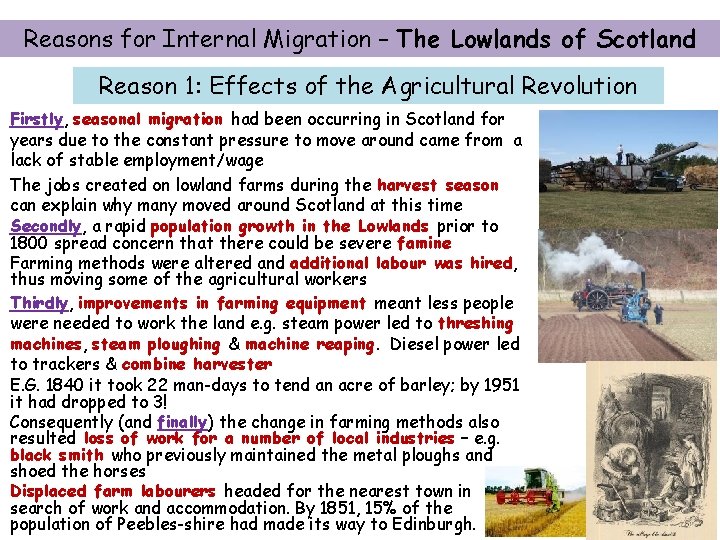
Reasons for Internal Migration – The Lowlands of Scotland Reason 1: Effects of the Agricultural Revolution Firstly, seasonal migration had been occurring in Scotland for years due to the constant pressure to move around came from a lack of stable employment/wage The jobs created on lowland farms during the harvest season can explain why many moved around Scotland at this time Secondly, a rapid population growth in the Lowlands prior to 1800 spread concern that there could be severe famine Farming methods were altered and additional labour was hired, thus moving some of the agricultural workers Thirdly, improvements in farming equipment meant less people were needed to work the land e. g. steam power led to threshing machines, steam ploughing & machine reaping. Diesel power led to trackers & combine harvester E. G. 1840 it took 22 man-days to tend an acre of barley; by 1951 it had dropped to 3! Consequently (and finally) the change in farming methods also resulted loss of work for a number of local industries – e. g. black smith who previously maintained the metal ploughs and shoed the horses Displaced farm labourers headed for the nearest town in search of work and accommodation. By 1851, 15% of the population of Peebles-shire had made its way to Edinburgh.
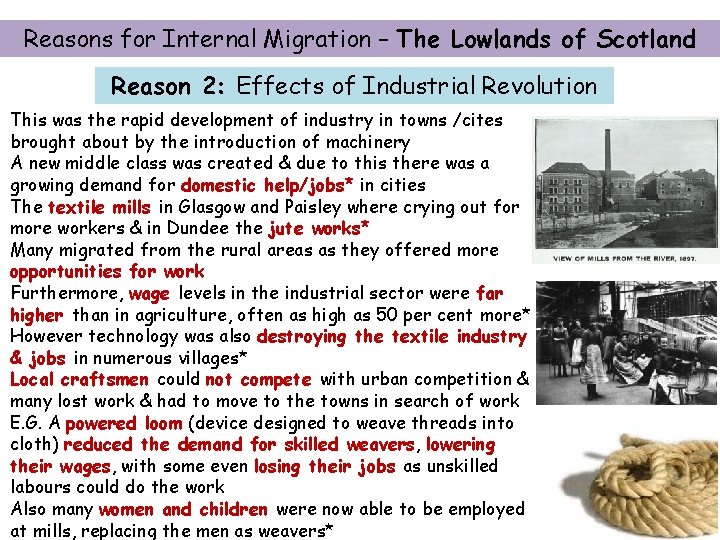
Reasons for Internal Migration – The Lowlands of Scotland Reason 2: Effects of Industrial Revolution This was the rapid development of industry in towns /cites brought about by the introduction of machinery A new middle class was created & due to this there was a growing demand for domestic help/jobs* in cities The textile mills in Glasgow and Paisley where crying out for more workers & in Dundee the jute works* Many migrated from the rural areas as they offered more opportunities for work Furthermore, wage levels in the industrial sector were far higher than in agriculture, often as high as 50 per cent more* However technology was also destroying the textile industry & jobs in numerous villages* Local craftsmen could not compete with urban competition & many lost work & had to move to the towns in search of work E. G. A powered loom (device designed to weave threads into cloth) reduced the demand for skilled weavers, lowering their wages, with some even losing their jobs as unskilled labours could do the work Also many women and children were now able to be employed at mills, replacing the men as weavers*
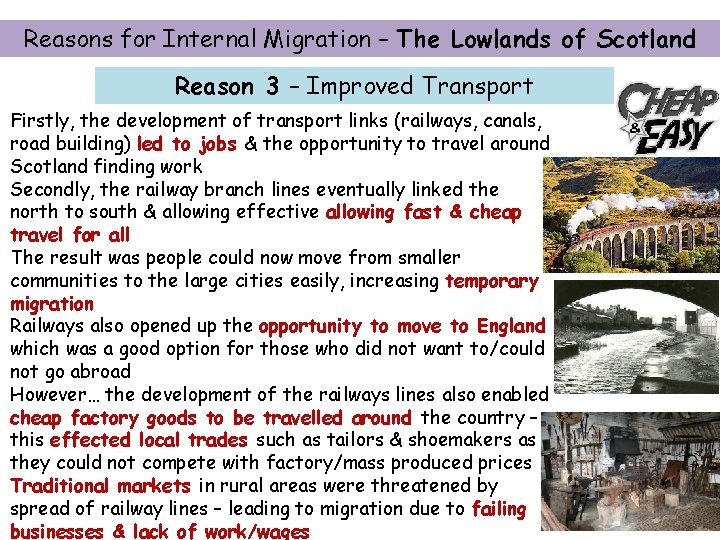
Reasons for Internal Migration – The Lowlands of Scotland Reason 3 – Improved Transport Firstly, the development of transport links (railways, canals, road building) led to jobs & the opportunity to travel around Scotland finding work Secondly, the railway branch lines eventually linked the north to south & allowing effective allowing fast & cheap travel for all The result was people could now move from smaller communities to the large cities easily, increasing temporary migration Railways also opened up the opportunity to move to England which was a good option for those who did not want to/could not go abroad However… the development of the railways lines also enabled cheap factory goods to be travelled around the country – this effected local trades such as tailors & shoemakers as they could not compete with factory/mass produced prices Traditional markets in rural areas were threatened by spread of railway lines – leading to migration due to failing businesses & lack of work/wages
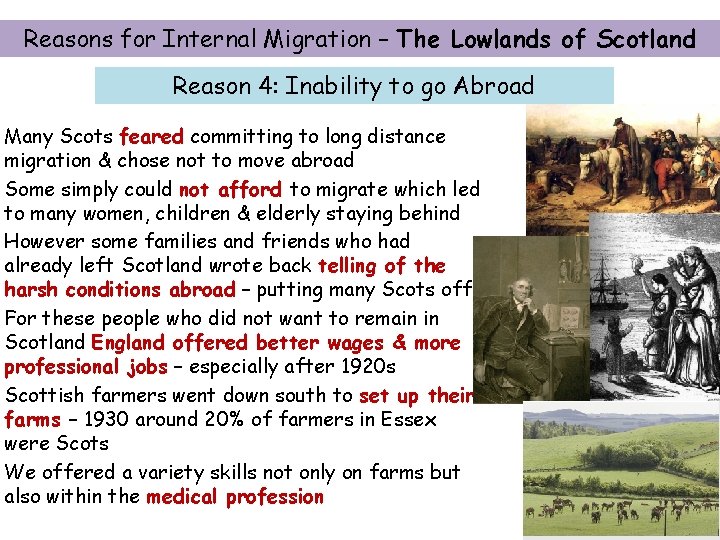
Reasons for Internal Migration – The Lowlands of Scotland Reason 4: Inability to go Abroad Many Scots feared committing to long distance migration & chose not to move abroad Some simply could not afford to migrate which led to many women, children & elderly staying behind However some families and friends who had already left Scotland wrote back telling of the harsh conditions abroad – putting many Scots off For these people who did not want to remain in Scotland England offered better wages & more professional jobs – especially after 1920 s Scottish farmers went down south to set up their farms – 1930 around 20% of farmers in Essex were Scots We offered a variety skills not only on farms but also within the medical profession
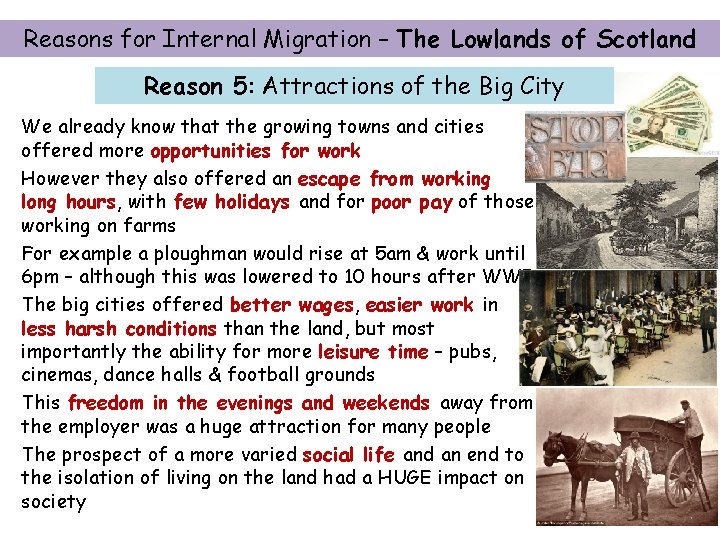
Reasons for Internal Migration – The Lowlands of Scotland Reason 5: Attractions of the Big City We already know that the growing towns and cities offered more opportunities for work However they also offered an escape from working long hours, with few holidays and for poor pay of those working on farms For example a ploughman would rise at 5 am & work until 6 pm – although this was lowered to 10 hours after WWI The big cities offered better wages, easier work in less harsh conditions than the land, but most importantly the ability for more leisure time – pubs, cinemas, dance halls & football grounds This freedom in the evenings and weekends away from the employer was a huge attraction for many people The prospect of a more varied social life and an end to the isolation of living on the land had a HUGE impact on society
And Finally… Failure of the kelp & industry & Herring Highland Clearances – thrown off land to make way for sheep Potato famine – leading to malnutrition & starvation Balmoralism – tourism to the Highlands. Types of jobs required changed Social life & higher Living in wages offered in bothy/black house towns/cities – poor living conditions England offered higher wages & better opportunities in trades & professions Over population of the Highlands – land too small to make a living. Dowry Railways and cannel made moving much easier for people & goods Invention of new farming machinery = less jobs on farms Could not afford to go to USA or were too scared Industrialisation meant the towns/cities offered jobs in factories
Pair & Share Task 1. Each pair will be given a coloured pen & have 60 seconds to write down reasons why the Scots migrated within Scotland 2. You will then move round the other groups & tick off their sheet the ones which you had remembered & add answers they don’t have 3. This will allow you share what you know, see how other groups word answers & ensure that we know at least 6 reasons!
Which are PUSH factors and which PULL factors? Failure of the kelp & industry & Herring Highland Clearances – thrown off land to make way for sheep Potato famine – leading to malnutrition & starvation Balmoralism – tourism to the Highlands. Types of jobs required changed Social life & higher Living in wages offered in bothy/black house towns/cities – poor living conditions England offered higher wages & better opportunities in trades & professions Over population of the Highlands – land too small to make a living. Dowry Railways and cannel made moving much easier for people & goods Invention of new farming machinery = less jobs on farms Could not afford to go to USA or were too scared Industrialisation meant the towns/cities offered jobs in factories
As a class what do we think are the 10 most important reasons for INTERNAL MIGRATION? 1. 2. 3. 4. 5. 6. 7. 8. 9.
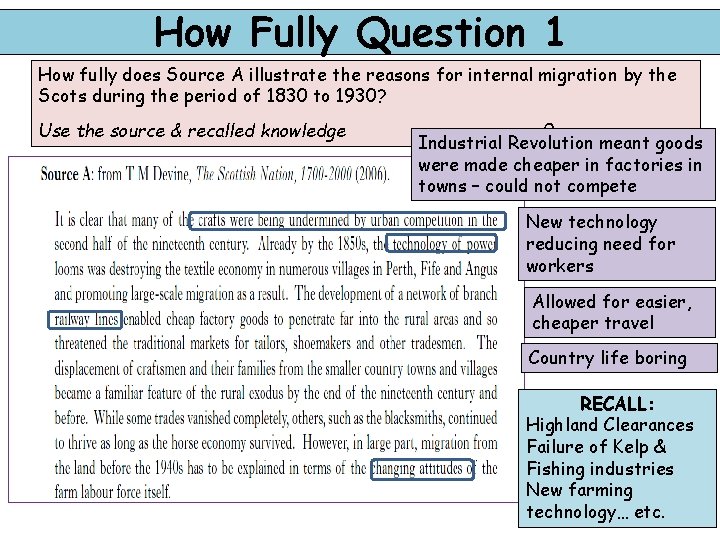
Exam Question Time… How fully does Source A illustrate the reasons for internal migration by the Scots during the period of 1830 to 1930? Use the source & recalled knowledge 9 ALL THAT YOU NEED TO DO IS: 1. Read each sentence carefully 2. Pick out 3 -4 quotes which explain reasons for the internal migration of the Scots 3. Back up each quote with some background knowledge to answer the question – e. g. don’t quote it (3 marks max. ) 4. Add in recall - up to 7 marks 5. Make a judgement – How Fully? ? (2 marks max. if not e. g. fairly good explanation)
How Fully Question 1 How fully does Source A illustrate the reasons for internal migration by the Scots during the period of 1830 to 1930? Use the source & recalled knowledge 9 Industrial Revolution meant goods were made cheaper in factories in towns – could not compete New technology reducing need for workers Allowed for easier, cheaper travel Country life boring RECALL: Highland Clearances Failure of Kelp & Fishing industries New farming technology… etc.
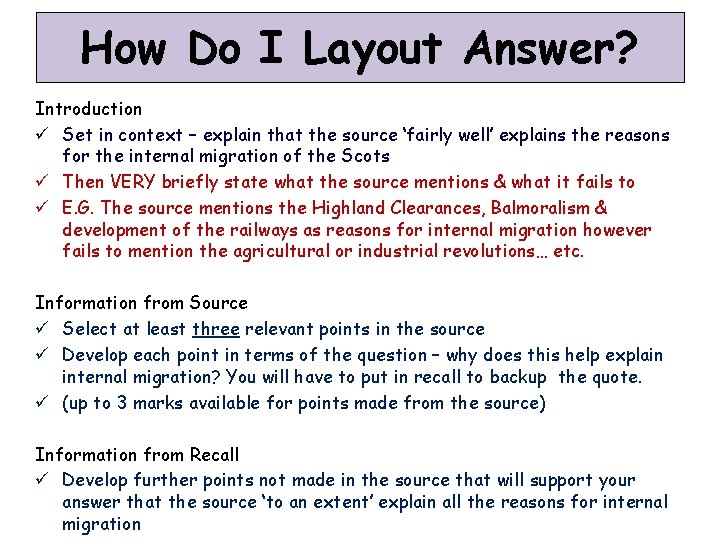
How Do I Layout Answer? Introduction ü Set in context – explain that the source ‘fairly well’ explains the reasons for the internal migration of the Scots ü Then VERY briefly state what the source mentions & what it fails to ü E. G. The source mentions the Highland Clearances, Balmoralism & development of the railways as reasons for internal migration however fails to mention the agricultural or industrial revolutions… etc. Information from Source ü Select at least three relevant points in the source ü Develop each point in terms of the question – why does this help explain internal migration? You will have to put in recall to backup the quote. ü (up to 3 marks available for points made from the source) Information from Recall ü Develop further points not made in the source that will support your answer that the source ‘to an extent’ explain all the reasons for internal migration
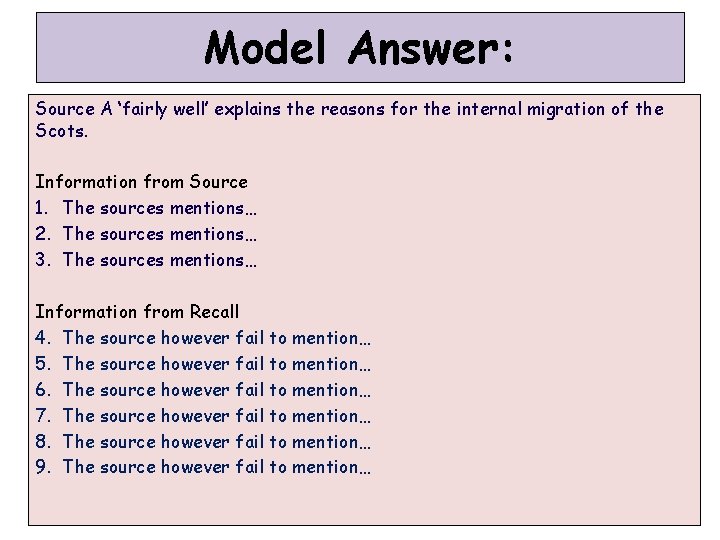
Model Answer: Source A ‘fairly well’ explains the reasons for the internal migration of the Scots. Information from Source 1. The sources mentions… 2. The sources mentions… 3. The sources mentions… Information from Recall 4. The source however fail to mention… 5. The source however fail to mention… 6. The source however fail to mention… 7. The source however fail to mention… 8. The source however fail to mention… 9. The source however fail to mention…
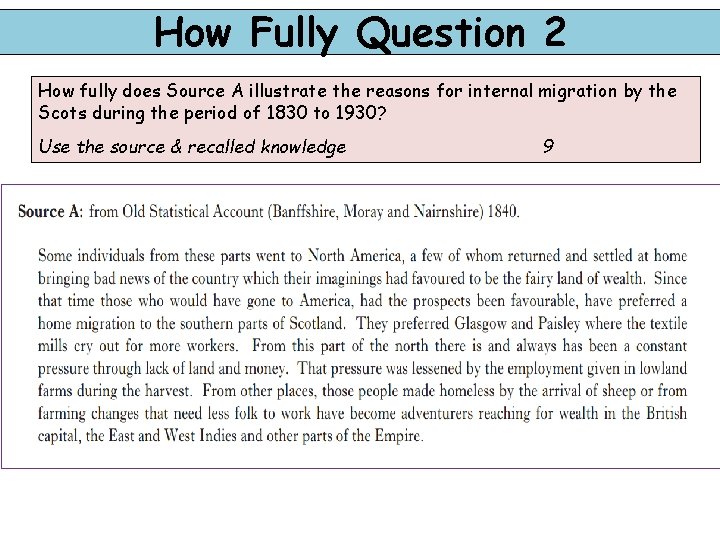
How Fully Question 2 Try this one in pairs How fully does Source A illustrate the reasons for internal migration by the Scots during the period of 1830 to 1930? Use the source & recalled knowledge 9
4 Read Through These Sources & See How Many Reason You Can Come Up With . . That Explain Why The Scots Emigrated 5 -6 5
Evaluation… Issue 1: Reasons for Internal Migration of the Scots 1. I can give at least 9 detailed explanations as to why there was internal migration in Scotland? 2. I can explain both push & pull factors explain the movement? 3. I know how to structure a How Fully question & where I get the marks from?