
ISSHR 2015 Biodata of speaker Name Shaman Ahuja
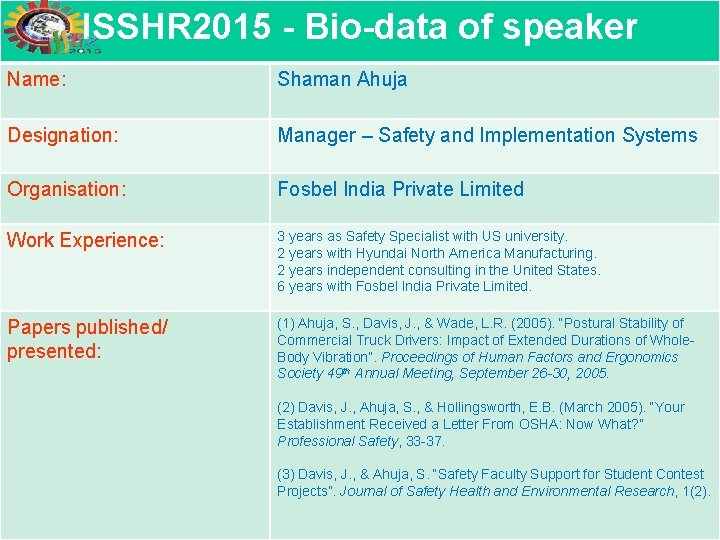
ISSHR 2015 - Bio-data of speaker Name: Shaman Ahuja Designation: Manager – Safety and Implementation Systems Organisation: Fosbel India Private Limited Work Experience: 3 years as Safety Specialist with US university. 2 years with Hyundai North America Manufacturing. 2 years independent consulting in the United States. 6 years with Fosbel India Private Limited. Papers published/ presented: (1) Ahuja, S. , Davis, J. , & Wade, L. R. (2005). “Postural Stability of Commercial Truck Drivers: Impact of Extended Durations of Whole. Body Vibration”. Proceedings of Human Factors and Ergonomics Society 49 th Annual Meeting, September 26 -30, 2005. (2) Davis, J. , Ahuja, S. , & Hollingsworth, E. B. (March 2005). “Your Establishment Received a Letter From OSHA: Now What? ” Professional Safety, 33 -37. (3) Davis, J. , & Ahuja, S. “Safety Faculty Support for Student Contest Projects”. Journal of Safety Health and Environmental Research, 1(2).
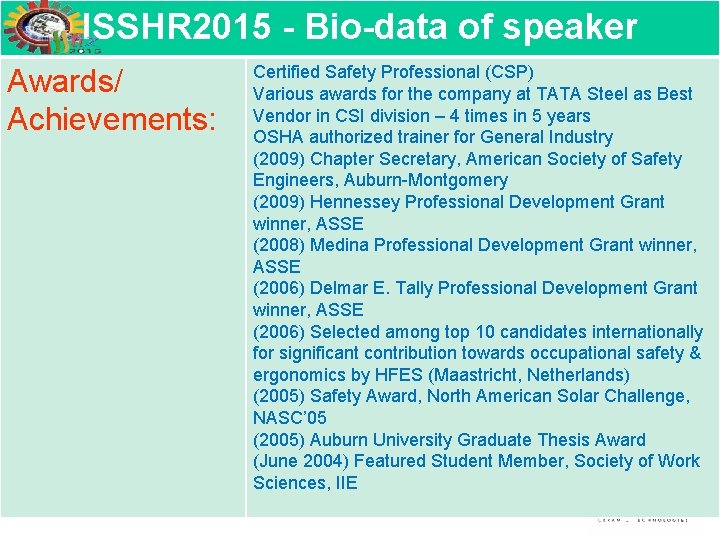
ISSHR 2015 - Bio-data of speaker Awards/ Achievements: Certified Safety Professional (CSP) Various awards for the company at TATA Steel as Best Vendor in CSI division – 4 times in 5 years OSHA authorized trainer for General Industry (2009) Chapter Secretary, American Society of Safety Engineers, Auburn-Montgomery (2009) Hennessey Professional Development Grant winner, ASSE (2008) Medina Professional Development Grant winner, ASSE (2006) Delmar E. Tally Professional Development Grant winner, ASSE (2006) Selected among top 10 candidates internationally for significant contribution towards occupational safety & ergonomics by HFES (Maastricht, Netherlands) (2005) Safety Award, North American Solar Challenge, NASC’ 05 (2005) Auburn University Graduate Thesis Award (June 2004) Featured Student Member, Society of Work Sciences, IIE
Safety @ Fosbel Path to Successful Safety Management Shaman Ahuja, CSP
Agenda • • Introduction Our commitment to safety Risk Management Engineering and Administrative Controls Behind Each Job – WI, JHA, SOP Personal Protective Equipment LIBBS – Employee involvement

Introduction • Fosbel is a world leader in furnace refractory maintenance with over 30 years of service. Various services offered are: – Ceramic Welding – Furnace re-bricking, rebuilding – Condition monitoring – In situ inspections, Anchorage technology – Comprehensive Battery Maintenance (CBM) – Sites in India – RSP, BSL, DSP, ISP, TATA Steel, JSW Bellary and more
Management Commitment • The management commits to promote safety and health consciousness among all employees by training and encouragement. • All employees have a responsibility to themselves, colleagues and customers to work and act in a safe manner, be diligent in recognizing and communicating hazards.
Site Safety Management Structure • On-site safety performance is directly related to leading indicators of business performance. • Safety personnel are deputed at various levels to manage the safety function at site. • Safety structure is assessed based on complexity of project undertaken and risk assessment conducted.
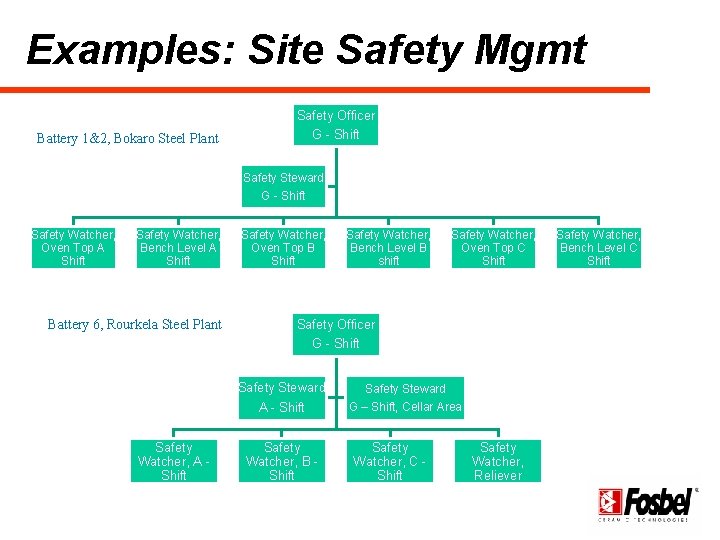
Examples: Site Safety Mgmt Battery 1&2, Bokaro Steel Plant Safety Officer G - Shift Safety Steward G - Shift Safety Watcher, Oven Top A Shift Safety Watcher, Bench Level A Shift Battery 6, Rourkela Steel Plant Safety Watcher, Oven Top B Shift Safety Watcher, Oven Top C Shift Safety Officer G - Shift Safety Steward A - Shift Safety Watcher, Bench Level B shift Safety Watcher, B - Shift Safety Steward G – Shift, Cellar Area Safety Watcher, C - Shift Safety Watcher, Reliever Safety Watcher, Bench Level C Shift
Behind each job - JSQP • JSQP – Job Site Quality Plan – Work Instruction (WI) – Written and pictorial info on how to perform the job based on refractory concerns and other operation parameters – Job Hazard Analysis (JHA) – Risk analysis and controls needed for each step pertaining to Fosbel global safety standards – Standard Operating Procedure (SOP) – Specific to TATA Steel requirements.
Behind each job • Comprehensive Global Safety Standards – Adhere to stringent safety standards applicable to regional laws, regulations and business ethics – Follow Fosbel corporate safety standards or regional standards whichever are more stringent.
Risk Management • Risk management involves 4 steps: – Identification of hazards – Assess risks if necessary – Control risks – Review control measures
Hazard Identification, Assessment and Control Fosbel H&S Program mentions 3 ways to identify hazards: 1. Inspection of workplace a) Walkthrough of work area b) Job specific inspection checklist 2. Consultation with workers a) Talk to employees regarding S&H issues, near misses, etc. b) Find whether previous controls implemented are helpful or not?
Hazard Identification • Review of Records – Workplace incidents, near misses, worker complaints etc. – Results of last inspections and investigations – Get an idea of the trend and root causes where program lacks.
Risk Control & Review • 3 levels of controls are put in place to control risks: – Engineering Controls (Level 1) – Administrative Controls (Level 2) – Personal Protective Equipment (Level 3) • The preference is always to implement Level 1 controls – elimination! • If this not reasonably practicable, reduce the risk by using Level 2&3 controls.
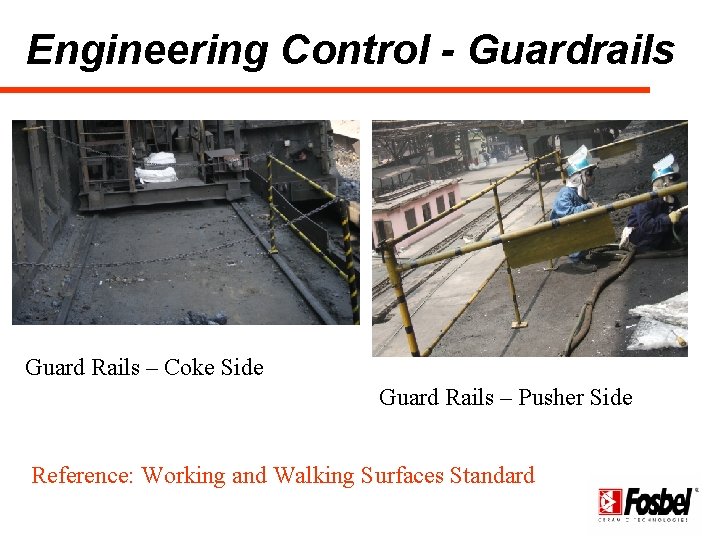
Engineering Control - Guardrails Guard Rails – Coke Side Guard Rails – Pusher Side Reference: Working and Walking Surfaces Standard
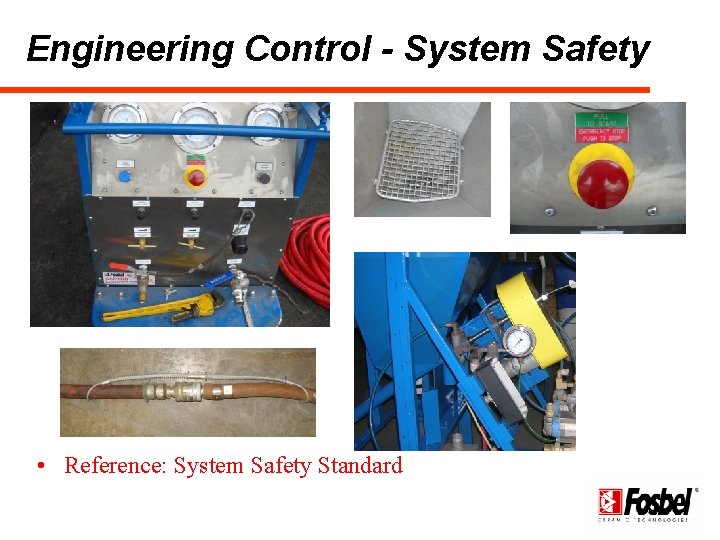
Engineering Control - System Safety • Reference: System Safety Standard
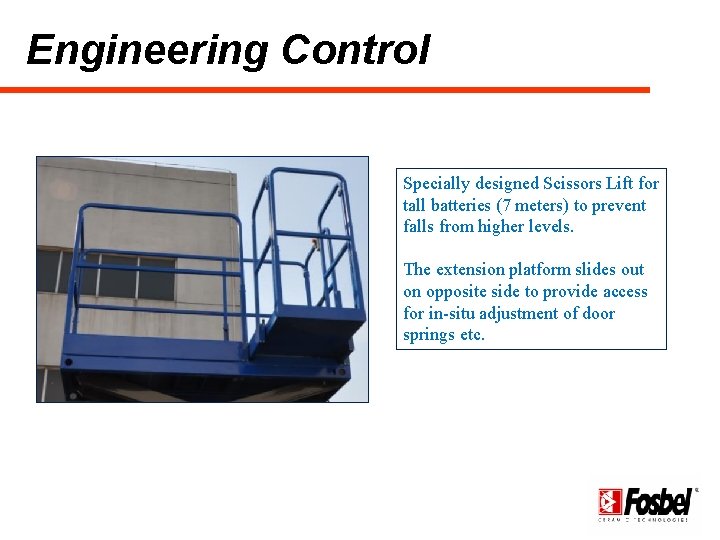
Engineering Control Specially designed Scissors Lift for tall batteries (7 meters) to prevent falls from higher levels. The extension platform slides out on opposite side to provide access for in-situ adjustment of door springs etc.
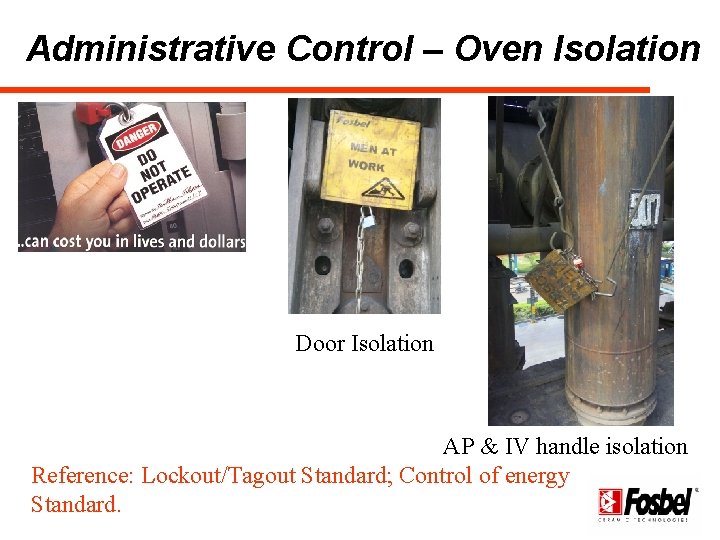
Administrative Control – Oven Isolation Door Isolation AP & IV handle isolation Reference: Lockout/Tagout Standard; Control of energy Standard.
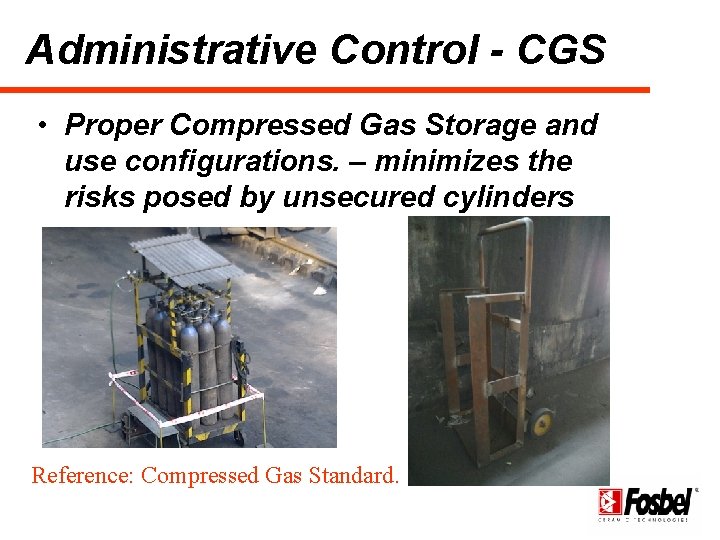
Administrative Control - CGS • Proper Compressed Gas Storage and use configurations. – minimizes the risks posed by unsecured cylinders Reference: Compressed Gas Standard.
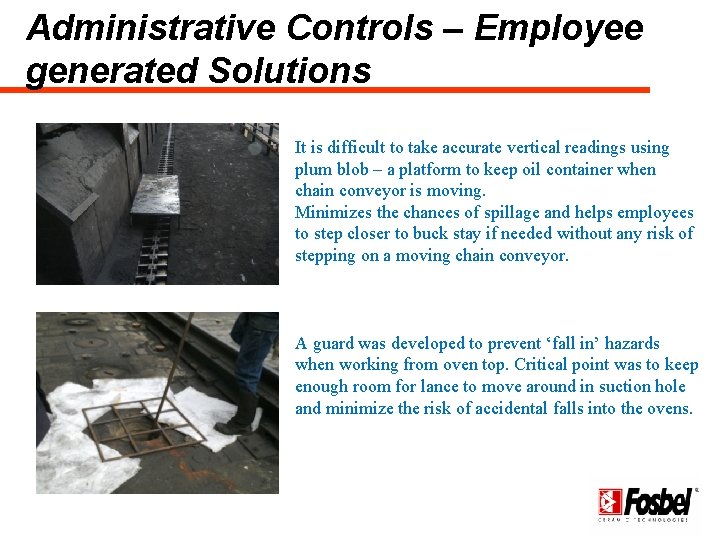
Administrative Controls – Employee generated Solutions It is difficult to take accurate vertical readings using plum blob – a platform to keep oil container when chain conveyor is moving. Minimizes the chances of spillage and helps employees to step closer to buck stay if needed without any risk of stepping on a moving chain conveyor. A guard was developed to prevent ‘fall in’ hazards when working from oven top. Critical point was to keep enough room for lance to move around in suction hole and minimize the risk of accidental falls into the ovens.
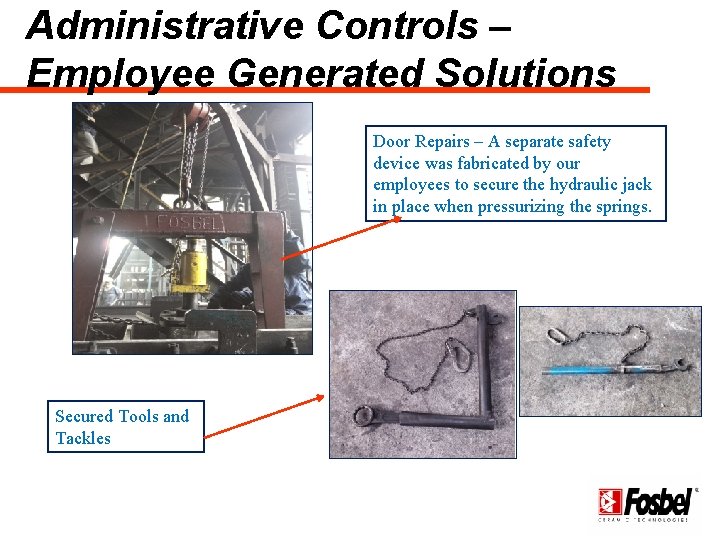
Administrative Controls – Employee Generated Solutions Door Repairs – A separate safety device was fabricated by our employees to secure the hydraulic jack in place when pressurizing the springs. Secured Tools and Tackles
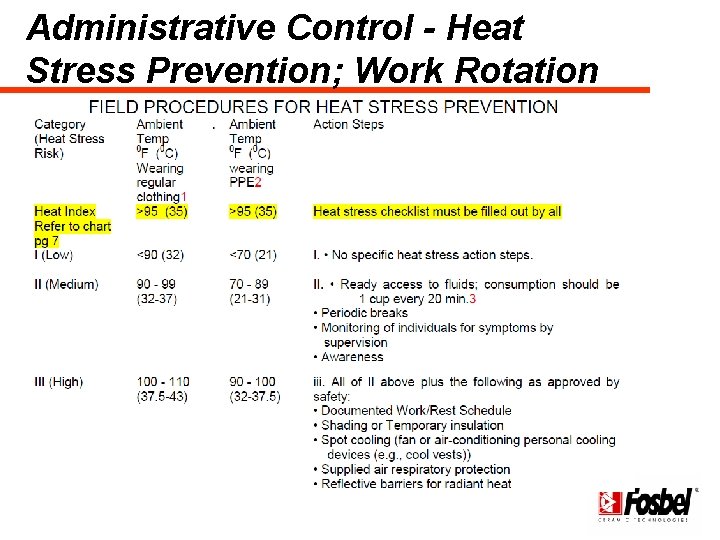
Administrative Control - Heat Stress Prevention; Work Rotation
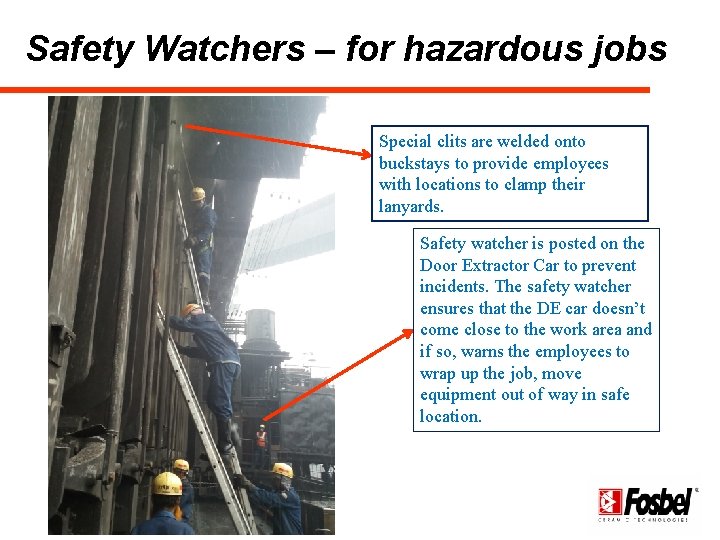
Safety Watchers – for hazardous jobs Special clits are welded onto buckstays to provide employees with locations to clamp their lanyards. Safety watcher is posted on the Door Extractor Car to prevent incidents. The safety watcher ensures that the DE car doesn’t come close to the work area and if so, warns the employees to wrap up the job, move equipment out of way in safe location.
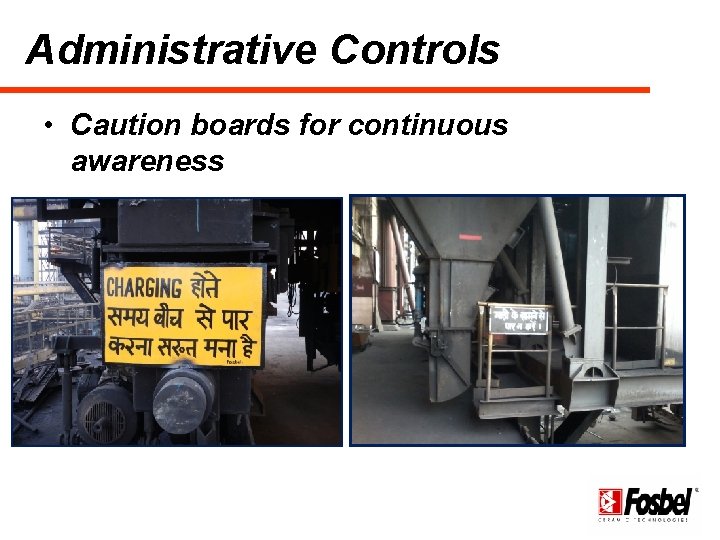
Administrative Controls • Caution boards for continuous awareness
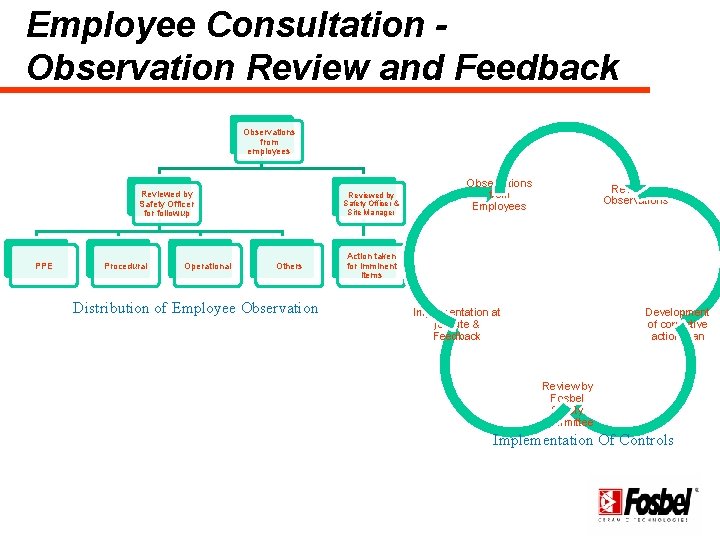
Employee Consultation Observation Review and Feedback Observations from employees Reviewed by Safety Officer followup PPE Procedural Operational Reviewed by Safety Officer & Site Manager Others Distribution of Employee Observations from Employees Review of Observations Action taken for imminent items Implementation at job site & Feedback Development of corrective action plan Review by Fosbel Safety Committee Implementation Of Controls
Personal Protective Equipment - PPE • Superior quality PPE for each employee – As per needs assessment for each job • • FR Clothing OV/AG cartridge respirator Nomex hoods Heat resistant face shields Heat resistant & Flame retardant Kevlar gloves Metatarsal shoes Other PPE as required.
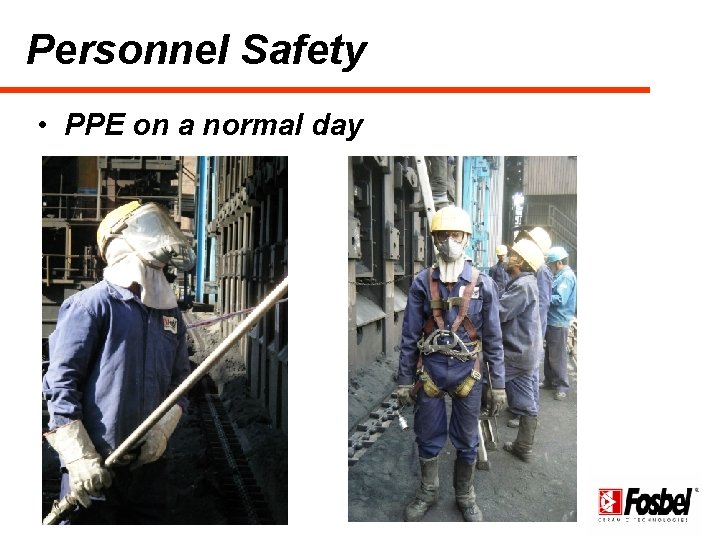
Personnel Safety • PPE on a normal day
Employee Training • Needs assessment • Employee Safety Training – New Employee Safety Orientation – Daily Toolbox Meetings – Weekly Safety Meetings/video trainings • Training durations are also used to discuss: – Hazards identified during inspections – Review of work procedures – Incidents, near misses etc. throughout all sites.
Employee Motivation Programs • Safety Skits by various employee groups – JSW Bellary – July 2015 – TATA Steel – August 2015 • Safety Awareness Campaigns – Bokaro Steel Plant – September 2015 • Safety Slogan Competition – Bokaro Steel Plant – August 2015 • Demonstrations – Fire Extinguishers – All sites in India
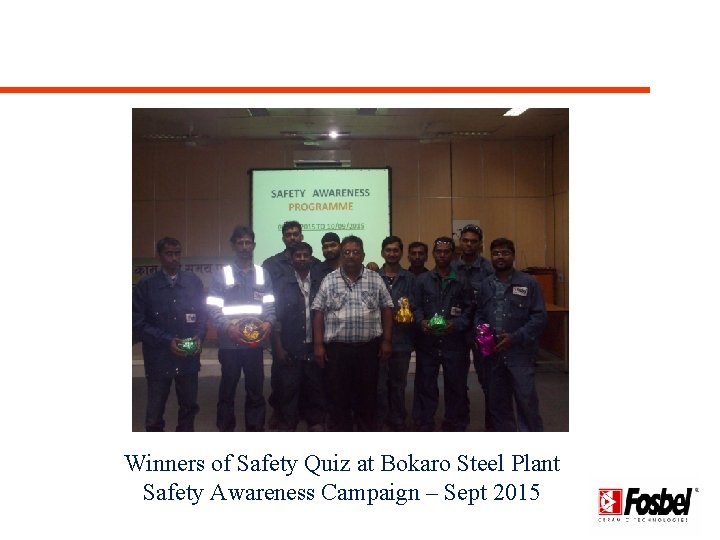
Winners of Safety Quiz at Bokaro Steel Plant Safety Awareness Campaign – Sept 2015
Thank You! Questions ?
- Slides: 31