
Isotope Production at LERF Andrew Hutton Jefferson Lab

Isotope Production at LERF Andrew Hutton Jefferson Lab for Hari Areti, Pavel Degtiarenko, Joe Gubeli, Kevin Jordan, George Kharashvili, George Neil Jefferson Lab Sundaresan Gobalakrishnan, Jamal Zweit Virginia Commonwealth University Doug Wells New Mexico Tech Acc. App’ 17 Quebec City August 1, 2017
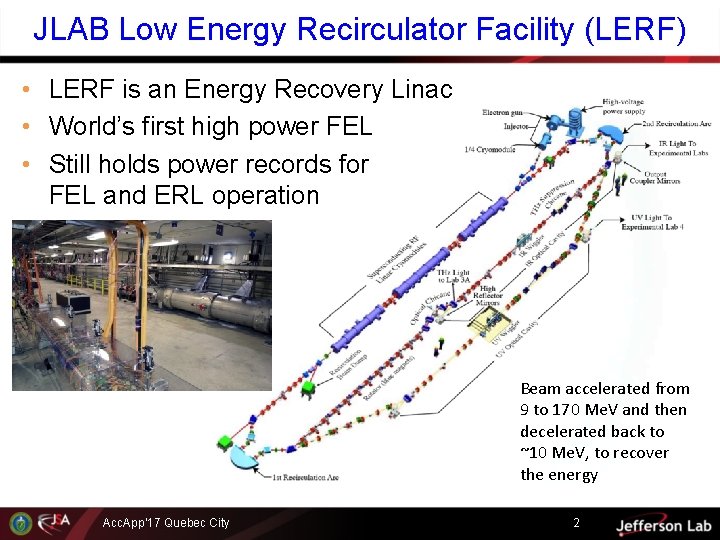
JLAB Low Energy Recirculator Facility (LERF) • LERF is an Energy Recovery Linac • World’s first high power FEL • Still holds power records for FEL and ERL operation 2 Acc. App’ 17 Quebec City Beam accelerated from 9 to 170 Me. V and then decelerated back to ~10 Me. V, to recover the energy 2
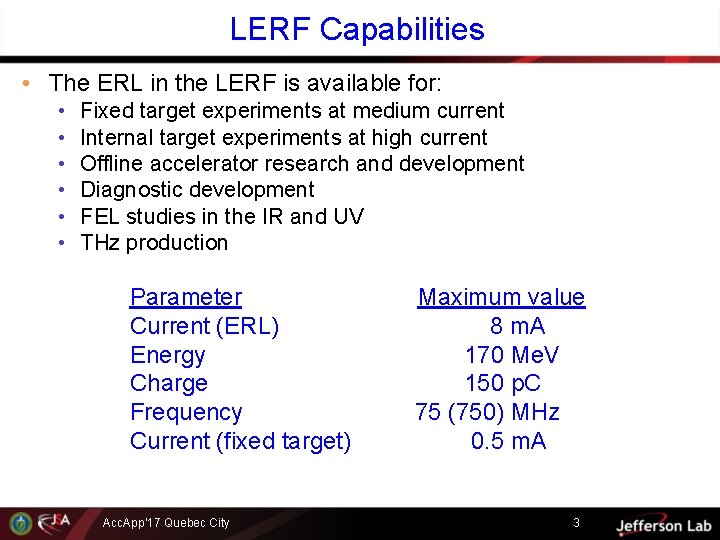
LERF Capabilities • The ERL in the LERF is available for: • • • Fixed target experiments at medium current Internal target experiments at high current Offline accelerator research and development Diagnostic development FEL studies in the IR and UV THz production Parameter Current (ERL) Energy Charge Frequency Current (fixed target) Acc. App’ 17 Quebec City Maximum value 8 m. A 170 Me. V 150 p. C 75 (750) MHz 0. 5 m. A 3
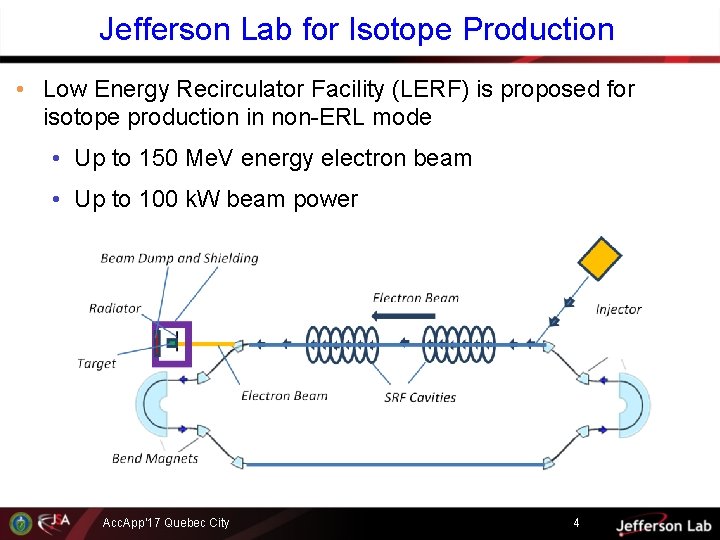
Jefferson Lab for Isotope Production • Low Energy Recirculator Facility (LERF) is proposed for isotope production in non-ERL mode • Up to 150 Me. V energy electron beam • Up to 100 k. W beam power Acc. App’ 17 Quebec City 4
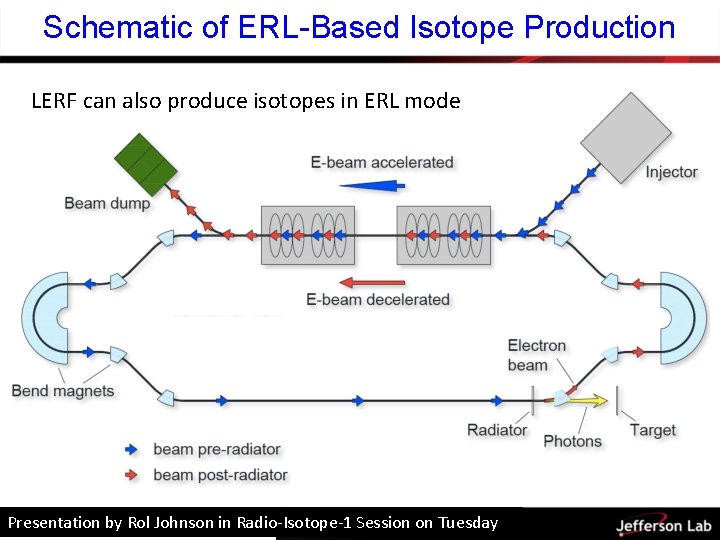
Schematic of ERL-Based Isotope Production LERF can also produce isotopes in ERL mode Presentation by Rol Johnson in Radio-Isotope-1 Session on Tuesday
NSAC Isotopes Recommendations on Isotope R&D • “Continue support for R&D on the production of alpha-emitting radioisotopes” • “Support R&D into the production of high specific activity theranostic radioisotopes” • “Continue support for R&D on the use of electron accelerators for isotope production” This study addresses all of these • “Support R&D on the development of irradiation materials for targets that will be exposed to extreme environments to take full advantage of the current suite of accelerator and reactor irradiation facilities” Acc. App’ 17 Quebec City 6
Isotope Production Collaboration Jefferson Lab: • Hari Areti, Pavel Degtiarenko, George Kharashvili, Joe Gubeli, Kevin Jordan, George Neil • Radiation physics, health physics, Monte-Carlo modeling, radiation metrology, high-power SRF electron accelerators, targetry, beam diagnostics, beam dumps Virginia Commonwealth University: • Jamal Zweit, Sundaresan Gobalakrishnan • Radiochemistry, radiopharmaceuticals, medical imaging, nanotechnology New Mexico Tech: • Doug Wells • Photonuclear physics, activation analysis, isotope production Acc. App’ 17 Quebec City 7
Recent Activities 2012 – Proposal for isotope production using LERF in ERL configuration submitted to DOE Isotope Program • not funded (DE-FOA-000743) 2015 – Pre-R&D Proposal Funded by DOE Isotope Program 2015 – White paper for photoproduction of 67 Cu 2016 – R&D proposal for 67 Cu production – DOE Isotope Program • not funded in 2017, under consideration for 2018 funding -FOA-0001588) (DE 2017 – US patent application: 67 Cu Photoproduction in Gallium 2015/2017 – Proof of concept studies • 67 Cu production in gallium and zinc targets at CEBAF injector • 67 Cu separation from gallium at VCU Acc. App’ 17 Quebec City 8
67 Cu for Targeted Radiotherapy • Theranostic radionuclide • 141 ke. V mean energy β- for therapy (range in tissue is about a cell diameter) • 185 ke. V energy γ for SPECT imaging • Can be paired with 64 Cu for PET imaging • Near-ideal half-life of 61. 8 hours • Convenient for production, transportation, and delivery to patient • Same order as biological half-life of copper and zinc (67 Cu decays to stable 67 Zn) • Favorable biochemistry – approved for human trials • Copper and zinc are essential for structural and functional activities of many proteins, enzymes and transcription factors • Not acutely toxic – both copper and zinc are essential trace nutrients Acc. App’ 17 Quebec City 9
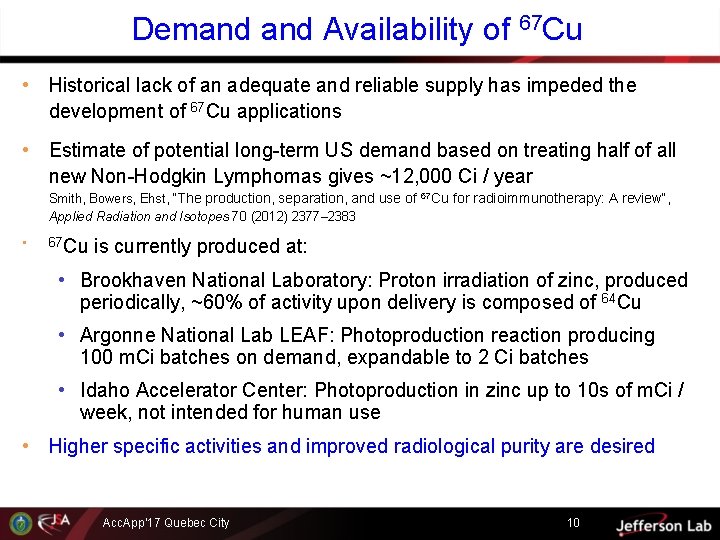
Demand Availability of 67 Cu • Historical lack of an adequate and reliable supply has impeded the development of 67 Cu applications • Estimate of potential long-term US demand based on treating half of all new Non-Hodgkin Lymphomas gives ~12, 000 Ci / year Smith, Bowers, Ehst, “The production, separation, and use of Applied Radiation and Isotopes 70 (2012) 2377– 2383 • 67 Cu for radioimmunotherapy: A review“, is currently produced at: • Brookhaven National Laboratory: Proton irradiation of zinc, produced periodically, ~60% of activity upon delivery is composed of 64 Cu • Argonne National Lab LEAF: Photoproduction reaction producing 100 m. Ci batches on demand, expandable to 2 Ci batches • Idaho Accelerator Center: Photoproduction in zinc up to 10 s of m. Ci / week, not intended for human use • Higher specific activities and improved radiological purity are desired Acc. App’ 17 Quebec City 10
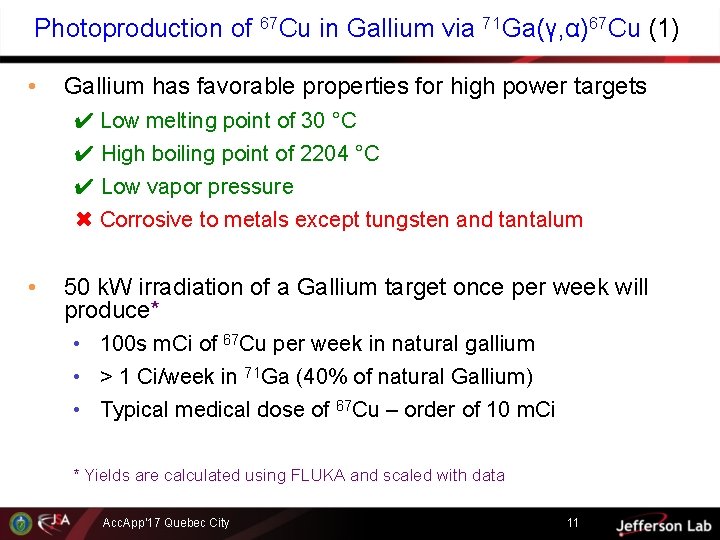
Photoproduction of 67 Cu in Gallium via 71 Ga(γ, α)67 Cu (1) • Gallium has favorable properties for high power targets ✔ Low melting point of 30 °C ✔ High boiling point of 2204 °C ✔ Low vapor pressure ✖ Corrosive to metals except tungsten and tantalum • 50 k. W irradiation of a Gallium target once per week will produce* • 100 s m. Ci of 67 Cu per week in natural gallium • > 1 Ci/week in 71 Ga (40% of natural Gallium) • Typical medical dose of 67 Cu – order of 10 m. Ci * Yields are calculated using FLUKA and scaled with data Acc. App’ 17 Quebec City 11
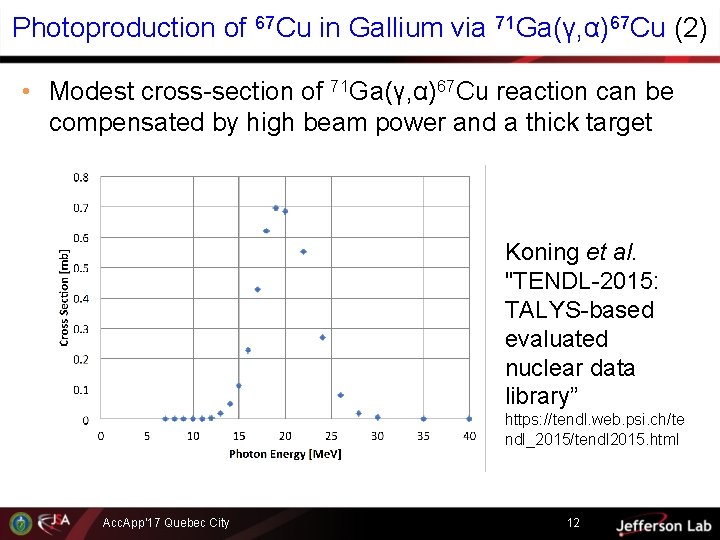
Photoproduction of 67 Cu in Gallium via 71 Ga(γ, α)67 Cu (2) • Modest cross-section of 71 Ga(γ, α)67 Cu reaction can be compensated by high beam power and a thick target Koning et al. "TENDL-2015: TALYS-based evaluated nuclear data library” https: //tendl. web. psi. ch/te ndl_2015/tendl 2015. html Acc. App’ 17 Quebec City 12
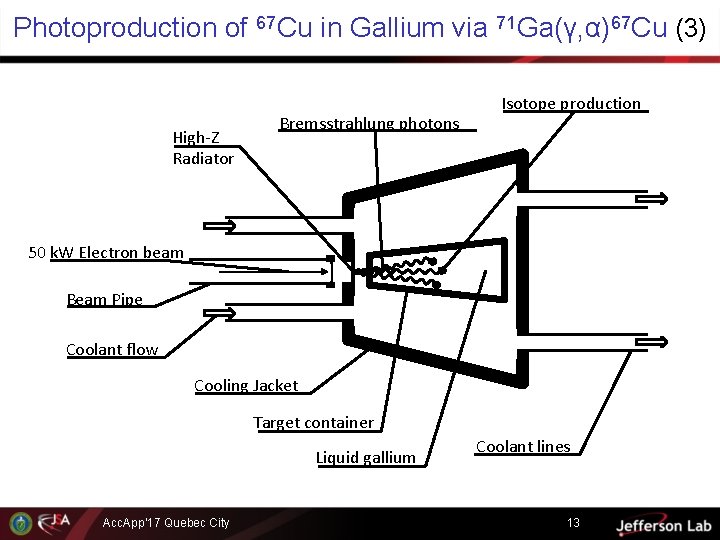
Photoproduction of 67 Cu in Gallium via 71 Ga(γ, α)67 Cu (3) High-Z Radiator Bremsstrahlung photons Isotope production 50 k. W Electron beam Beam Pipe Coolant flow Cooling Jacket Target container Liquid gallium Acc. App’ 17 Quebec City Coolant lines 13
Overall Objectives and First Steps • The overall objective is to integrate • Production • Chemical Separation • Delivery • First (opportunistic) steps • Confirm 67 Cu production in gallium • Chemically separate 67 Cu from gallium • Investigate 67 Cu delivery mechanisms Acc. App’ 17 Quebec City 14
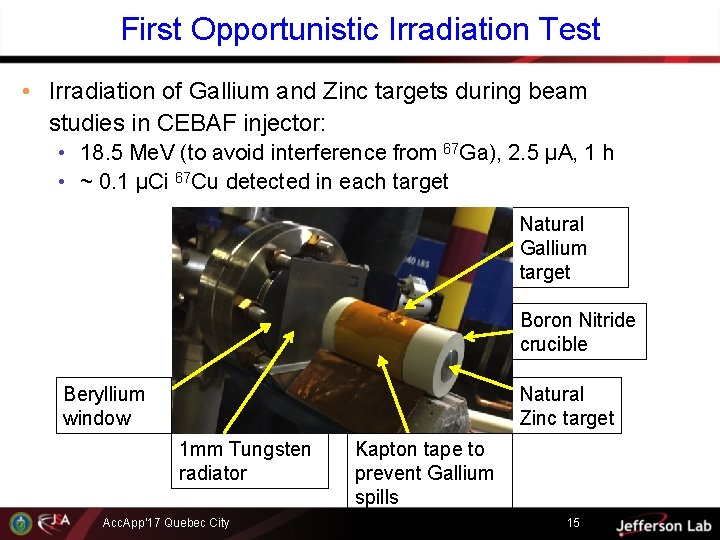
First Opportunistic Irradiation Test • Irradiation of Gallium and Zinc targets during beam studies in CEBAF injector: • 18. 5 Me. V (to avoid interference from 67 Ga), 2. 5 µA, 1 h • ~ 0. 1 µCi 67 Cu detected in each target Natural Gallium target Boron Nitride crucible Natural Zinc target Beryllium window 1 mm Tungsten radiator Acc. App’ 17 Quebec City Kapton tape to prevent Gallium spills 15
Chemical Separation Test • Chemical separation test at Virginia Commonwealth University (VCU) • 1 m. Ci of 67 Cu was obtained from the National Isotope Development Center • Shipped from BNL to VCU • The sample was dissolved in hydrochloric acid and added to gallium chloride in solution • Separation by liquid-liquid extraction and column chromatography recovered ~95% of the radioactive copper after a single pass Acc. App’ 17 Quebec City 16
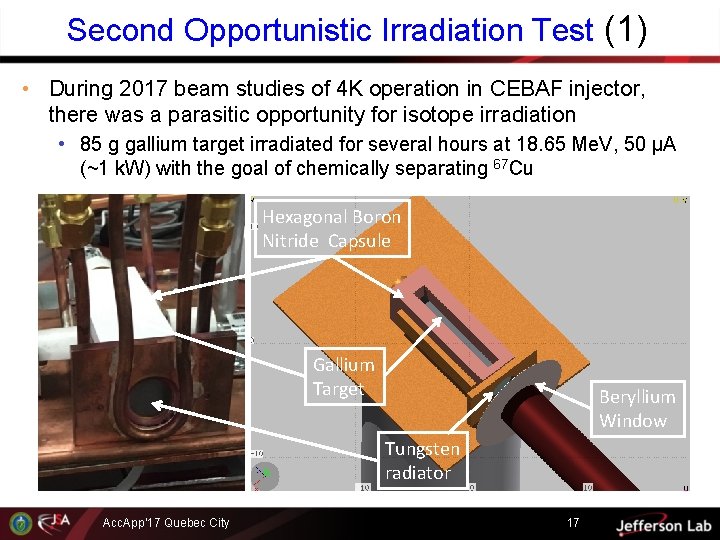
Second Opportunistic Irradiation Test (1) • During 2017 beam studies of 4 K operation in CEBAF injector, there was a parasitic opportunity for isotope irradiation • 85 g gallium target irradiated for several hours at 18. 65 Me. V, 50 µA (~1 k. W) with the goal of chemically separating 67 Cu Hexagonal Boron Nitride Capsule Gallium Target Beryllium Window Tungsten radiator Acc. App’ 17 Quebec City 17
Second Opportunistic Irradiation Test (2) • Due to failure of monitoring instrumentation, run was terminated earlier than anticipated • ~130 µCi 67 Cu was produced, ~70 µCi was available at the time of sample retrieval (aimed to produce ~500 µCi) • Due to transportation and communication issues did not proceed with chemical separation • The two, low-energy irradiation tests showed reasonable agreement with the model predictions • FLUKA (our primary tool for activation calculations) appears to overestimate 67 Cu yields in Gallium by approximately a factor of 2 at 18. 5 Me. V maximum bremsstrahlung energy Acc. App’ 17 Quebec City 18
Summary and Proposed Future Work • 67 Cu production via the 71 Ga(γ, α)67 Cu reaction at LERF: Production of high specific activity, theranostic isotope using a high-power electron accelerator ✔ Measured photoproduction of 67 Cu at low energies (< 20 Me. V) • No 64 Cu content detected ✔ Chemically separated 67 Cu from Gallium • Obtained from BNL, then dissolved in Gallium • Proposed future work • Complete smooth integration of photoproduction and chemical separation • Produce 67 Cu in Gallium target at optimal electron beam energies (> 30 Me. V) • Develop high power target system • Investigate photoproduction of α-emitters • 225 Ac production in 226 Ra, 230 Th, 232 Th targets Acc. App’ 17 Quebec City 19
- Slides: 19