
ISOM 2000 the map standard and misinterpretations Lszl
- Slides: 35
ISOM 2000 (the map standard and misinterpretations) László Zentai Map Commission http: //lazarus. elte. hu/mc ISOM 2000 (the map standard and misinterpretations) IOF Event Advisor’s Clinic April 19 -21. 2002, Brno, Czech Republic
Topics: • ISOM 2000 • Report on World Ranking Event maps 2001 • Sprint o-map specification ISOM 2000 (the map standard and misinterpretations) IOF Event Advisor’s Clinic April 19 -21. 2002, Brno, Czech Republic
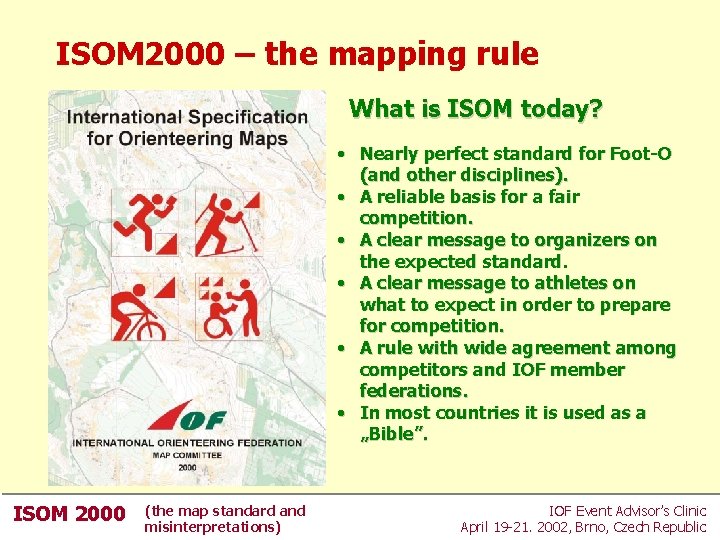
ISOM 2000 – the mapping rule What is ISOM today? • Nearly perfect standard for Foot-O (and other disciplines). • A reliable basis for a fair competition. • A clear message to organizers on the expected standard. • A clear message to athletes on what to expect in order to prepare for competition. • A rule with wide agreement among competitors and IOF member federations. • In most countries it is used as a „Bible”. ISOM 2000 (the map standard and misinterpretations) IOF Event Advisor’s Clinic April 19 -21. 2002, Brno, Czech Republic
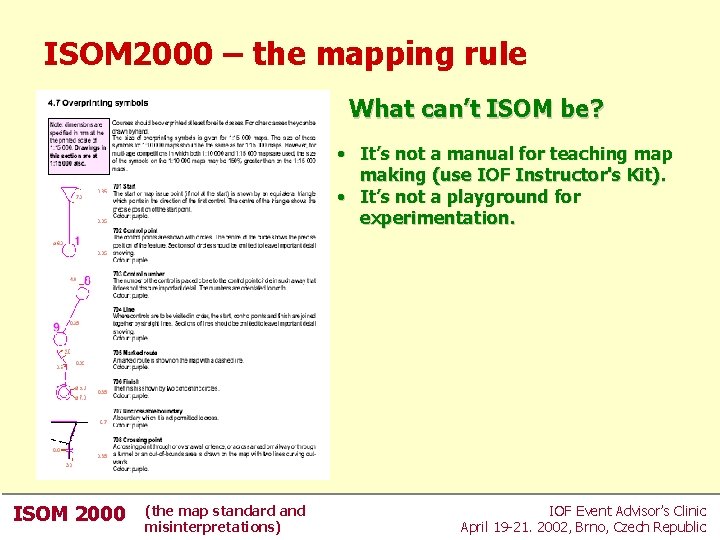
ISOM 2000 – the mapping rule What can’t ISOM be? • It’s not a manual for teaching map making (use IOF Instructor's Kit). • It’s not a playground for experimentation. ISOM 2000 (the map standard and misinterpretations) IOF Event Advisor’s Clinic April 19 -21. 2002, Brno, Czech Republic
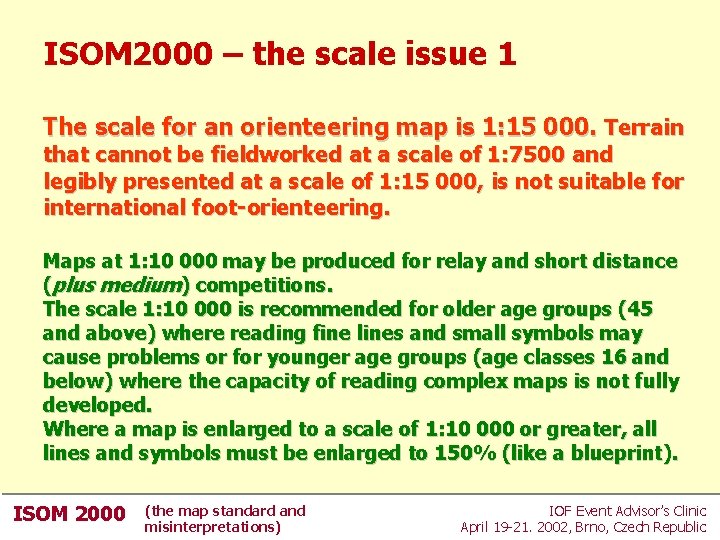
ISOM 2000 – the scale issue 1 The scale for an orienteering map is 1: 15 000. Terrain that cannot be fieldworked at a scale of 1: 7500 and legibly presented at a scale of 1: 15 000, is not suitable for international foot-orienteering. Maps at 1: 10 000 may be produced for relay and short distance (plus medium) competitions. The scale 1: 10 000 is recommended for older age groups (45 and above) where reading fine lines and small symbols may cause problems or for younger age groups (age classes 16 and below) where the capacity of reading complex maps is not fully developed. Where a map is enlarged to a scale of 1: 10 000 or greater, all lines and symbols must be enlarged to 150% (like a blueprint). ISOM 2000 (the map standard and misinterpretations) IOF Event Advisor’s Clinic April 19 -21. 2002, Brno, Czech Republic
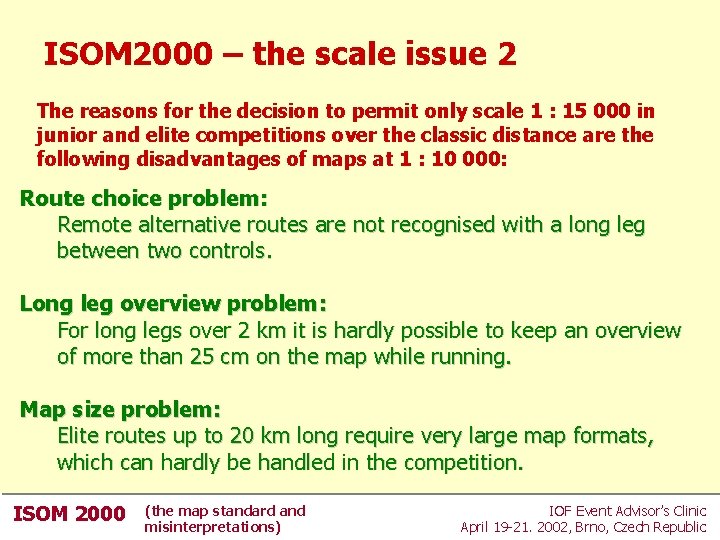
ISOM 2000 – the scale issue 2 The reasons for the decision to permit only scale 1 : 15 000 in junior and elite competitions over the classic distance are the following disadvantages of maps at 1 : 10 000: Route choice problem: Remote alternative routes are not recognised with a long leg between two controls. Long leg overview problem: For long legs over 2 km it is hardly possible to keep an overview of more than 25 cm on the map while running. Map size problem: Elite routes up to 20 km long require very large map formats, which can hardly be handled in the competition. ISOM 2000 (the map standard and misinterpretations) IOF Event Advisor’s Clinic April 19 -21. 2002, Brno, Czech Republic
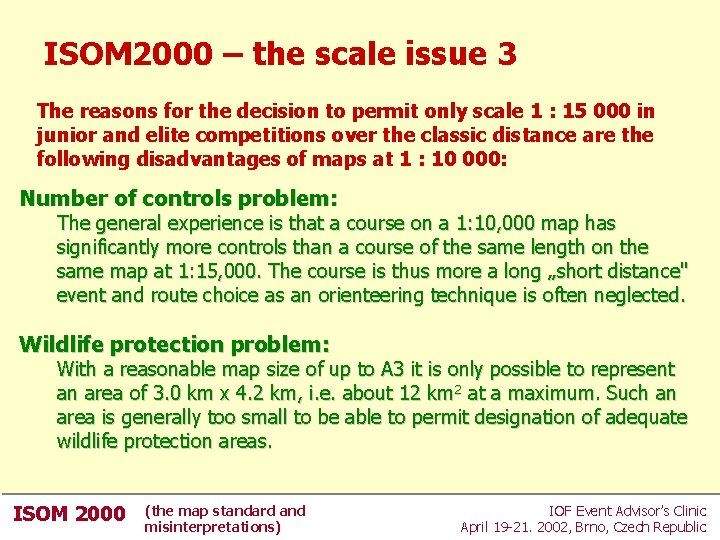
ISOM 2000 – the scale issue 3 The reasons for the decision to permit only scale 1 : 15 000 in junior and elite competitions over the classic distance are the following disadvantages of maps at 1 : 10 000: Number of controls problem: The general experience is that a course on a 1: 10, 000 map has significantly more controls than a course of the same length on the same map at 1: 15, 000. The course is thus more a long „ short distance" event and route choice as an orienteering technique is often neglected. Wildlife protection problem: With a reasonable map size of up to A 3 it is only possible to represent an area of 3. 0 km x 4. 2 km, i. e. about 12 km 2 at a maximum. Such an area is generally too small to be able to permit designation of adequate wildlife protection areas. ISOM 2000 (the map standard and misinterpretations) IOF Event Advisor’s Clinic April 19 -21. 2002, Brno, Czech Republic
ISOM 2000 – introduction These specifications (ISOM 2000) should be read in conjunction with the rules for IOF orienteering events. For IOF events (WOC, JWOC, WMOC, WRE) deviations are permissible only with the sanction of the IOF Map Commission (IOF MC). For other events such sanction must be given by the national federation. In addition, there are supplementary specifications for other orienteering disciplines on the basis of the specification for foot orienteering maps. ISOM 2000 (the map standard and misinterpretations) IOF Event Advisor’s Clinic April 19 -21. 2002, Brno, Czech Republic
ISOM 2000 – general requirements In the ideal case no competitor should gain an advantage or suffer a disadvantage because of faults on the map. For the mapmaker, the task is knowing which features to map and how to represent them. A continuing involvement in the sport is important for a basic understanding of the requirements for the orienteering map: its content, the need for accuracy, the level of detail and above all the need for legibility. ISOM 2000 (the map standard and misinterpretations) IOF Event Advisor’s Clinic April 19 -21. 2002, Brno, Czech Republic
Printing techniques Colour copiers, printers and other digital printing equipment are not yet suitable for printing orienteering maps for high level competitions. It is very difficult to achieve the line quality, legibility and colour appearance of traditional spot colour offset printed maps using this kind of equipment. It is expected that the continuing development of computer technology will lead to the possibility of using alternative printing methods with quality suitable for large competitions. Most printing devices use a 4 -colour technique (CMYK). For such devices the same colour settings as recommended for 4 colour offset printing may be suitable, but the colour appearance will vary slightly from one device to another and from one paper quality to another. ISOM 2000 (the map standard and misinterpretations) IOF Event Advisor’s Clinic April 19 -21. 2002, Brno, Czech Republic
The Event Advisor is not necessarily an experienced o-mapper, but he/she must be capable to judge the map quality. The advisor must be able to make the mapping rules strictly kept to guarantee the fair competition for each runner. Think globally, not locally. ISOM 2000 (the map standard and misinterpretations) IOF Event Advisor’s Clinic April 19 -21. 2002, Brno, Czech Republic
The mapping process and the role of the IOF Event Advisor In the ideal case the Advisor can influence some processes: q In connection with the mapping process: • choosing fair terrain (no advantage for local competitors); • choosing the mappers (international experience); • guarantee the map quality (national map controller). ISOM 2000 (the map standard and misinterpretations) IOF Event Advisor’s Clinic April 19 -21. 2002, Brno, Czech Republic
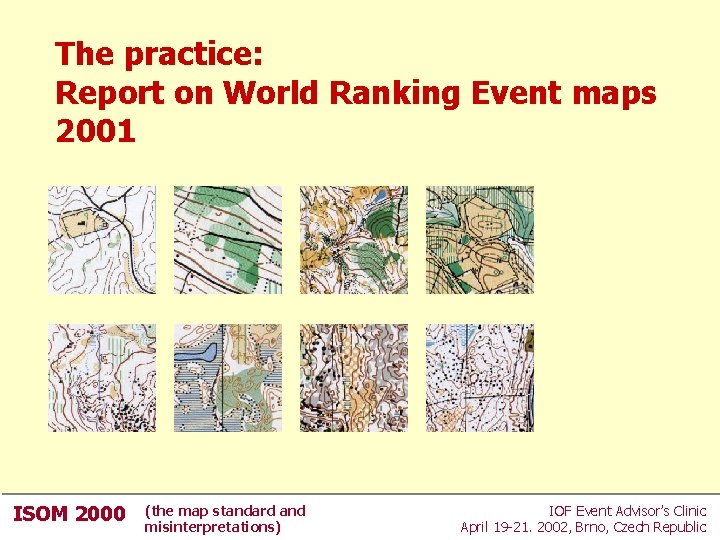
The practice: Report on World Ranking Event maps 2001 ISOM 2000 (the map standard and misinterpretations) IOF Event Advisor’s Clinic April 19 -21. 2002, Brno, Czech Republic
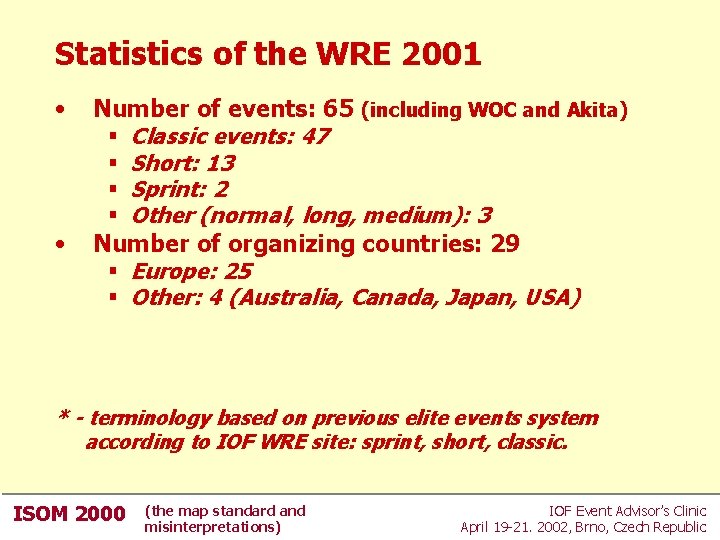
Statistics of the WRE 2001 • • Number of events: 65 (including WOC and Akita) § Classic events: 47 § Short: 13 § Sprint: 2 § Other (normal, long, medium): 3 Number of organizing countries: 29 § Europe: 25 § Other: 4 (Australia, Canada, Japan, USA) * - terminology based on previous elite events system according to IOF WRE site: sprint, short, classic. ISOM 2000 (the map standard and misinterpretations) IOF Event Advisor’s Clinic April 19 -21. 2002, Brno, Czech Republic
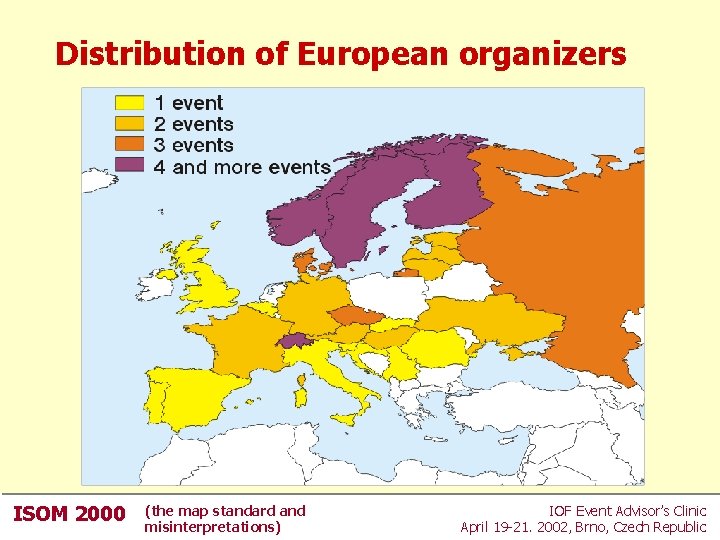
Distribution of European organizers ISOM 2000 (the map standard and misinterpretations) IOF Event Advisor’s Clinic April 19 -21. 2002, Brno, Czech Republic
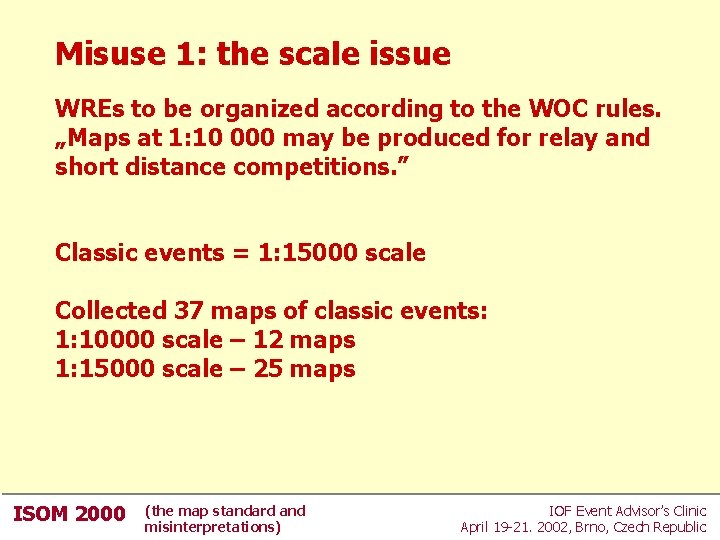
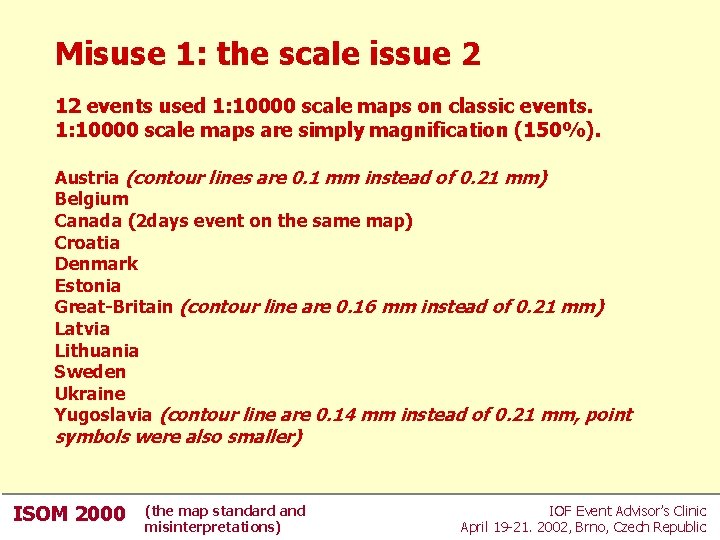
Misuse 1: the scale issue WREs to be organized according to the WOC rules. „Maps at 1: 10 000 may be produced for relay and short distance competitions. ” Classic events = 1: 15000 scale Collected 37 maps of classic events: 1: 10000 scale – 12 maps 1: 15000 scale – 25 maps ISOM 2000 (the map standard and misinterpretations) IOF Event Advisor’s Clinic April 19 -21. 2002, Brno, Czech Republic
Misuse 1: the scale issue 2 12 events used 1: 10000 scale maps on classic events. 1: 10000 scale maps are simply magnification (150%). Austria (contour lines are 0. 1 mm instead of 0. 21 mm) Belgium Canada (2 days event on the same map) Croatia Denmark Estonia Great-Britain (contour line are 0. 16 mm instead of 0. 21 mm) Latvia Lithuania Sweden Ukraine Yugoslavia (contour line are 0. 14 mm instead of 0. 21 mm, point symbols were also smaller) ISOM 2000 (the map standard and misinterpretations) IOF Event Advisor’s Clinic April 19 -21. 2002, Brno, Czech Republic
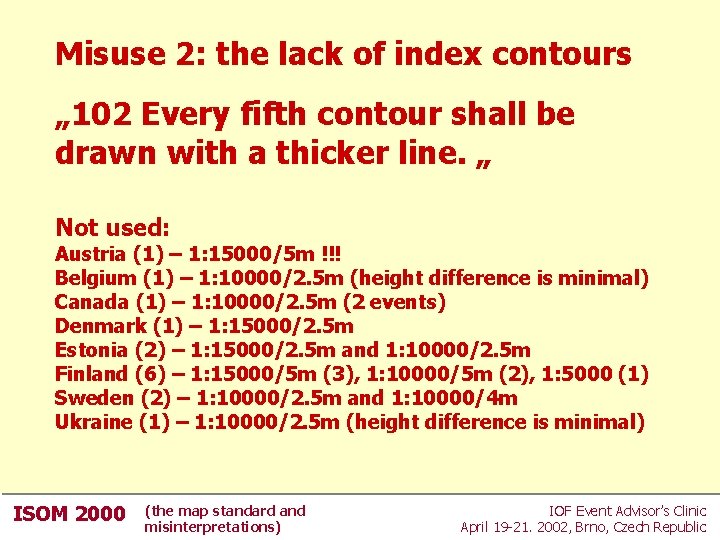
Misuse 2: the lack of index contours „ 102 Every fifth contour shall be drawn with a thicker line. „ Not used: Austria (1) – 1: 15000/5 m !!! Belgium (1) – 1: 10000/2. 5 m (height difference is minimal) Canada (1) – 1: 10000/2. 5 m (2 events) Denmark (1) – 1: 15000/2. 5 m Estonia (2) – 1: 15000/2. 5 m and 1: 10000/2. 5 m Finland (6) – 1: 15000/5 m (3), 1: 10000/5 m (2), 1: 5000 (1) Sweden (2) – 1: 10000/2. 5 m and 1: 10000/4 m Ukraine (1) – 1: 10000/2. 5 m (height difference is minimal) ISOM 2000 (the map standard and misinterpretations) IOF Event Advisor’s Clinic April 19 -21. 2002, Brno, Czech Republic
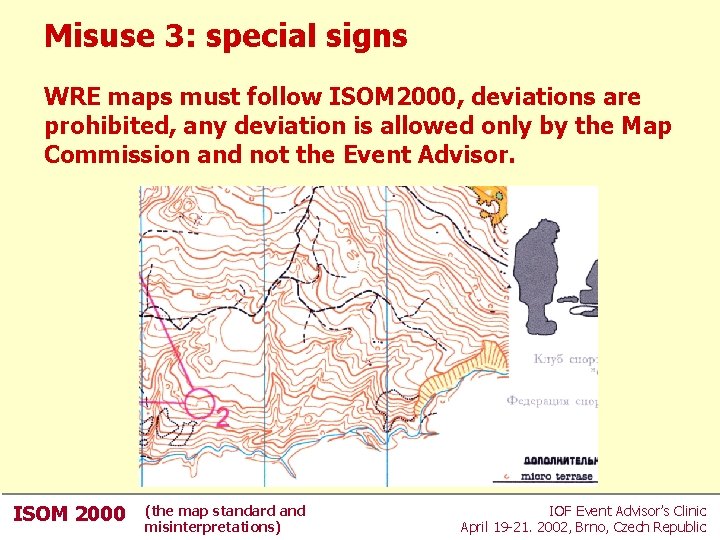
Misuse 3: special signs WRE maps must follow ISOM 2000, deviations are prohibited, any deviation is allowed only by the Map Commission and not the Event Advisor. ISOM 2000 (the map standard and misinterpretations) IOF Event Advisor’s Clinic April 19 -21. 2002, Brno, Czech Republic
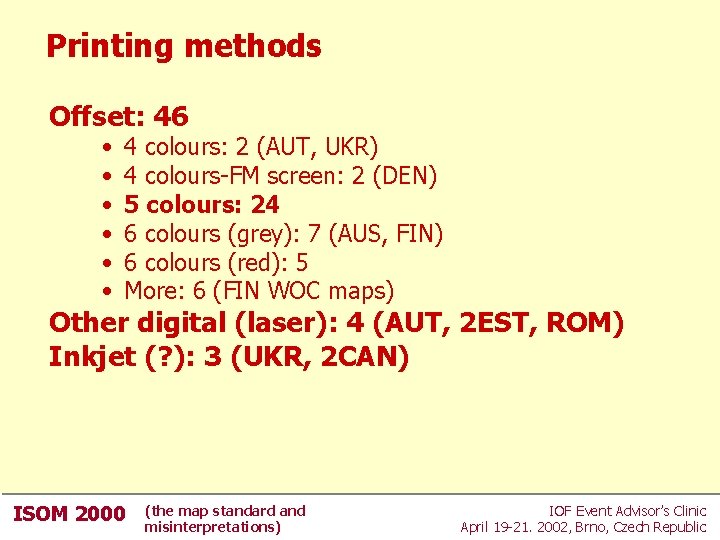
Printing methods Offset: 46 • • • 4 colours: 2 (AUT, UKR) 4 colours-FM screen: 2 (DEN) 5 colours: 24 6 colours (grey): 7 (AUS, FIN) 6 colours (red): 5 More: 6 (FIN WOC maps) Other digital (laser): 4 (AUT, 2 EST, ROM) Inkjet (? ): 3 (UKR, 2 CAN) ISOM 2000 (the map standard and misinterpretations) IOF Event Advisor’s Clinic April 19 -21. 2002, Brno, Czech Republic
Printing methods 2 „Other printing methods may be used, if colours and line width have the same quality as printing with spot colours (brown, black, green, yellow, blue). ” (ISOM 2000) Alternative printing methods are not suitable for international events: for local events and for disciplines like MBO, ski-o and trail-o. ISOM 2000 (the map standard and misinterpretations) IOF Event Advisor’s Clinic April 19 -21. 2002, Brno, Czech Republic
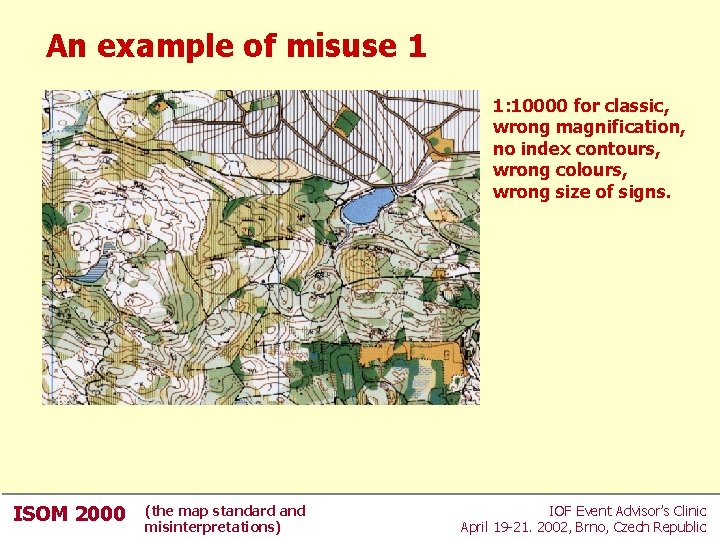
An example of misuse 1 1: 10000 for classic, wrong magnification, no index contours, wrong colours, wrong size of signs. ISOM 2000 (the map standard and misinterpretations) IOF Event Advisor’s Clinic April 19 -21. 2002, Brno, Czech Republic
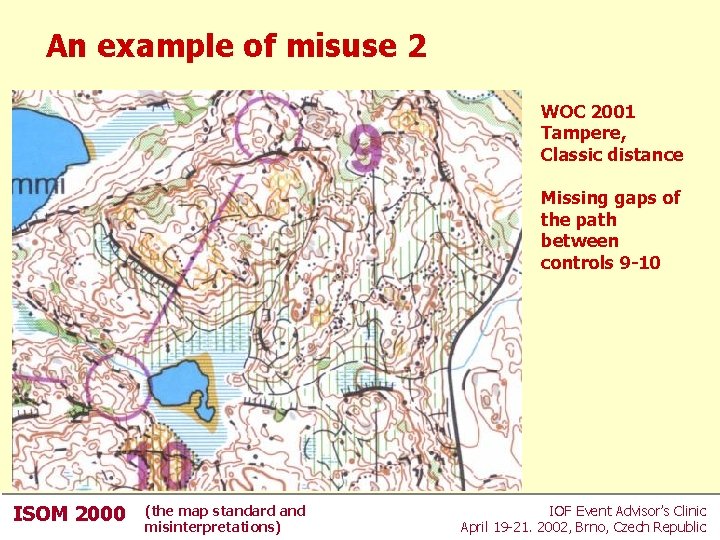
An example of misuse 2 WOC 2001 Tampere, Classic distance Missing gaps of the path between controls 9 -10 ISOM 2000 (the map standard and misinterpretations) IOF Event Advisor’s Clinic April 19 -21. 2002, Brno, Czech Republic
International Specification for Sprint (Urban) Orienteering Maps Antecedents: • ISOM 2000: only park orienteering – not rules, just guideline. • Leibnitz convention: IOF Congress, 2000. • Elite Event Group suggestion (yearly WOC, new structure: sprint is added) accepted in Tampere, 2001. The specification is still a proposal, but the Map Commission is working on it. ISOM 2000 (the map standard and misinterpretations) IOF Event Advisor’s Clinic April 19 -21. 2002, Brno, Czech Republic
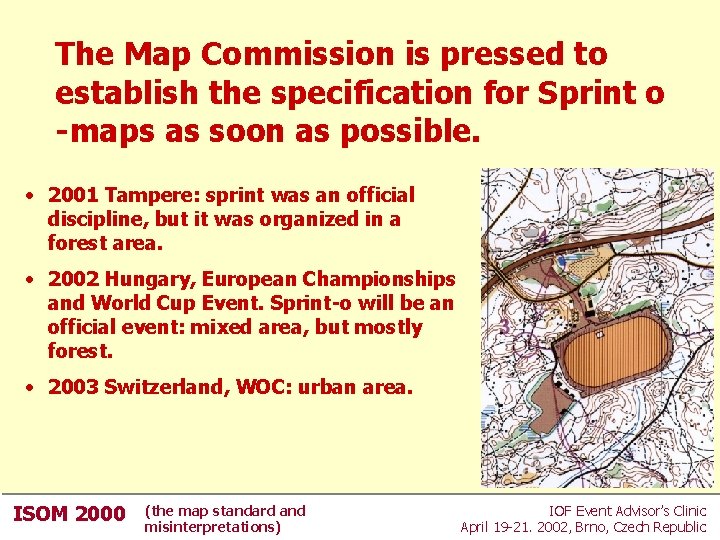
The Map Commission is pressed to establish the specification for Sprint o -maps as soon as possible. • 2001 Tampere: sprint was an official discipline, but it was organized in a forest area. • 2002 Hungary, European Championships and World Cup Event. Sprint-o will be an official event: mixed area, but mostly forest. • 2003 Switzerland, WOC: urban area. ISOM 2000 (the map standard and misinterpretations) IOF Event Advisor’s Clinic April 19 -21. 2002, Brno, Czech Republic
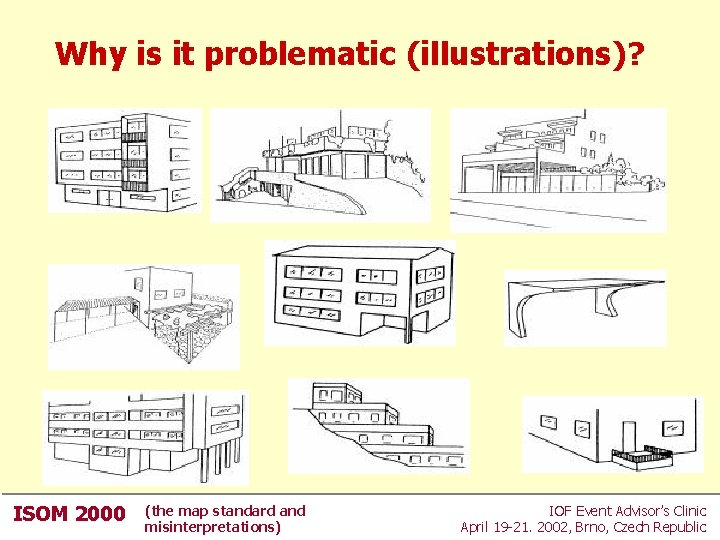
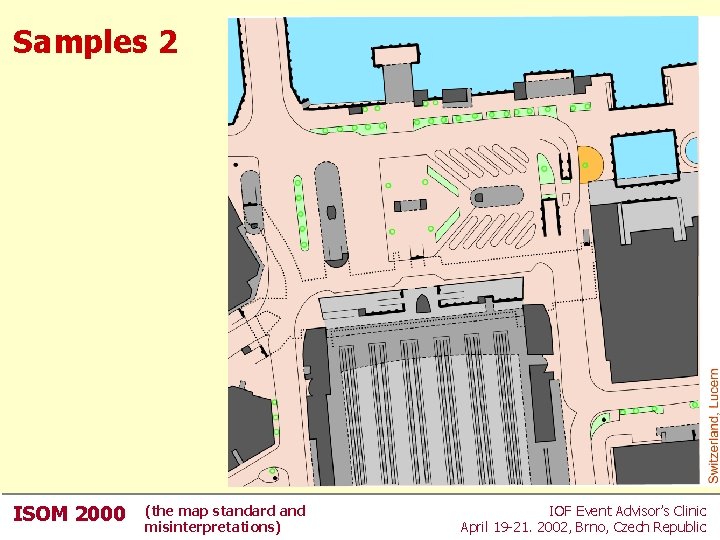
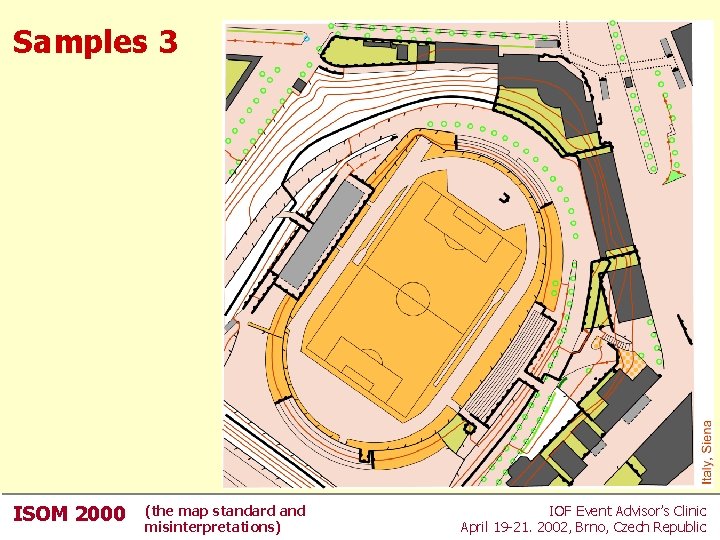
Why is it problematic? The integration of urban areas into the arena of orienteering sports causes some major problems from a cartographical point of view. • The urban terrain differs completely from the classical forest terrain. Especially in the center of old downtowns, the degree of details can be much higher then in a forest. • The urban areas, generally paved areas, permit very high running speed. However, in urban area, they’re also many restrictions (forbidden or dangerous areas), which runners must take into consideration; • The short distances / sprint (2. 5 to 4. 0 km) permit the use of large scale within the range of 1: 2000 - 1: 5000. ISOM 2000 (the map standard and misinterpretations) IOF Event Advisor’s Clinic April 19 -21. 2002, Brno, Czech Republic
Why is it problematic (illustrations)? ISOM 2000 (the map standard and misinterpretations) IOF Event Advisor’s Clinic April 19 -21. 2002, Brno, Czech Republic
The timeline of the process • Working Draft (Winter 2002) • Candidate Recommendation (Spring 2002), implementation into map project • Proposed Recommendation (Fall 2002) • Recommendation (February 2003) ISOM 2000 (the map standard and misinterpretations) IOF Event Advisor’s Clinic April 19 -21. 2002, Brno, Czech Republic
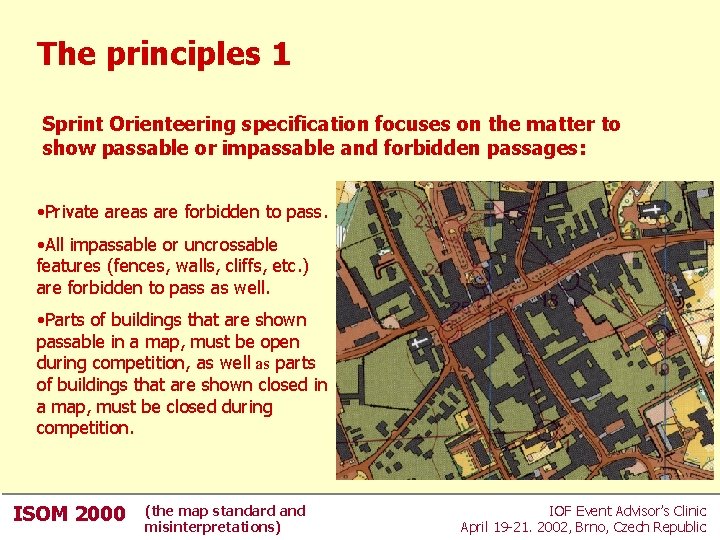
The principles 1 Sprint Orienteering specification focuses on the matter to show passable or impassable and forbidden passages: • Private areas are forbidden to pass. • All impassable or uncrossable features (fences, walls, cliffs, etc. ) are forbidden to pass as well. • Parts of buildings that are shown passable in a map, must be open during competition, as well as parts of buildings that are shown closed in a map, must be closed during competition. ISOM 2000 (the map standard and misinterpretations) IOF Event Advisor’s Clinic April 19 -21. 2002, Brno, Czech Republic
The principles 2 The following restrictions have to be mentioned in urban areas: • An International Sprint Orienteering event may not take place in the underground (e. g. cellars, underground buildings) or in buildings (indoor). Therefore, just the main level is shown on a map. • However, important underground passages (e. g. lighted tunnel, underpass), which are important for the runners must be shown in a map. • Traffic must be taken into consideration in urban areas. The organizers are responsible for the runner’s safety. They have to do everything, what is reasonable to prevent accidents (e. g. close roads or restrict traffic). If this is not possible, the chosen area is not suitable for sprint orienteering. ISOM 2000 (the map standard and misinterpretations) IOF Event Advisor’s Clinic April 19 -21. 2002, Brno, Czech Republic
The principles 3 The scale 1: 4000 or 1: 5000 can be used. Scale 1: 4000 is recommended for old and/or narrow downtowns. According to the certain scale, the contour interval must be adopted. In general, the contour interval value should be 2 m for 1: 4000 or 2. 5 m for 1. 5000. The minimum dimension of a features in a map is 2 x 2 m in its projection. An object smaller than 2 x 2 m can be shown if it’s very visible or high. ISOM 2000 (the map standard and misinterpretations) IOF Event Advisor’s Clinic April 19 -21. 2002, Brno, Czech Republic
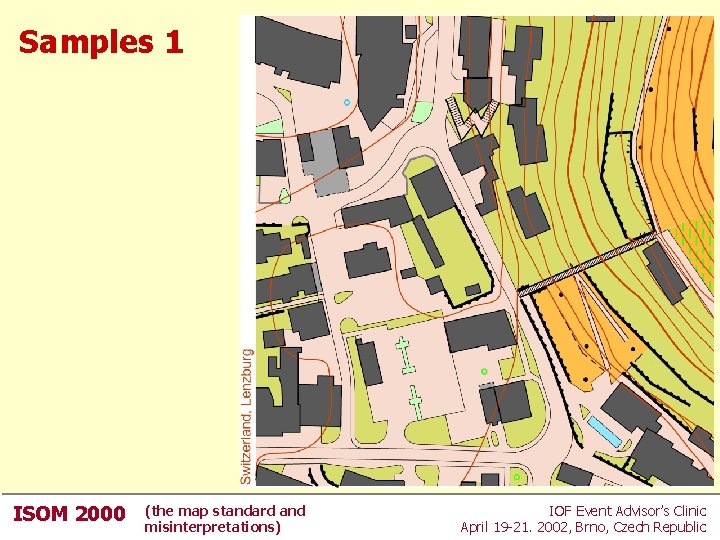
Samples 1 ISOM 2000 (the map standard and misinterpretations) IOF Event Advisor’s Clinic April 19 -21. 2002, Brno, Czech Republic
Samples 2 ISOM 2000 (the map standard and misinterpretations) IOF Event Advisor’s Clinic April 19 -21. 2002, Brno, Czech Republic
Samples 3 ISOM 2000 (the map standard and misinterpretations) IOF Event Advisor’s Clinic April 19 -21. 2002, Brno, Czech Republic
THE END Thank you for your attention László Zentai Map Commission http: //lazarus. elte. hu/mc ISOM 2000 (the map standard and misinterpretations) IOF Event Advisor’s Clinic April 19 -21. 2002, Brno, Czech Republic