
ISOLDE Nuclear Reaction and Nuclear Structure Course Fusion
- Slides: 35
ISOLDE Nuclear Reaction and Nuclear Structure Course Fusion reaction at low energy A. Di Pietro 1
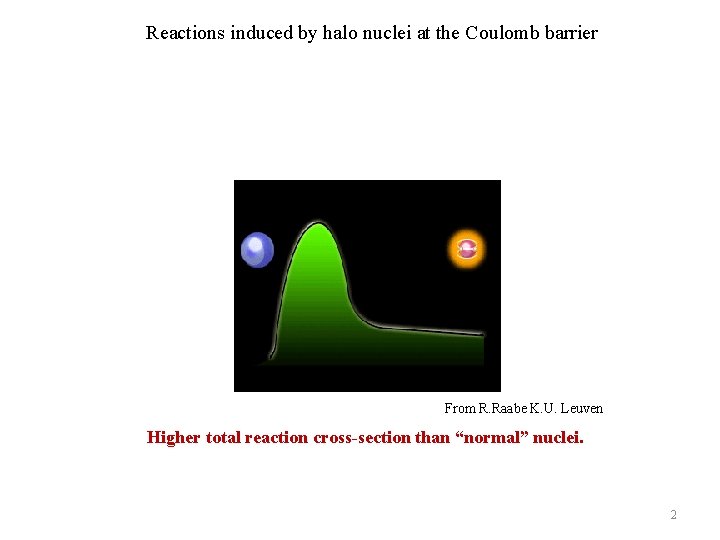
Reactions induced by halo nuclei at the Coulomb barrier From R. Raabe K. U. Leuven Higher total reaction cross-section than “normal” nuclei. 2
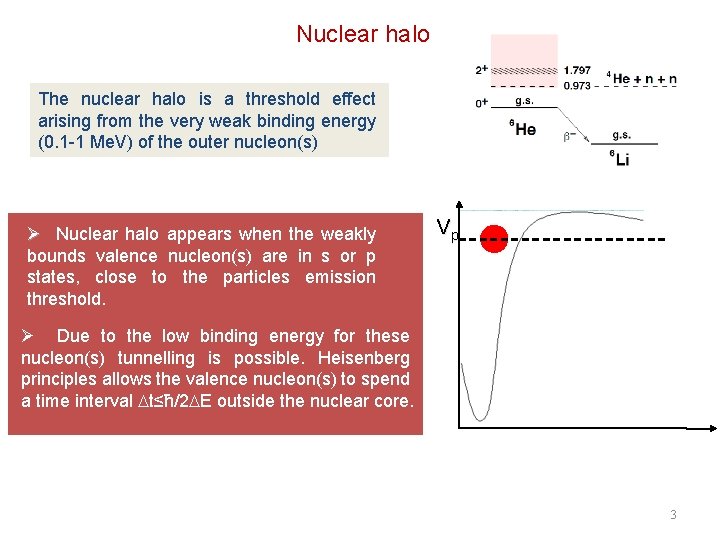
Nuclear halo The nuclear halo is a threshold effect arising from the very weak binding energy (0. 1 -1 Me. V) of the outer nucleon(s) Ø Nuclear halo appears when the weakly bounds valence nucleon(s) are in s or p states, close to the particles emission threshold. Vp Ø Due to the low binding energy for these nucleon(s) tunnelling is possible. Heisenberg principles allows the valence nucleon(s) to spend a time interval Dt≤ћ/2 DE outside the nuclear core. 3
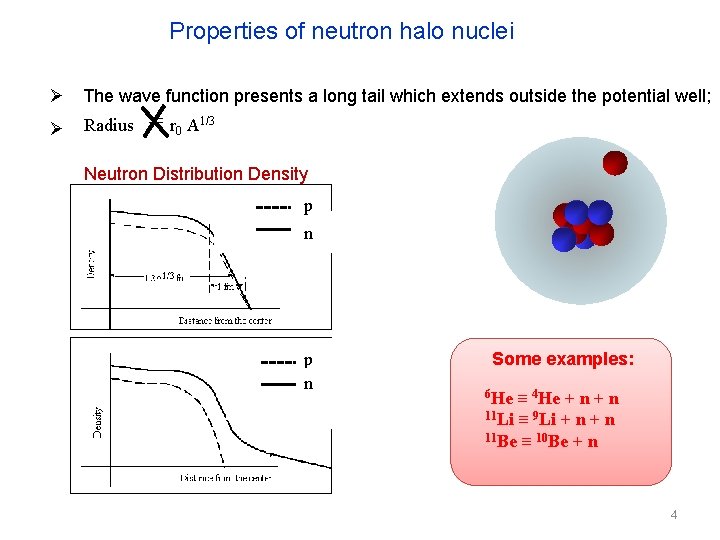
Properties of neutron halo nuclei Ø The wave function presents a long tail which extends outside the potential well; Ø Radius = r 0 A 1/3 Neutron Distribution Density p n Some examples: 6 He ≡ 4 He + n 11 Li ≡ 9 Li + n 11 Be ≡ 10 Be + n 4
Effects of halo structure on reaction processes: the sub-barrier fusion case. 5
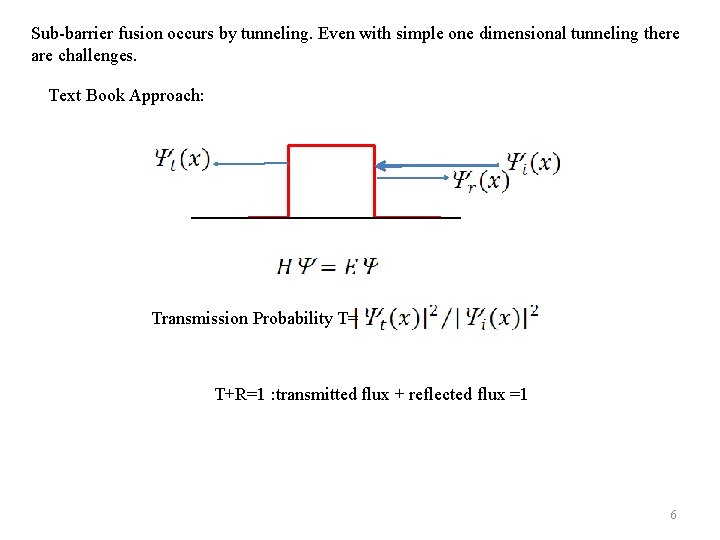
Sub-barrier fusion occurs by tunneling. Even with simple one dimensional tunneling there are challenges. Text Book Approach: Transmission Probability T= T+R=1 : transmitted flux + reflected flux =1 6
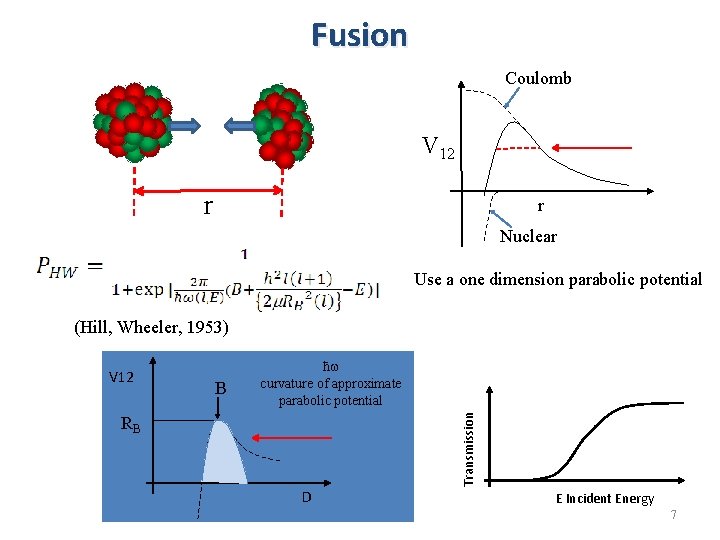
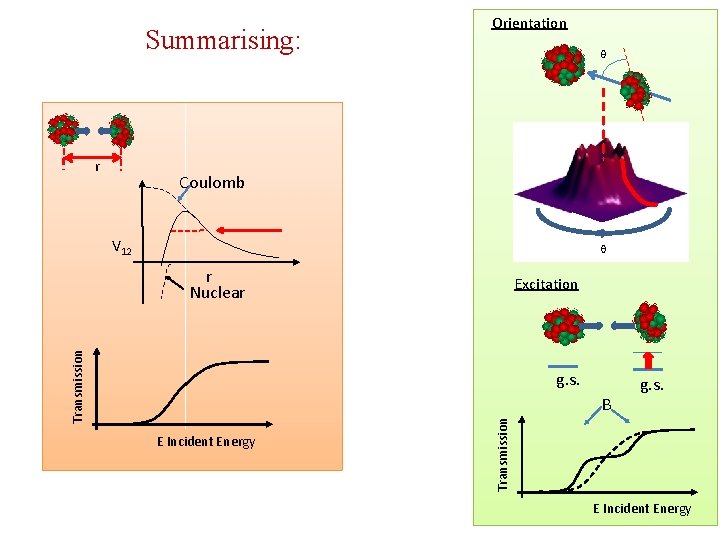
Fusion Coulomb V 12 r r Nuclear Use a one dimension parabolic potential (Hill, Wheeler, 1953) B ћ curvature of approximate parabolic potential RB D Transmission V 12 E Incident Energy 7
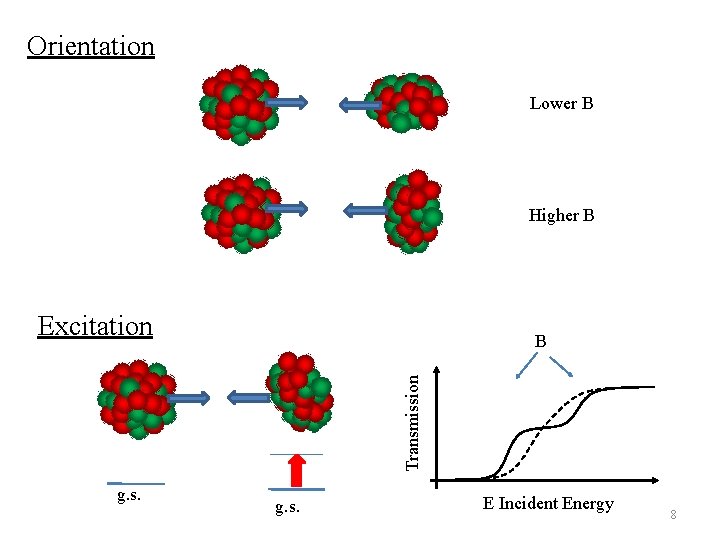
Orientation Lower B Higher B Excitation Transmission B g. s. E Incident Energy 8
r Summarising: Orientation Coulomb V 12 Transmission r Nuclear Excitation g. s. E Incident Energy Transmission B g. s. E Incident Energy 9
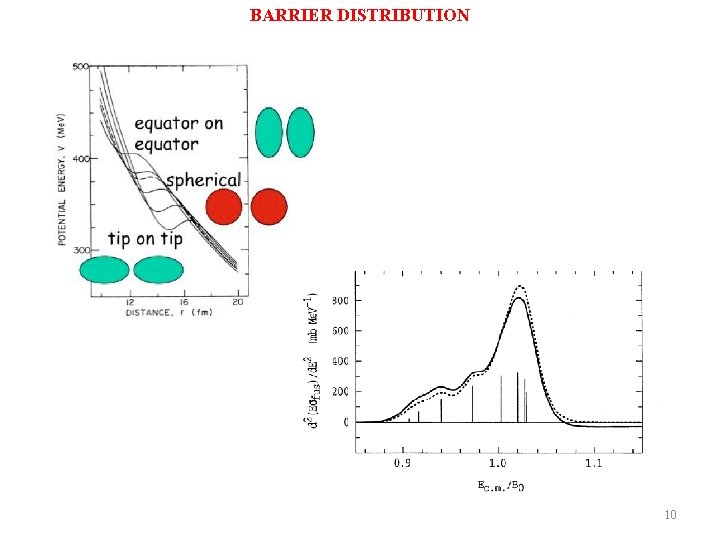
BARRIER DISTRIBUTION 10
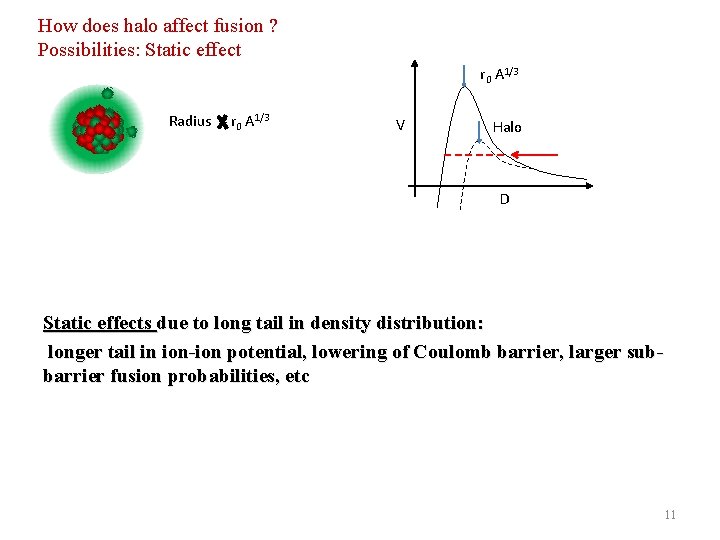
How does halo affect fusion ? Possibilities: Static effect r 0 A 1/3 Radius = r 0 A 1/3 V Halo D Static effects due to long tail in density distribution: longer tail in ion-ion potential, lowering of Coulomb barrier, larger subbarrier fusion probabilities, etc 11
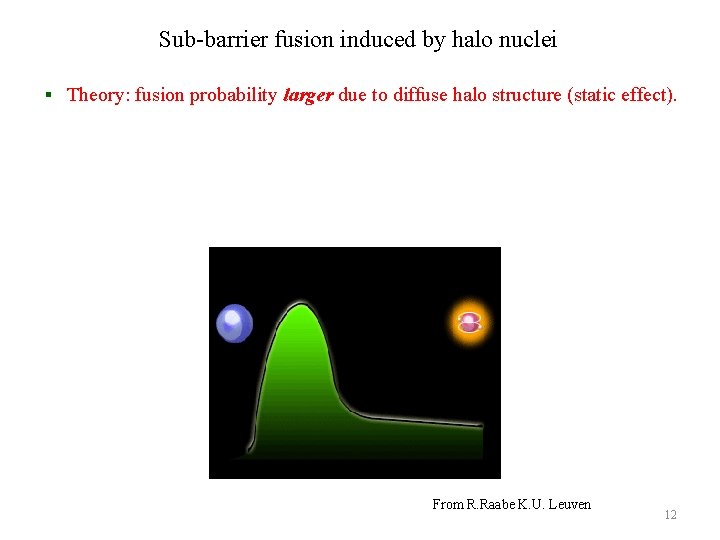
Sub-barrier fusion induced by halo nuclei § Theory: fusion probability larger due to diffuse halo structure (static effect). From R. Raabe K. U. Leuven 12
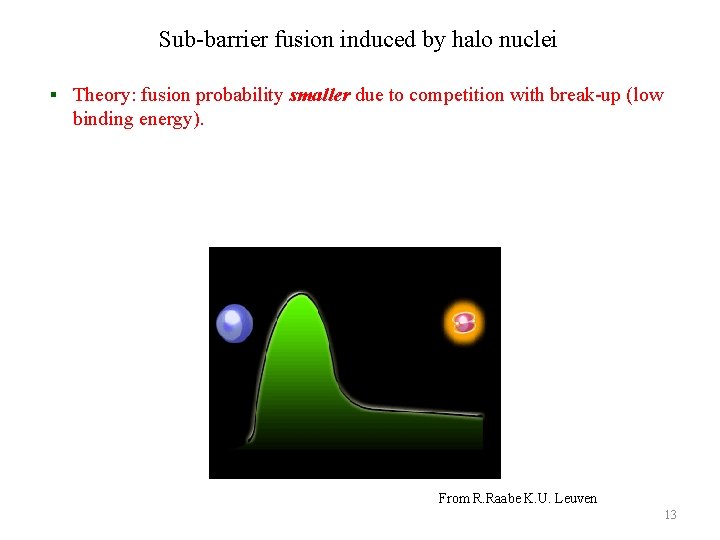
Sub-barrier fusion induced by halo nuclei § Theory: fusion probability smaller due to competition with break-up (low binding energy). From R. Raabe K. U. Leuven 13
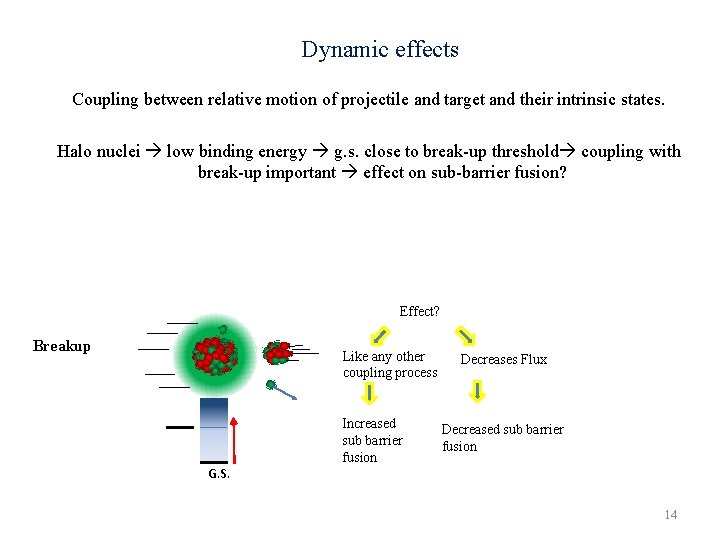
Dynamic effects Coupling between relative motion of projectile and target and their intrinsic states. Halo nuclei low binding energy g. s. close to break-up threshold coupling with break-up important effect on sub-barrier fusion? Effect? Breakup Like any other coupling process G. S. Increased sub barrier fusion Decreases Flux Decreased sub barrier fusion 14
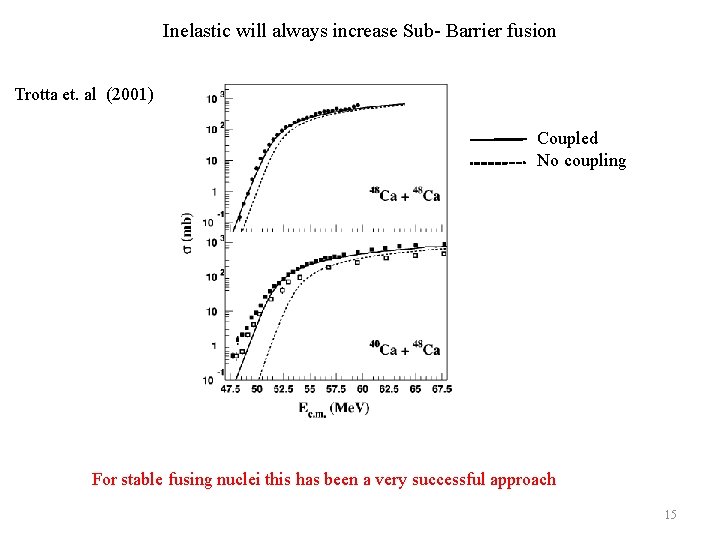
Inelastic will always increase Sub- Barrier fusion Trotta et. al (2001) Coupled No coupling For stable fusing nuclei this has been a very successful approach 15
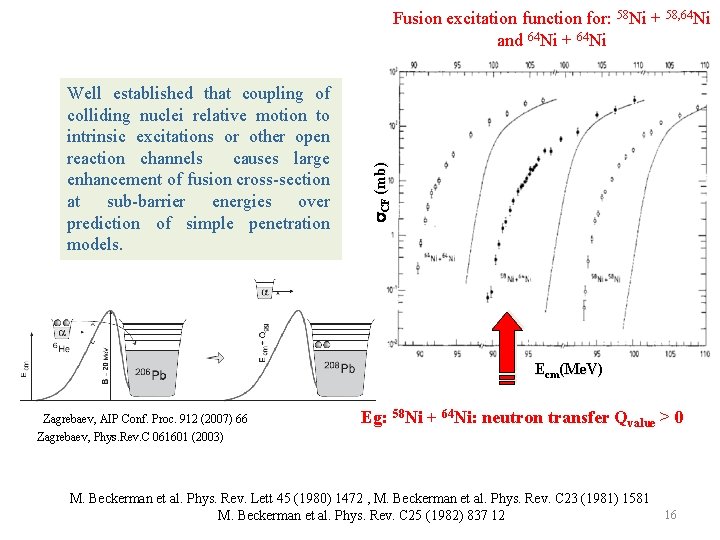
Well established that coupling of colliding nuclei relative motion to intrinsic excitations or other open reaction channels causes large enhancement of fusion cross-section at sub-barrier energies over prediction of simple penetration models. CF (mb) Fusion excitation function for: 58 Ni + 58, 64 Ni and 64 Ni + 64 Ni Ecm(Me. V) Zagrebaev, AIP Conf. Proc. 912 (2007) 66 Eg: 58 Ni + 64 Ni: neutron transfer Qvalue > 0 Zagrebaev, Phys. Rev. C 061601 (2003) M. Beckerman et al. Phys. Rev. Lett 45 (1980) 1472 , M. Beckerman et al. Phys. Rev. C 23 (1981) 1581 M. Beckerman et al. Phys. Rev. C 25 (1982) 837 12 16
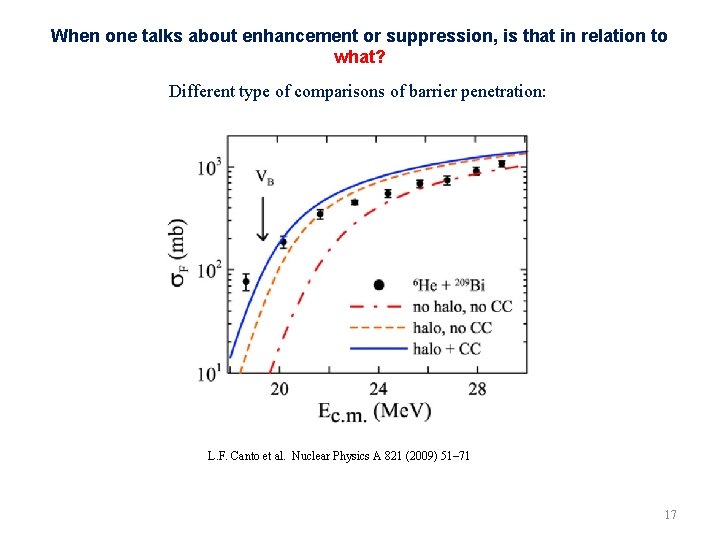
When one talks about enhancement or suppression, is that in relation to what? Different type of comparisons of barrier penetration: L. F. Canto et al. Nuclear Physics A 821 (2009) 51– 71 17
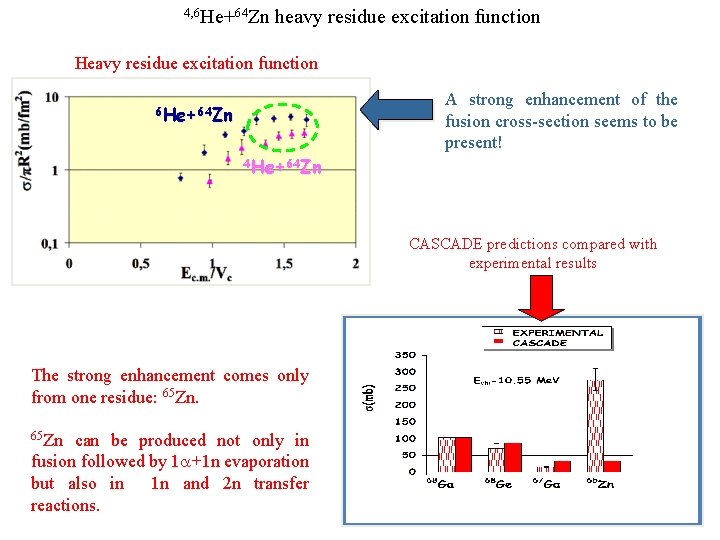
4, 6 He+64 Zn heavy residue excitation function Heavy residue excitation function A strong enhancement of the fusion cross-section seems to be present! 6 He+64 Zn 4 He+64 Zn CASCADE predictions compared with experimental results The strong enhancement comes only from one residue: 65 Zn can be produced not only in fusion followed by 1 +1 n evaporation but also in 1 n and 2 n transfer reactions. 18
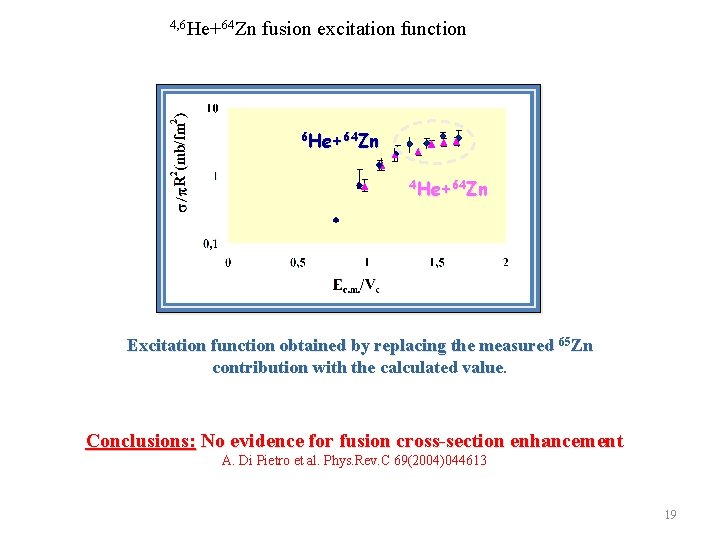
4, 6 He+64 Zn fusion excitation function 6 He+64 Zn 4 He+64 Zn Excitation function obtained by replacing the measured 65 Zn contribution with the calculated value Conclusions: No evidence for fusion cross-section enhancement A. Di Pietro et al. Phys. Rev. C 69(2004)044613 19
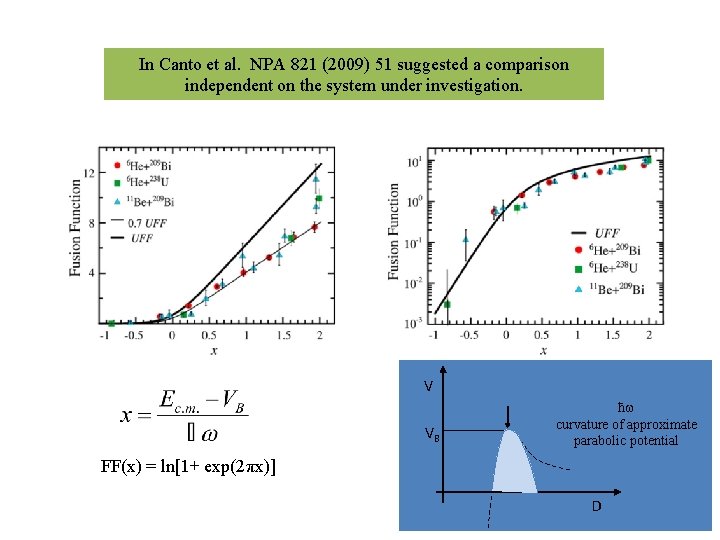
In Canto et al. NPA 821 (2009) 51 suggested a comparison independent on the system under investigation. V VB ћ curvature of approximate parabolic potential FF(x) = ln[1+ exp(2πx)] D 20
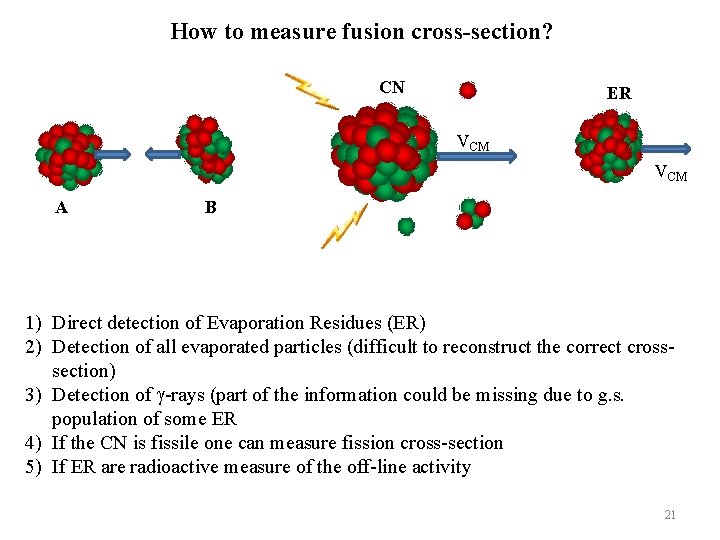
How to measure fusion cross-section? CN ER VCM A B 1) Direct detection of Evaporation Residues (ER) 2) Detection of all evaporated particles (difficult to reconstruct the correct crosssection) 3) Detection of g-rays (part of the information could be missing due to g. s. population of some ER 4) If the CN is fissile one can measure fission cross-section 5) If ER are radioactive measure of the off-line activity 21
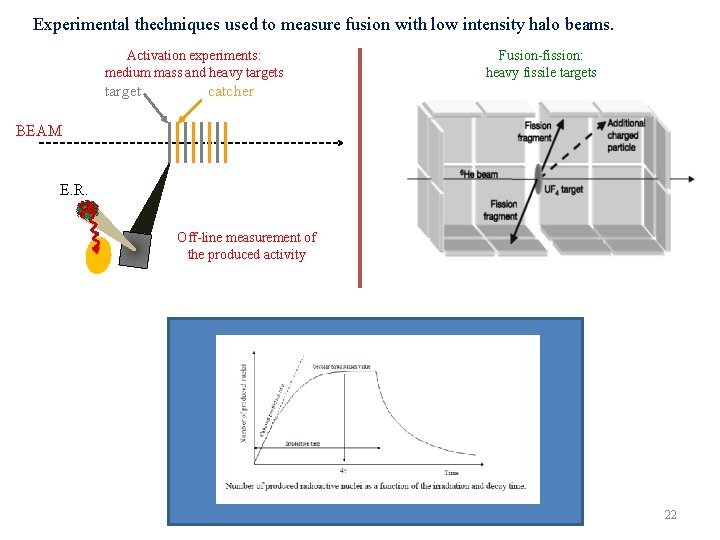
Experimental thechniques used to measure fusion with low intensity halo beams. Activation experiments: medium mass and heavy targets target Fusion-fission: heavy fissile targets catcher BEAM E. R. Off-line measurement of the produced activity 22
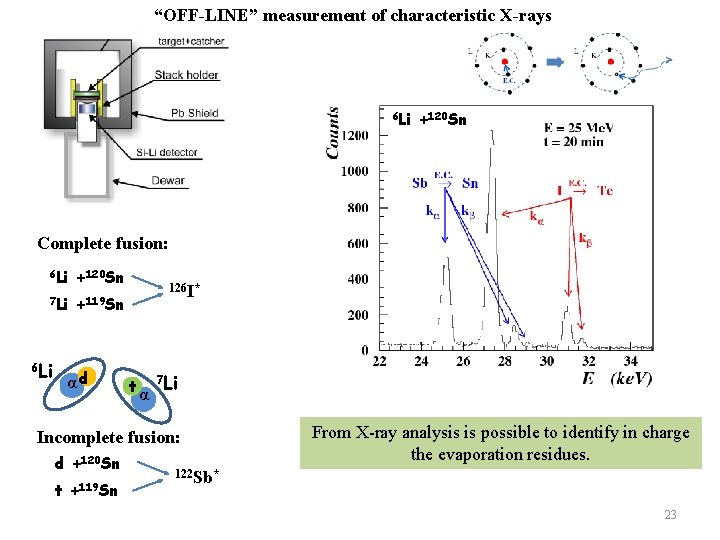
“OFF-LINE” measurement of characteristic X-rays 6 Li +120 Sn Complete fusion: 6 Li +120 Sn 7 Li +119 Sn 6 Li αd 126 I* t α 7 Li Incomplete fusion: d +120 Sn t +119 Sn From X-ray analysis is possible to identify in charge the evaporation residues. 122 Sb* 23
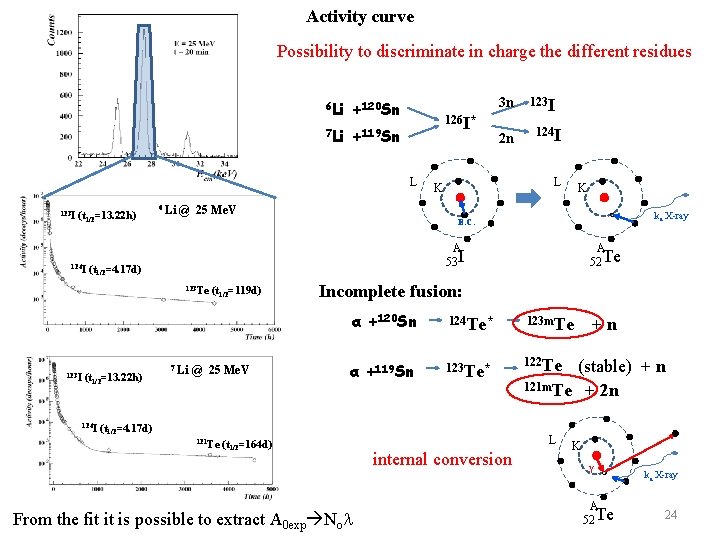
Activity curve Possibility to discriminate in charge the different residues 6 Li +120 Sn 7 Li +119 Sn 3 n 126 I* L 123 I (t 1/2=13. 22 h) 124 I 6 Li 124 I L K K kα X-ray E. C. A 53 I (t 1/2=4. 17 d) (t 1/2=13. 22 h) 124 I @ 25 Me. V 123 Te 123 I 2 n 123 I 7 Li (t 1/2=119 d) @ 25 Me. V Incomplete fusion: α +120 Sn 124 Te* α +119 Sn 123 Te* (t 1/2=4. 17 d) 121 Te A 52 Te (t 1/2=164 d) From the fit it is possible to extract A 0 exp Nol 123 m. Te 122 Te (stable) + n 121 m. Te + 2 n L internal conversion +n K γ A 52 Te kα X-ray 24
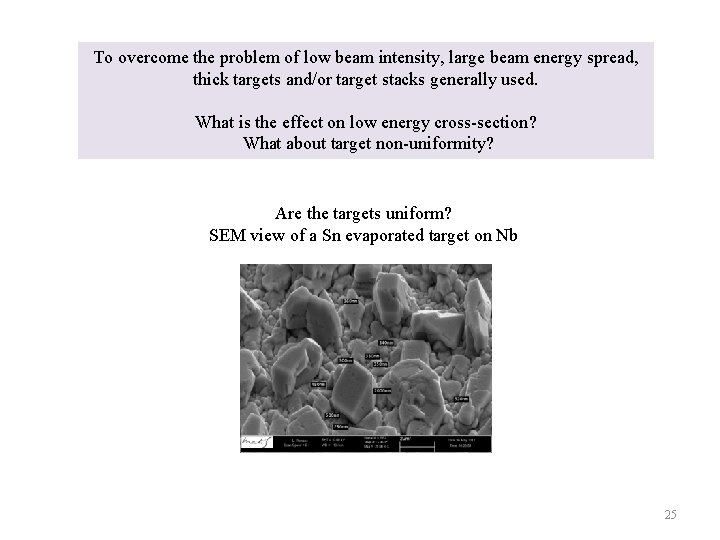
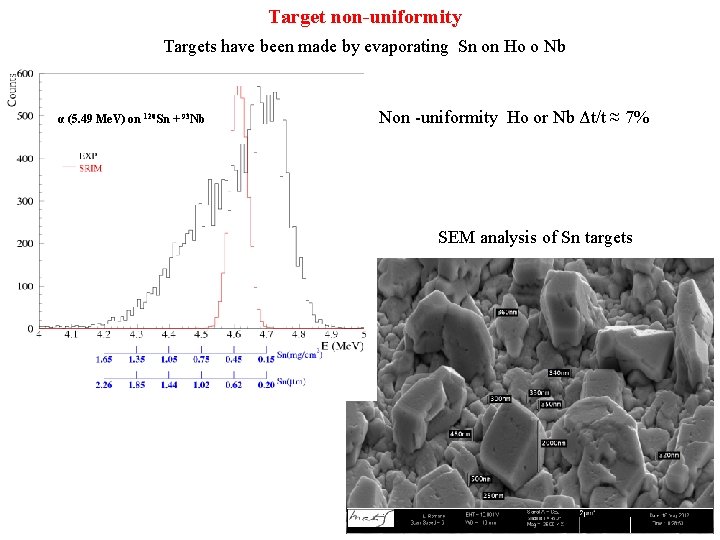
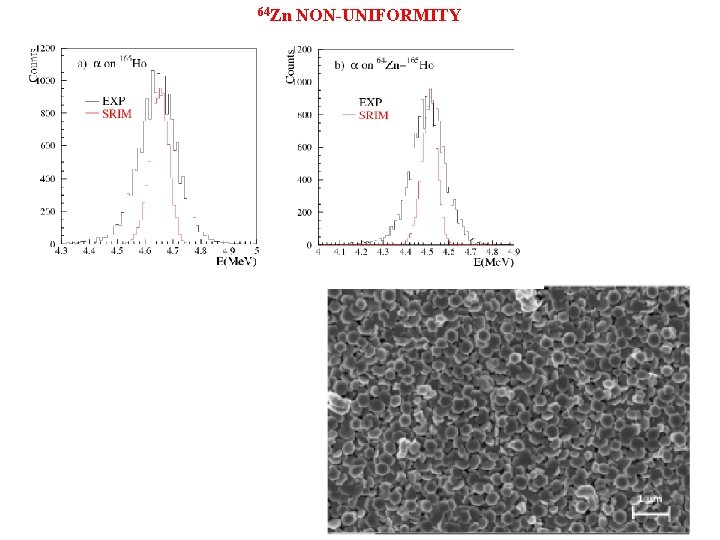
To overcome the problem of low beam intensity, large beam energy spread, thick targets and/or target stacks generally used. What is the effect on low energy cross-section? What about target non-uniformity? Are the targets uniform? SEM view of a Sn evaporated target on Nb 25
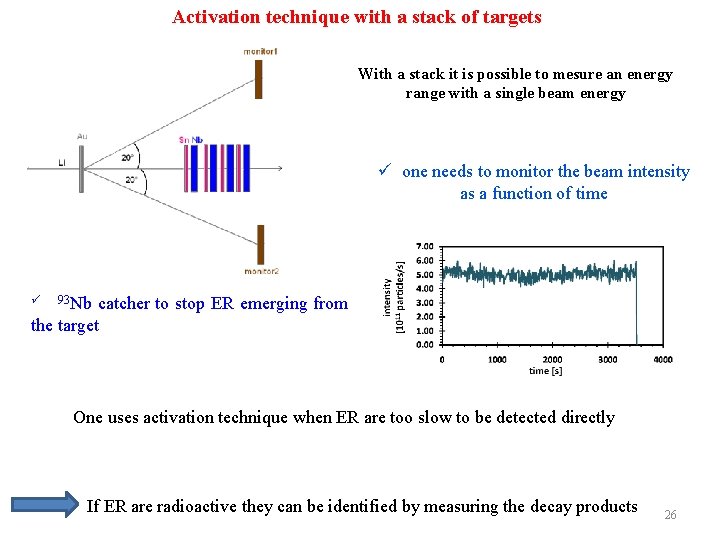
Activation technique with a stack of targets With a stack it is possible to mesure an energy range with a single beam energy ü one needs to monitor the beam intensity as a function of time ü 93 Nb catcher to stop ER emerging from the target One uses activation technique when ER are too slow to be detected directly If ER are radioactive they can be identified by measuring the decay products 26
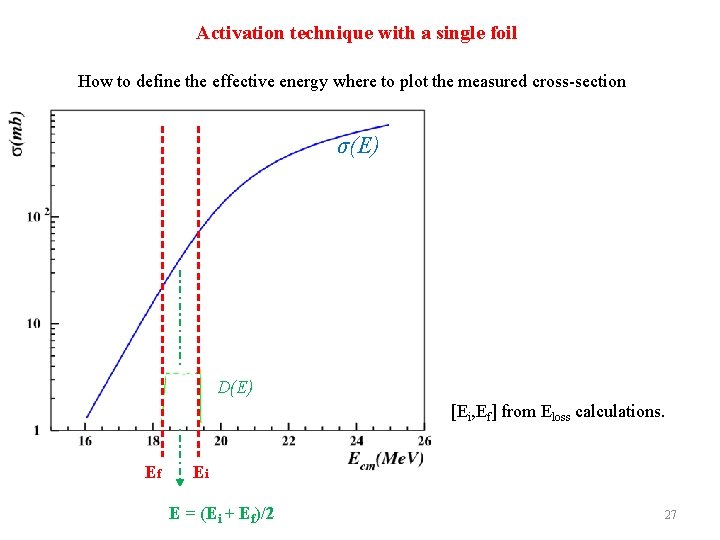
Activation technique with a single foil How to define the effective energy where to plot the measured cross-section σ(E) D(E) [Ei, Ef] from Eloss calculations. Ef Ei E = (Ei + Ef)/2 27
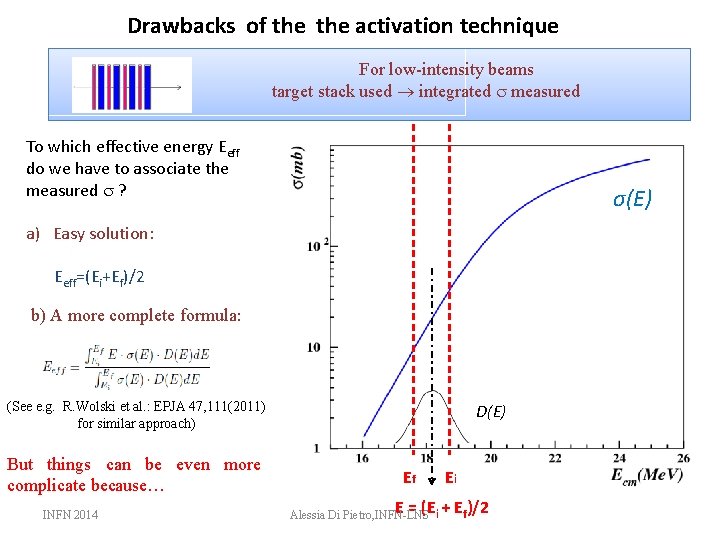
Drawbacks of the activation technique For low-intensity beams target stack used integrated measured To which effective energy Eeff do we have to associate the measured ? σ(E) a) Easy solution: Eeff=(Ei+Ef)/2 b) A more complete formula: (See e. g. R. Wolski et al. : EPJA 47, 111(2011) for similar approach) But things can be even more complicate because… INFN 2014 D(E) Ef Ei E = (Ei + Alessia Di Pietro, INFN-LNS Ef)/2
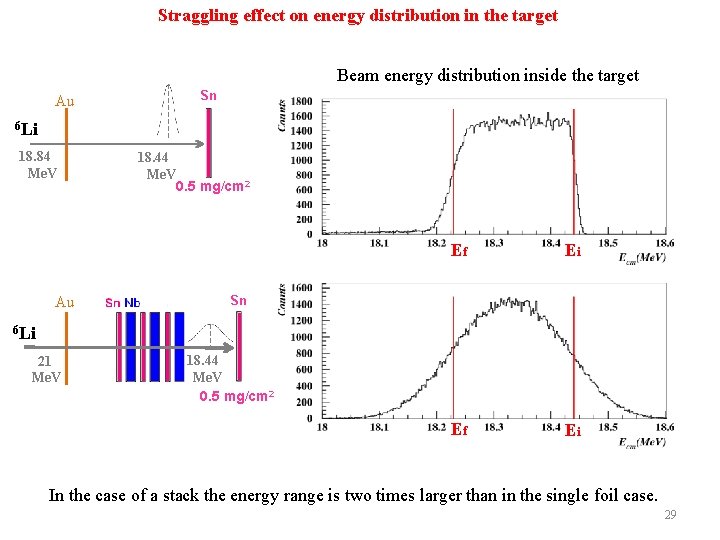
Straggling effect on energy distribution in the target Beam energy distribution inside the target Sn Au 6 Li 18. 84 Me. V Au 18. 44 Me. V 0. 5 mg/cm 2 Ef Ei Sn 6 Li 21 Me. V 18. 44 Me. V 0. 5 mg/cm 2 In the case of a stack the energy range is two times larger than in the single foil case. 29
Target non-uniformity Targets have been made by evaporating Sn on Ho o Nb α (5. 49 Me. V) on 93 Nb α (5. 49 Me. V) on 120 Sn + 93 Nb Non -uniformity Ho or Nb Δt/t ≈ 7% SEM analysis of Sn targets 30
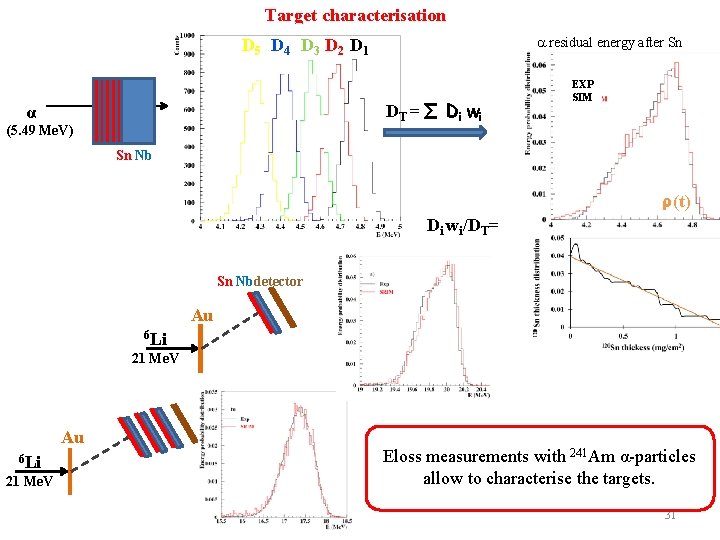
Target characterisation residual energy after Sn D 5 D 4 D 3 D 2 D 1 D T = ∑ D i wi α (5. 49 Me. V) EXP SIM Sn Nb ρ(t) Di wi/DT= Sn Nbdetector Au 6 Li 21 Me. V Eloss measurements with 241 Am α-particles allow to characterise the targets. 31
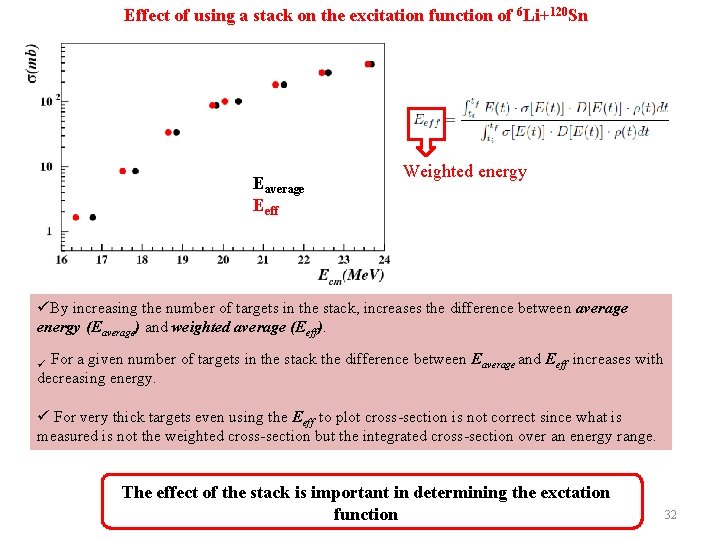
Effect of using a stack on the excitation function of 6 Li+120 Sn Eaverage Eeff Weighted energy üBy increasing the number of targets in the stack, increases the difference between average energy (Eaverage) and weighted average (Eeff). For a given number of targets in the stack the difference between Eaverage and Eeff increases with decreasing energy. ü ü For very thick targets even using the Eeff to plot cross-section is not correct since what is measured is not the weighted cross-section but the integrated cross-section over an energy range. The effect of the stack is important in determining the exctation function 32
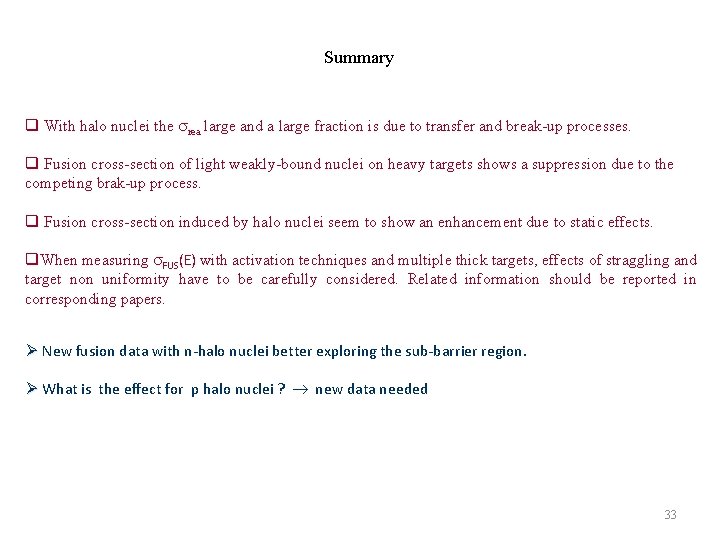
Summary q With halo nuclei the rea large and a large fraction is due to transfer and break-up processes. q Fusion cross-section of light weakly-bound nuclei on heavy targets shows a suppression due to the competing brak-up process. q Fusion cross-section induced by halo nuclei seem to show an enhancement due to static effects. q. When measuring FUS(E) with activation techniques and multiple thick targets, effects of straggling and target non uniformity have to be carefully considered. Related information should be reported in corresponding papers. Ø New fusion data with n-halo nuclei better exploring the sub-barrier region. Ø What is the effect for p halo nuclei ? new data needed 33
64 Zn NON-UNIFORMITY 34
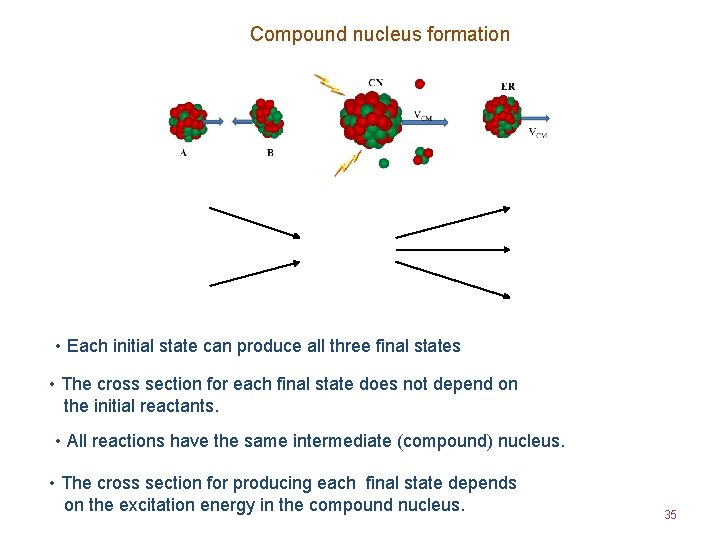
Compound nucleus formation • Each initial state can produce all three final states • The cross section for each final state does not depend on the initial reactants. • All reactions have the same intermediate (compound) nucleus. • The cross section for producing each final state depends on the excitation energy in the compound nucleus. 35