
Isolationists vs Interventionists WWYD Isolationists Committee to Defend


- Slides: 17
Isolationists vs. Interventionists WWYD? • Isolationists= Committee to Defend America First, said we should stay out of Europe’s business. – Herbert Hoover, Frank Lloyd Write, Charles Lindbergh • Interventionists=Committee to Defend America by Aiding the Allies, said we should get involved. – William Allen White- Kansas Journalist
WWYD • Page 502 – What does the cartoon support? Why? – What were most Americans? Why? – At this point, what would you do? • Poland had been invaded • Czechoslovakia and Austria has been invaded • Why?
US Moves to War • Neutrality Acts kept us out of WWII for 2 years and the Spanish Civil War • Axis goals (IT, GR and JP) – Keep USA out of WWII – If at war, make USA fight a 2 front war • Fall of FR and evacuation at Dunkirk – USA sent guns and destroyers to replace those lost – WWYD?
Build up of USA forces • Before WWII (1940) • 18 nations had a larger army • Navy barely big enough to defend the Pacific Coast, not the Atlantic or Gulf of MX • IT Airforce had more air power than USA • FDR re-elected by 55% vote – Congress passed the Selective Service Act – Lend Lease Act passed • Supplies to BR and USSR • GR U-boats tried to stop the flow of supplies
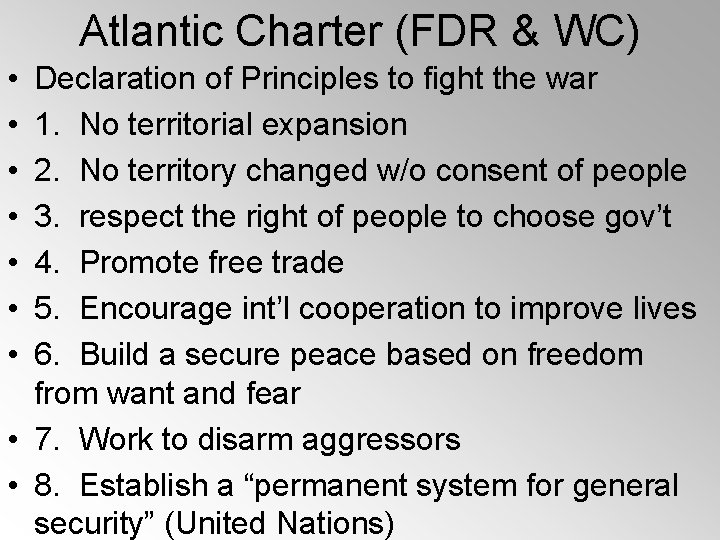
Atlantic Charter (FDR & WC) • • Declaration of Principles to fight the war 1. No territorial expansion 2. No territory changed w/o consent of people 3. respect the right of people to choose gov’t 4. Promote free trade 5. Encourage int’l cooperation to improve lives 6. Build a secure peace based on freedom from want and fear • 7. Work to disarm aggressors • 8. Establish a “permanent system for general security” (United Nations)
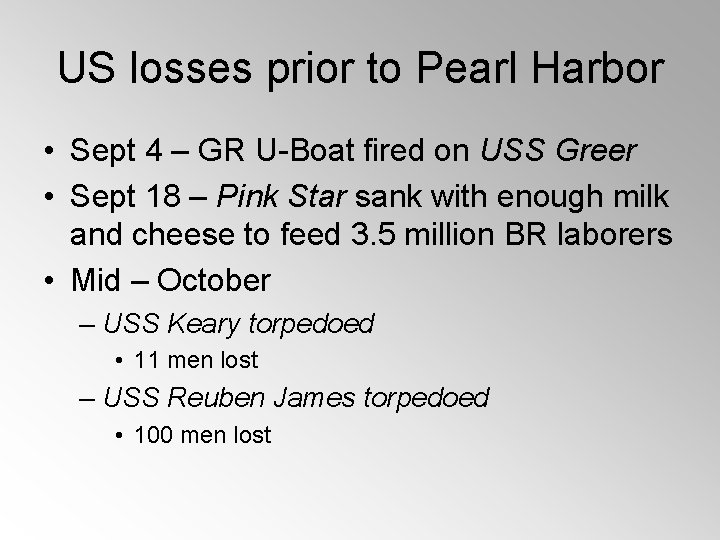
US losses prior to Pearl Harbor • Sept 4 – GR U-Boat fired on USS Greer • Sept 18 – Pink Star sank with enough milk and cheese to feed 3. 5 million BR laborers • Mid – October – USS Keary torpedoed • 11 men lost – USS Reuben James torpedoed • 100 men lost
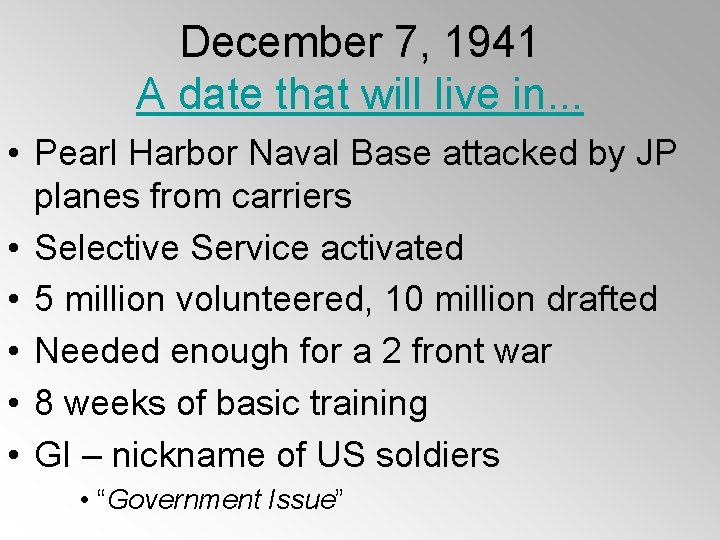
December 7, 1941 A date that will live in. . . • Pearl Harbor Naval Base attacked by JP planes from carriers • Selective Service activated • 5 million volunteered, 10 million drafted • Needed enough for a 2 front war • 8 weeks of basic training • GI – nickname of US soldiers • “Government Issue”
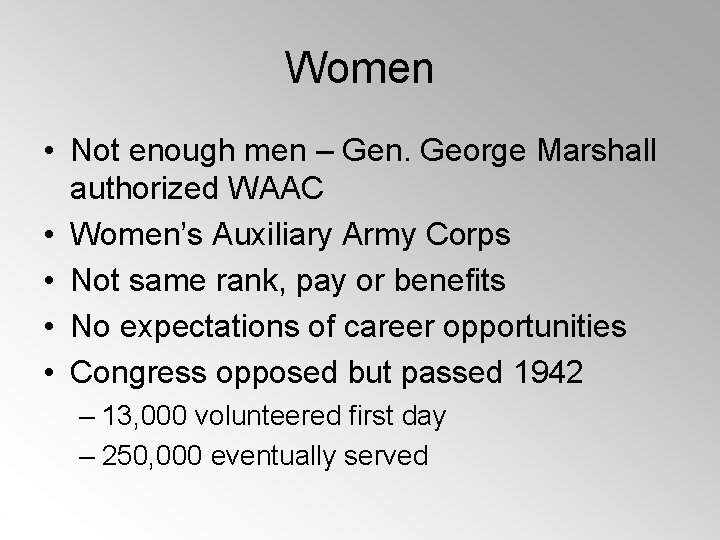
Women • Not enough men – Gen. George Marshall authorized WAAC • Women’s Auxiliary Army Corps • Not same rank, pay or benefits • No expectations of career opportunities • Congress opposed but passed 1942 – 13, 000 volunteered first day – 250, 000 eventually served
Minorities • New dilemmas for groups – Racially segregated neighborhoods – Reservations – Denied citizenship rights • • • ½ million Latinos Million + African Americans – Tuskegee Airmen 13, 000 Chinese 33, 000 Japanese Americans – 442 nd Nisei 25, 000 Native Americans – Navajo Code Talkers
Homefront • Industry – Car production ended in 1942 – Companies turned to war production • Soft drink company filled shells with explosives – Shipyards turned out liberty ships – 3 days • Labor – 18 million workers in factories • 6 million women • Earned 60% of men doing same job • Executive order preventing segregation of workplaces
Science • Office of Scientific Research and Development • Radar, sonar, DDT (pesticide), penicillin • Atomic bomb • Manhattan Project in Los Alamos, NM • J. Robert Oppenheimer headed the project • Jets, computers, Freeze-dried foods, semiconductors, synthetic materials
Internment of Japanese • War Department mass evacuated • Newspapers ran ugly stories • Executive Order by FDR – To remove people of Japanese ancestry from West Coast – 110, 000 shipped to internment camps • Nisei were 2/3 American citizens – 1, 000 s volunteered for military service
Civilian Contributions • Rationing of civilian consumer goods • Coupons to purchase scarce goods • Meat, sugar, coffee, gasoline, etc. • Personal contribution to the war effort • Car-pooled, rode bikes, victory gardens • Shortages in things from tires to toys • Black Market • Illegally buy rationed goods without coupons • Conscientious objectors
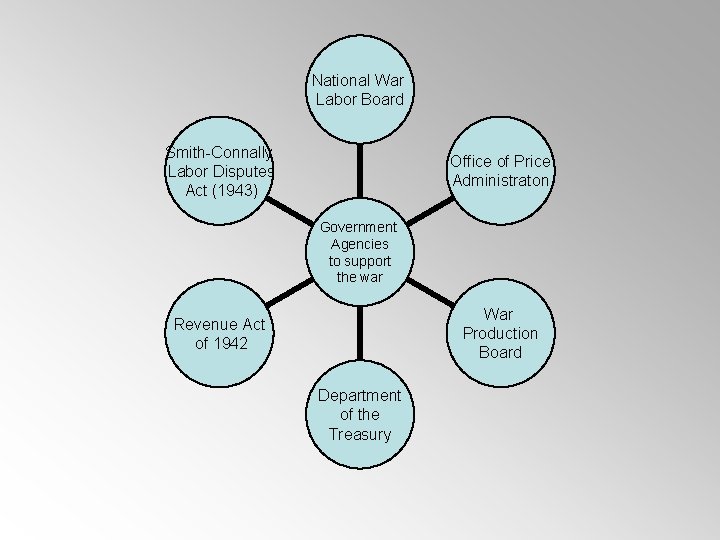
National War Labor Board Smith-Connally Labor Disputes Act (1943) Office of Price Administraton Government Agencies to support the war War Production Board Revenue Act of 1942 Department of the Treasury
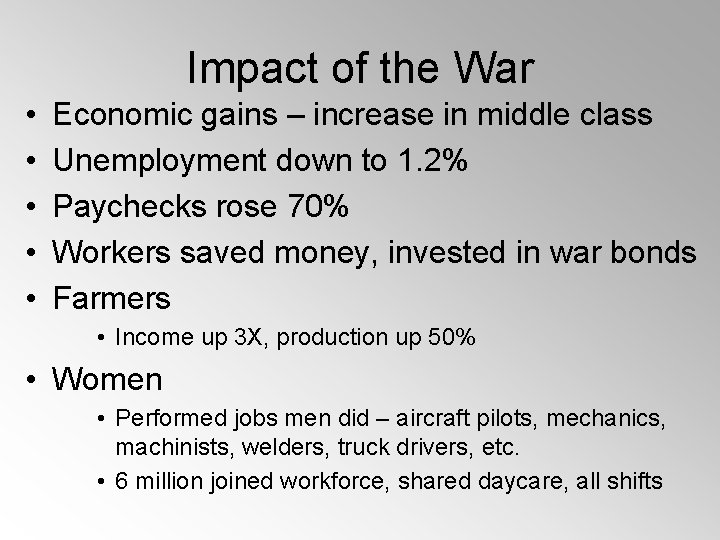
Impact of the War • • • Economic gains – increase in middle class Unemployment down to 1. 2% Paychecks rose 70% Workers saved money, invested in war bonds Farmers • Income up 3 X, production up 50% • Women • Performed jobs men did – aircraft pilots, mechanics, machinists, welders, truck drivers, etc. • 6 million joined workforce, shared daycare, all shifts
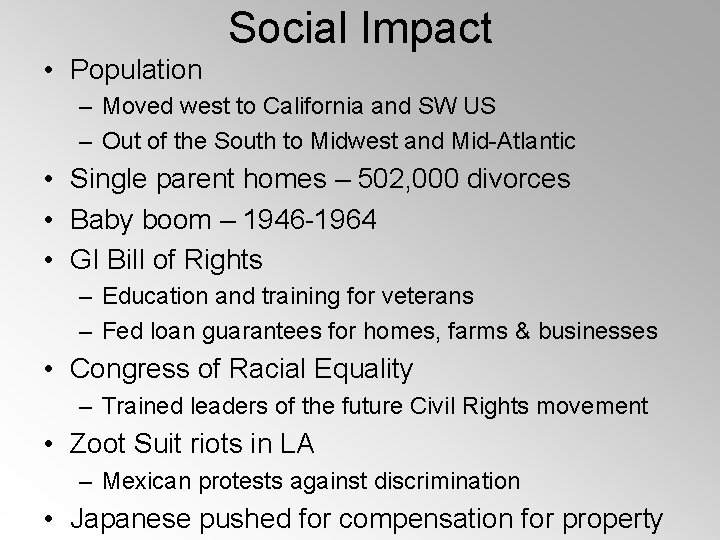
Social Impact • Population – Moved west to California and SW US – Out of the South to Midwest and Mid-Atlantic • Single parent homes – 502, 000 divorces • Baby boom – 1946 -1964 • GI Bill of Rights – Education and training for veterans – Fed loan guarantees for homes, farms & businesses • Congress of Racial Equality – Trained leaders of the future Civil Rights movement • Zoot Suit riots in LA – Mexican protests against discrimination • Japanese pushed for compensation for property