
ISOLATION PRECAUTION 101 THEIN SHWE MPH MS MBBS
ISOLATION PRECAUTION 101 THEIN SHWE, MPH, MS, MBBS HEALTHCARE ASSOCIATED INFECTION COORDINATOR DIVISION OF INFECTIOUS DISEASE EPIDEMIOLOGY OFFICE OF EPIDEMIOLOGY & PREVENTION SERVICES BUREAU FOR PUBLIC HEALTH WEST VIRGINIA DEPARTMENT OF HEALTH AND HUMAN RESOURCES 1
LEARNING OBJECTIVES � � � Discuss chain of infection and different types of mode of transmission Define isolation precautions and describe different types isolation precautions. Describe standard precautions procedures and conditions under which to use standard precautions Describe contact precautions and conditions under which to use contact precautions. Describe conditions under which to use droplet precautions. Describe conditions under which to use airborne precautions. 2
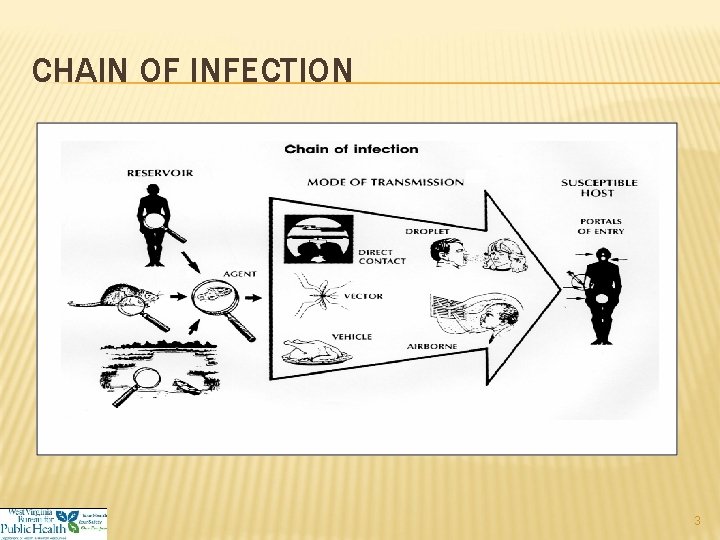
CHAIN OF INFECTION 3
MODE OF TRANSMISSION � A microorganism may be spread by a single or multiple routes. � Contact, direct or indirect � Droplet � Airborne � Vector-borne (usually arthropod) and � Common environmental sources or vehicles includes food-borne and waterborne, medications e. g. , contaminated IV fluids 4
CONTACT TRANSMISSION � Direct-contact � Direct body surface-to-body surface contact and � Physical transfer of microorganisms between a susceptible host and an infected or colonized person � Indirect-contact � Contact of a susceptible host with a contaminated intermediate object, usually inanimate, such as contaminated instruments, needles, or dressings, or contaminated hands or gloves 5
DROPLET TRANSMISSION � Droplet generation � coughing, � sneezing, � talking, � procedures such as suctioning and bronchoscopy � Droplet transmission � Droplet deposited on the host’s conjunctivae, nasal mucosa, or mouth. 6
AIRBORNE TRANSMISSION � Small-particle residue {5µm or smaller} of evaporated droplets containing microorganisms � Suspended in the air for long periods of time � Dispersed by air currents � Inhaled by a susceptible host within the same room or over a longer distance 7
DEFINITION OF ISOLATION PRECAUTIONS SOURCE: MOSBY'S MEDICAL DICTIONARY, 8 TH EDITION. © 2009, ELSEVIER. � Special precautionary measures, practices, and procedures used in the care of patients with contagious or communicable diseases 8
1996 CDC Guidelines for Isolation Precautions in Hospitals Hospital infection control practices advisory committee (HICPAC) 9
FUNDAMENTALS OF ISOLATION PRECAUTIONS � � Handwashing and gloving Personal protective equipments: � � � Masks, respiratory protection, eye protection, face shields, gowns and protective apparel Patient-care equipment and articles Linen and laundry Routine and terminal cleaning Patient placement Transport of infected patients 10
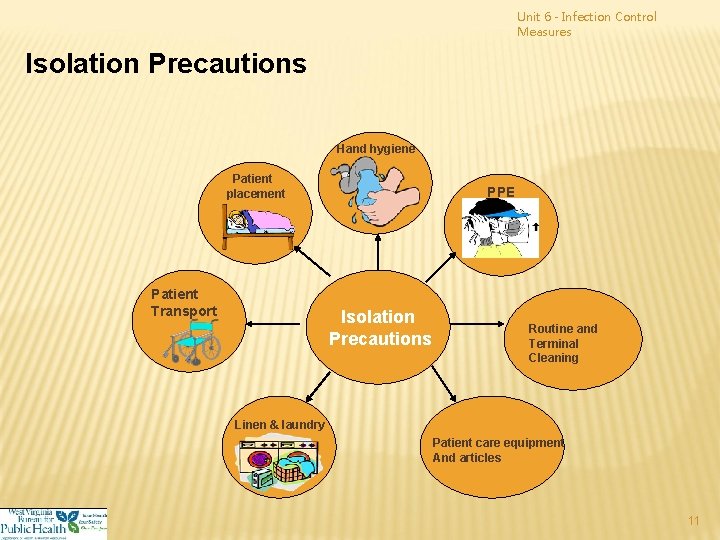
Unit 6 - Infection Control Measures Isolation Precautions Hand hygiene Patient placement Patient Transport PPE Isolation Precautions Routine and Terminal Cleaning Linen & laundry Patient care equipment And articles 11
TYPES OF ISOLATION PRECAUTIONS � Standard precautions � Transmission-based precautions � Contact precautions � Airborne precautions � Droplet precautions 12
DEFINITION OF STANDARD PRECAUTIONS � Apply to all patients receiving care in hospitals regardless of their diagnosis or presumed infection status. � Apply to (1) blood; (2) all body fluids, secretions, and excretions except sweat, regardless of whether or not they contain blood; (3) nonintact skin; and (4) mucous membranes. 13
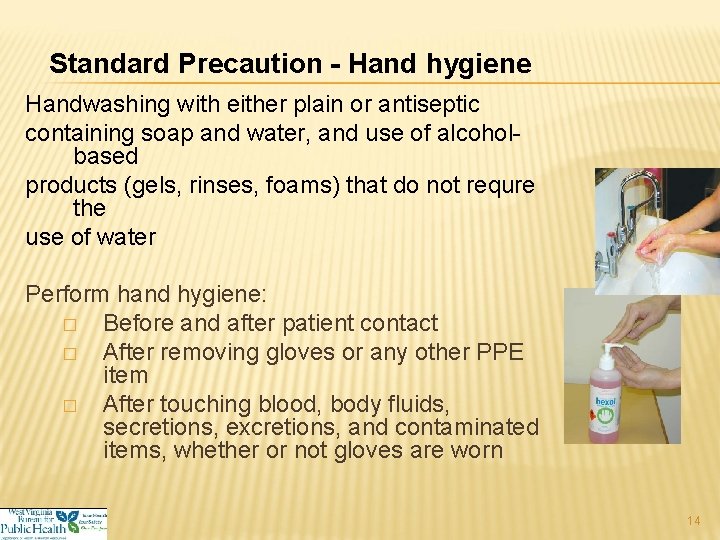
Standard Precaution - Hand hygiene Handwashing with either plain or antiseptic containing soap and water, and use of alcoholbased products (gels, rinses, foams) that do not requre the use of water Perform hand hygiene: � Before and after patient contact � After removing gloves or any other PPE item � After touching blood, body fluids, secretions, excretions, and contaminated items, whether or not gloves are worn 14
STANDARD PRECAUTIONS PERSONAL PROTECTIVE EQUIPMENT (PPE) � The selection of PPE based on � The nature of patient interaction and/or � The likely mode(s) of transmission � Designated containers for used disposable or reusable PPE should be placed in a convenient to the site of removal � Hand hygiene is always the final step after removing and disposing of PPE 15
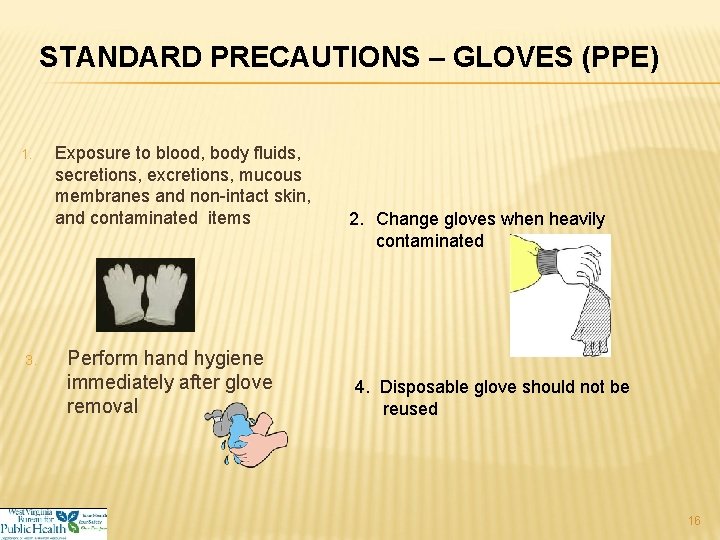
STANDARD PRECAUTIONS – GLOVES (PPE) 1. 3. Exposure to blood, body fluids, secretions, excretions, mucous membranes and non-intact skin, and contaminated items Perform hand hygiene immediately after glove removal 2. Change gloves when heavily contaminated 4. Disposable glove should not be reused 16
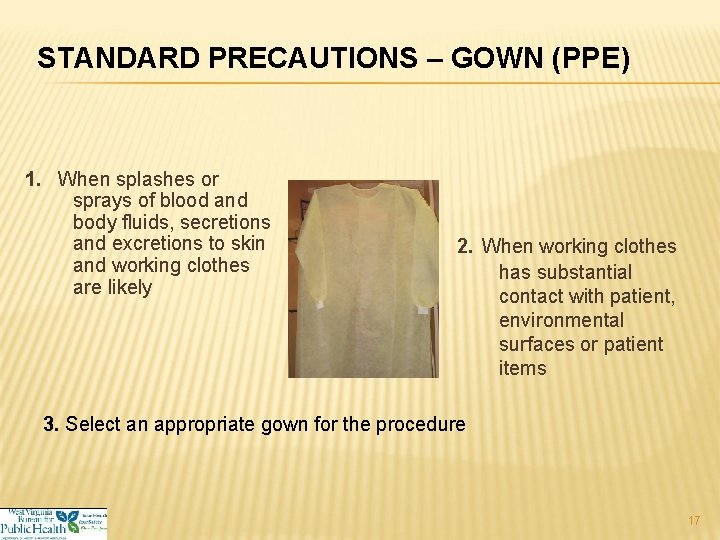
STANDARD PRECAUTIONS – GOWN (PPE) 1. When splashes or sprays of blood and body fluids, secretions and excretions to skin and working clothes are likely 2. When working clothes has substantial contact with patient, environmental surfaces or patient items 3. Select an appropriate gown for the procedure 17
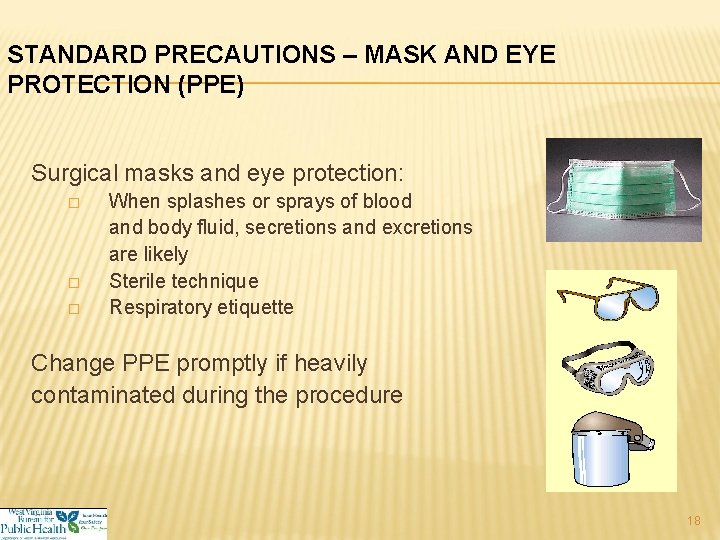
STANDARD PRECAUTIONS – MASK AND EYE PROTECTION (PPE) Surgical masks and eye protection: � � � When splashes or sprays of blood and body fluid, secretions and excretions are likely Sterile technique Respiratory etiquette Change PPE promptly if heavily contaminated during the procedure 18
STANDARD PRECAUTIONS - PREVENT HCWS EXPOSURE TO BLOODBORNE PATHOGENS � Prevent needles and other sharps instrument injuries � Prevent mucous membrane exposures � Safe work practices and PPE to protect mucous membranes and non-intact skin 19
STANDARD PRECAUTIONS: ENVIRONMENTAL MEASURES � Clean and disinfect non-critical surfaces in patient-care areas are part of SP. � Clean and disinfect all frequently touched surfaces in patient-care areas � EPA-registered disinfectants or detergents 20
STANDARD PRECAUTIONS: PATIENT CARE EQUIPMENT AND INSTRUMENTS/DEVICES � Clean and maintain medical equipment and instruments/devices according to the manufacturers’ instructions 21
STANDARD PRECAUTIONS: TEXTILE AND LAUNDRY � Key principles for handling of soiled laundry: � � Don’t shaking items or handle them in any way that may aerosolize infectious agents � Avoid contact with one’s body and personal clothing � Contain soiled items in a laundry bag or designated bin 22
STANDARD PRECAUTIONS – 2007 GUIDELINES FOR ISOLATION PRECAUTIONS � Three new elements added to standard precautions: � Respiratory hygiene/cough etiquette � Safe injection practices � Use of masks for insertion of catheters or injection into spinal or epidural areas 23
RESPIRATORY HYGIENE AND COUGH ETIQUETTE � Three elements include: � Educate healthcare workers, patients, and visitors � Post signs in appropriate language(s) � Source control measures: �Cover the nose/mouth when coughing or sneezing �Use tissue paper respiratory secretions and dispose in the waste receptacle �Perform hand hygiene after contact with respiratory secretions and contaminated objects �Place a surgical mask on the coughing person when tolerated and appropriate �Spatial separation, ideally >3 feet 24
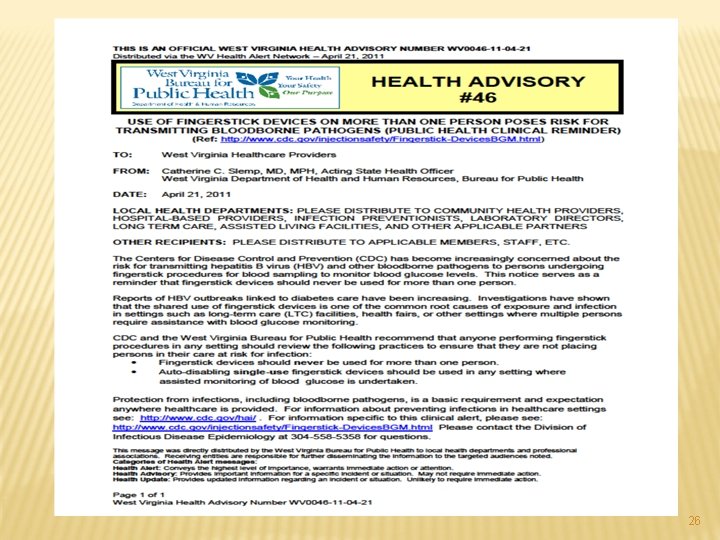
SAFE INJECTION PRACTICES � Large outbreaks of HBV and HCV among patients in the United States � The primary breaches � Reinsertion of used needles into a multiple-dose vial or solution container (e. g. , saline bag) � Use of a single needle/syringe to administer intravenous medication to multiple patients. 25
26
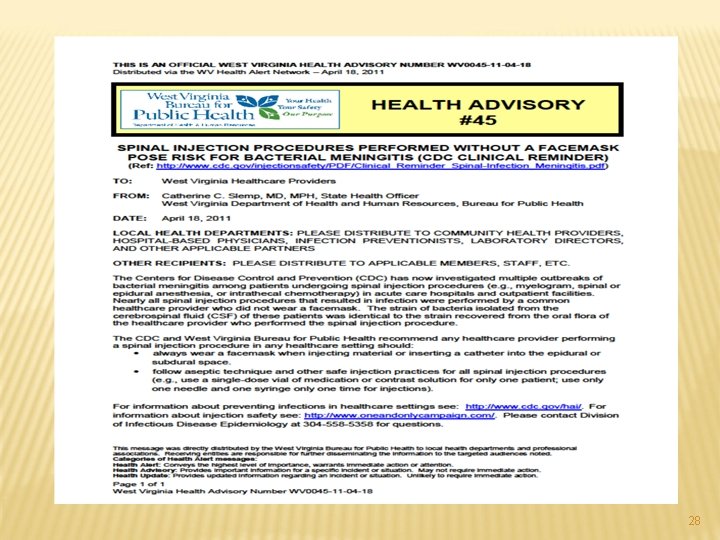
MASKS FOR SPECIAL LUMBAR PUNCTURE PROCEDURES OR CENTRAL LINE PLACEMENT � Face masks limit dispersal of oro-pharyngeal droplets during: � central venous catheters placement � Placement of catheter or injection to epidural space � HICPAC recommends the use of a face mask when placing a catheter or injection to epidural space. 27
28
TRANSMISSION-BASED PRECAUTIONS 29
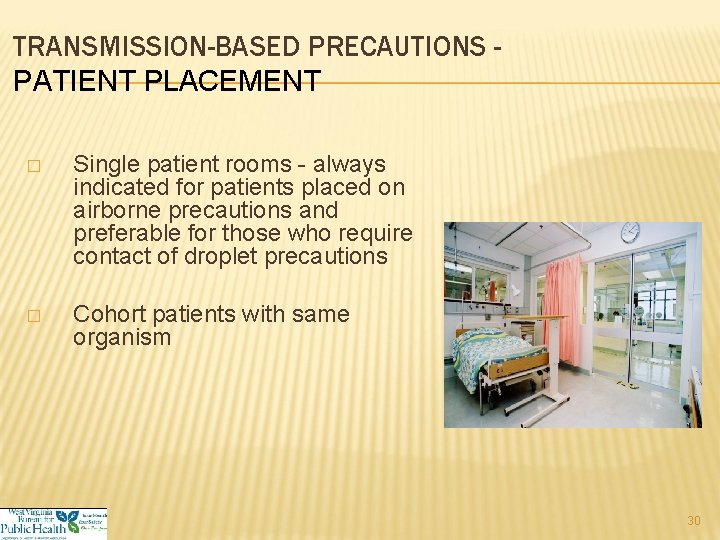
TRANSMISSION-BASED PRECAUTIONS PATIENT PLACEMENT � Single patient rooms - always indicated for patients placed on airborne precautions and preferable for those who require contact of droplet precautions � Cohort patients with same organism 30
TRANSMISSION-BASED PRECAUTIONS MANAGEMENT OF VISITORS � Visitors as sources of healthcare associated infections – e. g. , pertussis, influenza, tuberculosis � Cough � Use etiquette of barrier precautions by visitors � Educate patients and family members � Follow signs for isolation precautions 31
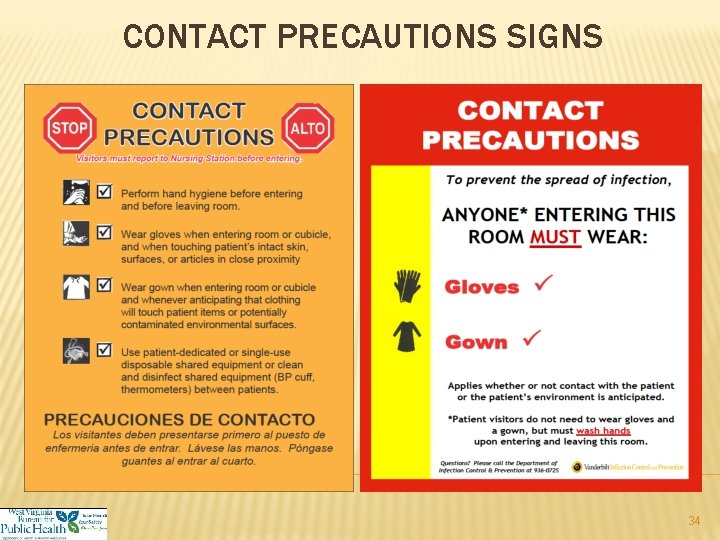
TRANSMISSION-BASED PRECAUTIONS CONTACT PRECAUTIONS � � � � Infections spread by direct or indirect contact with patients or patient-care environment – shigellosis, C. difficle, MRSA Limit patient movement Private/SINGLE room or cohort with patients with same infection Wear disposable gown and gloves when entering the patient room Remove and discard used disposable gown and gloves inside the patient room Wash hands immediately after leaving the patient room Clean patient room daily using a hospital disinfectant, with attention to frequently touched surfaces (bed rails, bedside tables, lavatory surfaces, blood pressure cuff, equipment surfaces) Use dedicated equipment if possible (e. g. , stethoscope) 32
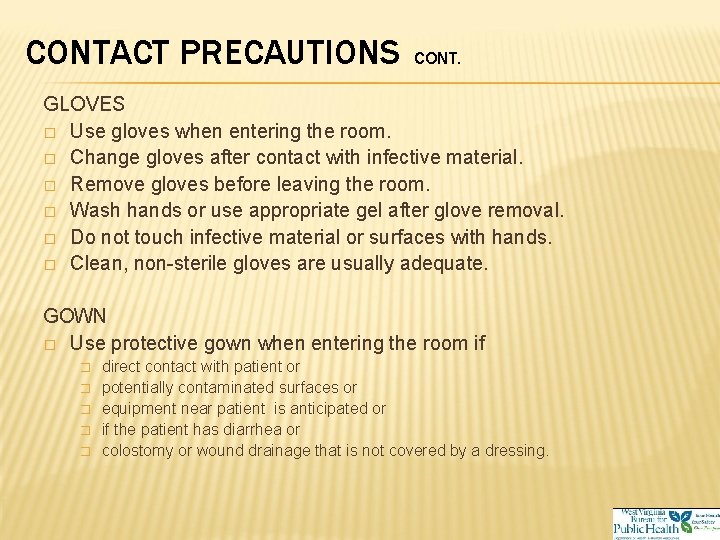
CONTACT PRECAUTIONS CONT. GLOVES � Use gloves when entering the room. � Change gloves after contact with infective material. � Remove gloves before leaving the room. � Wash hands or use appropriate gel after glove removal. � Do not touch infective material or surfaces with hands. � Clean, non-sterile gloves are usually adequate. GOWN � Use protective gown when entering the room if � � � direct contact with patient or potentially contaminated surfaces or equipment near patient is anticipated or if the patient has diarrhea or colostomy or wound drainage that is not covered by a dressing. 33
CONTACT PRECAUTIONS SIGNS 34
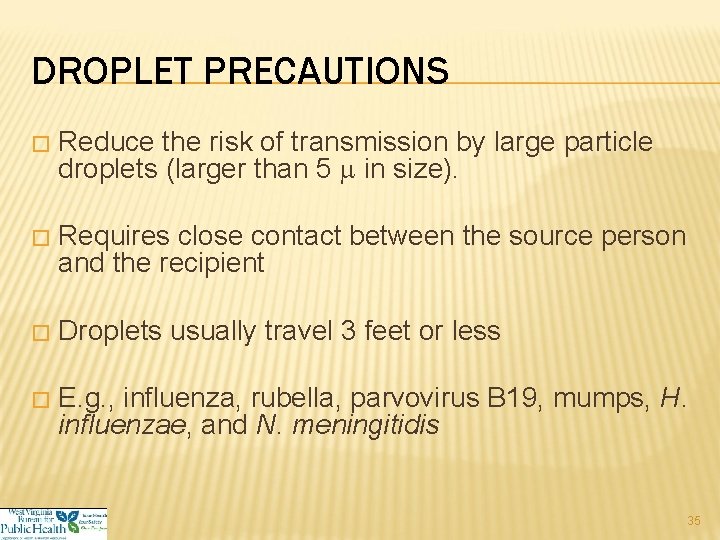
DROPLET PRECAUTIONS � Reduce the risk of transmission by large particle droplets (larger than 5 m in size). � Requires close contact between the source person and the recipient � Droplets usually travel 3 feet or less � E. g. , influenza, rubella, parvovirus B 19, mumps, H. influenzae, and N. meningitidis 35
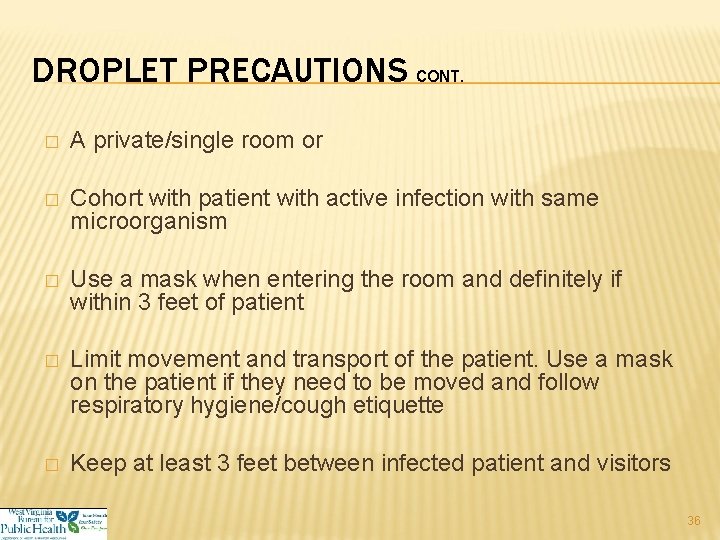
DROPLET PRECAUTIONS CONT. � A private/single room or � Cohort with patient with active infection with same microorganism � Use a mask when entering the room and definitely if within 3 feet of patient � Limit movement and transport of the patient. Use a mask on the patient if they need to be moved and follow respiratory hygiene/cough etiquette � Keep at least 3 feet between infected patient and visitors 36
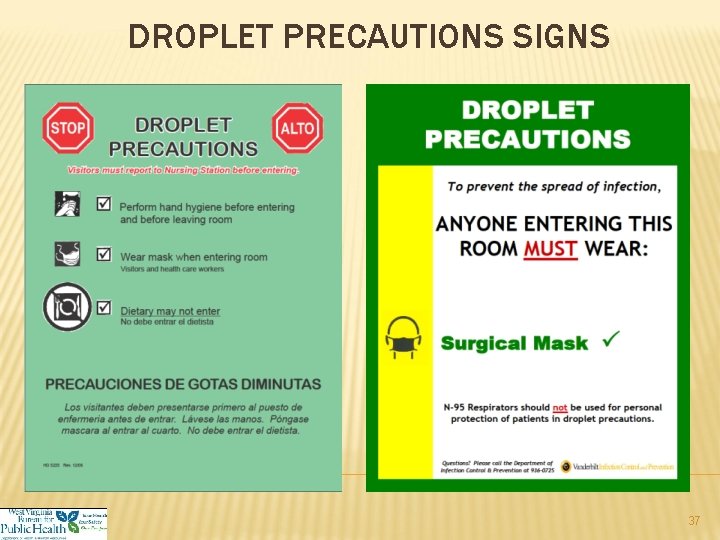
DROPLET PRECAUTIONS SIGNS 37
AIRBORNE PRECAUTIONS � Tuberculosis, measles, varicella � Place the patient in an airborne infection isolation room (AIIR) � Pressure should be monitored with visible indicator � Use of respiratory protection (e. g. , fit tested N 95 respirator) or powered air-purifying respirator (PAPR) when entering the room � Limit movement and transport of the patient. Use a mask on the patient if they need to be moved � Keep patient room door closed. 38
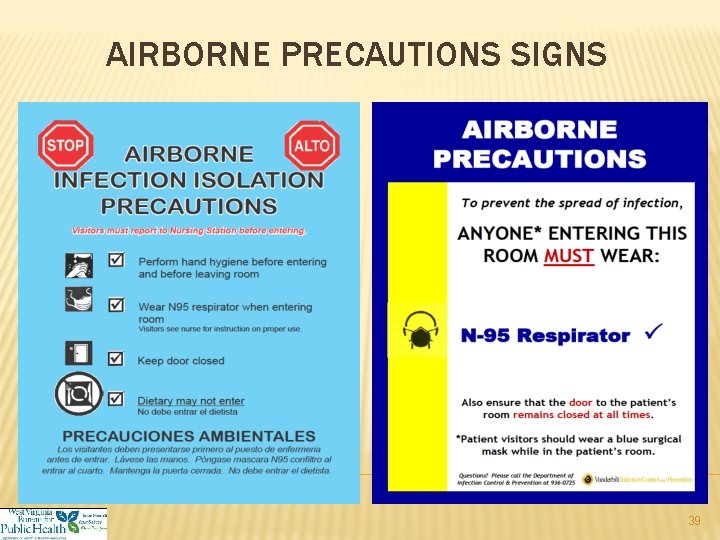
AIRBORNE PRECAUTIONS SIGNS 39
SUMMARY � Isolation precautions is important in all healthcare settings to prevention transmission of infections � 2 types of isolation precautions � Usage of each type of precautions 40
ISOLATION PRECAUTIONS
Contact Precautions Standard Airborne Precautions 100 200 200 300 300 400 400 500 500 100
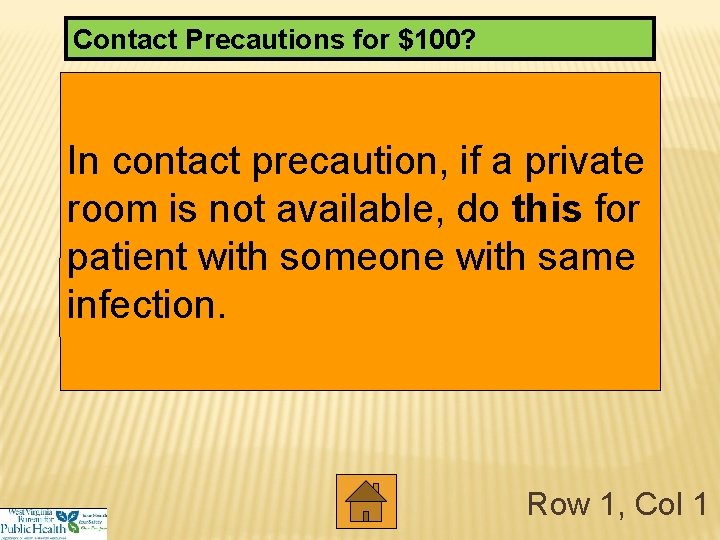
Contact Precautions for $100? In contact precaution, if a private room is not available, do this for patient with someone with same infection. Row 1, Col 1
Contact Precautio ns Standard Airborne Precautio ns Precautions 100 200 200 300 300 400 400 500 500 100
Standard Precautions for $300? You should wear this when touching blood and other body fluids and contaminated instruments. 1, 3
Contact Precautio ns Standard Airborne Precautio ns Precautions 100 200 200 300 300 400 400 500 500 100
Airborne Precautions for $200? These infections require airborne precautions in a Healthcare facility. 1, 4

TO BE CONTINUED! 48
REFERENCES � � � 2007 Guideline for isolation precautions: preventing transmission of infectious agents in healthcare settings: http: //www. cdc. gov/hicpac/2007 IP/2007 isolation. Precautions. html CDC guidelines for isolation precautions in hospitals 1996, Hospital Infection Control Practices Advisory Committee (HICPAC): http: //wonder. cdc. gov/wonder/prevguid/p 0000419. asp Principles of Epidemiology in public health practice, 3 rd edition 49
- Slides: 49