
Isolation of Cholesterol From Egg Yolk Cholesterol Is





- Slides: 19
Isolation of Cholesterol From Egg Yolk
Cholesterol Ø Is the most abundant steroid in the body. Ø Is a waxy substance found in all of the body cells. Ø Has methyl CH 3 - groups, alkyl chain, and -OH attached to the steroid nucleus.
1. Help and maintain cell membranes. 2. Protect and insulate nerve fibers. 3. Involved in the formation of sex hormones such as: estrogen. 4. Production of bile salts, which help digesting fats.
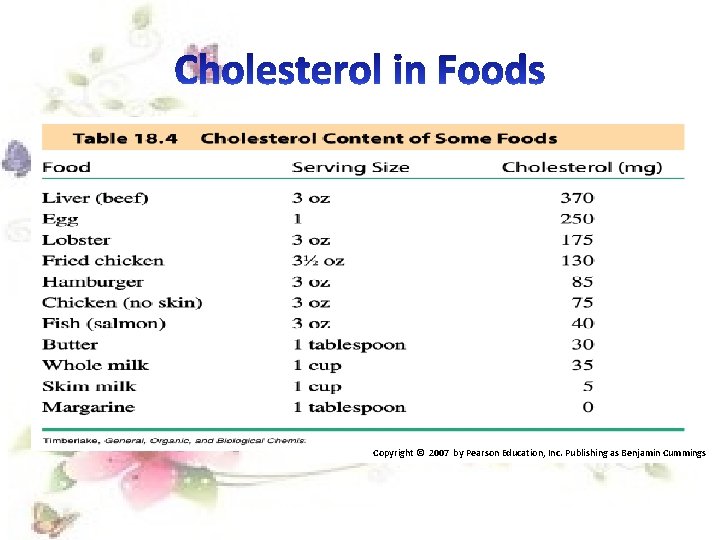
• Is synthesized in the liver (80%). • Is obtained from meats, milk, and eggs (20%). • Is needed for cell membranes, brain , nerve tissue, steroid hormones, and Vitamin D. • Cholesterol is considered elevated if plasma cholesterol exceeds 200 mg/d. L (cholestrol-emia). • Clogs arteries when high levels form plaque. A normal, open artery. An artery clogged by cholesterol plaque.
Copyright © 2007 by Pearson Education, Inc. Publishing as Benjamin Cummings
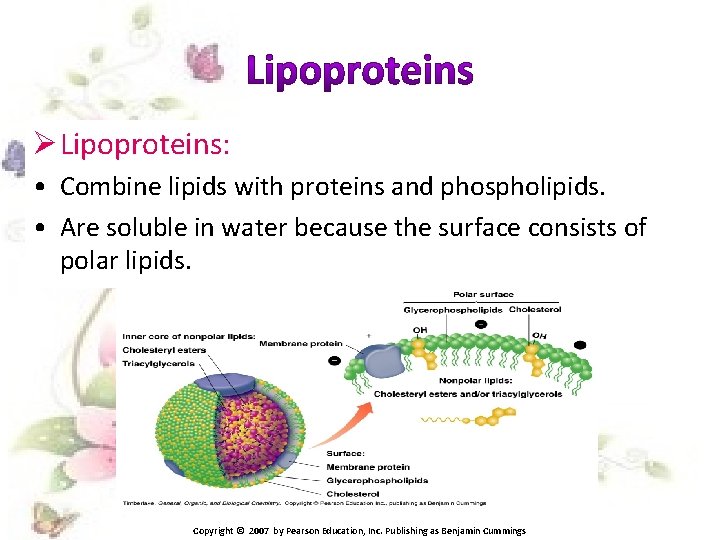
Ø Lipoproteins: • Combine lipids with proteins and phospholipids. • Are soluble in water because the surface consists of polar lipids. Copyright © 2007 by Pearson Education, Inc. Publishing as Benjamin Cummings
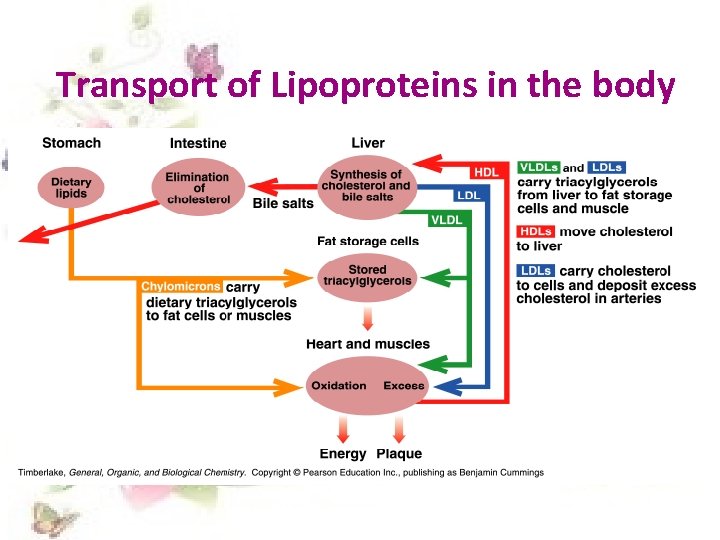
Ø Lipoproteins: • Differ in density, composition, and function. ü Include: § Chylomicrons: carry external lipids (dietary lipids) to cells. § Very low-density lipoprotein (VLDL), low-density lipoprotein (LDL) and high-density lipoprotein (HDL): carry internal lipids.
Transport of Lipoproteins in the body
High-density lipoprotein (HDL) • High-density lipoproteins (HDL) leave the liver, pick up excess cholesterol on their route through the blood stream and take it back to liver. • The liver excretes this cholesterol into the bile then out of the body or use it in bile salts production through the bowels. • Because HDL particles remove excess cholesterol from the body, they are considered protective. • That’s why HDL cholesterol is often referred to as: Good cholesterol.
Low-density lipoprotein (LDL) • LDL transport cholesterol throughout the body, delivering cholesterol to different tissues and organs. • When the cells have all the cholesterol they need, they reduce the number of receptors, or gateways, for cholesterol to enter. • As a result, cholesterol contained in the LDL particles starts to build up in the blood stream. • Over time, circulating LDL cholesterol undergoes chemical changes (becomes oxidized) and also reduces in size. These smaller particles more easily enter the blood vessel wall and start to build up under the vessel lining. • Deposits of LDL cholesterol particles in vessel walls are called plaques and can lead to inflammation, bleeding into the area, and calcium buildup (calcification).
• Eventually, the buildup of plaques can start to crowd the space within the blood vessel and obstruct the blood flow. This process of plaque accumulation is called Atherosclerosis. • When atherosclerosis affects the arteries leading to the heart (coronary arteries), one may have chest pain and other symptoms of coronary artery disease. • If plaques tear or rupture, a blood clot may form, blocking the flow of blood or breaking free and plugging an artery downstream. • If blood flow to part of the heart stops, a heart attack will occur. • If blood flow to the brain stops, a stroke occurs. • This is why LDL cholesterol is often referred to as: Bad cholesterol.
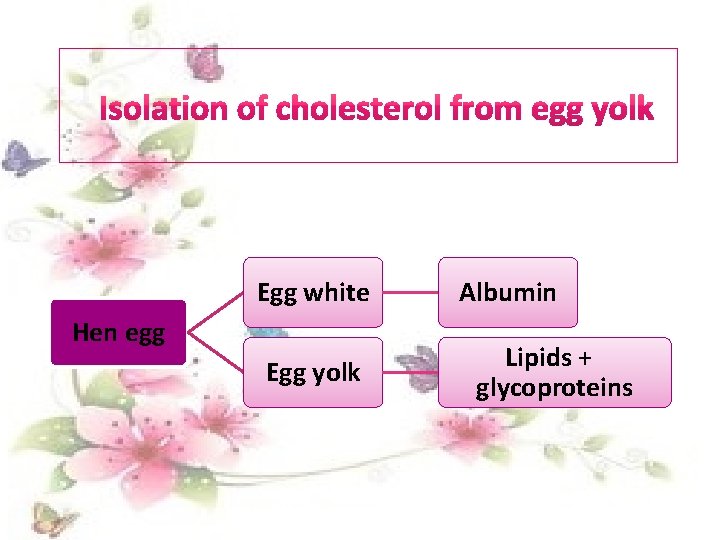
Egg white Hen egg Egg yolk Albumin Lipids + glycoproteins
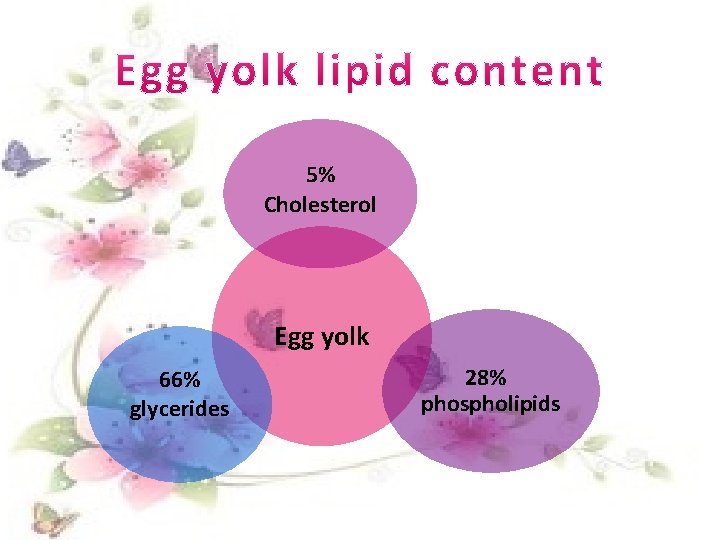
5% Cholesterol Egg yolk 66% glycerides 28% phospholipids
• Egg yolk is rich in lipids of which the most prominent are glycerides, cholesterol, and phosphatidylcholine (lecithin). • Phosphatidylcholine (lecithin): § The most abundant phospholipid in animals and plants, often accounting to almost 50% of the total, and as such it is obviously a key building block of membrane bilayers. § In particular, it makes up a very high proportion of the outer leaflet of the plasma membrane. § Phosphatidylcholine: is also the principal phospholipid circulating in plasma, where it is an integral component of the lipoproteins, especially the HDL. 14
Experiment • Reagents and instruments: – A hard boiled hen egg. – Acetone, water bath, flask, funnel, filter paper, beaker.
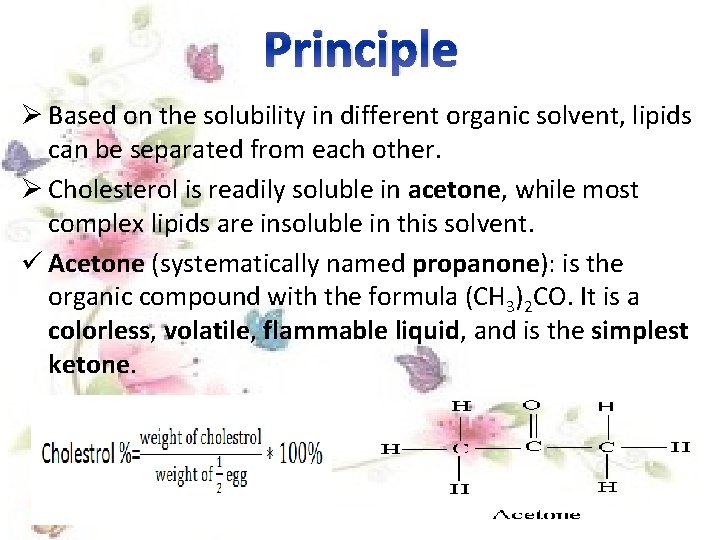
Principle Ø Based on the solubility in different organic solvent, lipids can be separated from each other. Ø Cholesterol is readily soluble in acetone, while most complex lipids are insoluble in this solvent. ü Acetone (systematically named propanone): is the organic compound with the formula (CH 3)2 CO. It is a colorless, volatile, flammable liquid, and is the simplest ketone. 16
1. Peal the hard boiled egg and remove the egg white. 2. In a beaker weigh a ½ egg yolk and mash it. 3. To the mashed egg yolk add a 25 ml of acetone and keep stirring for 5 min. 4. Allow the solid to settle and carefully remove the acetone (the above liquid phase) and transfer it to a clean 100 ml Erlenmeyer flask and cover it tightly. 5. To the remained solid phase add a new 25 ml of acetone and repeat step 4. Now you have collected twice the 25 ml of acetone extract (it contains the cholesterol).
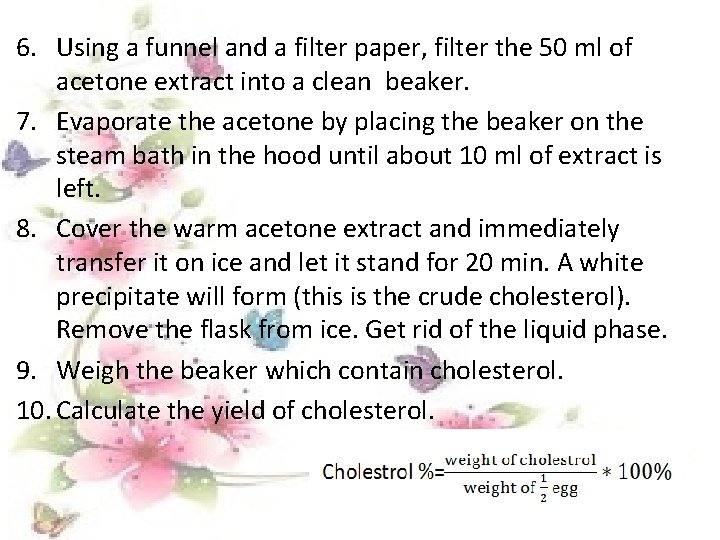
6. Using a funnel and a filter paper, filter the 50 ml of acetone extract into a clean beaker. 7. Evaporate the acetone by placing the beaker on the steam bath in the hood until about 10 ml of extract is left. 8. Cover the warm acetone extract and immediately transfer it on ice and let it stand for 20 min. A white precipitate will form (this is the crude cholesterol). Remove the flask from ice. Get rid of the liquid phase. 9. Weigh the beaker which contain cholesterol. 10. Calculate the yield of cholesterol.
The End