
ISO TC 37 Standards Basic Principles of Terminology
ISO TC 37 Standards Basic Principles of Terminology Networked Knowledge Organization Systems/Services NKOS Sue Ellen Wright Institute for Applied Linguistics, Kent State University 1
Standards for the Language Industry Å Translation & localization, multilingual text representation, Internet content, multilingual content management Å See: http: //appling. kent. edu/Resource. Pages/LTStandards/Chart/Lang uage. Technology. Standards. htm Networked Knowledge Organization Systems/Services NKOS 2
ISO TC 37 Terminology and other Language Resources Å Standards for the basic principles of terminology management Å Standards for layout and lexicography Å Standards for computerized terminology management Å Standards for natural language processing applications Å Metadata registry for all of the above Networked Knowledge Organization Systems/Services NKOS 3
Language Codes Å Å Å ISO 639: 1988 Code for the representation of names of languages ISO 639 -2: 1998 Code for the representation of names of languages - Part 2: Alpha-3 code ISO CD 639 -3: 2003 Code for the representation of names of languages - Part 3: Alpha-3 code for comprehensive coverage of languages ISO NWI 639 -4: 2003 Code for the representation of names of languages - Part 4: Implementation guidelines and general principles for language coding ISO NWI 639 -5: 2003 Code for the representation of names of languages - Part 5: Alpha-3 code for language families and groups ISO NWI 639 -6: 2003 Code for the representation of names of languages - Part 6: Alpha-4 code [for dialects] Networked Knowledge Organization Systems/Services NKOS 4

Core TC 37 Standards Å ISO 704: 2000 Terminology work - Principles and methods Å ISO 860: 1996 Terminology work Harmonization of concepts and terms Å ISO 1087 -1: 2000 Terminology work Vocabulary - Part 1: Theory and application Å ISO 1087 -2: 2000 Terminology work Vocabulary - Part 2: Computer applications Networked Knowledge Organization Systems/Services NKOS 5
Terminological View Å Objects ¿ ¿ Å Concepts ¿ ¿ ¿ Å perceived or conceived, concrete or abstracted or conceptualized into concepts depict or correspond to a set of objects based on a defined set of characteristics represented or expressed in language by designations or by definitions organized into concept systems Designations ¿ ¿ ¿ represented as terms, names (appellations) or symbols designate or represent a concept attributed to a concept by consensus within a special language community Networked Knowledge Organization Systems/Services NKOS 7
Fundamental Activities Å Identifying concepts and concept relations; Analyzing and modeling concept systems on the basis of identified concepts and concept relations; ¿ Establishing representations of concept systems through concept diagrams; ¿ Crafting concept-oriented definitions; ¿ Attributing designations (predominantly terms) to each concept in one or more languages; and, ¿ Recording and presenting terminological data, principally in terminological entries stored in print and electronic media (terminography). ¿ Networked Knowledge Organization Systems/Services NKOS 9

Frege, Peirce, Ogden & Richards Unit of Thinking (Concept) Designation (Symbol, Sign, Term, Formula etc. ) Networked Knowledge Organization Systems/Services NKOS (Unit of Thought, Unit of Knowledge) Referent (Concrete Object, Real Thing, Conceived Object) 10
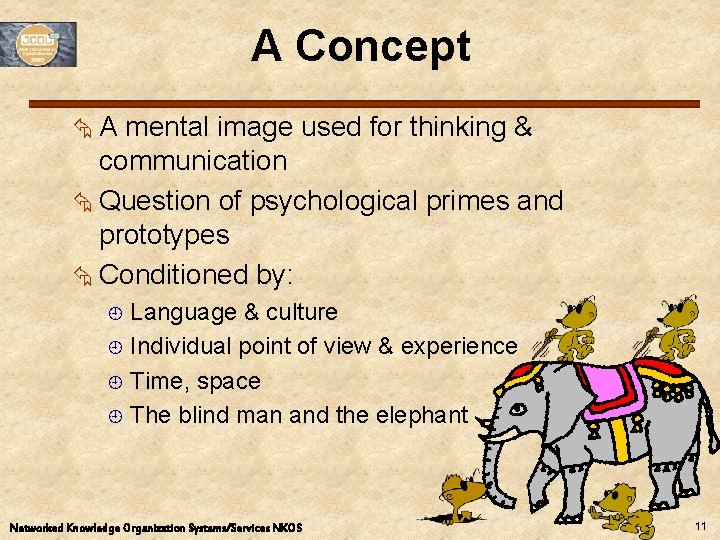
A Concept ÅA mental image used for thinking & communication Å Question of psychological primes and prototypes Å Conditioned by: Language & culture ¿ Individual point of view & experience ¿ Time, space ¿ The blind man and the elephant ¿ Networked Knowledge Organization Systems/Services NKOS 11
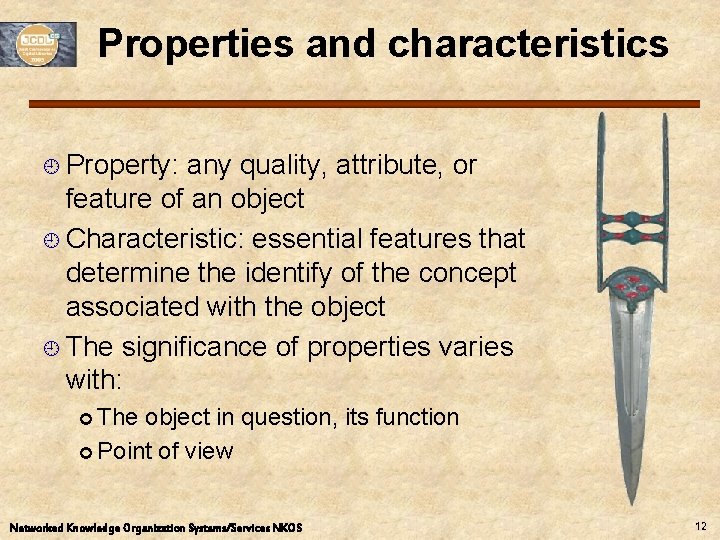
Properties and characteristics ¿ Property: any quality, attribute, or feature of an object ¿ Characteristic: essential features that determine the identify of the concept associated with the object ¿ The significance of properties varies with: ¢ The object in question, its function ¢ Point of view Networked Knowledge Organization Systems/Services NKOS 12
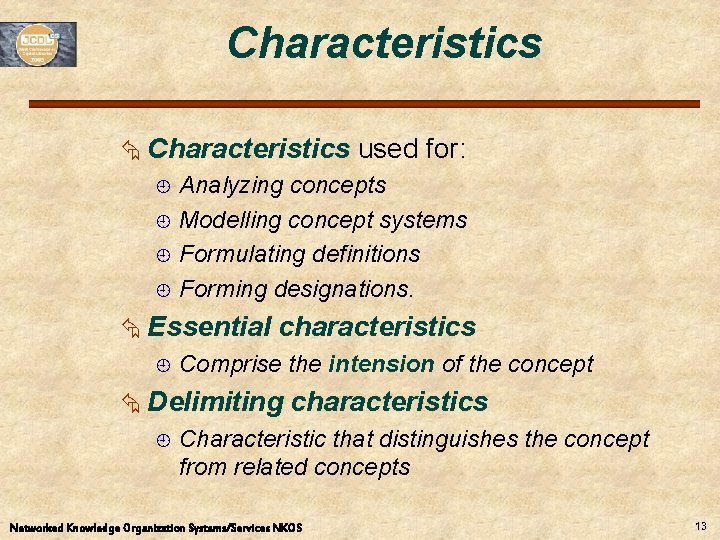
Characteristics Å Characteristics used for: Analyzing concepts ¿ Modelling concept systems ¿ Formulating definitions ¿ Forming designations. ¿ Å Essential ¿ characteristics Comprise the intension of the concept Å Delimiting ¿ characteristics Characteristic that distinguishes the concept from related concepts Networked Knowledge Organization Systems/Services NKOS 13
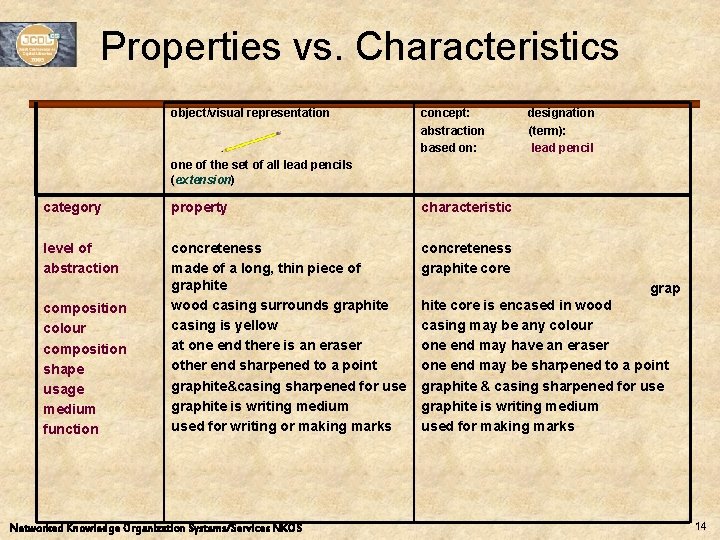
Properties vs. Characteristics object/visual representation concept: abstraction based on: designation (term): lead pencil one of the set of all lead pencils (extension) category property characteristic level of abstraction concreteness made of a long, thin piece of graphite wood casing surrounds graphite casing is yellow at one end there is an eraser other end sharpened to a point graphite&casing sharpened for use graphite is writing medium used for writing or making marks concreteness graphite core composition colour composition shape usage medium function Networked Knowledge Organization Systems/Services NKOS grap hite core is encased in wood casing may be any colour one end may have an eraser one end may be sharpened to a point graphite & casing sharpened for use graphite is writing medium used for making marks 14

Concept Relations Å hierarchical relations ¿ superordinate concepts Å generic concept + subordinate relations ¿ generic Å partitive concept + specific concepts relations ¿ comprehensive concepts Networked Knowledge Organization Systems/Services NKOS concept + partitive 15
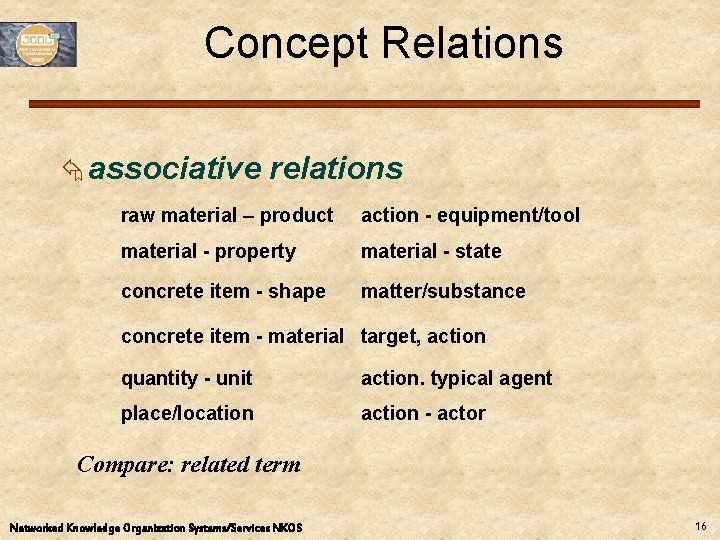
Concept Relations Å associative relations raw material – product action - equipment/tool material - property material - state concrete item - shape matter/substance concrete item - material target, action quantity - unit action. typical agent place/location action - actor Compare: related term Networked Knowledge Organization Systems/Services NKOS 16

Modeling Concept Systems Å Å Å Select the concept field, the preliminary designations and concepts to be treated by taking into account the subject field, the user group and its needs. Analyze the intension and extension of each concept. Determine the relation and position of these concepts within the concept system. Formulate and evaluate definitions for the concepts based on the concept relations. Attribute designations [terms or other forms of representation] to each concept. Networked Knowledge Organization Systems/Services NKOS 17
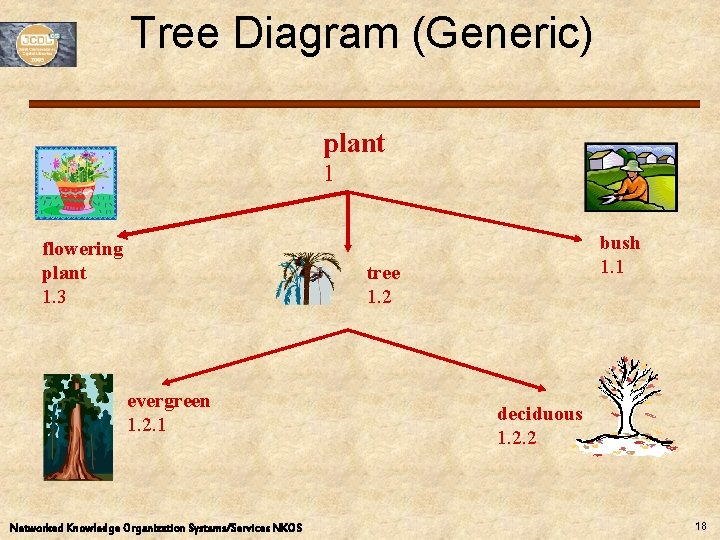
Tree Diagram (Generic) plant 1 flowering plant 1. 3 bush 1. 1 tree 1. 2 evergreen 1. 2. 1 Networked Knowledge Organization Systems/Services NKOS deciduous 1. 2. 2 18
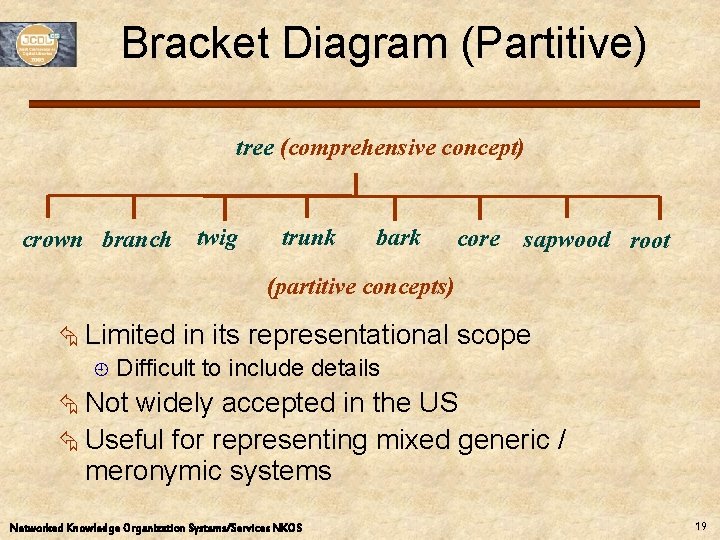
Bracket Diagram (Partitive) tree (comprehensive concept) crown branch twig trunk bark core sapwood root (partitive concepts) Å Limited in its representational ¿ Difficult to include details scope Å Not widely accepted in the US Å Useful for representing mixed generic / meronymic systems Networked Knowledge Organization Systems/Services NKOS 19
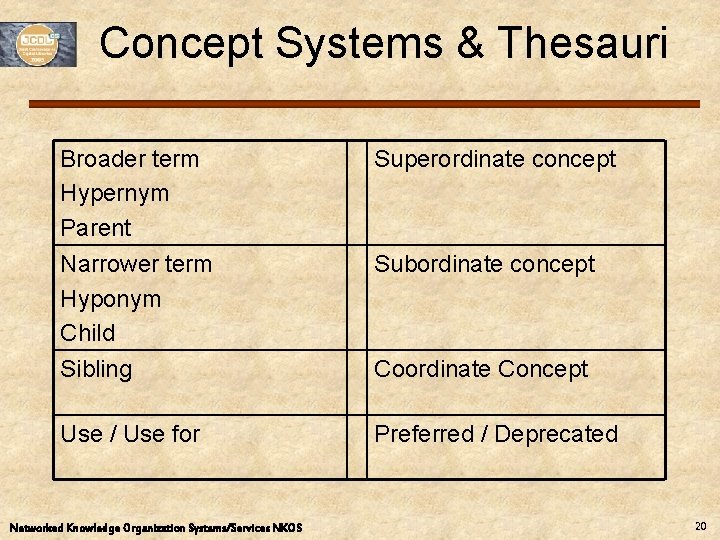
Concept Systems & Thesauri Broader term Hypernym Parent Superordinate concept Narrower term Hyponym Child Subordinate concept Sibling Coordinate Concept Use / Use for Preferred / Deprecated Networked Knowledge Organization Systems/Services NKOS 20
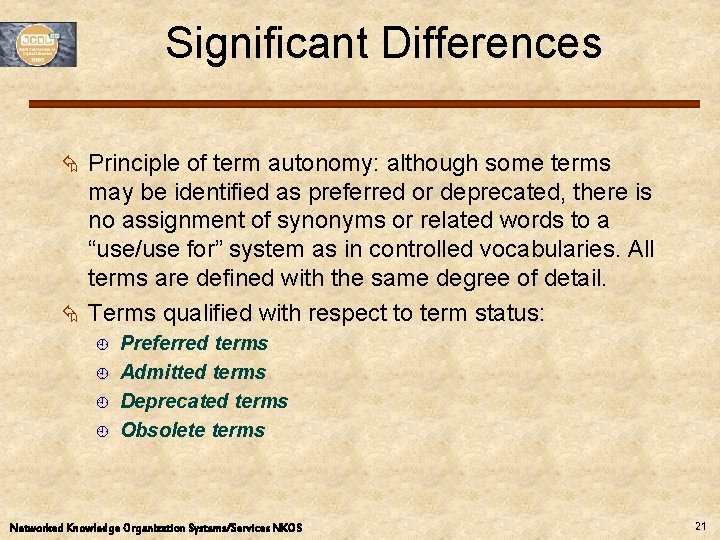
Significant Differences Principle of term autonomy: although some terms may be identified as preferred or deprecated, there is no assignment of synonyms or related words to a “use/use for” system as in controlled vocabularies. All terms are defined with the same degree of detail. Å Terms qualified with respect to term status: Å ¿ ¿ Preferred terms Admitted terms Deprecated terms Obsolete terms Networked Knowledge Organization Systems/Services NKOS 21
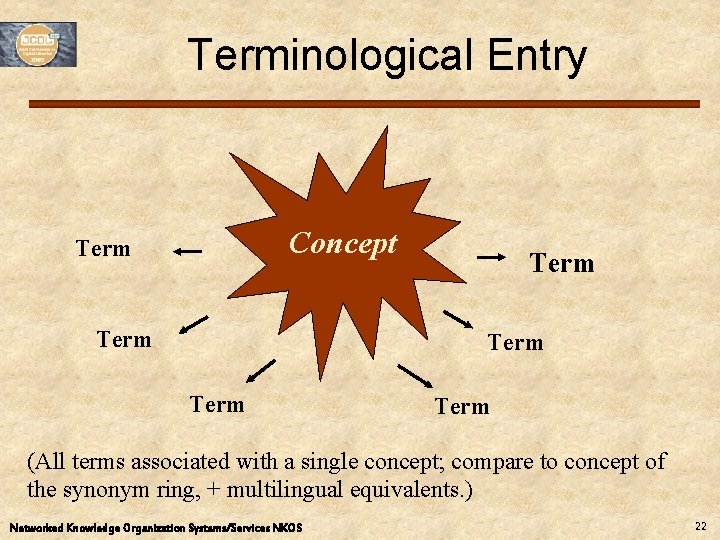
Terminological Entry Concept Term Term (All terms associated with a single concept; compare to concept of the synonym ring, + multilingual equivalents. ) Networked Knowledge Organization Systems/Services NKOS 22
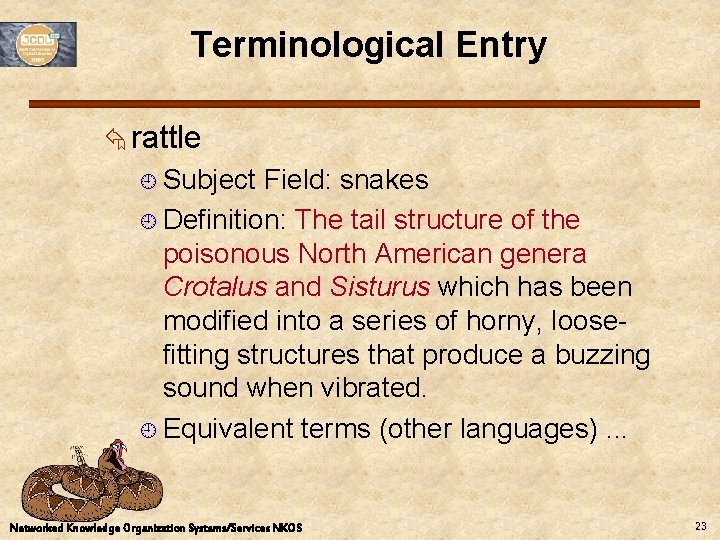
Terminological Entry Å rattle ¿ Subject Field: snakes ¿ Definition: The tail structure of the poisonous North American genera Crotalus and Sisturus which has been modified into a series of horny, loosefitting structures that produce a buzzing sound when vibrated. ¿ Equivalent terms (other languages). . . Networked Knowledge Organization Systems/Services NKOS 23
Form of Definitions Å Preferably intentional definitions Å The statement of a superordinate or broader concept followed by a statement of the essential characteristics making up the intension of the concept, with emphasis on the delimiting characteristic(s) that differentiate that concept from similar concepts Å Always defined with reference to a specific subject field Networked Knowledge Organization Systems/Services NKOS 24
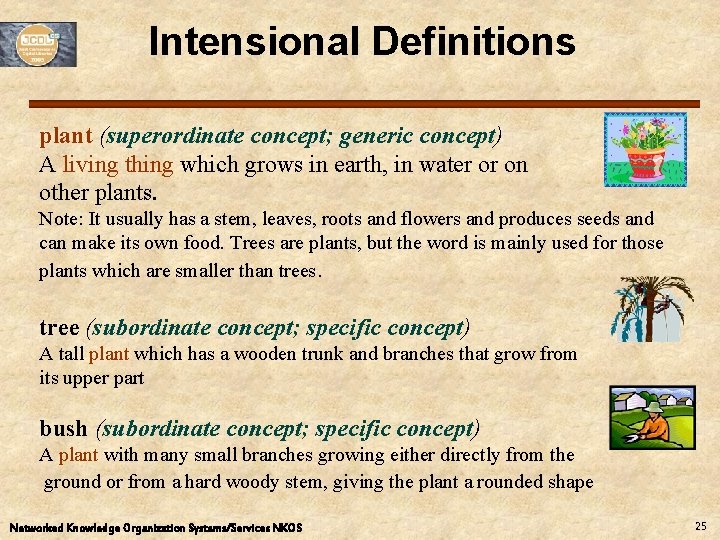
Intensional Definitions plant (superordinate concept; generic concept) A living thing which grows in earth, in water or on other plants. Note: It usually has a stem, leaves, roots and flowers and produces seeds and can make its own food. Trees are plants, but the word is mainly used for those plants which are smaller than trees. tree (subordinate concept; specific concept) A tall plant which has a wooden trunk and branches that grow from its upper part bush (subordinate concept; specific concept) A plant with many small branches growing either directly from the ground or from a hard woody stem, giving the plant a rounded shape Networked Knowledge Organization Systems/Services NKOS 25
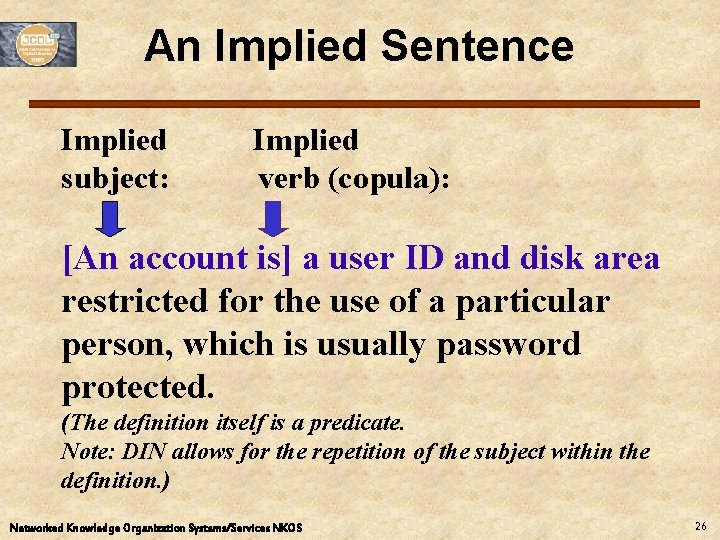
An Implied Sentence Implied subject: Implied verb (copula): [An account is] a user ID and disk area restricted for the use of a particular person, which is usually password protected. (The definition itself is a predicate. Note: DIN allows for the repetition of the subject within the definition. ) Networked Knowledge Organization Systems/Services NKOS 26
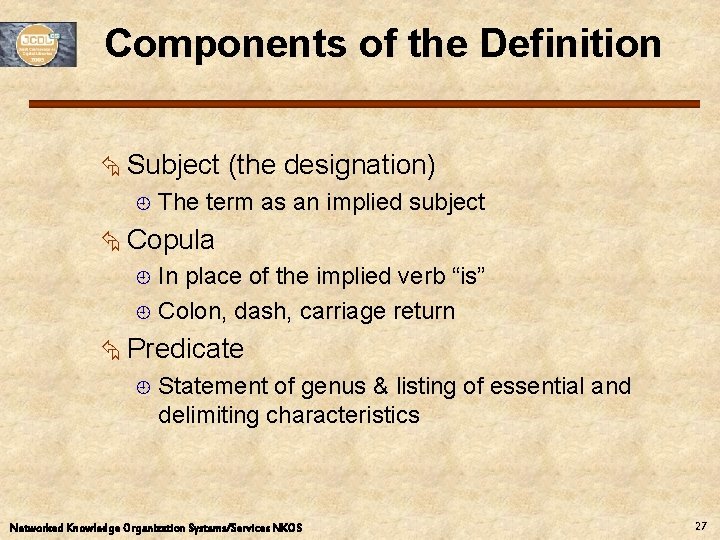
Components of the Definition Å Subject ¿ (the designation) The term as an implied subject Å Copula In place of the implied verb “is” ¿ Colon, dash, carriage return ¿ Å Predicate ¿ Statement of genus & listing of essential and delimiting characteristics Networked Knowledge Organization Systems/Services NKOS 27
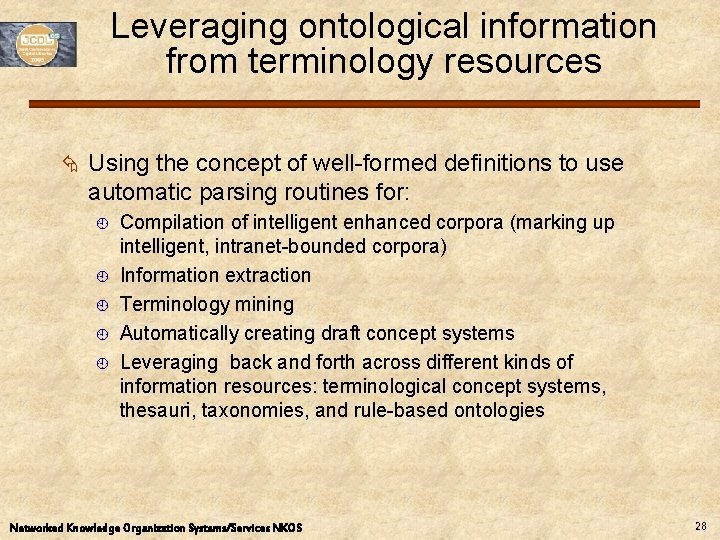
Leveraging ontological information from terminology resources Å Using the concept of well-formed definitions to use automatic parsing routines for: ¿ ¿ ¿ Compilation of intelligent enhanced corpora (marking up intelligent, intranet-bounded corpora) Information extraction Terminology mining Automatically creating draft concept systems Leveraging back and forth across different kinds of information resources: terminological concept systems, thesauri, taxonomies, and rule-based ontologies Networked Knowledge Organization Systems/Services NKOS 28
For More Information Sue Ellen Wright Institute for Applied Linguistics Kent State University 109 Satterfield Hall Kent, Ohio 44242, USA sewright@neo. rr. com sellenwright@gmail. com Networked Knowledge Organization Systems/Services NKOS 29
- Slides: 27