
ISO Standards and Total Quality Management System By
ISO Standards and Total Quality Management System By: Dr. Anand P. Gadad KLE College of Pharmacy, Belagavi A constituent Unit of KLE Academy of Higher Education and Research Nehru Nagar, Belagavi – 590 010, Karnataka, India Phone: 0831 -2471399; Fax: 0831 -2472387; Web: http: //www. klepharm. edu. E-mail: principal@klepharm. edu
Contents • Introduction to International Organization for Standardization (ISO). • History. • ISO: 9000 series and ISO: 14000 series. • Quality management principles. • Introduction to TQM • Principles and benefits of TQM • Organizing of TQM • Functions of management in TQM • References. 2

The name "ISO", has been derived from the Greek word isos, meaning "equal". • ISO (International Organization for Standardization) is the world's largest developer and publisher of International Standards. • ISO is a network of the national standards institutes of 163 countries, one member per country, with a Central Secretariat in Geneva, Switzerland, that coordinates the system. • ISO is a non-governmental organization that forms a bridge between the public and private sectors. 3
ISO's origins In 1946, delegates from 25 countries met in London and decided to create a new international organization, of which the object would be "to facilitate the international coordination and unification of industrial standards". The new organization, ISO, officially began operations on 23 February 1947, in Geneva, Switzerland. 4

Why Standards matter? Standards ensure desirable characteristics of products and services such as quality, environmental friendliness, safety, reliability, efficiency at an economical cost. Standards • make the development, manufacturing and supply of products and services more efficient, safer and cleaner • facilitate trade between countries and make it fairer • share technological advances and good management practice • disseminate innovation • safeguard consumers, and users in general, of products and services • make life simpler by providing solutions to common problems 5

The scope of ISO's work ISO has more than 17500 International Standards and other types of normative documents in its current portfolio. ISO's work programme ranges from standards for traditional activities, such as agriculture and construction, through mechanical engineering, manufacturing and distribution, medical devices, information and communication technologies, and to standards for good management practice and for services. 6

Who develops ISO standards? • ISO standards are developed by technical committees comprising experts from the industrial, technical and business sectors which have asked for the standards, and which subsequently put them to use. These experts may be joined by representatives of government agencies, testing laboratories, consumer associations, nongovernmental organizations and academic circles. • The experts participate as national delegations, chosen by the ISO national member institute for the country concerned. • This enables them to present a consolidated, national consensus position to the technical committee. 7
Iso's International Partners • ISO collaborates with its partners in international standardization, the International Electrotechnical Commission (IEC) and International Telecommunication Union (ITU). The three organizations, all based in Geneva, Switzerland, have formed the World Standards Cooperation for the promotion of international standardization. • ISO has a close relationship with the World Trade Organization (WTO) which reduces technical barriers to trade. • ISO collaborates with the United Nations (UN) Organization and its specialized agencies and commissions, such as: • CODEX Alimentarius, on food safety measurement, management. 8

• UN Economic Commission for Europe (UN/ECE) • World Health Organization (WHO), on health technologies • International Maritime Organization (IMO) • World Economic Forum (WEF) • International Federation of Standards Users (IFAN). • ISO's technical committees have formal liaison relations with over 600 international and regional organizations. 9

ISO 9001 (quality) and ISO 14001 (environment) These are "generic management system standards". "Generic" means that the same standard can be applied to any organization, large or small, whatever its product or service, in any sector of activity. ISO 9001 contains a generic set of requirements for implementing a quality management system and, ISO 14001 for an environmental management system. 10

ISO 9000 family • The ISO 9000 family addresses "Quality management". This means the organization does to fulfill: • • the customer's quality requirements, and applicable regulatory requirements, while aiming to enhance customer satisfaction, and achieve continual improvement of its performance. 11
ISO 14000 family • The ISO 14000 family addresses "Environmental management". This means the organization does to: • minimize harmful effects on the environment caused by its activities, and to • achieve continual improvement of its environmental performance. 12

ISO STANDARDS ISO-9000 ISO 9001 Compendium of documented procedures and helps in understanding the basic elements of quality management. To establish a Quality Management system for Design, development, production, installation & servicing. 13

ISO 9002 To establish a Quality Management system for production and installation ISO 9003 Inspecting To establish&a Quality Testing Products Management system for inspecting and testing products. ISO 9004 Guideline for application of standards in quality management & quality system 14
Quality Management Principles Principle 1: Customer focus • Organizations depend on their customers and therefore should understand current and future customer needs, should meet customer requirements and strive to exceed customer expectations. Key benefits: • Increased revenue and market share obtained through flexible and fast responses to market opportunities. • Increased effectiveness in the use of the organization's resources to enhance customer satisfaction. • Improved customer loyalty leading to repeat business. 15
Principle 2: Leadership • Leaders establish unity of purpose and direction of the organization. They should create and maintain the internal environment in which people can become fully involved in achieving the organization's objectives. Key benefits: • People will understand be motivated towards the organization's goals and objectives. • Activities are evaluated, aligned and implemented in a unified way. • Miscommunication between levels of an organization will be minimized. 16
Principle 3: Involvement of people • People at all levels are the essence of an organization and their full involvement enables their abilities to be used for the organization's benefit. Key benefits: • Motivated, committed and involved people within the organization. • Innovation and creativity in achieving the organization's objectives. • People eager to participate in and contribute to continual improvement. 17

Principle 4: Process approach • A desired result is achieved more efficiently when activities and related resources are managed as a process. Key benefits: • Lower costs and shorter cycle times through effective use of resources. • Improved, consistent and predictable results. • Focused and prioritized improvement opportunities. 18
Principle 5: System approach to management • Identifying, understanding and managing interrelated processes as a system contributes to the organization's effectiveness and efficiency in achieving its objectives. Key benefits: • Integration and alignment of the processes that will best achieve the desired results. • Ability to focus effort on the key processes. • Providing confidence to interested parties as to the consistency, effectiveness and efficiency of the organization. 19

Principle 6: Continual improvement • Continual improvement of the organization's overall performance should be a permanent objective of the organization. Key benefits: • Performance advantage through improved organizational capabilities. • Alignment of improvement activities at all levels to an organization's strategic extent. • Flexibility to react quickly to opportunities. 20
Principle 7: Factual approach to decision making • Effective decisions are based on the analysis of data and information Key benefits: • Informed decisions. • An increased ability to demonstrate the effectiveness of past decisions through reference to factual records. • Increased ability to review, challenge and change opinions and decisions. 21
Principle 8: Mutually beneficial supplier relationships • An organization and its suppliers are interdependent and a mutually beneficial relationship enhances the ability of both to create value Key benefits: • Increased ability to create value for both parties. • Flexibility and speed of joint responses to changing market or customer needs and expectations. • Optimization of costs and resources. 22
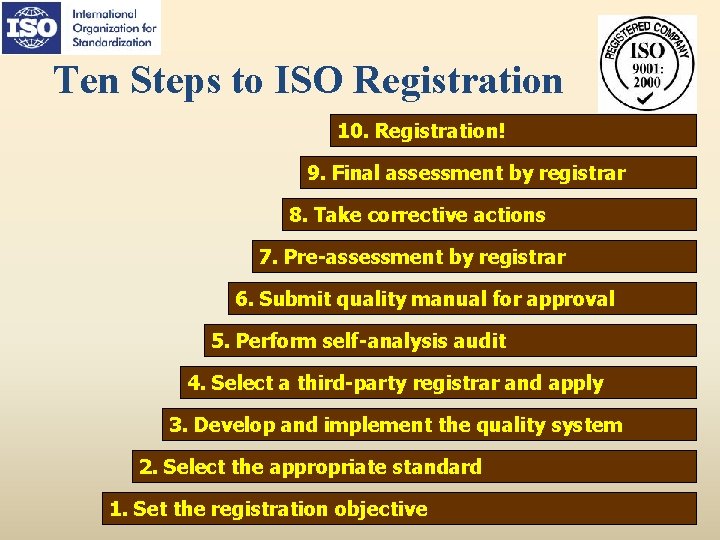
Ten Steps to ISO Registration 10. Registration! 9. Final assessment by registrar 8. Take corrective actions 7. Pre-assessment by registrar 6. Submit quality manual for approval 5. Perform self-analysis audit 4. Select a third-party registrar and apply 3. Develop and implement the quality system 2. Select the appropriate standard 1. Set the registration objective 23

TOTAL QUALITY MANAGEMENT 24
INTRODUCTION • The term “control” in the context of management is a function where by performance is measured against planned objectives and in case of any deficiency necessary remedial measures are taken to ensure the achievement of the set objectives. • When applied to the quality of product the term “Quality Control” denotes all those activities which are directed to maintaining and improving it. 25
Ø Quality control involves, a. b. c. d. Setting of targets Appraisal of conformance to standards Taking corrective action where any deviation is noticed Planning for improvements in quality Ø Since this is basically a management function involving directions by top management and co-ordination of all quality related activities throughout the company, “Total Quality Management” is a better term to describe this new concept on quality. 26

1. 2. 3. 4. 5. 6. 7. 8. 9. 10. Principles of TQM Concentrate on the customer and be customer focused. Do it right first time. Constantly improve. Quality is an Attitude not an inspection process. Communicate and educate. Train the work force. Measure and record Top management must be involved Empower the staff Make the business a good place to work and drive out fears of staff 11. Introduce team working 12. Organize by process not by function 27
Benefits of TQM Advantages unique to TQM Ø It makes company a leader not a follower. Ø It fosters team work. Ø It makes the company more sensitive to customer needs. Benefits for customer ØFewer problems with the product or service. ØBetter customer care. ØGreater satisfaction. 28
Benefits for company Ø Ø Ø Quality improves Employees are motivated Productivity increases Cost reduced Zero defects Problems resolved faster Benefits for staff Ø Empowerment Ø More training and more skills Ø More recognition 29
Organizing for TQM Team working and co-operative relationships are of great importance in total quality management because quality can not be achieved by any one individual or department alone. 1. Quality engineering a. b. c. d. e. Its main work elements are : Advice to the management on the quality policy of the company and laying down realistic objectives. Analysis of the customers quality requirements. Defining quality standards and preparation of product specification. Quality Audit of the company. Organizing training in Quality program. 30

2. Quality Control The main work elements are : a. b. c. d. e. Assistance in establishing quality controls at various points of manufacturing process. Maintenance and calibration of process control equipments. Investigation of defects and assistance in solving quality problems during production. Implementation of Quality Control measures for incoming materials and stores. Arranging final inspection to asses the quality of the end product. 31
Contd…. . f. Checking the quality of the packaging to ensure that the product is able to withstand transportation hazards. g. Conducting tests on the goods of which customer complaints have been received h. Feedback to defect data and customer complaints. 32
KEY ELEMENTS FOR SUCCESSFUL IMPLEMENTATION OF TQM • • • • 1. QUALITY PLANING: Plan-Do-Check-Act 2. LEADERSHIP & Management commitment 3. Training 4. Quality Chains & Teamwork 5. Quality control 6. Quality Assurance 7. Quality Audit 8. Quality Circles 9. Effective Communication 10. Recognition of staff 11. Customer satisfaction & Customer feedback 12. Statistical Monitoring 13. Zero Defects concept 33
Functions of management in TQM Planning: It involves, Ø Diagnosis of the problem Ø Development of alternatives Ø Evaluation of alternatives Ø Selection of the best course of action Organization: Ø It is a tool for achieving objectives in a systematic and scientific manner. It is necessary for the implementation of the policies and programmes in a right manner. 34
Direction: It involves the functions ofi. Supervision ii. Leadership iii. Motivation iv. Communication Control: It is a process of evaluation of the work assigned to individuals and various departments with a view to achieve the goals. Co-ordination: It is necessary to achieve the commonness of the purpose. 35
REFERENCES & Theory And Practice Of Industrial Pharmacy By Leon Lachman, H. A. Liberman, Verghese Publication House, 3 rd Edition, Bombay pp: 242254 & Pharmaceutical Jurisprudence, by N. K. Jain, Vallabh Prakashan, Delhi, page no. : 83 – 96. & Remington, The Science and Practice of Pharmacy by Lippincott Williams and Wilkins, Ed. 21 st, Vol. I, 2005; pp – 124 – 153. & Pharmaceutical Technology: Concepts & Applications, by S. Bharath & http: //www. iso. org & http: //www. fda. gov & http: //google. com 36
- Slides: 36