
ISO 14001 4 3 1 ENVIRONMENTAL ASPECTS Lesson


- Slides: 32
ISO 14001 4. 3. 1 ENVIRONMENTAL ASPECTS
Lesson Learning Goals At the end of this lesson you should be able to: è Define and give examples of: » environmental aspects and environmental impacts » significant environmental aspects and impacts Give examples of activities and their potential environmental aspects and impacts è Conduct a simple risk assessment for environmental aspects è Participate in a process to determine significant environmental aspects and ISO 14001 Environmental Management Systems impacts è 2
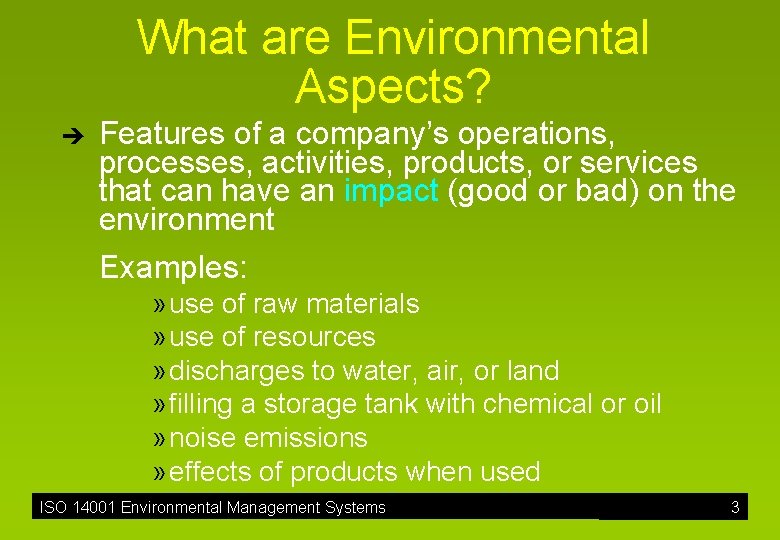
What are Environmental Aspects? è Features of a company’s operations, processes, activities, products, or services that can have an impact (good or bad) on the environment Examples: » use of raw materials » use of resources » discharges to water, air, or land » filling a storage tank with chemical or oil » noise emissions » effects of products when used ISO 14001 Environmental Management Systems 3
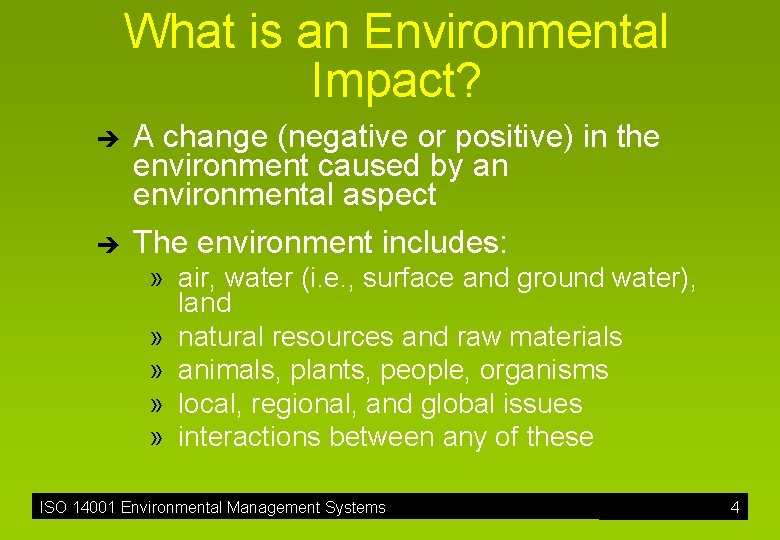
What is an Environmental Impact? è è A change (negative or positive) in the environment caused by an environmental aspect The environment includes: » air, water (i. e. , surface and ground water), land » natural resources and raw materials » animals, plants, people, organisms » local, regional, and global issues » interactions between any of these ISO 14001 Environmental Management Systems 4
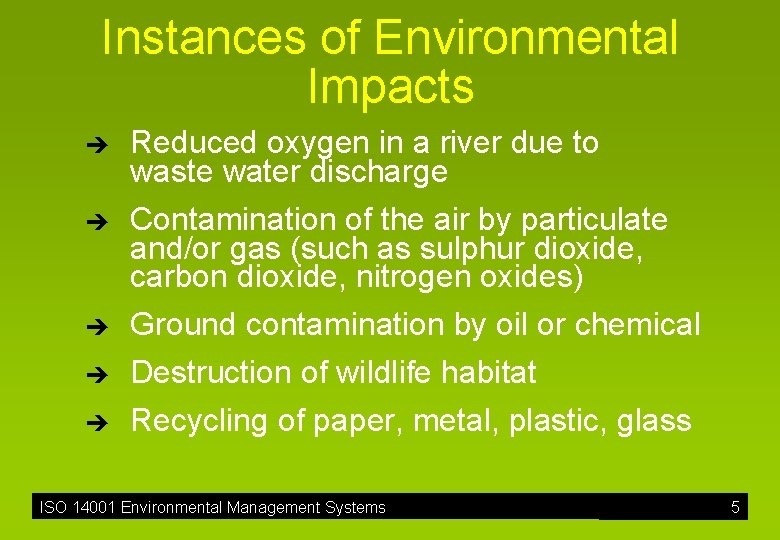
Instances of Environmental Impacts è Reduced oxygen in a river due to waste water discharge Contamination of the air by particulate and/or gas (such as sulphur dioxide, carbon dioxide, nitrogen oxides) Ground contamination by oil or chemical Destruction of wildlife habitat è Recycling of paper, metal, plastic, glass è è è ISO 14001 Environmental Management Systems 5
Environmental Aspect Example Maintenance of vehicles: è è Discharge of water used to wash vehicles Disposal of: » waste oil, oil filters, oily rags, oil spill absorbent » air conditioner CFC » used tyres and batteries » used vehicle parts » waste solvent used to clean engine parts ISO 14001 Environmental Management Systems 6
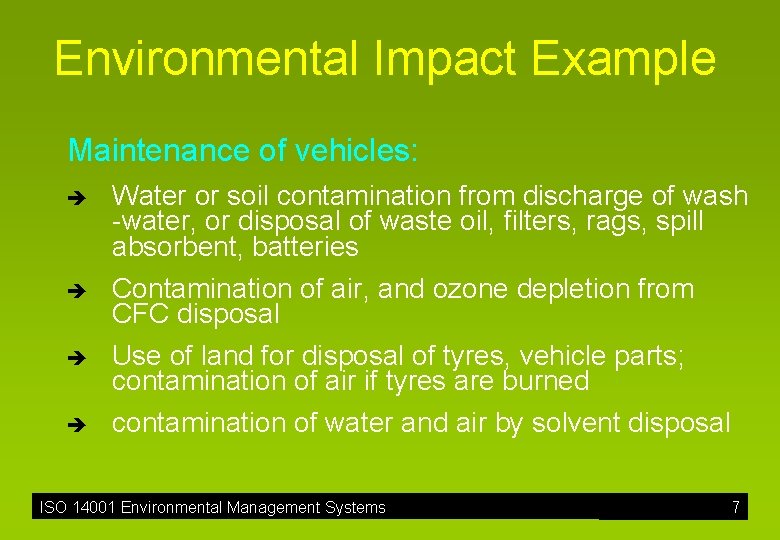
Environmental Impact Example Maintenance of vehicles: è Water or soil contamination from discharge of wash -water, or disposal of waste oil, filters, rags, spill absorbent, batteries è Contamination of air, and ozone depletion from CFC disposal è Use of land for disposal of tyres, vehicle parts; contamination of air if tyres are burned contamination of water and air by solvent disposal è ISO 14001 Environmental Management Systems 7
ISO 14001 Environmental Aspects says: The organisation shall establish and maintain (a) procedure(s) to identify the environmental aspects of activities, products, or services that it can control and over which it can be expected to have an influence, to determine those which have, or can have, significant impacts on the environment ISO 14001 Environmental Management Systems 8
Establish and Maintain a Procedure Used frequently in the ISO 14001 Standard Establish = develop, implement, set up Maintain = keep up-to-date, accurate Procedure = sequence of actions required to carry out a task ISO 14001 Environmental Management Systems 9
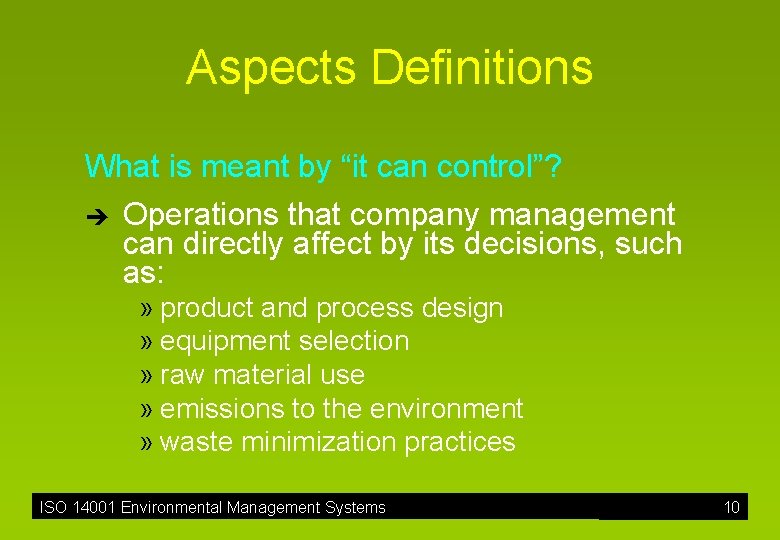
Aspects Definitions What is meant by “it can control”? è Operations that company management can directly affect by its decisions, such as: » product and process design » equipment selection » raw material use » emissions to the environment » waste minimization practices ISO 14001 Environmental Management Systems 10
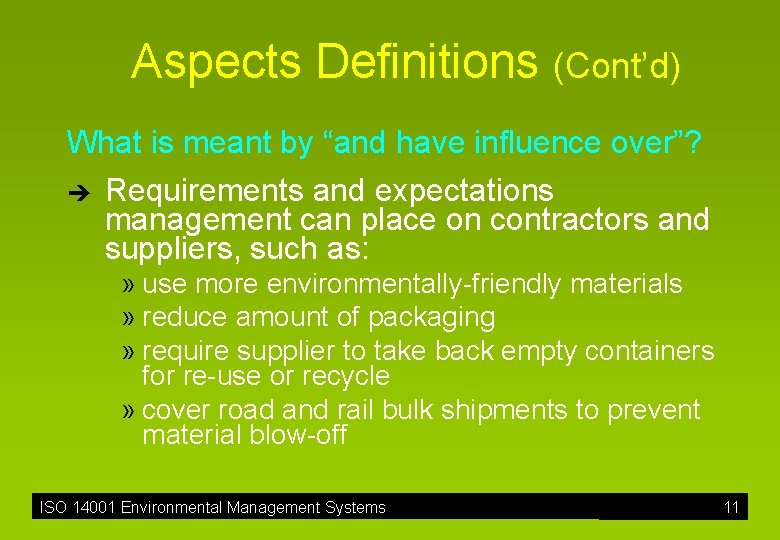
Aspects Definitions (Cont’d) What is meant by “and have influence over”? è Requirements and expectations management can place on contractors and suppliers, such as: » use more environmentally-friendly materials » reduce amount of packaging » require supplier to take back empty containers for re-use or recycle » cover road and rail bulk shipments to prevent material blow-off ISO 14001 Environmental Management Systems 11
ISO 14001 Environmental Aspects also says: è è Ensure that environmental aspects related to significant impacts are considered when setting environmental objectives Keep the information up to date ISO 14001 Environmental Management Systems 12
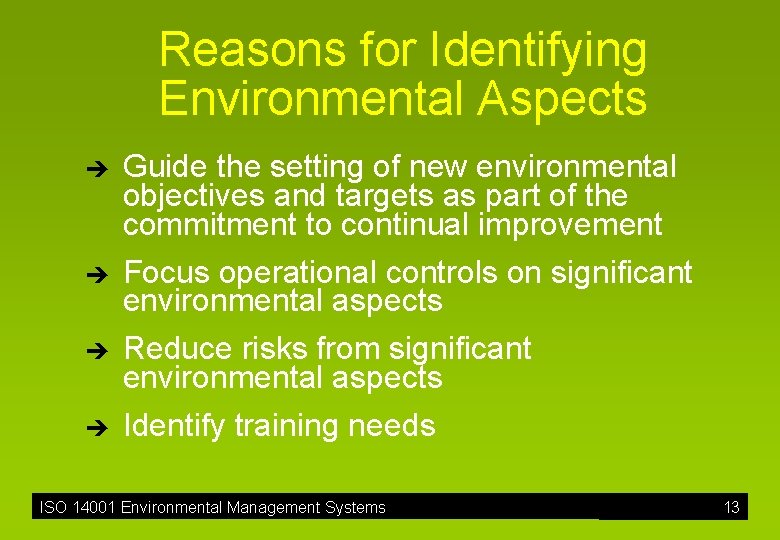
Reasons for Identifying Environmental Aspects è è Guide the setting of new environmental objectives and targets as part of the commitment to continual improvement Focus operational controls on significant environmental aspects Reduce risks from significant environmental aspects Identify training needs ISO 14001 Environmental Management Systems 13
Include Supporting Services Environmental aspects relate not only to manufacturing processes, but also to activities by support services such as: » research and development » » design and engineering transport and storage of raw materials storage and transport of product packaging ISO 14001 Environmental Management Systems 14
Supporting Services (Cont’d) » construction and maintenance » » » office work laboratory cafeteria security and emergency response yard crews, clean-up purchasing, shipping/receiving, stores » contractor and supplier activities ISO 14001 Environmental Management Systems 15
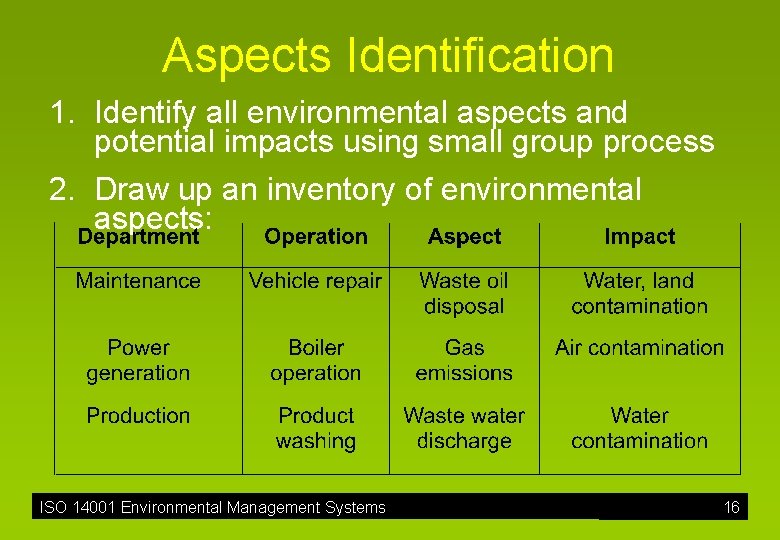
Aspects Identification 1. Identify all environmental aspects and potential impacts using small group process 2. Draw up an inventory of environmental aspects: ISO 14001 Environmental Management Systems 16
Aspects Identification (Cont’d) è è In practice, each operation will have a more detailed breakdown of tasks, for each of which there will be environmental aspects and impacts Environmental impacts need to be more detailed than illustrated here, e. g. , specify type of water contamination (BOD, suspended solids, p. H, toxic organics, metals, etc. ), and air (carbon dioxide, sulphur or nitrogen oxides, particulate, etc. ) ISO 14001 Environmental Management Systems 17
What is a Significant Environmental Impact? One where the risk to the environment is above a threshold level è è Risk = Probability x Consequence where: » probability reflects frequency and likelihood » consequence reflects both magnitude and public perception ISO 14001 Environmental Management Systems 18
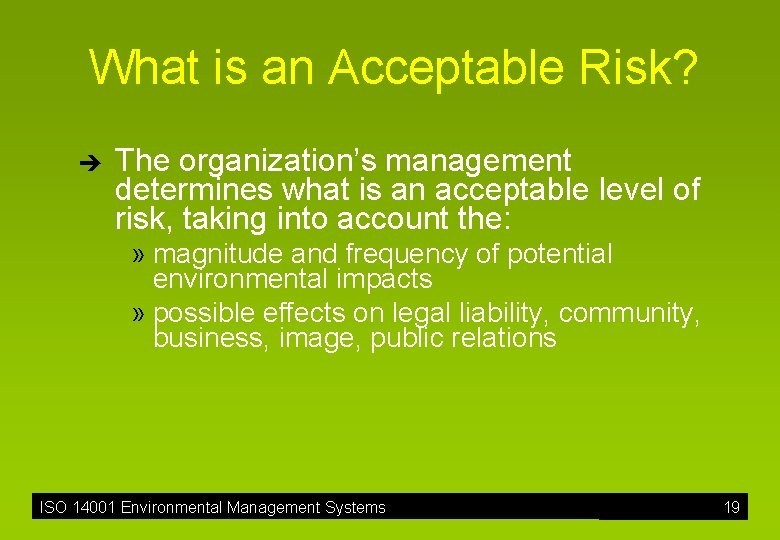
What is an Acceptable Risk? è The organization’s management determines what is an acceptable level of risk, taking into account the: » magnitude and frequency of potential environmental impacts » possible effects on legal liability, community, business, image, public relations ISO 14001 Environmental Management Systems 19
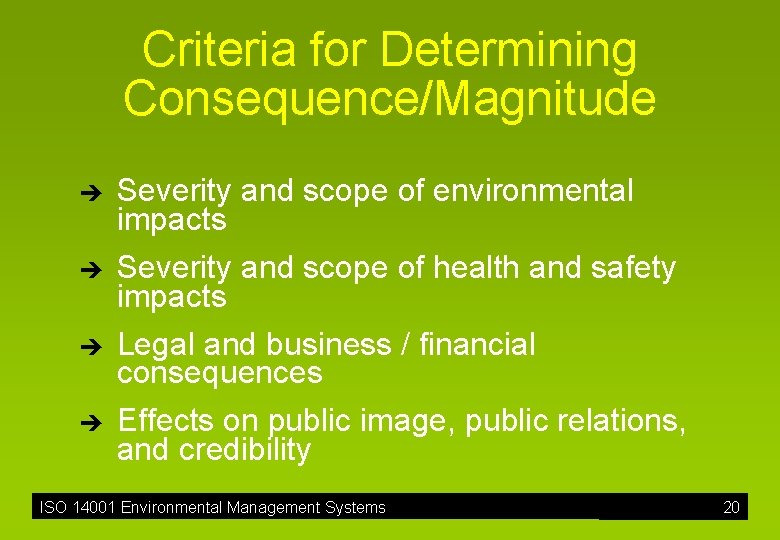
Criteria for Determining Consequence/Magnitude è è Severity and scope of environmental impacts Severity and scope of health and safety impacts Legal and business / financial consequences Effects on public image, public relations, and credibility ISO 14001 Environmental Management Systems 20
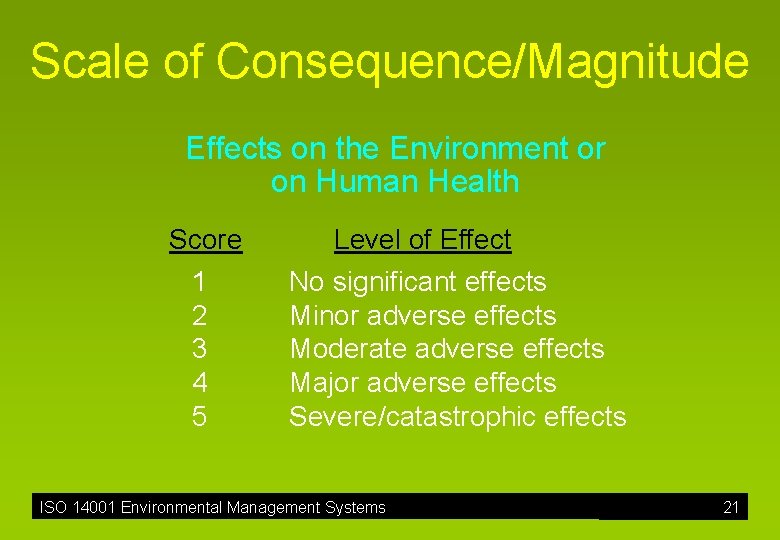
Scale of Consequence/Magnitude Effects on the Environment or on Human Health Score 1 2 3 4 5 Level of Effect No significant effects Minor adverse effects Moderate adverse effects Major adverse effects Severe/catastrophic effects ISO 14001 Environmental Management Systems 21
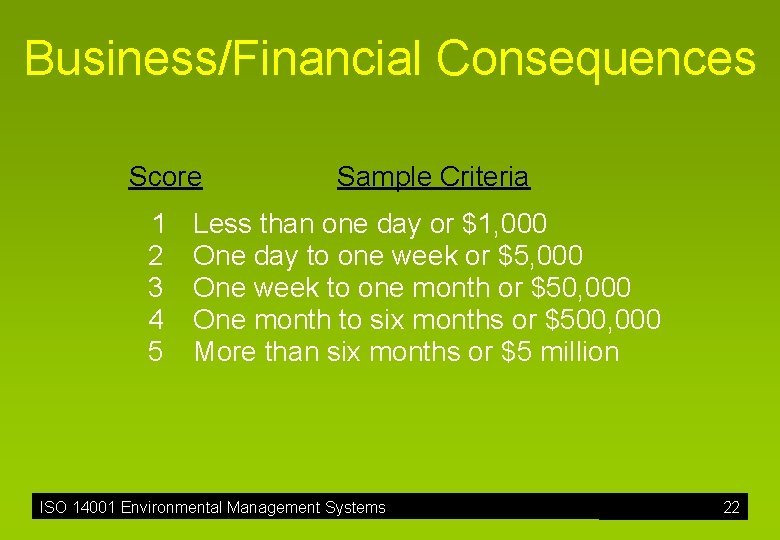
Business/Financial Consequences Score 1 2 3 4 5 Sample Criteria Less than one day or $1, 000 One day to one week or $5, 000 One week to one month or $50, 000 One month to six months or $500, 000 More than six months or $5 million ISO 14001 Environmental Management Systems 22
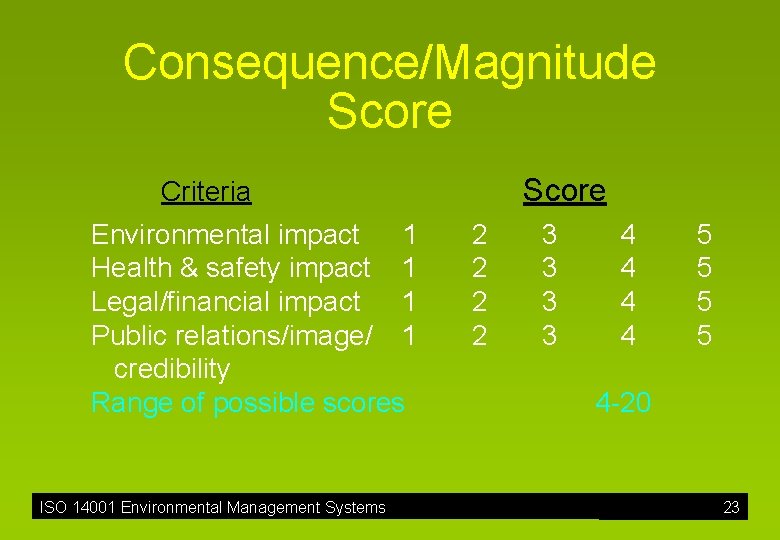
Consequence/Magnitude Score Criteria Environmental impact 1 Health & safety impact 1 Legal/financial impact 1 Public relations/image/ 1 credibility Range of possible scores ISO 14001 Environmental Management Systems 2 2 3 3 4 4 5 5 4 -20 23
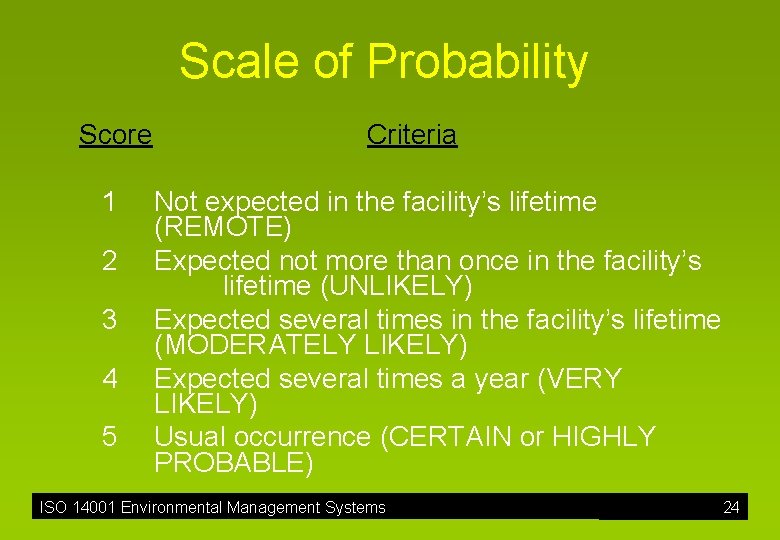
Scale of Probability Score 1 2 3 4 5 Criteria Not expected in the facility’s lifetime (REMOTE) Expected not more than once in the facility’s lifetime (UNLIKELY) Expected several times in the facility’s lifetime (MODERATELY LIKELY) Expected several times a year (VERY LIKELY) Usual occurrence (CERTAIN or HIGHLY PROBABLE) ISO 14001 Environmental Management Systems 24
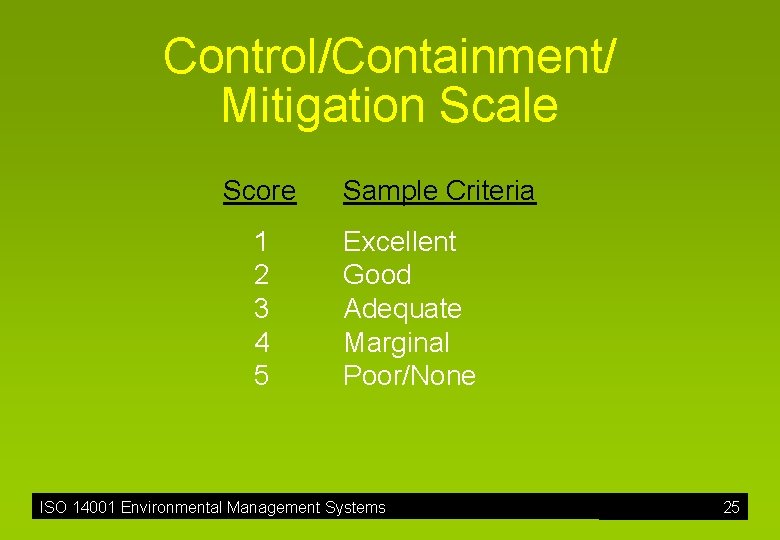
Control/Containment/ Mitigation Scale Score 1 2 3 4 5 Sample Criteria Excellent Good Adequate Marginal Poor/None ISO 14001 Environmental Management Systems 25
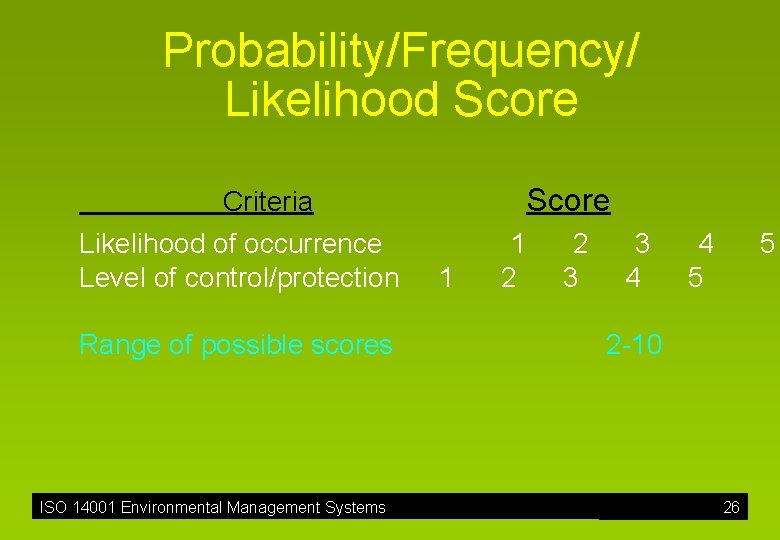
Probability/Frequency/ Likelihood Score Criteria Likelihood of occurrence Level of control/protection Range of possible scores ISO 14001 Environmental Management Systems 1 1 2 2 3 3 4 4 5 5 2 -10 26
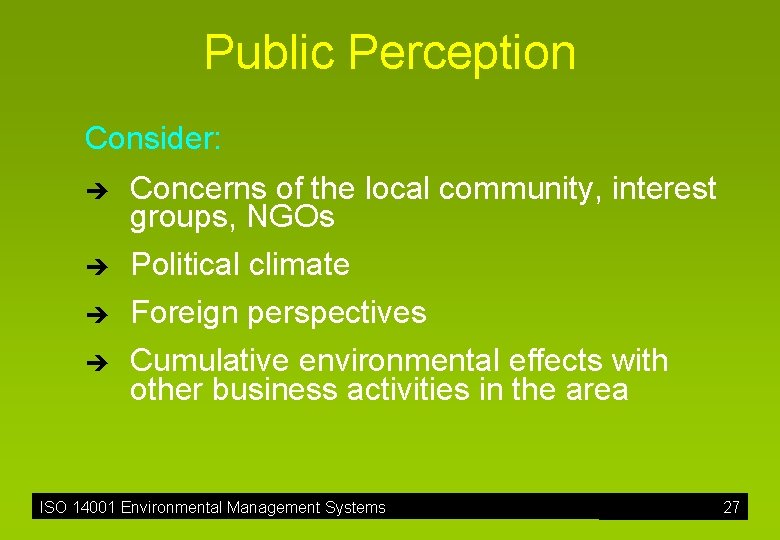
Public Perception Consider: è è Concerns of the local community, interest groups, NGOs Political climate Foreign perspectives Cumulative environmental effects with other business activities in the area ISO 14001 Environmental Management Systems 27
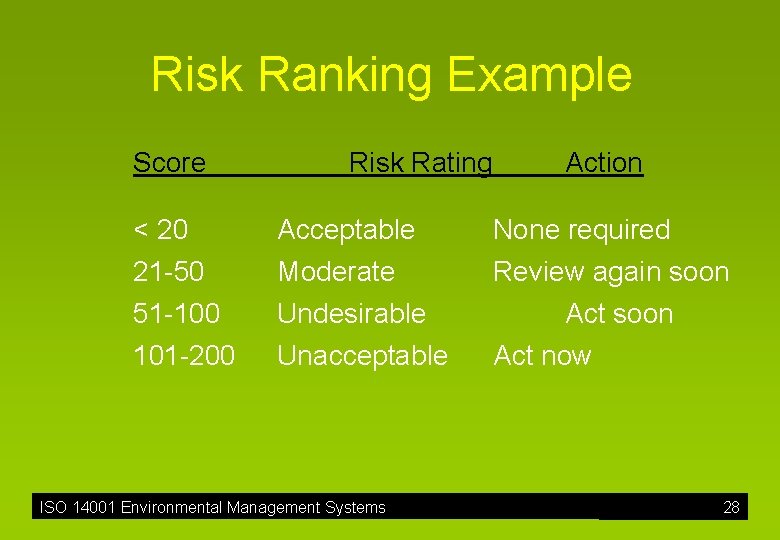
Risk Ranking Example Score Risk Rating Action < 20 21 -50 51 -100 Acceptable Moderate Undesirable None required Review again soon Act soon 101 -200 Unacceptable Act now ISO 14001 Environmental Management Systems 28
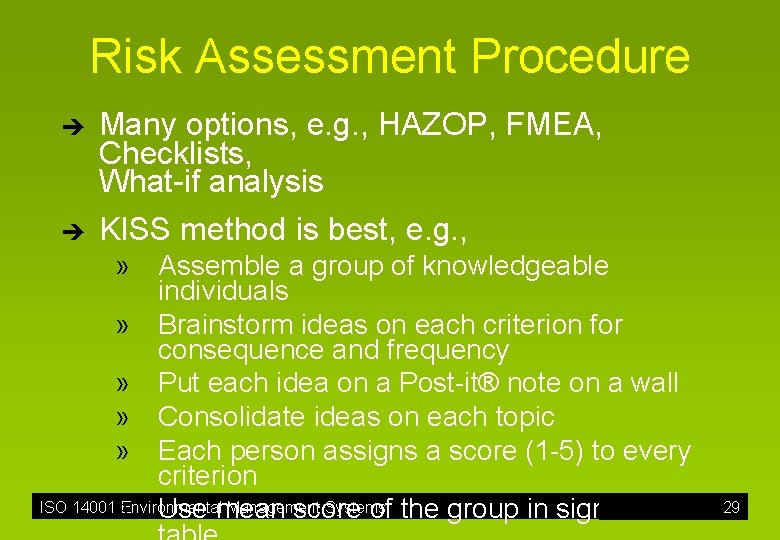
Risk Assessment Procedure è è Many options, e. g. , HAZOP, FMEA, Checklists, What-if analysis KISS method is best, e. g. , » Assemble a group of knowledgeable individuals » Brainstorm ideas on each criterion for consequence and frequency » Put each idea on a Post-it® note on a wall » Consolidate ideas on each topic » Each person assigns a score (1 -5) to every criterion ISO 14001» Environmental Management Systems Use mean score of the group in significance 29
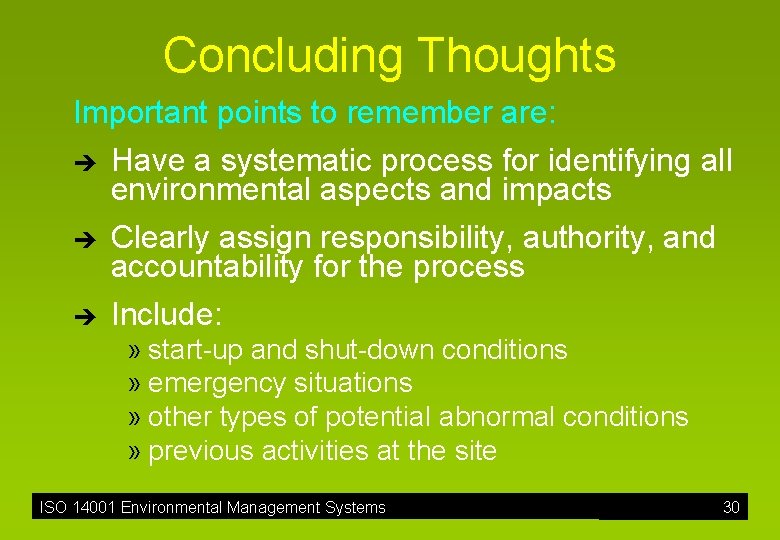
Concluding Thoughts Important points to remember are: è è è Have a systematic process for identifying all environmental aspects and impacts Clearly assign responsibility, authority, and accountability for the process Include: » start-up and shut-down conditions » emergency situations » other types of potential abnormal conditions » previous activities at the site ISO 14001 Environmental Management Systems 30
Concluding Thoughts (Cont’d) Additional points to remember are: è Then assess risks to identify which are significant impacts and aspects è Define criteria for assessing significance è Define frequency with which environmental aspects will be reviewed (i. e. , keep them up to date) ISO 14001 Environmental Management Systems 31
Concluding Thoughts (Cont’d) More points to remember are: è Review environmental aspects whenever there is a change to any raw material, process, product, or activity è ISO 14001 does not specify documenting environmental aspects and impacts, but in practice it must be done ISO 14001 Environmental Management Systems 32