
ISMS 2017 MK 02 Highresolution dualcomb spectroscopy with
ISMS 2017 MK 02 High-resolution dual-comb spectroscopy with ultra-low noise frequency combs W. Hänsel 1, Michele Giunta 1, 2 , K. Beha 1, A. Perry 1, R. Holzwarth 1, 2 1) Menlo Systems Gmb. H, Munich, Germany 2) Max-Planck Institute for Quantum Optics, Garching, Germany
Outline: Dual-Comb Spectroscopy • Motivation • Principle of DCS • ULN frequency comb • DCS with ULN frequency comb • Conclusion ν
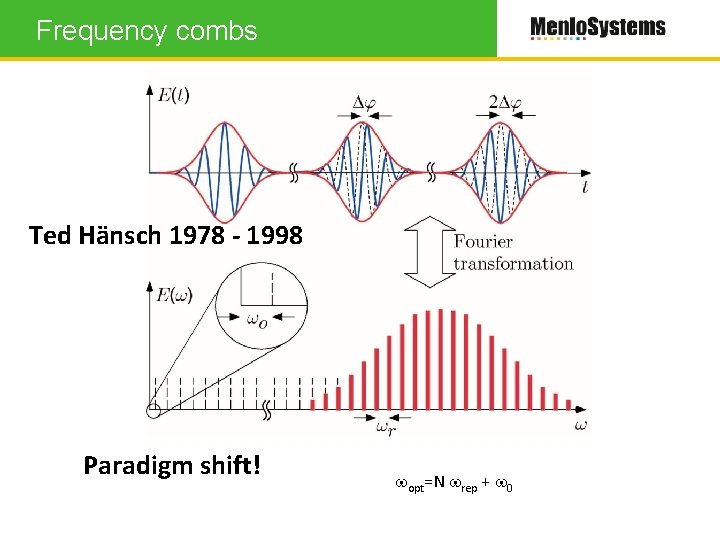
Frequency combs Ted Hänsch 1978 - 1998 Paradigm shift! wopt=N wrep + w 0
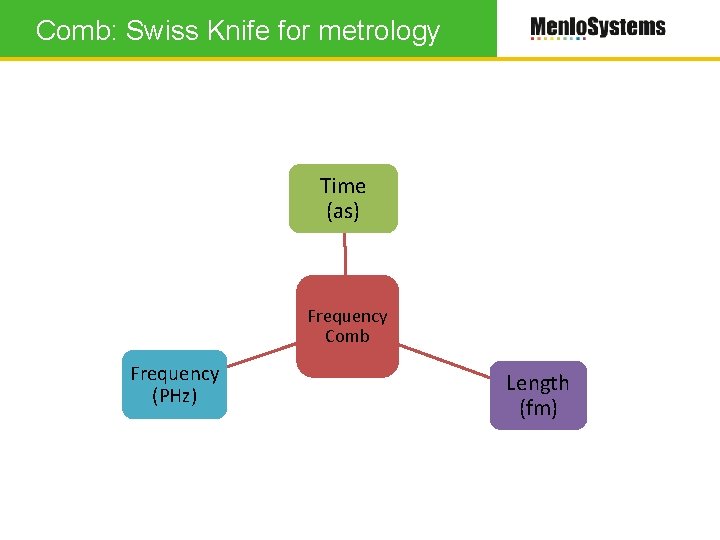
Comb: Swiss Knife for metrology Time (as) Frequency Comb Frequency (PHz) Length (fm)
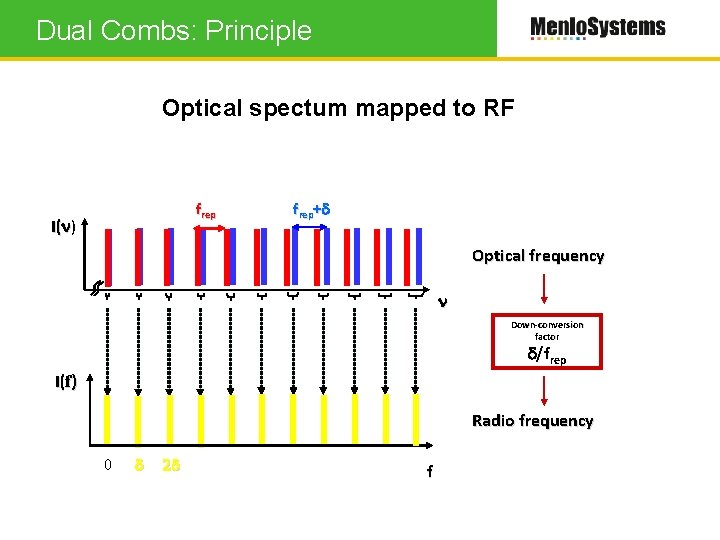
Dual Combs: Principle Optical spectum mapped to RF frep I(n) frep+d Optical frequency n Down-conversion factor d/frep I ( f) Radio frequency 0 d 2 d f

Principle of dual-comb spectroscopy FFT Optical unambiguity range: Speed: Resolution: single-shot scanning
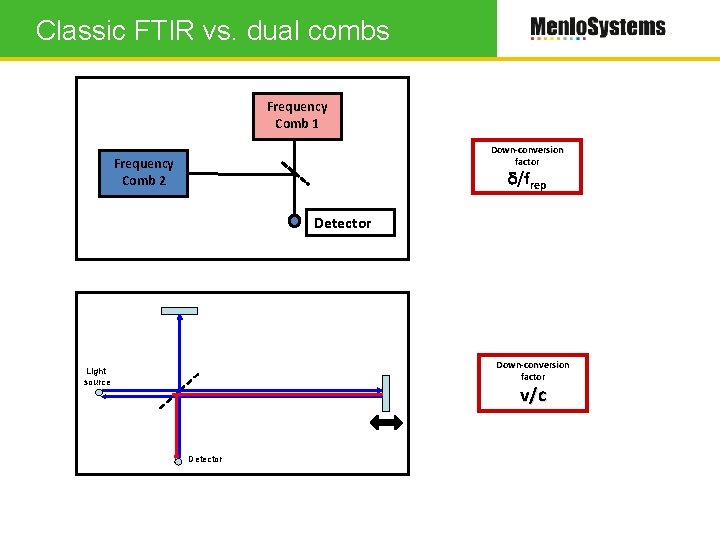
Classic FTIR vs. dual combs Frequency Comb 1 Down-conversion factor Frequency Comb 2 d/frep Detector Down-conversion factor Light source v/c Detector
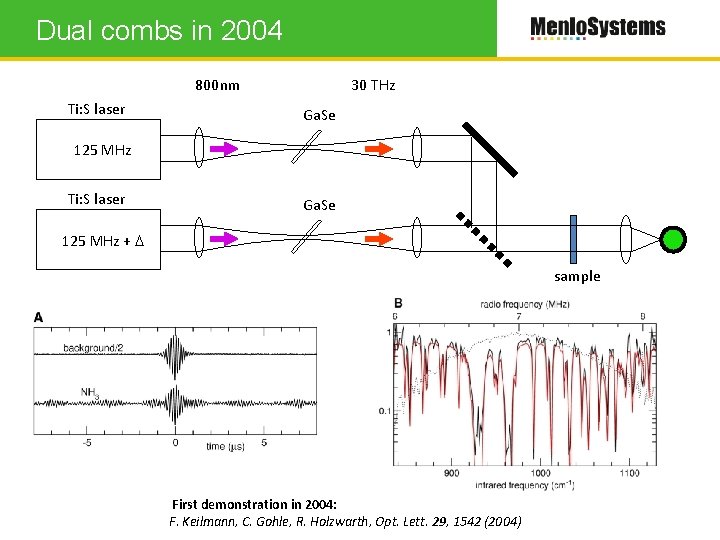
Dual combs in 2004 800 nm Ti: S laser 30 THz Ga. Se 125 MHz Ti: S laser Ga. Se 125 MHz + D sample First demonstration in 2004: F. Keilmann, C. Gohle, R. Holzwarth, Opt. Lett. 29, 1542 (2004)
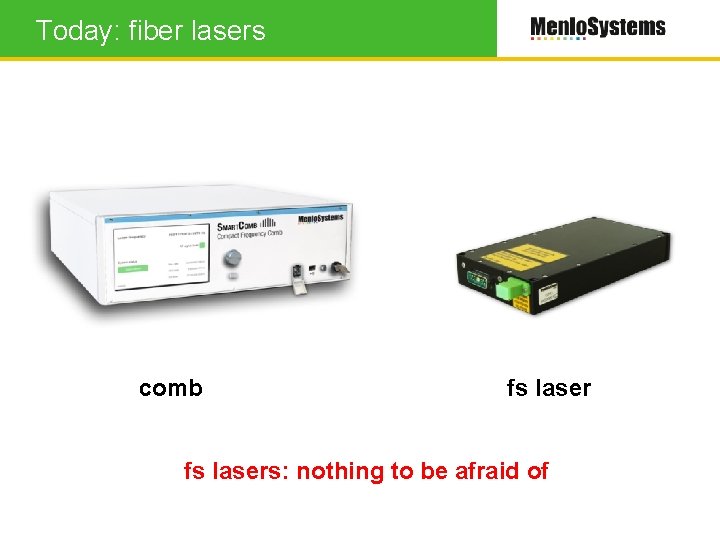
Today: fiber lasers comb fs lasers: nothing to be afraid of
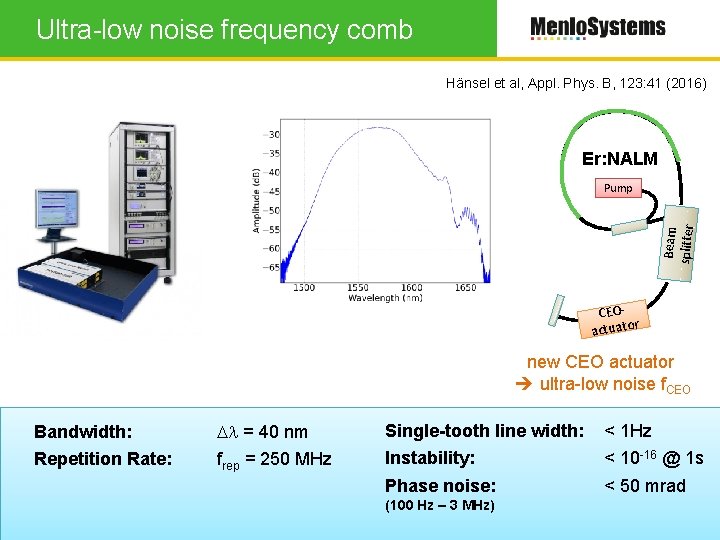
Ultra-low noise frequency comb Hänsel et al, Appl. Phys. B, 123: 41 (2016) Er: NALM Beam splitter Pump CEOr actuato new CEO actuator ultra-low noise f. CEO Bandwidth: Dl = 40 nm Single-tooth line width: < 1 Hz Repetition Rate: frep = 250 MHz Instability: < 10 -16 @ 1 s Phase noise: < 50 mrad (100 Hz – 3 MHz)
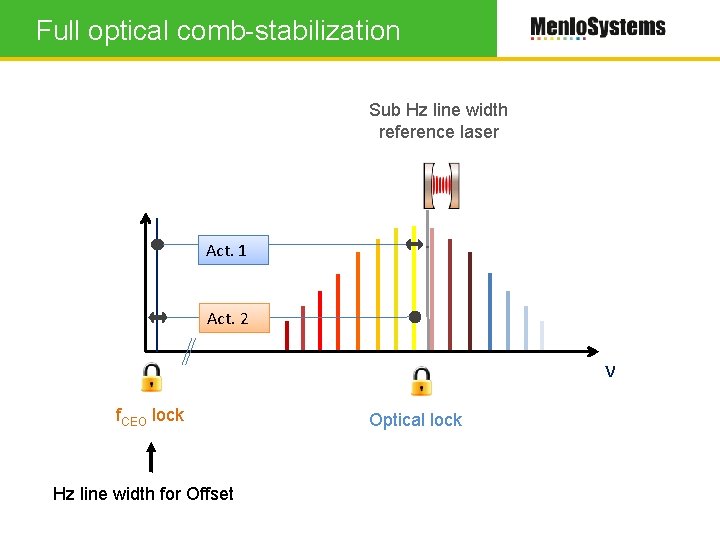
Full optical comb-stabilization Sub Hz line width reference laser Act. 1 Act. 2 ν f. CEO lock Hz line width for Offset Optical lock
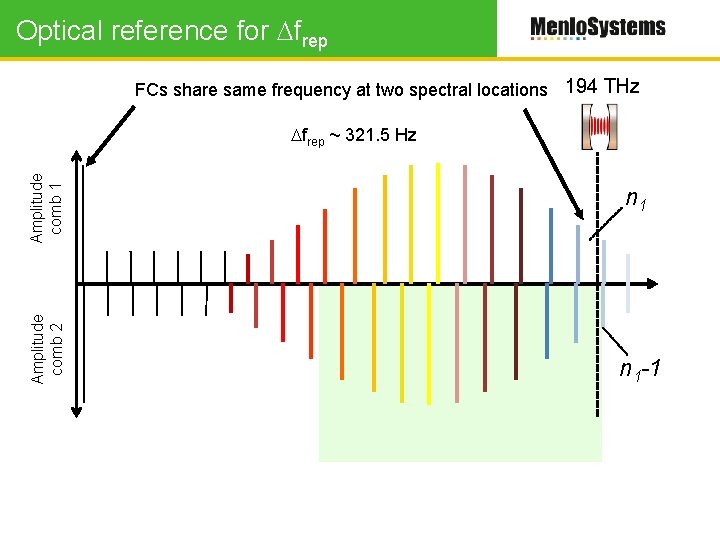
Optical reference for Dfrep FCs share same frequency at two spectral locations 194 THz Amplitude comb 2 Amplitude comb 1 Dfrep ~ 321. 5 Hz n 1 -1
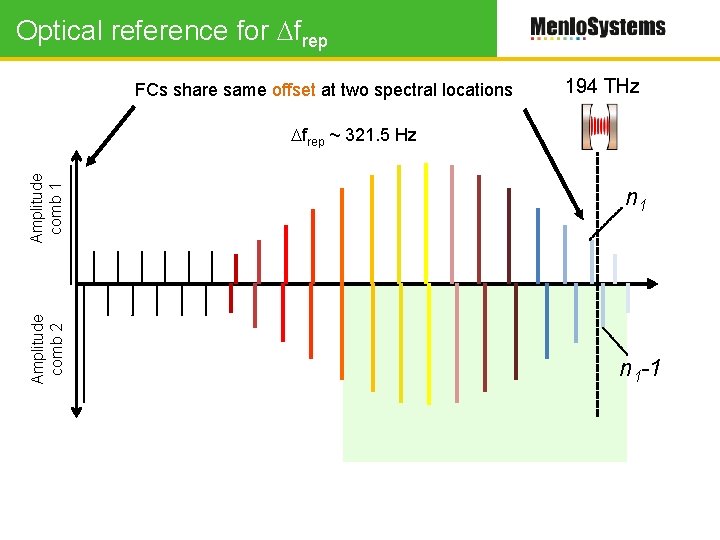
Optical reference for Dfrep FCs share same offset at two spectral locations 194 THz Amplitude comb 2 Amplitude comb 1 Dfrep ~ 321. 5 Hz n 1 -1
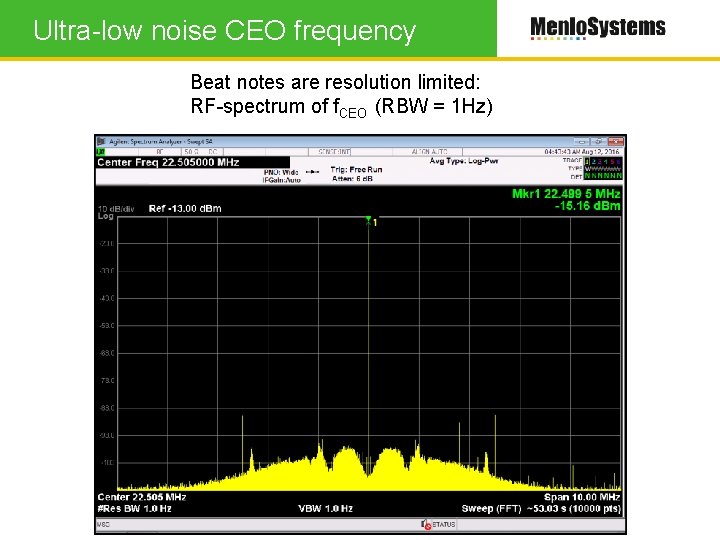
Ultra-low noise CEO frequency Beat notes are resolution limited: RF-spectrum of f. CEO (RBW = 1 Hz)
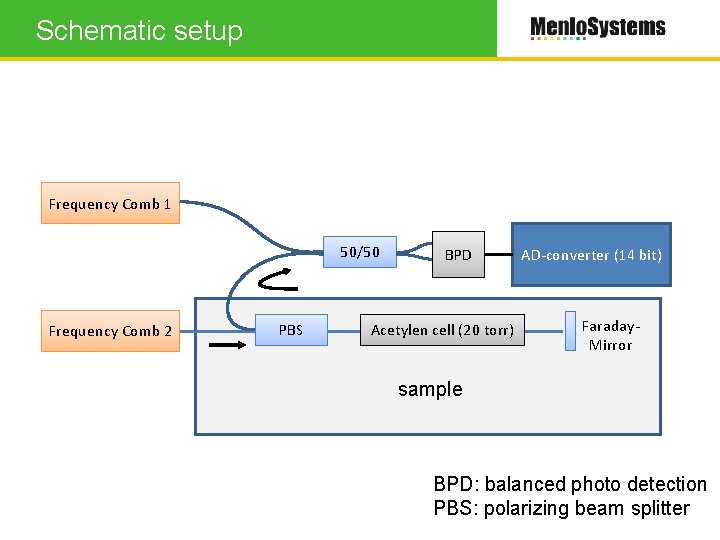
Schematic setup Frequency Comb 1 50/50 Frequency Comb 2 PBS BPD Acetylen cell (20 torr) AD-converter (14 bit) Faraday. Mirror sample BPD: balanced photo detection PBS: polarizing beam splitter
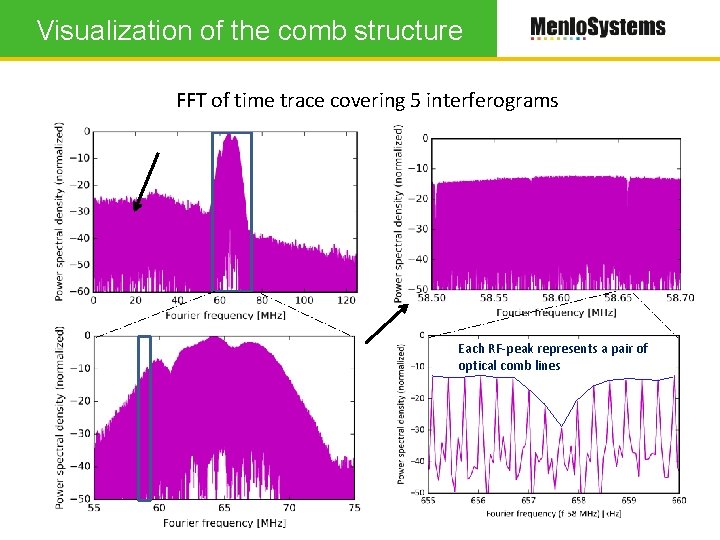
Visualization of the comb structure FFT of time trace covering 5 interferograms Each RF-peak represents a pair of optical comb lines
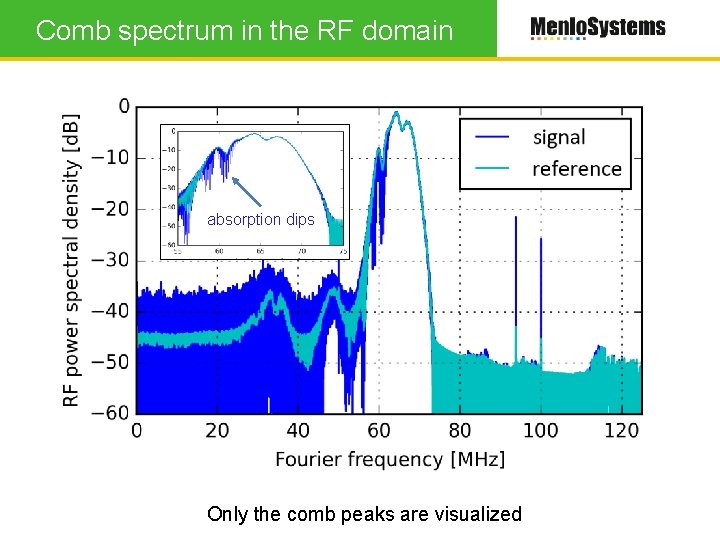
Comb spectrum in the RF domain absorption dips Only the comb peaks are visualized
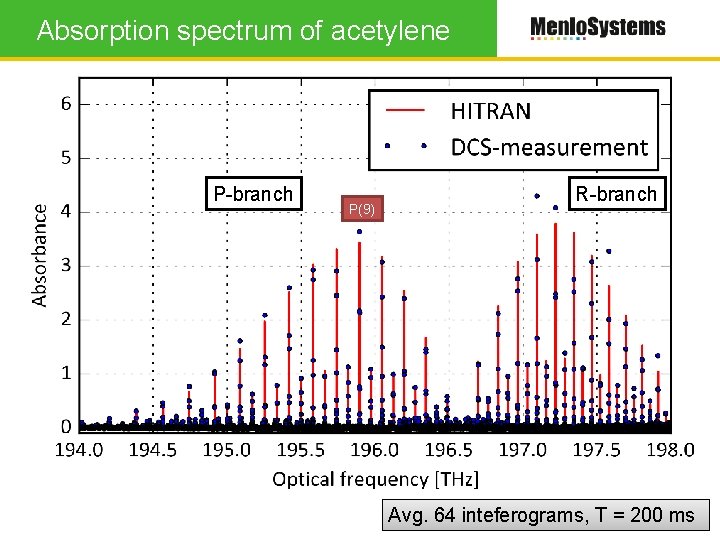
Absorption spectrum of acetylene P-branch P(9) R-branch Avg. 64 inteferograms, T = 200 ms
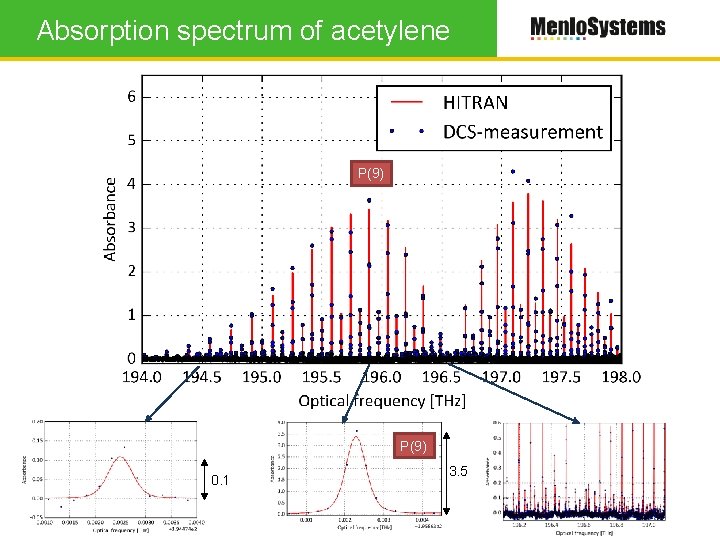
Absorption spectrum of acetylene P(9) 0. 1 3. 5
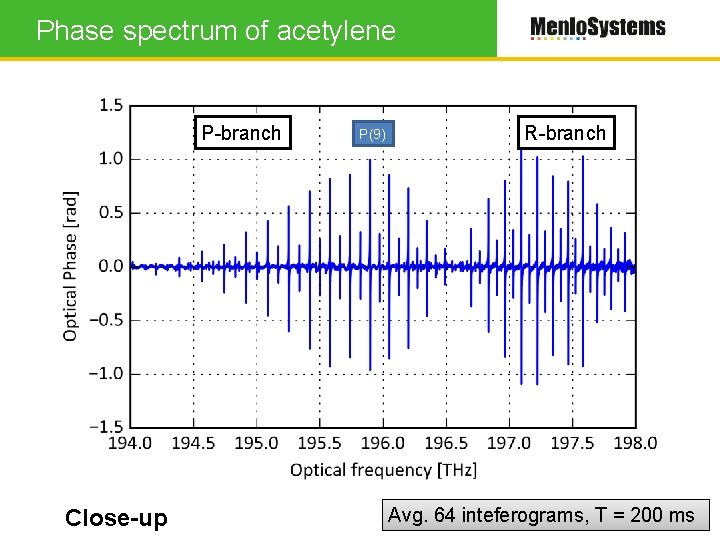
Phase spectrum of acetylene P-branch Close-up P(9) R-branch Avg. 64 inteferograms, T = 200 ms
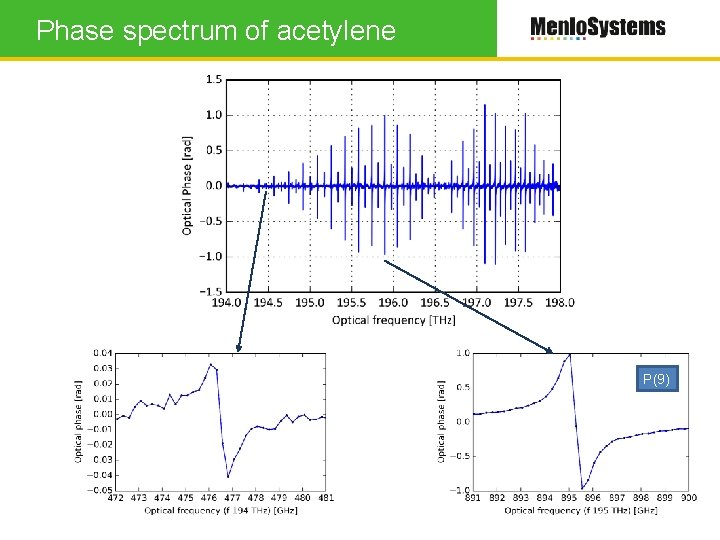
Phase spectrum of acetylene P(9)
Conclusion Dual comb spectroscopy with ultra-low noise combs • High signal-to-noise ratio • Well defined peaks in the optical domain • Low complexity in signal analysis (no adaptive sampling necessary) • High flexibility in choice of sampling parameters
Thank you … … for your attention for your support

- Slides: 24