
ISMANTO BANK RAKYAT INDONESIA Micro Credit Financing and

ISMANTO BANK RAKYAT INDONESIA Micro Credit Financing and Poverty Alleviation in OIC Member States Istanbul, July 9 -11, 2007
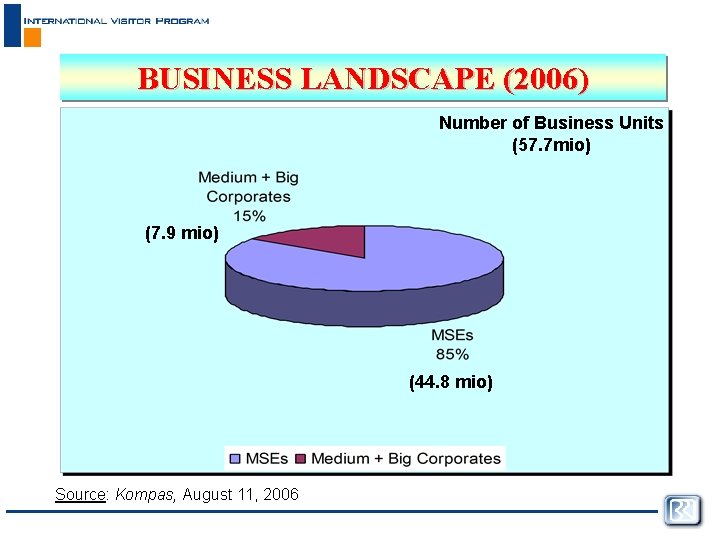
BUSINESS LANDSCAPE (2006) Number of Business Units (57. 7 mio) (7. 9 mio) 7. 9 mio (15%) (44. 8 mio) Source: Kompas, August 11, 2006
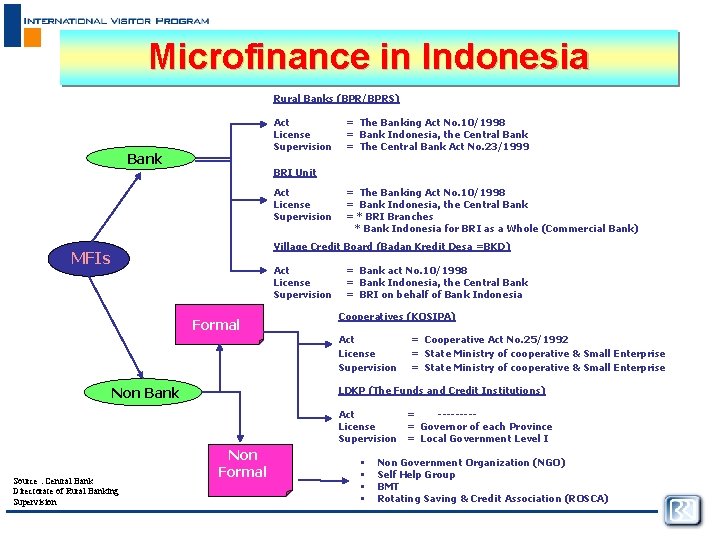
Microfinance in Indonesia Rural Banks (BPR/BPRS) Act License Supervision Bank = The Banking Act No. 10/1998 = Bank Indonesia, the Central Bank = The Central Bank Act No. 23/1999 BRI Unit Act License Supervision = The Banking Act No. 10/1998 = Bank Indonesia, the Central Bank = * BRI Branches * Bank Indonesia for BRI as a Whole (Commercial Bank) Village Credit Board (Badan Kredit Desa =BKD) MFIs Act License Supervision Formal = Bank act No. 10/1998 = Bank Indonesia, the Central Bank = BRI on behalf of Bank Indonesia Cooperatives (KOSIPA) Act License Supervision Non Bank = Cooperative Act No. 25/1992 = State Ministry of cooperative & Small Enterprise LDKP (The Funds and Credit Institutions) Act = ----License = Governor of each Province Supervision = Local Government Level I Source : Central Bank Directorate of Rural Banking Supervision Non Formal • • Non Government Organization (NGO) Self Help Group BMT Rotating Saving & Credit Association (ROSCA)
ABOUT BANK BRI… v Bank BRI was founded in 1895 by Raden Arya Wirya Atmaja, in Purwokerto (Central Java) as a Support and savings bank for civil servants. v The growth of BRI is regarded as the beginning of Indonesian rural banking. v After 111 years of operation, Bank BRI still focuses its business on microbanking: making banking products and services accessible for the poor in Indonesia.
VISION MISSION Becoming a leading commercial bank in Indonesia which puts customers’ satisfaction as the priority. 1. Performing the best banking activities focusing on providing services for Micro, Small, and Medium Enterprises to support Indonesia’s economy. 2. Providing excellent services for customers through widespread network, supported by professional HR by implementing GCG. 3. Providing optimum added values for all stakeholders.
STRATEGIES 1. 2. 3. 4. Focus on the core business Expand operational coverage Strengthen Risk Management Use information technology for operational efficiency
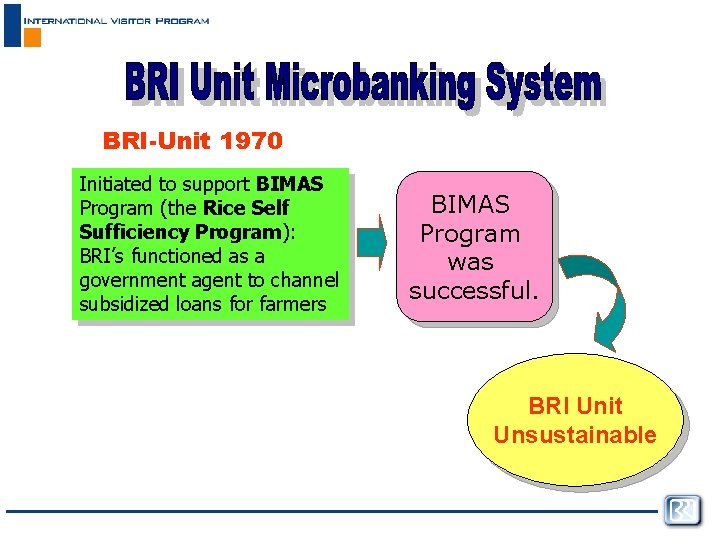
BRI-Unit 1970 Initiated to support BIMAS Program (the Rice Self Sufficiency Program): BRI’s functioned as a government agent to channel subsidized loans for farmers BIMAS Program was successful. BRI Unit Unsustainable
Since 1984, BRI Units … q Structurally an autonomous financial unit q Staff accountability closely associated with Unit’s performance q Under branch’s supervision q Strengthening the internal supervision, audit capacities and staff capability q Commercial approach q Market based products
Fundamental Changes in Unit Banking Business Policies q Micro Banking staff become BRI Employees q New accounting system focusing on transparency q Introduction of KUPEDES (General Rural Credit) q Relocation of Poorly-sited BRI Units q Development of SIMPEDES (Rural Savings) q Introduction of performance incentives q Organization of staff and supervision q Personnel Training and Development
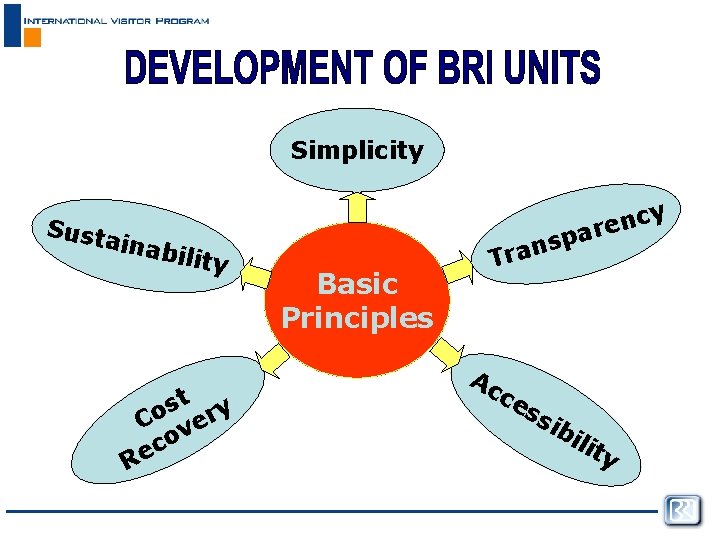
Simplicity Sust ainab ility t y s Co ver o c Re Basic Principles cy n e ar p s n ra T Ac ce ss ib ili t y
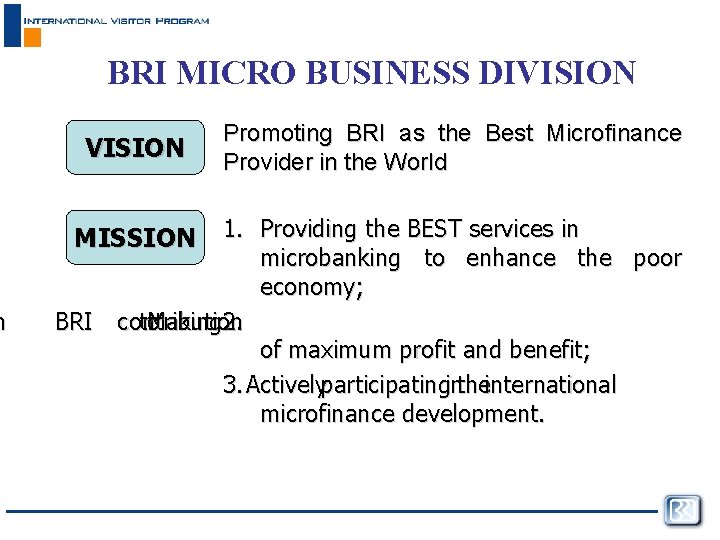
n BRI MICRO BUSINESS DIVISION Promoting BRI as the Best Microfinance Provider in the World 1. Providing the BEST services in microbanking to enhance the poor economy; BRI contribution to Making 2. of maximum profit and benefit; 3. Activelyparticipatingintheinternational microfinance development. MISSION
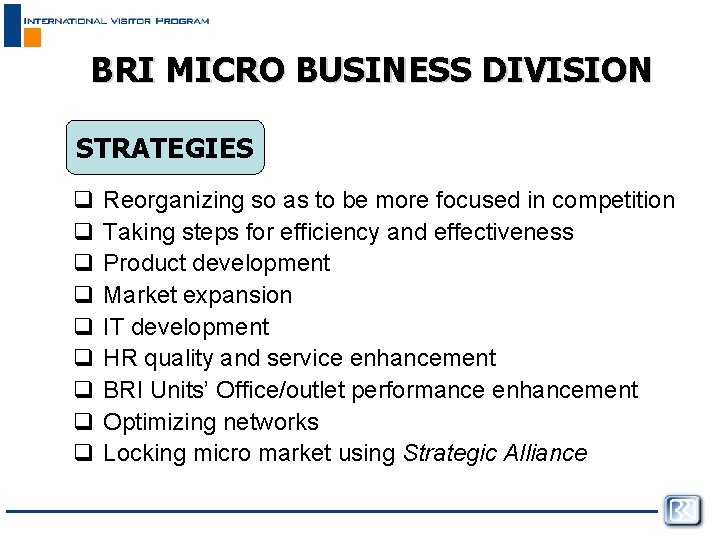
BRI MICRO BUSINESS DIVISION STRATEGIES q q q q q Reorganizing so as to be more focused in competition Taking steps for efficiency and effectiveness Product development Market expansion IT development HR quality and service enhancement BRI Units’ Office/outlet performance enhancement Optimizing networks Locking micro market using Strategic Alliance

BANK RAKYAT INDONESIA Networks 1 Head Office 13 Regional Offices 11 Regional Audit Offices 4. 229 BRI Units 133 Village Service Posts ATMs : 977 ATM BRI 331 Branches 9. 000 ATM Bersama 3. 627 ATM Link 207 Sub Branches 45 Sharia Branches ATM Cirrus & Alto around the world Phone Banking Facility
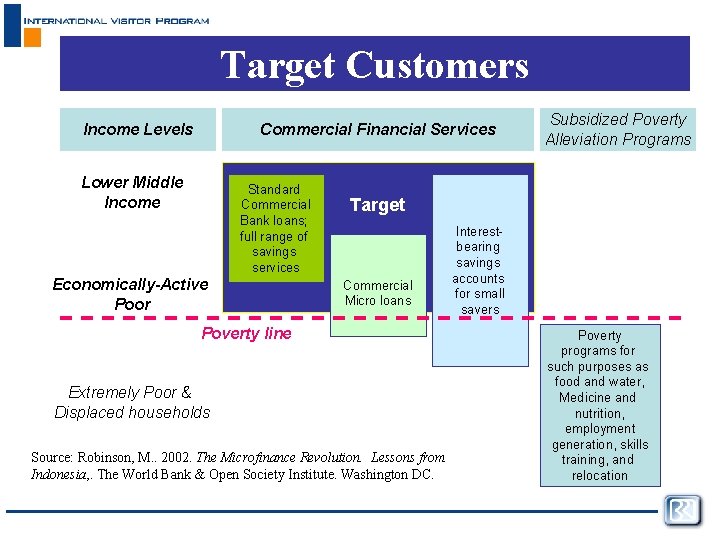
Target Customers Income Levels Commercial Financial Services Lower Middle Income Standard Commercial Bank loans; full range of savings services Economically-Active Poor Subsidized Poverty Alleviation Programs Target Commercial Micro loans Poverty line Extremely Poor & Displaced households Source: Robinson, M. . 2002. The Microfinance Revolution. Lessons from Indonesia, . The World Bank & Open Society Institute. Washington DC. Interestbearing savings accounts for small savers Poverty programs for such purposes as food and water, Medicine and nutrition, employment generation, skills training, and relocation
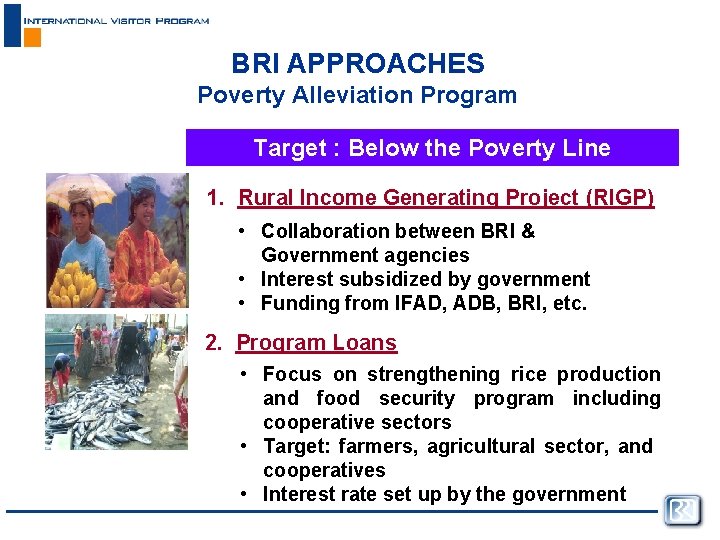
BRI APPROACHES Poverty Alleviation Program Target : Below the Poverty Line 1. Rural Income Generating Project (RIGP) • Collaboration between BRI & Government agencies • Interest subsidized by government • Funding from IFAD, ADB, BRI, etc. 2. Program Loans • Focus on strengthening rice production and food security program including cooperative sectors • Target: farmers, agricultural sector, and cooperatives • Interest rate set up by the government
BRI’S APPROACHES Target : Above the Poverty Line 3. Microbanking v v v Target: micro entrepreneurs & the economically active poor Loan size up to Rp 50 million (US$ 5, 600) Commercial approach Simple procedures, quick disbursement Loan product: Kupedes (the General Rural Credit) 4. Small Loans v Target: Viable small enterprises v Loan size up to Rp 5 billion (US$ 55, 000) v Conventional banking approach

BANK RAKYAT INDONESIA - MICROBANKING A Commercially Sustainable Microfinance System BRI is known as the largest and the best microbanking system in the world. • more than 4, 200 outlet, covers the country up to the level of sub-district and village • almost 30, 000 employees • 3. 4 million borrowers, 32 million savers • Provide wide range market-driven products (loan, saving and other services) • Good financial performance (almost all outlets are profitable, NPL<2%, ROA>6%)

BRI GO PUBLIC • Bank BRI made its Initial Public Offering (IPO) in November 2003, with 59. 5% of the shares was owned by the government and 40. 5% belonged to the public (55. 3% went to foreign investors, and 44. 7% to domestic investors). • As of September 2006, 42. 6% of the shares was owned by the public (88. 5% went to foreign investors; 11. 5% to the domestic)
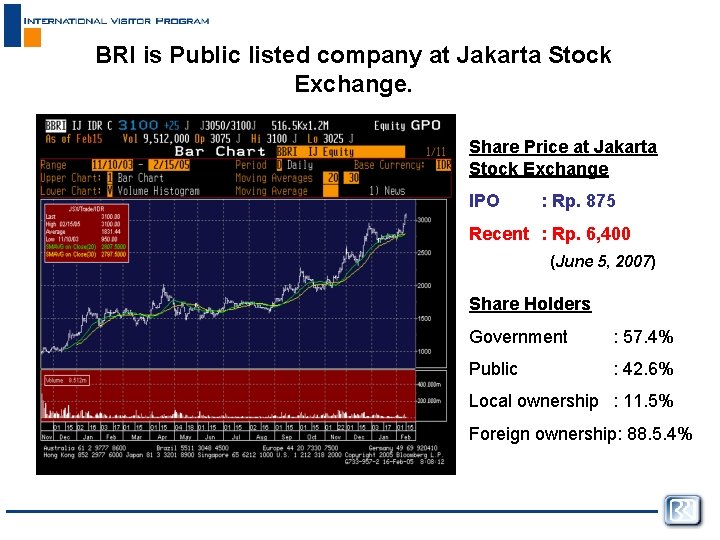
BRI is Public listed company at Jakarta Stock Exchange. Share Price at Jakarta Stock Exchange IPO : Rp. 875 Recent : Rp. 6, 400 (June 5, 2007) Share Holders Government : 57. 4% Public : 42. 6% Local ownership : 11. 5% Foreign ownership: 88. 5. 4%
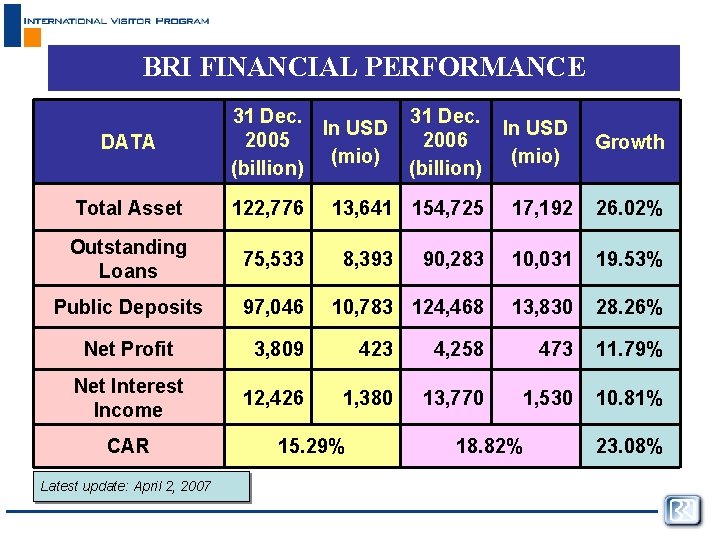
BRI FINANCIAL PERFORMANCE DATA 31 Dec. In USD 2005 (mio) (billion) 31 Dec. 2006 (billion) In USD (mio) Growth 13, 641 154, 725 17, 192 26. 02% 90, 283 10, 031 19. 53% 10, 783 124, 468 13, 830 28. 26% Total Asset 122, 776 Outstanding Loans 75, 533 Public Deposits 97, 046 Net Profit 3, 809 423 4, 258 473 11. 79% Net Interest Income 12, 426 1, 380 13, 770 1, 530 10. 81% CAR Latest update: April 2, 2007 8, 393 15. 29% 18. 82% 23. 08%

BANK RAKYAT INDONESIA Financial Highlight Loans: Maintained Key Success Factor Proven Commitment and Focus to Micro, Small and Medium Enterprises 86. 7% Loans to MSME Loan Definitions : By Loan Size Micro Loans : Up to Rp 50 mio (US$ 5, 000) Small Consumer : Up to Rp 200 mio (US$ 20, 000) Small Commercial : > Rp 50 mio to Rp 5 bio (US$500, 000) Medium Loans : > Rp 5 bio to Rp 50 bio (US$ 500, 000 – US$ 5 mio) Corporate Loans : > Rp 50 bio ( > US$ 5 mio)

BANK RAKYAT INDONESIA Loans: Steady High Growth Loan CAGR – by Business Segment


BANK RAKYAT INDONESIA Loans: Steady High Growth § In the last five years, loan growth was driven by micro, small and medium loans § Medium loans showed the highest growth in percentage, but in the amount of loan, micro loans and small commercial loans were still the segment where BRI expanded its loan book. § In 2005 -2006, loan increased by IDR 14. 75 trillion. Micro and Small Commercial Loans contributed 50 % of it.

BANK RAKYAT INDONESIA Loans: Steady High Growth

BANK RAKYAT INDONESIA Deposits: Trending Down of Cost of Funds and Improving Mix

BANK RAKYAT INDONESIA Deposits: Trending Down of Cost of Funds and Improving Mix v BRI’s cost of funds had been relatively resilient in the period of increasing interest rate, and decreasing steadily in the time of declining interest rate v Although there were some shifts toward high cost funds (time deposits) in late 2005 up to Q 3 2006, low cost funds were still the majority in BRI deposits. v Despite the shift, BRI’s deposits mix was steadily better than the Industry’s
2007 : Outlook
Changes in Regulatory Environment Relaxation Policies from Bank Indonesia Intended to spur loan disbursements, especially loans to MSMEs q Easing criteria of one debtor one loan classification. Single loan classification will only be applied to loans with total exposure of equal or more than Rp. 5 billion q Opportunities for companies with bad loan history to get new loans as long as the cause of the bad loans are not related to any mismanagement practices or any bad intentions. q Quality of loans with total exposure below Rp 5 billion , or loans to projects guaranteed by the Government, will be determined solely on timeliness of payments. q Maximum loans of up to 30% bank’s legal lending limit will be permitted for loans to all State Owned Enterprises engaged in development projects (not only infrastructure projects).
BRI in 2007 : General Directions q Maintaining loan growth at around 20% q Maintaining high loan quality, by keeping NPLs (gross) at around + 5% q Targeting deposits growth at around + 14% q Maintaining the dominance of low cost funds in the deposit mix, targeting more retail depositors q Lower interest rate will give more advantage to BRI: High net interest margin can be maintained: - Better mix of funds resulted in a lower cost of funds - High quality of loan growth better valuation of government bonds q BI’s relaxation policy and lucrative business in serving MSMEs meanthat there will be more opportunities as well as more competitions among banks
BRI in 2007 : General Directions Micro Businesses - Emphasizing the Economic of Scale q Opening new outlets in the prospective areas, continue the online process of the existing outlets, on cost and benefit basis q Widening micro customer base by recruiting new customers long fostered through ‘subsidized loan schemes’ q Setting more challenging targets for micro units accompanied by fairer incentive schemes q Improving and polishing products to cater more to customers’ needs and to compete better

THANK YOU
- Slides: 32