
Islands Aliasing Protection In ObjectOriented Languages By John
Islands : Aliasing Protection In Object-Oriented Languages By : John Hogg OOPSLA 91 Aharon Abadi 1
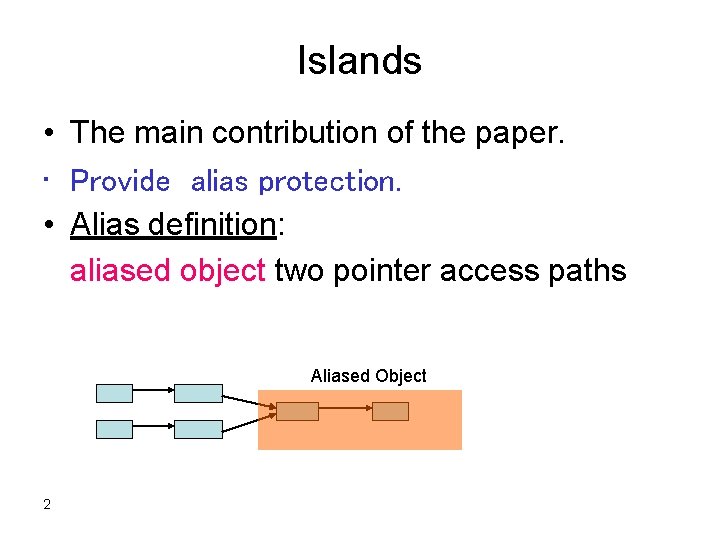
Islands • The main contribution of the paper. • Provide alias protection. • Alias definition: aliased object two pointer access paths Aliased Object 2

Aliases problem • Aliased objects allow changing the state through different access paths x y Perform operation x = x+ 1 3 Harmless aliasing: y is unaffected x y z 3 3 3 4 x y Perform operation x. increment Harm aliasing: y is affected z 4
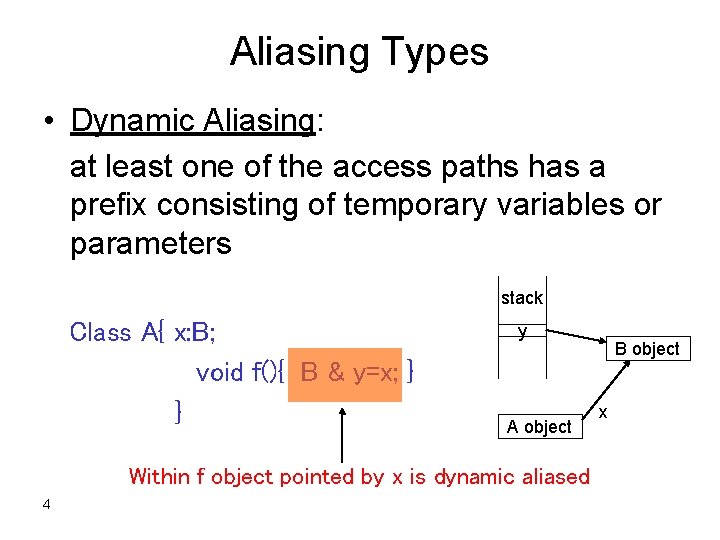
Aliasing Types • Dynamic Aliasing: at least one of the access paths has a prefix consisting of temporary variables or parameters stack Class A{ x: B; void f(){ B & y=x; } } y A object Within f object pointed by x is dynamic aliased 4 B object x
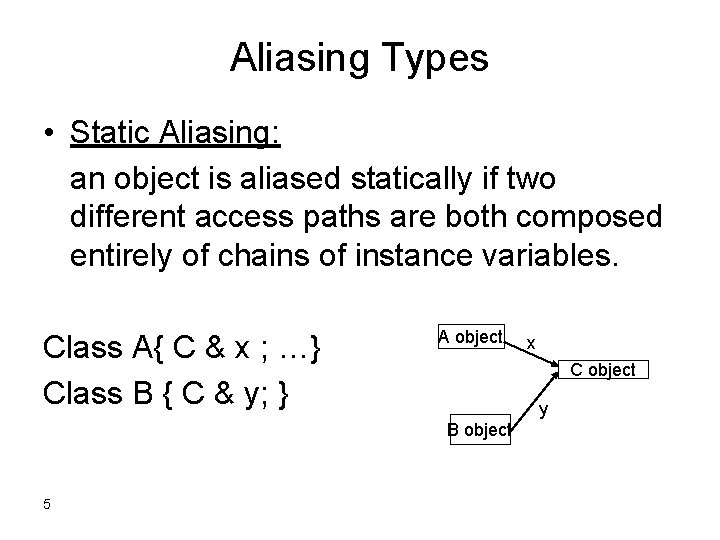
Aliasing Types • Static Aliasing: an object is aliased statically if two different access paths are both composed entirely of chains of instance variables. Class A{ C & x ; …} Class B { C & y; } A object C object y B object 5 x
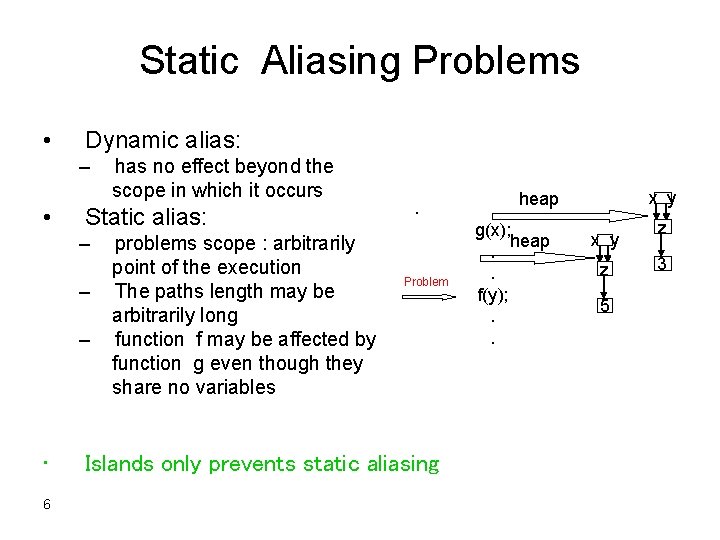
Static Aliasing Problems • Dynamic alias: – • Static alias: – – – • 6 has no effect beyond the scope in which it occurs problems scope : arbitrarily point of the execution The paths length may be arbitrarily long function f may be affected by function g even though they share no variables . Problem Islands only prevents static aliasing x y heap g(x); heap. . f(y); . . x y z 5 z 3
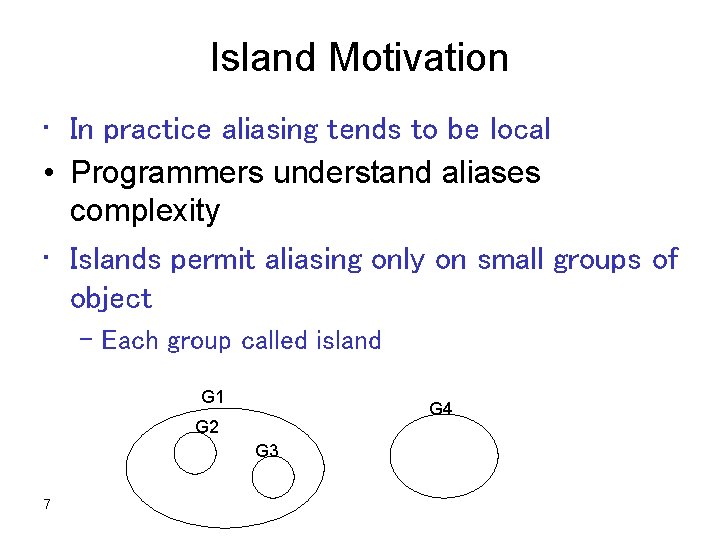
Island Motivation • In practice aliasing tends to be local • Programmers understand aliases complexity • Islands permit aliasing only on small groups of object – Each group called island G 1 G 4 G 2 G 3 7
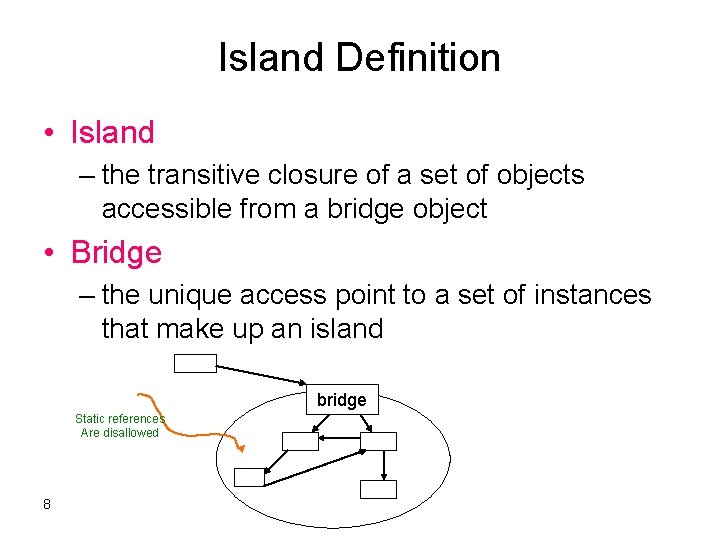
Island Definition • Island – the transitive closure of a set of objects accessible from a bridge object • Bridge – the unique access point to a set of instances that make up an island bridge Static references Are disallowed 8
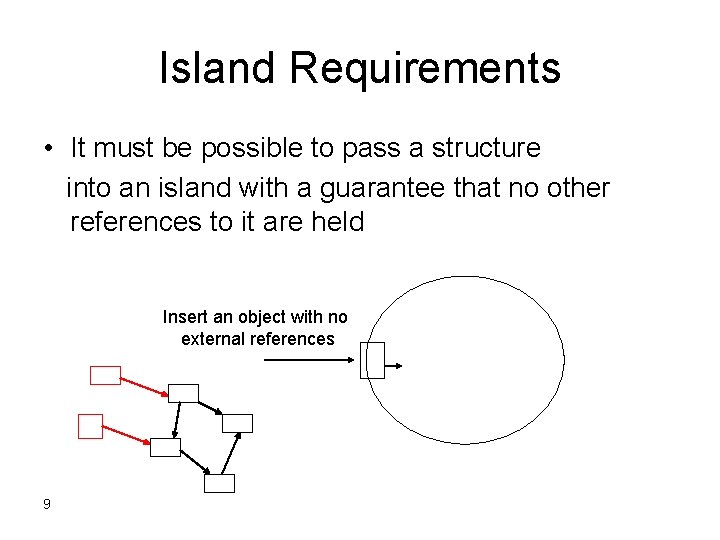
Island Requirements • It must be possible to pass a structure into an island with a guarantee that no other references to it are held Insert an object with no external references 9
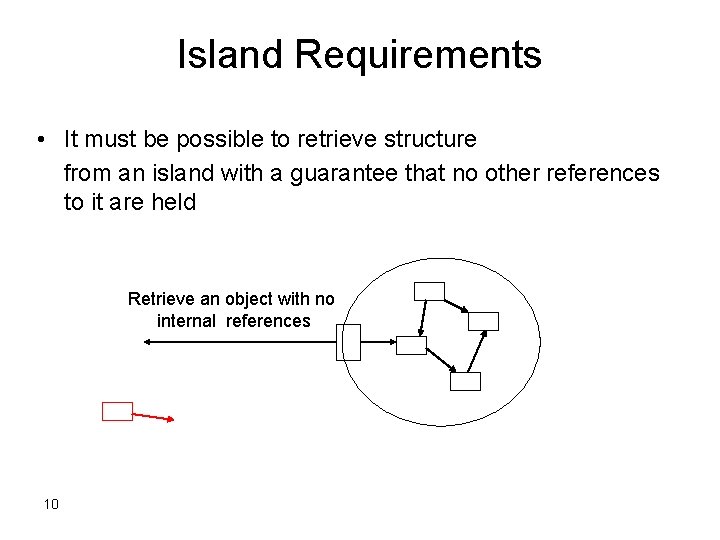
Island Requirements • It must be possible to retrieve structure from an island with a guarantee that no other references to it are held Retrieve an object with no internal references 10
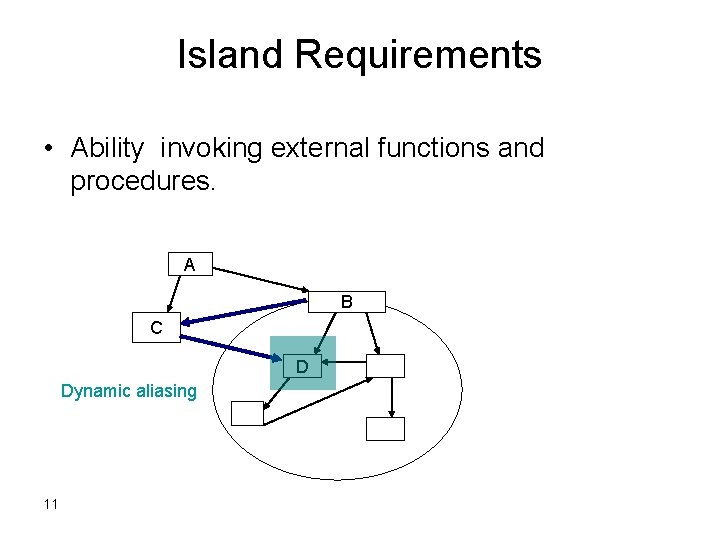
Island Requirements • Ability invoking external functions and procedures. A B C D Dynamic aliasing 11
Island Benefits and Disadvantages Benefits: • Static references cannot cross Island boundary • Dynamic references that cross Island boundary are visible and controlled by the bridge • An island provides a true encapsulation of its components. Disadvantages: • Dynamic aliasing prevents information hiding is not supported (not in the paper) • Need to construct a proof about intra-island behavior. 12
Island Implementation Language Extension • One new operation: destructive read • Two more access modes: unique and free which mutually exclusive to read 13
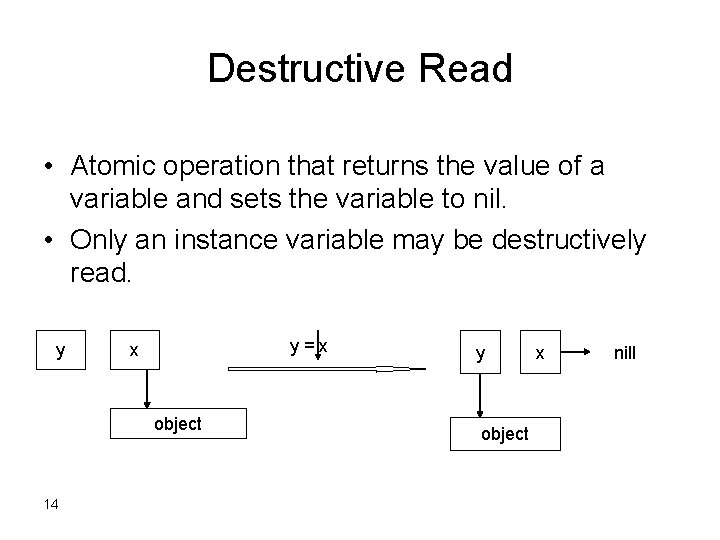
Destructive Read • Atomic operation that returns the value of a variable and sets the variable to nil. • Only an instance variable may be destructively read. y y=x x object 14 y object x nill
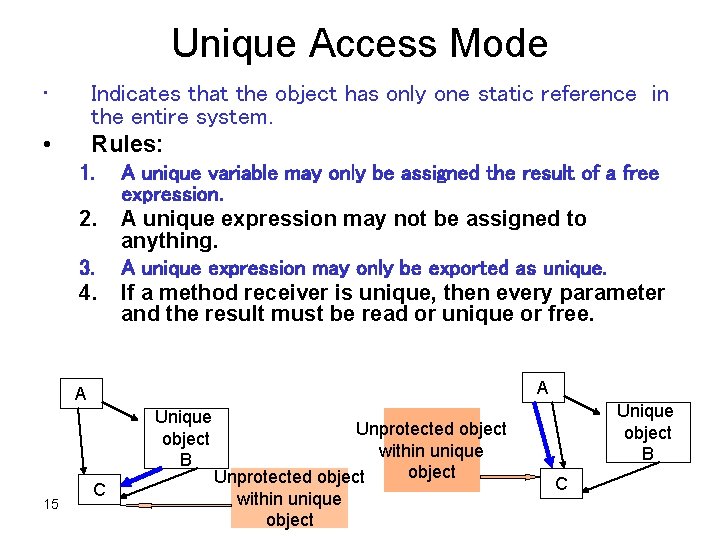
Unique Access Mode • Indicates that the object has only one static reference in the entire system. Rules: • 1. 2. 3. 4. A unique variable may only be assigned the result of a free expression. A unique expression may not be assigned to anything. A unique expression may only be exported as unique. If a method receiver is unique, then every parameter and the result must be read or unique or free. A A Unique object B 15 C Unprotected object within unique object Unique object B C
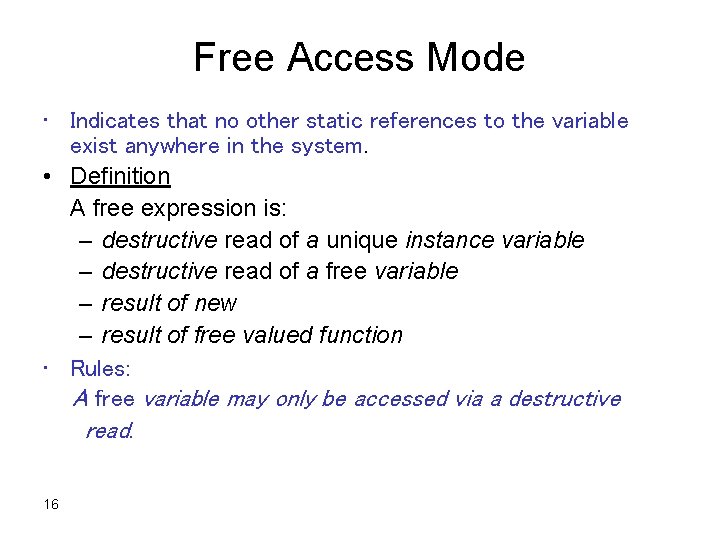
Free Access Mode • Indicates that no other static references to the variable exist anywhere in the system. • Definition A free expression is: – destructive read of a unique instance variable – destructive read of a free variable – result of new – result of free valued function • Rules: A free variable may only be accessed via a destructive read. 16
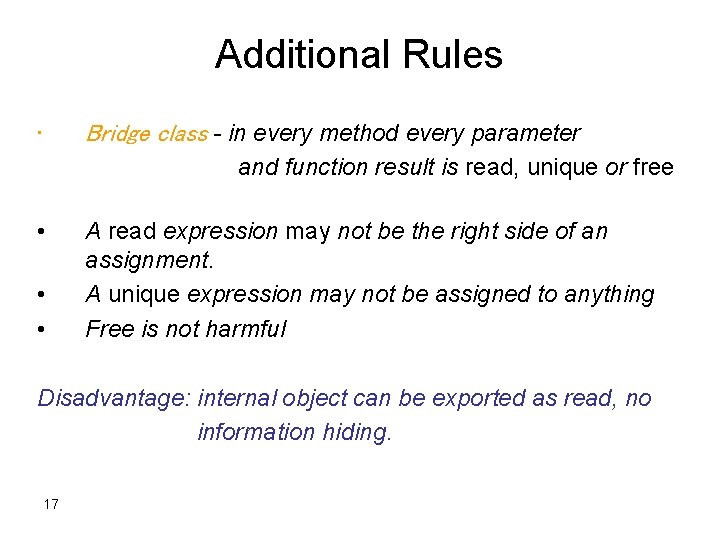
Additional Rules Bridge class - in every method every parameter • and function result is read, unique or free • • • A read expression may not be the right side of an assignment. A unique expression may not be assigned to anything Free is not harmful Disadvantage: internal object can be exported as read, no information hiding. 17
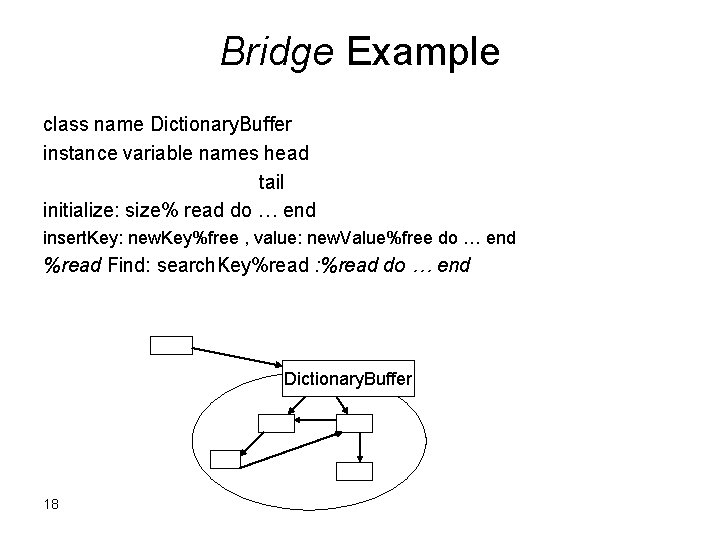
Bridge Example class name Dictionary. Buffer instance variable names head tail initialize: size% read do … end insert. Key: new. Key%free , value: new. Value%free do … end %read Find: search. Key%read : %read do … end Dictionary. Buffer 18
Conclusion • Islands : allow a set of objects to be nicely encapsulated. • Bridge : may used as true black box. • Future work: extension to multiple threads 19
- Slides: 19