
Islam Topic 3 Revision Booklet Practices that shape

Islam Topic 3 Revision Booklet Practices that shape and express religious identity Miss Connolly
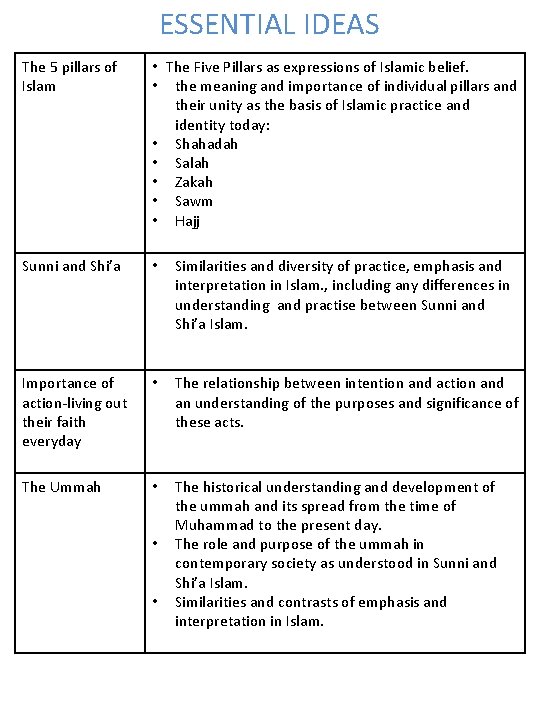
ESSENTIAL IDEAS The 5 pillars of Islam • The Five Pillars as expressions of Islamic belief. • the meaning and importance of individual pillars and their unity as the basis of Islamic practice and identity today: • Shahadah • Salah • Zakah • Sawm • Hajj Sunni and Shi’a • Similarities and diversity of practice, emphasis and interpretation in Islam. , including any differences in understanding and practise between Sunni and Shi’a Islam. Importance of action-living out their faith everyday • The relationship between intention and action and an understanding of the purposes and significance of these acts. The Ummah • The historical understanding and development of the ummah and its spread from the time of Muhammad to the present day. The role and purpose of the ummah in contemporary society as understood in Sunni and Shi’a Islam. Similarities and contrasts of emphasis and interpretation in Islam. • •
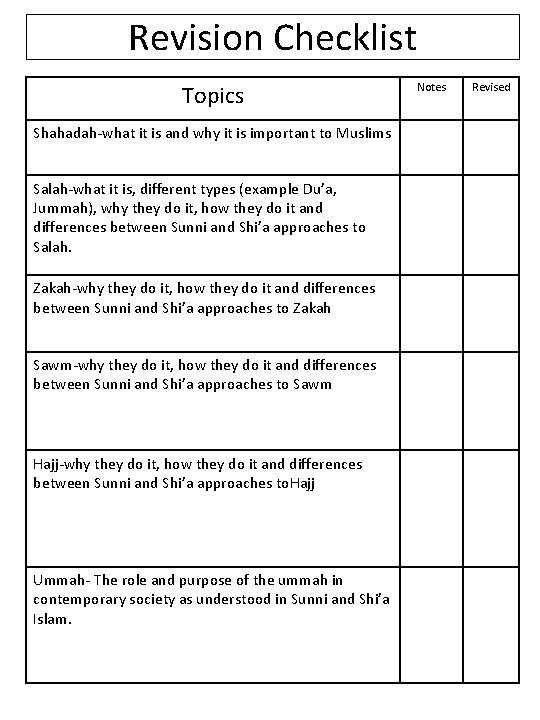
Revision Checklist Topics Shahadah-what it is and why it is important to Muslims Salah-what it is, different types (example Du’a, Jummah), why they do it, how they do it and differences between Sunni and Shi’a approaches to Salah. Zakah-why they do it, how they do it and differences between Sunni and Shi’a approaches to Zakah Sawm-why they do it, how they do it and differences between Sunni and Shi’a approaches to Sawm Hajj-why they do it, how they do it and differences between Sunni and Shi’a approaches to. Hajj Ummah- The role and purpose of the ummah in contemporary society as understood in Sunni and Shi’a Islam. Notes Revised
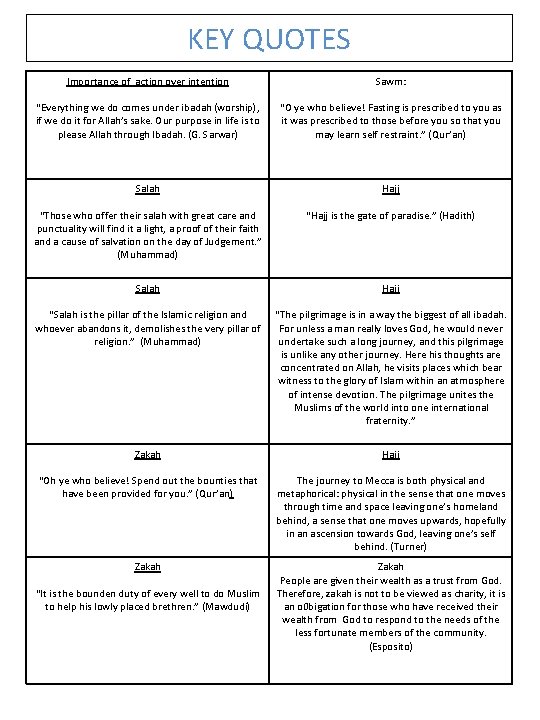
KEY QUOTES Importance of action over intention Sawm: “Everything we do comes under ibadah (worship), if we do it for Allah’s sake. Our purpose in life is to please Allah through Ibadah. (G. Sarwar) “O ye who believe! Fasting is prescribed to you as it was prescribed to those before you so that you may learn self restraint. ” (Qur’an) Salah Hajj “Those who offer their salah with great care and punctuality will find it a light, a proof of their faith and a cause of salvation on the day of Judgement. ” (Muhammad) “Hajj is the gate of paradise. ” (Hadith) Salah Hajj “Salah is the pillar of the Islamic religion and whoever abandons it, demolishes the very pillar of religion. ” (Muhammad) “The pilgrimage is in a way the biggest of all ibadah. For unless a man really loves God, he would never undertake such a long journey, and this pilgrimage is unlike any other journey. Here his thoughts are concentrated on Allah, he visits places which bear witness to the glory of Islam within an atmosphere of intense devotion. The pilgrimage unites the Muslims of the world into one international fraternity. ” Zakah Hajj “Oh ye who believe! Spend out the bounties that have been provided for you. ” (Qur’an) The journey to Mecca is both physical and metaphorical: physical in the sense that one moves through time and space leaving one’s homeland behind, a sense that one moves upwards, hopefully in an ascension towards God, leaving one’s self behind. (Turner) Zakah People are given their wealth as a trust from God. Therefore, zakah is not to be viewed as charity, it is an o 0 bigation for those who have received their wealth from God to respond to the needs of the less fortunate members of the community. (Esposito) “It is the bounden duty of every well to do Muslim to help his lowly placed brethren. ” (Mawdudi)
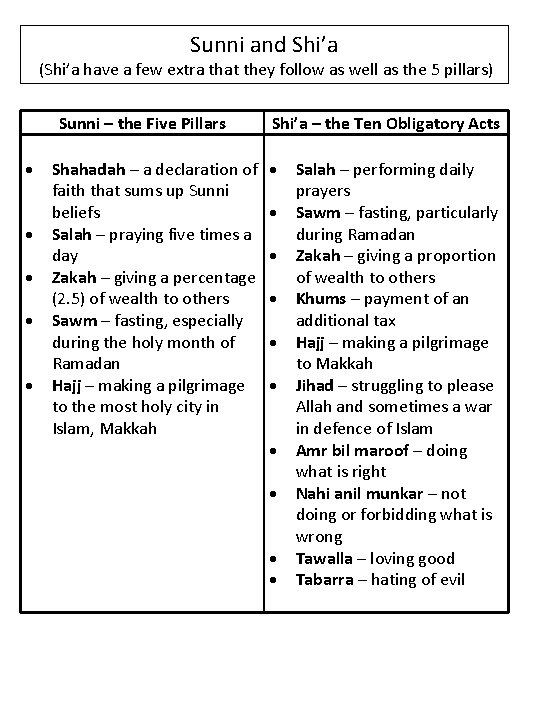
Sunni and Shi’a (Shi’a have a few extra that they follow as well as the 5 pillars) Sunni – the Five Pillars Shahadah – a declaration of faith that sums up Sunni beliefs Salah – praying five times a day Zakah – giving a percentage (2. 5) of wealth to others Sawm – fasting, especially during the holy month of Ramadan Hajj – making a pilgrimage to the most holy city in Islam, Makkah Shi’a – the Ten Obligatory Acts Salah – performing daily prayers Sawm – fasting, particularly during Ramadan Zakah – giving a proportion of wealth to others Khums – payment of an additional tax Hajj – making a pilgrimage to Makkah Jihad – struggling to please Allah and sometimes a war in defence of Islam Amr bil maroof – doing what is right Nahi anil munkar – not doing or forbidding what is wrong Tawalla – loving good Tabarra – hating of evil
ESSENTIAL IDEAS Shahadah What? • Basic statement of belief for Muslims. “There is no God but Allah, and Muhammad is his messenger. ” Shia Muslims also add, “And Ali is the friend of Muhammad. ” This is important for Shi’a Muslims as they are stating their belief that Ali was the rightful successor of Muhammad Muslim If someone converts to Islam, all they have to do is say the words of the Shahadah in front of a witness Key belief The Shahadah makes it clear to Muslims that they should reject polytheism and trinitarianism. There is no God but Allah. Different to Christianity It also reminds Muslims that under no circumstances should Muhammad be regarded as on par with Allah. The Shahadah also sets Muslims aside from Christians in their beliefs. Christians believe Jesus was the son of God, the human version of God, whereas this statement makes clear that Muhammad is not to be viewed in this way. He was only a prophet. When? • The words of the Shahadah are repeated many times throughout the day during prayer. • They are announced 5 times a day from the minaret of the mosque • Muslim fathers whisper the words of the Shahadah into the ear of their new born child so they are the first words a child hears • Faithful Muslims, who know they are about to die, try to make these words their last breath.

ESSENTIAL IDEAS Salah • Muslims pray 5 times a day • Why? Where? Qur’an and Sunnah • The Qur’an states that Muslims should pray 5 times a day, but does not state the times exactly. So most Muslims follow the example of how Muhammad prayed (as set out in the Sunnah-what Muhammad did) Commitment • Salah is regarded by many Muslim scholars as the most important of the 4 practical pillars, as it requires a great deal of commitment. “The prayers serve to distinguish those who really do have faith and wish sincerely to serve Allah from those who are content with lip service. ” Muhammad • “Salah is the pillar of the Islamic religion and whoever abandons it, demolishes the very pillar of religion. ” (Hadithwhat Muhammad said) Why? • Prayer is significant for Muslims because they believe that when praying they are in Allah’s presence and that prayer structures their day around their faith. A Muslim can never forget that they have submitted themselves to the will of Allah because Salah is performed 5 times a day. Because all Muslims face Makkah when they pray, all perform the same actions (although there are some variations between Sunnis and Shi’as) and because prayer times are set, this unites Muslims around the world in the ummah. Link to akhirah: “Those who offer their salah with great care and punctuality will find it a light, a proof of their faith and a cause of salvation on the day of Judgement. ” (Muhammad “Can there be a better course of moral and spiritual training than prayers? It is this training that makes a man a perfect Muslim. ” (Mawdudi) Salah is a discipline. It forces Muslims to take their religion seriously. It is also an act of gratitude to Allah. It is an acknowledgement by Muslims that they place absolute faith in Allah • • •
ESSENTIAL IDEAS – QUICK QUESTIONS Salah • Muslims pray 5 times a day • When and How? When? The call to prayer is called the adhan. This is called by a person known as a muezzin from the minaret, a tall tower in the mosque. This happens: • Between dawn and sunrise • After midday-early afternoon • Between late afternoon and sunset • Between sunset and end of daylight • Between sunset and dawn. Preparation Muslims will ritual wash before every prayer time so they are clean and pure before Allah. This is called Wudu. How? They will face the same direction (towards the Ka’ba in Mecca in Saudi Arabia). They perform a number of movements called Raka: Intention versus action Muslims must focus at all times during prayer. Remember, though, that the intention to pray is very important if for some reason prayer is interrupted. Niyyah, or intention, is an important concept in Islam. If a person cannot complete prayers for some reason, it is very important is that he or she had the intention of doing so.
ESSENTIAL IDEAS SALAH • Du’a • Juma • Key differences: Sunni and Shi’a Du’a After completing one Raka, Muslims can make their own prayers to Allah. They are not an essential part of salah but Muslims may take this opportunity to prayer for a loved one who is unwell or for themselves if they need help or forgiveness. Du’a is voluntary prayer. MORE DETAIL ON DU’A Juma • • • Where? Muslims gather in mosques on Friday for juma prayers. These prayers have to be attended by at least 40 male Muslims. These prayers are led by the Imam. There is no official day of rest in Islam and work can commence after Juma prayers. Shops etc only need to close for two hours around lunchtime. There is a tradition in Asian Islam that women do not have to attend juma prayers because of their household duties, but in many countries, they are expected to attend. Many Muslim men go to their mosque to pray, but if this is not possible, prayers can be said in any clean place. Women will often pray at home. If they do go to a mosque, they will pray separately from the men. In Muslim countries, schools and work will stop at prayer times. “Bow down your heads with those who bow down in worship. ” Sunni and • Shi’a • • • Shi’a pray 5 prayers , but sometimes combine Asr and Zuhr (prayer 2 and 3 in the middle of the day) together, and combine Isha and Maghrib. (prayer 4 and 5 at the end of the day) whereas Sunni Muslims pray five times a day. Sunni Muslims touch their heads to the ground whereas Shia Muslims use a wooden block or tablet of clay to rest their heads during prostration. Sunni Muslims fold their arms whereas Shia Muslims do not fold their arms during namaz. (Arabic word for prayer) Shia Muslim scholars prohibit the use of word Amen during the namaz (prayer) whereas Sunni Muslims consider it as a must.
ESSENTIAL IDEAS – QUICK QUESTIONS Jummah • The importance of communal prayer for Muslims • Communal prayer versus personal prayer What? • • Friday prayers Have to be attended by at least 40 adult male Muslims. The Imam leads the congregation in the first two rakah Then preaches a sermon (khutba) either on how to behave as a Muslim in the community or telling Hadith about the Prophet Muhammad Why? Qur’an • It is commanded in the Qu’ran: “Oh ye who believe! When the call is proclaimed to prayer on the day of assembly (Friday), hasten earnestly to the remembrance of Allah, and leave off business. ” (Sura 62) Why? Religion as priority • It emphasises the need for making prayer a priority over other worldly matters like work, which should be suspended in favour of Jummah. Why? Muhammad Following in the footsteps of Muhammad who used to hold communal gatherings of prayers at his own abode. Muhammad himself said that praying in the company of others was 25 times more meritorious than individual prayer at home. Why? Strengthens the Ummah The practice of communal prayer on Friday not only brings an individual closer to Allah, but closer to other members of the Ummah. It signifies the unity of the Ummah. • • Why? Link to Judgement day Question: But women are excluded and not all Muslims prayer in the same place so it does not unite them? Response: Uniting the Ummah does not necessarily mean in physical terms but means more spiritually and refers to praying together but in different places. “Those who offer their Salah with great care and punctuality will find it a light, a proof of their faith and cause of their salvation on the day of judgement. ” Hadith
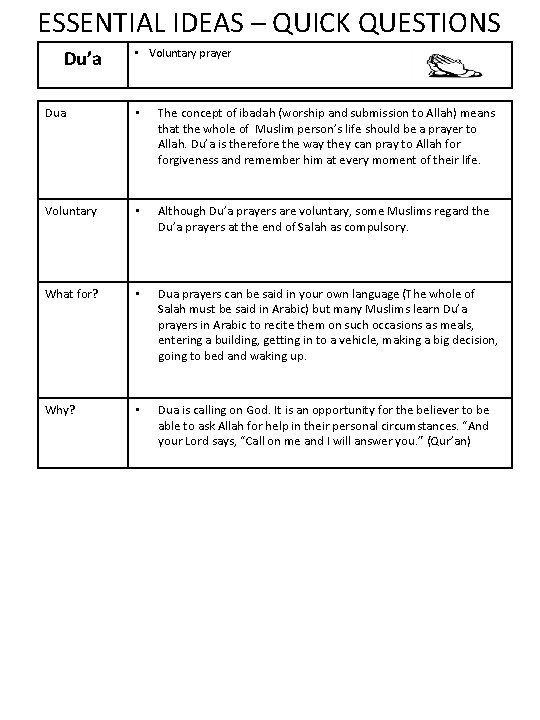
ESSENTIAL IDEAS – QUICK QUESTIONS Du’a • Voluntary prayer Dua • The concept of ibadah (worship and submission to Allah) means that the whole of Muslim person’s life should be a prayer to Allah. Du’a is therefore the way they can pray to Allah forgiveness and remember him at every moment of their life. Voluntary • Although Du’a prayers are voluntary, some Muslims regard the Du’a prayers at the end of Salah as compulsory. What for? • Dua prayers can be said in your own language (The whole of Salah must be said in Arabic) but many Muslims learn Du’a prayers in Arabic to recite them on such occasions as meals, entering a building, getting in to a vehicle, making a big decision, going to bed and waking up. Why? • Dua is calling on God. It is an opportunity for the believer to be able to ask Allah for help in their personal circumstances. “And your Lord says, “Call on me and I will answer you. ” (Qur’an)

POSSIBLE QUESTION Explore the different types of prayer for Muslims. (8 marks) Salah • One of 5 pillars, 5 times a day, says to pray 5 times in Qur’an, following example of Muhammad who stipulated the times. Perform Wudu (explain this) May pray at home or in Mosque Call to prayer called Adhan performed by Muezzin in Mosque Face the direction of Makkah Qiblah in Mosque compass in wall to show the direction Perform a number of Rakahs Bow and prostrate, kneel and sit up again Some difference between Sunni and Shi-briefly explain differences Must be said in Arabic Dua • • Voluntary prayers Can be said in any language Can ask Allah for your own intentions Give examples of when Muslims might opt for Du’a prayers Jummah • • Friday afternoon prayers in Mosque All work and business must stop Instructed to do so in Qur’an Must have 40 male adults present Imam leads congregation Performs 2 rakahs then gives a sermon. Not compulsory for omen to attend although in some countries they do. Strengthens the Ummah and shows complete obedience to Allah. • • • Include quote about importance of Salah “Salah is the pillar of the Islamic religion and whoever abandons it, demolishes the very pillar of religion. ” (Muhammad)

POSSIBLE QUESTION Explore the importance of prayer for Muslims. (8 marks) • Prayer is significant for Muslims because they believe that when praying they are in Allah’s presence and that prayer structures their day around their faith. A Muslim can never forget that they have submitted themselves to the will of Allah because Salah is performed 5 times a day. • Because all Muslims face Makkah when they pray, all perform the same actions (although there are some variations between Sunnis and Shi’as) and because prayer times are set, this unites Muslims around the world in the ummah. It is a practical expression of the brotherhood of Islam. • Link to akhirah: “Those who offer their salah with great care and punctuality will find it a light, a proof of their faith and a cause of salvation on the day of Judgement. ” (Hadith/Muhammad) • “The 5 prayers remove sins as water removes dirt. ” (Hadith/Muhammad) • “Can there be a better course of moral and spiritual training than prayers? It is this training that makes a man a perfect Muslim. ” (Mawdudi) • Salah is a discipline. It forces Muslims to take their religion seriously. It is also an act of gratitude to Allah. • It is an acknowledgement by Muslims that they place absolute faith in Allah.

POSSIBLE QUESTION Explore the practice of Salah for Muslims. (8 marks) Write your answer below including all of the key terms from the word bank below: WORD BANK 5 Pillars, 5 times, Wudu, Niyat (prayer must be performed with intention-they must first perform religious ritual to ensure they are in the appropriate mental and emotional state of mind), Rakah, Bowing, Prostration, Recite, Qur’an, Du’a, Sunni, Shia, Quote about Salah
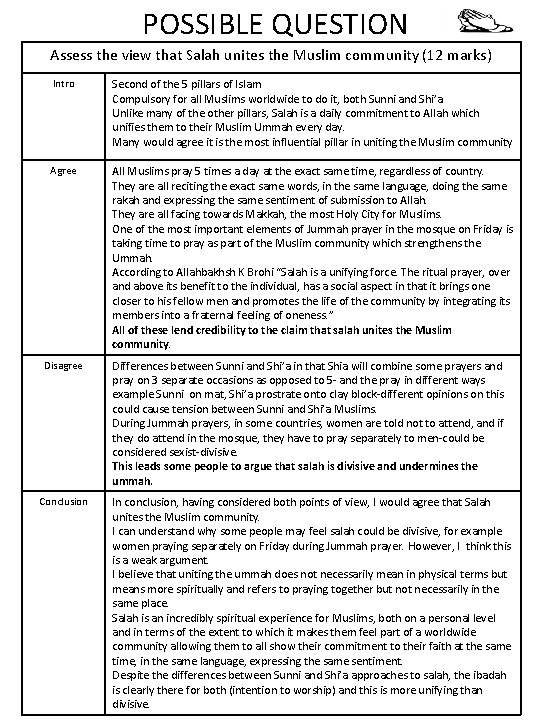
POSSIBLE QUESTION Assess the view that Salah unites the Muslim community (12 marks) Intro Second of the 5 pillars of Islam Compulsory for all Muslims worldwide to do it, both Sunni and Shi’a Unlike many of the other pillars, Salah is a daily commitment to Allah which unifies them to their Muslim Ummah every day. Many would agree it is the most influential pillar in uniting the Muslim community Agree All Muslims pray 5 times a day at the exact same time, regardless of country. They are all reciting the exact same words, in the same language, doing the same rakah and expressing the same sentiment of submission to Allah. They are all facing towards Makkah, the most Holy City for Muslims. One of the most important elements of Jummah prayer in the mosque on Friday is taking time to pray as part of the Muslim community which strengthens the Ummah. According to Allahbakhsh K Brohi “Salah is a unifying force. The ritual prayer, over and above its benefit to the individual, has a social aspect in that it brings one closer to his fellow men and promotes the life of the community by integrating its members into a fraternal feeling of oneness. ” All of these lend credibility to the claim that salah unites the Muslim community. Disagree Conclusion Differences between Sunni and Shi’a in that Shia will combine some prayers and pray on 3 separate occasions as opposed to 5 - and the pray in different ways example Sunni on mat, Shi’a prostrate onto clay block-different opinions on this could cause tension between Sunni and Shi’a Muslims. During Jummah prayers, in some countries, women are told not to attend, and if they do attend in the mosque, they have to pray separately to men-could be considered sexist-divisive. This leads some people to argue that salah is divisive and undermines the ummah. In conclusion, having considered both points of view, I would agree that Salah unites the Muslim community. I can understand why some people may feel salah could be divisive, for example women praying separately on Friday during Jummah prayer. However, I think this is a weak argument. I believe that uniting the ummah does not necessarily mean in physical terms but means more spiritually and refers to praying together but not necessarily in the same place. Salah is an incredibly spiritual experience for Muslims, both on a personal level and in terms of the extent to which it makes them feel part of a worldwide community allowing them to all show their commitment to their faith at the same time, in the same language, expressing the same sentiment. Despite the differences between Sunni and Shi’a approaches to salah, the ibadah is clearly there for both (intention to worship) and this is more unifying than divisive.
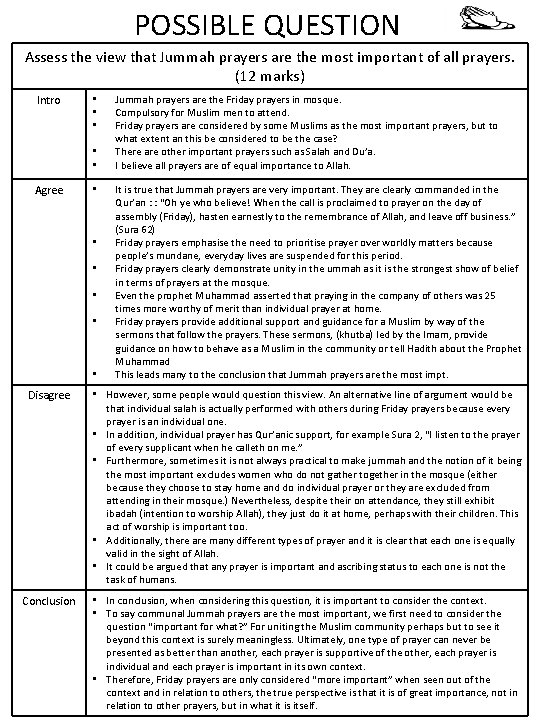
POSSIBLE QUESTION Assess the view that Jummah prayers are the most important of all prayers. (12 marks) Intro • • • Agree • • • Jummah prayers are the Friday prayers in mosque. Compulsory for Muslim men to attend. Friday prayers are considered by some Muslims as the most important prayers, but to what extent an this be considered to be the case? There are other important prayers such as Salah and Du’a. I believe all prayers are of equal importance to Allah. It is true that Jummah prayers are very important. They are clearly commanded in the Qur’an : : “Oh ye who believe! When the call is proclaimed to prayer on the day of assembly (Friday), hasten earnestly to the remembrance of Allah, and leave off business. ” (Sura 62) Friday prayers emphasise the need to prioritise prayer over worldly matters because people’s mundane, everyday lives are suspended for this period. Friday prayers clearly demonstrate unity in the ummah as it is the strongest show of belief in terms of prayers at the mosque. Even the prophet Muhammad asserted that praying in the company of others was 25 times more worthy of merit than individual prayer at home. Friday prayers provide additional support and guidance for a Muslim by way of the sermons that follow the prayers. These sermons, (khutba) led by the Imam, provide guidance on how to behave as a Muslim in the community or tell Hadith about the Prophet Muhammad This leads many to the conclusion that Jummah prayers are the most impt. Disagree • However, some people would question this view. An alternative line of argument would be that individual salah is actually performed with others during Friday prayers because every prayer is an individual one. • In addition, individual prayer has Qur’anic support, for example Sura 2, “I listen to the prayer of every supplicant when he calleth on me. ” • Furthermore, sometimes it is not always practical to make jummah and the notion of it being the most important excludes women who do not gather together in the mosque (either because they choose to stay home and do individual prayer or they are excluded from attending in their mosque. ) Nevertheless, despite their on attendance, they still exhibit ibadah (intention to worship Allah), they just do it at home, perhaps with their children. This act of worship is important too. • Additionally, there are many different types of prayer and it is clear that each one is equally valid in the sight of Allah. • It could be argued that any prayer is important and ascribing status to each one is not the task of humans. Conclusion • In conclusion, when considering this question, it is important to consider the context. • To say communal Jummah prayers are the most important, we first need to consider the question “important for what? ” For uniting the Muslim community perhaps but to see it beyond this context is surely meaningless. Ultimately, one type of prayer can never be presented as better than another, each prayer is supportive of the other, each prayer is individual and each prayer is important in its own context. • Therefore, Friday prayers are only considered “more important” when seen out of the context and in relation to others, the true perspective is that it is of great importance, not in relation to other prayers, but in what it is itself.
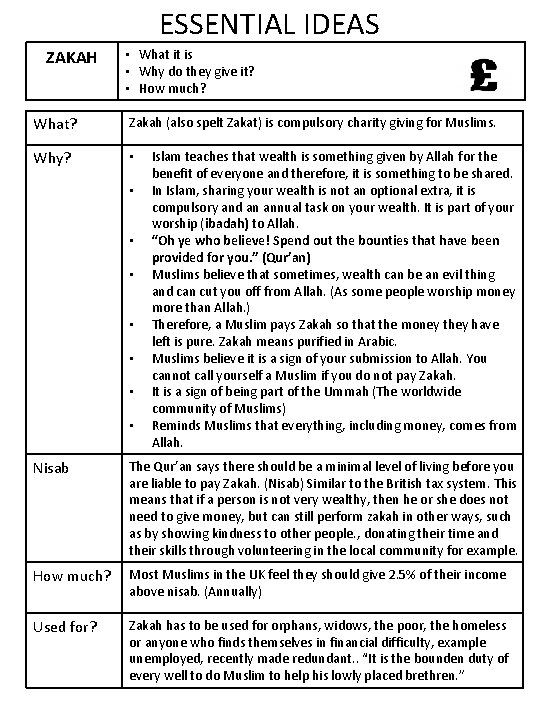
ESSENTIAL IDEAS ZAKAH • What it is • Why do they give it? • How much? What? Zakah (also spelt Zakat) is compulsory charity giving for Muslims. Why? • • Islam teaches that wealth is something given by Allah for the benefit of everyone and therefore, it is something to be shared. In Islam, sharing your wealth is not an optional extra, it is compulsory and an annual task on your wealth. It is part of your worship (ibadah) to Allah. “Oh ye who believe! Spend out the bounties that have been provided for you. ” (Qur’an) Muslims believe that sometimes, wealth can be an evil thing and can cut you off from Allah. (As some people worship money more than Allah. ) Therefore, a Muslim pays Zakah so that the money they have left is pure. Zakah means purified in Arabic. Muslims believe it is a sign of your submission to Allah. You cannot call yourself a Muslim if you do not pay Zakah. It is a sign of being part of the Ummah (The worldwide community of Muslims) Reminds Muslims that everything, including money, comes from Allah. Nisab The Qur’an says there should be a minimal level of living before you are liable to pay Zakah. (Nisab) Similar to the British tax system. This means that if a person is not very wealthy, then he or she does not need to give money, but can still perform zakah in other ways, such as by showing kindness to other people. , donating their time and their skills through volunteering in the local community for example. How much? Most Muslims in the UK feel they should give 2. 5% of their income above nisab. (Annually) Used for? Zakah has to be used for orphans, widows, the poor, the homeless or anyone who finds themselves in financial difficulty, example unemployed, recently made redundant. . “It is the bounden duty of every well to do Muslim to help his lowly placed brethren. ”
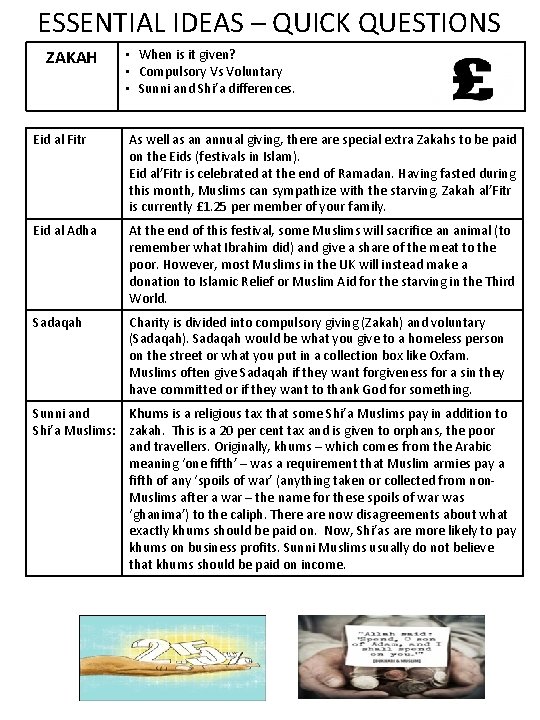
ESSENTIAL IDEAS – QUICK QUESTIONS ZAKAH • When is it given? • Compulsory Vs Voluntary • Sunni and Shi’a differences. Eid al Fitr As well as an annual giving, there are special extra Zakahs to be paid on the Eids (festivals in Islam). Eid al’Fitr is celebrated at the end of Ramadan. Having fasted during this month, Muslims can sympathize with the starving. Zakah al’Fitr is currently £ 1. 25 per member of your family. Eid al Adha At the end of this festival, some Muslims will sacrifice an animal (to remember what Ibrahim did) and give a share of the meat to the poor. However, most Muslims in the UK will instead make a donation to Islamic Relief or Muslim Aid for the starving in the Third World. Sadaqah Charity is divided into compulsory giving (Zakah) and voluntary (Sadaqah). Sadaqah would be what you give to a homeless person on the street or what you put in a collection box like Oxfam. Muslims often give Sadaqah if they want forgiveness for a sin they have committed or if they want to thank God for something. Sunni and Khums is a religious tax that some Shi’a Muslims pay in addition to Shi’a Muslims: zakah. This is a 20 per cent tax and is given to orphans, the poor and travellers. Originally, khums – which comes from the Arabic meaning ‘one fifth’ – was a requirement that Muslim armies pay a fifth of any ‘spoils of war’ (anything taken or collected from non. Muslims after a war – the name for these spoils of war was ‘ghanima’) to the caliph. There are now disagreements about what exactly khums should be paid on. Now, Shi’as are more likely to pay khums on business profits. Sunni Muslims usually do not believe that khums should be paid on income.
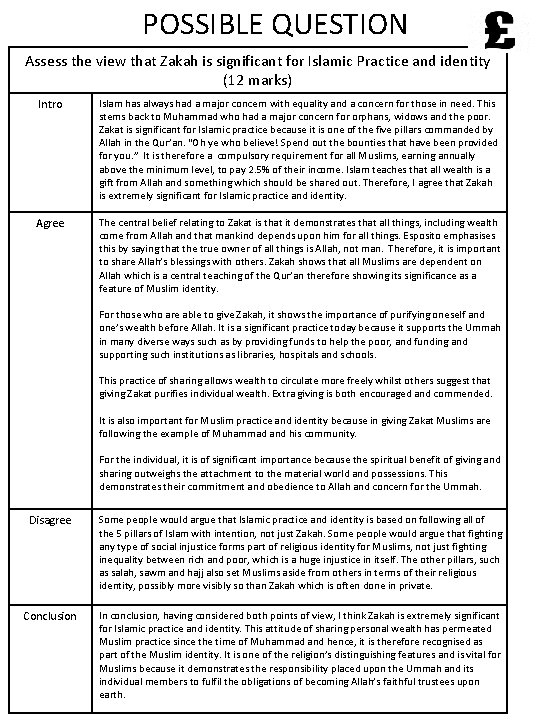
POSSIBLE QUESTION Assess the view that Zakah is significant for Islamic Practice and identity (12 marks) Intro Islam has always had a major concern with equality and a concern for those in need. This stems back to Muhammad who had a major concern for orphans, widows and the poor. Zakat is significant for Islamic practice because it is one of the five pillars commanded by Allah in the Qur’an. “Oh ye who believe! Spend out the bounties that have been provided for you. ” It is therefore a compulsory requirement for all Muslims, earning annually above the minimum level, to pay 2. 5% of their income. Islam teaches that all wealth is a gift from Allah and something which should be shared out. Therefore, I agree that Zakah is extremely significant for Islamic practice and identity. Agree The central belief relating to Zakat is that it demonstrates that all things, including wealth come from Allah and that mankind depends upon him for all things. Esposito emphasises this by saying that the true owner of all things is Allah, not man. Therefore, it is important to share Allah’s blessings with others. Zakah shows that all Muslims are dependent on Allah which is a central teaching of the Qur’an therefore showing its significance as a feature of Muslim identity. For those who are able to give Zakah, it shows the importance of purifying oneself and one’s wealth before Allah. It is a significant practice today because it supports the Ummah in many diverse ways such as by providing funds to help the poor, and funding and supporting such institutions as libraries, hospitals and schools. This practice of sharing allows wealth to circulate more freely whilst others suggest that giving Zakat purifies individual wealth. Extra giving is both encouraged and commended. It is also important for Muslim practice and identity because in giving Zakat Muslims are following the example of Muhammad and his community. For the individual, it is of significant importance because the spiritual benefit of giving and sharing outweighs the attachment to the material world and possessions. This demonstrates their commitment and obedience to Allah and concern for the Ummah. Disagree Some people would argue that Islamic practice and identity is based on following all of the 5 pillars of Islam with intention, not just Zakah. Some people would argue that fighting any type of social injustice forms part of religious identity for Muslims, not just fighting inequality between rich and poor, which is a huge injustice in itself. The other pillars, such as salah, sawm and hajj also set Muslims aside from others in terms of their religious identity, possibly more visibly so than Zakah which is often done in private. Conclusion In conclusion, having considered both points of view, I think Zakah is extremely significant for Islamic practice and identity. This attitude of sharing personal wealth has permeated Muslim practice since the time of Muhammad and hence, it is therefore recognised as part of the Muslim identity. It is one of the religion’s distinguishing features and is vital for Muslims because it demonstrates the responsibility placed upon the Ummah and its individual members to fulfil the obligations of becoming Allah’s faithful trustees upon earth.
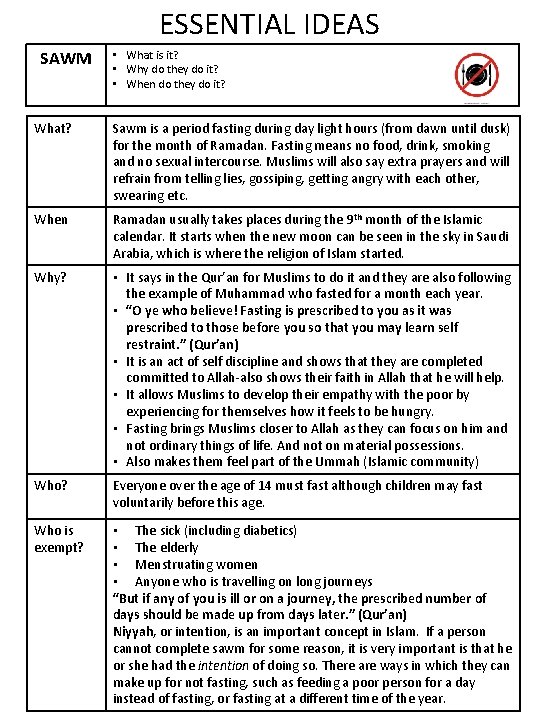
ESSENTIAL IDEAS SAWM • What is it? • Why do they do it? • When do they do it? What? Sawm is a period fasting during day light hours (from dawn until dusk) for the month of Ramadan. Fasting means no food, drink, smoking and no sexual intercourse. Muslims will also say extra prayers and will refrain from telling lies, gossiping, getting angry with each other, swearing etc. When Ramadan usually takes places during the 9 th month of the Islamic calendar. It starts when the new moon can be seen in the sky in Saudi Arabia, which is where the religion of Islam started. Why? • It says in the Qur’an for Muslims to do it and they are also following the example of Muhammad who fasted for a month each year. • “O ye who believe! Fasting is prescribed to you as it was prescribed to those before you so that you may learn self restraint. ” (Qur’an) • It is an act of self discipline and shows that they are completed committed to Allah-also shows their faith in Allah that he will help. • It allows Muslims to develop their empathy with the poor by experiencing for themselves how it feels to be hungry. • Fasting brings Muslims closer to Allah as they can focus on him and not ordinary things of life. And not on material possessions. • Also makes them feel part of the Ummah (Islamic community) Who? Everyone over the age of 14 must fast although children may fast voluntarily before this age. Who is exempt? • The sick (including diabetics) • The elderly • Menstruating women • Anyone who is travelling on long journeys “But if any of you is ill or on a journey, the prescribed number of days should be made up from days later. ” (Qur’an) Niyyah, or intention, is an important concept in Islam. If a person cannot complete sawm for some reason, it is very important is that he or she had the intention of doing so. There are ways in which they can make up for not fasting, such as feeding a poor person for a day instead of fasting, or fasting at a different time of the year.
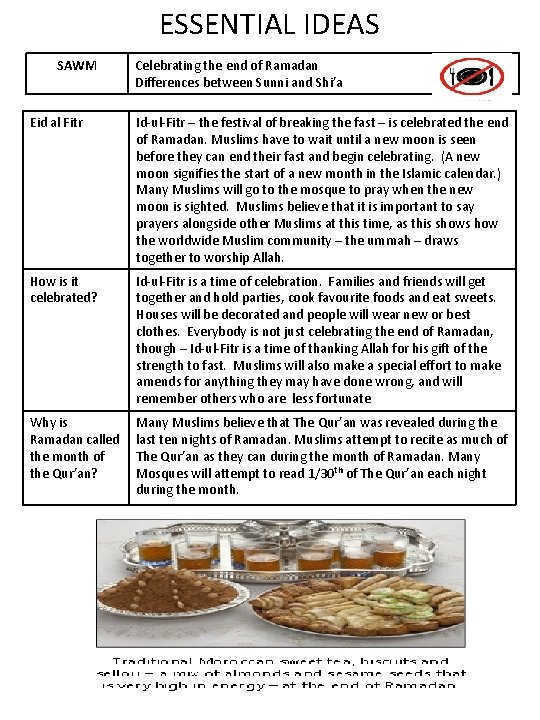
ESSENTIAL IDEAS SAWM Celebrating the end of Ramadan Differences between Sunni and Shi’a Eid al Fitr Id-ul-Fitr – the festival of breaking the fast – is celebrated the end of Ramadan. Muslims have to wait until a new moon is seen before they can end their fast and begin celebrating. (A new moon signifies the start of a new month in the Islamic calendar. ) Many Muslims will go to the mosque to pray when the new moon is sighted. Muslims believe that it is important to say prayers alongside other Muslims at this time, as this shows how the worldwide Muslim community – the ummah – draws together to worship Allah. How is it celebrated? Id-ul-Fitr is a time of celebration. Families and friends will get together and hold parties, cook favourite foods and eat sweets. Houses will be decorated and people will wear new or best clothes. Everybody is not just celebrating the end of Ramadan, though – Id-ul-Fitr is a time of thanking Allah for his gift of the strength to fast. Muslims will also make a special effort to make amends for anything they may have done wrong, and will remember others who are less fortunate Why is Ramadan called the month of the Qur’an? Many Muslims believe that The Qur’an was revealed during the last ten nights of Ramadan. Muslims attempt to recite as much of The Qur’an as they can during the month of Ramadan. Many Mosques will attempt to read 1/30 th of The Qur’an each night during the month.
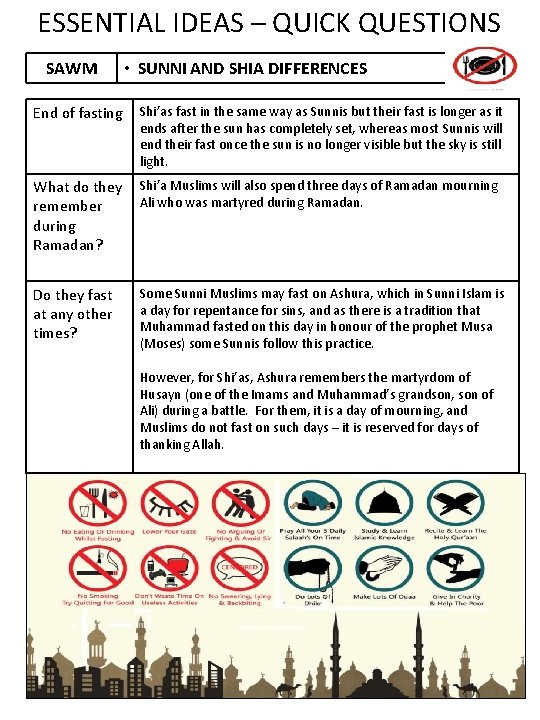
ESSENTIAL IDEAS – QUICK QUESTIONS SAWM End of fasting • SUNNI AND SHIA DIFFERENCES Shi’as fast in the same way as Sunnis but their fast is longer as it ends after the sun has completely set, whereas most Sunnis will end their fast once the sun is no longer visible but the sky is still light. What do they Shi’a Muslims will also spend three days of Ramadan mourning Ali who was martyred during Ramadan. remember during Ramadan? Do they fast at any other times? Some Sunni Muslims may fast on Ashura, which in Sunni Islam is a day for repentance for sins, and as there is a tradition that Muhammad fasted on this day in honour of the prophet Musa (Moses) some Sunnis follow this practice. However, for Shi’as, Ashura remembers the martyrdom of Husayn (one of the Imams and Muhammad’s grandson, son of Ali) during a battle. For them, it is a day of mourning, and Muslims do not fast on such days – it is reserved for days of thanking Allah.
ESSENTIAL IDEAS-HAJJ What is it? Hajj is a Muslim pilgrimage to the Holy city of Mecca in Saudi Arabia. This is where the Ka’ba is, the most Holy structure of Islam and is where the religion is Islam is said to have started. Origins The origins of the Hajj go back to the prophet Ibrahim and a time when his wife Hagar and baby son Ismail were in the desert to escape the jealousy of Ibrahim’s other wife, Sarah. Muslims believe that Allah told Ibrahim to leave them, which he did, having given them food and water. However, these quickly ran out, leaving the baby Ismail dehydrated. Hagar ran between two hills to find help, but failed; however, when Ismail struck the ground with his foot, a spring of water flowed, and they were saved. Allah instructed Ibrahim to build a shrine as a place for people who wanted to worship Allah. The area in which Hagar and Ismail almost died became that around Makkah, and the spring of water a well called Zam, and the two hills are now called Safa and Marwa. The shrine became the Ka’aba. It became a site for worship of other gods before Muhammad led the first Hajj to the area, retracing the journey of Ibrahim, Hagar and Ismail. Muhammad also cleansed and rededicated the Ka’aba.
ESSENTIAL IDEAS-HAJJ Why? • What happens while they are there? • • • Who can go? It helps them remember the people who have been important to the religion of Islam: Ibrahim, Ishamil, Adam and of course, Muhammad. They are following the example of Prophet Muhammad. Everything they do on Hajj is following in the footsteps of Muhammad. “Hajj is the Gate of Paradise. ” (Hadith) The pilgrimage to Makkah makes the Muslim’s faith stronger They feel it makes them more obedient to Allah (they carry out his wishes) as it is a physically demanding trip. Makes them feel a part of the Ummah (worldwide Muslim community) The pilgrim has taken part in the holiest event in the Muslim calendar and has come as close to Allah as possible in this earthly life. Many Muslims believe that if you have not completed hajj during your earthly life, then you may be denied a place in paradise in the after life. Upon completion, the pilgrims can be called hajji when they return home. This is a title of honour and means they should be highly regarded in the community. Anyone who is old enough and who can afford to go. Muslims can only go on Hajj if they have sufficient money to leave to care for their dependants whilst they are away from home and if they are physically and mentally fit enough to do it. (Hajj is a physically demanding ritual.
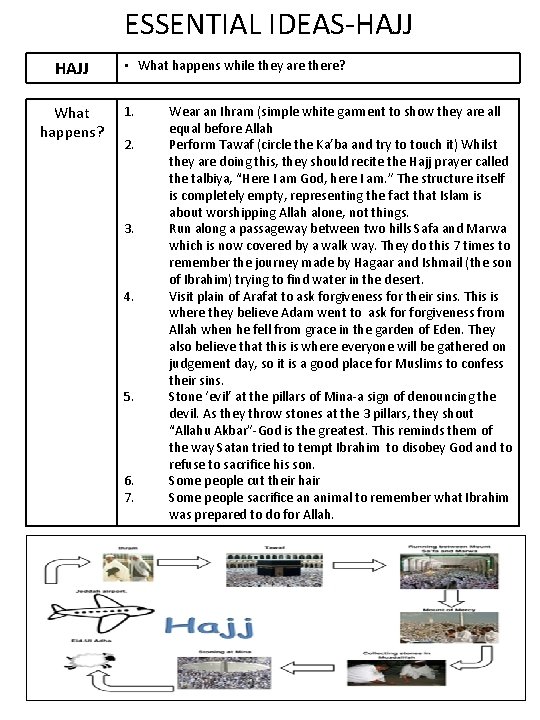
ESSENTIAL IDEAS-HAJJ What happens? • What happens while they are there? 1. 2. 3. 4. 5. 6. 7. Wear an Ihram (simple white garment to show they are all equal before Allah Perform Tawaf (circle the Ka’ba and try to touch it) Whilst they are doing this, they should recite the Hajj prayer called the talbiya, “Here I am God, here I am. ” The structure itself is completely empty, representing the fact that Islam is about worshipping Allah alone, not things. Run along a passageway between two hills Safa and Marwa which is now covered by a walk way. They do this 7 times to remember the journey made by Hagaar and Ishmail (the son of Ibrahim) trying to find water in the desert. Visit plain of Arafat to ask forgiveness for their sins. This is where they believe Adam went to ask forgiveness from Allah when he fell from grace in the garden of Eden. They also believe that this is where everyone will be gathered on judgement day, so it is a good place for Muslims to confess their sins. Stone ‘evil’ at the pillars of Mina-a sign of denouncing the devil. As they throw stones at the 3 pillars, they shout “Allahu Akbar”-God is the greatest. This reminds them of the way Satan tried to tempt Ibrahim to disobey God and to refuse to sacrifice his son. Some people cut their hair Some people sacrifice an animal to remember what Ibrahim was prepared to do for Allah.
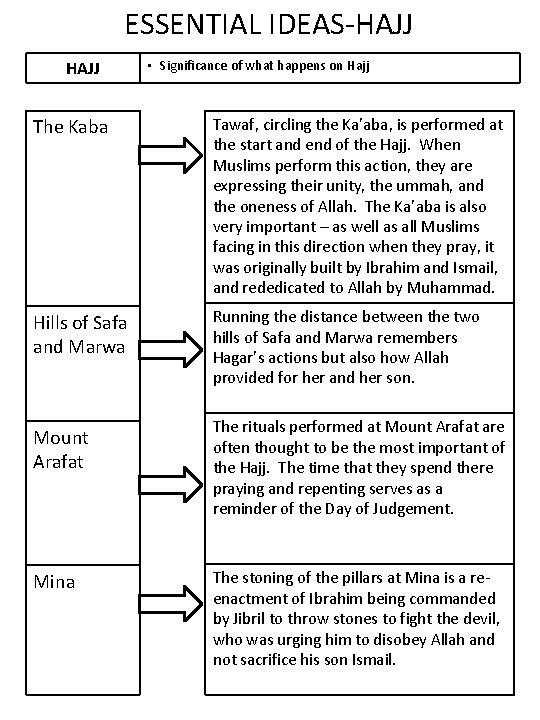
ESSENTIAL IDEAS-HAJJ • Significance of what happens on Hajj The Kaba Tawaf, circling the Ka’aba, is performed at the start and end of the Hajj. When Muslims perform this action, they are expressing their unity, the ummah, and the oneness of Allah. The Ka’aba is also very important – as well as all Muslims facing in this direction when they pray, it was originally built by Ibrahim and Ismail, and rededicated to Allah by Muhammad. Hills of Safa and Marwa Running the distance between the two hills of Safa and Marwa remembers Hagar’s actions but also how Allah provided for her and her son. Mount Arafat Mina The rituals performed at Mount Arafat are often thought to be the most important of the Hajj. The time that they spend there praying and repenting serves as a reminder of the Day of Judgement. The stoning of the pillars at Mina is a reenactment of Ibrahim being commanded by Jibril to throw stones to fight the devil, who was urging him to disobey Allah and not sacrifice his son Ismail.
ESSENTIAL IDEAS-HAJJ Importance “The pilgrimage is in a way the biggest of all ibadah. For unless a man really loves God, he would never undertake such a long journey, and this pilgrimage is unlike any other journey. Here his thoughts are concentrated on Allah, he visits places which bear witness to the glory of Islam within an atmosphere of intense devotion. The pilgrimage unites the Muslims of the world into one international fraternity. (Mawdudi) Sunni and Shi’a Although Shi’a are expected to go on Hajj to mecca, they also go on pilgrimage to Shi’a shrines and graves of Imam in places such as Karbala and Najaf. (in Iraq) Shi’a believe they get grace from Allah from visiting the tombs of Shi’a saints. Eid al Adha Most Muslims will celebrate two Ids. Id-ul-Adha – the name means the ‘festival of sacrifice’ – is actually the more important of the two. It lasts for three days and takes place at the end of the Hajj in the month of Dhu al Hijjah, the final month of the Muslim year. It remembers Allah asking Ibrahim to sacrifice his son Ismail. Ultimately, Ibrahim did not have to go through with this act, as he had proven his faith and submission to Allah, who provided a sheep instead. While Muslims do celebrate at Id-ul-Adha, they are also to remember Ibrahim’s example and the way in which he unquestioningly submitted to Allah’s will. This encourages them to make their own sacrifices and remember Allah’s importance and centrality in their faith. In Islamic countries, Id-ul-Adha is a four-day public holiday. As with Id-ul-Fitr, this festival does not last for as long in Britain as it does in Muslim countries, but Id-ul-Adha is still a very important time for Muslims in Britain. Again, some schools, colleges and businesses may give Muslim staff time off to celebrate, and people will wear new or best clothes, and go to a mosque and pray. Families will spend time together and eat traditional or favourite foods. Because of the focus on sacrifice, this is a time of year during which Muslims consider people who are not as fortunate, and mosques and community centres may hold charity events and communal meals.
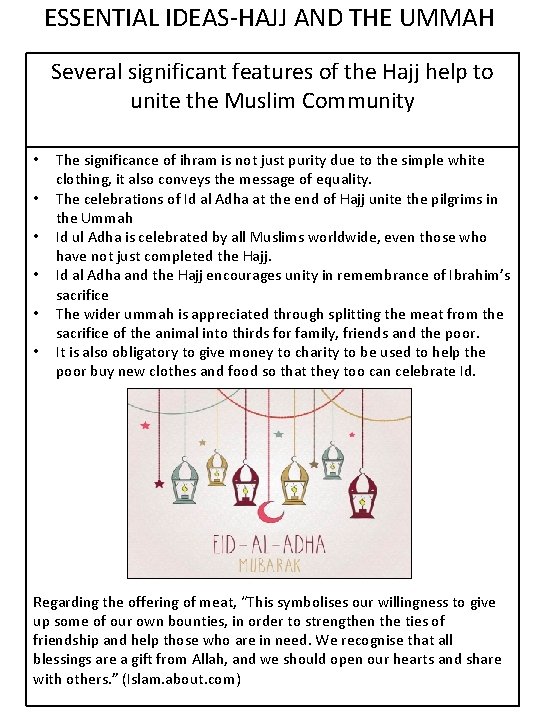
ESSENTIAL IDEAS-HAJJ AND THE UMMAH Several significant features of the Hajj help to unite the Muslim Community • • • The significance of ihram is not just purity due to the simple white clothing, it also conveys the message of equality. The celebrations of Id al Adha at the end of Hajj unite the pilgrims in the Ummah Id ul Adha is celebrated by all Muslims worldwide, even those who have not just completed the Hajj. Id al Adha and the Hajj encourages unity in remembrance of Ibrahim’s sacrifice The wider ummah is appreciated through splitting the meat from the sacrifice of the animal into thirds for family, friends and the poor. It is also obligatory to give money to charity to be used to help the poor buy new clothes and food so that they too can celebrate Id. Regarding the offering of meat, “This symbolises our willingness to give up some of our own bounties, in order to strengthen the ties of friendship and help those who are in need. We recognise that all blessings are a gift from Allah, and we should open our hearts and share with others. ” (Islam. about. com)
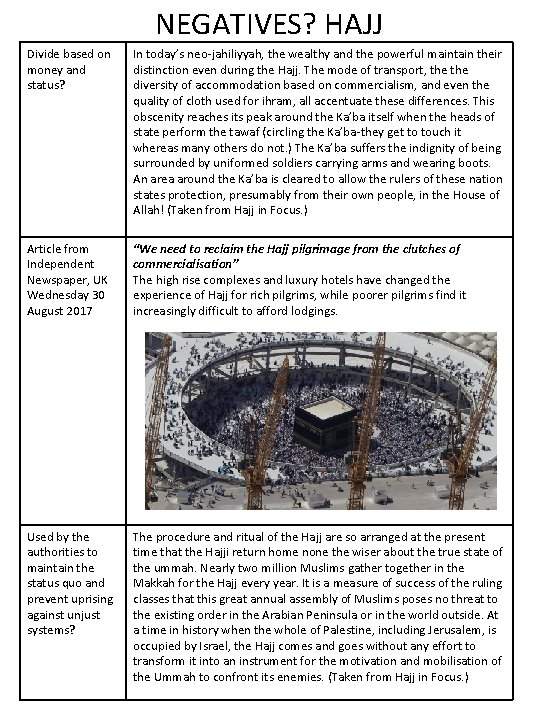
NEGATIVES? HAJJ Divide based on money and status? In today’s neo-jahiliyyah, the wealthy and the powerful maintain their distinction even during the Hajj. The mode of transport, the diversity of accommodation based on commercialism, and even the quality of cloth used for ihram, all accentuate these differences. This obscenity reaches its peak around the Ka’ba itself when the heads of state perform the tawaf (circling the Ka’ba-they get to touch it whereas many others do not. ) The Ka’ba suffers the indignity of being surrounded by uniformed soldiers carrying arms and wearing boots. An area around the Ka’ba is cleared to allow the rulers of these nation states protection, presumably from their own people, in the House of Allah! (Taken from Hajj in Focus. ) Article from Independent Newspaper, UK Wednesday 30 August 2017 “We need to reclaim the Hajj pilgrimage from the clutches of commercialisation” The high rise complexes and luxury hotels have changed the experience of Hajj for rich pilgrims, while poorer pilgrims find it increasingly difficult to afford lodgings. Used by the authorities to maintain the status quo and prevent uprising against unjust systems? The procedure and ritual of the Hajj are so arranged at the present time that the Hajji return home none the wiser about the true state of the ummah. Nearly two million Muslims gather together in the Makkah for the Hajj every year. It is a measure of success of the ruling classes that this great annual assembly of Muslims poses no threat to the existing order in the Arabian Peninsula or in the world outside. At a time in history when the whole of Palestine, including Jerusalem, is occupied by Israel, the Hajj comes and goes without any effort to transform it into an instrument for the motivation and mobilisation of the Ummah to confront its enemies. (Taken from Hajj in Focus. )
ESSENTIAL IDEAS Remember-it is VERY important that you are able to emphasise in any essay that you write on this, the different beliefs from Sunni and Shi’a Muslims to the “practices that shape their religious identity. ” To reinforce this, watch the following video clip and note down the differences highlighted between Sunni and Shi beliefs and practices. https: //www. truetube. co. uk/film/shia-sunni SUNNI SHIA
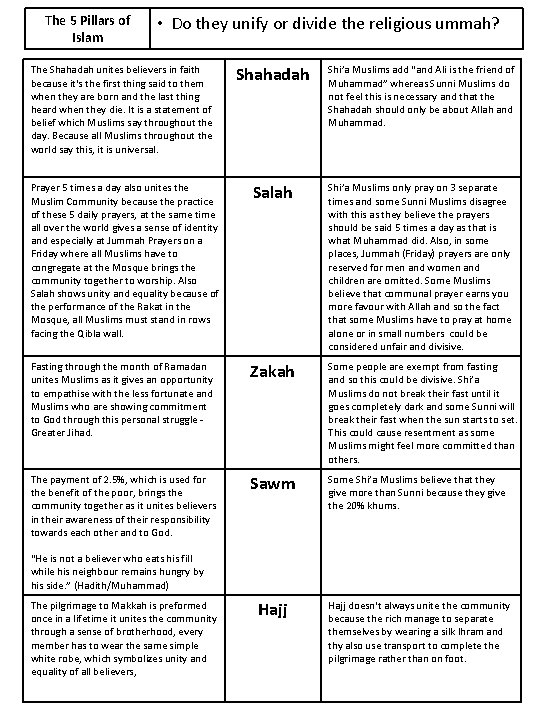
The 5 Pillars of Islam • Do they unify or divide the religious ummah? The Shahadah unites believers in faith because it's the first thing said to them when they are born and the last thing heard when they die. It is a statement of belief which Muslims say throughout the day. Because all Muslims throughout the world say this, it is universal. Shahadah Shi’a Muslims add “and Ali is the friend of Muhammad” whereas Sunni Muslims do not feel this is necessary and that the Shahadah should only be about Allah and Muhammad. Prayer 5 times a day also unites the Muslim Community because the practice of these 5 daily prayers, at the same time all over the world gives a sense of identity and especially at Jummah Prayers on a Friday where all Muslims have to congregate at the Mosque brings the community together to worship. Also Salah shows unity and equality because of the performance of the Rakat in the Mosque, all Muslims must stand in rows facing the Qibla wall. Salah Shi’a Muslims only pray on 3 separate times and some Sunni Muslims disagree with this as they believe the prayers should be said 5 times a day as that is what Muhammad did. Also, in some places, Jummah (Friday) prayers are only reserved for men and women and children are omitted. Some Muslims believe that communal prayer earns you more favour with Allah and so the fact that some Muslims have to pray at home alone or in small numbers could be considered unfair and divisive. Fasting through the month of Ramadan unites Muslims as it gives an opportunity to empathise with the less fortunate and Muslims who are showing commitment to God through this personal struggle - Greater Jihad. Zakah Some people are exempt from fasting and so this could be divisive. Shi’a Muslims do not break their fast until it goes completely dark and some Sunni will break their fast when the sun starts to set. This could cause resentment as some Muslims might feel more committed than others. The payment of 2. 5%, which is used for the benefit of the poor, brings the community together as it unites believers in their awareness of their responsibility towards each other and to God. Sawm Some Shi’a Muslims believe that they give more than Sunni because they give the 20% khums. Hajj doesn't always unite the community because the rich manage to separate themselves by wearing a silk Ihram and thy also use transport to complete the pilgrimage rather than on foot. “He is not a believer who eats his fill while his neighbour remains hungry by his side. ” (Hadith/Muhammad) The pilgrimage to Makkah is preformed once in a lifetime it unites the community through a sense of brotherhood, every member has to wear the same simple white robe, which symbolizes unity and equality of all believers,
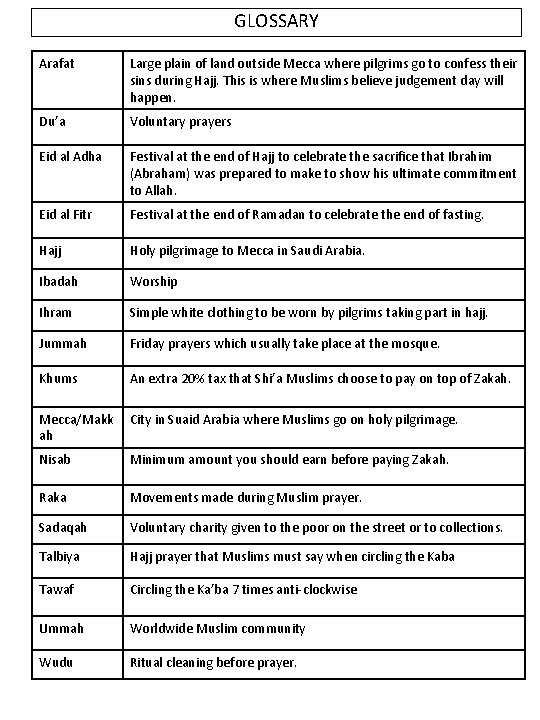
GLOSSARY Arafat Large plain of land outside Mecca where pilgrims go to confess their sins during Hajj. This is where Muslims believe judgement day will happen. Du’a Voluntary prayers Eid al Adha Festival at the end of Hajj to celebrate the sacrifice that Ibrahim (Abraham) was prepared to make to show his ultimate commitment to Allah. Eid al Fitr Festival at the end of Ramadan to celebrate the end of fasting. Hajj Holy pilgrimage to Mecca in Saudi Arabia. Ibadah Worship Ihram Simple white clothing to be worn by pilgrims taking part in hajj. Jummah Friday prayers which usually take place at the mosque. Khums An extra 20% tax that Shi’a Muslims choose to pay on top of Zakah. Mecca/Makk ah City in Suaid Arabia where Muslims go on holy pilgrimage. Nisab Minimum amount you should earn before paying Zakah. Raka Movements made during Muslim prayer. Sadaqah Voluntary charity given to the poor on the street or to collections. Talbiya Hajj prayer that Muslims must say when circling the Kaba Tawaf Circling the Ka’ba 7 times anti-clockwise Ummah Worldwide Muslim community Wudu Ritual cleaning before prayer.
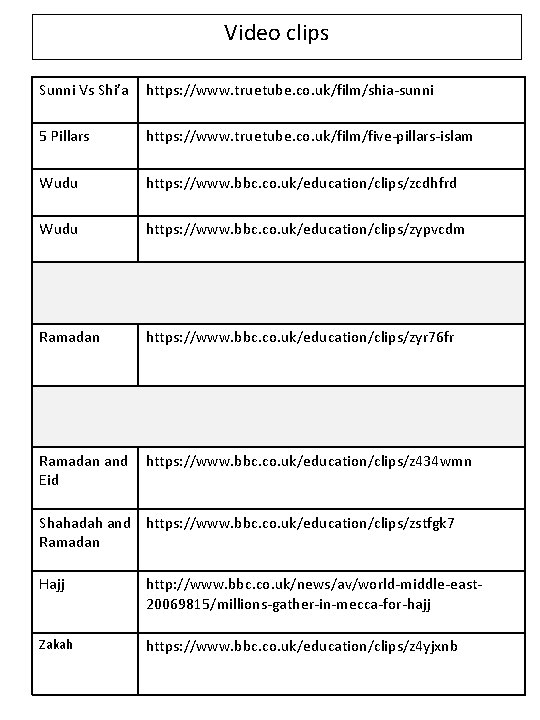
Video clips Sunni Vs Shi’a https: //www. truetube. co. uk/film/shia-sunni 5 Pillars https: //www. truetube. co. uk/film/five-pillars-islam Wudu https: //www. bbc. co. uk/education/clips/zcdhfrd Wudu https: //www. bbc. co. uk/education/clips/zypvcdm Ramadan https: //www. bbc. co. uk/education/clips/zyr 76 fr Ramadan and https: //www. bbc. co. uk/education/clips/z 434 wmn Eid Shahadah and https: //www. bbc. co. uk/education/clips/zstfgk 7 Ramadan Hajj http: //www. bbc. co. uk/news/av/world-middle-east 20069815/millions-gather-in-mecca-for-hajj Zakah https: //www. bbc. co. uk/education/clips/z 4 yjxnb

Possible questions-make a mind map for each of these: Explore the practice of salah/sawm/zakah/hajj for Muslims (what do they do? ) Explore the importance of sahadah/salah/sawm/zakah/hajj for Muslims. Explore the different types of prayer for Muslims (Make a mind pap with at least 7 points and one quote for each) Assess the view that Salah/sawm/zakah/hajj unites the Muslim community Assess the view that Jummah prayers are the most important of all prayers. Assess the view that the Shahadah/salah/sawm/zakah/hajj is the most important of the 5 pillars. Assess the view that all parts of the Hajj are equally important. Assess the view that Zakah/Salah/Sawm/Hajj is significant for Islamic practice and identity (Make a mind map including ideas, reasons for agreeing and disagreeing including relevant quotes. )
- Slides: 34