
Islam the Arab Empire Ch 3 1 p
Islam & the Arab Empire Ch 3. 1, p. 43
The Arab Empire 600 - 1400 • Begins in _________ • Muhammad, early 600 s • Followers called Muslims • By 700 s, Arabs lived from Spain and Morocco to the border of India! • Big cities: • Damascus, Baghdad, Cairo, Cordoba
• • • Ch 3. 1 Vocab Sheikh Quran Muslim Bedouin Allah Islam Hijrah Hajj Five Pillars of Islam Shari’ah Revelations Submission
Arabian Trade • Nomads traded in a harsh desert land. – Always searching for an ____ • After domestication of the ______, trade expanded further inland – Communities along trade routes began to prosper.
Arabian Peninsula • Becomes increasingly important because of trade demand • Tensions begin to arise… • Wealthy merchants start to show little concern for lower income groups. • Early Arabs were _______ • BUT with a supreme god called ____ • Allah’s Black Stone was/is placed in a sacred central shrine in Makkah
Life of Muhammad • Born in _______ – Orphaned at age 5 • Troubled by gap btwn rich and poor – TO THE HILLS! • Meditates and receives revelations from God – Nobody believes him in home town • Road trip
Muhammad’s Road Trip • Discouraged by persecution of his followers and Mecca’s rejection of his message • Leaves for Madinah in 622 with only his closest followers (<30 ppl) • ______ became year 1 of the official Islam calendar • Still used today • Returns to Mecca in 630 with…. 10, 000 followers • _____ support
Islam cometh… • Modern Islam is ______ – Allah = God • _____ is considered a prophet • The Quran is the sacred book of Islam
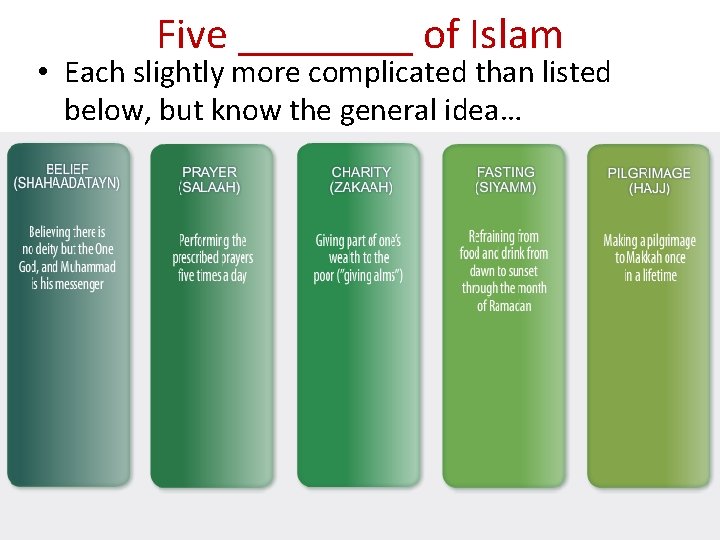
Five ____ of Islam • Each slightly more complicated than listed below, but know the general idea…
Shari’ah (law) • Islamic law • Based on Quran and Sunnah • Unlike other religions, Islam openly regulates business ___________________
Islamic Law • Stresses the need to obey will of Allah and practice Five Pillars – _____________________ • Islam is considered a way of life, not just a religion • Shari’ah (law) applies the Quran to everyday life – Regulates all aspects of life, no separation of civil or political law
Popular World Religions • Islam, Christianity and Judaism are all monotheistic • ______ believe that Allah revealed himself through Moses and Jesus but that Allah’s final revelations came through _______. – Muhammad is not “divine” to Muslims, just a prophet • BUT Christians believe Jesus to be divine. • Moses is a key prophet in all three faiths, but is critically important in Judaism.
Ch 3. 1 Discussion & Review • What is the code of Islamic law which also regulates everyday life? – __________ • According to Islamic teaching, Muhammad received revelations from communication with whom? – __________ • List the Five Pillars of Islam. – _____________________
Hot Sauce • What is the significance of Shari’ah in the lives of Muslims? ______________________ • Why did communities on the Arabian Peninsula prosper economically? ______________________ • What was the significance of Gabriel’s messages to Muhammad according to Islamic teachings? ______________________
The Arab Empire & Caliphates Ch 3. 2, p. 50
Ch 3. 2 Vocab • • Caliph Jihad Shia Sunni Vizier Sultan Caliphate
Succession Post-Muhammad • No estate planner. – Lots of assassinations b/c no clear line of succesion • _______ – 632 -634: subdued internal conflict, expanded land • Umar – 634 -644: Islamic calendar, expansion cont’d. , allowed ppl to keep personal faiths • Uthman and then Ali – Both couldn’t control unrest, madness ensues.
Abu Bakr • Muhammad’s father-in-law • And chief advisor • Chose as political and religious successor in 632 • Unites Muslim world despite revolts • Conquests into ________________ • Ruled the empire from Madinah • Also dies with __________!
And then…. the ______ • Hereditary _______ – Mu’awiya, an Arab general founded line in 661 • Capital moved to Damascus • Continued expansions – Entire coast of North Africa and Most of Spain, and parts of Asia! • BUT setbacks ensued… – The Byzantines and Franks defeated the Arabs in 717 and 732, halting inroads in Europe
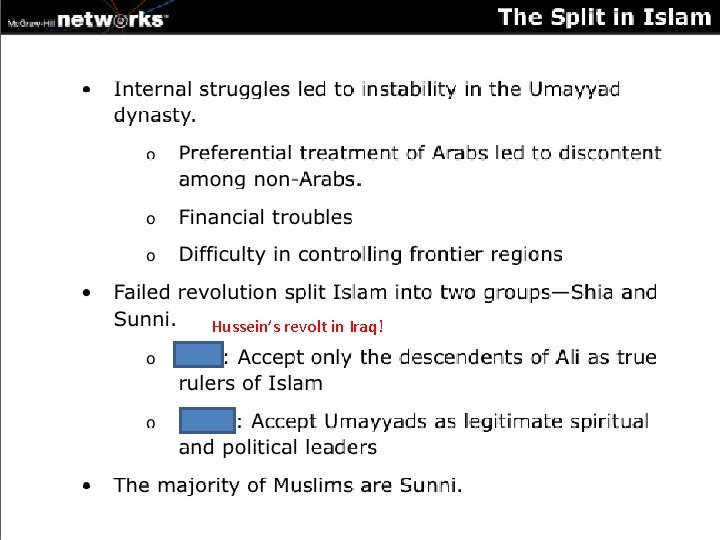
Hussein’s revolt in Iraq!
Abbasid Dynasty and Seljuk Turks • In 750, Abu al-’abbas (descendant of Muhammad’s uncle) overthrew the Umayyads – ______ dynasty is born – Capital moved to Baghdad
Abbasid Dynasty • Influenced by Persians and other foreign culture – Shift of focus from _________________________________ – Lots of trade and tolerance of foreign ideas • Art and literature flourish – More complex bureaucracy
Abbasid Cont’d. • Decline and Division – Financial corruption – Fighting over succession • Shortage of qualified ‘Arabs’ so Persians and Turks start to ________ – Over time this leads to division in the Muslim Empire
Seljuk Turks Originally ______ ppl from central Asia Served in the Abbasid Army Converted to Islam Slowly took over eastern provinces of Abbasid domain • IN 1055 a Seljuk Turk became the political leader (sultan) of the empire • • – While the Abbasid caliph remained head of religion
Ch 3. 2 Discussion & Review • What Abbasid caliphate ruled during the a golden age? – ______________________ • When Muhammad passed away, Abu-Bakr took control. What was their relationship? – ______________________ • The _____ were a pastoral ppl in Northern African who were conquered/converted to Islam. – ________
Extra Goodies • What is the significance of Abu Bakr being named Caliph? ______________________ • Why was there tension over who should rule the empire after the death of Muhammad? ______________________ • What changes did the Abbasid rulers bring to the world of Islam? ______________________
Islamic Civilizations Ch 3. 3, p. 55
Ch 2. 3 Vocab • • • Bazaar Dowry Astrolabe Arabesques Minaret Muezzin
Prosperity in Islamic World • Thriving Trade – Extensive trade network, Africa to India to China • Cities – ____________ • Awesome palaces, _____, public buildings and ______
Trade • Arab Empire traded like crazy –Think ______ –Influence of Islam increased as well • Development of ______ –______ used
Islamic Society • Social Structure – equal to Allah, but not everyone else… – __________________: Inferior, usually served as soldiers or domestic servants. • Slaves could purchase or be granted freedom – ________ • Equal per Quran, but Men decided otherwise… – Arranged marriages by guardians
Social Structure, Cont’d. • Upper Class – Ruling families – Nomadic elites – Senior officials – _____ merchants
Social Structure, Cont’d. • Non-Muslims/Slaves – Most came from Africa and Asia – Sometimes capture in war – Many served in army or as domestic servants – Islamic law says that slaves must be treated _____ AND that it was a “good act” to free them.
Social Structure, Cont’d. • Women – Quran says that women have spiritual and social ______ with men. • Right to own and inherit property shared btwn both – BUT over time Islamic ideas were eroded by older customs, ____________ • Every woman has a male guardian • Some kept from contact w/ males • Body covering = mandatory
Philosophy, Science and History • Contributions to Planet Earth – Preservation of ancient knowledge • Especially good when the Library at Alexandria burned – Math: invented ____, adopted numerals from India – Astronomy – Medicine: _________ – History! • Historian, Ibn-Khaldun, adopted ___________________
Literature, Art and Architecture • Spiritual glory is key • Literary works – Rubaiyat by Omar Khayyam (poetry) • Visual – Islamic art included Arab, Turkish and Persian traditions. _________important, instead of human portrayals. • Mosques & Palaces – Samarra
Ch 3. 3 Discussion & Review • T/F: Slavery was widespread in the Islamic world. – ________ • What was a mathematical discipline invented by the Arabs? – _________ • How far did Arab trade routes extend? – ___________
MOAR! (sic) • Why was the bazaar an important part of a Muslim city or town? ____________________ • What were the major contributions of Islamic scholars? ____________________ • What factors allowed both urban and rural areas to flourish after the eighth century within the Arab empire? ____________________
- Slides: 38