
Islam Muslim Empire Unit 8 The Arabian Peninsula

Islam & Muslim Empire Unit 8
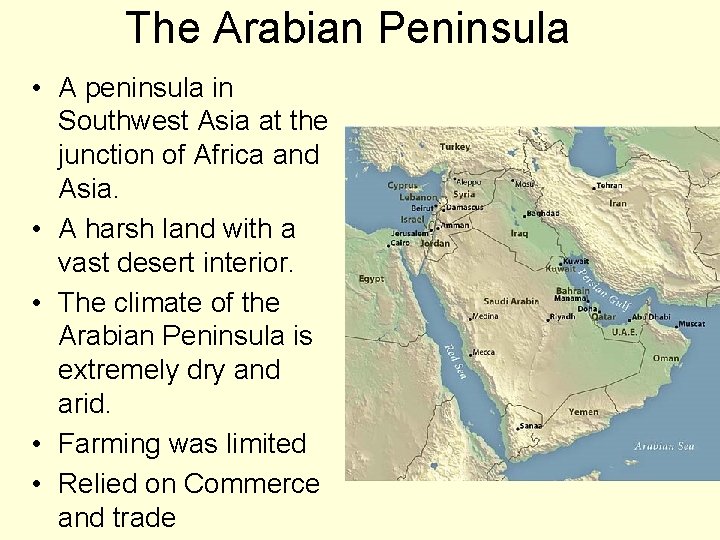
The Arabian Peninsula • A peninsula in Southwest Asia at the junction of Africa and Asia. • A harsh land with a vast desert interior. • The climate of the Arabian Peninsula is extremely dry and arid. • Farming was limited • Relied on Commerce and trade
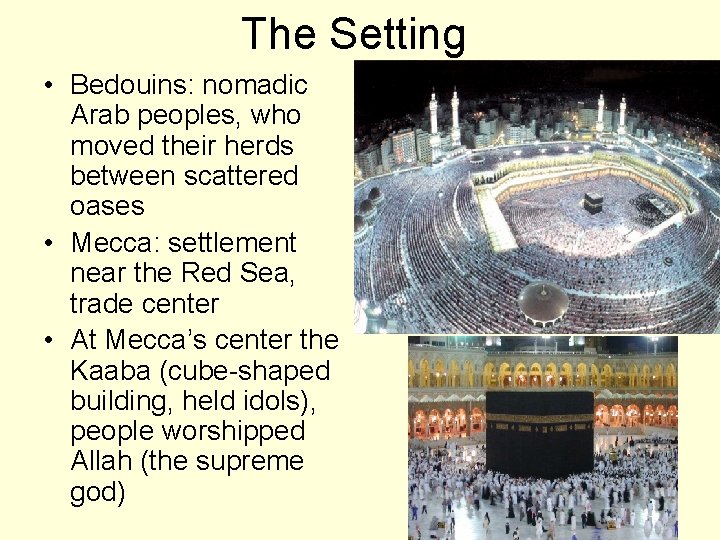
The Setting • Bedouins: nomadic Arab peoples, who moved their herds between scattered oases • Mecca: settlement near the Red Sea, trade center • At Mecca’s center the Kaaba (cube-shaped building, held idols), people worshipped Allah (the supreme god)

Muhammad’s Early Life • Muhammad: a boy who was raised by his uncle • Career: successful merchant, fair and intelligent • Life: married a widow, had six children and one survived • 610: on a retreat, an angel who commanded him to speak messages or revelations from Allah, concluded that God had chosen him to be His prophet
Muhammad the Messenger The Revelations: • Messages: – Allah was the one and only true and all-powerful God – instructions about how people should live if they hoped to please Allah and live in paradise after death Sharing the Revelations • Medina/Yathrib: city where Muhammad moved to, “the Prophet’s City” • Hegira: journey from Mecca to Medina, first year of the Islamic calendar • Islam: faith of Muhammad and followers, “achieving peace through submission to God” • Muslims: followers of Islam • Mecca: Muhammad and followers gained control of city and the western part of the Arabian Peninsula
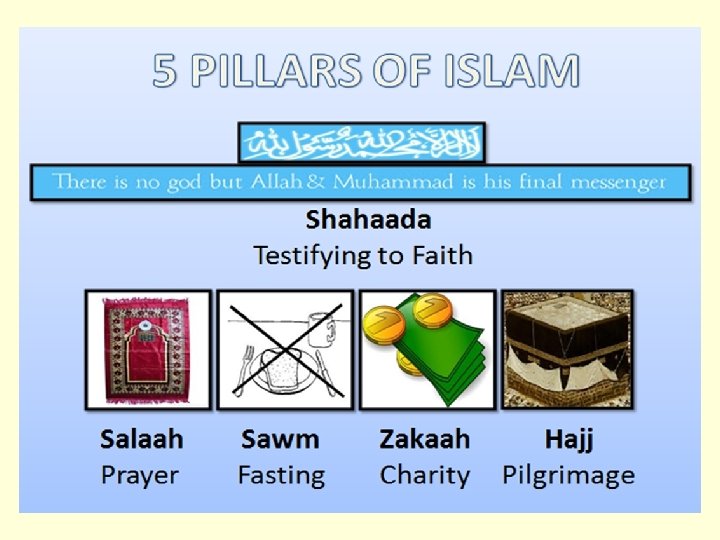
The Five Pillars • Qur’an: sacred text of Islam, direct revelations from Allah The Five Pillars of Islam • Five basic acts of worship, central to Islam • 1: profession of faith: Every Muslim must believe that there is only one God and that Mohammed is his messenger and the prophet. Although Christians and Jews worship the same God, only Islam reveres Mohammed. • 2: daily prayer, face Mecca (5 times a day) • 3: giving alms (charity) • 4: fast during Ramadan: from daybreak to sunset each day during the month of Ramadan. This means they do not eat or drink anything during those hours. • 5: take a hajj or pilgrimage to Mecca • Mosque: a place of worship
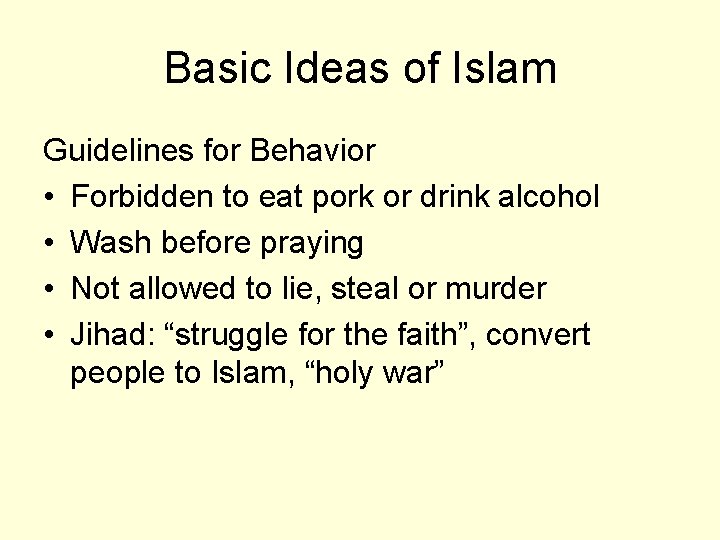
Basic Ideas of Islam Guidelines for Behavior • Forbidden to eat pork or drink alcohol • Wash before praying • Not allowed to lie, steal or murder • Jihad: “struggle for the faith”, convert people to Islam, “holy war”
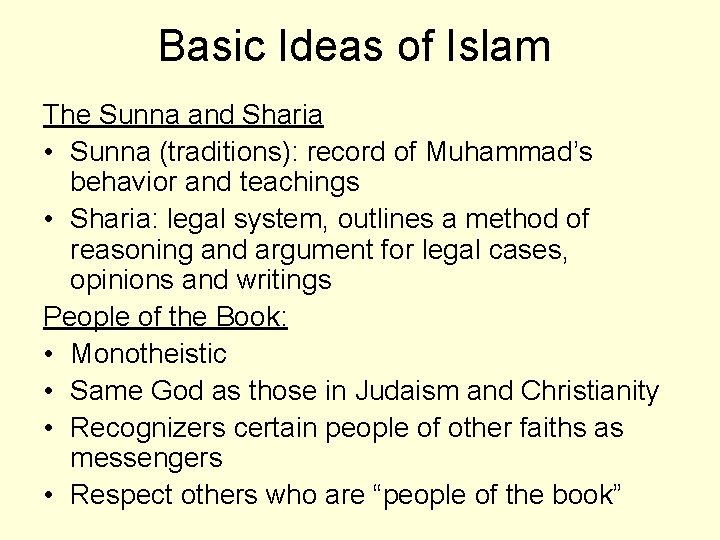
Basic Ideas of Islam The Sunna and Sharia • Sunna (traditions): record of Muhammad’s behavior and teachings • Sharia: legal system, outlines a method of reasoning and argument for legal cases, opinions and writings People of the Book: • Monotheistic • Same God as those in Judaism and Christianity • Recognizers certain people of other faiths as messengers • Respect others who are “people of the book”
Muslim Society • Culture: affected all parts of life Slaves • Slaves were to be treated fairly • Freeing slaves was a religious act The Economy • Built on trade/commerce • Middlemen: connected supplies in the East to markets in the West • Expanded the use of coinage, standardized weights and measures, used credit
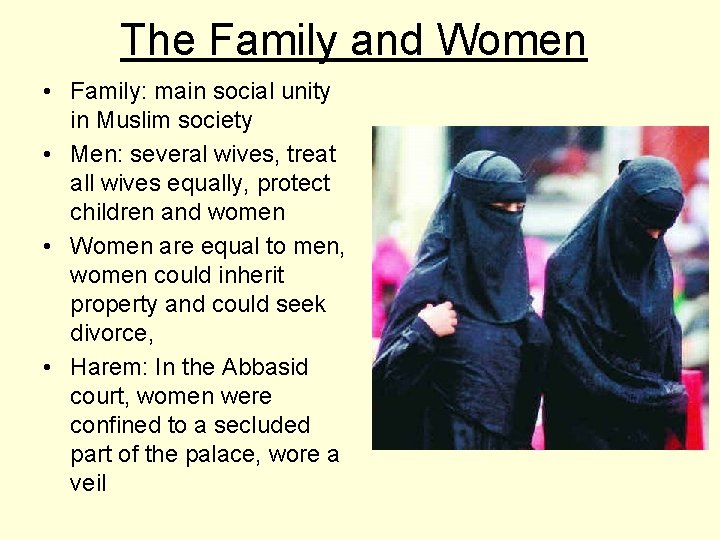
The Family and Women • Family: main social unity in Muslim society • Men: several wives, treat all wives equally, protect children and women • Women are equal to men, women could inherit property and could seek divorce, • Harem: In the Abbasid court, women were confined to a secluded part of the palace, wore a veil
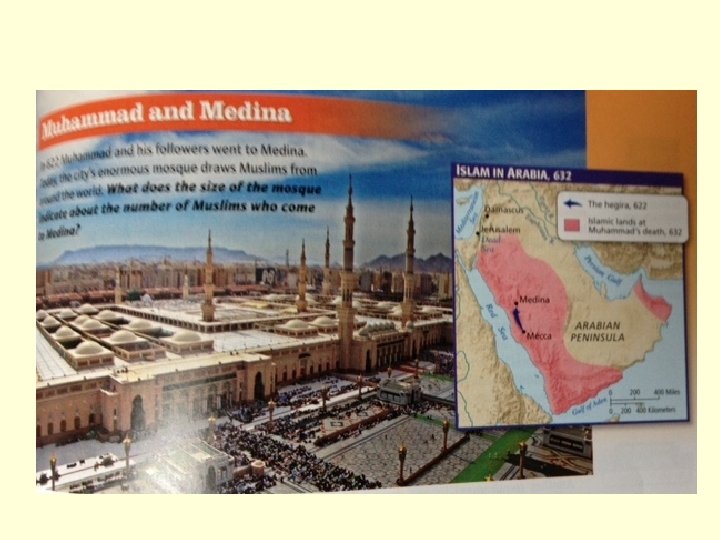
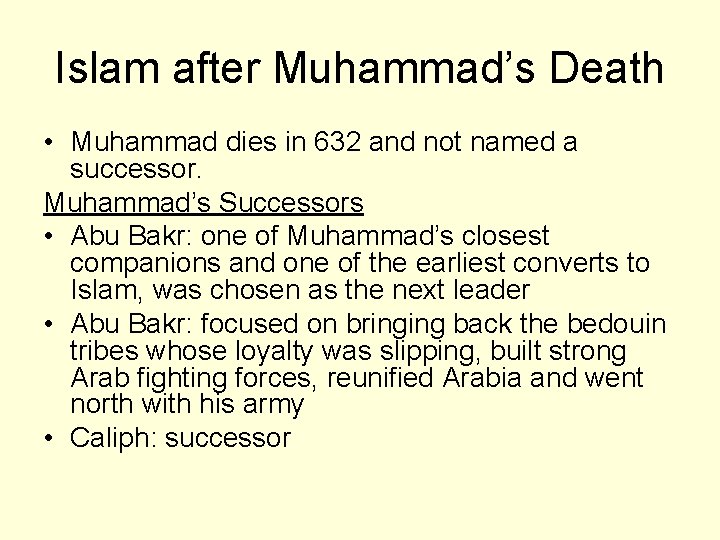
Islam after Muhammad’s Death • Muhammad dies in 632 and not named a successor. Muhammad’s Successors • Abu Bakr: one of Muhammad’s closest companions and one of the earliest converts to Islam, was chosen as the next leader • Abu Bakr: focused on bringing back the bedouin tribes whose loyalty was slipping, built strong Arab fighting forces, reunified Arabia and went north with his army • Caliph: successor
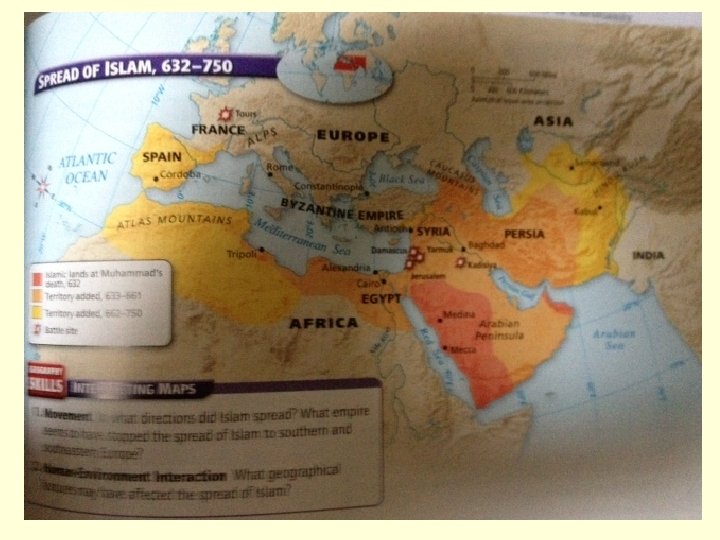
Expansion of Territory • Abu Bakr and Umar (successor): Muslim ruled expanded • 637: Muslim forces defeated Persian forces in Iraq • 642: victory over Persian Empire • Byzantine Empire: eastern half of the old Roman Empire, lost Damascus, Syria and Jerusalem • 639: the Byzantine province of Egypt fell • 642: Nile Valley came under Arab rule • 642: created an empire • 661: caliphate (area ruled by a caliph) stretched from northern Africa to Persia
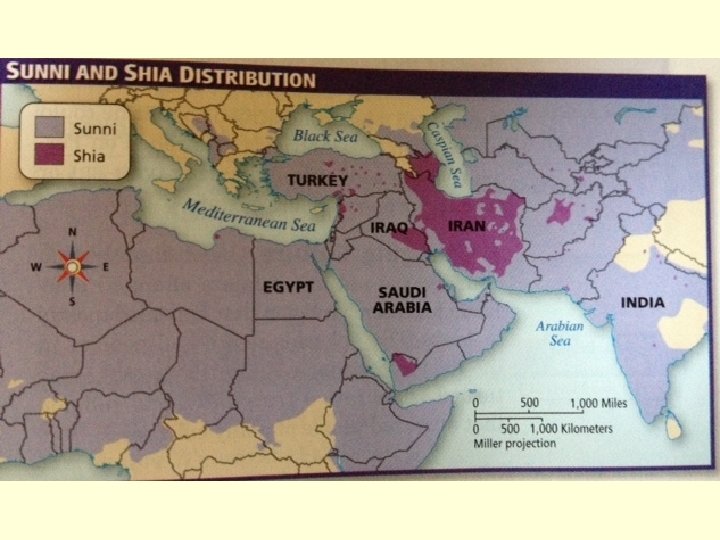
Internal Conflict and Division • Tension: between Abu Bakr and Ali • 644: Ali was not chosen, Uthman was chosen • Umayyad: clan of Mecca, enemies of Muhammad, unpopular, killed Uthman • Ali: finally became caliph, but civil war broke out, Ali was killed and the Umayyads retook control • Sunnis (followers of the Sunna or way of the Prophet) didn’t like the Ummayyad • Shia: (party of Ali), God had specially blessed Ali’s descendants because they were Muhammad’s true heirs, imam (leader) only one who can interprut the Qur’an • 680: Yazid (Mu’awiya’s son and successor) and Husayn (grandson of Muhammad) met in battle (martyrdom of Husayn) where Husayn was killed and Yazid’s forces were victorious • Sufis: another group of Muslims, seek a mystical, personal connection with God
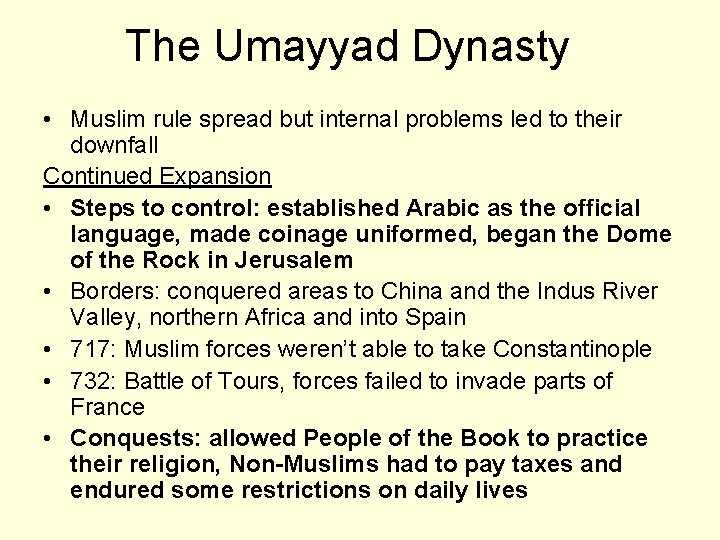
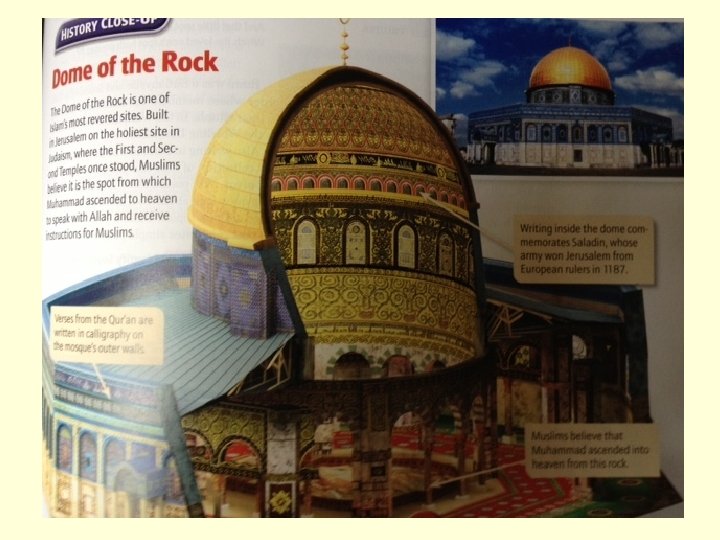
The Umayyad Dynasty • Muslim rule spread but internal problems led to their downfall Continued Expansion • Steps to control: established Arabic as the official language, made coinage uniformed, began the Dome of the Rock in Jerusalem • Borders: conquered areas to China and the Indus River Valley, northern Africa and into Spain • 717: Muslim forces weren’t able to take Constantinople • 732: Battle of Tours, forces failed to invade parts of France • Conquests: allowed People of the Book to practice their religion, Non-Muslims had to pay taxes and endured some restrictions on daily lives
The Umayyad Dynasty Ruling the Empire • Arab Muslims: ruling class with power and privilege and led to conflict of equality • Wars: causing Muslims to become unhappy with political ambitions End of the Umayyads • Abbasids: family that seized control, restore to pure Islamic values • 740 s: Abbasids wiped out the Umayyad family and began the Abbasid Dynasty
The Abbasid Dynasty • Relocated the capital to Baghdad and lived in splendor Persian Influence • Ended the Arab domination of the Muslim world • Abbasids: adopted a Persian style of government, cut themselves off from the people, throne room had a screen, vizier (deputy) oversaw affairs of state
The Abbasid Dynasty A Changing of Culture • Abbasids: invited all people to join the faith • Islam: became a universal religion, especially through trade • Harun al-Rashid: most prominent Abbasid caliph, brought Muslim culture to great heights during his reign

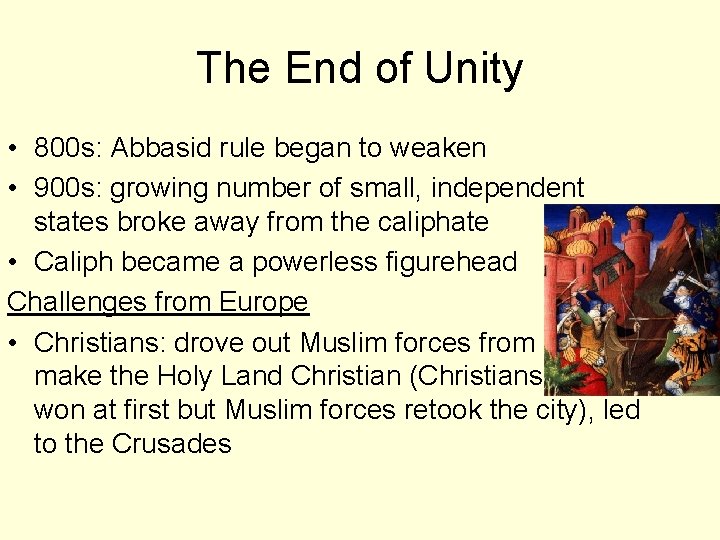
The End of Unity • 800 s: Abbasid rule began to weaken • 900 s: growing number of small, independent states broke away from the caliphate • Caliph became a powerless figurehead Challenges from Europe • Christians: drove out Muslim forces from Europe, make the Holy Land Christian (Christians forces won at first but Muslim forces retook the city), led to the Crusades
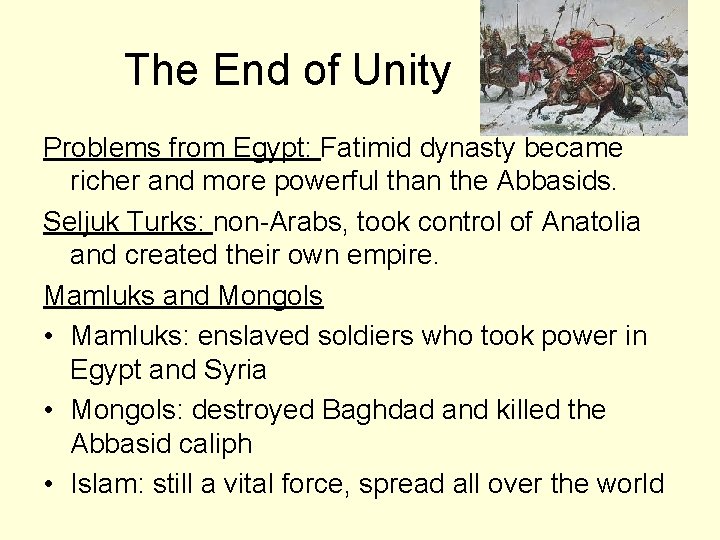
The End of Unity Problems from Egypt: Fatimid dynasty became richer and more powerful than the Abbasids. Seljuk Turks: non-Arabs, took control of Anatolia and created their own empire. Mamluks and Mongols • Mamluks: enslaved soldiers who took power in Egypt and Syria • Mongols: destroyed Baghdad and killed the Abbasid caliph • Islam: still a vital force, spread all over the world
Muslim Scholarship A Culture of Learning • Reasons: Islam commanded its followers to examine their world and seek evidence of Allah in its wonders, vastness of caliphate and the cultures within the caliphate • Contributions: translation of Greek into Arabic, Arabic translations into Latin
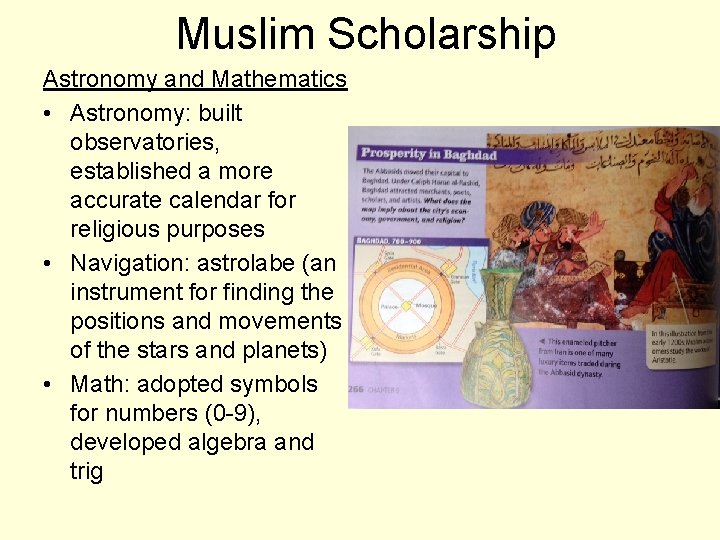
Muslim Scholarship Astronomy and Mathematics • Astronomy: built observatories, established a more accurate calendar for religious purposes • Navigation: astrolabe (an instrument for finding the positions and movements of the stars and planets) • Math: adopted symbols for numbers (0 -9), developed algebra and trig
Muslim Scholarship Medicine • Doctors had to pass tests before they could practice • First school of pharmacy • Ibn Sina: famous for advancements Other Fields of Study • Geography: wrote travel guides • History: Ibn Khaldun wrote a history of the world
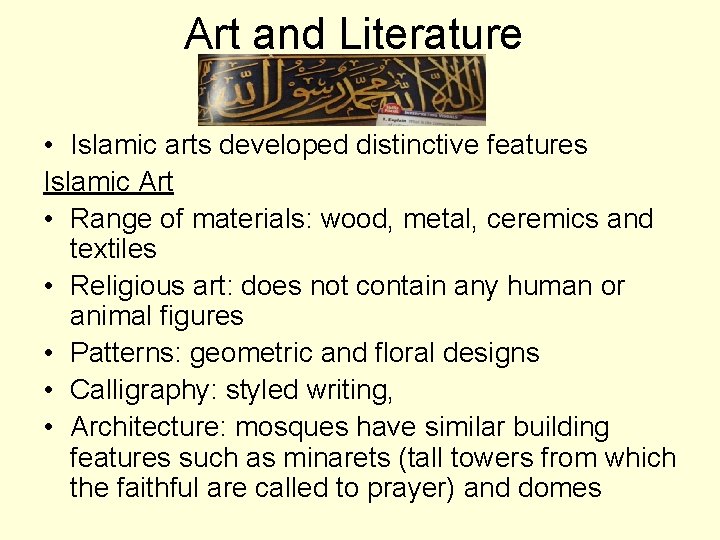
Art and Literature • Islamic arts developed distinctive features Islamic Art • Range of materials: wood, metal, ceremics and textiles • Religious art: does not contain any human or animal figures • Patterns: geometric and floral designs • Calligraphy: styled writing, • Architecture: mosques have similar building features such as minarets (tall towers from which the faithful are called to prayer) and domes
Art and Architecture Literature • Qur’an most important piece of literature! • Other: Arabian Nights, poetry (Rumi and Omar Khayyam)
- Slides: 30