
ISF 1101 Foundation of Islamic Finance TOPIC 4










- Slides: 56
ISF 1101 Foundation of Islamic Finance TOPIC 4. HISTORY AND DEVELOPMENT OF ISLAMIC BANKING AND FINANCE AROUND THE WORLD
TOPIC CONTENT 1. 2. 3. 4. 5. Business and Financial Activities during the Time of the Prophet Early establishment of Islamic Banking and Finance: 1950 -1970 s Commercialization of IBF: 1980 s-1990 s Rapid Growth of IBF: 2000 and beyond Development of IBF: Country-specific Experience
1. Business and Financial Activities during the Time of the Prophet
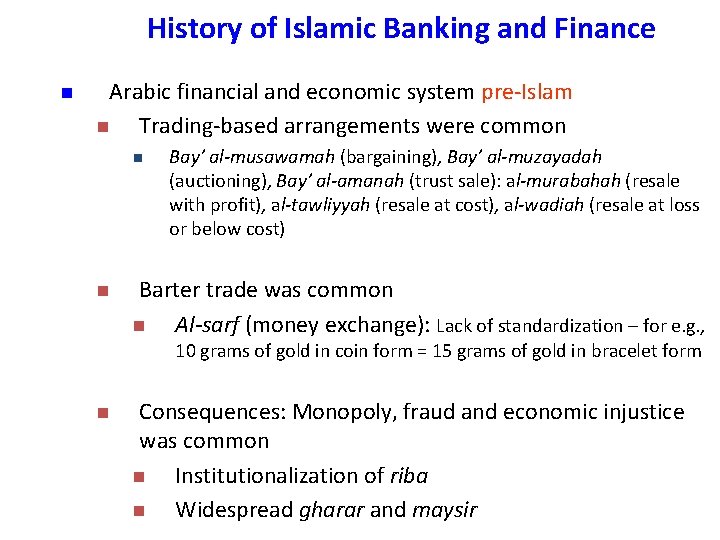
History of Islamic Banking and Finance n Arabic financial and economic system pre-Islam n Trading-based arrangements were common n n Bay’ al-musawamah (bargaining), Bay’ al-muzayadah (auctioning), Bay’ al-amanah (trust sale): al-murabahah (resale with profit), al-tawliyyah (resale at cost), al-wadiah (resale at loss or below cost) Barter trade was common n Al-sarf (money exchange): Lack of standardization – for e. g. , 10 grams of gold in coin form = 15 grams of gold in bracelet form n Consequences: Monopoly, fraud and economic injustice was common n Institutionalization of riba n Widespread gharar and maysir
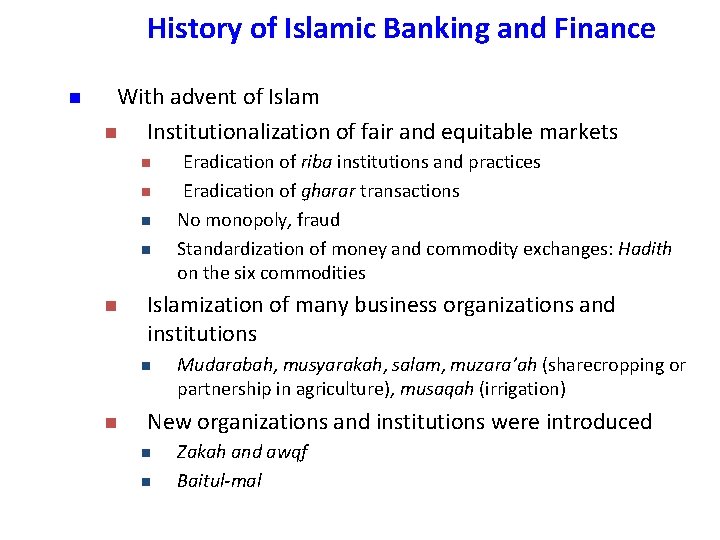
History of Islamic Banking and Finance n With advent of Islam n Institutionalization of fair and equitable markets n n n Islamization of many business organizations and institutions n n Eradication of riba institutions and practices Eradication of gharar transactions No monopoly, fraud Standardization of money and commodity exchanges: Hadith on the six commodities Mudarabah, musyarakah, salam, muzara’ah (sharecropping or partnership in agriculture), musaqah (irrigation) New organizations and institutions were introduced n n Zakah and awqf Baitul-mal
2. Early Establishment of Islamic Banking and Finance: 19501970 s
History of Islamic Banking and Finance n IBF is relatively new compared to conventional banking and finance n 1963 - Earliest Islamic financial institution can be traced to a savings institution based on profit sharing in Mit Ghamr, Egypt n 1970 s - Oil boom triggered a rapid growth of Islamic financial institutions n 1975 - Establishment of first Islamic bank (Dubai Islamic Bank in UAE) and Islamic Development Bank (IDB) in Saudi Arabia n 1978 - First attempt in the West to establish Islamic banking was in Luxembourg
History of Islamic Banking and Finance The first attempt to establish IB was in the 1950’s – in the rural area of Pakistan -Pious landowners deposits their funds without interest rewards -Credit was advanced to other poorer landowners for agricultural improvements -Although there was no shortage of borrowers, for the depositors, it was a once and for all effort -Depositors took considerable interest on how the money was loaned out
History of Islamic Banking and Finance 25 th July 1963 – February 1967: Mit ghamr Islamic Savings Bank started in Egypt by El. Naggar: -Based on German saving bank -Purpose to mobilize idle savings of the majority of Muslim within the Syariah and to provide halal returns on their saving -El-Naggar was an academic himself -Managed the staff
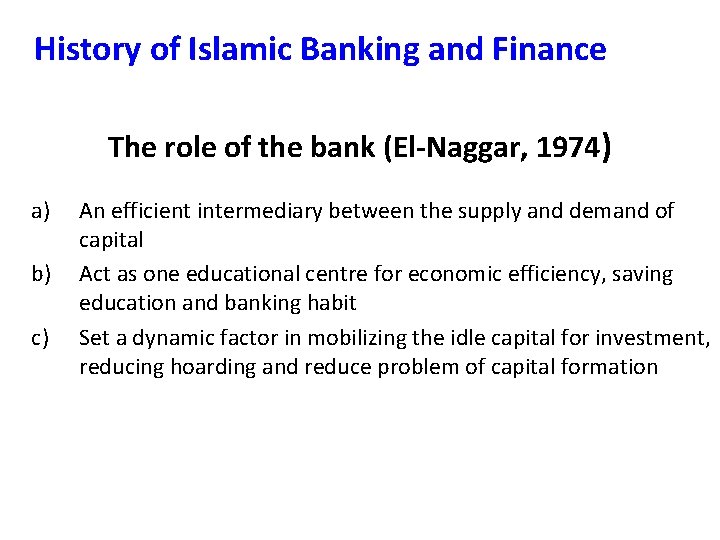
History of Islamic Banking and Finance The role of the bank (El-Naggar, 1974) a) b) c) An efficient intermediary between the supply and demand of capital Act as one educational centre for economic efficiency, saving education and banking habit Set a dynamic factor in mobilizing the idle capital for investment, reducing hoarding and reduce problem of capital formation
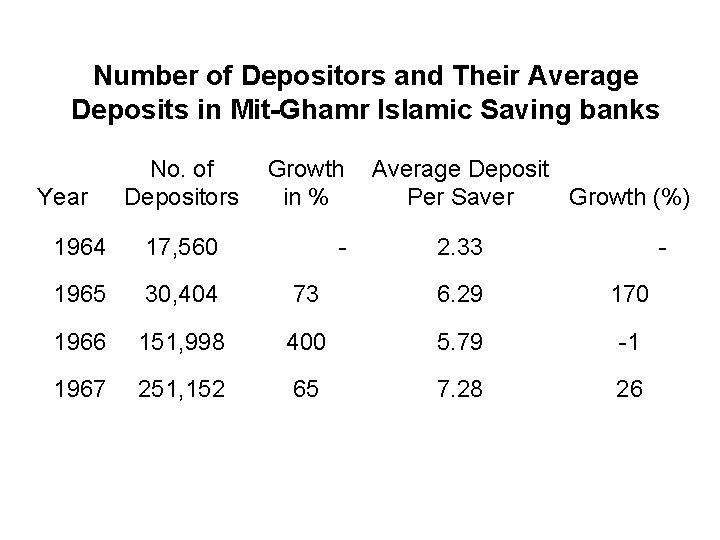
Number of Depositors and Their Average Deposits in Mit-Ghamr Islamic Saving banks Year No. of Depositors Growth in % - Average Deposit Per Saver Growth (%) 1964 17, 560 2. 33 - 1965 30, 404 73 6. 29 170 1966 151, 998 400 5. 79 -1 1967 251, 152 65 7. 28 26
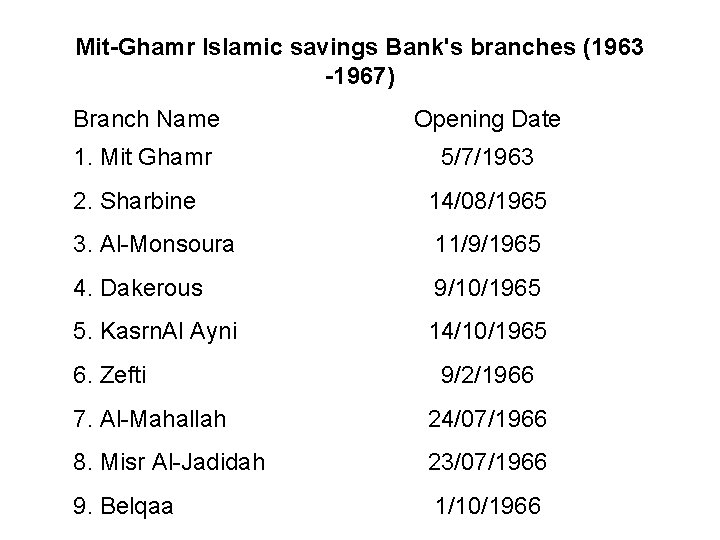
Mit-Ghamr Islamic savings Bank's branches (1963 -1967) Branch Name Opening Date 1. Mit Ghamr 5/7/1963 2. Sharbine 14/08/1965 3. Al-Monsoura 11/9/1965 4. Dakerous 9/10/1965 5. Kasrn. Al Ayni 14/10/1965 6. Zefti 9/2/1966 7. Al-Mahallah 24/07/1966 8. Misr Al-Jadidah 23/07/1966 9. Belqaa 1/10/1966
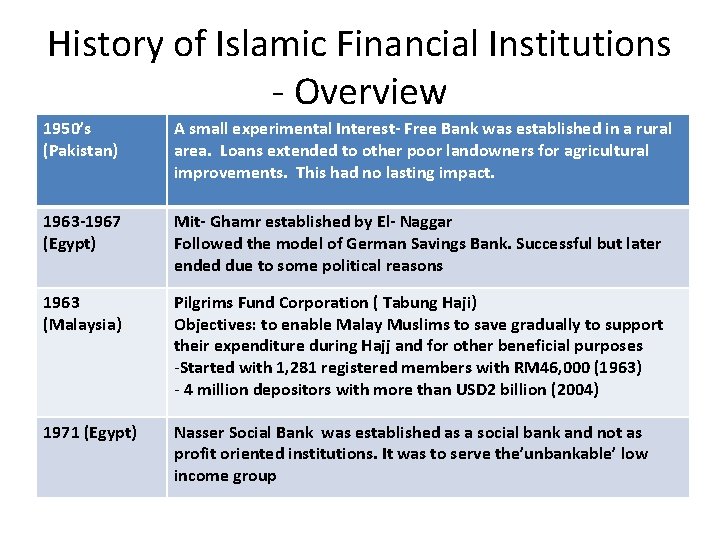
History of Islamic Financial Institutions - Overview 1950’s (Pakistan) A small experimental Interest- Free Bank was established in a rural area. Loans extended to other poor landowners for agricultural improvements. This had no lasting impact. 1963 -1967 (Egypt) Mit- Ghamr established by El- Naggar Followed the model of German Savings Bank. Successful but later ended due to some political reasons 1963 (Malaysia)) Pilgrims Fund Corporation ( Tabung Haji) Objectives: to enable Malay Muslims to save gradually to support their expenditure during Hajj and for other beneficial purposes -Started with 1, 281 registered members with RM 46, 000 (1963) - 4 million depositors with more than USD 2 billion (2004) 1971 (Egypt) Nasser Social Bank was established as a social bank and not as profit oriented institutions. It was to serve the’unbankable’ low income group
History of Islamic Financial Institutions - Overview (2) 1975 (Jeddah, KSA) IDB was established as an Inter-governmental institution to foster the economic and social development of its member countries 1975 (Dubai, UAE) Dubai Islamic Bank was established as a first major Islamic commercial bank. Started the series of IFIs. 1977 (Sudan) Faisal Islamic Bank of Sudan was established. 1977 ( Egypt) Faisal Islamic Bank of Egypt was also established. 1978 (Jeddah, KSA) Centre for Research in IE in KAU was established. The first institution specilalizing in IBF. 1979 (Bahrain) Bahrain Islamic Bank was established. 1983 ( Malaysia) Bank Islam Malaysia Berhad was established.
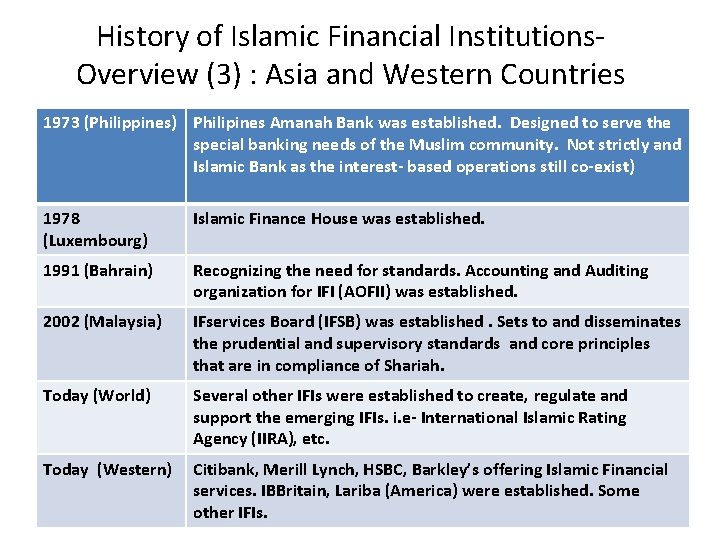
History of Islamic Financial Institutions. Overview (3) : Asia and Western Countries 1973 (Philippines) Philipines Amanah Bank was established. Designed to serve the special banking needs of the Muslim community. Not strictly and Islamic Bank as the interest- based operations still co-exist) 1978 (Luxembourg) Islamic Finance House was established. 1991 (Bahrain) Recognizing the need for standards. Accounting and Auditing organization for IFI (AOFII) was established. 2002 (Malaysia) IFservices Board (IFSB) was established. Sets to and disseminates the prudential and supervisory standards and core principles that are in compliance of Shariah. Today (World) Several other IFIs were established to create, regulate and support the emerging IFIs. i. e- International Islamic Rating Agency (IIRA), etc. Today (Western) Citibank, Merill Lynch, HSBC, Barkley’s offering Islamic Financial services. IBBritain, Lariba (America) were established. Some other IFIs.
3. Internationalization of IBF: 1980 s-1990 s
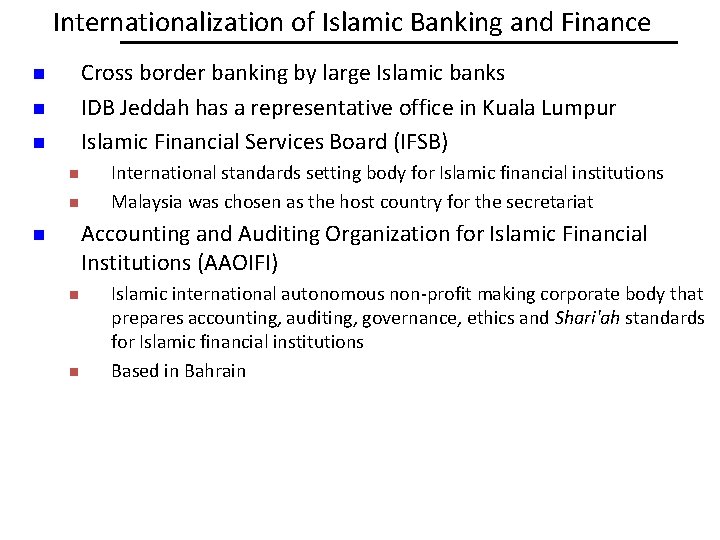
Internationalization of Islamic Banking and Finance Cross border banking by large Islamic banks IDB Jeddah has a representative office in Kuala Lumpur Islamic Financial Services Board (IFSB) n n n International standards setting body for Islamic financial institutions Malaysia was chosen as the host country for the secretariat Accounting and Auditing Organization for Islamic Financial Institutions (AAOIFI) n n n Islamic international autonomous non-profit making corporate body that prepares accounting, auditing, governance, ethics and Shari'ah standards for Islamic financial institutions Based in Bahrain
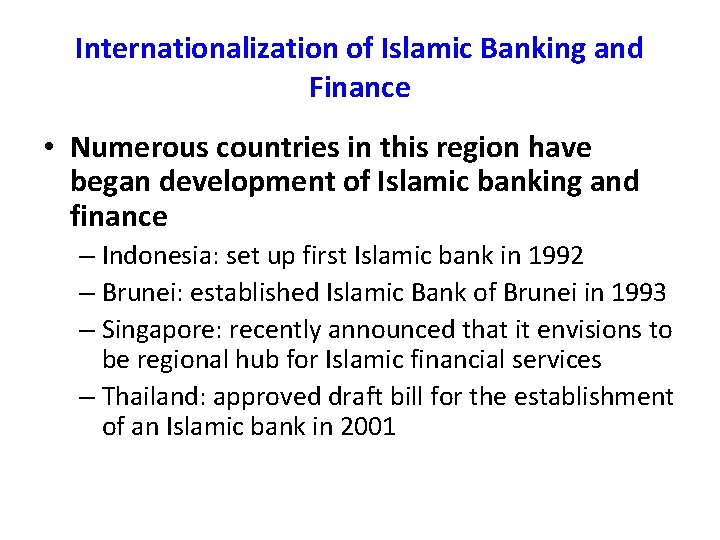
Internationalization of Islamic Banking and Finance • Numerous countries in this region have began development of Islamic banking and finance – Indonesia: set up first Islamic bank in 1992 – Brunei: established Islamic Bank of Brunei in 1993 – Singapore: recently announced that it envisions to be regional hub for Islamic financial services – Thailand: approved draft bill for the establishment of an Islamic bank in 2001
4. Rapid Growth of IBF: 2000 and beyond
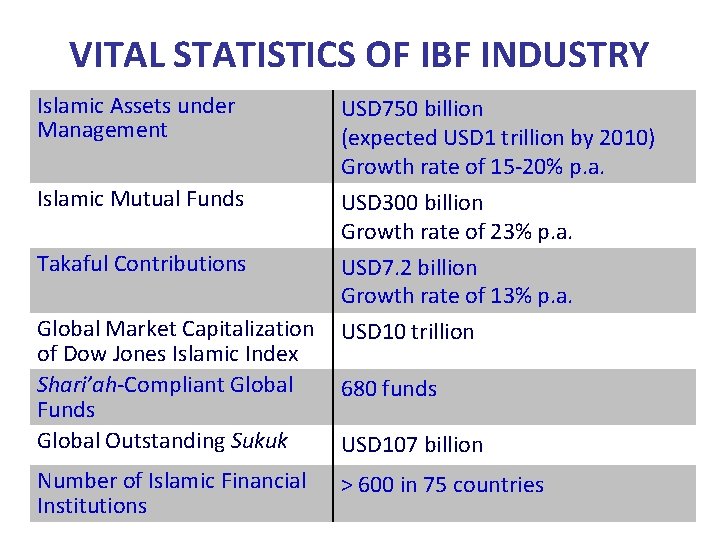
VITAL STATISTICS OF IBF INDUSTRY Islamic Assets under Management Islamic Mutual Funds Takaful Contributions Global Market Capitalization of Dow Jones Islamic Index Shari’ah-Compliant Global Funds Global Outstanding Sukuk Number of Islamic Financial Institutions USD 750 billion (expected USD 1 trillion by 2010) Growth rate of 15 -20% p. a. USD 300 billion Growth rate of 23% p. a. USD 7. 2 billion Growth rate of 13% p. a. USD 10 trillion 680 funds USD 107 billion > 600 in 75 countries 20 of 44
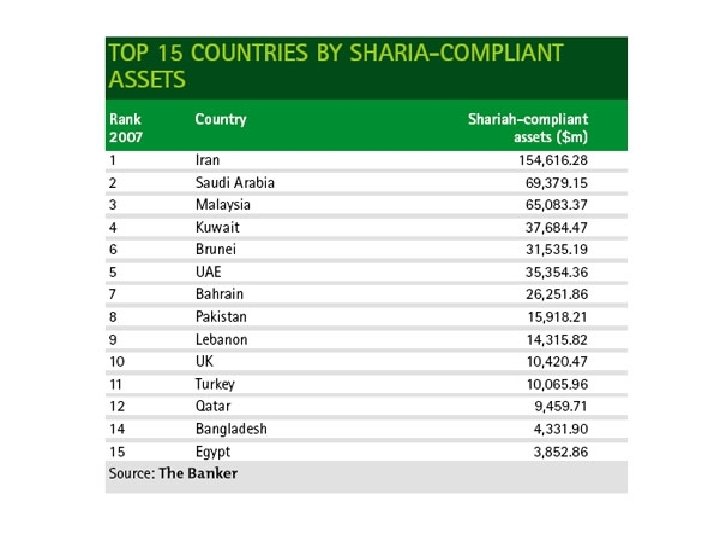
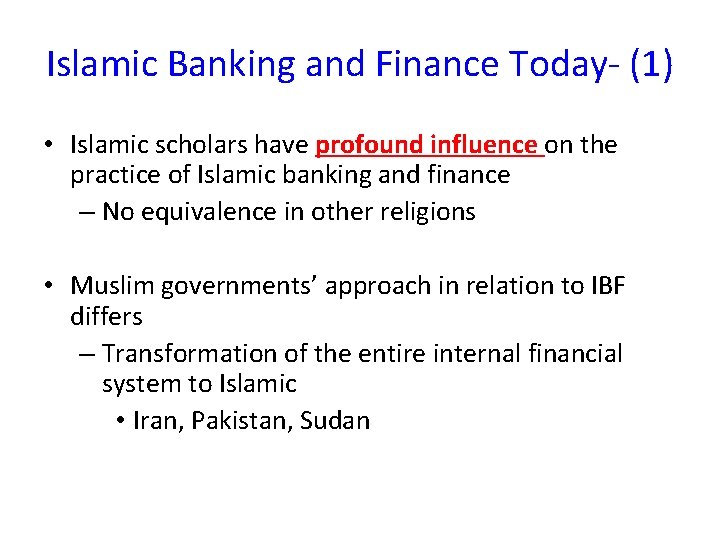
Islamic Banking and Finance Today- (1) • Islamic scholars have profound influence on the practice of Islamic banking and finance – No equivalence in other religions • Muslim governments’ approach in relation to IBF differs – Transformation of the entire internal financial system to Islamic • Iran, Pakistan, Sudan
Islamic Banking and Finance Today- (2) – Embrace Islamic banking as a national policy concurrently with conventional banking and finance (dual track banking) • Bahrain, Brunei, Indonesia, Kuwait, Malaysia, Turkey, UAE – Neither support nor oppose Islamic banking • Egypt, Yemen – Actively discourage separate Islamic banking presence • Saudi Arabia, Oman
5. Development of IBF: Case of Malaysia and other Countries
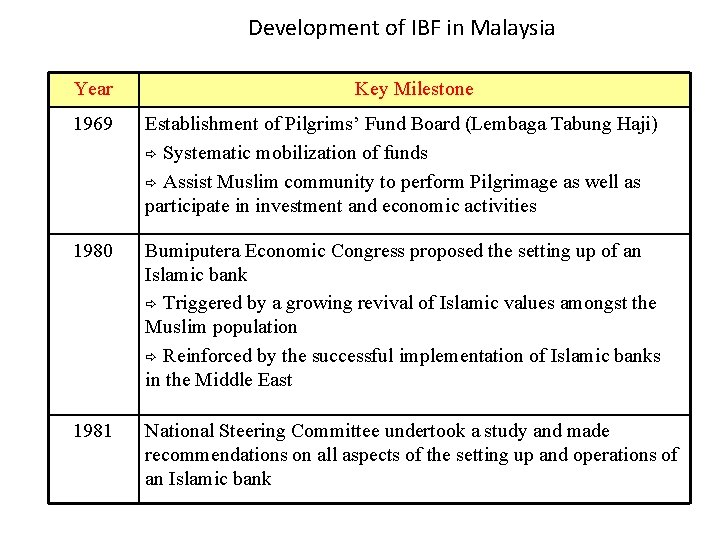
Development of IBF in Malaysia Year Key Milestone 1969 Establishment of Pilgrims’ Fund Board (Lembaga Tabung Haji) ð Systematic mobilization of funds ð Assist Muslim community to perform Pilgrimage as well as participate in investment and economic activities 1980 Bumiputera Economic Congress proposed the setting up of an Islamic bank ð Triggered by a growing revival of Islamic values amongst the Muslim population ð Reinforced by the successful implementation of Islamic banks in the Middle East 1981 National Steering Committee undertook a study and made recommendations on all aspects of the setting up and operations of an Islamic bank
Development of Islamic Banking and Finance in Malaysia (2) Year 1983 Key Milestone Enactment of the Islamic Banking Act (IBA) 1983 Bank Islam Malaysia Berhad (BIMB) was incorporated as Malaysia’s first Islamic bank ð BIMB was given a grace period of 10 years to operate without competition, to protect its growth and development ð Over the period of 1983 – 1993, BIMB achieved an average annual growth rate of 48% Enactment of the Government Investment Act (GIA) 1983 ð Enables the issuance of government papers and bonds ð Government investment certificates (GIC) initially offered on the basis of qardh hasan but subsequently changed to bay’ al-’inah 1984 Setting up of takaful companies, to complement the operations of Islamic banks 1992 BIMB was listed on KLSE
Development of Islamic Banking and Finance in Malaysia (3) Year Key Milestone 1993 The Dual Banking System was implemented, allowing Islamic and conventional banking to co-exist and run concurrently in the financial system ð Islamic Banking Scheme (IBS) introduced, which allowed conventional banks to offer Islamic banking windows 1994 ðEstablishment 1999 Bank Muamalat Malaysia Berhad, Malaysia’s second full-fledged Islamic bank, was incorporated ð Resulting from the merger between Bank Bumiputera Malaysia Berhad (BBMB) and Bank of Commerce Berhad (BOCB) of Islamic Interbank Money Market KLSE Islamic Index was introduced 2000 Establishment of Association of Islamic Banking Institutions of Malaysia (AIBIM) ð To harmonize and streamline Islamic banking practices; as platform to voice issues with the authorities Establishment of Islamic Banking and Finance Institute Malaysia (IBFIM)
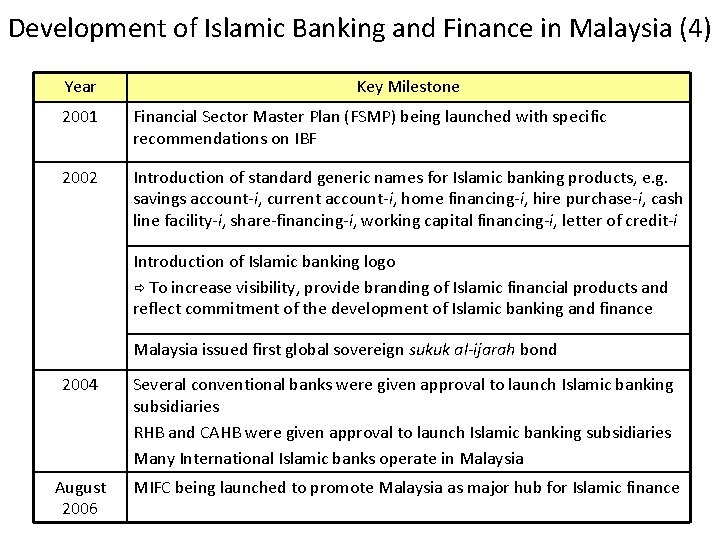
Development of Islamic Banking and Finance in Malaysia (4) Year Key Milestone 2001 Financial Sector Master Plan (FSMP) being launched with specific recommendations on IBF 2002 Introduction of standard generic names for Islamic banking products, e. g. savings account-i, current account-i, home financing-i, hire purchase-i, cash line facility-i, share-financing-i, working capital financing-i, letter of credit-i Introduction of Islamic banking logo ð To increase visibility, provide branding of Islamic financial products and reflect commitment of the development of Islamic banking and finance Malaysia issued first global sovereign sukuk al-ijarah bond 2004 Several conventional banks were given approval to launch Islamic banking subsidiaries RHB and CAHB were given approval to launch Islamic banking subsidiaries Many International Islamic banks operate in Malaysia August 2006 MIFC being launched to promote Malaysia as major hub for Islamic finance
Development of IBF in Malaysia Market liberalisation, upgrading infrastructures, strengthen overall Islamic finance landscape Advanced stage Increase number of players, develop financial markets & enhance Shariah governance Building foundation of legal, regulatory & Shariah framework Intermediate stage Inception stage Instituting foundations of Islamic finance & financial inclusion • Islamic Banking Act 1983 • Takaful Act 1984 • Government Funding Act 1983 • 1 st Islamic bank • 1 st takaful company 1983 Visioning, comprehensive & international integration Institutional building, stimulate competition, activity generation & market vibrancy 1993 • FSMP – 10 year roadmap • Islamic windows • Foreign Islamic banks • 2 nd Islamic bank • Islamic subsidiaries • 2 nd takaful company • New takaful & • Islamic money market • Shariah Advisory Council at retakaful licences • Tax neutrality policy BNM 2001 • IBFIM • SIDC • INCEIF • ISRA • BNM Act 2009 • 2010 & beyond FSMP – Financial Sector Masterplan, IBFIM - Islamic Banking and Finance Institute of Malaysia, SIDC – Securities Industry Development Corporation, INCEIF - International Centre 33 for Education in Islamic Finance, ISRA – International Shariah Research Academy for Islamic Finance
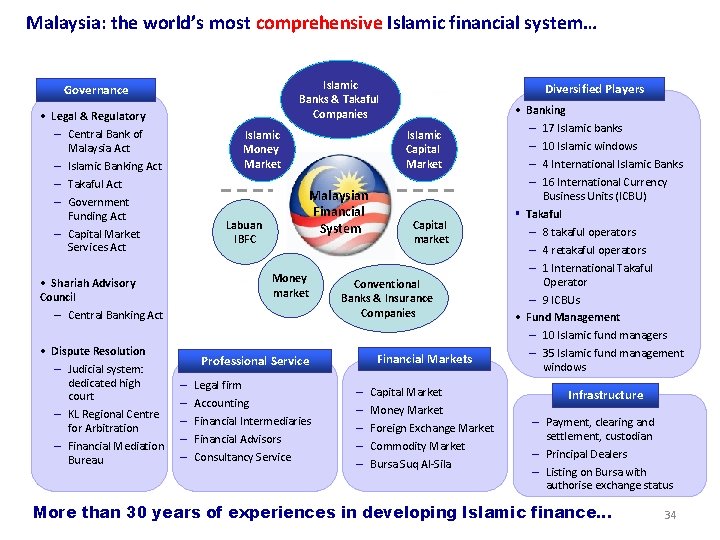
Malaysia: the world’s most comprehensive Islamic financial system… Islamic Banks & Takaful Companies Governance • Legal & Regulatory – Central Bank of Malaysia Act – Islamic Banking Act – Takaful Act – Government Funding Act – Capital Market Services Act Islamic Money Market Money market • Shariah Advisory Council – Central Banking Act • Dispute Resolution – Judicial system: dedicated high court – KL Regional Centre for Arbitration – Financial Mediation Bureau Islamic Capital Market Malaysian Financial System Labuan IBFC Legal firm Accounting Financial Intermediaries Financial Advisors Consultancy Service Capital market Conventional Banks & Insurance Companies Financial Markets Professional Service – – – Diversified Players – – – Capital Market Money Market Foreign Exchange Market Commodity Market Bursa Suq Al-Sila • Banking – 17 Islamic banks – 10 Islamic windows – 4 International Islamic Banks – 16 International Currency Business Units (ICBU) § Takaful – 8 takaful operators – 4 retakaful operators – 1 International Takaful Operator – 9 ICBUs • Fund Management – 10 Islamic fund managers – 35 Islamic fund management windows Infrastructure – Payment, clearing and settlement, custodian – Principal Dealers – Listing on Bursa with authorise exchange status More than 30 years of experiences in developing Islamic finance… 34
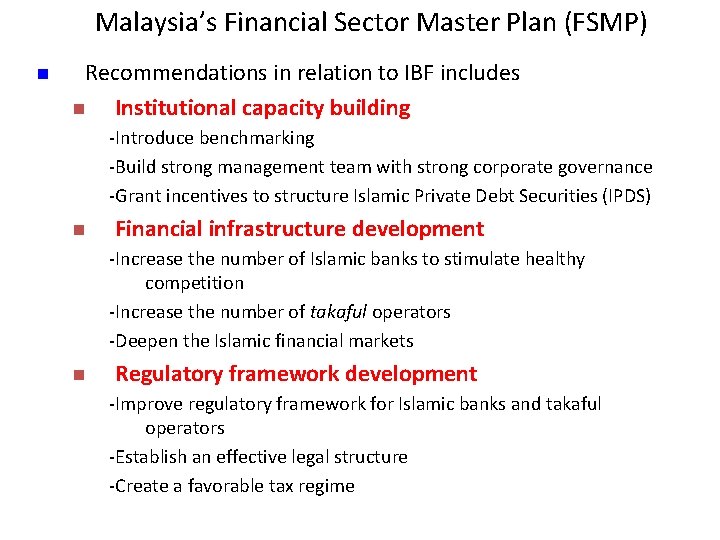
Malaysia’s Financial Sector Master Plan (FSMP) n Recommendations in relation to IBF includes n Institutional capacity building -Introduce benchmarking -Build strong management team with strong corporate governance -Grant incentives to structure Islamic Private Debt Securities (IPDS) n Financial infrastructure development -Increase the number of Islamic banks to stimulate healthy competition -Increase the number of takaful operators -Deepen the Islamic financial markets n Regulatory framework development -Improve regulatory framework for Islamic banks and takaful operators -Establish an effective legal structure -Create a favorable tax regime
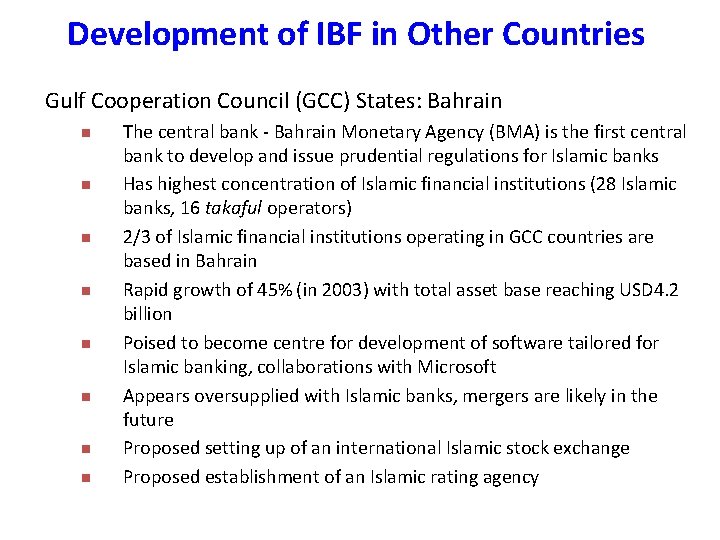
Development of IBF in Other Countries Gulf Cooperation Council (GCC) States: Bahrain n n n n The central bank - Bahrain Monetary Agency (BMA) is the first central bank to develop and issue prudential regulations for Islamic banks Has highest concentration of Islamic financial institutions (28 Islamic banks, 16 takaful operators) 2/3 of Islamic financial institutions operating in GCC countries are based in Bahrain Rapid growth of 45% (in 2003) with total asset base reaching USD 4. 2 billion Poised to become centre for development of software tailored for Islamic banking, collaborations with Microsoft Appears oversupplied with Islamic banks, mergers are likely in the future Proposed setting up of an international Islamic stock exchange Proposed establishment of an Islamic rating agency
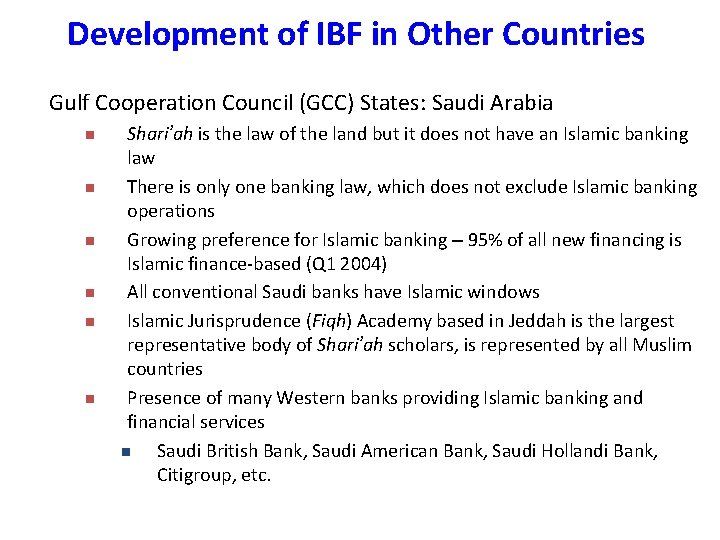
Development of IBF in Other Countries Gulf Cooperation Council (GCC) States: Saudi Arabia n n n Shari’ah is the law of the land but it does not have an Islamic banking law There is only one banking law, which does not exclude Islamic banking operations Growing preference for Islamic banking – 95% of all new financing is Islamic finance-based (Q 1 2004) All conventional Saudi banks have Islamic windows Islamic Jurisprudence (Fiqh) Academy based in Jeddah is the largest representative body of Shari’ah scholars, is represented by all Muslim countries Presence of many Western banks providing Islamic banking and financial services n Saudi British Bank, Saudi American Bank, Saudi Hollandi Bank, Citigroup, etc.
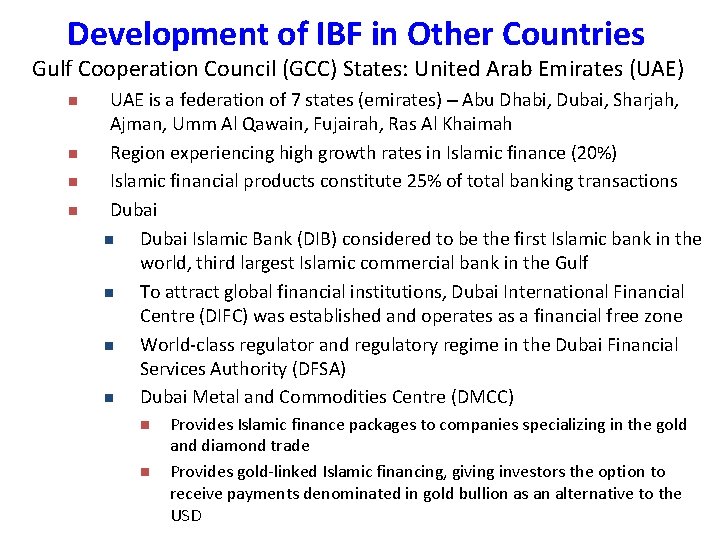
Development of IBF in Other Countries Gulf Cooperation Council (GCC) States: United Arab Emirates (UAE) n n UAE is a federation of 7 states (emirates) – Abu Dhabi, Dubai, Sharjah, Ajman, Umm Al Qawain, Fujairah, Ras Al Khaimah Region experiencing high growth rates in Islamic finance (20%) Islamic financial products constitute 25% of total banking transactions Dubai n Dubai Islamic Bank (DIB) considered to be the first Islamic bank in the world, third largest Islamic commercial bank in the Gulf n To attract global financial institutions, Dubai International Financial Centre (DIFC) was established and operates as a financial free zone n World-class regulator and regulatory regime in the Dubai Financial Services Authority (DFSA) n Dubai Metal and Commodities Centre (DMCC) n n Provides Islamic finance packages to companies specializing in the gold and diamond trade Provides gold-linked Islamic financing, giving investors the option to receive payments denominated in gold bullion as an alternative to the USD
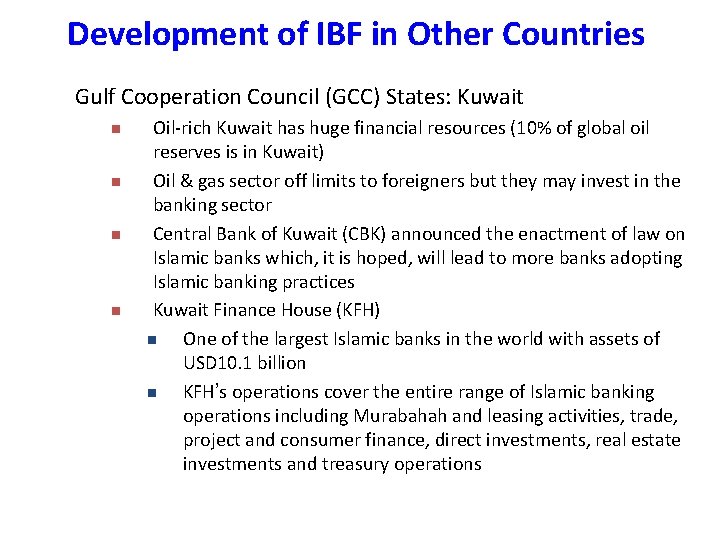
Development of IBF in Other Countries Gulf Cooperation Council (GCC) States: Kuwait n n Oil-rich Kuwait has huge financial resources (10% of global oil reserves is in Kuwait) Oil & gas sector off limits to foreigners but they may invest in the banking sector Central Bank of Kuwait (CBK) announced the enactment of law on Islamic banks which, it is hoped, will lead to more banks adopting Islamic banking practices Kuwait Finance House (KFH) n One of the largest Islamic banks in the world with assets of USD 10. 1 billion n KFH’s operations cover the entire range of Islamic banking operations including Murabahah and leasing activities, trade, project and consumer finance, direct investments, real estate investments and treasury operations
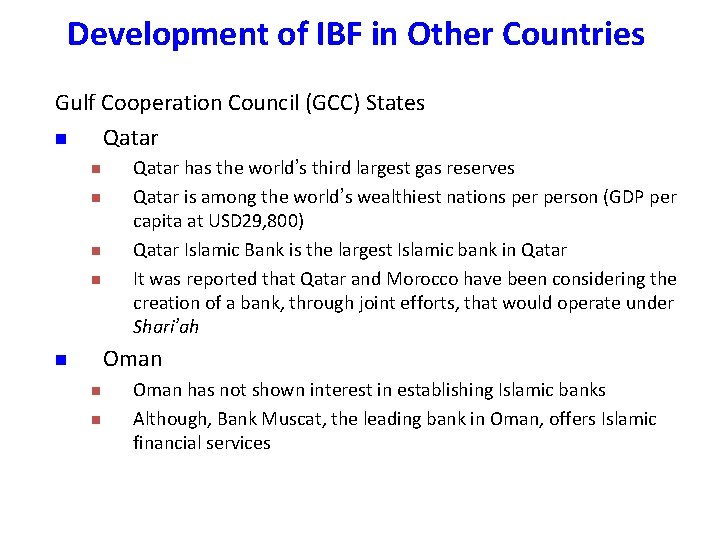
Development of IBF in Other Countries Gulf Cooperation Council (GCC) States n Qatar n n Qatar has the world’s third largest gas reserves Qatar is among the world’s wealthiest nations person (GDP per capita at USD 29, 800) Qatar Islamic Bank is the largest Islamic bank in Qatar It was reported that Qatar and Morocco have been considering the creation of a bank, through joint efforts, that would operate under Shari’ah Oman n Oman has not shown interest in establishing Islamic banks Although, Bank Muscat, the leading bank in Oman, offers Islamic financial services
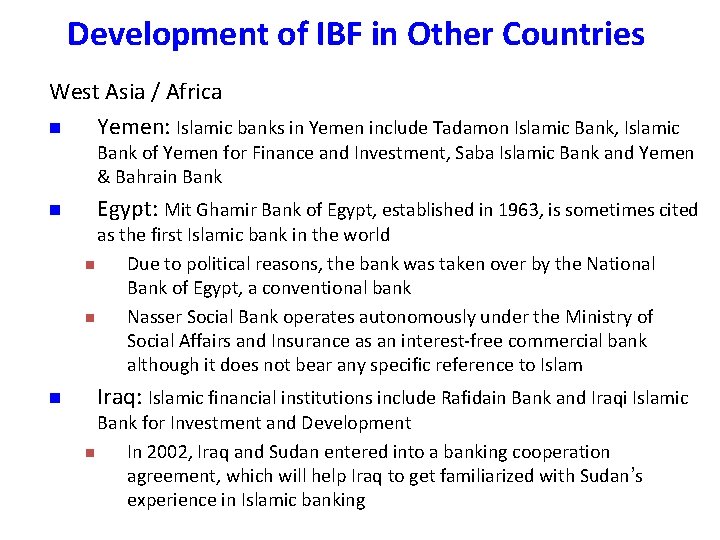
Development of IBF in Other Countries West Asia / Africa n Yemen: Islamic banks in Yemen include Tadamon Islamic Bank, Islamic Bank of Yemen for Finance and Investment, Saba Islamic Bank and Yemen & Bahrain Bank n Egypt: Mit Ghamir Bank of Egypt, established in 1963, is sometimes cited as the first Islamic bank in the world n Due to political reasons, the bank was taken over by the National Bank of Egypt, a conventional bank n Nasser Social Bank operates autonomously under the Ministry of Social Affairs and Insurance as an interest-free commercial bank although it does not bear any specific reference to Islam n Iraq: Islamic financial institutions include Rafidain Bank and Iraqi Islamic Bank for Investment and Development n In 2002, Iraq and Sudan entered into a banking cooperation agreement, which will help Iraq to get familiarized with Sudan’s experience in Islamic banking
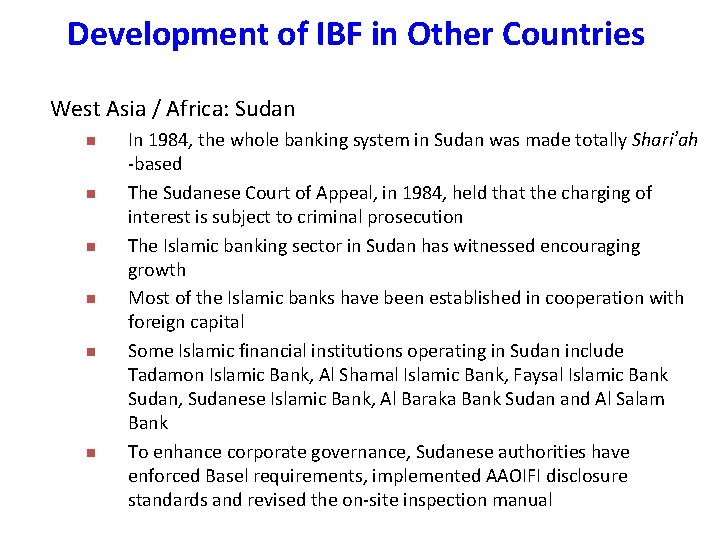
Development of IBF in Other Countries West Asia / Africa: Sudan n n n In 1984, the whole banking system in Sudan was made totally Shari’ah -based The Sudanese Court of Appeal, in 1984, held that the charging of interest is subject to criminal prosecution The Islamic banking sector in Sudan has witnessed encouraging growth Most of the Islamic banks have been established in cooperation with foreign capital Some Islamic financial institutions operating in Sudan include Tadamon Islamic Bank, Al Shamal Islamic Bank, Faysal Islamic Bank Sudan, Sudanese Islamic Bank, Al Baraka Bank Sudan and Al Salam Bank To enhance corporate governance, Sudanese authorities have enforced Basel requirements, implemented AAOIFI disclosure standards and revised the on-site inspection manual
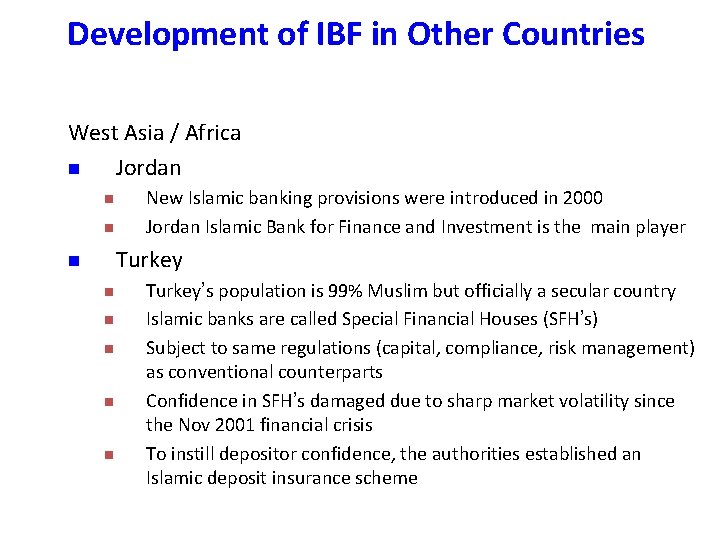
Development of IBF in Other Countries West Asia / Africa n Jordan n n New Islamic banking provisions were introduced in 2000 Jordan Islamic Bank for Finance and Investment is the main player Turkey n n n Turkey’s population is 99% Muslim but officially a secular country Islamic banks are called Special Financial Houses (SFH’s) Subject to same regulations (capital, compliance, risk management) as conventional counterparts Confidence in SFH’s damaged due to sharp market volatility since the Nov 2001 financial crisis To instill depositor confidence, the authorities established an Islamic deposit insurance scheme
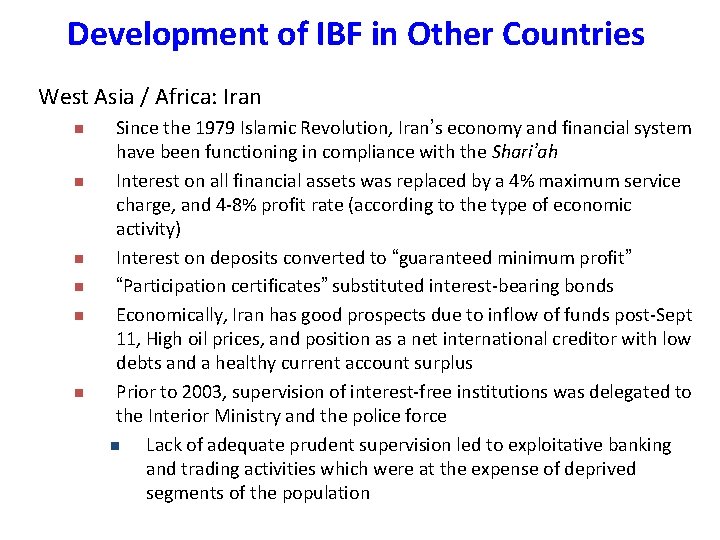
Development of IBF in Other Countries West Asia / Africa: Iran n n n Since the 1979 Islamic Revolution, Iran’s economy and financial system have been functioning in compliance with the Shari’ah Interest on all financial assets was replaced by a 4% maximum service charge, and 4 -8% profit rate (according to the type of economic activity) Interest on deposits converted to “guaranteed minimum profit” “Participation certificates” substituted interest-bearing bonds Economically, Iran has good prospects due to inflow of funds post-Sept 11, High oil prices, and position as a net international creditor with low debts and a healthy current account surplus Prior to 2003, supervision of interest-free institutions was delegated to the Interior Ministry and the police force n Lack of adequate prudent supervision led to exploitative banking and trading activities which were at the expense of deprived segments of the population
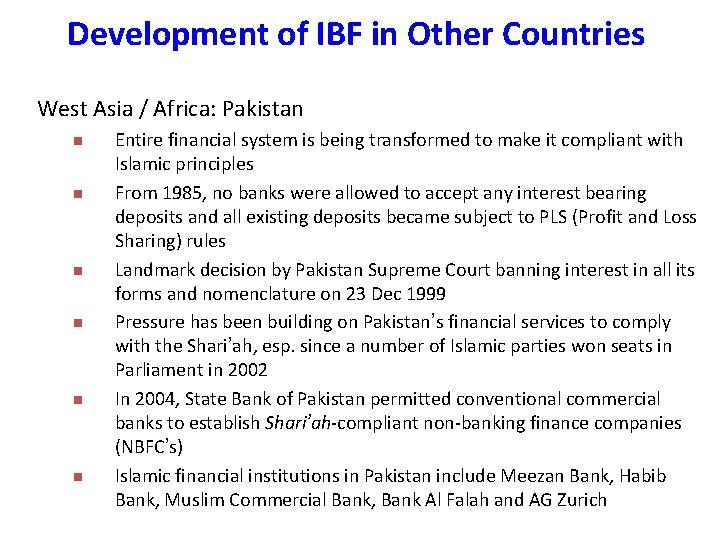
Development of IBF in Other Countries West Asia / Africa: Pakistan n n n Entire financial system is being transformed to make it compliant with Islamic principles From 1985, no banks were allowed to accept any interest bearing deposits and all existing deposits became subject to PLS (Profit and Loss Sharing) rules Landmark decision by Pakistan Supreme Court banning interest in all its forms and nomenclature on 23 Dec 1999 Pressure has been building on Pakistan’s financial services to comply with the Shari’ah, esp. since a number of Islamic parties won seats in Parliament in 2002 In 2004, State Bank of Pakistan permitted conventional commercial banks to establish Shari’ah-compliant non-banking finance companies (NBFC’s) Islamic financial institutions in Pakistan include Meezan Bank, Habib Bank, Muslim Commercial Bank, Bank Al Falah and AG Zurich
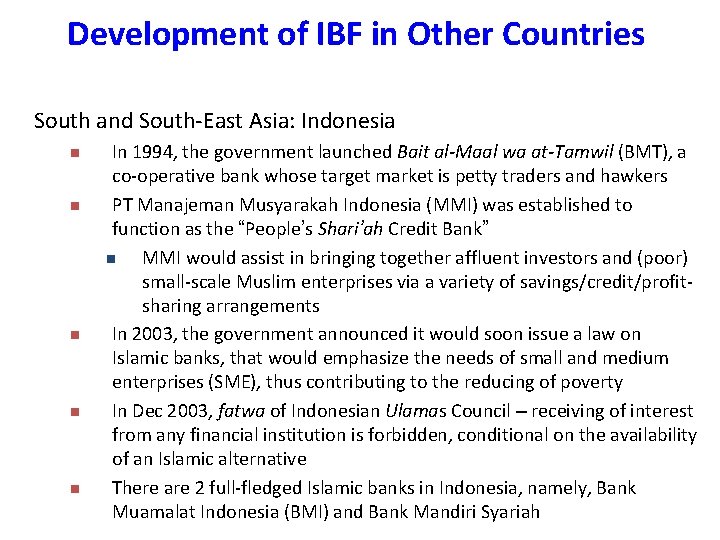
Development of IBF in Other Countries South and South-East Asia: Indonesia n n n In 1994, the government launched Bait al-Maal wa at-Tamwil (BMT), a co-operative bank whose target market is petty traders and hawkers PT Manajeman Musyarakah Indonesia (MMI) was established to function as the “People’s Shari’ah Credit Bank” n MMI would assist in bringing together affluent investors and (poor) small-scale Muslim enterprises via a variety of savings/credit/profitsharing arrangements In 2003, the government announced it would soon issue a law on Islamic banks, that would emphasize the needs of small and medium enterprises (SME), thus contributing to the reducing of poverty In Dec 2003, fatwa of Indonesian Ulamas Council – receiving of interest from any financial institution is forbidden, conditional on the availability of an Islamic alternative There are 2 full-fledged Islamic banks in Indonesia, namely, Bank Muamalat Indonesia (BMI) and Bank Mandiri Syariah
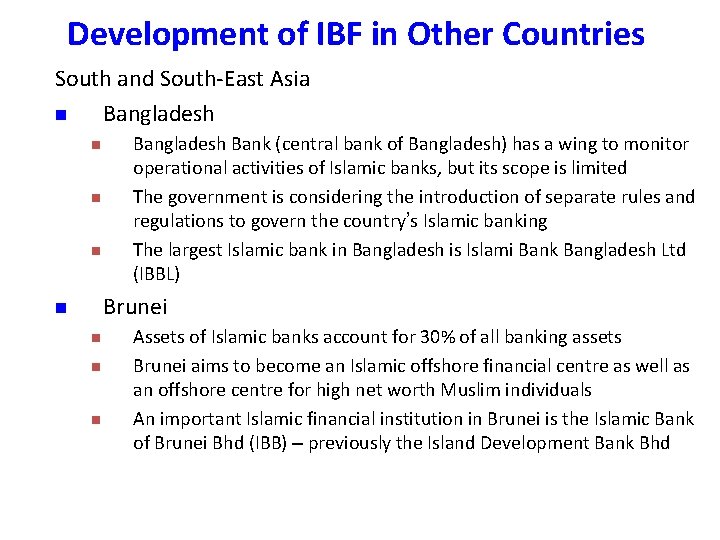
Development of IBF in Other Countries South and South-East Asia n Bangladesh n n n Bangladesh Bank (central bank of Bangladesh) has a wing to monitor operational activities of Islamic banks, but its scope is limited The government is considering the introduction of separate rules and regulations to govern the country’s Islamic banking The largest Islamic bank in Bangladesh is Islami Bank Bangladesh Ltd (IBBL) Brunei n n Assets of Islamic banks account for 30% of all banking assets Brunei aims to become an Islamic offshore financial centre as well as an offshore centre for high net worth Muslim individuals An important Islamic financial institution in Brunei is the Islamic Bank of Brunei Bhd (IBB) – previously the Island Development Bank Bhd
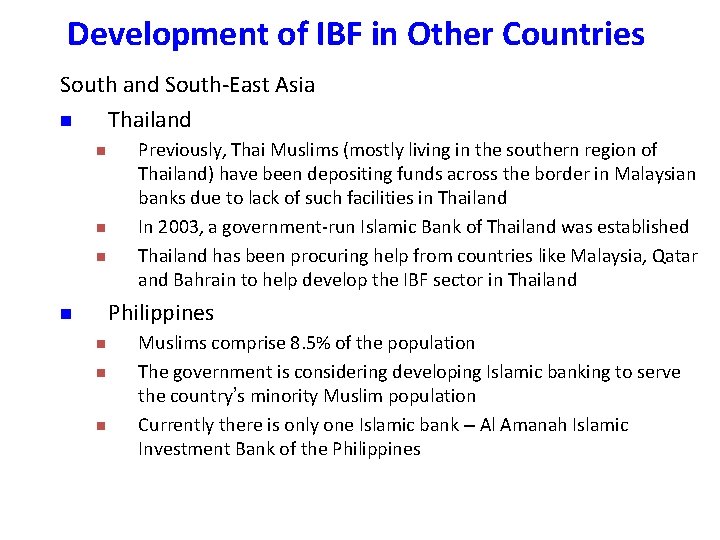
Development of IBF in Other Countries South and South-East Asia n Thailand n n n Previously, Thai Muslims (mostly living in the southern region of Thailand) have been depositing funds across the border in Malaysian banks due to lack of such facilities in Thailand In 2003, a government-run Islamic Bank of Thailand was established Thailand has been procuring help from countries like Malaysia, Qatar and Bahrain to help develop the IBF sector in Thailand Philippines n n Muslims comprise 8. 5% of the population The government is considering developing Islamic banking to serve the country’s minority Muslim population Currently there is only one Islamic bank – Al Amanah Islamic Investment Bank of the Philippines
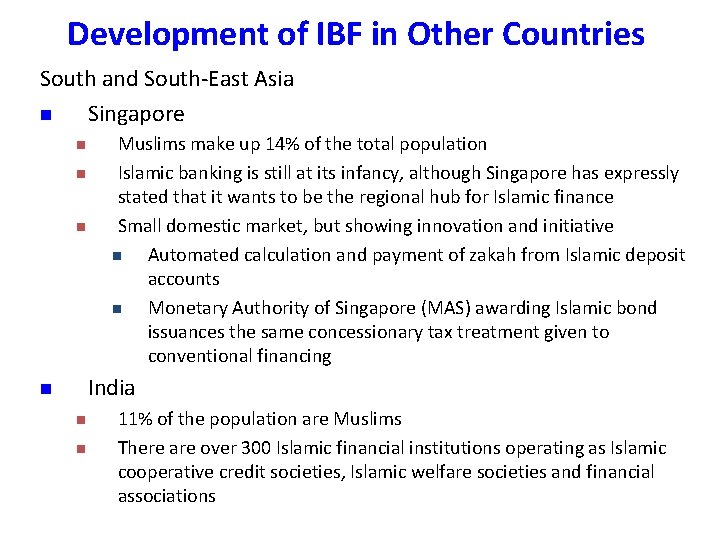
Development of IBF in Other Countries South and South-East Asia n Singapore n n n Muslims make up 14% of the total population Islamic banking is still at its infancy, although Singapore has expressly stated that it wants to be the regional hub for Islamic finance Small domestic market, but showing innovation and initiative n Automated calculation and payment of zakah from Islamic deposit accounts n Monetary Authority of Singapore (MAS) awarding Islamic bond issuances the same concessionary tax treatment given to conventional financing India n n n 11% of the population are Muslims There are over 300 Islamic financial institutions operating as Islamic cooperative credit societies, Islamic welfare societies and financial associations
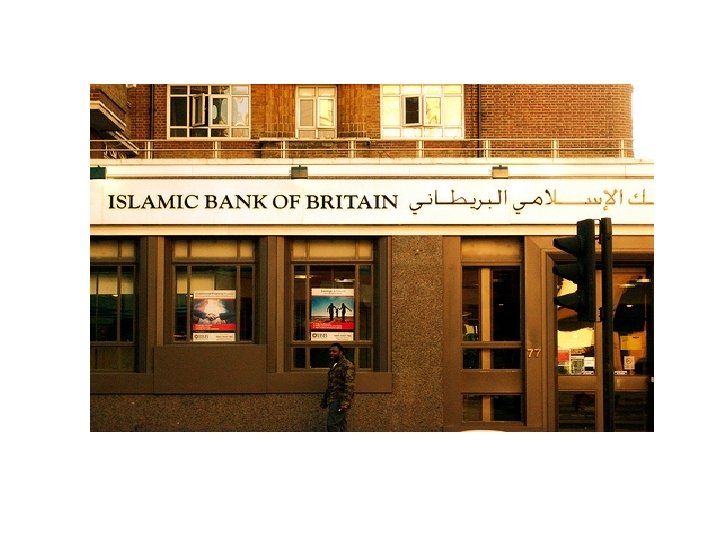
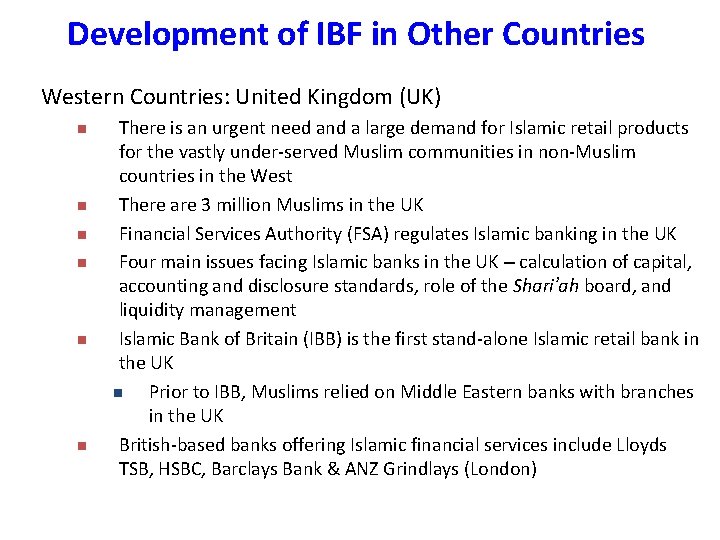
Development of IBF in Other Countries Western Countries: United Kingdom (UK) n n n There is an urgent need and a large demand for Islamic retail products for the vastly under-served Muslim communities in non-Muslim countries in the West There are 3 million Muslims in the UK Financial Services Authority (FSA) regulates Islamic banking in the UK Four main issues facing Islamic banks in the UK – calculation of capital, accounting and disclosure standards, role of the Shari’ah board, and liquidity management Islamic Bank of Britain (IBB) is the first stand-alone Islamic retail bank in the UK n Prior to IBB, Muslims relied on Middle Eastern banks with branches in the UK British-based banks offering Islamic financial services include Lloyds TSB, HSBC, Barclays Bank & ANZ Grindlays (London)
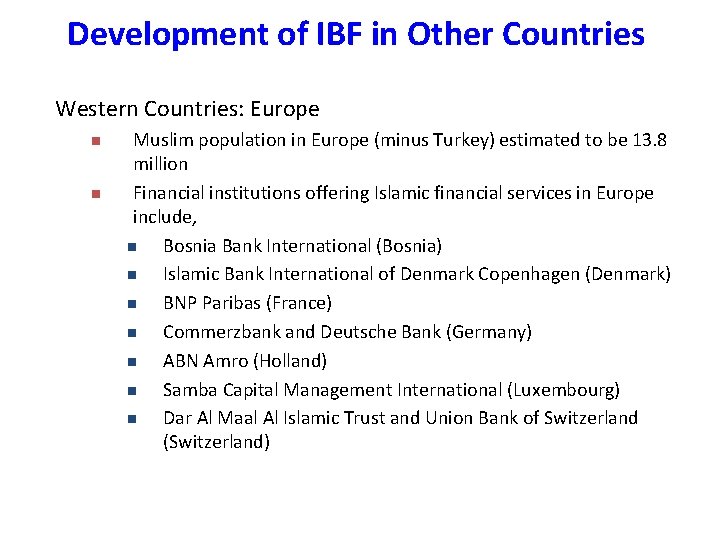
Development of IBF in Other Countries Western Countries: Europe n n Muslim population in Europe (minus Turkey) estimated to be 13. 8 million Financial institutions offering Islamic financial services in Europe include, n Bosnia Bank International (Bosnia) n Islamic Bank International of Denmark Copenhagen (Denmark) n BNP Paribas (France) n Commerzbank and Deutsche Bank (Germany) n ABN Amro (Holland) n Samba Capital Management International (Luxembourg) n Dar Al Maal Al Islamic Trust and Union Bank of Switzerland (Switzerland)
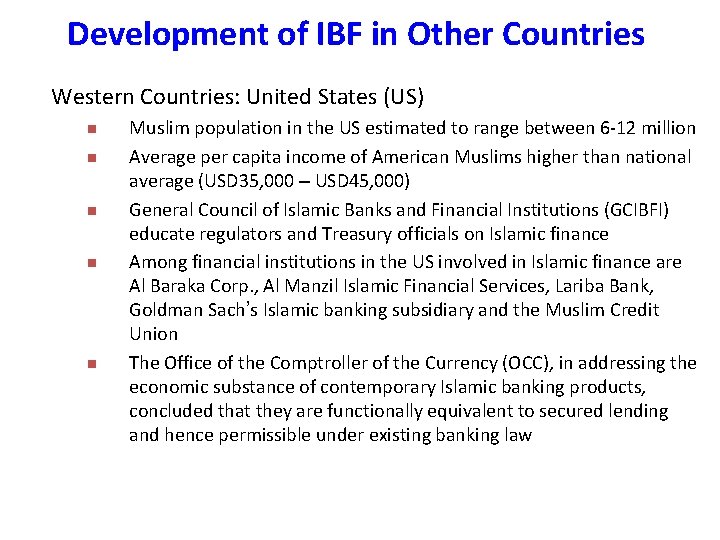
Development of IBF in Other Countries Western Countries: United States (US) n n n Muslim population in the US estimated to range between 6 -12 million Average per capita income of American Muslims higher than national average (USD 35, 000 – USD 45, 000) General Council of Islamic Banks and Financial Institutions (GCIBFI) educate regulators and Treasury officials on Islamic finance Among financial institutions in the US involved in Islamic finance are Al Baraka Corp. , Al Manzil Islamic Financial Services, Lariba Bank, Goldman Sach’s Islamic banking subsidiary and the Muslim Credit Union The Office of the Comptroller of the Currency (OCC), in addressing the economic substance of contemporary Islamic banking products, concluded that they are functionally equivalent to secured lending and hence permissible under existing banking law
Islamic Banks in Malaysia • • BNM List of Licensed Banking Institutions in Malaysia: Senarai Institusi Perbankan Berlesen di Malaysia Local vs Foreign
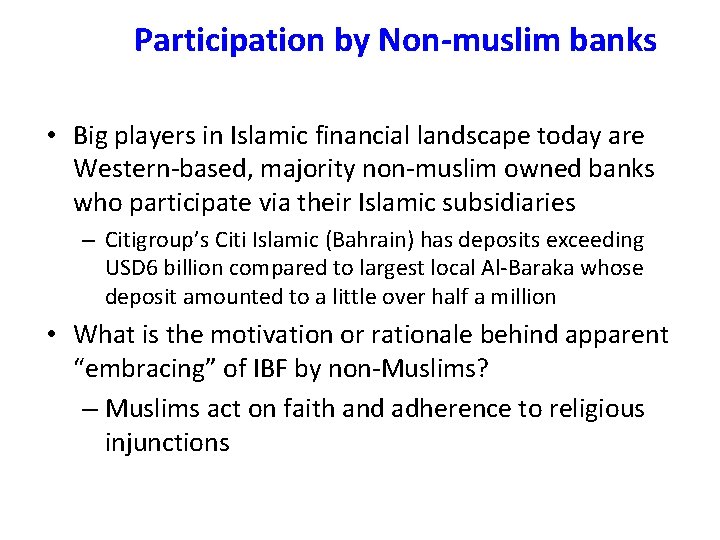
Participation by Non-muslim banks • Big players in Islamic financial landscape today are Western-based, majority non-muslim owned banks who participate via their Islamic subsidiaries – Citigroup’s Citi Islamic (Bahrain) has deposits exceeding USD 6 billion compared to largest local Al-Baraka whose deposit amounted to a little over half a million • What is the motivation or rationale behind apparent “embracing” of IBF by non-Muslims? – Muslims act on faith and adherence to religious injunctions
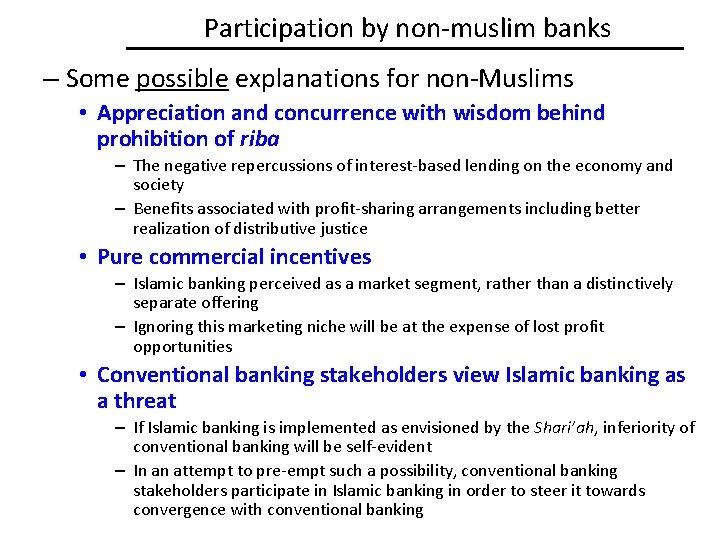
Participation by non-muslim banks – Some possible explanations for non-Muslims • Appreciation and concurrence with wisdom behind prohibition of riba – The negative repercussions of interest-based lending on the economy and society – Benefits associated with profit-sharing arrangements including better realization of distributive justice • Pure commercial incentives – Islamic banking perceived as a market segment, rather than a distinctively separate offering – Ignoring this marketing niche will be at the expense of lost profit opportunities • Conventional banking stakeholders view Islamic banking as a threat – If Islamic banking is implemented as envisioned by the Shari’ah, inferiority of conventional banking will be self-evident – In an attempt to pre-empt such a possibility, conventional banking stakeholders participate in Islamic banking in order to steer it towards convergence with conventional banking
Student Assignment Work in a group and provide the latest update of IBF in a country of your choice. Write a 5 -page report and present in class.