
ISDN Integrated Services Digital Network 2 BD Basic
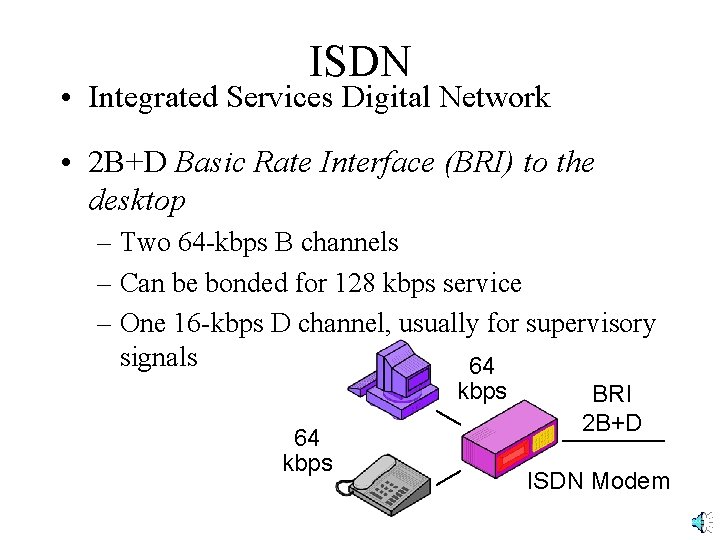
ISDN • Integrated Services Digital Network • 2 B+D Basic Rate Interface (BRI) to the desktop – Two 64 -kbps B channels – Can be bonded for 128 kbps service – One 16 -kbps D channel, usually for supervisory signals 64 kbps BRI 2 B+D ISDN Modem
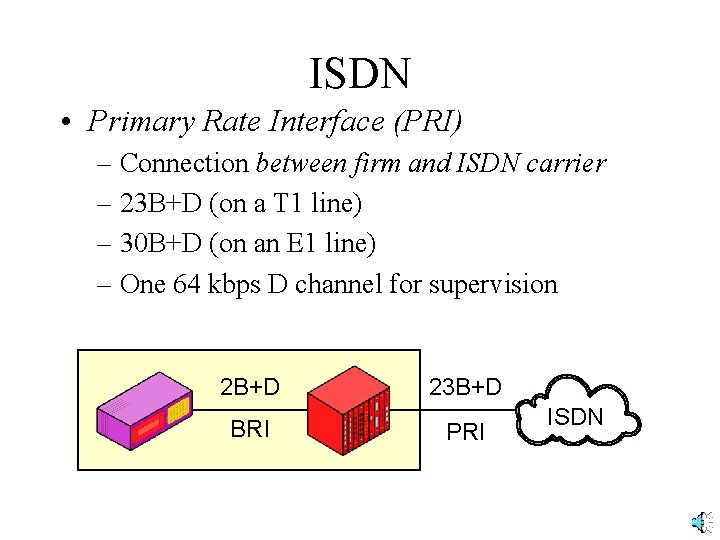
ISDN • Primary Rate Interface (PRI) – Connection between firm and ISDN carrier – 23 B+D (on a T 1 line) – 30 B+D (on an E 1 line) – One 64 kbps D channel for supervision 2 B+D BRI 23 B+D PRI ISDN
• Circuit-Switched ISDN – Dedicated capacity – Expensive for data • Dial-Up Connection – Must connect each time you wish to communicate – Other PSDNs are dedicated (always on) • Unreliable • Only Popular PSDN that is either circuitswitched or dial-up
ISDN • Never achieved strong market use • Being overtaken by PSDNs that are both faster and less expensive • Often, ISDN is spelled out as “It still does nothing” • However, there is enough ISDN in use that you must know it • Also, if connectivity is only needed a short time each day, ISDN is still a good choice for low-speed transmission
X. 25 • First Packet-Switched PSDN Standard – Developed in the 1970 s – Now obsolete – But still used, especially in third-world countries and Europe • Slow: Usually 64 kbps or slower – Some faster X. 25 services are available • Reliable, so costs of switches are high – So cost of service is high – But works even if transmission lines are poor
- Slides: 5