
Ischemic Preconditioning in the Younger and Aged Heart
- Slides: 1
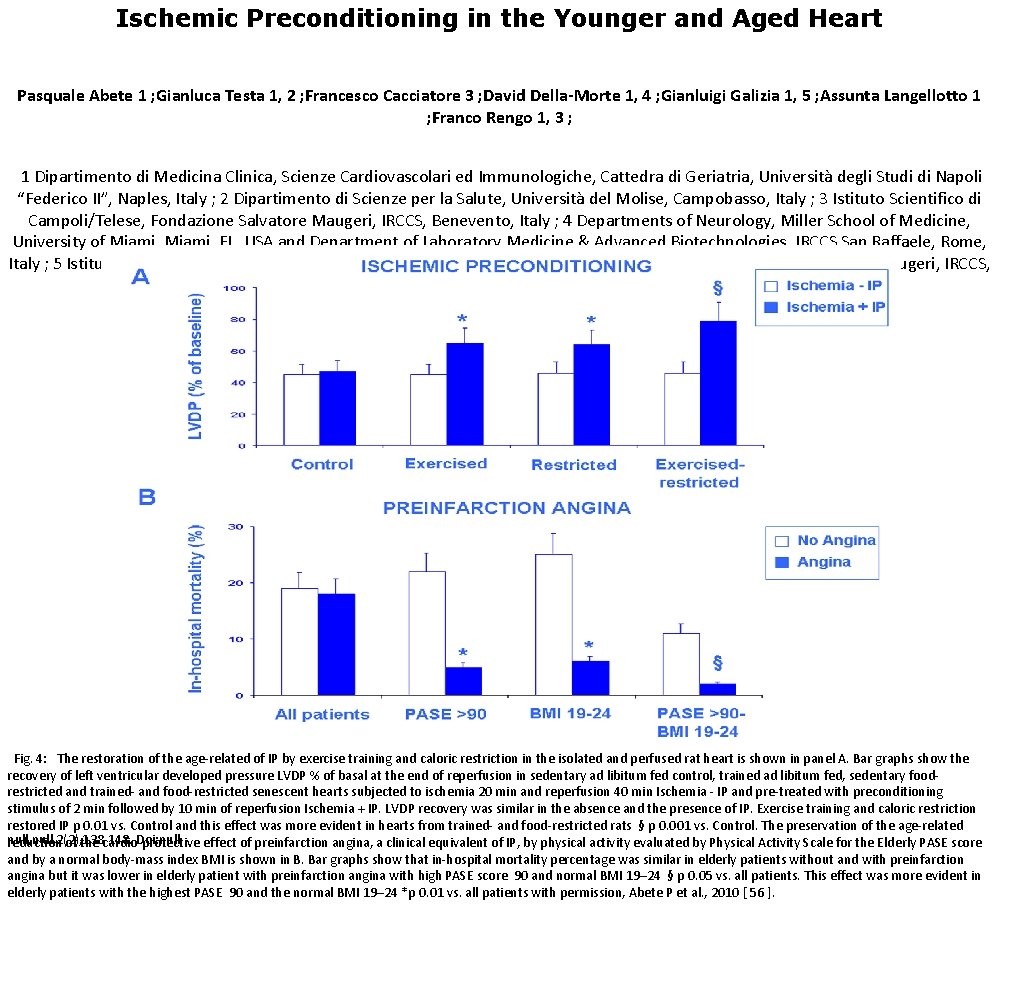
Ischemic Preconditioning in the Younger and Aged Heart Pasquale Abete 1 ; Gianluca Testa 1, 2 ; Francesco Cacciatore 3 ; David Della-Morte 1, 4 ; Gianluigi Galizia 1, 5 ; Assunta Langellotto 1 ; Franco Rengo 1, 3 ; 1 Dipartimento di Medicina Clinica, Scienze Cardiovascolari ed Immunologiche, Cattedra di Geriatria, Università degli Studi di Napoli “Federico II”, Naples, Italy ; 2 Dipartimento di Scienze per la Salute, Università del Molise, Campobasso, Italy ; 3 Istituto Scientifico di Campoli/Telese, Fondazione Salvatore Maugeri, IRCCS, Benevento, Italy ; 4 Departments of Neurology, Miller School of Medicine, University of Miami, FL, USA and Department of Laboratory Medicine & Advanced Biotechnologies, IRCCS San Raffaele, Rome, Italy ; 5 Istituto Scientifico di Veruno (Novara), Divisione di Recupero e Rieducazione Funzionale, Fondazione Salvatore Maugeri, IRCCS, Veruno (Novara), Italy ; Fig. 4: The restoration of the age-related of IP by exercise training and caloric restriction in the isolated and perfused rat heart is shown in panel A. Bar graphs show the recovery of left ventricular developed pressure LVDP % of basal at the end of reperfusion in sedentary ad libitum fed control, trained ad libitum fed, sedentary foodrestricted and trained- and food-restricted senescent hearts subjected to ischemia 20 min and reperfusion 40 min Ischemia - IP and pre-treated with preconditioning stimulus of 2 min followed by 10 min of reperfusion Ischemia + IP. LVDP recovery was similar in the absence and the presence of IP. Exercise training and caloric restriction restored IP p 0. 01 vs. Control and this effect was more evident in hearts from trained- and food-restricted rats § p 0. 001 vs. Control. The preservation of the age-related null, 2(2), 138 -148. Doi: null reduction of the cardio-protective effect of preinfarction angina, a clinical equivalent of IP, by physical activity evaluated by Physical Activity Scale for the Elderly PASE score and by a normal body-mass index BMI is shown in B. Bar graphs show that in-hospital mortality percentage was similar in elderly patients without and with preinfarction angina but it was lower in elderly patient with preinfarction angina with high PASE score 90 and normal BMI 19– 24 § p 0. 05 vs. all patients. This effect was more evident in elderly patients with the highest PASE 90 and the normal BMI 19– 24 *p 0. 01 vs. all patients with permission, Abete P et al. , 2010 [ 56 ].