
ISA 201 Intermediate Information Systems Acquisition Lesson 15
- Slides: 29
ISA 201 Intermediate Information Systems Acquisition
Lesson 15 a Software Quality
Learning Objectives • • Today we will learn to: Define software quality Identify characteristics unique to software that impact quality Identify characteristics of generic DOD software system domains (e. g. Platform IT, Command Control, and Defense Business Systems), that might influence how each system is reviewed in a software quality program Recognize that every IT acquisition program requires a Program Manager approved software quality statement. Given several process-focused and product-focused software quality assurance methods, describe how each assures quality in a software acquisition Recognize the benefits of applying Capability Maturity Model Integrated (CMMI) concepts and principles to a Do. D SW development project Given a software acquisition scenario, recognize the preferred method for identifying and tracking defects Given an acquisition scenario with multiple software related programmatic issues, analyze how each may impact the program’s ability to meet its Software Quality Assurance 3 quality objectives
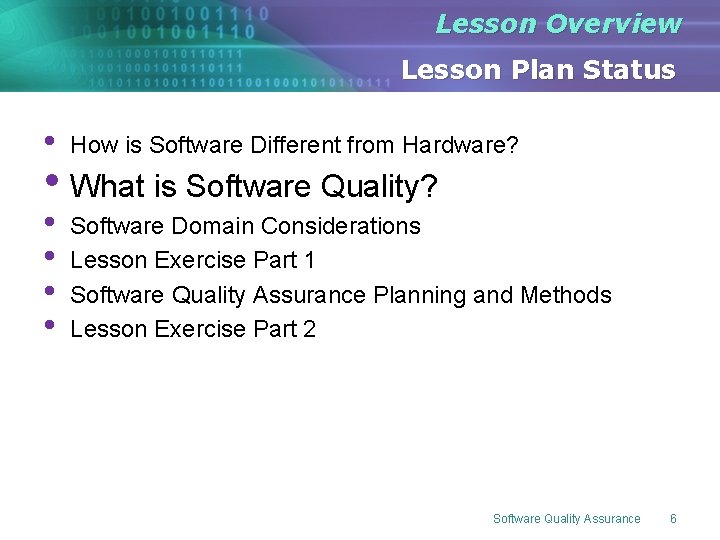
Lesson Overview Lesson Plan • How is Software Different from Hardware? • • • What is Software Quality? Software Domain Considerations Lesson Exercise Part 1 Software Quality Assurance Planning and Methods Lesson Exercise Part 2 Software Quality Assurance 4
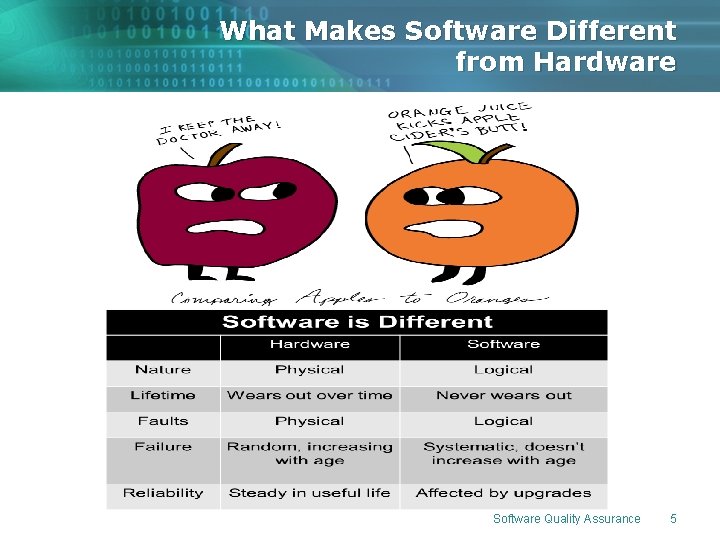
What Makes Software Different from Hardware Software Quality Assurance 5
Lesson Overview Lesson Plan Status • How is Software Different from Hardware? • • Software Domain Considerations Lesson Exercise Part 1 Software Quality Assurance Planning and Methods Lesson Exercise Part 2 • What is Software Quality? Software Quality Assurance 6
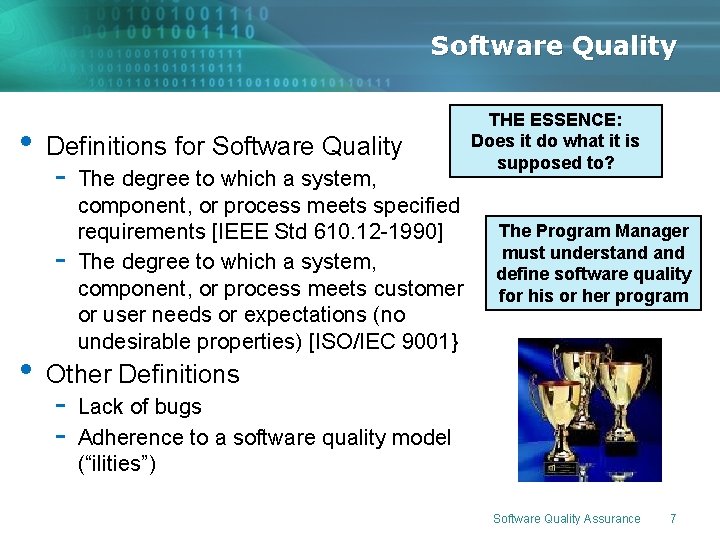
Software Quality • Definitions for Software Quality - • The degree to which a system, component, or process meets specified requirements [IEEE Std 610. 12 -1990] The degree to which a system, component, or process meets customer or user needs or expectations (no undesirable properties) [ISO/IEC 9001} THE ESSENCE: Does it do what it is supposed to? The Program Manager must understand define software quality for his or her program Other Definitions - Lack of bugs Adherence to a software quality model (“ilities”) Software Quality Assurance 7
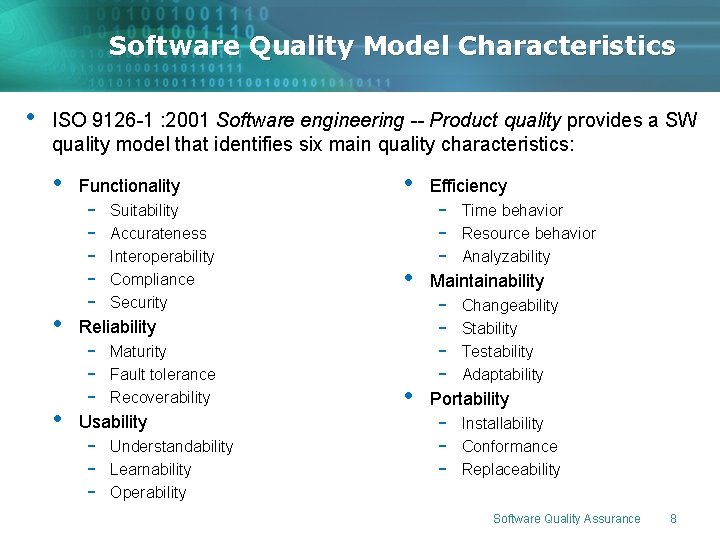
Software Quality Model Characteristics • ISO 9126 -1 : 2001 Software engineering -- Product quality provides a SW quality model that identifies six main quality characteristics: • • • Functionality - Suitability Accurateness Interoperability Compliance Security • • Reliability - Maturity Fault tolerance Recoverability Usability - Understandability Learnability Operability • Efficiency - Time behavior Resource behavior Analyzability Maintainability - Changeability Stability Testability Adaptability Portability - Installability Conformance Replaceability Software Quality Assurance 8
Lesson Overview Lesson Plan Status • • How is Software Different from Hardware? What is Software Quality? • • • Lesson Exercise Part 1 Software Quality Assurance Planning and Methods Lesson Exercise Part 2 • Software Domain Considerations Software Quality Assurance 9
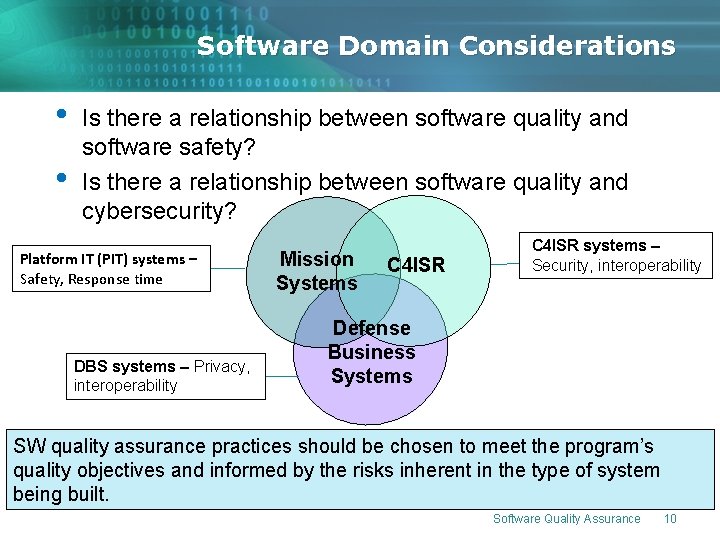
Software Domain Considerations • • Is there a relationship between software quality and software safety? Is there a relationship between software quality and cybersecurity? Platform IT (PIT) systems – Safety, Response time DBS systems – Privacy, interoperability Mission Systems C 4 ISR systems – Security, interoperability Defense Business Systems SW quality assurance practices should be chosen to meet the program’s quality objectives and informed by the risks inherent in the type of system being built. Software Quality Assurance 10
Lesson Overview Lesson Plan Status • • • How is Software Different from Hardware? What is Software Quality? How do I achieve Software Quality? • • Software Quality Assurance Planning and Methods Lesson Exercise Part 2 • Lesson Exercise Part 1 Software Quality Assurance 11
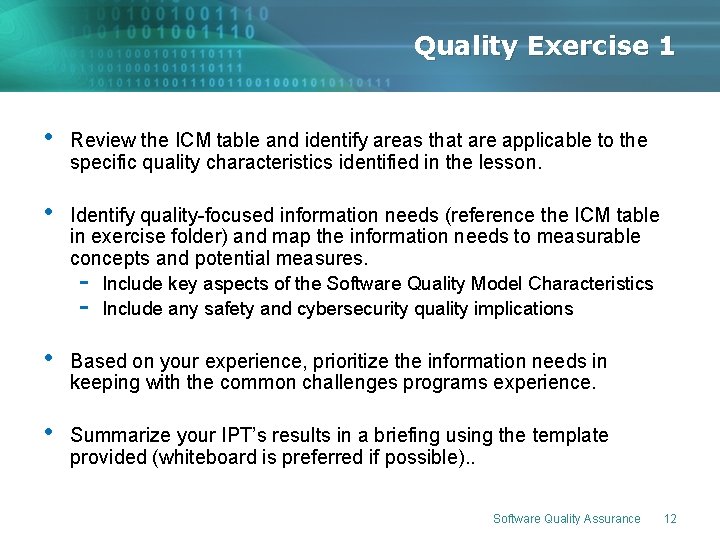
Quality Exercise 1 • Review the ICM table and identify areas that are applicable to the specific quality characteristics identified in the lesson. • Identify quality-focused information needs (reference the ICM table in exercise folder) and map the information needs to measurable concepts and potential measures. - Include key aspects of the Software Quality Model Characteristics Include any safety and cybersecurity quality implications • Based on your experience, prioritize the information needs in keeping with the common challenges programs experience. • Summarize your IPT’s results in a briefing using the template provided (whiteboard is preferred if possible). . Software Quality Assurance 12
Lesson Overview Lesson Plan Status • • How is Software Different from Hardware? What is Software Quality? How do I achieve Software Quality? Lesson Exercise Part 1 • Software Quality Assurance Planning and • Methods Lesson Exercise Part 2 Software Quality Assurance 13
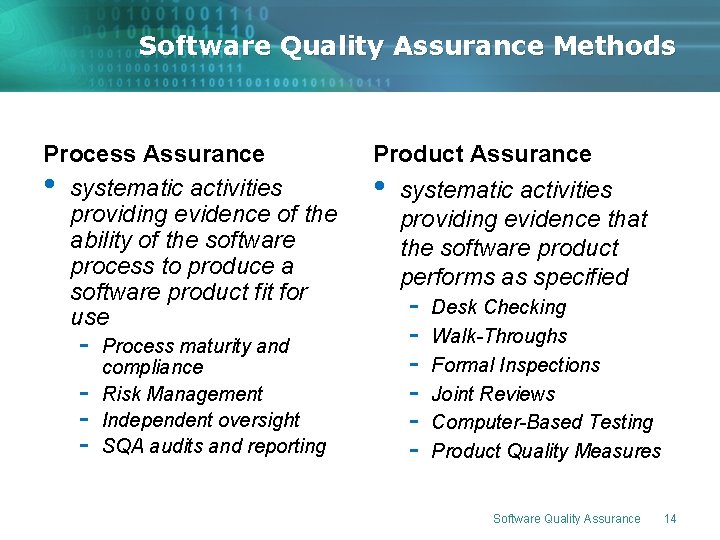
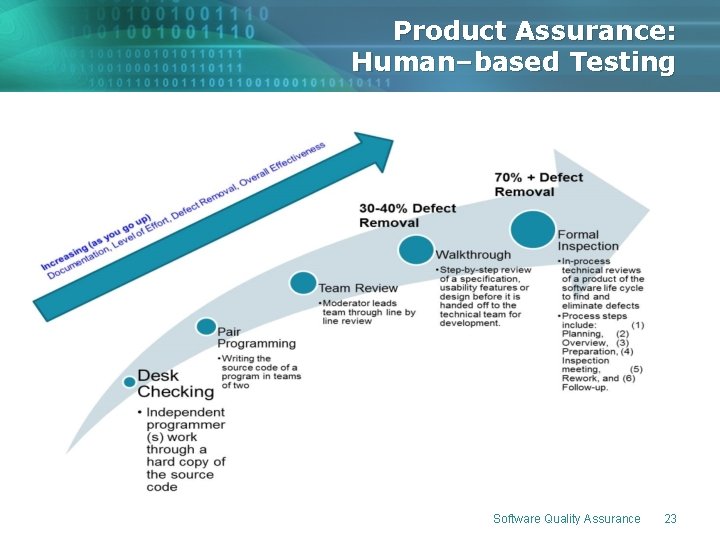
Software Quality Assurance Methods Process Assurance • systematic activities providing evidence of the ability of the software process to produce a software product fit for use - Process maturity and compliance Risk Management Independent oversight SQA audits and reporting Product Assurance • systematic activities providing evidence that the software product performs as specified - Desk Checking Walk-Throughs Formal Inspections Joint Reviews Computer-Based Testing Product Quality Measures Software Quality Assurance 14
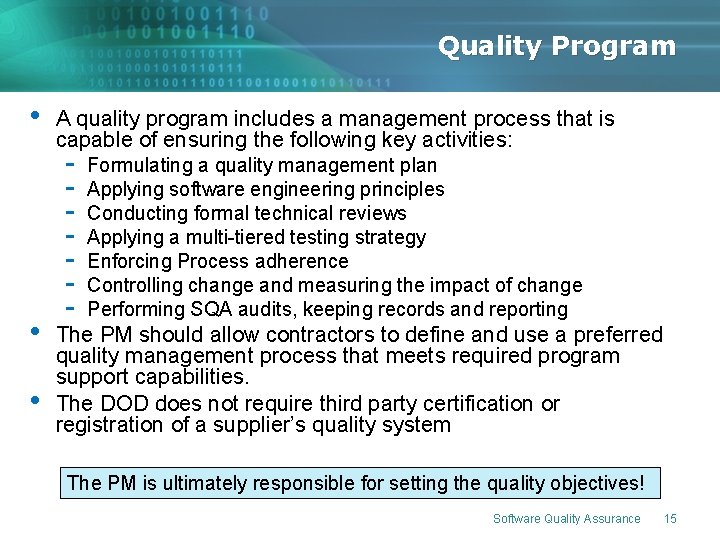
Quality Program • • • A quality program includes a management process that is capable of ensuring the following key activities: - Formulating a quality management plan Applying software engineering principles Conducting formal technical reviews Applying a multi-tiered testing strategy Enforcing Process adherence Controlling change and measuring the impact of change Performing SQA audits, keeping records and reporting The PM should allow contractors to define and use a preferred quality management process that meets required program support capabilities. The DOD does not require third party certification or registration of a supplier’s quality system The PM is ultimately responsible for setting the quality objectives! Software Quality Assurance 15
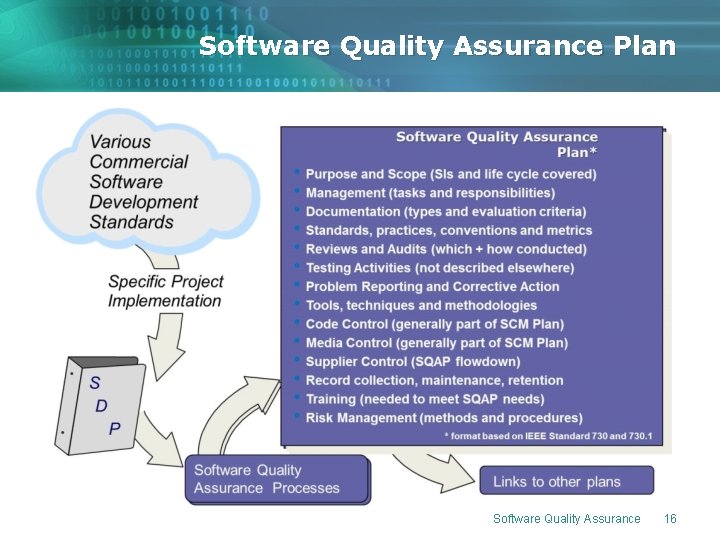
Software Quality Assurance Plan Software Quality Assurance 16
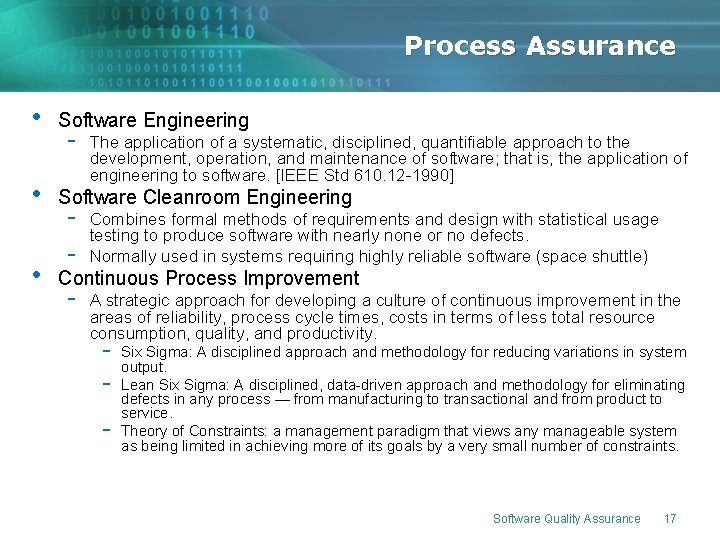
Process Assurance • Software Engineering • Software Cleanroom Engineering • Continuous Process Improvement - The application of a systematic, disciplined, quantifiable approach to the development, operation, and maintenance of software; that is, the application of engineering to software. [IEEE Std 610. 12 -1990] - Combines formal methods of requirements and design with statistical usage testing to produce software with nearly none or no defects. Normally used in systems requiring highly reliable software (space shuttle) - A strategic approach for developing a culture of continuous improvement in the areas of reliability, process cycle times, costs in terms of less total resource consumption, quality, and productivity. - Six Sigma: A disciplined approach and methodology for reducing variations in system output. Lean Six Sigma: A disciplined, data-driven approach and methodology for eliminating defects in any process — from manufacturing to transactional and from product to service. Theory of Constraints: a management paradigm that views any manageable system as being limited in achieving more of its goals by a very small number of constraints. Software Quality Assurance 17
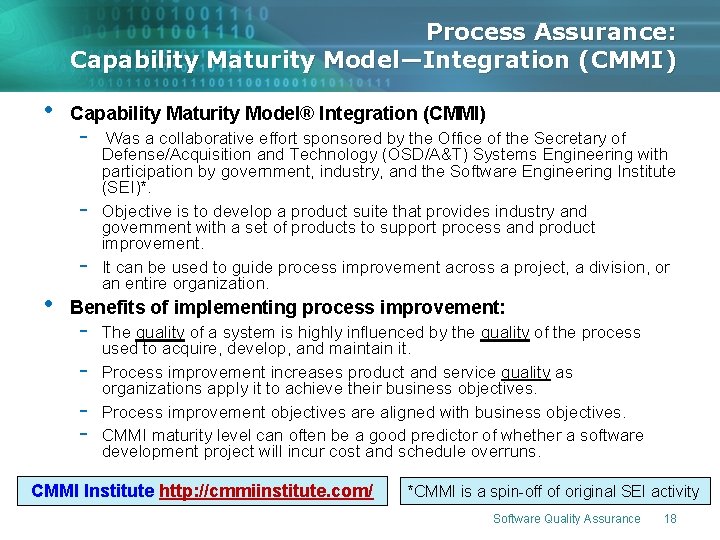
Process Assurance: Capability Maturity Model—Integration (CMMI) • Capability Maturity Model® Integration (CMMI) - • Was a collaborative effort sponsored by the Office of the Secretary of Defense/Acquisition and Technology (OSD/A&T) Systems Engineering with participation by government, industry, and the Software Engineering Institute (SEI)*. Objective is to develop a product suite that provides industry and government with a set of products to support process and product improvement. It can be used to guide process improvement across a project, a division, or an entire organization. Benefits of implementing process improvement: - The quality of a system is highly influenced by the quality of the process used to acquire, develop, and maintain it. Process improvement increases product and service quality as organizations apply it to achieve their business objectives. Process improvement objectives are aligned with business objectives. CMMI maturity level can often be a good predictor of whether a software development project will incur cost and schedule overruns. CMMI Institute http: //cmmiinstitute. com/ *CMMI is a spin-off of original SEI activity Software Quality Assurance 18
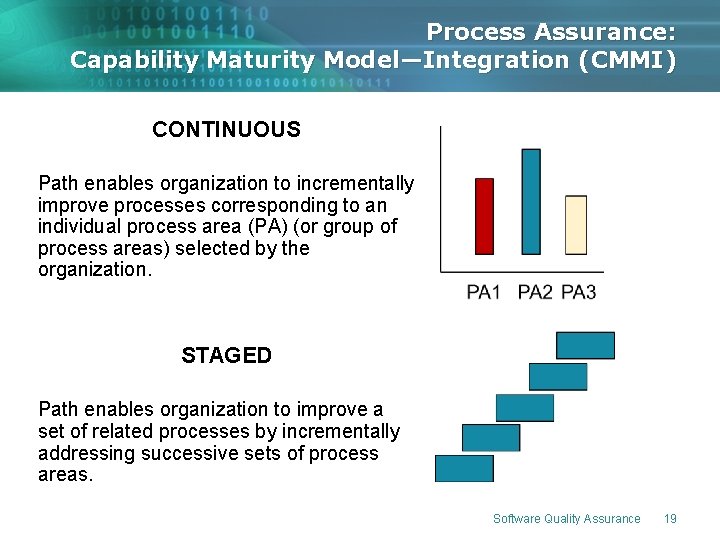
Process Assurance: Capability Maturity Model—Integration (CMMI) CONTINUOUS Path enables organization to incrementally improve processes corresponding to an individual process area (PA) (or group of process areas) selected by the organization. STAGED Path enables organization to improve a set of related processes by incrementally addressing successive sets of process areas. Software Quality Assurance 19
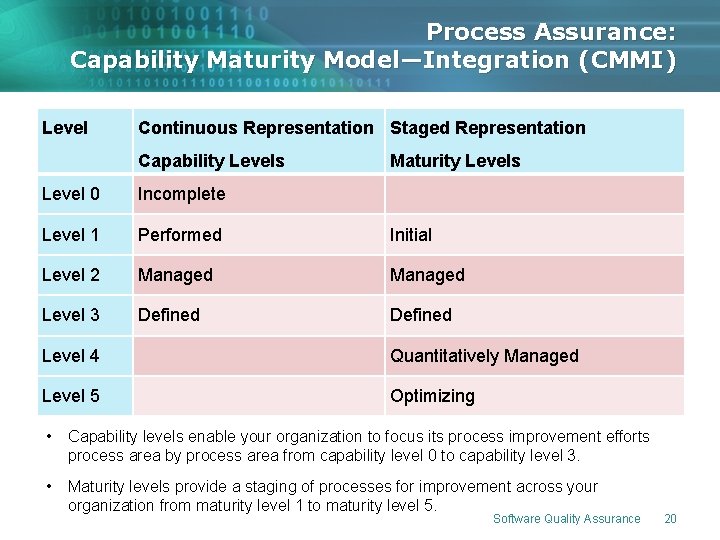
Process Assurance: Capability Maturity Model—Integration (CMMI) Level Continuous Representation Staged Representation Capability Levels Maturity Levels Level 0 Incomplete Level 1 Performed Initial Level 2 Managed Level 3 Defined Level 4 Quantitatively Managed Level 5 Optimizing • Capability levels enable your organization to focus its process improvement efforts process area by process area from capability level 0 to capability level 3. • Maturity levels provide a staging of processes for improvement across your organization from maturity level 1 to maturity level 5. Software Quality Assurance 20
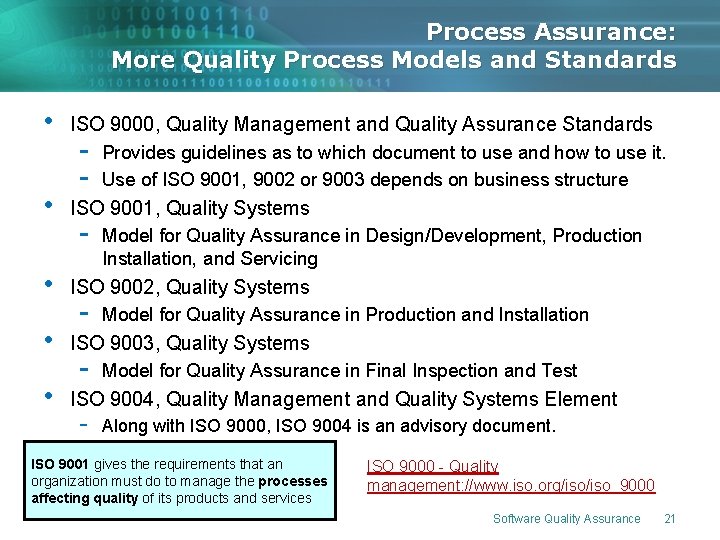
Process Assurance: More Quality Process Models and Standards • • • ISO 9000, Quality Management and Quality Assurance Standards - Provides guidelines as to which document to use and how to use it. Use of ISO 9001, 9002 or 9003 depends on business structure ISO 9001, Quality Systems - Model for Quality Assurance in Design/Development, Production Installation, and Servicing ISO 9002, Quality Systems - Model for Quality Assurance in Production and Installation ISO 9003, Quality Systems - Model for Quality Assurance in Final Inspection and Test ISO 9004, Quality Management and Quality Systems Element - Along with ISO 9000, ISO 9004 is an advisory document. ISO 9001 gives the requirements that an organization must do to manage the processes affecting quality of its products and services ISO 9000 - Quality management: //www. iso. org/iso_9000 Software Quality Assurance 21
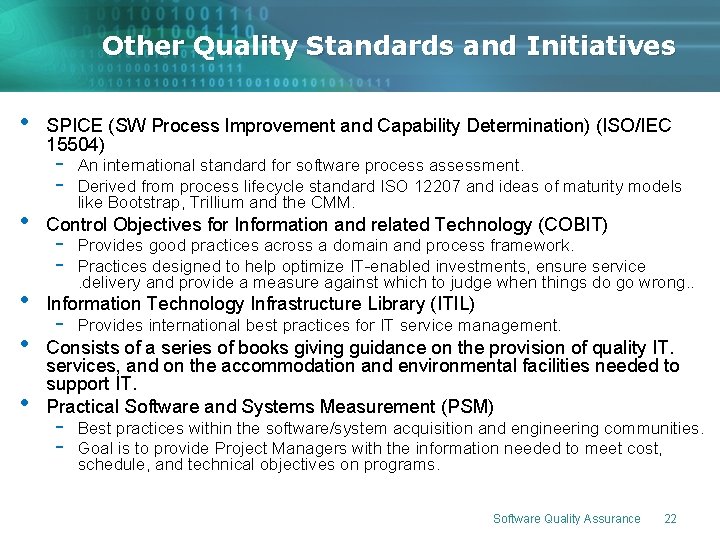
Other Quality Standards and Initiatives • SPICE (SW Process Improvement and Capability Determination) (ISO/IEC 15504) - • An international standard for software process assessment. Derived from process lifecycle standard ISO 12207 and ideas of maturity models like Bootstrap, Trillium and the CMM. Control Objectives for Information and related Technology (COBIT) - Provides good practices across a domain and process framework. Practices designed to help optimize IT-enabled investments, ensure service . delivery and provide a measure against which to judge when things do go wrong. . • Information Technology Infrastructure Library (ITIL) - Provides international best practices for IT service management. • Consists of a series of books giving guidance on the provision of quality IT. • services, and on the accommodation and environmental facilities needed to support IT. Practical Software and Systems Measurement (PSM) - Best practices within the software/system acquisition and engineering communities. Goal is to provide Project Managers with the information needed to meet cost, schedule, and technical objectives on programs. Software Quality Assurance 22
Product Assurance: Human–based Testing Software Quality Assurance 23
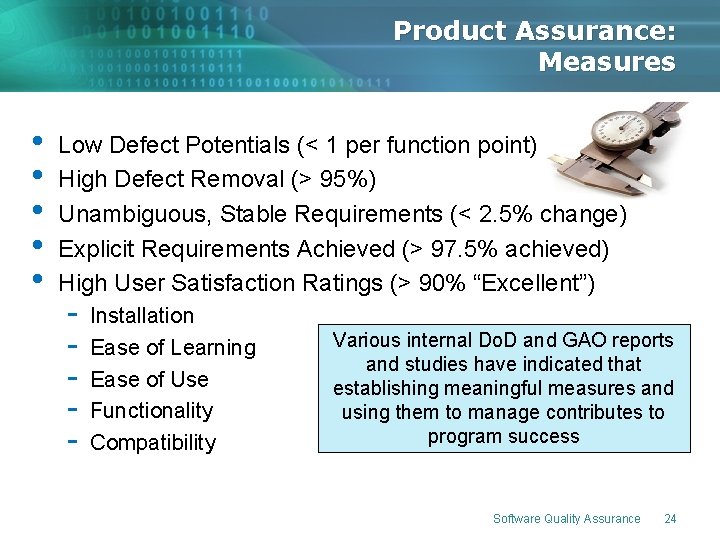
Product Assurance: Measures • • • Low Defect Potentials (< 1 per function point) High Defect Removal (> 95%) Unambiguous, Stable Requirements (< 2. 5% change) Explicit Requirements Achieved (> 97. 5% achieved) High User Satisfaction Ratings (> 90% “Excellent”) - Installation Ease of Learning Ease of Use Functionality Compatibility Various internal Do. D and GAO reports and studies have indicated that establishing meaningful measures and using them to manage contributes to program success Software Quality Assurance 24
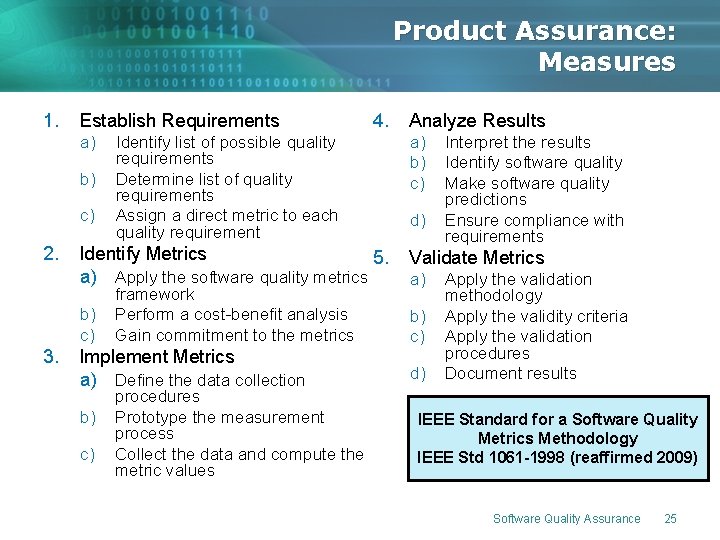
Product Assurance: Measures 1. Establish Requirements a) b) c) 2. 3. 4. Identify list of possible quality requirements Determine list of quality requirements Assign a direct metric to each quality requirement Analyze Results a) b) c) d) Interpret the results Identify software quality Make software quality predictions Ensure compliance with requirements Identify Metrics 5. a) Apply the software quality metrics Validate Metrics b) c) framework Perform a cost-benefit analysis Gain commitment to the metrics Implement Metrics a) Define the data collection b) c) procedures Prototype the measurement process Collect the data and compute the metric values a) d) Apply the validation methodology Apply the validity criteria Apply the validation procedures Document results IEEE Standard for a Software Quality Metrics Methodology IEEE Std 1061 -1998 (reaffirmed 2009) Software Quality Assurance 25
Lesson Overview Lesson Plan Status • • • How is Software Different from Hardware? What is Software Quality? How do I achieve Software Quality? Lesson Exercise Part 1 Software Quality Assurance Planning and Methods • Lesson Exercise Part 2 Software Quality Assurance 26
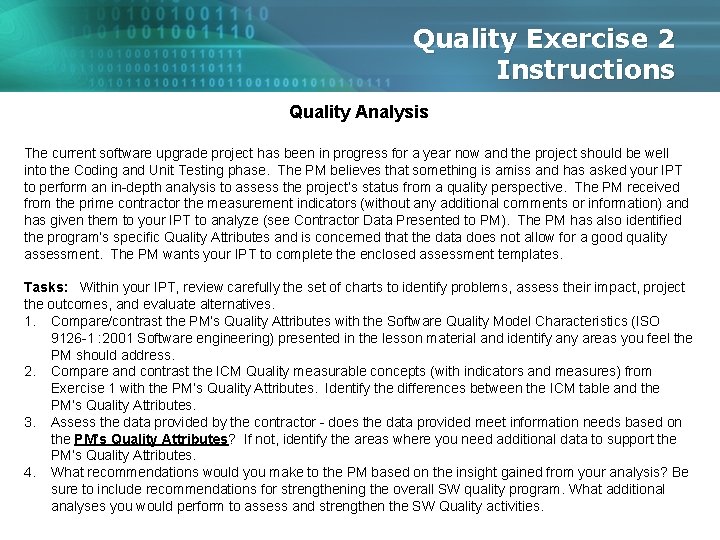
Quality Exercise 2 Instructions Quality Analysis The current software upgrade project has been in progress for a year now and the project should be well into the Coding and Unit Testing phase. The PM believes that something is amiss and has asked your IPT to perform an in-depth analysis to assess the project’s status from a quality perspective. The PM received from the prime contractor the measurement indicators (without any additional comments or information) and has given them to your IPT to analyze (see Contractor Data Presented to PM). The PM has also identified the program’s specific Quality Attributes and is concerned that the data does not allow for a good quality assessment. The PM wants your IPT to complete the enclosed assessment templates. Tasks: Within your IPT, review carefully the set of charts to identify problems, assess their impact, project the outcomes, and evaluate alternatives. 1. Compare/contrast the PM’s Quality Attributes with the Software Quality Model Characteristics (ISO 9126 -1 : 2001 Software engineering) presented in the lesson material and identify any areas you feel the PM should address. 2. Compare and contrast the ICM Quality measurable concepts (with indicators and measures) from Exercise 1 with the PM’s Quality Attributes. Identify the differences between the ICM table and the PM’s Quality Attributes. 3. Assess the data provided by the contractor - does the data provided meet information needs based on the PM’s Quality Attributes? If not, identify the areas where you need additional data to support the PM’s Quality Attributes. 4. What recommendations would you make to the PM based on the insight gained from your analysis? Be sure to include recommendations for strengthening the overall SW quality program. What additional analyses you would perform to assess and strengthen the SW Quality activities.
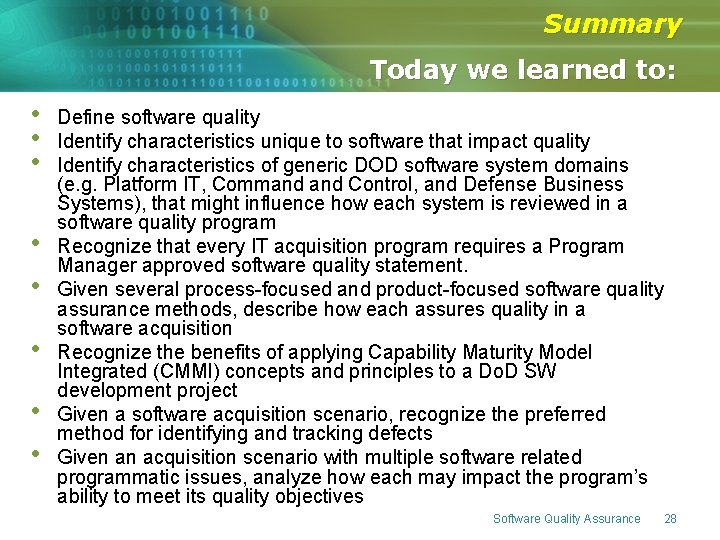
Summary Today we learned to: • • Define software quality Identify characteristics unique to software that impact quality Identify characteristics of generic DOD software system domains (e. g. Platform IT, Command Control, and Defense Business Systems), that might influence how each system is reviewed in a software quality program Recognize that every IT acquisition program requires a Program Manager approved software quality statement. Given several process-focused and product-focused software quality assurance methods, describe how each assures quality in a software acquisition Recognize the benefits of applying Capability Maturity Model Integrated (CMMI) concepts and principles to a Do. D SW development project Given a software acquisition scenario, recognize the preferred method for identifying and tracking defects Given an acquisition scenario with multiple software related programmatic issues, analyze how each may impact the program’s ability to meet its quality objectives Software Quality Assurance 28
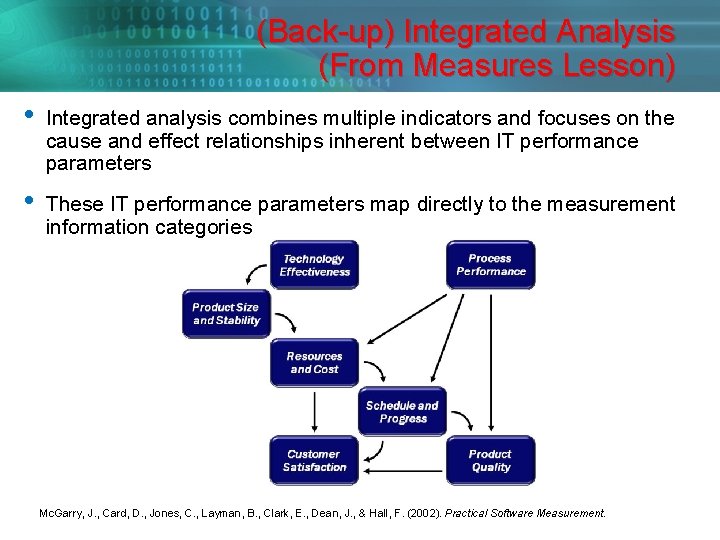
(Back-up) Integrated Analysis (From Measures Lesson) • Integrated analysis combines multiple indicators and focuses on the cause and effect relationships inherent between IT performance parameters • These IT performance parameters map directly to the measurement information categories Mc. Garry, J. , Card, D. , Jones, C. , Layman, B. , Clark, E. , Dean, J. , & Hall, F. (2002). Practical Software Measurement.