
Is Vertical Expandable Prosthetic Titanium Rib VEPTR Application

Is Vertical Expandable Prosthetic Titanium Rib (VEPTR) Application a Sufficient Method to Provide Expected Spinal Growth in Congenital Scoliosis? M. Bulent Balioglu, Y. Emre Akman, Akif Albayrak, Yunus Atici, M. Temel Tacal, Deniz Kargin, M. Akif Kaygusuz BALTALIMANI METIN SABANCI DISEASE OF THE BONE EDUCATION AND RESEARCH HOSPITAL İSTANBUL, TURKEY
Author Disclosure Information �M. B. Balioglu �Y. E. Akman �A. Albayrak �Y. Atici �M. T. Tacal �D. Kargin �M. A. Kaygusuz None None

Classifying Non-Fusion Techniques and Growth friendly Implants Growing Rod (Single/Dual) Distraction <8 y, all et. VEPTR (FDA) Hibrid Growth Rod MCGR (Phenix/MAGEC) Growth guidance <9 y, all et. Convex Compression Tension >8 y Congenital ø Shilla Luque trolley Stapling (Shape memory staples) Tethers Skaggs, Witale et al Tis , Karlin, Akbarnia et al

Methods � Expansion Thoracostomy +/ Open Thoracic wedge osteotomy � � � Treatment option for TIS Aetiologies (Congenital) 5 patients (4 F, 1 M) Age 48 m (20 -79) AP Cobb angle Preop 72° (60 -97) Last control 52° (40 -78) � � � FU 52 m (20 -62) Correction 28% Lengthening and surgical intervention 6. 8 (6 -9) LK
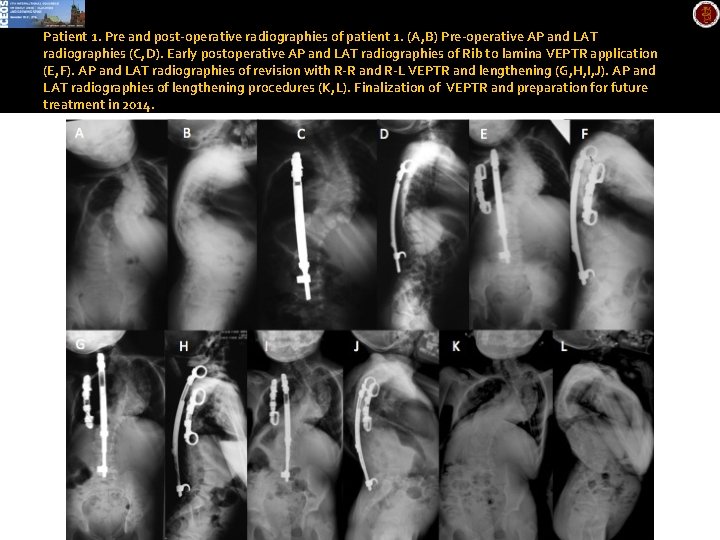
Patient 1. Pre and post-operative radiographies of patient 1. (A, B) Pre-operative AP and LAT radiographies (C, D). Early postoperative AP and LAT radiographies of Rib to lamina VEPTR application (E, F). AP and LAT radiographies of revision with R-R and R-L VEPTR and lengthening (G, H, I, J). AP and LAT radiographies of lengthening procedures (K, L). Finalization of VEPTR and preparation for future treatment in 2014.

Patient 2. Pre and postoperative radiographies (A). Pre-operative AP radiography (B, C). Pre-operative MRI and CT (D, E). Early postoperative AP and LAT radiographies of Rib to Pelvis VEPTR application (F, G). AP and LAT radiographies of lengthening (H, I, J, K). AP and LAT radiographies after replacement of R-P with Growing Rod and lengthening with VEPTR.

Patient 3. Pre and post-operative radiographies (A, B). Preop AP-LAT radiographies (C). Early Postoperative AP radiography (D, E, F). Radiographies during the lengthening procedures (G-H) of VEPTR revised to Rib to Lamina configuration (H-I) AP and LAT radiographies during the last control after final posterior fusion.

Patient 4. Pre and post-operative radiographies (A, B). Preoperative AP and LAT radiographies (C, D). Early postoperative AP and LAT radiographies (E, F). Postoperative Rib to Lamina VEPTR application (G, H, I, J). Radiographies during the lengthening procedures (K, L). AP and LAT radiographies during the last control in 2014.
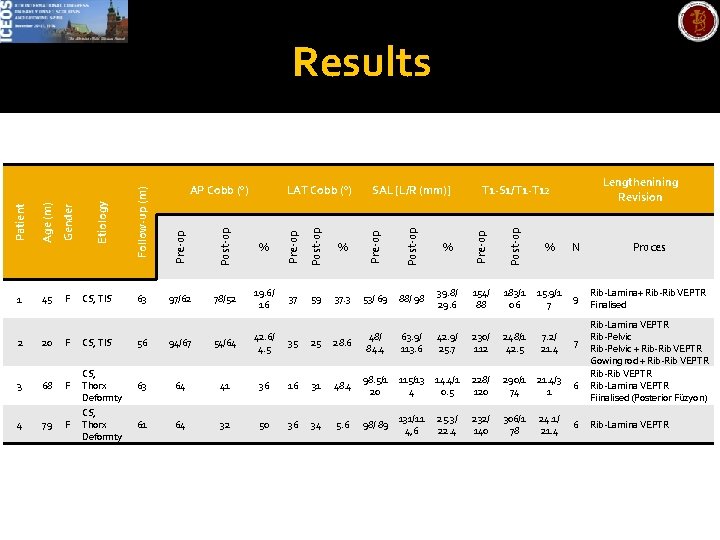
4 79 F CS, Thorx Deformty 35 59 37. 3 53/ 69 88/ 98 39. 8/ 29. 6 28. 6 48/ 84. 4 63. 9/ 113. 6 42. 9/ 25. 7 25 Post-op F 37 % Lengthenining Revision T 1 -S 1/T 1 -T 12 Pre-op 68 19. 6/ 16 Post-op 3 CS, TIS 78/52 % SAL [L/R (mm)] Pre-op F 97/62 Post-op 20 63 % Pre-op 2 CS, TIS LAT Cobb (°) Post-op F AP Cobb (°) Pre-op Gender 45 Follow-up (m) Age (m) 1 Etiology Patient Results % N Proces 154/ 88 183/1 06 15. 9/1 7 9 Rib-Lamina+ Rib-Rib VEPTR Finalised 230/ 112 248/1 42. 5 7. 2/ 21. 4 7 56 94/67 54/64 42. 6/ 4. 5 63 64 41 36 16 31 48. 4 98. 5/1 20 115/13 4 14. 4/1 0. 5 228/ 120 290/1 74 21. 4/3 1 6 61 64 32 50 36 34 5. 6 98/ 89 131/11 4, 6 25. 3/ 22. 4 232/ 140 306/1 78 24. 1/ 21. 4 6 Rib-Lamina VEPTR Rib-Pelvic + Rib-Rib VEPTR Gowing rod + Rib-Rib VEPTR Rib-Lamina VEPTR Fiinalised (Posterior Füzyon) Rib-Lamina VEPTR

Results Age 53 m (20 -79) FU 5. 1 y (4. 5 -5. 4) Correction of the Curve 28. 4 % (4. 5 -50) SAL (L) 30. 6 % SAL (R) 22 % Annual length T 1 -T 12 0. 7 mm Annual length T 1 -S 1 0. 9 mm Complications Migration of the device 3 Wound problems 2 Rod fracture 1
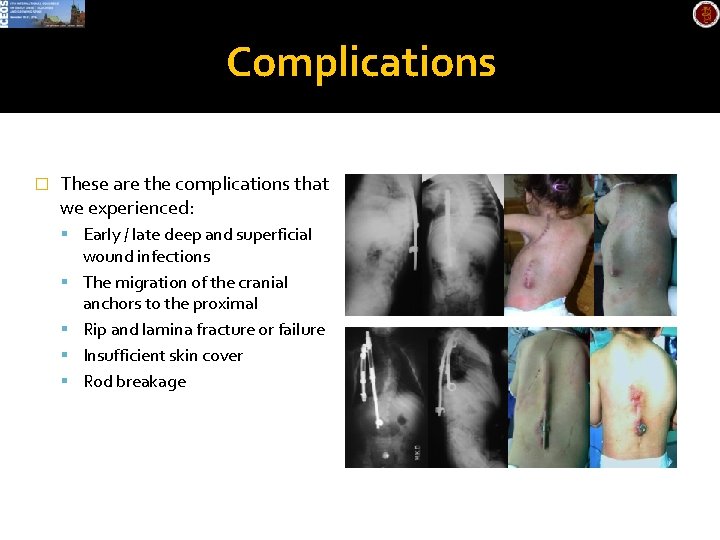
Complications � These are the complications that we experienced: Early / late deep and superficial wound infections The migration of the cranial anchors to the proximal Rip and lamina fracture or failure Insufficient skin cover Rod breakage

Conclusions � VEPTR may provide a good correction in the treatment of congenital spinal and thoracic deformities. � However obtained spinal height and the increase in the respiratory functions may not be sufficient. � Long term, multicenter, prospective studies that compare the spinal height, respiratory functions, the severity of the deformity and the spinal balance are required in order to evaluate the efficacy of VEPTR.
- Slides: 12