
Is this legally allowed at public high school
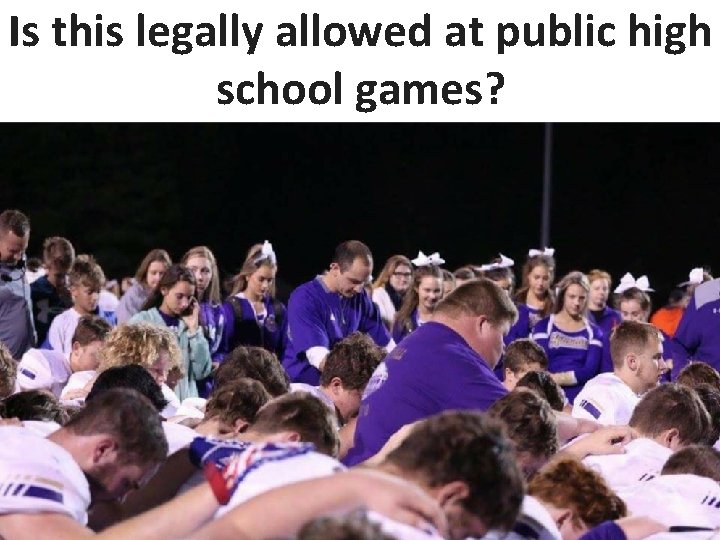
Is this legally allowed at public high school games?
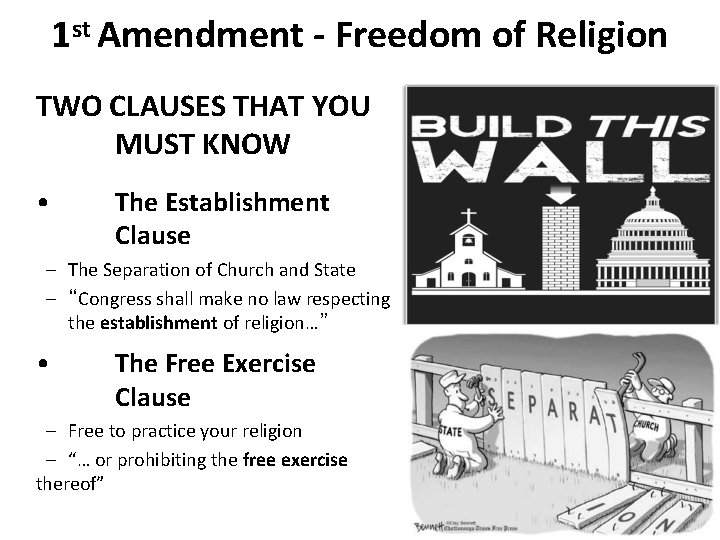
1 st Amendment - Freedom of Religion TWO CLAUSES THAT YOU MUST KNOW • The Establishment Clause – The Separation of Church and State – “Congress shall make no law respecting the establishment of religion…” • The Free Exercise Clause – Free to practice your religion – “… or prohibiting the free exercise thereof”
FREEDOM OF RELIGION - THE ESTABLISHMENT CLAUSE • No Government “Establishment of Religion” – A “wall of separation” - Separation of church and state (words of Jefferson; it is implied within 1 st Amendment, but not stated – kind of like “fair trial”) • Basic meaning of establishment clause: government may not establish an official religion. – “Accomodationist View”: Government should bend a bit and allow a certain degree of church/state blending (allowing nativity scenes on city property, and allowing a nondenominational prayer in public school) – “Separationist View”: Government should allow virtually no blending of church and state. There should be a “wall of separation” between the two. 5
FREEDOM OF RELIGION - THE ESTABLISHMENT CLAUSE • Lemon v. Kurtzman: Established a 3 -part test (the Lemon test) to determine if a statute or practice violates the establishment clause: 1. Non-Secular (Religious) Purpose 2. Advances or Inhibits Religion 3. Excessive Entanglement with Government – If any is present, the statute or practice is unconstitutional 6
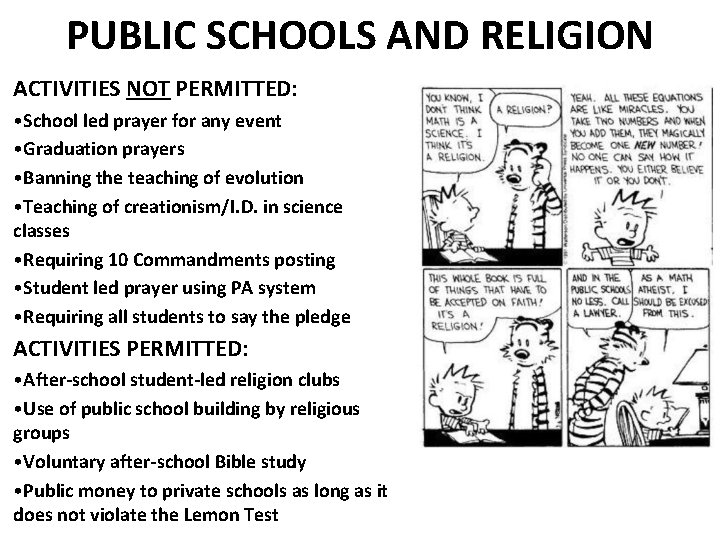
PUBLIC SCHOOLS AND RELIGION ACTIVITIES NOT PERMITTED: • School led prayer for any event • Graduation prayers • Banning the teaching of evolution • Teaching of creationism/I. D. in science classes • Requiring 10 Commandments posting • Student led prayer using PA system • Requiring all students to say the pledge ACTIVITIES PERMITTED: • After-school student-led religion clubs • Use of public school building by religious groups • Voluntary after-school Bible study • Public money to private schools as long as it does not violate the Lemon Test
FREEDOM OF RELIGION - THE ESTABLISHMENT CLAUSE Key rulings: • Engle v. Vitale, 1962: no state-sponsored, recited prayer in public school. No teacher-led prayer. • No devotional Bible-reading in public school. • Moment of silence in public school is constitutional (as long as the purpose is not stated as being for prayer). • State laws may not prohibit the teaching of evolution in public school. • State laws that require the posting of the 10 Commandments in public school are unconstitutional. • Released time for students is constitutional. Allowing students to meet on campus for religious groups (such as Christian Club) is constitutional. • Christmas displays in town squares are constitutional as long as they include some secular content. • Constitutional forms of state aid to private schools: textbooks, classrooms, lunches, bus transportation. • Unconstitutional forms of state aid to private schools: field trips, teacher salaries, counseling services, remedial instruction. 8
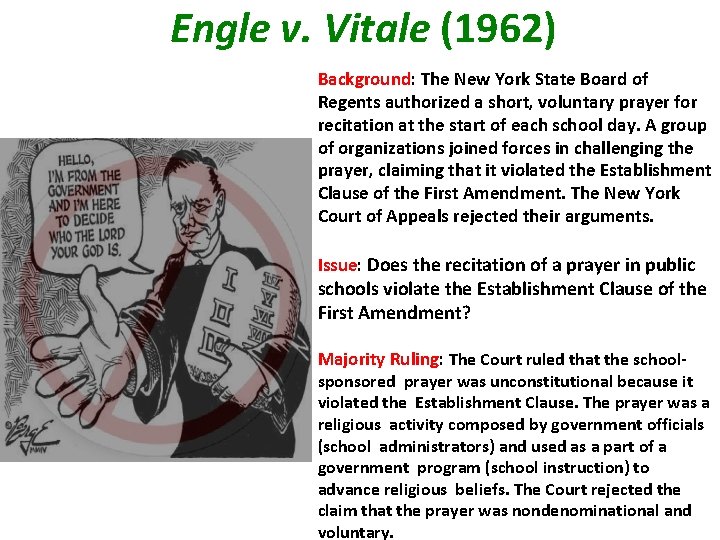
Engle v. Vitale (1962) Background: The New York State Board of Regents authorized a short, voluntary prayer for recitation at the start of each school day. A group of organizations joined forces in challenging the prayer, claiming that it violated the Establishment Clause of the First Amendment. The New York Court of Appeals rejected their arguments. Issue: Does the recitation of a prayer in public schools violate the Establishment Clause of the First Amendment? Majority Ruling: The Court ruled that the school- sponsored prayer was unconstitutional because it violated the Establishment Clause. The prayer was a religious activity composed by government officials (school administrators) and used as a part of a government program (school instruction) to advance religious beliefs. The Court rejected the claim that the prayer was nondenominational and voluntary.
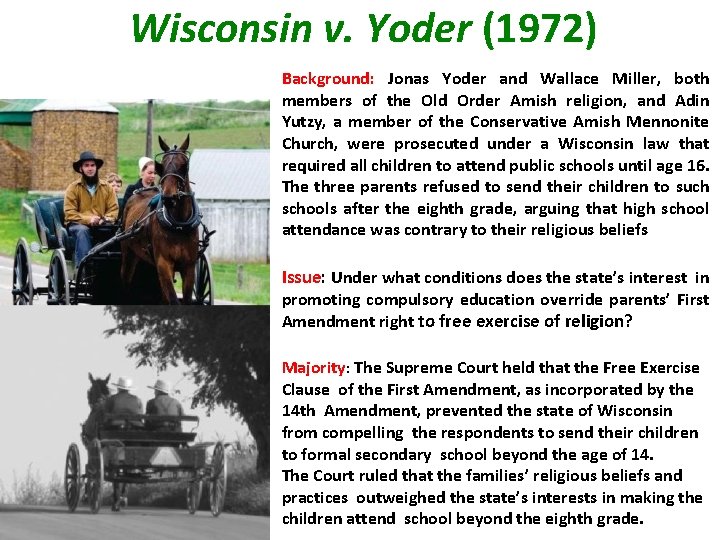
Wisconsin v. Yoder (1972) Background: Jonas Yoder and Wallace Miller, both members of the Old Order Amish religion, and Adin Yutzy, a member of the Conservative Amish Mennonite Church, were prosecuted under a Wisconsin law that required all children to attend public schools until age 16. The three parents refused to send their children to such schools after the eighth grade, arguing that high school attendance was contrary to their religious beliefs Issue: Under what conditions does the state’s interest in promoting compulsory education override parents’ First Amendment right to free exercise of religion? Majority: The Supreme Court held that the Free Exercise Clause of the First Amendment, as incorporated by the 14 th Amendment, prevented the state of Wisconsin from compelling the respondents to send their children to formal secondary school beyond the age of 14. The Court ruled that the families’ religious beliefs and practices outweighed the state’s interests in making the children attend school beyond the eighth grade.
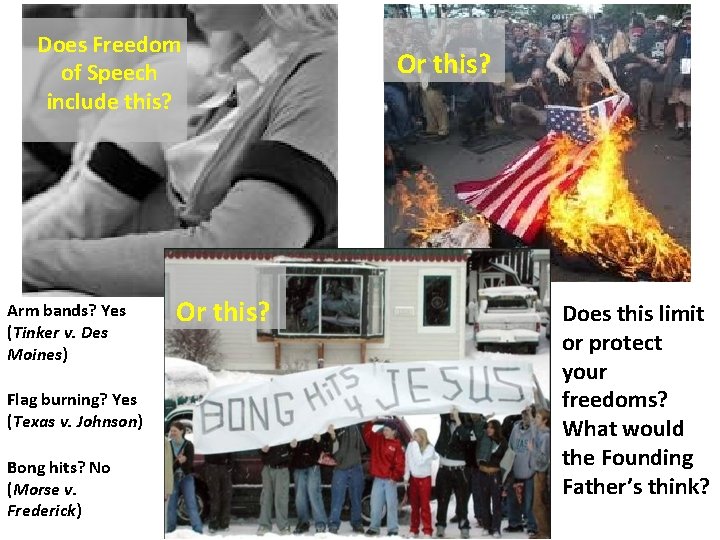
Does Freedom of Speech include this? Arm bands? Yes (Tinker v. Des Moines) Flag burning? Yes (Texas v. Johnson) Bong hits? No (Morse v. Frederick) Or this? Does this limit or protect your freedoms? What would the Founding Father’s think?
PROTECTED SPEECH • Prior restraint – Blocking speech before it is given. – Such action is presumed by courts to be unconstitutional. • Symbolic speech – Tinker v. Des Moines (1969) – wearing black armband at school at protest Vietnam War – Texas v. Johnson (1989) – flag burning 22
NON-PROTECTED SPEECH • Libel and slander – Libel is a written defamation that falsely attacks a person’s good name and reputation – Slander is a spoken defamation that falsely attacks a person’s good name and reputation 19
NON-PROTECTED SPEECH • Obscenity (i. e. pornography) – Miller v. California (1973) gave constitutional definition of obscenity 1. Appeals to prurient interest in sex, 2. Patently offensive, and 3. Must lack serious literary/artistic/political/scientific value. • If not meeting all three criteria, then not obscene – Sexually explicit materials about or aimed at minors are not protected by the First Amendment 20
NON-PROTECTED SPEECH • Commercial speech – Commercial speech (such as advertising) is more restricted than are expressions of opinion on religious, political, or other matters. – The Federal Trade Commission (FTC) decides what kinds of goods may be advertised on radio and television and regulates the content of such advertising. • Fighting words – Governments may punish certain well-defined and narrowly limited classes of speech that by their very utterance inflict injury or tend to incite an immediate breach of peace 21
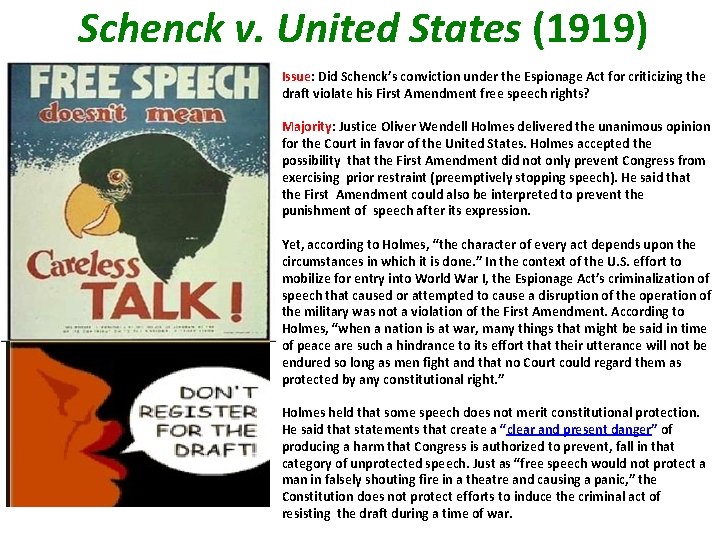
Schenck v. United States (1919) Issue: Did Schenck’s conviction under the Espionage Act for criticizing the draft violate his First Amendment free speech rights? Majority: Justice Oliver Wendell Holmes delivered the unanimous opinion for the Court in favor of the United States. Holmes accepted the possibility that the First Amendment did not only prevent Congress from exercising prior restraint (preemptively stopping speech). He said that the First Amendment could also be interpreted to prevent the punishment of speech after its expression. Yet, according to Holmes, “the character of every act depends upon the circumstances in which it is done. ” In the context of the U. S. effort to mobilize for entry into World War I, the Espionage Act’s criminalization of speech that caused or attempted to cause a disruption of the operation of the military was not a violation of the First Amendment. According to Holmes, “when a nation is at war, many things that might be said in time of peace are such a hindrance to its effort that their utterance will not be endured so long as men fight and that no Court could regard them as protected by any constitutional right. ” Holmes held that some speech does not merit constitutional protection. He said that statements that create a “clear and present danger” of producing a harm that Congress is authorized to prevent, fall in that category of unprotected speech. Just as “free speech would not protect a man in falsely shouting fire in a theatre and causing a panic, ” the Constitution does not protect efforts to induce the criminal act of resisting the draft during a time of war.
EXAMPLE OF PRIOR RESTRAINT In the famous case of New York Times v. United States (1971), the U. S. government sought a court order to keep the newspaper company, New York Times, from printing “The Pentagon Papers. ” These documents entailed U. S. secret missions and involvement in the Vietnam War, which were stolen and leaked to the press. The Nixon Administration, battling the Watergate Scandal at the same time, tried to prevent (prior restraint) the documents from being published. The Burger Court found that the government couldn’t show the papers endangered national security enough to justify prior restraint.
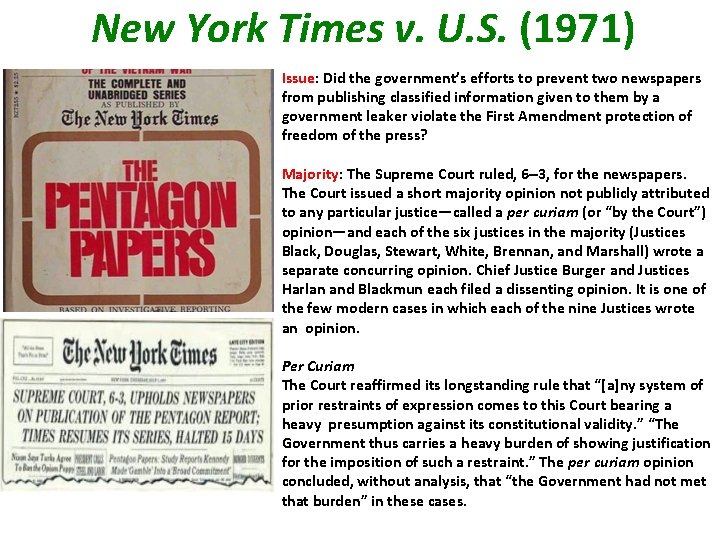
New York Times v. U. S. (1971) Issue: Did the government’s efforts to prevent two newspapers from publishing classified information given to them by a government leaker violate the First Amendment protection of freedom of the press? Majority: The Supreme Court ruled, 6 3, for the newspapers. The Court issued a short majority opinion not publicly attributed to any particular justice—called a per curiam (or “by the Court”) opinion—and each of the six justices in the majority (Justices Black, Douglas, Stewart, White, Brennan, and Marshall) wrote a separate concurring opinion. Chief Justice Burger and Justices Harlan and Blackmun each filed a dissenting opinion. It is one of the few modern cases in which each of the nine Justices wrote an opinion. Per Curiam The Court reaffirmed its longstanding rule that “[a]ny system of prior restraints of expression comes to this Court bearing a heavy presumption against its constitutional validity. ” “The Government thus carries a heavy burden of showing justification for the imposition of such a restraint. ” The per curiam opinion concluded, without analysis, that “the Government had not met that burden” in these cases.
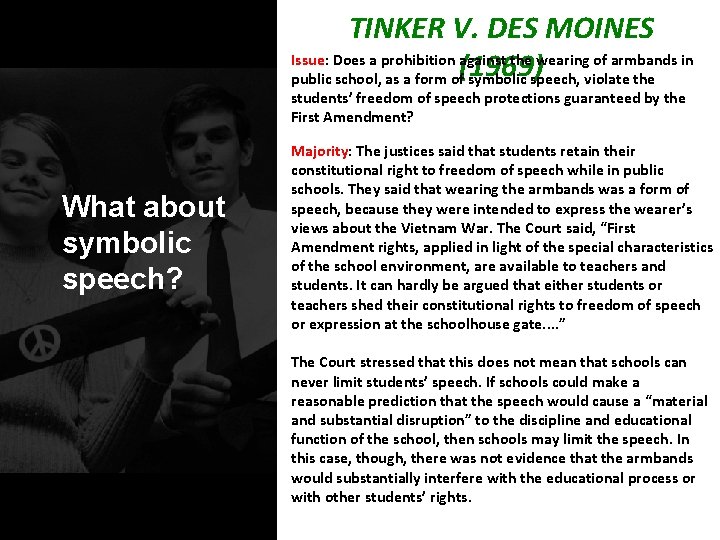
TINKER V. DES MOINES Issue: Does a prohibition against the wearing of armbands in public school, as a form of(1969) symbolic speech, violate the students’ freedom of speech protections guaranteed by the First Amendment? What about symbolic speech? Majority: The justices said that students retain their constitutional right to freedom of speech while in public schools. They said that wearing the armbands was a form of speech, because they were intended to express the wearer’s views about the Vietnam War. The Court said, “First Amendment rights, applied in light of the special characteristics of the school environment, are available to teachers and students. It can hardly be argued that either students or teachers shed their constitutional rights to freedom of speech or expression at the schoolhouse gate. . ” The Court stressed that this does not mean that schools can never limit students’ speech. If schools could make a reasonable prediction that the speech would cause a “material and substantial disruption” to the discipline and educational function of the school, then schools may limit the speech. In this case, though, there was not evidence that the armbands would substantially interfere with the educational process or with other students’ rights.
FREEDOM OF ASSEMBLY PUBLIC FORUMS AND TIME, PLACE, AND MANNER REGULATIONS • Governments may not specify what can or cannot be said, but they can make reasonable time, place, and manner regulations for the holdings of assemblies, protests, or gatherings • Police must have right to order groups to disperse (public order) • Problem of “heckler’s veto”: if govt. restricted assembly every time an opposing group claimed that there might be “violence or disorder” there would be very few assemblies. Courts are therefore reluctant to impose prior restraint. • The extent to which governments may limit access depends on the kind of forums involved: – Public forums (historically associated with free exercise such as streets, parks) – Limited public forums (public property such as city hall or schools after-hours) – Nonpublic forums (libraries, courthouses, government offices) - can not interfere with normal activities in order to stage a public protest • Civil disobedience is not a protected right 29
- Slides: 18