
Is the Inner Radio Jet of BL Lac
Is the Inner Radio Jet of BL Lac Precessing? R. L. Mutel University of Iowa Astrophysics Seminar 17 September 2003 UI Astrophysics Seminar Sept 2003
BL Lac VLBP monitoring log • • 9 epochs from 1998. 7 – 2001. 4 3 -5 month separation between observations 15, 22, 43 GHz, VLBA, full polarization EVPA calibration using VLBA calibration Database UI Astrophysics Seminar Sept 2003
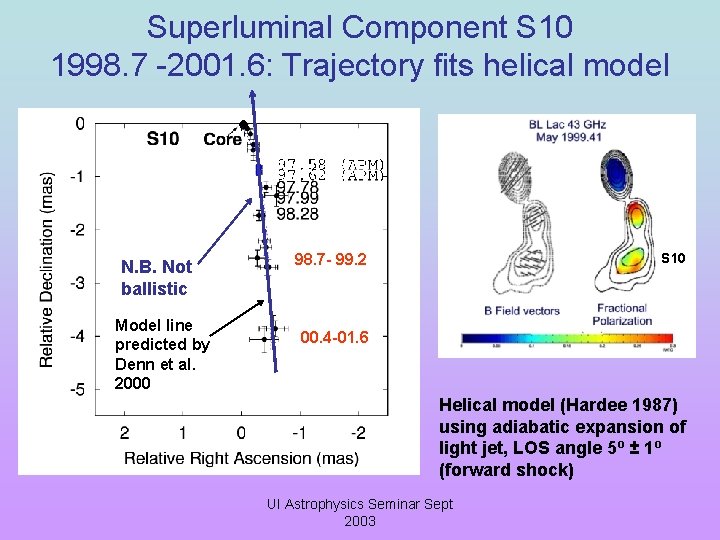
Superluminal Component S 10 1998. 7 -2001. 6: Trajectory fits helical model N. B. Not ballistic Model line predicted by Denn et al. 2000 S 10 98. 7 - 99. 2 00. 4 -01. 6 Helical model (Hardee 1987) using adiabatic expansion of light jet, LOS angle 5º ± 1º (forward shock) UI Astrophysics Seminar Sept 2003
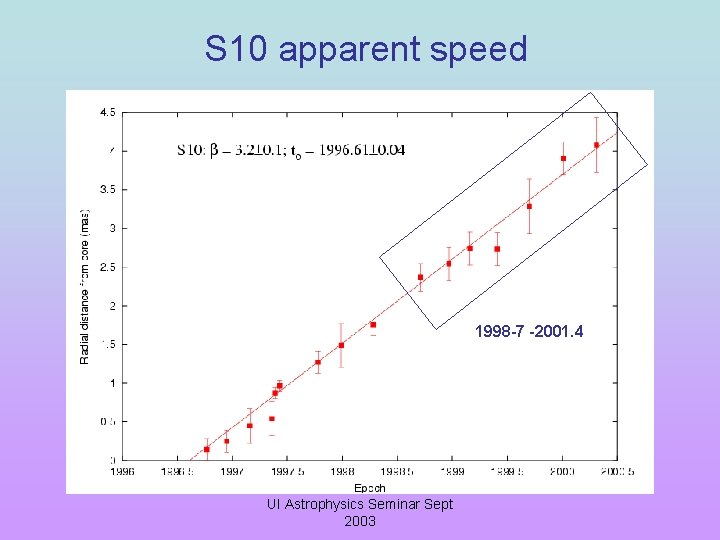
S 10 apparent speed 1998 -7 -2001. 4 UI Astrophysics Seminar Sept 2003

Bl Lac May 1999 PPOL maps 1. Core, component EVPA structure at high frequencies 2. Low Rotation measure in jet, vs. high RM of core Core (high RM) Core N Core S S 11 (low RM) Note: hint of gradient S 10 (low RM) 15 GHz 22 GHz UI Astrophysics Seminar Sept 2003 43 GHz
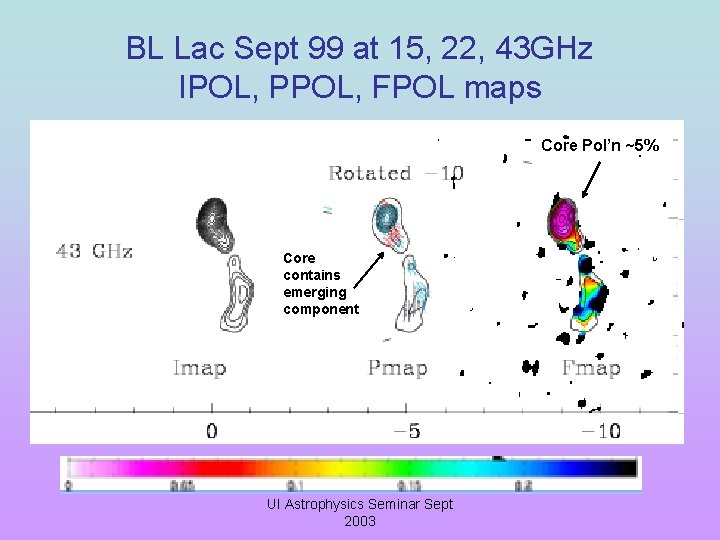
BL Lac Sept 99 at 15, 22, 43 GHz IPOL, PPOL, FPOL maps Note: low Core polarization (~2%) Core Pol’n ~5% Core contains emerging component S 9 only visible on PPOL map UI Astrophysics Seminar Sept 2003
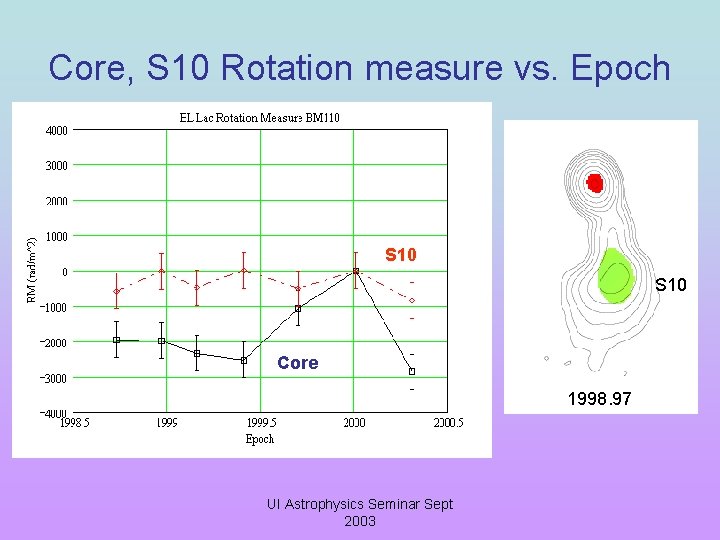
Core, S 10 Rotation measure vs. Epoch S 10 Core 1998. 97 UI Astrophysics Seminar Sept 2003
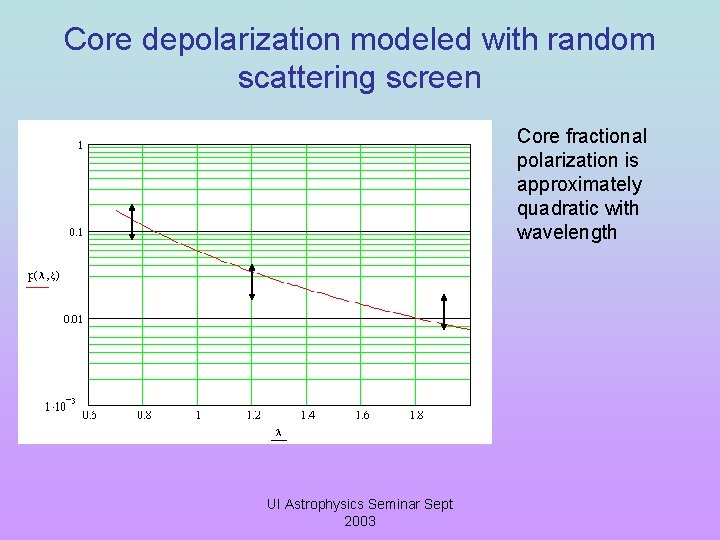
Core depolarization modeled with random scattering screen Core fractional polarization is approximately quadratic with wavelength UI Astrophysics Seminar Sept 2003
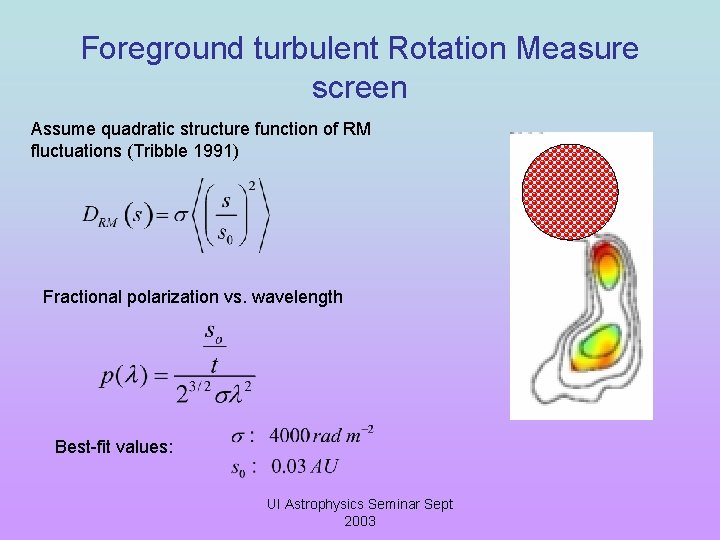
Foreground turbulent Rotation Measure screen Assume quadratic structure function of RM fluctuations (Tribble 1991) Fractional polarization vs. wavelength Best-fit values: UI Astrophysics Seminar Sept 2003
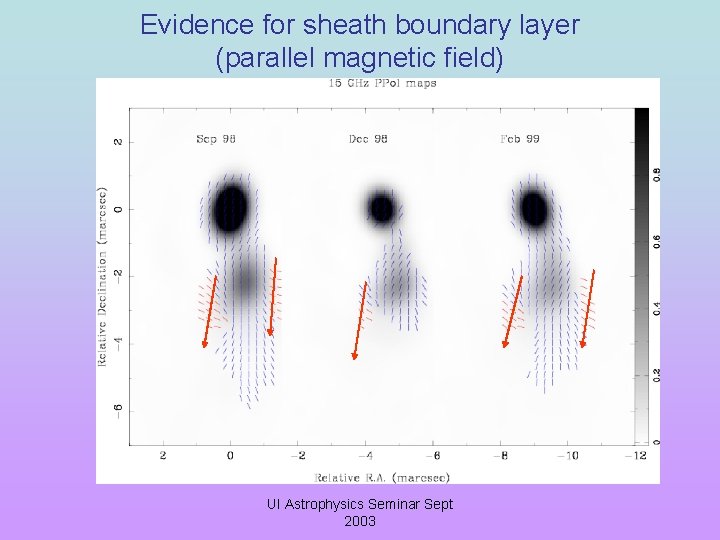
Evidence for sheath boundary layer (parallel magnetic field) UI Astrophysics Seminar Sept 2003
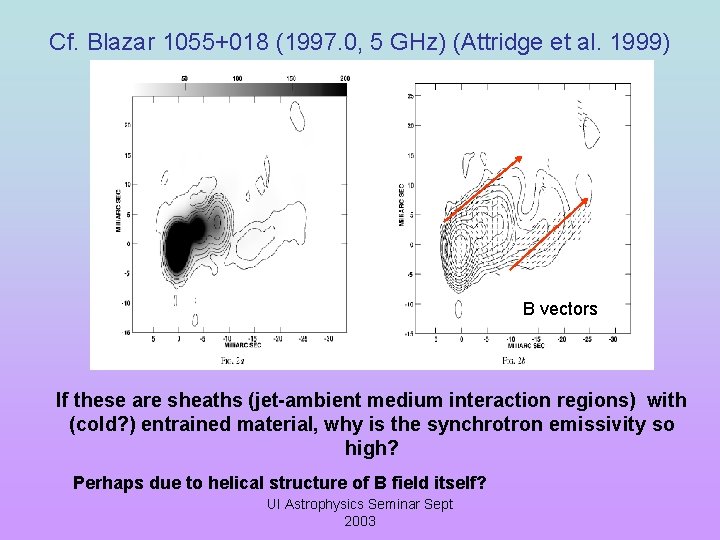
Cf. Blazar 1055+018 (1997. 0, 5 GHz) (Attridge et al. 1999) B vectors If these are sheaths (jet-ambient medium interaction regions) with (cold? ) entrained material, why is the synchrotron emissivity so high? Perhaps due to helical structure of B field itself? UI Astrophysics Seminar Sept 2003
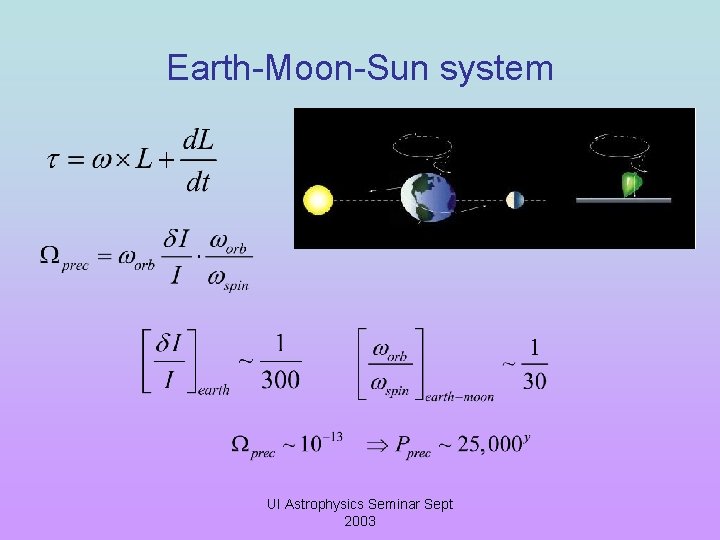
Earth-Moon-Sun system UI Astrophysics Seminar Sept 2003
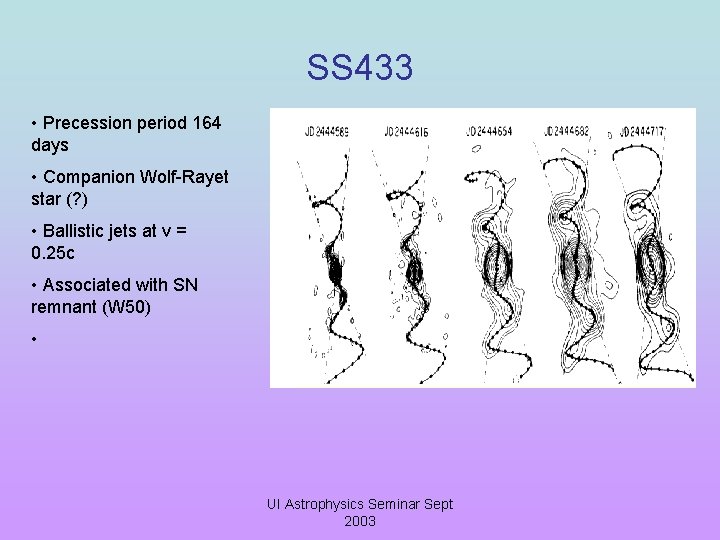
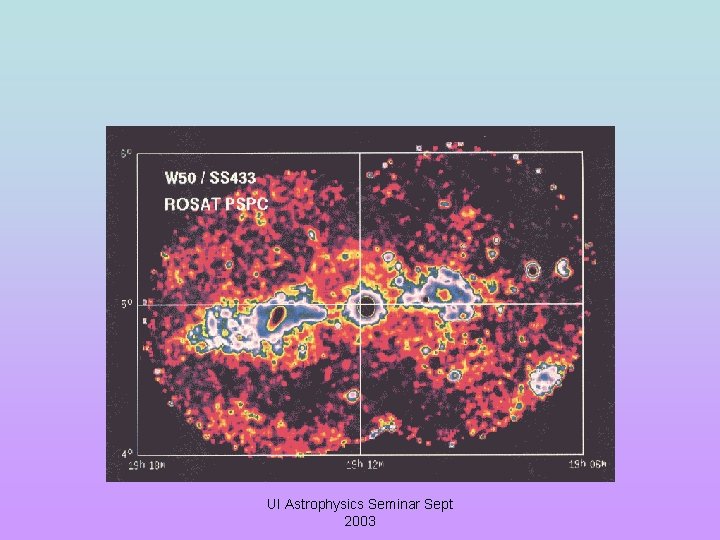
SS 433 • Precession period 164 days • Companion Wolf-Rayet star (? ) • Ballistic jets at v = 0. 25 c • Associated with SN remnant (W 50) • UI Astrophysics Seminar Sept 2003
UI Astrophysics Seminar Sept 2003
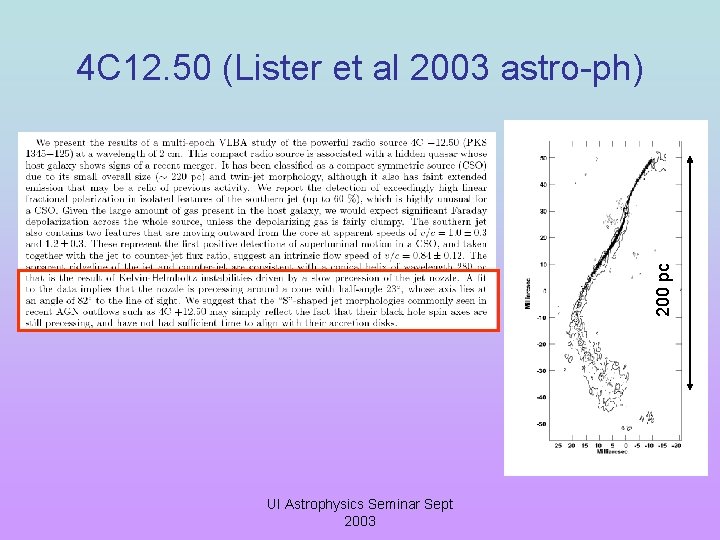
200 pc 4 C 12. 50 (Lister et al 2003 astro-ph) UI Astrophysics Seminar Sept 2003
Is the jet nozzle of BL Precessing? • Precession: physics summary • Examples – Earth-Moon-Sun system (companion torque) – Galactic jets: SS 433 (companion torque) – Extragalactic Jets: 4 C 12. 50 (Accretion disk torque? ) • Evidence for BL Lac Precession (Stirling et al. MNRAS 2003) • Independent test (Mutel et al. 2003) • Possible problems with precession – Binary hypothesis: Gravitational radiation timescale – Accretion disk precession: Lens-Thirring timescale UI Astrophysics Seminar Sept 2003
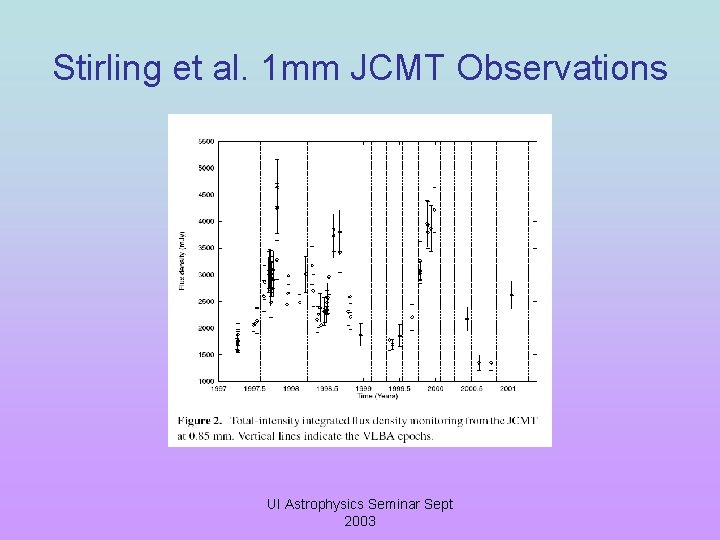
Stirling et al. 1 mm JCMT Observations UI Astrophysics Seminar Sept 2003
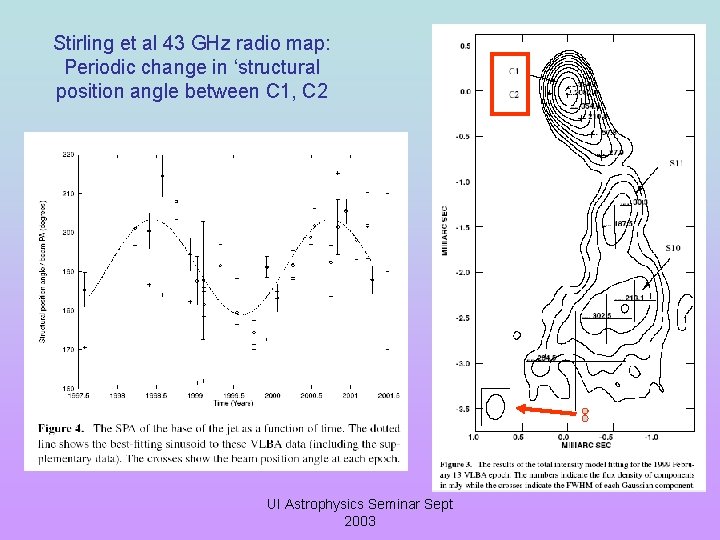
Stirling et al 43 GHz radio map: Periodic change in ‘structural position angle between C 1, C 2 UI Astrophysics Seminar Sept 2003
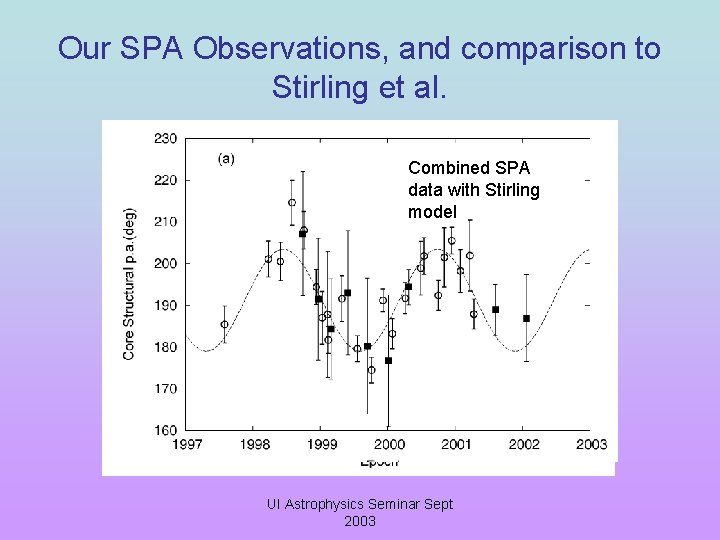
Our SPA Observations, and comparison to Stirling et al. Our data, constant model 2 = 0. 83 Our data. Combined with best-fit. SPA model Stirling (solid, 2 =data 0. 58), with Stirling model (dashed) UI Astrophysics Seminar Sept 2003
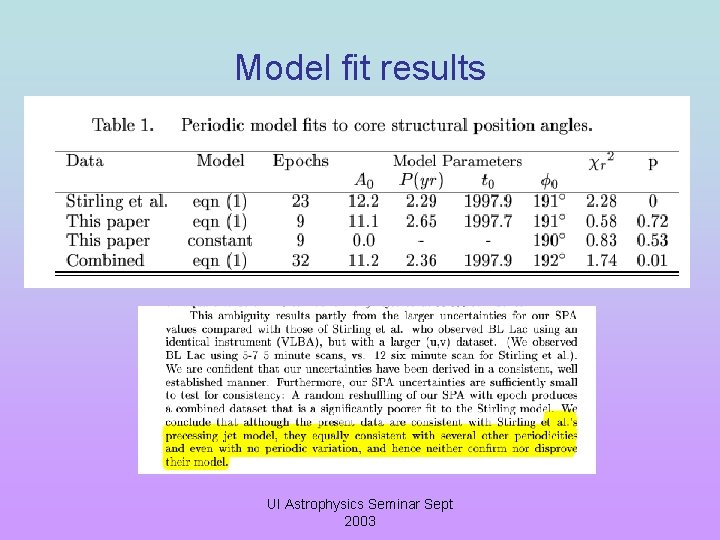
Model fit results UI Astrophysics Seminar Sept 2003
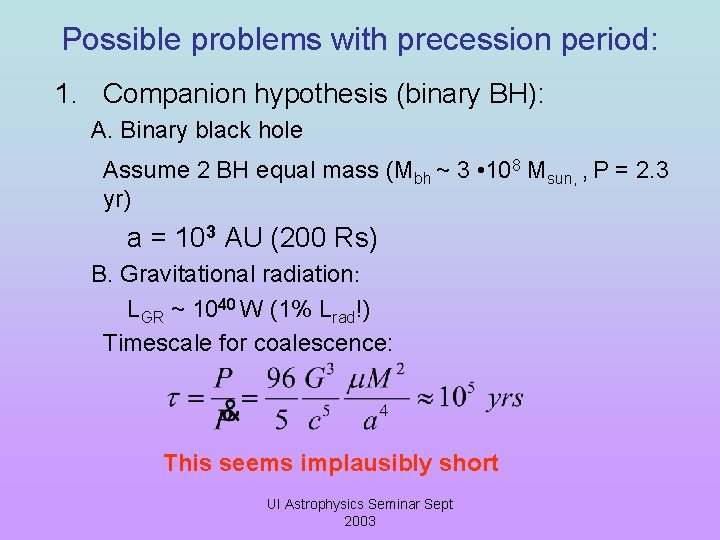
Possible problems with precession period: 1. Companion hypothesis (binary BH): A. Binary black hole Assume 2 BH equal mass (Mbh ~ 3 • 108 Msun, , P = 2. 3 yr) a = 103 AU (200 Rs) B. Gravitational radiation: LGR ~ 1040 W (1% Lrad!) Timescale for coalescence: This seems implausibly short UI Astrophysics Seminar Sept 2003
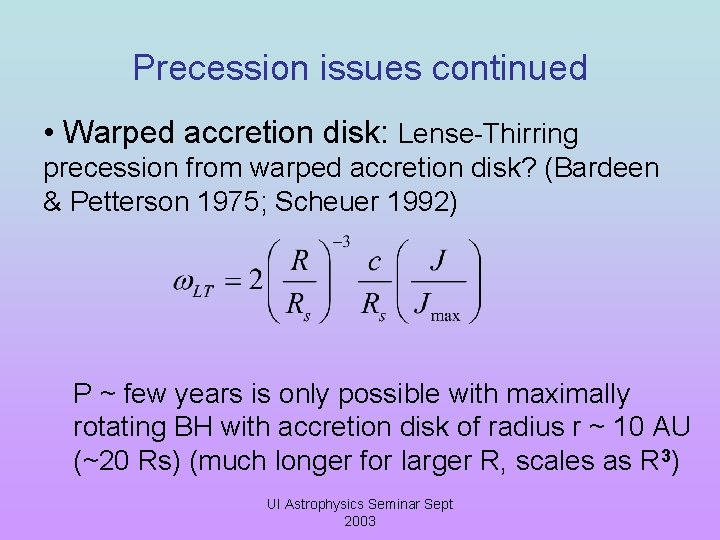
Precession issues continued • Warped accretion disk: Lense-Thirring precession from warped accretion disk? (Bardeen & Petterson 1975; Scheuer 1992) P ~ few years is only possible with maximally rotating BH with accretion disk of radius r ~ 10 AU (~20 Rs) (much longer for larger R, scales as R 3) UI Astrophysics Seminar Sept 2003
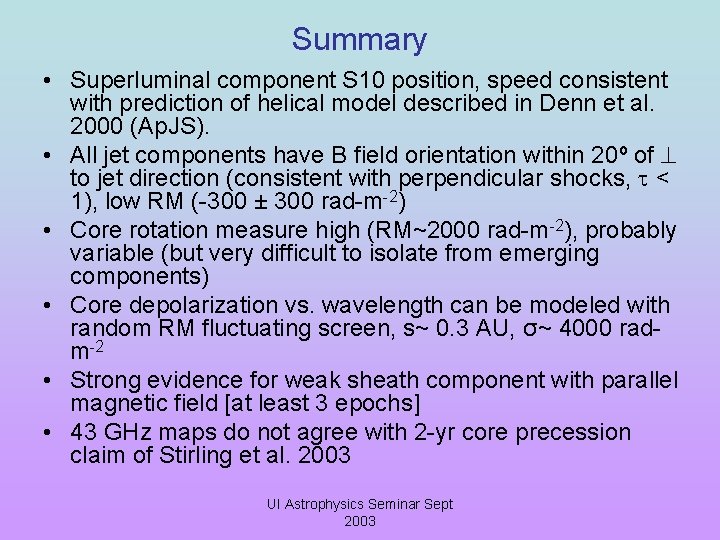
Summary • Superluminal component S 10 position, speed consistent with prediction of helical model described in Denn et al. 2000 (Ap. JS). • All jet components have B field orientation within 20º of to jet direction (consistent with perpendicular shocks, < 1), low RM (-300 ± 300 rad-m-2) • Core rotation measure high (RM~2000 rad-m-2), probably variable (but very difficult to isolate from emerging components) • Core depolarization vs. wavelength can be modeled with random RM fluctuating screen, s~ 0. 3 AU, σ~ 4000 radm-2 • Strong evidence for weak sheath component with parallel magnetic field [at least 3 epochs] • 43 GHz maps do not agree with 2 -yr core precession claim of Stirling et al. 2003 UI Astrophysics Seminar Sept 2003
- Slides: 23