
Is Social Exclusion a Moral Issue Moral Violation
- Slides: 1
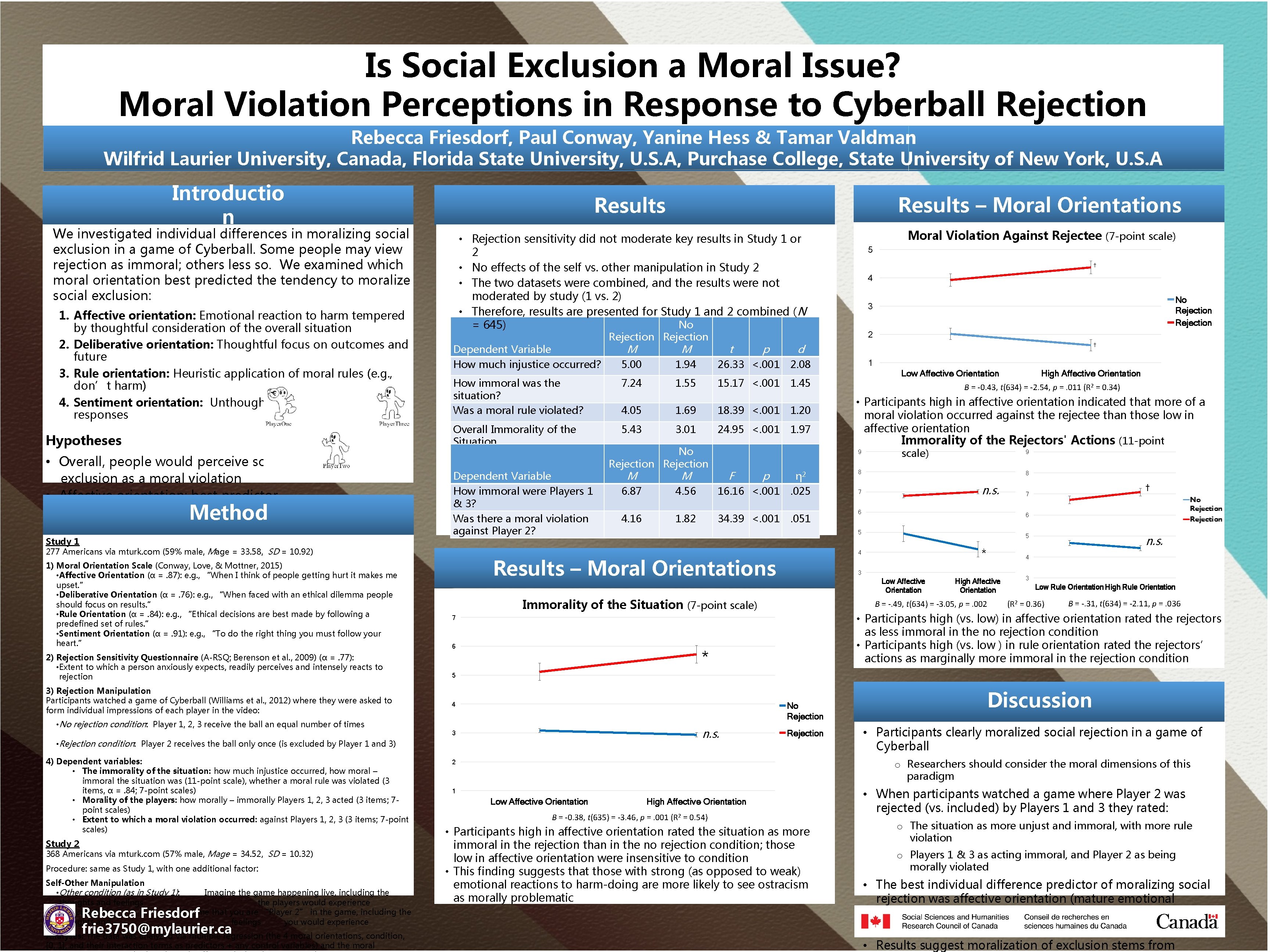
Is Social Exclusion a Moral Issue? Moral Violation Perceptions in Response to Cyberball Rejection Rebecca Friesdorf, Paul Conway, Yanine Hess & Tamar Valdman Wilfrid Laurier University, Canada, Florida State University, U. S. A, Purchase College, State University of New York, U. S. A Introductio n We investigated individual differences in moralizing social exclusion in a game of Cyberball. Some people may view rejection as immoral; others less so. We examined which moral orientation best predicted the tendency to moralize social exclusion: 1. Affective orientation: Emotional reaction to harm tempered by thoughtful consideration of the overall situation 2. Deliberative orientation: Thoughtful focus on outcomes and future 3. Rule orientation: Heuristic application of moral rules (e. g. , don’t harm) 4. Sentiment orientation: Unthoughtful, idiosyncratic responses Hypotheses • Overall, people would perceive social exclusion as a moral violation • Affective orientation: best predictor of moralization of exclusion Method Study 1 2) Rejection Sensitivity Questionnaire (A-RSQ; Berenson et al. , 2009) (α =. 77): • Extent to which a person anxiously expects, readily perceives and intensely reacts to rejection 3) Rejection Manipulation Participants watched a game of Cyberball (Williams et al. , 2012) where they were asked to form individual impressions of each player in the video: • No rejection condition: Player 1, 2, 3 receive the ball an equal number of times Results – Moral Orientations • Rejection sensitivity did not moderate key results in Study 1 or 2 • No effects of the self vs. other manipulation in Study 2 • The two datasets were combined, and the results were not moderated by study (1 vs. 2) • Therefore, results are presented for Study 1 and 2 combined ( N No = 645) Moral Violation Against Rejectee (7 -point scale) M 5. 00 1. 94 26. 33 <. 001 2. 08 How immoral was the situation? Was a moral rule violated? 7. 24 1. 55 15. 17 <. 001 1. 45 4. 05 1. 69 18. 39 <. 001 1. 20 Overall Immorality of the Situation 5. 43 3. 01 24. 95 <. 001 1. 97 Dependent Variable How immoral were Players 1 & 3? Was there a moral violation against Player 2? Study 2 368 Americans via mturk. com (57% male, Mage = 34. 52, SD = 10. 32) Procedure: same as Study 1, with one additional factor: Self-Other Manipulation • Other condition (as in Study 1): Imagine the game happening live, including the thoughts and feelings the players would experience • Self condition: Imagine that you are “Player 2” in the game, including the thoughts and feelings you would experience Rebecca Friesdorf frie 3750@mylaurier. ca Analyses: The data was analyzed via multiple regression (the 4 moral orientations, condition, [0, 1], and their interaction terms as predictors + any control variables) and the moral t No Rejection M M 6. 87 4. 56 4. 16 p F p 34. 39 <. 001 η 2. 025. 051 4 No Rejection 3 2 † 1 Low Affective Orientation High Affective Orientation B = -0. 43, t(634) = -2. 54, p =. 011 (R 2 = 0. 34) • Participants high in affective orientation indicated that more of a moral violation occurred against the rejectee than those low in affective orientation Immorality of the Rejectors' Actions (11 -point scale) 9 8 8 n. s. 7 6 † 7 6 5 n. s. 5 * 4 4 3 Low Affective Orientation Immorality of the Situation (7 -point scale) High Affective Orientation B = -. 49, t(634) = -3. 05, p =. 002 3 Low Rule Orientation High Rule Orientation (R 2 = 0. 36) B = -. 31, t(634) = -2. 11, p =. 036 • Participants high (vs. low) in affective orientation rated the rejectors as less immoral in the no rejection condition • Participants high (vs. low ) in rule orientation rated the rejectors’ actions as marginally more immoral in the rejection condition 7 6 † 9 16. 16 <. 001 1. 82 5 d Results – Moral Orientations * 5 4 No Rejection n. s. 3 • Rejection condition: Player 2 receives the ball only once (is excluded by Player 1 and 3) 4) Dependent variables: • The immorality of the situation: how much injustice occurred, how moral – immoral the situation was (11 -point scale), whether a moral rule was violated (3 items, α =. 84; 7 -point scales) • Morality of the players: how morally – immorally Players 1, 2, 3 acted (3 items; 7 point scales) • Extent to which a moral violation occurred: against Players 1, 2, 3 (3 items; 7 -point scales) Rejection M Dependent Variable How much injustice occurred? 277 Americans via mturk. com (59% male, Mage = 33. 58, SD = 10. 92) 1) Moral Orientation Scale (Conway, Love, & Mottner, 2015) • Affective Orientation (α =. 87): e. g. , “When I think of people getting hurt it makes me upset. ” • Deliberative Orientation (α =. 76): e. g. , “When faced with an ethical dilemma people should focus on results. ” • Rule Orientation (α =. 84): e. g. , “Ethical decisions are best made by following a predefined set of rules. ” • Sentiment Orientation (α =. 91): e. g. , “To do the right thing you must follow your heart. ” Results Rejection Discussion • Participants clearly moralized social rejection in a game of Cyberball o Researchers should consider the moral dimensions of this paradigm 2 1 Low Affective Orientation High Affective Orientation B = -0. 38, t(635) = -3. 46, p =. 001 (R 2 = 0. 54) • Participants high in affective orientation rated the situation as more immoral in the rejection than in the no rejection condition; those low in affective orientation were insensitive to condition • This finding suggests that those with strong (as opposed to weak) emotional reactions to harm-doing are more likely to see ostracism as morally problematic • When participants watched a game where Player 2 was rejected (vs. included) by Players 1 and 3 they rated: o The situation as more unjust and immoral, with more rule violation o Players 1 & 3 as acting immoral, and Player 2 as being morally violated • The best individual difference predictor of moralizing social rejection was affective orientation (mature emotional reaction to harm), with some support from rule orientation (focus on moral rules) • Results suggest moralization of exclusion stems from