
Is Justified True Belief Knowledge Edmund Gettier Before
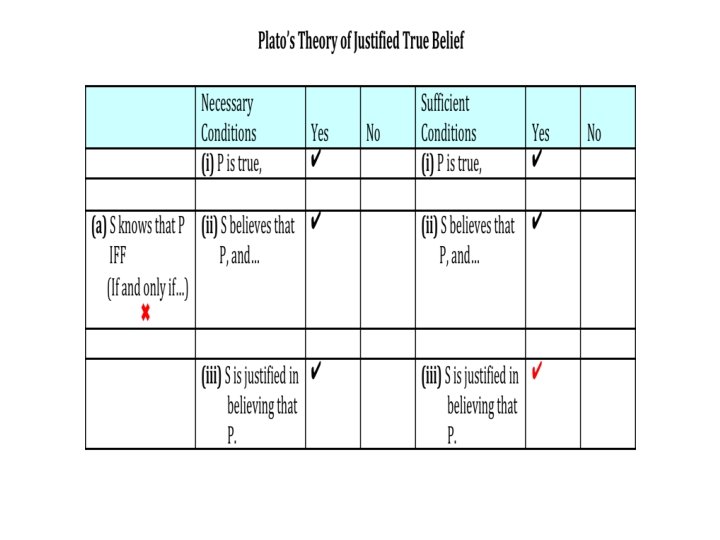
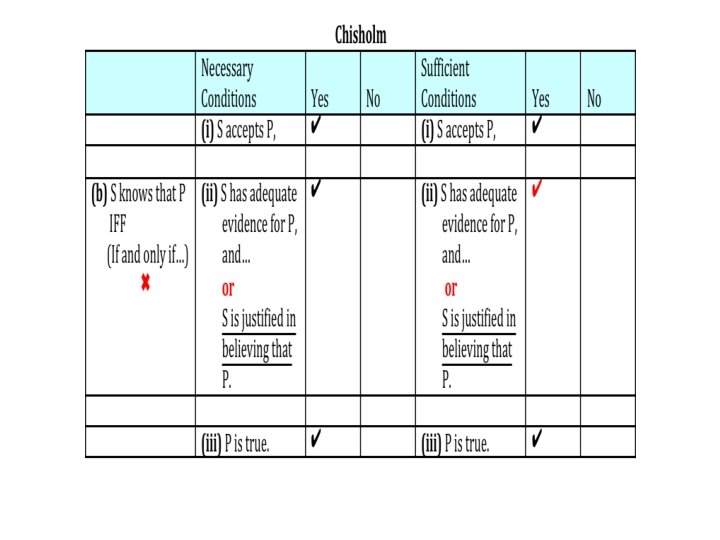
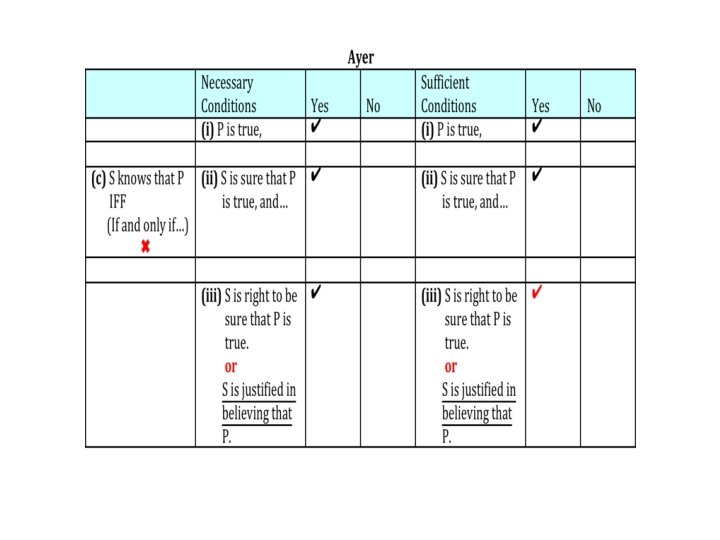
“Is Justified True Belief Knowledge? ” Edmund Gettier Before we can ‘unpack’ the argument posed by Gettier in “Is Justified True Belief Knowledge, ” we must understand the following: What is epistemology? Who is Plato, Chisholm, and Ayer? What is JTB (Justified True Belief)? What is meant by necessary conditions? What is meant by sufficient conditions? What is justification? What is meant by entailment?
What is epistemology? Epistemology is the study of knowledge. Epistemologists concern themselves with a number of tasks, which we might sort into two categories. First, we must determine the nature of knowledge; that is, what does it mean to say that someone knows, or fails to know, something? Second, we must determine the extent of human knowledge; that is, how much do we, or can we, know? (http: //www. iep. utm. edu/epistemo/)
Who is Plato, Chisholm, and Ayer? Plato is one of the world's best known and most widely read and studied philosophers. He was the student of Socrates and the teacher of Aristotle, and he wrote in the middle of the fourth century B. C. E. in ancient Greece. Though influenced primarily by Socrates, to the extent that Socrates is usually the main character in many of Plato's writings, he was also influenced by Heraclitus, Parmenides, and the Pythagoreans. http: //www. iep. utm. edu/plato/ Roderick Milton Chisholm (1916 – 1999) is widely regarded as one of the most creative, productive, and influential American philosophers of the 20 th Century. Chisholm worked in epistemology, metaphysics, ethics, philosophy of language, philosophy of mind, and other areas. http: //plato. stanford. edu/entries/chisholm/ Sir A. J. Ayer, in full Sir Alfred Jules Ayer (1910 – 1989) was British philosopher and educator and a leading representative of logical positivism through his widely read work Language, Truth, and Logic (1936). Although Ayer’s views changed considerably after the 1930 s, becoming more moderate and increasingly subtle, he remained loyal to empiricism, convinced that all knowledge of the world derives from sense experience and that nothing in experience justifies a belief in God or in any other extravagant metaphysical entity. http: //www. britannica. com/EBchecked/topic/46462/Sir-AJ-Ayer
What are necessary and sufficient conditions? A necessary condition for some state of affairs P is a condition that must be satisfied in order for P to obtain. For example, what are the necessary conditions P that must be satisfied in order for some student S to pass a course at some college or university? The student must: (1) submit assignments in a timely manner (2) take all of the exams and quizzes This means that if the student S does not submit the assignments in a timely manner and take all of the exams and quizzes, student S will not pass the class.
What are necessary and sufficient conditions? (Contd. ) A sufficient condition for some state of affairs P is a condition that, if satisfied, guarantees that P obtains. For example, what are the sufficient conditions P that must be satisfied to guarantee some student S will pass a course at some college or university? The student must: (1) get a passing grade on all assignments (2) pass all exams and quizzes This means that if the student S gets a passing grade on all assignments and passes all exams and quizzes, this will guarantee that student S will pass the class.
What is justification? Loosely speaking, justification is the reason why someone (properly) holds the belief, the explanation as to why the belief is a true one, or an account of how one knows what one know. https: //www. princeton. edu/~achaney/tmve/wiki 100 k/docs/Theory_of_justification. ht ml Accidental truth, accidental justification, or “luck” are considered as justification. What is entailment? Entailment means that if P entails Q, then where P is true, Q is true; and Q is the logical consequence of P. For example, the proposition ‘Joe has a car and John has a new job’ entails the proposition ‘Joe has a car’. This means that ‘Joe has a car’ is the logical consequence of ‘Joe has a car and John has a new job’. Similarly, the proposition ‘Mary is a student’ entails the proposition ‘Mary is a student or Molly is a teacher’…
Gettier’s Argument Premise 1: ‘S being justified in believing that P’ is a necessary condition for ‘S knows P’ though it is possible for S to justified in believing a proposition that is false. Premise 2: S is justified in believing in proposition Q that is entailed in (or a logical consequence of) proposition P, which S believes to be true. Conclusion: JTB (Justified True Belief) does not necessarily fulfill the sufficient conditions that guarantee the truth of the proposition that S knows P.
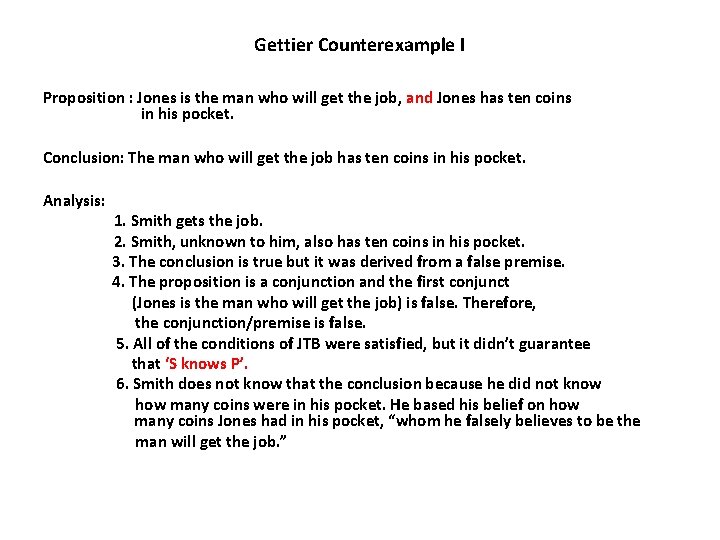
Gettier Counterexample I Proposition : Jones is the man who will get the job, and Jones has ten coins in his pocket. Conclusion: The man who will get the job has ten coins in his pocket. Analysis: 1. Smith gets the job. 2. Smith, unknown to him, also has ten coins in his pocket. 3. The conclusion is true but it was derived from a false premise. 4. The proposition is a conjunction and the first conjunct (Jones is the man who will get the job) is false. Therefore, the conjunction/premise is false. 5. All of the conditions of JTB were satisfied, but it didn’t guarantee that ‘S knows P’. 6. Smith does not know that the conclusion because he did not know how many coins were in his pocket. He based his belief on how many coins Jones had in his pocket, “whom he falsely believes to be the man will get the job. ”
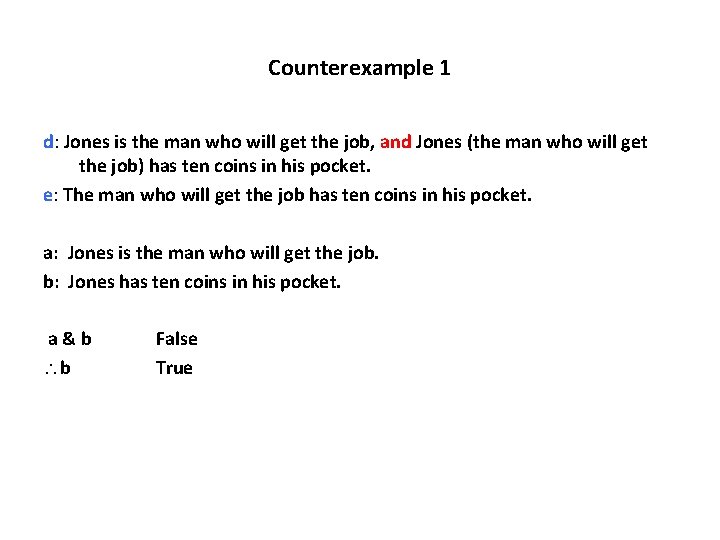
Counterexample 1 d: Jones is the man who will get the job, and Jones (the man who will get the job) has ten coins in his pocket. e: The man who will get the job has ten coins in his pocket. a: Jones is the man who will get the job. b: Jones has ten coins in his pocket. a&b b False True
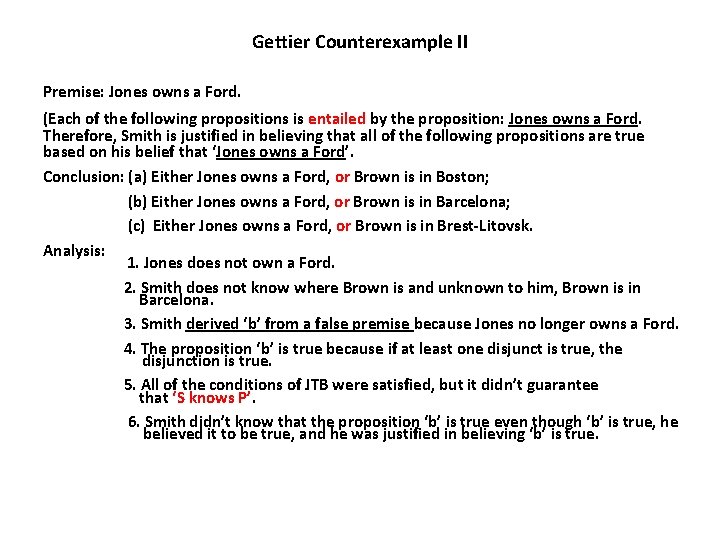
Gettier Counterexample II Premise: Jones owns a Ford. (Each of the following propositions is entailed by the proposition: Jones owns a Ford. Therefore, Smith is justified in believing that all of the following propositions are true based on his belief that ‘Jones owns a Ford’. Conclusion: (a) Either Jones owns a Ford, or Brown is in Boston; (b) Either Jones owns a Ford, or Brown is in Barcelona; (c) Either Jones owns a Ford, or Brown is in Brest-Litovsk. Analysis: 1. Jones does not own a Ford. 2. Smith does not know where Brown is and unknown to him, Brown is in Barcelona. 3. Smith derived ‘b’ from a false premise because Jones no longer owns a Ford. 4. The proposition ‘b’ is true because if at least one disjunct is true, the disjunction is true. 5. All of the conditions of JTB were satisfied, but it didn’t guarantee that ‘S knows P’. 6. Smith didn’t know that the proposition ‘b’ is true even though ‘b’ is true, he believed it to be true, and he was justified in believing ‘b’ is true.
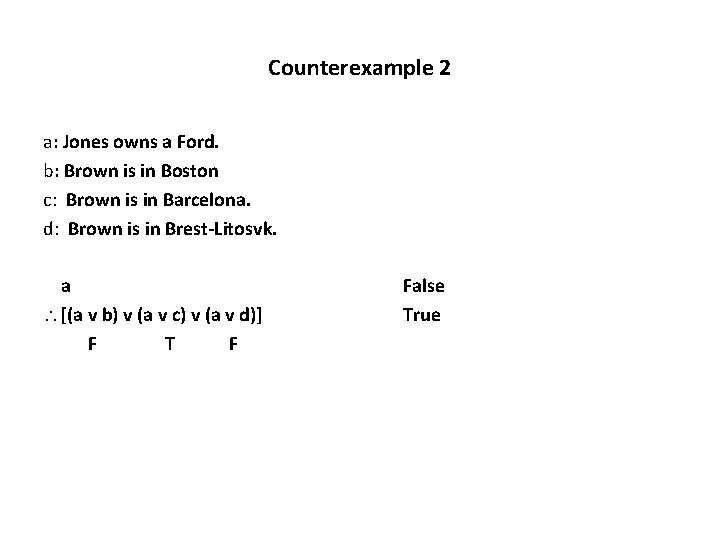
Counterexample 2 a: Jones owns a Ford. b: Brown is in Boston c: Brown is in Barcelona. d: Brown is in Brest-Litosvk. a [(a v b) v (a v c) v (a v d)] F T F False True
- Slides: 14