
Is it true Hemi thyroidectomy Partial thyroidectomy Subtotal
Is it true?


• • • Hemi thyroidectomy Partial thyroidectomy Subtotal thyroidectomy Total thyroidectomy Completion thyroidectomy endoscopic thyroid surgery

Total thyroidectomy is prefered • To avoid recurrence • To avoid post operative hypothyroidism • To avoid re-operation in cases of accidental malignancy
After total thyroidectomy • The patient will take replacement therapy for life
The story started at 1927 at Washington university school of medicine, Department of pathology When group of Guinea pigs (150 animals) were used for an experiment The 2 lobes of thyroid gland were implanted in s. c. pockets in the anterior abdominal wall The results were as follows
• In the 1 st 2 days gland was necrotic large central part from the • After 48 hours surrounded the graft fibroblasts & PNLs • After 1 day the center of the graft these cells began to appear at • After 4 days the necrotic center became smaller & new blood vessels were seen & increase at number of fibroblasts found • After 20 days the groups of acini were destroyed by fibrous bands
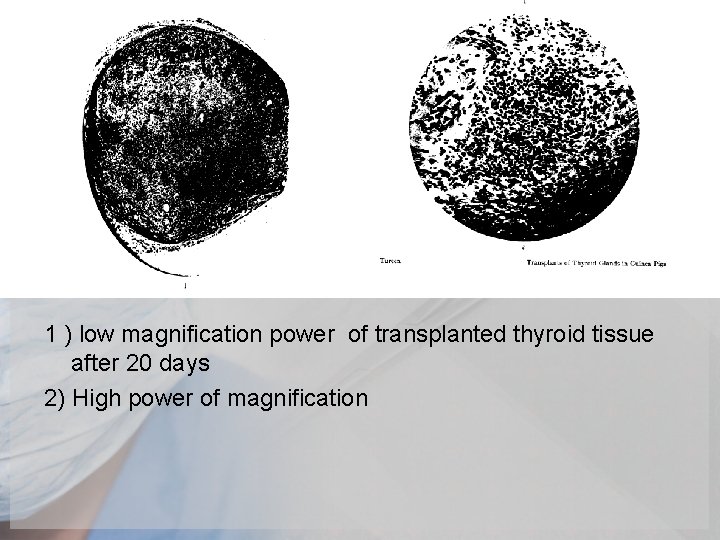
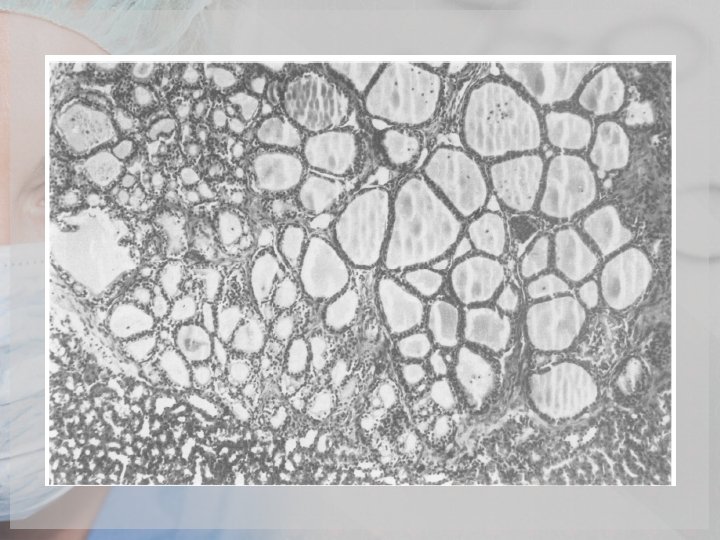
1 ) low magnification power of transplanted thyroid tissue after 20 days 2) High power of magnification
Another trial done at University of Minnesota, at 1975 but used rats & the result was the next text Fresh grafts functioned transiently but then failed due to rejection. No function was detected for cultured grafts, and rejection was seen histologically. The rat thyroid graft therefore differs from the rat parathyroid allograft, which often
After that many trials done with multiple modalities in age & type of animals & site of insertion of the graft & size of the graft tissues The 1 st trial that has seen the light was by Kerkof has demonstrated that monolayers of rat thyroid cells in tissue culture will reorganize into a follicular pattern in the presence of thyroid stimulating hormone (TSH). iodoamino acids was also enhanced& if maintained in culture for 3 days were shown to reorganize into follicles when reimplanted subcutaneously into thyroidectomized recipient rats of the same strain. The reorganized follicles functioned, incorporating Iodine into iodoamino acids and releasing -thyroxine into the circulation.
1 ). A piece of the excised gland is finely minced, mixed with saline as emulsion, and injected in thigh muscles. 2) the surgical specimen is partially cryopreserved at( -196) degrees C until it is used for autotransplantation
1. injected in thigh muscles 2. autotransplantion into the forearm muscle 3. intramuscularly into the quadriceps muscle 4. in the rectus abdominalis muscle
1. By the emulsion method gland 2. By the cryo method cryopreserved thyroid tissue 5 - 10 grams of the 2. 5 to 3. 5 g of
• Some of the results were very promising 1. In the emulsion method. TSH was elevated in the majority of cases to maintain normal or near normal thyroid hormones. Ten-gram implants showed higher isotope uptake than 5 -g, although this difference was not reflected by thyroid hormone profile. The implant seemed to function better with the passage of time from 2 months to 12 months.
2) In the cryo method in > 72 % the clinical symptoms of hypothyroidism disappeared because of an improved serum thyroidstimulating hormone level. Pathologic and immunohistochemical examinations of the cryopreserved tissue demonstrated well-preserved thyroid structure and thyroglobulin-positive follicular cells and colloids, suggesting that the transplanted material was functioning But in about 27 % of cases recurrent hypothyroidism was found
• • Done by follow up of FT 3 & FT 4 & tsh by intervals of time kidney transamidinase (a thyroxine-induced enzyme), weight gain, histological appearance of the implants.
• Rejection may reach 20 % • In 35. 7% of the grafts, we noted the development of fibrous tissue and gigantocytic granulomas in the periphery, which could be interpretated as a “foreign body” reaction • Exposure to trauma can lead to disturbances in function of the graft as reported by some studies
• Transplanation of parathyroid gland has proved its successfulness • Transplanation of thyroid tissues is adream that is changing into reality • 2 steps at the way of transplantation of endocrine glands • Will we see at one day success at transplantation of insulin secreting cells to erase the suffer of diabetic patients?
- Slides: 23