
Is it Necessary to Verify Blood Return in
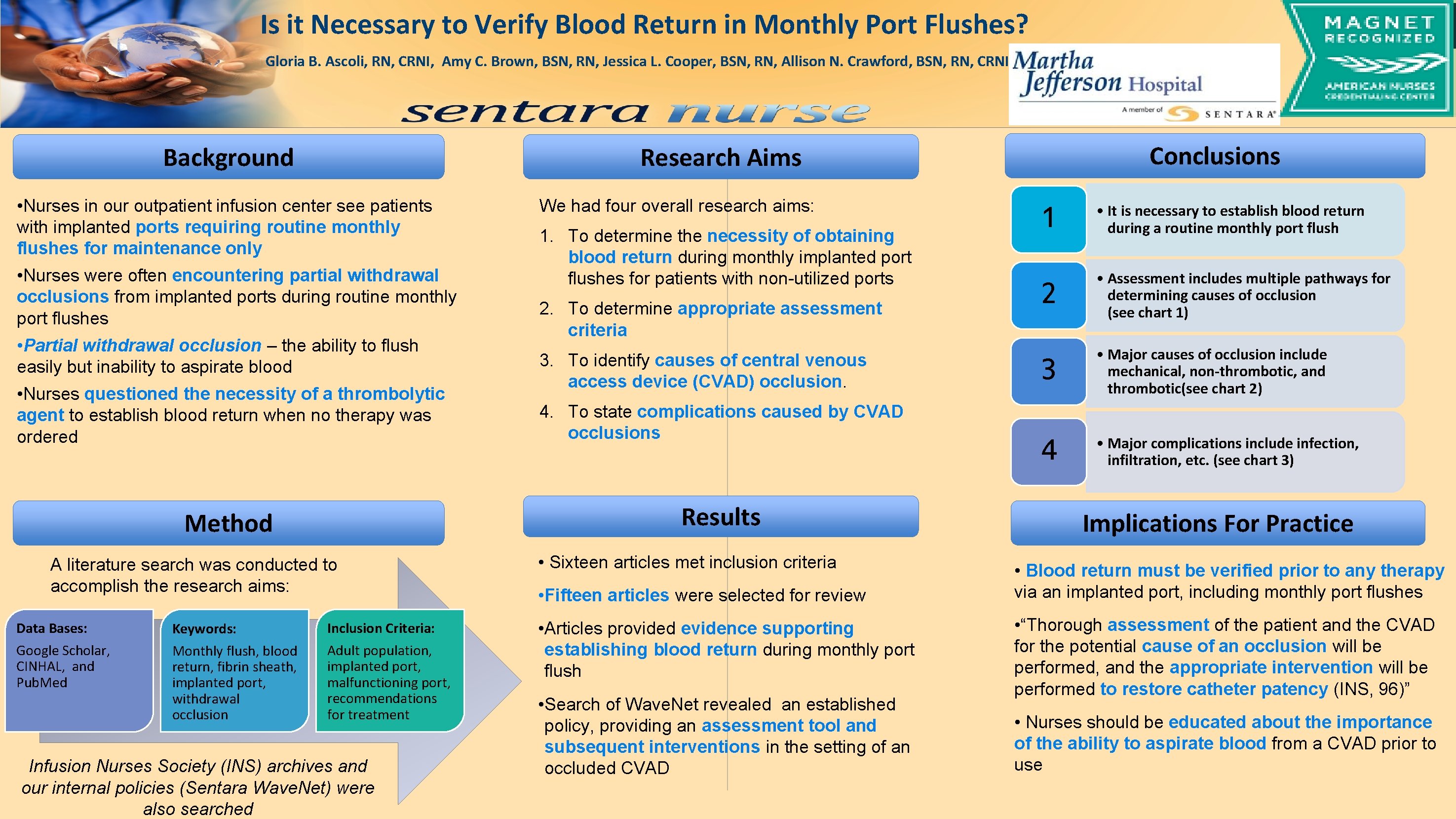
Is it Necessary to Verify Blood Return in Monthly Port Flushes? Gloria B. Ascoli, RN, CRNI, Amy C. Brown, BSN, RN, Jessica L. Cooper, BSN, RN, Allison N. Crawford, BSN, RN, CRNI Background • Nurses in our outpatient infusion center see patients with implanted ports requiring routine monthly flushes for maintenance only • Nurses were often encountering partial withdrawal occlusions from implanted ports during routine monthly port flushes • Partial withdrawal occlusion – the ability to flush easily but inability to aspirate blood • Nurses questioned the necessity of a thrombolytic agent to establish blood return when no therapy was ordered A literature search was conducted to accomplish the research aims: Keywords: Monthly flush, blood return, fibrin sheath, implanted port, withdrawal occlusion We had four overall research aims: 1. To determine the necessity of obtaining blood return during monthly implanted port flushes for patients with non-utilized ports 2. To determine appropriate assessment criteria 3. To identify causes of central venous access device (CVAD) occlusion. 4. To state complications caused by CVAD occlusions Results Method Data Bases: Google Scholar, CINHAL, and Pub. Med Conclusions Research Aims Inclusion Criteria: Adult population, implanted port, malfunctioning port, recommendations for treatment Infusion Nurses Society (INS) archives and our internal policies (Sentara Wave. Net) were also searched • Sixteen articles met inclusion criteria • Fifteen articles were selected for review • Articles provided evidence supporting establishing blood return during monthly port flush • Search of Wave. Net revealed an established policy, providing an assessment tool and subsequent interventions in the setting of an occluded CVAD 1 • It is necessary to establish blood return during a routine monthly port flush 2 • Assessment includes multiple pathways for determining causes of occlusion (see chart 1) 3 • Major causes of occlusion include mechanical, non-thrombotic, and thrombotic(see chart 2) 4 • Major complications include infection, infiltration, etc. (see chart 3) Implications For Practice • Blood return must be verified prior to any therapy via an implanted port, including monthly port flushes • “Thorough assessment of the patient and the CVAD for the potential cause of an occlusion will be performed, and the appropriate intervention will be performed to restore catheter patency (INS, 96)” • Nurses should be educated about the importance of the ability to aspirate blood from a CVAD prior to use
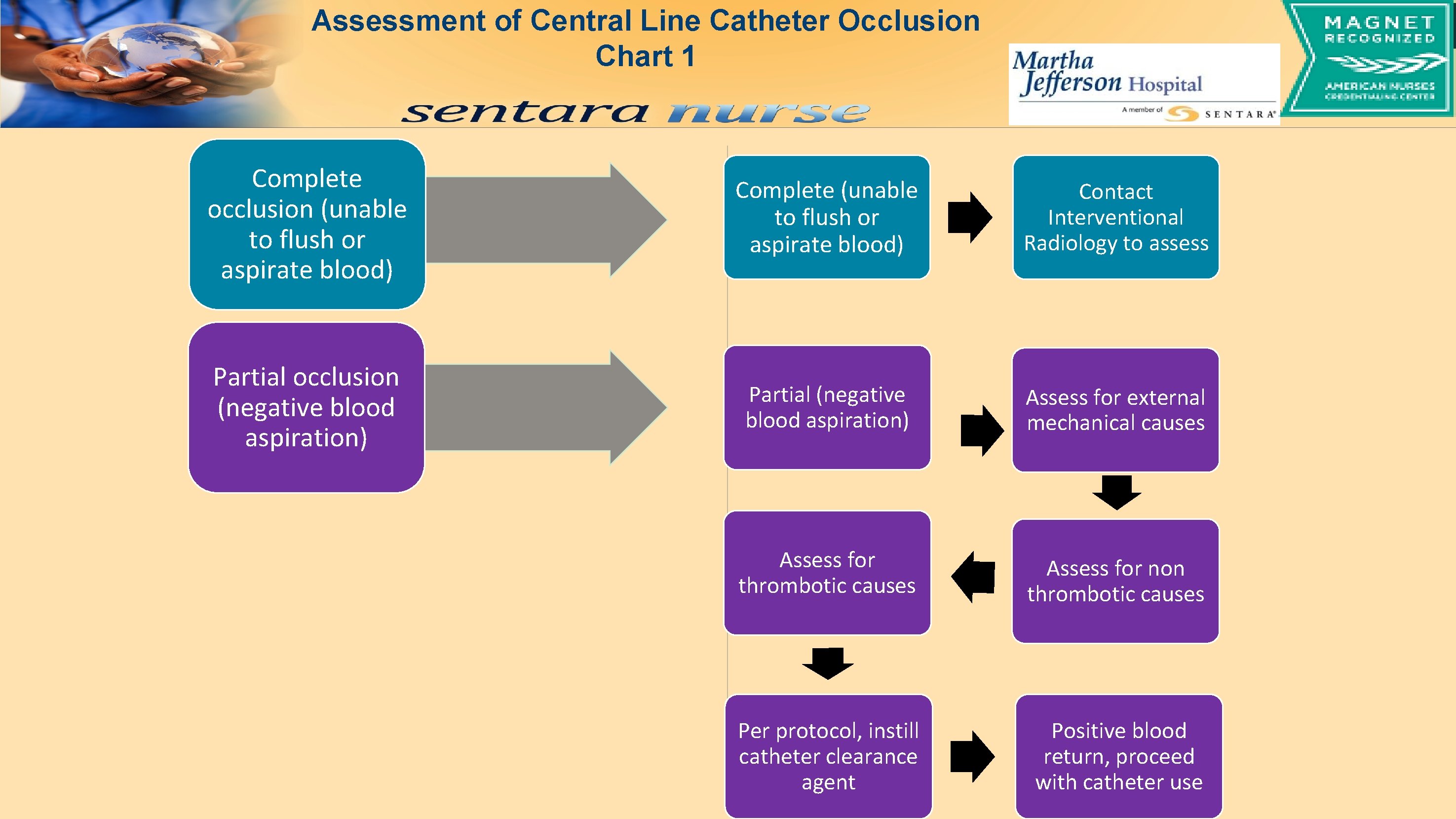
Assessment of Central Line Catheter Occlusion Chart 1 Complete occlusion (unable to flush or aspirate blood) Complete (unable to flush or aspirate blood) Contact Interventional Radiology to assess Partial occlusion (negative blood aspiration) Partial (negative blood aspiration) Assess for external mechanical causes Assess for thrombotic causes Assess for non thrombotic causes Per protocol, instill catheter clearance agent Positive blood return, proceed with catheter use
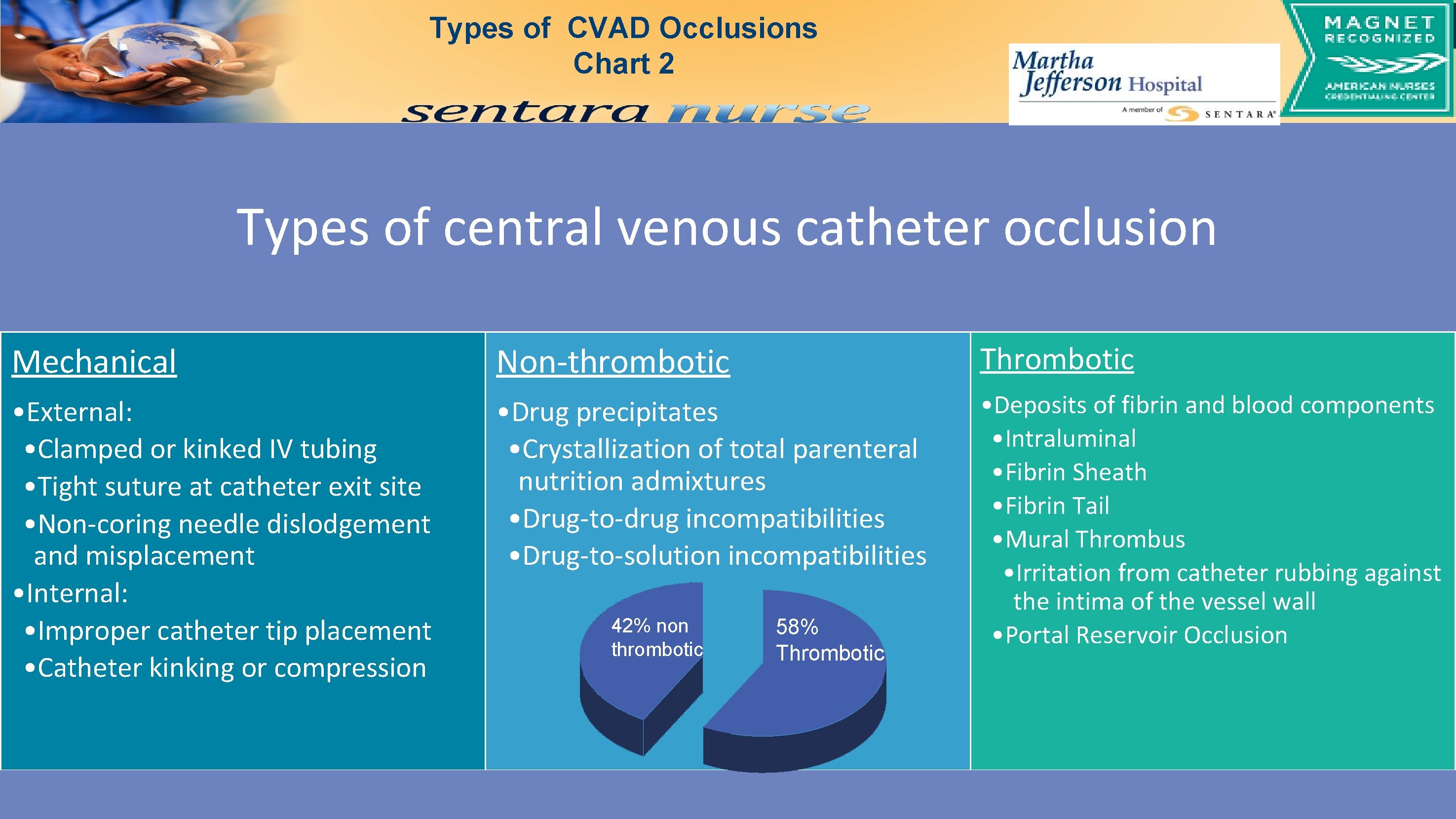
Types of CVAD Occlusions Chart 2 Types of central venous catheter occlusion Mechanical • External: • Clamped or kinked IV tubing • Tight suture at catheter exit site • Non-coring needle dislodgement and misplacement • Internal: • Improper catheter tip placement • Catheter kinking or compression Non-thrombotic Thrombotic • Drug precipitates • Crystallization of total parenteral nutrition admixtures • Drug-to-drug incompatibilities • Drug-to-solution incompatibilities • Deposits of fibrin and blood components • Intraluminal • Fibrin Sheath • Fibrin Tail • Mural Thrombus • Irritation from catheter rubbing against the intima of the vessel wall • Portal Reservoir Occlusion 42% non thrombotic 58% Thrombotic
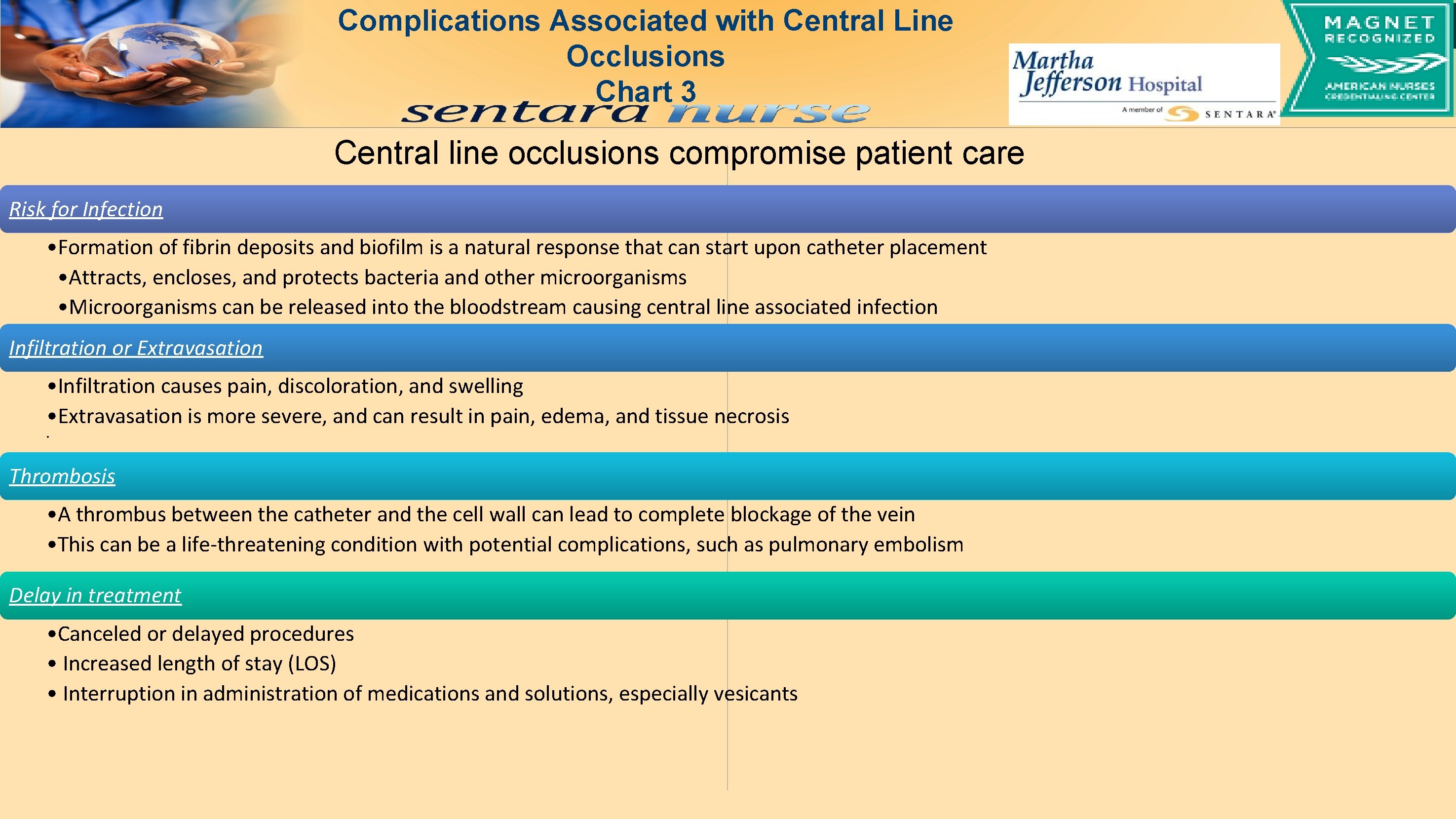
Complications Associated with Central Line Occlusions Chart 3 Central line occlusions compromise patient care Risk for Infection • Formation of fibrin deposits and biofilm is a natural response that can start upon catheter placement • Attracts, encloses, and protects bacteria and other microorganisms • Microorganisms can be released into the bloodstream causing central line associated infection Infiltration or Extravasation • Infiltration causes pain, discoloration, and swelling • Extravasation is more severe, and can result in pain, edema, and tissue necrosis • Thrombosis • A thrombus between the catheter and the cell wall can lead to complete blockage of the vein • This can be a life-threatening condition with potential complications, such as pulmonary embolism Delay in treatment • Canceled or delayed procedures • Increased length of stay (LOS) • Interruption in administration of medications and solutions, especially vesicants
References Andris, D. , Elizabeth, K. , Schulte, W. , Ausman, R. , & Quebbeman, E. (1994). Pinch-off syndrome: A rare etiology for central venous catheter occlusion. Journal of Parenteral and Enteral Nutrition, 531 -33. Doughtery, L. (2011). Implanted ports: Benefits, challenges, and guidance for use. British Journal of Nursing, 20 (8), S 12 -19. Genetech. (2014). Catheter management education. Retrieved from http: //www. cathmatters. com/education-cvad-care. jsp Harpel, J. (2013). Best practices for vascular resource teams. Journal of Infusion Nursing, 36(1), 46 -50. Infusion Nursing Society. (2011). Policies and procedures for infusion nursing. Krywda, E. (1999). Predisposing factors, prevention, and management of central venous catheter occlusions. Journal of Intravenous Nursing, 22, 11. Kuo, Y. S. , Schwartz, B. , Santiago, J. , & Anderson, P. S. (2005). How often should a port-a-cath be flushed? Cancer Investigation, 23, 582 -5. Kuter, D. (2004). Thrombotic complications of central venous catheters in cancer patients. The Oncologist, 9(9), 207 -16. Lawson, M. (1991). Partial occlusions of indwelling central venous catheters. Journal of Intravenous Nursing, 14(3), 127 -9. Mayo, D. (2001). Catheter-related thrombosis. Journal of Intravenous Nursing, 24(3 S), S 13 -22. Mehall, J. , Saltzmann, D. , Jackson, R. , & Smith, S. (2002). Fibrin sheath enhances central venous catheter infection. Critical Care Med, 30(4), 908 -11. Reeb, H. (1998). Diagnosis of central venous access devices occlusion. Journal of Intravenous Nursing, 21 (5 S), S 115 -121. Rumsey, K. , & Richardson, D. (1995). Management of infection and occlusion associated with vascular access devices. Seminars in Oncology Nursing, 11(3), 174 -83. Schummer, W. , Schummer, C. , & Schelenz, C. (2003). Case report: The malfunctioning implanted venous access device. , 12, 210 -14. Simcock, L. (2001). Managing occlusion in central venous catheters. Nursing Times, 97(21), 36. Vescia, S. , Baumgartner, A. , Jacobs, V. , Kiechle, M. , Rody, A. , Lobil, S. , & Harbeck, N. (2008). Management of venous port systems in oncology: A review of current evidence. Annals of Oncology, 19(1), 9 -15. Viale, P. (2003). Complications associated with implantable vascular access devices in the patient with cancer. Journal of Infusion Nursing, 23(2), 97 -102.
- Slides: 5