
Is it Better to Use Status or Growth
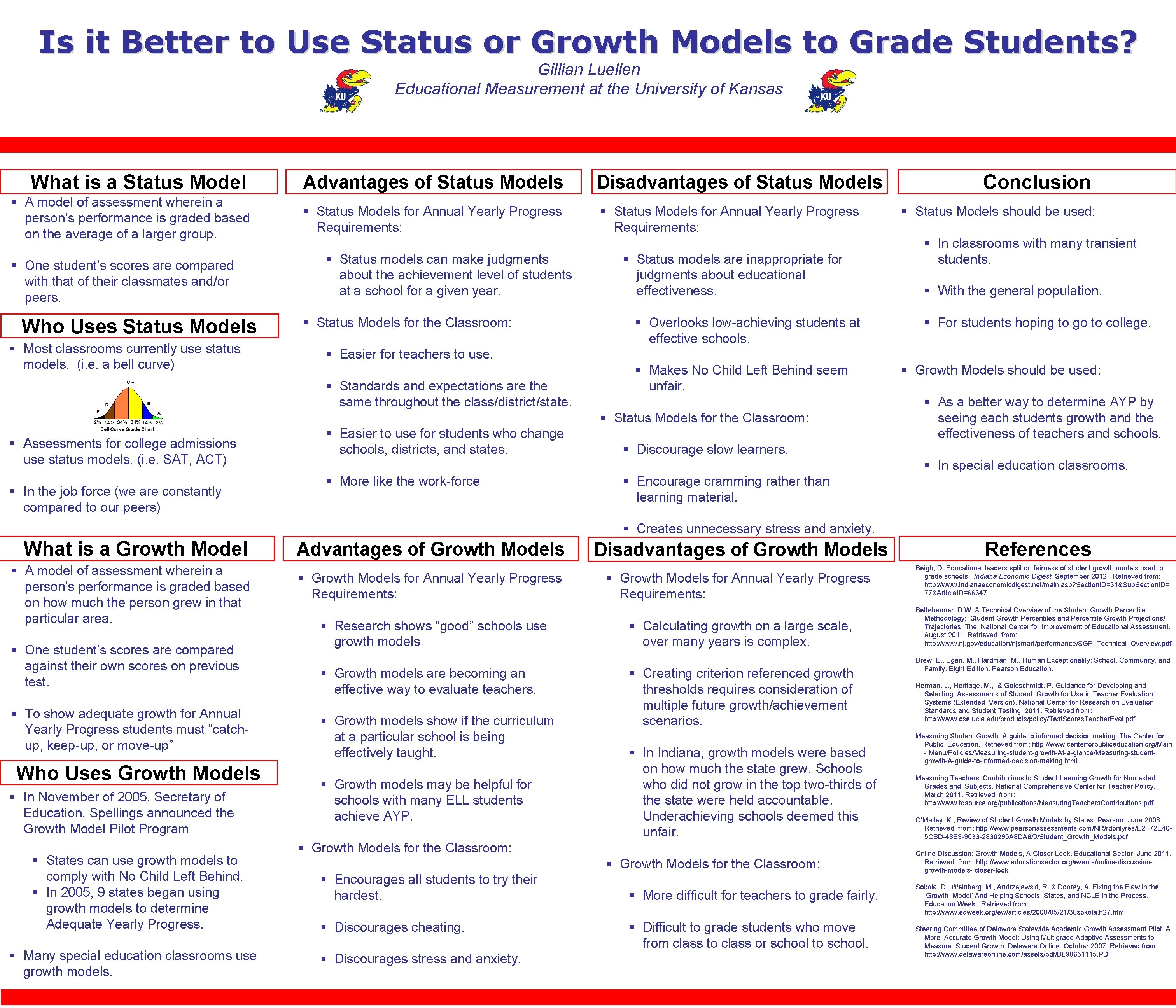
Is it Better to Use Status or Growth Models to Grade Students? Gillian Luellen Educational Measurement at the University of Kansas What is a Status Model Advantages of Status Models Disadvantages of Status Models § A model of assessment wherein a person’s performance is graded based on the average of a larger group. § Status Models for Annual Yearly Progress Requirements: § One student’s scores are compared with that of their classmates and/or peers. Who Uses Status Models § Most classrooms currently use status models. (i. e. a bell curve) § Status models can make judgments about the achievement level of students at a school for a given year. § Status Models for the Classroom: § Status models are inappropriate for judgments about educational effectiveness. § Overlooks low-achieving students at effective schools. § Makes No Child Left Behind seem unfair. § Status Models for the Classroom: § In the job force (we are constantly compared to our peers) § Status Models should be used: § In classrooms with many transient students. § With the general population. § For students hoping to go to college. § Easier for teachers to use. § Standards and expectations are the same throughout the class/district/state. § Assessments for college admissions use status models. (i. e. SAT, ACT) Conclusion § Easier to use for students who change schools, districts, and states. § Growth Models should be used: § As a better way to determine AYP by seeing each students growth and the effectiveness of teachers and schools. § Discourage slow learners. § In special education classrooms. § More like the work-force § Encourage cramming rather than learning material. § Creates unnecessary stress and anxiety. What is a Growth Model § A model of assessment wherein a person’s performance is graded based on how much the person grew in that particular area. § One student’s scores are compared against their own scores on previous test. § To show adequate growth for Annual Yearly Progress students must “catchup, keep-up, or move-up” Who Uses Growth Models § In November of 2005, Secretary of Education, Spellings announced the Growth Model Pilot Program § States can use growth models to comply with No Child Left Behind. § In 2005, 9 states began using growth models to determine Adequate Yearly Progress. § Many special education classrooms use growth models. Advantages of Growth Models § Growth Models for Annual Yearly Progress Requirements: § Research shows “good” schools use growth models § Growth models are becoming an effective way to evaluate teachers. § Growth models show if the curriculum at a particular school is being effectively taught. § Growth models may be helpful for schools with many ELL students achieve AYP. Disadvantages of Growth Models § Growth Models for Annual Yearly Progress Requirements: § Calculating growth on a large scale, over many years is complex. § Creating criterion referenced growth thresholds requires consideration of multiple future growth/achievement scenarios. § In Indiana, growth models were based on how much the state grew. Schools who did not grow in the top two-thirds of the state were held accountable. Underachieving schools deemed this unfair. § Growth Models for the Classroom: § Encourages all students to try their hardest. § Discourages cheating. § Discourages stress and anxiety. § More difficult for teachers to grade fairly. § Difficult to grade students who move from class to class or school to school. References Beigh, D. Educational leaders split on fairness of student growth models used to grade schools. Indiana Economic Digest. September 2012. Retrieved from: http: //www. indianaeconomicdigest. net/main. asp? Section. ID=31&Sub. Section. ID= 77&Art. Icle. ID=66647 Bettebenner, D. W. A Technical Overview of the Student Growth Percentile Methodology: Student Growth Percentiles and Percentile Growth Projections/ Trajectories. The National Center for Improvement of Educational Assessment. August 2011. Retrieved from: http: //www. nj. gov/education/njsmart/performance/SGP_Technical_Overview. pdf Drew, E. , Egan, M. , Hardman, M. , Human Exceptionality: School, Community, and Family. Eight Edition. Pearson Education. Herman, J. , Heritage, M. , & Goldschmidt, P. Guidance for Developing and Selecting Assessments of Student Growth for Use in Teacher Evaluation Systems (Extended Version). National Center for Research on Evaluation Standards and Student Testing. 2011. Retrieved from: http: //www. cse. ucla. edu/products/policy/Test. Scores. Teacher. Eval. pdf Measuring Student Growth: A guide to informed decision making. The Center for Public Education. Retrieved from: http: //www. centerforpubliceducation. org/Main - Menu/Policies/Measuring-student-growth-At-a-glance/Measuring-studentgrowth-A-guide-to-informed-decision-making. html Measuring Teachers’ Contributions to Student Learning Growth for Nontested Grades and Subjects. National Comprehensive Center for Teacher Policy. March 2011. Retrieved from: http: //www. tqsource. org/publications/Measuring. Teachers. Contributions. pdf O'Malley, K. , Review of Student Growth Models by States. Pearson. June 2008. Retrieved from: http: //www. pearsonassessments. com/NR/rdonlyres/E 2 F 72 E 405 CBD-48 B 9 -9033 -2830295 A 8 DA 8/0/Student_Growth_Models. pdf Online Discussion: Growth Models, A Closer Look. Educational Sector. June 2011. Retrieved from: http: //www. educationsector. org/events/online-discussiongrowth-models- closer-look Sokola, D. , Weinberg, M. , Andrzejewski, R. & Doorey, A. Fixing the Flaw in the ‘Growth Model’ And Helping Schools, States, and NCLB in the Process. Education Week. Retrieved from: http: //www. edweek. org/ew/articles/2008/05/21/38 sokola. h 27. html Steering Committee of Delaware Statewide Academic Growth Assessment Pilot. A More Accurate Growth Model: Using Multigrade Adaptive Assessments to Measure Student Growth. Delaware Online. October 2007. Retrieved from: http: //www. delawareonline. com/assets/pdf/BL 90651115. PDF
- Slides: 1