
Is HighGrade Squamous Intraepithelial Lesion HSIL always highrisk
- Slides: 1
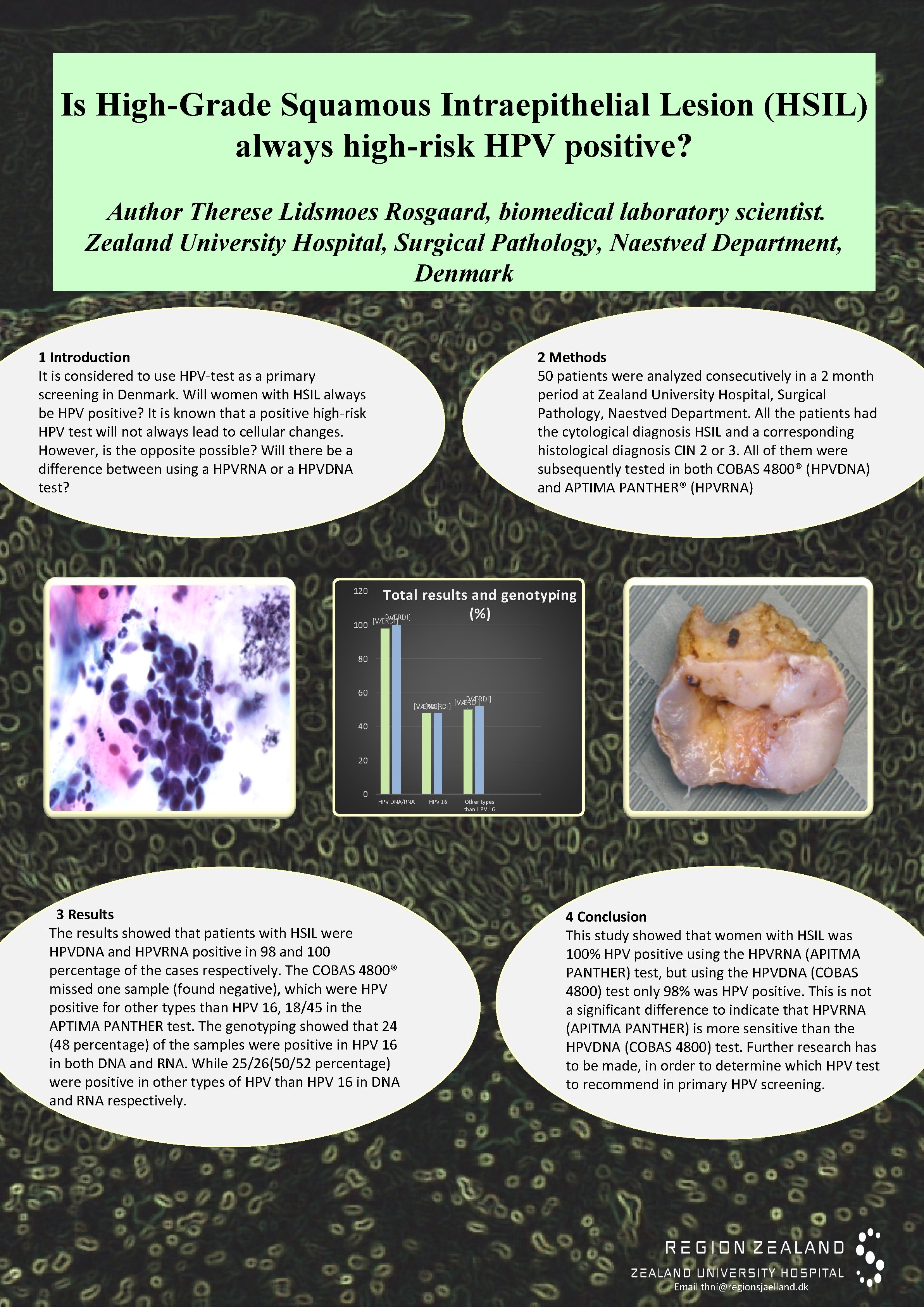
Is High-Grade Squamous Intraepithelial Lesion (HSIL) always high-risk HPV positive? Author Therese Lidsmoes Rosgaard, biomedical laboratory scientist. Zealand University Hospital, Surgical Pathology, Naestved Department, Denmark 1 Introduction It is considered to use HPV-test as a primary screening in Denmark. Will women with HSIL always be HPV positive? It is known that a positive high-risk HPV test will not always lead to cellular changes. However, is the opposite possible? Will there be a difference between using a HPVRNA or a HPVDNA test? 120 100 2 Methods 50 patients were analyzed consecutively in a 2 month period at Zealand University Hospital, Surgical Pathology, Naestved Department. All the patients had the cytological diagnosis HSIL and a corresponding histological diagnosis CIN 2 or 3. All of them were subsequently tested in both COBAS 4800® (HPVDNA) and APTIMA PANTHER® (HPVRNA) Total results and genotyping (%) [VÆRDI] 80 60 [VÆRDI] 40 20 0 HPV DNA/RNA 3 Results The results showed that patients with HSIL were HPVDNA and HPVRNA positive in 98 and 100 percentage of the cases respectively. The COBAS 4800® missed one sample (found negative), which were HPV positive for other types than HPV 16, 18/45 in the APTIMA PANTHER test. The genotyping showed that 24 (48 percentage) of the samples were positive in HPV 16 in both DNA and RNA. While 25/26(50/52 percentage) were positive in other types of HPV than HPV 16 in DNA and RNA respectively. HPV 16 Other types than HPV 16 4 Conclusion This study showed that women with HSIL was 100% HPV positive using the HPVRNA (APITMA PANTHER) test, but using the HPVDNA (COBAS 4800) test only 98% was HPV positive. This is not a significant difference to indicate that HPVRNA (APITMA PANTHER) is more sensitive than the HPVDNA (COBAS 4800) test. Further research has to be made, in order to determine which HPV test to recommend in primary HPV screening. Email thni@regionsjaelland. dk