
Is EBP Really Improving Practice Dr Martha Thompson
Is EBP Really Improving Practice? Dr. Martha Thompson
Objectives for the day • Discuss three pros and cons of Evidence Based Practices • Identify several challenges of privatized health care and treatment • Develop strategies and ideas to manage the changes we face with EBP and privatization
Trying to identify specific interventions that could be dispensed reliably for specific problems has a strong commonsense appeal. No one would argue with the success of the idea of problemspecific interventions in the field of medicine. But the evidence is incontrovertible.

Go to Kahoot. it on your phone or laptop
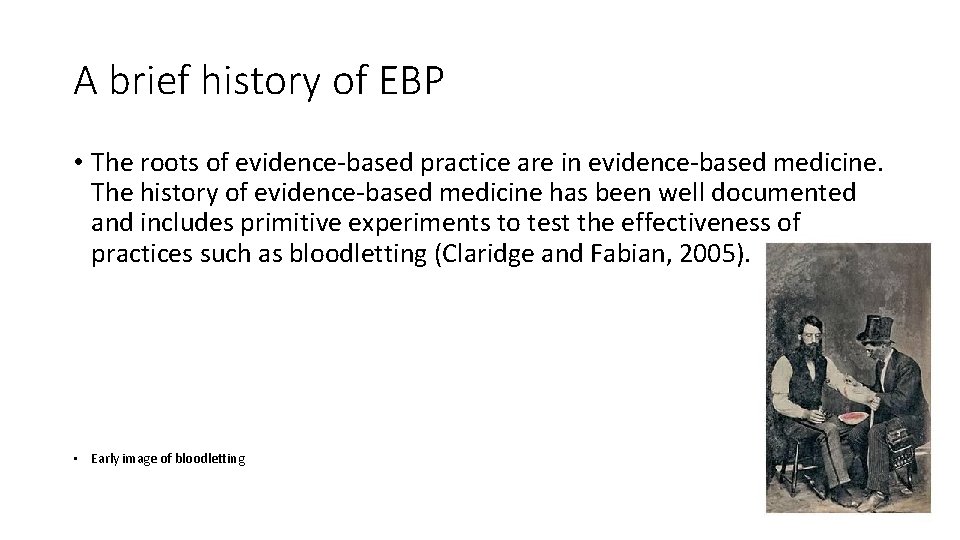
A brief history of EBP • The roots of evidence-based practice are in evidence-based medicine. The history of evidence-based medicine has been well documented and includes primitive experiments to test the effectiveness of practices such as bloodletting (Claridge and Fabian, 2005). • Early image of bloodletting

History continued • 1972 - Archie Cochrane pointed out the importance of properly testing the effectiveness of health care strategies, and stressed the role of randomized controlled studies to provide evidence on which health care is based. • The term "evidence-based medicine" was introduced by Guyatt et al in 1992 to shift the emphasis in clinical decision making from "intuition, unsystematic clinical experience, and pathophysiologic rationale" to scientific, clinically relevant research.
A bit more history • 1996 - Sackett et al explained evidence-based clinical decision making as a combination of not only research evidence but also clinical expertise, taking into account the patient’s preferences. • Clinical expertise was defined as the “proficiency and judgment that individual clinicians acquire through clinical experience and clinical practice”.
Hang on the history lesson is almost over • 2003 - a statement on evidence-based practice was prepared by the delegates of the Evidence-based Health Care Teachers and Developers conference. • The conference was held in Sicily, and the statement is known as the Sicily Statement (Dawes et al, 2005). • It helped to introduce the broader concept of evidence-based decision making to health care generally.
• 2009 - Satterfield et al developed a transdisciplinary model for evidence-based practice. • This model depicts the three core components of EBP (best available research evidence, clinical expertise and patient’s preferences) within the broader clinical or organizational context. • In a sense, the organizational context is a fourth EBP component.
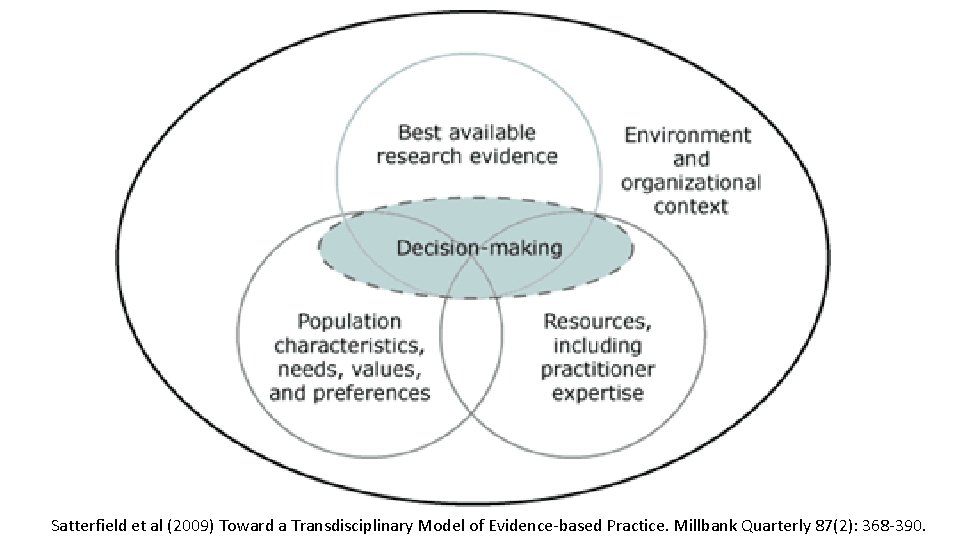
Satterfield et al (2009) Toward a Transdisciplinary Model of Evidence-based Practice. Millbank Quarterly 87(2): 368 -390.
How are we doing now • The formalized concept was embraced by many, but also elicited some criticisms, including that evidence-based medicine relies too heavily on research. • It was still being described by some as a “new approach” almost twenty years later (Selvaraj et al, 2010), suggesting that it has taken some time to become integrated into the medical profession worldwide. • It’s 2017…. . where are we now?
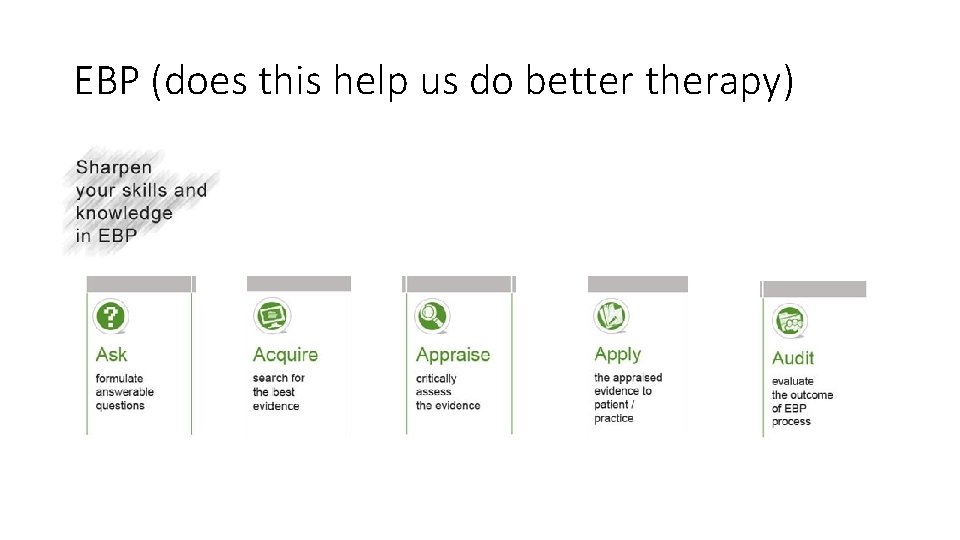
EBP (does this help us do better therapy)
• Ask: Formulate a question that encompasses the clinical scenario, and for which evidence can be found by searching the literature. To facilitate the search process, the question should include terms that can be used in the literature search. • Acquire: Search the peer-reviewed literature for research evidence relevant to the clinical question. • Appraise: Evaluate the relevant research evidence, to find the highest quality (most reliable, or valid) evidence available relevant to this question.
• Apply: Use the highest quality research evidence in combination with clinical expertise and the patient’s preferences, within the context of the practice environment, to make a clinical decision (e. g. a strategy for treatment, diagnosis or management). • Audit: A regular assessment of the extent to which clinical decisions in the practice were based on the best available research evidence. • How do you apply these steps? • Where is there room for improvement?
EBP for DA treatment • Behavior therapy and CBT • Modest to strong research support • Mindfulness based cognitive therapy • Strong research support • Acceptance and commitment therapy • Modest to strong research support • Dialectical behavioral therapy • Strong research support • Motivational Interviewing • Strong research support
What we are looking for with EBP • Diagnosis how to select and interpret diagnostic tests • prospective, blind comparison to a gold standard or cross-sectional • Therapy how to select treatments that do more good than harm and that are worth the efforts and costs of using them • randomized controlled trial > cohort study • Prognosis how to estimate the patient’s likely clinical course over time (based on factors other than the intervention) and anticipate likely complications of disease • cohort study > case control > case series • Harm/Etiology how to identify causes for disease (including iatrogenic forms) • cohort > case control > case series
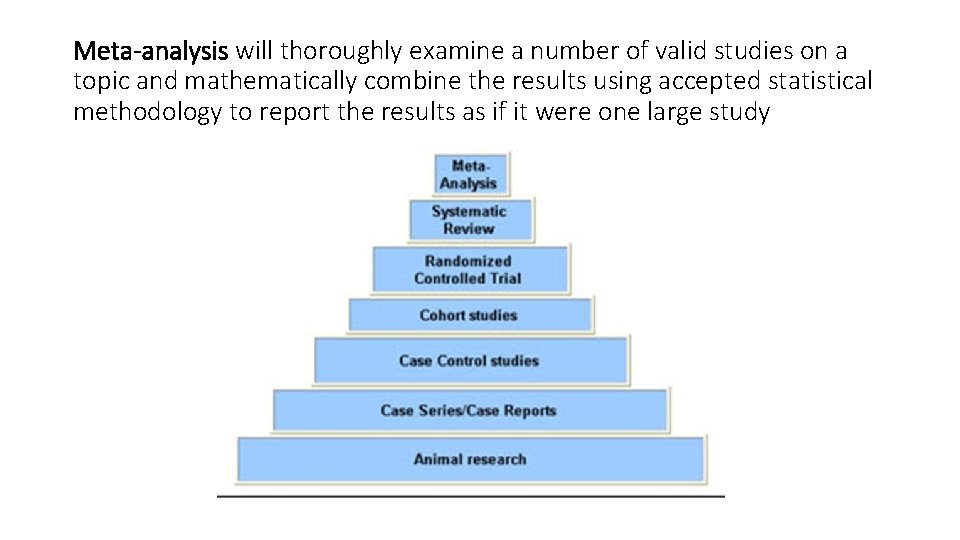
Meta-analysis will thoroughly examine a number of valid studies on a topic and mathematically combine the results using accepted statistical methodology to report the results as if it were one large study
When EBP becomes mandated… • The purpose of EBPP is to promote effective psychological practice and enhance public health by applying empirically supported principles of psychological assessment, case formulation, therapeutic relationship, and intervention. – APA 2005 • Is it really effective? • Little is known about the effectiveness of services offered by the community sector (Figure 3; Dillenburger, 2001; Smyth, 2001), mainly because of problems with agreement on evaluation methods, content to be evaluated, outcome measures, theoretical perspectives, heterogeneity of type of interventions, and complex political contexts (Forte, Hill, Pazder, & Feudtner, 2004; Lavoie, 1990).
What makes us effective? • Supershrinks • Clients of the best therapists improve at a rate at least 50 percent higher and drop out at a rate at least 50 percent lower than those of average clinicians • Who provides therapy is a much more important determinant of success than what treatment approach is provided.
• Bruce Wampold and Jeb Brown in 2006 published in the Journal of Consulting and Clinical Psychology. 581 licensed providers, including psychologists, psychiatrists, and master's-level providers, who were treating a diverse sample of over 6, 000 clients. • The therapists, the clientele, and the presenting complaints were not different in any meaningful way from clinical settings nationwide. • The clients' age, gender, and diagnosis had no impact on the treatment success rate and neither did the experience, training, or theoretical orientation of therapists.
Making the best • The best of the best simply work harder at improving their performance than others. • To reach the top level, attentiveness to feedback is crucial. • It isn't the same as the number of hours spent on the job, but rather the amount of time devoted specifically to reaching for objectives "just beyond one's level of proficiency. “ • https: //www. psychotherapy. net/article/successful-psychotherapists
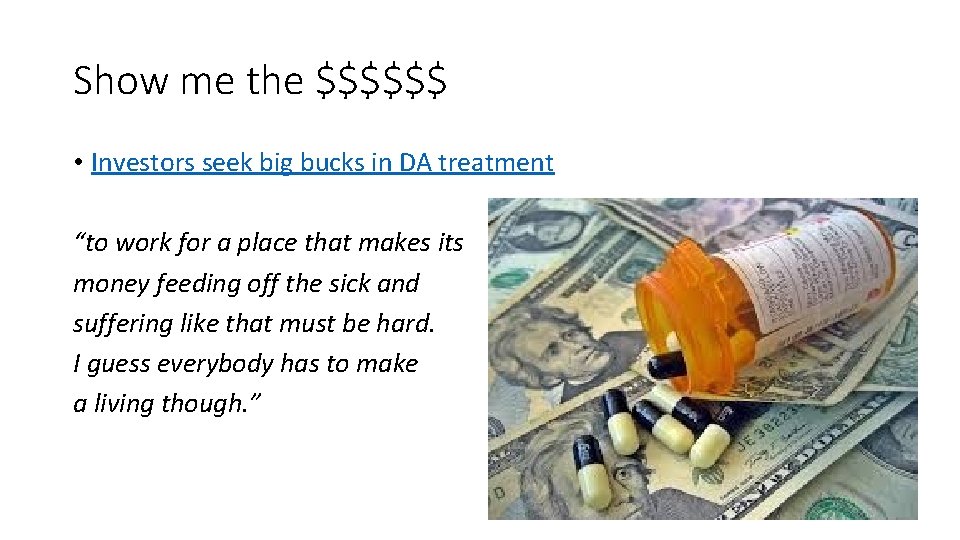
Show me the $$$$$$ • Investors seek big bucks in DA treatment “to work for a place that makes its money feeding off the sick and suffering like that must be hard. I guess everybody has to make a living though. ”
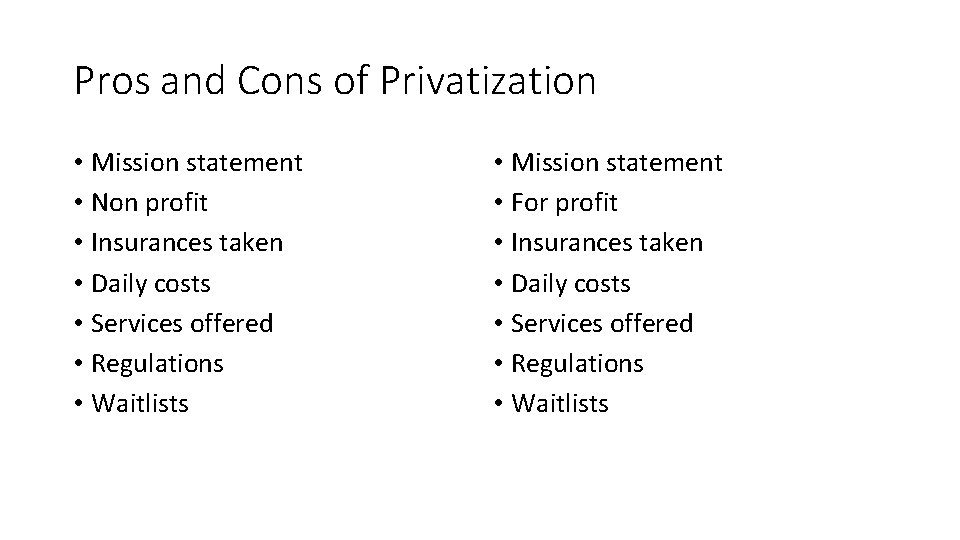
Pros and Cons of Privatization • Mission statement • Non profit • Insurances taken • Daily costs • Services offered • Regulations • Waitlists • Mission statement • For profit • Insurances taken • Daily costs • Services offered • Regulations • Waitlists

Rouge Rehabs • Dr. Oz and Sarah Howe
Working in an imperfect system • Now what do we do…. • We are mandated to use EBP • but we are not really using EBP • We want to be the best we can be • But are we able to do that • We want our clients to get quality treatment • But is that fair or really happening
The end • Martha Thompson Psy. D. , LPC. , CAADC • Empower the Mind LLC • drmartha@empowerthemind. org • 717 -304 -2631
- Slides: 26