
Is Dr Fern Riddell right to describe the
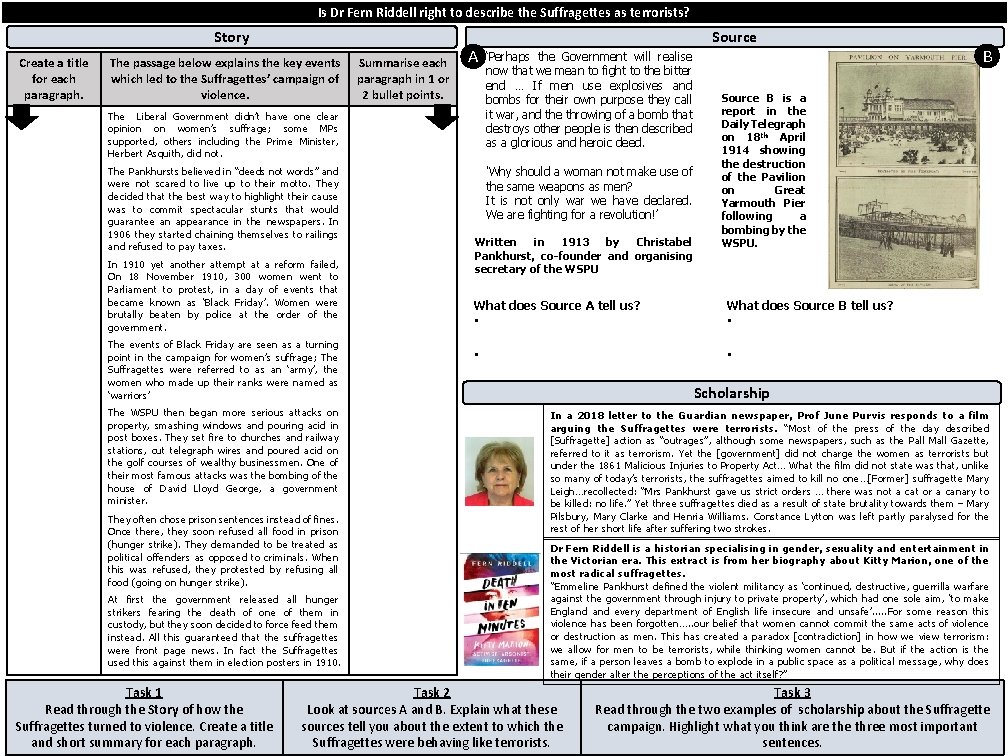
Is Dr Fern Riddell right to describe the Suffragettes as terrorists? Story Create a title for each paragraph. The passage below explains the key events which led to the Suffragettes’ campaign of violence. Summarise each paragraph in 1 or 2 bullet points. A The Liberal Government didn’t have one clear opinion on women’s suffrage; some MPs supported, others including the Prime Minister, Herbert Asquith, did not. The Pankhursts believed in “deeds not words” and were not scared to live up to their motto. They decided that the best way to highlight their cause was to commit spectacular stunts that would guarantee an appearance in the newspapers. In 1906 they started chaining themselves to railings and refused to pay taxes. In 1910 yet another attempt at a reform failed, On 18 November 1910, 300 women went to Parliament to protest, in a day of events that became known as ‘Black Friday’. Women were brutally beaten by police at the order of the government. The events of Black Friday are seen as a turning point in the campaign for women’s suffrage; The Suffragettes were referred to as an ‘army’, the women who made up their ranks were named as ‘warriors’ The WSPU then began more serious attacks on property, smashing windows and pouring acid in post boxes. They set fire to churches and railway stations, cut telegraph wires and poured acid on the golf courses of wealthy businessmen. One of their most famous attacks was the bombing of the house of David Lloyd George, a government minister. They often chose prison sentences instead of fines. Once there, they soon refused all food in prison (hunger strike). They demanded to be treated as political offenders as opposed to criminals. When this was refused, they protested by refusing all food (going on hunger strike). At first the government released all hunger strikers fearing the death of one of them in custody, but they soon decided to force feed them instead. All this guaranteed that the suffragettes were front page news. In fact the Suffragettes used this against them in election posters in 1910. Task 1 Read through the Story of how the Suffragettes turned to violence. Create a title and short summary for each paragraph. Source ‘Perhaps the Government will realise now that we mean to fight to the bitter end … If men use explosives and bombs for their own purpose they call it war, and the throwing of a bomb that destroys other people is then described as a glorious and heroic deed. 'Why should a woman not make use of the same weapons as men? It is not only war we have declared. We are fighting for a revolution!’ Written in 1913 by Christabel Pankhurst, co-founder and organising secretary of the WSPU Source B is a report in the Daily Telegraph on 18 th April 1914 showing the destruction of the Pavilion on Great Yarmouth Pier following a bombing by the WSPU. What does Source A tell us? What does Source B tell us? • • • B • Scholarship In a 2018 letter to the Guardian newspaper, Prof June Purvis responds to a film arguing the Suffragettes were terrorists. “Most of the press of the day described [Suffragette] action as “outrages”, although some newspapers, such as the Pall Mall Gazette, referred to it as terrorism. Yet the [government] did not charge the women as terrorists but under the 1861 Malicious Injuries to Property Act… What the film did not state was that, unlike so many of today’s terrorists, the suffragettes aimed to kill no one…[Former] suffragette Mary Leigh…recollected: “Mrs Pankhurst gave us strict orders … there was not a cat or a canary to be killed: no life. ” Yet three suffragettes died as a result of state brutality towards them – Mary Pilsbury, Mary Clarke and Henria Williams. Constance Lytton was left partly paralysed for the rest of her short life after suffering two strokes. Dr Fern Riddell is a historian specialising in gender, sexuality and entertainment in the Victorian era. This extract is from her biography about Kitty Marion, one of the most radical suffragettes. “Emmeline Pankhurst defined the violent militancy as ‘continued, destructive, guerrilla warfare against the government through injury to private property’, which had one sole aim, ‘to make England every department of English life insecure and unsafe’. . . For some reason this violence has been forgotten…. . our belief that women cannot commit the same acts of violence or destruction as men. This has created a paradox [contradiction] in how we view terrorism: we allow for men to be terrorists, while thinking women cannot be. But if the action is the same, if a person leaves a bomb to explode in a public space as a political message, why does their gender alter the perceptions of the act itself? ” Task 2 Look at sources A and B. Explain what these sources tell you about the extent to which the Suffragettes were behaving like terrorists. Task 3 Read through the two examples of scholarship about the Suffragette campaign. Highlight what you think are three most important sentences.
- Slides: 1