
Is Danielson or Marzano Right for You TC

- Slides: 45
Is Danielson or Marzano Right for You? TC J T E N f & o I e g SR e l l o C n o t k c o t 2 S 1 d 0 r 2 a , h 1 c i 2 R y a e M Th y a d Mon Presented by: B a m r o N . D. d E , oakes so A fes o r P e t ssocia on cati u d E f ro e Georg . D. d E , Sharpe ation rof P t n a t Assis Edu f o r o ess c
Danielson Framework Workshop Goals • Understand why Danielson Framework was selected as one of 5 state-approved teacher evaluation models • Gain an understanding of the researchbase of the Danielson Framework • Develop an understanding of the four core domains of the Danielson that embody the art of teaching
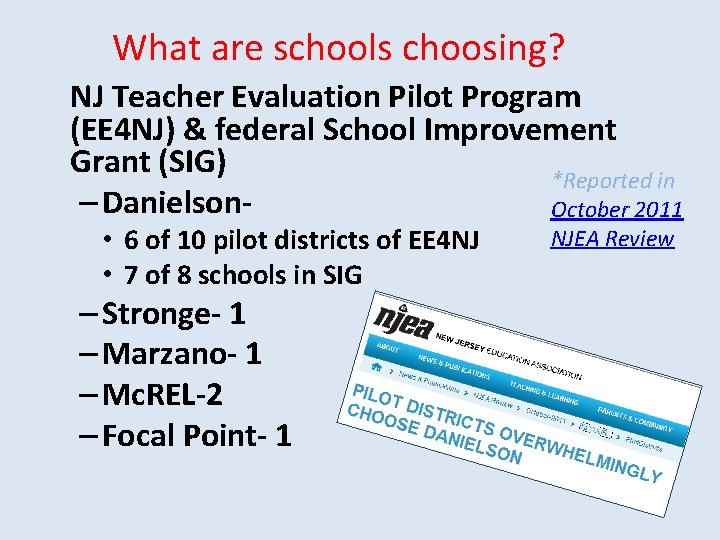
What are schools choosing? NJ Teacher Evaluation Pilot Program (EE 4 NJ) & federal School Improvement Grant (SIG) *Reported in – Danielson. October 2011 • 6 of 10 pilot districts of EE 4 NJ • 7 of 8 schools in SIG – Stronge- 1 – Marzano- 1 – Mc. REL-2 – Focal Point- 1 NJEA Review
Why have teacher evaluation? We’ve been evaluating teachers as part of our duties for a long time. Beyond the fact that it is mandated by the state why do it? As an administrator, why is evaluating teachers important to your school? Take a moment to write reasons that come to mind.
Ensure Quality Teaching Danielson’s “Framework for Teachers”: • Defines what good teaching looks like and consists of • Provides a common language among professionals • Structure that recognizes and respects the complexities of teaching but provides a simple layout for conversations about teaching • Versatility for all levels of expertise and experience
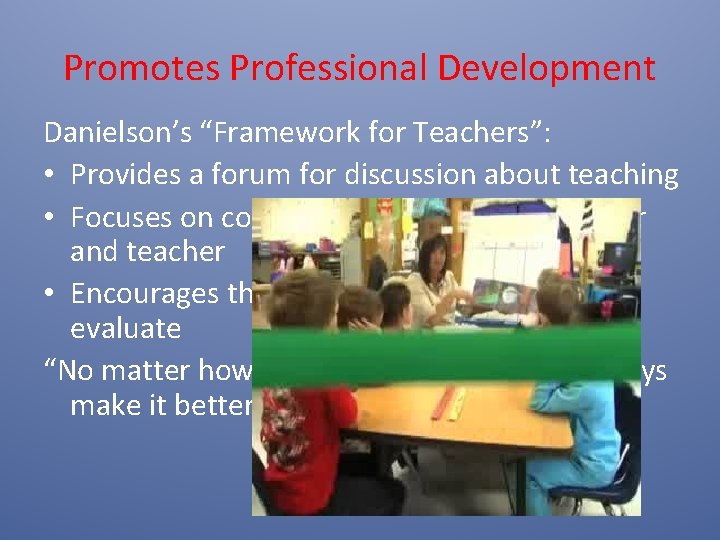
Promotes Professional Development Danielson’s “Framework for Teachers”: • Provides a forum for discussion about teaching • Focuses on collaboration between evaluator and teacher • Encourages the teacher to self-reflect and evaluate “No matter how good a lesson is, we can always make it better. ” (Danielson)
Correlation to National Frameworks • Interstate New Teacher Assessment and Support Consortium (INTASC) • National Council for Accreditation of Teacher Evaluation (NCATE) • National Board for Professional Teaching Standards (NBTS) • New Jersey Professional Standards for Teachers (NJPST)
Danielson and the Praxis III • Praxis III is used by 6 states to assess actual teaching skills and classroom performance as part of the initial teacher licensure process • Danielson worked with ETS to help prepare and validate the Praxis III • Research to create the Praxis III took seven years, multiple pilot studies, and involved thousands of educators • Danielson designed the training program used by assessors • By nature, this system must fair, highly accurate, and reliable
Danielson & the MET Project • Large scale research study, called Measures of Effective Teaching Project, launched in 2009 by the Bill & Melissa Gates Foundation • Tests the reliability and validity of ways of using a combination of different instruments to measure teacher effectiveness • Evaluated over 13, 000 classroom lessons using multiple teacher evaluation methods including the Danielson Framework
Other facts worth knowing… • The Framework has been shown to be a predictor of student learning according to research from the University of Chicago Consortium on School Research • Implemented in over 16 states • Approved teacher evaluation tool in many states including New York, Ohio, Pennsylvania, & Washington
Underlying Assumptions of the Framework • It is important for students to develop “deep, conceptual understanding” • Developing high levels of understanding requires effective models of instruction • Decisions made in the classroom are “purposeful”. • Teaching is a profession.
Features of the Framework • Comprehensive- The Framework describes “all teaching” • Based on large body of sound educational research • There’s no “gotcha” factor. Teachers know what and how they are evaluated. • The framework allows for all types of teaching situations. • The complexity of teaching is captured within a clear set of themes • No one approach to teaching is focused upon.
The “Wow” Factor Think of when you observed an excellent teacher in the classroom or a professional context. What would you see or hear that made you think this teacher was excellent at their profession? What would make you think I want my child in this teacher’s class or this is what I like to see in my school? Write one trait on each post -it note. Can you come up with 5 -7 major traits?
Clip from ABC News- What Makes Great Teachers featured 2 -26 -2010
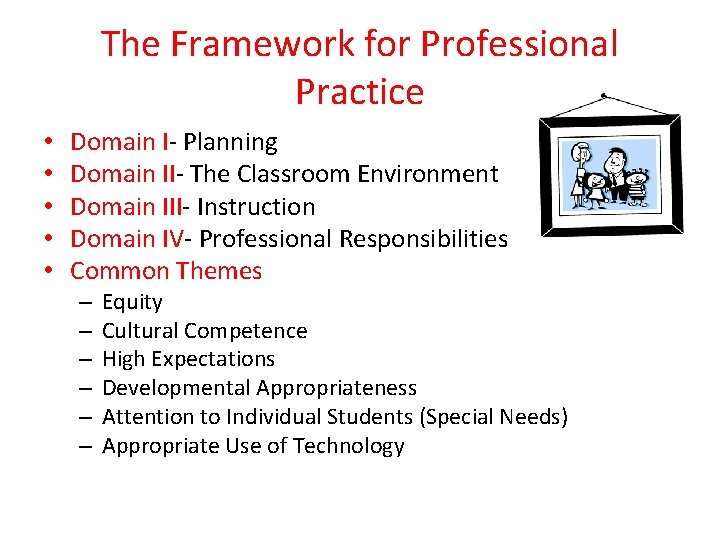
The Framework for Professional Practice • • • Domain I- Planning Domain II- The Classroom Environment Domain III- Instruction Domain IV- Professional Responsibilities Common Themes – – – Equity Cultural Competence High Expectations Developmental Appropriateness Attention to Individual Students (Special Needs) Appropriate Use of Technology
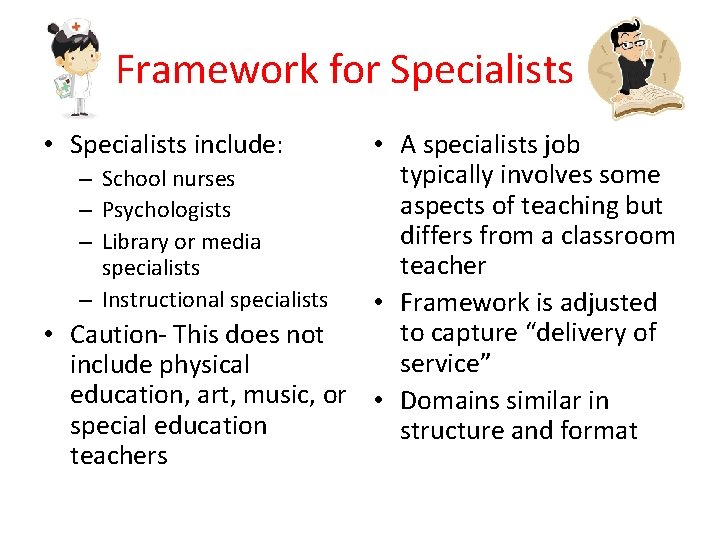
Framework for Specialists • Specialists include: • A specialists job typically involves some – School nurses aspects of teaching but – Psychologists differs from a classroom – Library or media teacher specialists – Instructional specialists • Framework is adjusted to capture “delivery of • Caution- This does not service” include physical education, art, music, or • Domains similar in special education structure and format teachers
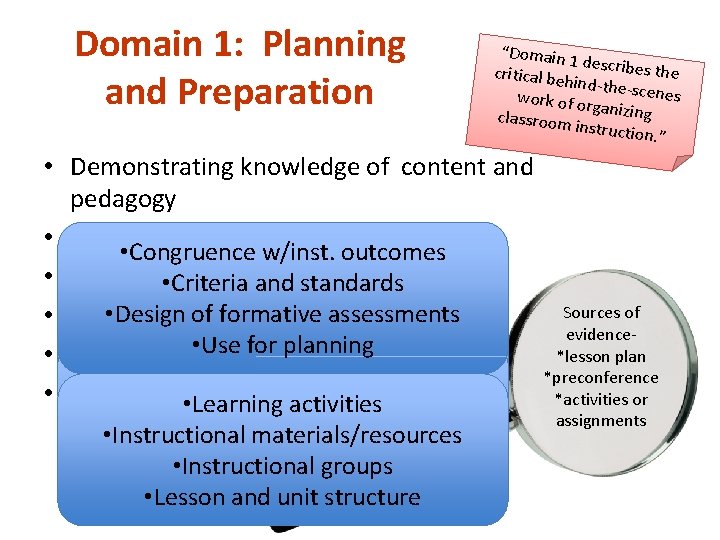
Domain 1: Planning and Preparation “Domain 1 describes the critical be hind-the-s cenes work of or ganizing classroom instruction. ” • Demonstrating knowledge of content and pedagogy • Demonstrating knowledge of students • Congruence w/inst. outcomes • Content and structure of discipline • Setting instructional outcomes • Child & adolescent development • Criteria and standards • Prerequisite relationships • Learning process • Design of formative assessments • Demonstrating knowledge of resources • Content-related pedagogy • Students’ skills, language proficiency • Use for planning • Value, sequence, alignment • Designing coherent instruction • Students’ interest & heritage • Clarity & balance • For classroom use • Designing student assessments • Students’ needs • Learning activities Suitability forspecial diverse learners • • To extend content & pedagogy • Instructional • Formaterials/resources students • Instructional groups • Lesson and unit structure Sources of evidence*lesson plan *preconference *activities or assignments
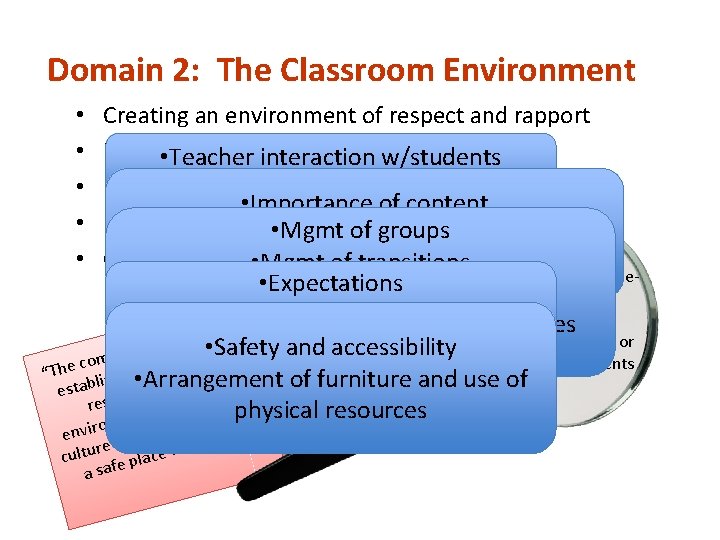
Domain 2: The Classroom Environment Creating an environment of respect and rapport Establishing a culture for learning • Teacher interaction w/students Managing classroom procedures • Student interaction w/students • Importance of content Managing student behavior • Mgmt of groups • Expectations for learning & achievement Organizing physical space Mgmt ofpride transitions • • Student in work Sources of evidence • Expectations • Mgmt of supplies & materials *classroom • Monitoring of student behavior duties interactions n 2 i a • Performance of non-instructional m o D *interviews with or s of • Safety t. Response nd toand n a e • student misbehavior e accessibility n l o b omp omforta • Supv of volunteers/paraprof surveys of students c e h m c o “T a o r h ss lis • Arrangement a of furniture and use of estab pectful cla ultivates s at c res h t reate t c physical resources n d e n nm ga • • • . o envir for learnin isk taking rr re cultu fe place fo a sa
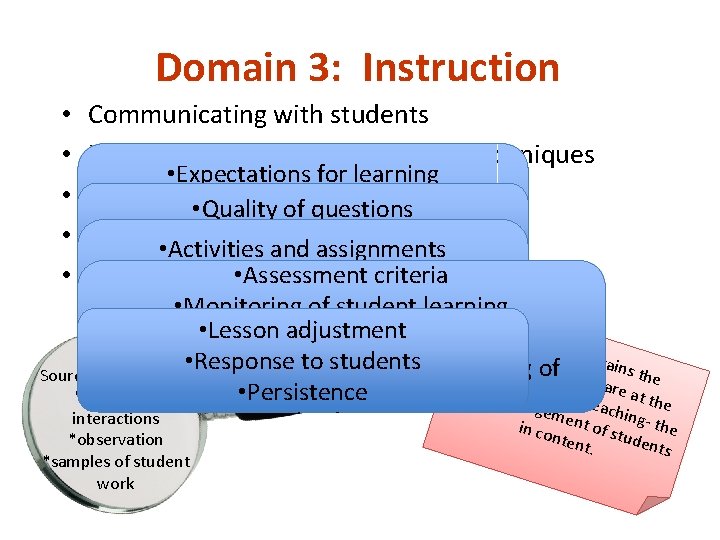
Domain 3: Instruction • • • Communicating with students Using questioning and discussion techniques • Expectations for learning Engaging students in learning • Directions and procedures • Quality of questions • • Explanations of content Using assessment in instruction Discussion techniques • Activities and assignments • Use of written and oralcriteria language • • Student participations • Assessment Demonstrating flexibility and Grouping of students responsiveness • Monitoring of student learning • Instructional materials & resources • Lesson adjustment • Feedback students com. Domain 3 • Structure andto pacing cont pone e ains • Response to students s nts t sent • Student self assessment & monitoring of Sources of evidenceh i a at ar the l hea actu e at rt of al en • Persistence *classroom t progress gage each the m i interactions *observation *samples of student work n in co ent of st g- the uden nten t. ts
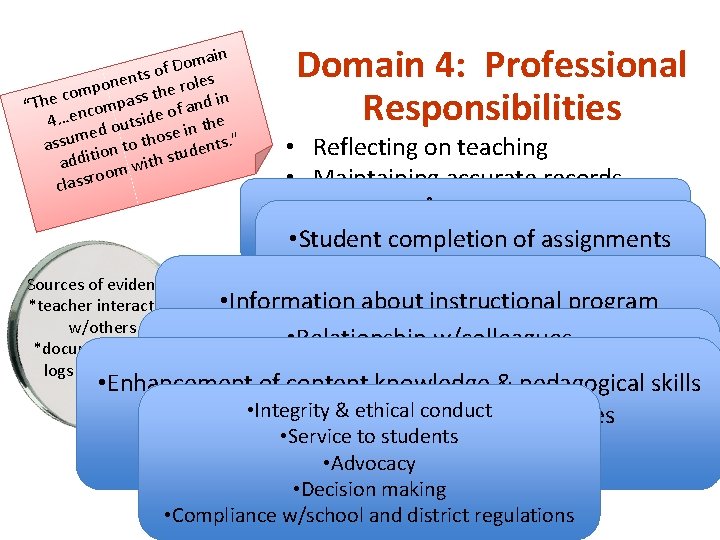
ain m o D of s t n e on roles p e m h o t c “The ncompass of and in side n the 4…e t u o ed ei s m o u h s t ts. ” as o n t e n d o i u addit m with st oo r s s a l c Domain 4: Professional Responsibilities • Reflecting on teaching • Maintaining accurate records • Accuracy • Communicating with families • Usecompletion in future teaching of assignments • • Student Participating in a professional community • Student progress in learning Sources of evidence • Growing and developing • Non-instructional records • Information about instructional program *teacher interaction professionally w/others • Information aboutw/colleagues individual students • Relationship *documentation in • Showing professionalism • Engagement of families in professional instructionalinquiry program logs or portfolio • Involvement in culture of • Enhancement of content knowledge & pedagogical skills • Service to school • Integrity ethical conduct • Receptivity to&feedback from colleagues • Participation in students school & district projects • Service to the profession • Advocacy • Decision making • Compliance w/school and district regulations
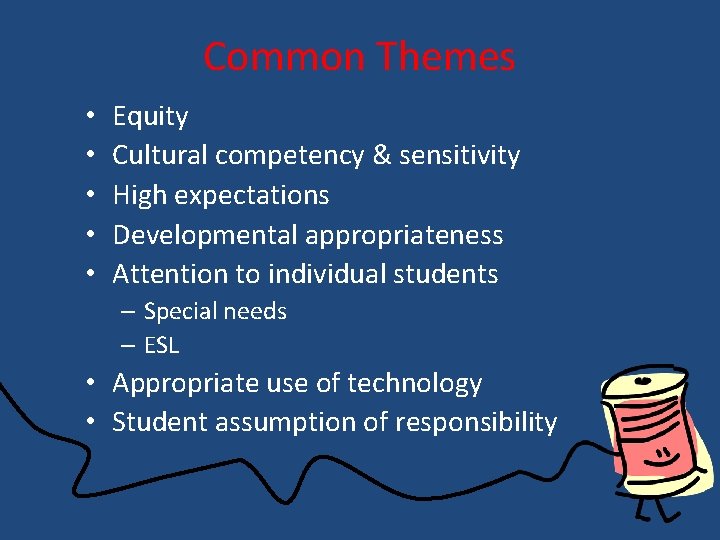
Common Themes • • • Equity Cultural competency & sensitivity High expectations Developmental appropriateness Attention to individual students – Special needs – ESL • Appropriate use of technology • Student assumption of responsibility
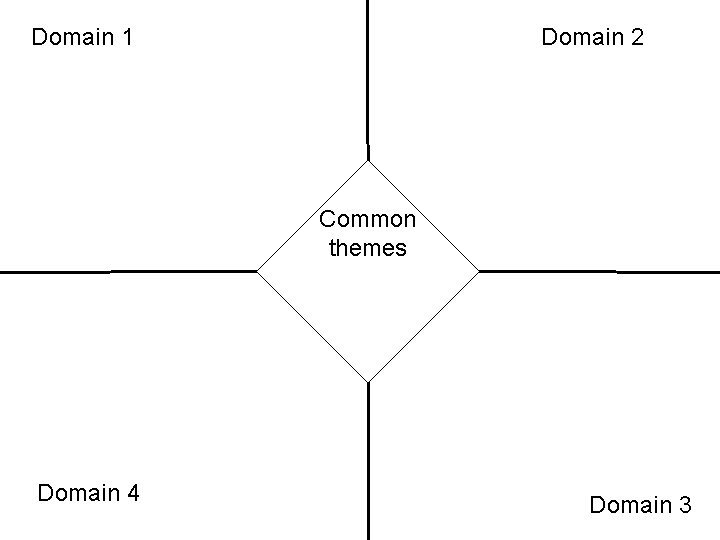
Domain 1 Domain 2 Common themes Domain 4 Domain 3
2011 Revised Edition of Danielson NEW • Revised language within components to be more precise • Critical attributes or observable teacher/student behaviors or actions added within each component and level of performance • Possible teaching examples listed within each component and level of performance
Evidence of Teaching • Evidence refers to artifacts, actions or statements, and decisions made by the teacher • Evidence is used as the foundation of the judgment of teaching • Evidence comes in many forms and is determined by your school district
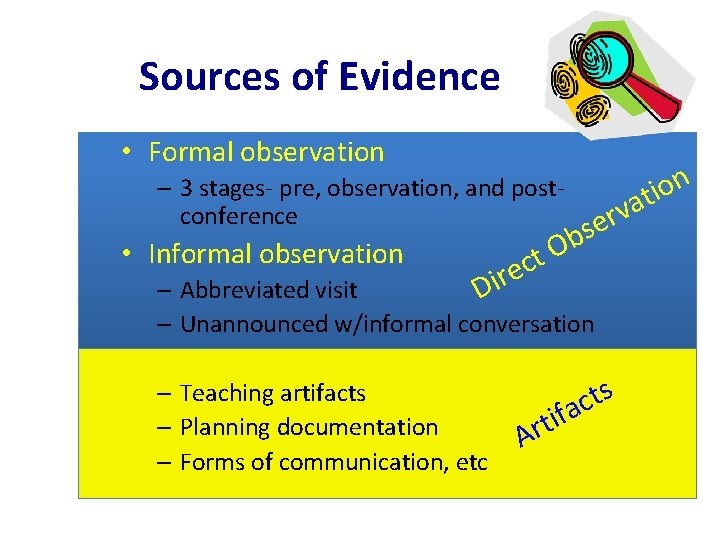
Sources of Evidence • Formal observation – 3 stages- pre, observation, and postconference • Informal observation v r e bs O t ec r i – Abbreviated visit D – Unannounced w/informal conversation – Teaching artifacts – Planning documentation – Forms of communication, etc s t c ifa t r A n o i at
Evidence of Student Learning • Framework explains what teachers can doinput • Indirect evidence is also considered important to judge student learningoutput – Results of state-mandated tests – Student and parent surveys – Teaching artifacts- units, lessons, assessments, communications to parents, etc.
Formal Observation • Pre-conference or “planning conference” – Teacher interview – Review of documents – Discussion of procedure/process • Observation – Gathering of evidence • Post-conference or “reflection conference” – Teacher lesson reflection – Discussion w/teacher
Preconference • Purpose- chance for the teacher to discuss their planning process/skills • Things to consider – Give teachers questions in advance to review – Have teachers bring copies of written materials for lesson – Review the teacher’s lesson prior to the conference • Seen as core part of evaluating Domain 1
Documenting Evidence • Evidence is statements, actions, or behaviors • Evidence can include artifacts prepared by the teacher, students, or others • Evidence is NOT personal opinion or bias. It is selected through the observer’s and/or teachers’ use of professional judgment
A Quick Quiz- Evidence or Opinion? • The class was out of control • All but 2 students participated in the exercise. • The students didn’t understand expectations. • The teacher stopped to review instructions when the teacher saw that students were of-task. • The students were engaged in the lesson.
• Listen for evidence of planning from the teacher • Write down evidence gathered from the planning conference using the Planning Conference Handout Let’s see how a pre-conference might look. Remember much of Domain 1 is captured here.
Classroom Observation • Focuses on Domains 2 & 3 • One observation may not capture every componentover time a teacher should demonstrate them all** • Observer should – Focus on evidence/facts and avoid interpretation or opinion (adj/adv. ) – Be familiar w/components so they are recognized during lesson – Note what teacher says/does as well as questions, statements, actions (verbal/non verbal) • Recommended to give teacher notes after visit- helps w/transparency
As you watch the brief video clip, write down evidence that you note as it applies to the components of Domain 2 & 3 It takes time to be familiar with the components. Focus on differentiating between D 2 & D 3
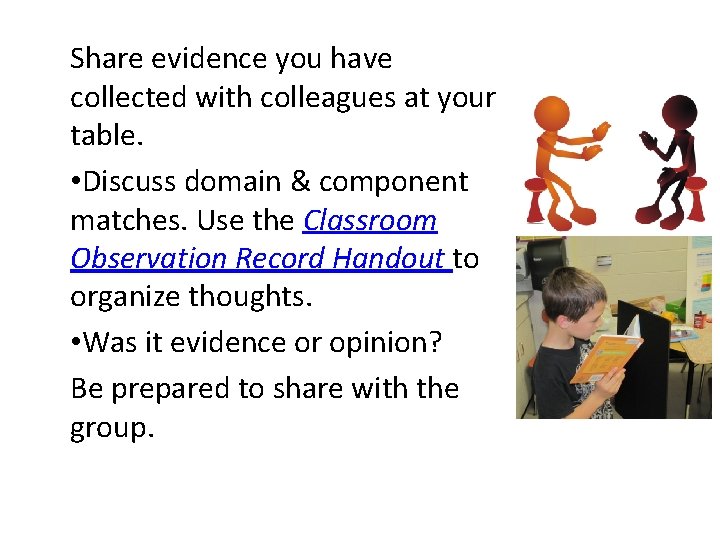
Share evidence you have collected with colleagues at your table. • Discuss domain & component matches. Use the Classroom Observation Record Handout to organize thoughts. • Was it evidence or opinion? Be prepared to share with the group.
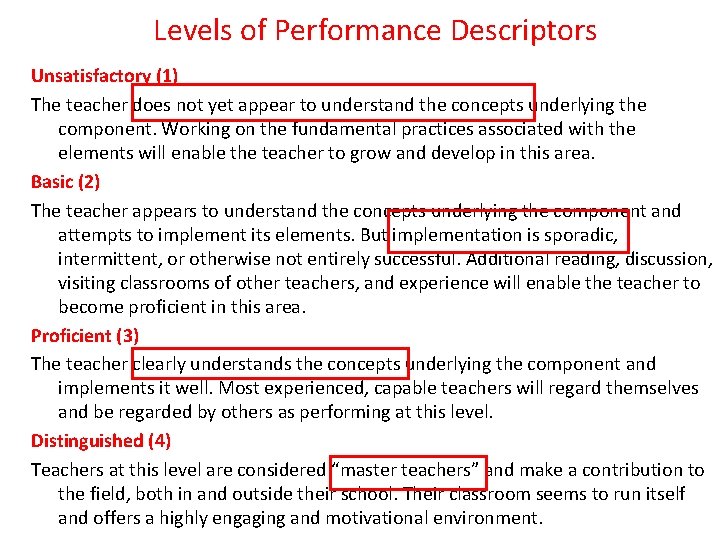
Preparing for the post-conference • Write a brief summary (few paragraphs) recording major events of lesson based on formal observation notes such that a non-observer would get sense of what was observed • Match observation notes to the components within each of the domains & write samples of evidence observed down • Highlight words/phrases within levels of performance that best characterize the lesson
Post-Observation Conference or “Reflection Conference” • Conversation designed to promote teacher thinking and growth • Provides perspective on Domain 4 • Encouraged to have the teacher self-assess in preparation for this conference • Chance to “compare notes” and identify strengths/areas for improvement • Discussion should include a written summary that captures views of both parties
Informal observations • Unannounced observation of teaching • Last about 5 -10 minutes • May be used as evidence in a teacher’s evaluation (depends on negotiated contract) • Danielson’s suggested procedure – Take notes on lesson (see informal observation form) – (Opt) Leave note for teacher w/brief supportive comment about lesson – Speak w/teacher briefly after to have a professional conversation about aspects seen – If form used, note relevant aspects observed in domains
Levels of Performance • 4 Levels within each of the Domains & Components • Unsatisfactory (1) • Basic (2) • Proficient (3) • Distinguished (4) • Levels represent the performance of teaching not of teachers • It is natural for teachers to move among ratings • Higher levels reflect experience as well as expertise • Most effective when multiple measures are used before determining a level of performance
Levels of Performance Descriptors Unsatisfactory (1) The teacher does not yet appear to understand the concepts underlying the component. Working on the fundamental practices associated with the elements will enable the teacher to grow and develop in this area. Basic (2) The teacher appears to understand the concepts underlying the component and attempts to implement its elements. But implementation is sporadic, intermittent, or otherwise not entirely successful. Additional reading, discussion, visiting classrooms of other teachers, and experience will enable the teacher to become proficient in this area. Proficient (3) The teacher clearly understands the concepts underlying the component and implements it well. Most experienced, capable teachers will regard themselves and be regarded by others as performing at this level. Distinguished (4) Teachers at this level are considered “master teachers” and make a contribution to the field, both in and outside their school. Their classroom seems to run itself and offers a highly engaging and motivational environment.
Preparing to assign levels • Training is core for evaluators to determine levels of performance • Ratings can be assigned as part of each evaluation and/or at the end of the school year • Teachers can self-reflect and determine ratings as part of the process • Some elements are not best judged by observation
What’s next if you choose Danielson? • Spend more time learning and understanding the Framework – Domains, components, & sub-components – Documenting evidence during observation – Judging levels of performance • Consider the forms of evidence your school will use to judge teacher performance in the four domains • Develop the format and structure of yearly evaluation
References • Danielson, C. (2011). It’s your evaluation: Collaborating to improve teacher practice. In NJEA Review, pp. 24 -27. • Danielson, C. & Dwyer, C. (1995). How Praxis III supports beginning teachers. In Educational Leadership, 52(6), pp. 66 -67. • PR Newswire (March 27, 2012). Charlotte Danielson enhances framework for teaching with new evaluation instrument.
s e rc Re u o s Enhancing Professional Practice- A Framework for Teaching (2 nd Edition) by Charlotte Danielson **Handbook for Enhancing Professional Practice- Using the Framework for Teaching in your School by Charlotte Danielson **Enhancing Professional Practice Series DVD by ASCD www. delicious. com/nboakes- Look at the “Danielson” stack
Comparison of Teacher Evaluation Models • National Comprehensive Center for Teacher Quality: Improving Instruction Through Effective Teacher Evaluation • http: //www. tqsource. org/publications/February 2008 Brief. pdf • Teacher Evaluation: Assessing Principals’ Perceptions in the State of New Jersey • http: //scholar. google. com/scholar? hl=en&q=comparison+of+danielson+ marzano+and+mcrel+teacher+evaluation+models&btn. G=Search&as_sdt =0%2 C 31&as_ylo=&as_vis=1 • Danielson (www. danielsongroup. org) • Marzano (www. marzanoevaluation. com) • Mc. Rel (www. mcrel. org/evalsystems) • Stronge (http: //education. wm. edu/facultystaffprofiles/jamesstronge. php) • TAP (http: //www. mff. org/about/lmilken. taf) • NJEA Review. October 2011 (pp 24 -27) and November 2011 (pp 22 -26) editions 44
n i n o i t a p i c i t r a p r u o y r o f. C u T o T y E k I n R S y Tha b d e g n a r r a p o h s k r o w this