
Is assessment for learning really assessment Prof Gavin
- Slides: 19
Is assessment for learning really assessment? Prof. Gavin T L Brown, Ph. D Presentation to NZ Cancelled Conference Conversations Digital Conference May 2020 Contact: gt. brown@auckland. ac. nz
What’s the point? �I want to present my thoughts on the assessment for learning agenda in education ◦ Compare & Contrast what Af. L is with what assessment is ◦ Suggest new options for Af. L
Assessment for Learning � MOST basically ◦ Collecting evidence about learning early enough so that teacher instruction (teaching) and student activity (learning) changes in a way that causes progress towards intended goals and targets ◦ Progress involves faster, more, and better quality performances and products on the part of students
Essential facets of Af. L �Formative ◦ Before the end ◦ Leads to changes in teaching & learning practices ◦ Results in progress ◦ Evidence must be capable of accurately and appropriately guiding changed practices
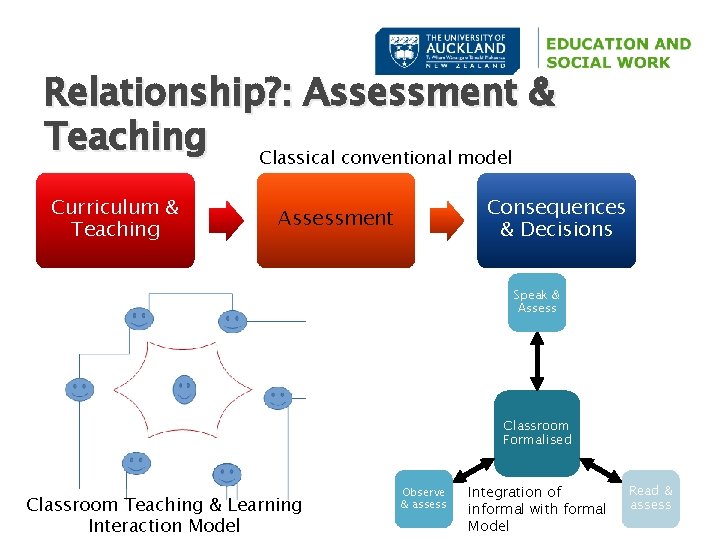
Relationship? : Assessment & Teaching Classical conventional model Curriculum & Teaching Consequences & Decisions Assessment Speak & Assess Classroom Formalised Classroom Teaching & Learning Interaction Model Observe & assess Integration of informal with formal Model Read & assess
Af. L as pedagogy � Assessment for the purpose of improving student learning is best understood as an ongoing process that arises out of the interaction between teaching and learning. It involves the focused and timely gathering, analysis, interpretation, and use of information that can provide evidence of student progress. Much of this evidence is ‘of the moment’. Analysis and interpretation often take place in the mind of the teacher, who then uses the insights gained to shape their actions as they continue to work with their students. ◦ Ministry of Education. (2007). The New Zealand Curriculum for English -medium teaching and learning in years 1 -13. Wellington, NZ: Learning Media. (p. 39)
Af. L as pedagogy � ‘five broad strategies to be equally powerful for teachers of all content areas and at all grade levels: ◦ clarifying and sharing learning intentions and criteria for success; ◦ engineering effective classroom discussions, questions, and learning tasks; ◦ providing feedback that moves learners forward; ◦ activating students as the owners of their own learning; and ◦ activating students as instructional resources for one another’. � Leahy, S. , Lyon, C. , Thompson, M. , & Wiliam, D. (2005). Classroom assessment minute by minute, day by day. Educational Leadership, 63(3), 18 -24.
These approaches to Af. L � Very student-oriented, de-emphasise teacher role � Very anti-testing, judgement matters � Very anti-formal, systematic procedures, trust the teacher or student’s judgements � Is there no error in judgments and feedback? � Is it assessment or just good teaching?
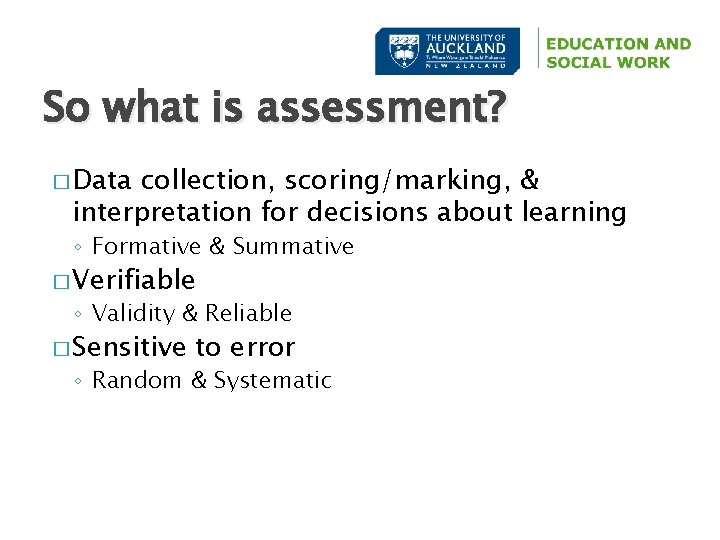
So what is assessment? � Data collection, scoring/marking, & interpretation for decisions about learning ◦ Formative & Summative � Verifiable ◦ Validity & Reliable � Sensitive to error ◦ Random & Systematic
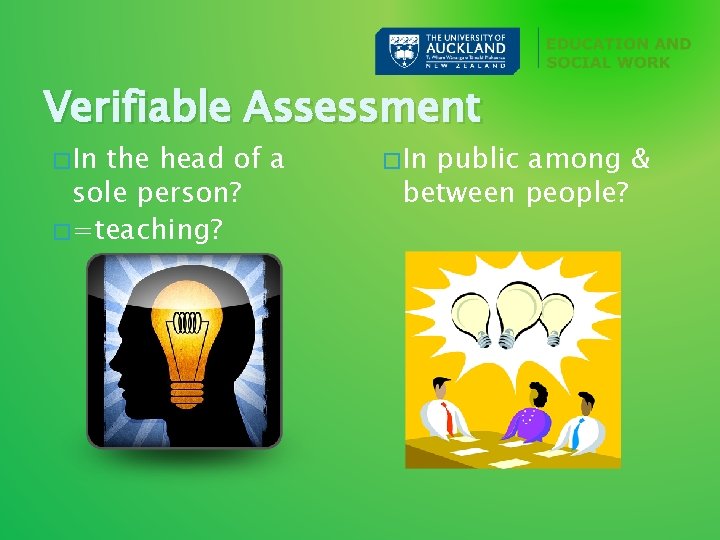
Verifiable Assessment � In the head of a sole person? � =teaching? � In public among & between people?
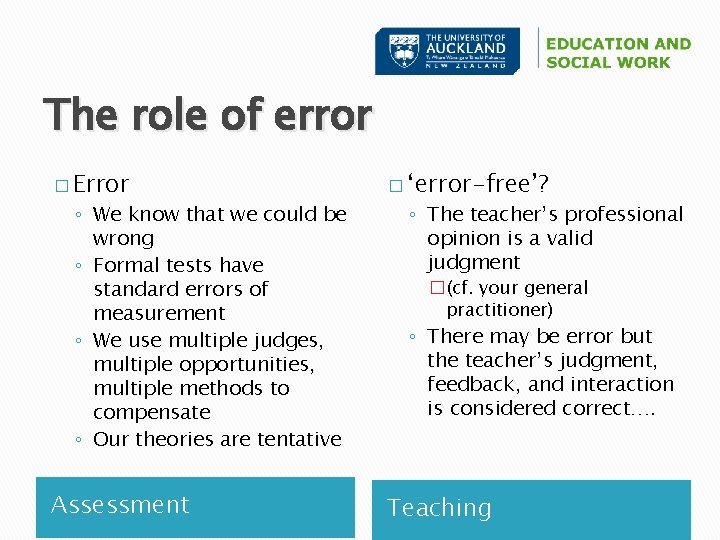
The role of error � Error ◦ We know that we could be wrong ◦ Formal tests have standard errors of measurement ◦ We use multiple judges, multiple opportunities, multiple methods to compensate ◦ Our theories are tentative Assessment � ‘error-free’? ◦ The teacher’s professional opinion is a valid judgment �(cf. your general practitioner) ◦ There may be error but the teacher’s judgment, feedback, and interaction is considered correct…. Teaching
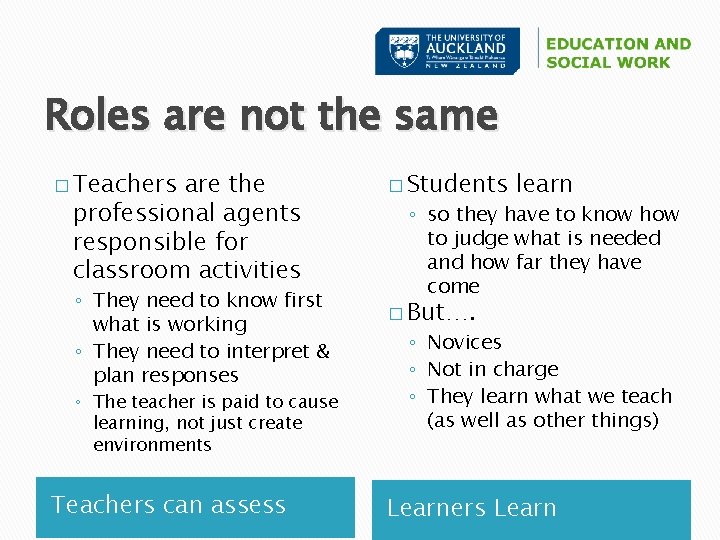
Roles are not the same � Teachers are the professional agents responsible for classroom activities ◦ They need to know first what is working ◦ They need to interpret & plan responses ◦ The teacher is paid to cause learning, not just create environments Teachers can assess � Students learn ◦ so they have to know how to judge what is needed and how far they have come � But…. ◦ Novices ◦ Not in charge ◦ They learn what we teach (as well as other things) Learners Learn
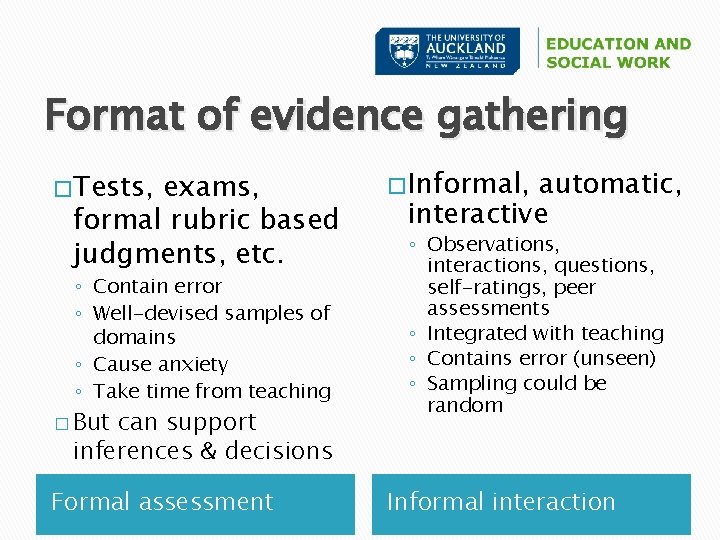
Format of evidence gathering � Tests, exams, formal rubric based judgments, etc. ◦ Contain error ◦ Well-devised samples of domains ◦ Cause anxiety ◦ Take time from teaching � But can support inferences & decisions Formal assessment � Informal, automatic, interactive ◦ Observations, interactions, questions, self-ratings, peer assessments ◦ Integrated with teaching ◦ Contains error (unseen) ◦ Sampling could be random Informal interaction
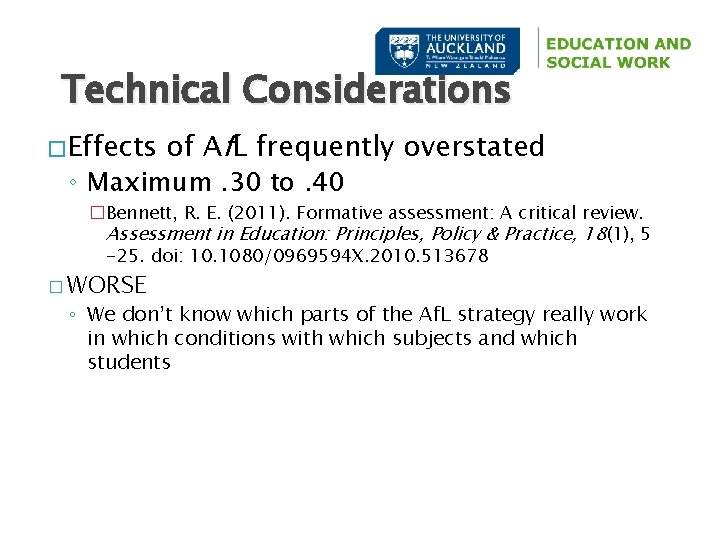
Technical Considerations � Effects of Af. L frequently overstated ◦ Maximum. 30 to. 40 �Bennett, R. E. (2011). Formative assessment: A critical review. Assessment in Education: Principles, Policy & Practice, 18(1), 5 -25. doi: 10. 1080/0969594 X. 2010. 513678 � WORSE ◦ We don’t know which parts of the Af. L strategy really work in which conditions with which subjects and which students
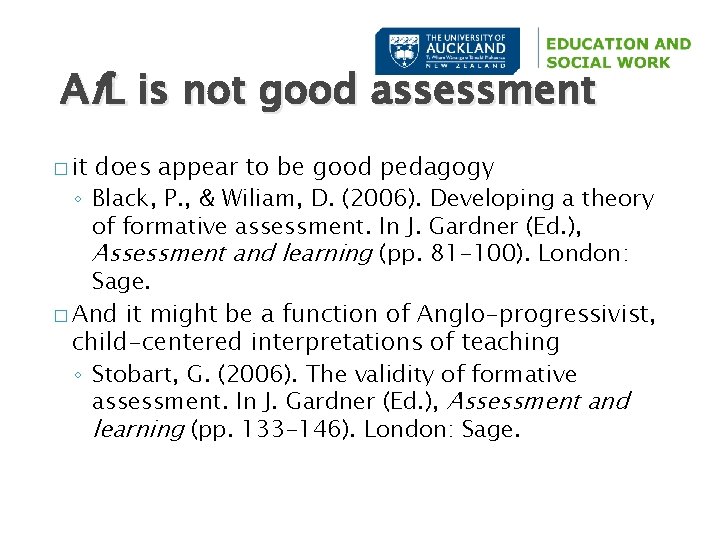
Af. L is not good assessment � it does appear to be good pedagogy ◦ Black, P. , & Wiliam, D. (2006). Developing a theory of formative assessment. In J. Gardner (Ed. ), Assessment and learning (pp. 81 -100). London: Sage. � And it might be a function of Anglo-progressivist, child-centered interpretations of teaching ◦ Stobart, G. (2006). The validity of formative assessment. In J. Gardner (Ed. ), Assessment and learning (pp. 133 -146). London: Sage.
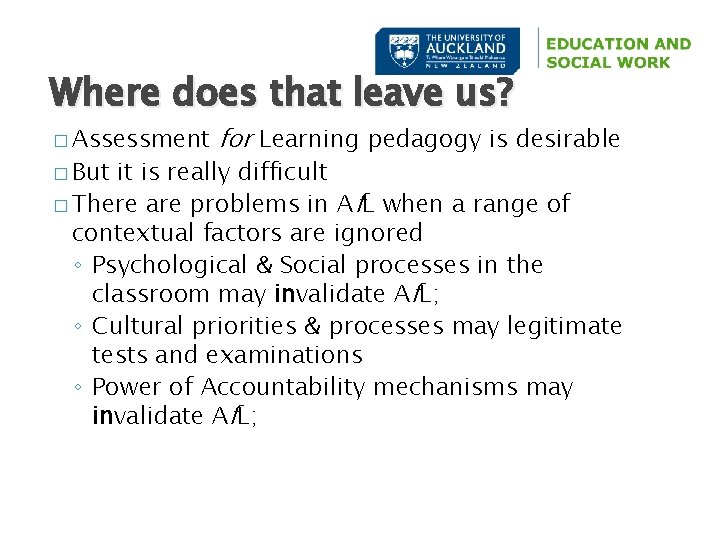
Where does that leave us? � Assessment � But for Learning pedagogy is desirable it is really difficult � There are problems in Af. L when a range of contextual factors are ignored ◦ Psychological & Social processes in the classroom may invalidate Af. L; ◦ Cultural priorities & processes may legitimate tests and examinations ◦ Power of Accountability mechanisms may invalidate Af. L;
A new Af. L 2. 0? � Emphasise the importance of the teacher as the expert in content and pedagogy and pedagogical content knowledge whose job is to enable progress among novices ◦ Teachers teach Emphasise pedagogical practices that are known to effect learning ◦ (i. e. , the activator strategies identified by Hattie, 2009) � Systematic, formal use of high-quality, highlyinformative tests (e. g. , as. TTle), but infrequently ◦ To inform teaching ◦ To calibrate judgements ◦ As part of a ‘toolbox’ of validated methods/tools � Source: Hattie & Brown (2008, 2010)
A new Af. L 2. 0? � Systematic, formal use of moderation procedures to assure quality of teacher judgements ◦ Esp. for reporting or administrative purposes ◦ To develop a community of understanding about progress, teaching, & curriculum � Make it safe to discover bad news—avoid highstakes public consequences for assessments prior to qualifications � Make assessment about improved learning for each and every individual student for both the student and the teacher; not just school improvement! Source: Hattie & Brown (2008, 2010)
Read more � Harris, L. R. , & Brown, G. T. L. (2016). Volume introduction: The human and social experience of assessment: Valuing the person and context. In G. T. L. Brown & L. R. Harris (Eds. ), Handbook of Human and Social Factors in Assessment (pp. 1 -18). New York: Routledge. � Brown, G. T. L. , & Harris, L. R. (2016). Volume Conclusion: The future of assessment as a human and social endeavour. In G. T. L. Brown & L. R. Harris (Eds. ), Handbook of Human and Social Conditions in Assessment (pp. 506 -524). New York: Routledge.