
IS 556 Enterprise Project Management 1 PMO Cost
![Bonham, chapter 6 Asset Management Lecture 7 [57] IS 556 --Spring 2008 May 12,](https://slidetodoc.com/presentation_image_h2/1a70fa6a2729ce0e2f1eac7ffe6fc6ce/image-18.jpg "Bonham, chapter 6 Asset Management Lecture 7 [57] IS 556 --Spring 2008 May 12,")
- Slides: 27
IS 556 Enterprise Project Management 1
PMO: Cost Center or Profit Center 2
Cost Center or Profit Center? p Depends on what the PMO is set up to handle p Can easily just generate costs if PMO is constructed in answer to a particular crisis. p Profit center PMOs are those that create project management systems that add value dependably and repeatedly. 3
Major Contributions p p Program management (Pg. M) comes from manufacturing where products are always been developed, implemented, marketed and closed out Program management (Pg. M) roles n n Primary – manage the business on the program to insure the return & other business objectives are achieved. Secondary – lead multiple pjt teams thru the product development life cycle through coordination and control mechanisms 4
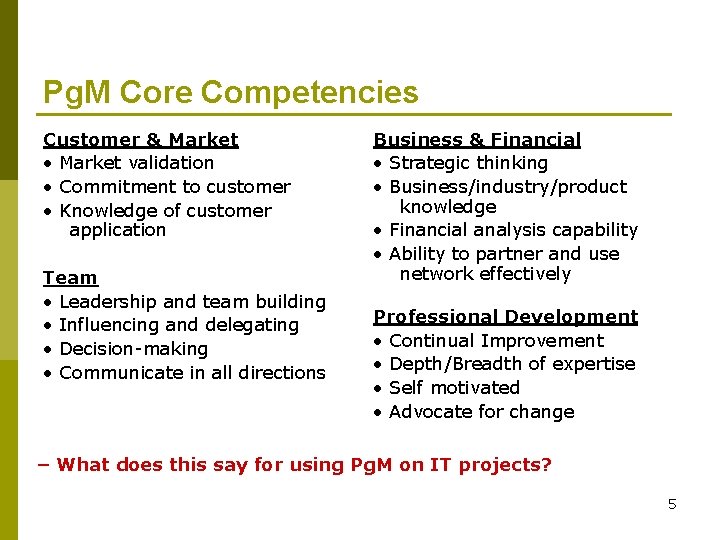
Pg. M Core Competencies Customer & Market • Market validation • Commitment to customer • Knowledge of customer application Team • Leadership and team building • Influencing and delegating • Decision-making • Communicate in all directions Business & Financial • Strategic thinking • Business/industry/product knowledge • Financial analysis capability • Ability to partner and use network effectively Professional Development • Continual Improvement • Depth/Breadth of expertise • Self motivated • Advocate for change – What does this say for using Pg. M on IT projects? 5
Bonham, chapter 5 Architecture Management 6
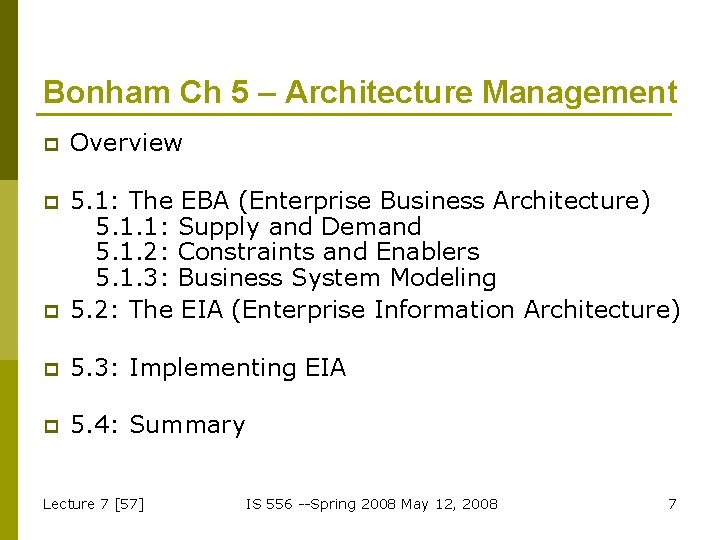
Bonham Ch 5 – Architecture Management p Overview p p 5. 1: The EBA (Enterprise Business Architecture) 5. 1. 1: Supply and Demand 5. 1. 2: Constraints and Enablers 5. 1. 3: Business System Modeling 5. 2: The EIA (Enterprise Information Architecture) p 5. 3: Implementing EIA p 5. 4: Summary Lecture 7 [57] IS 556 --Spring 2008 May 12, 2008 7
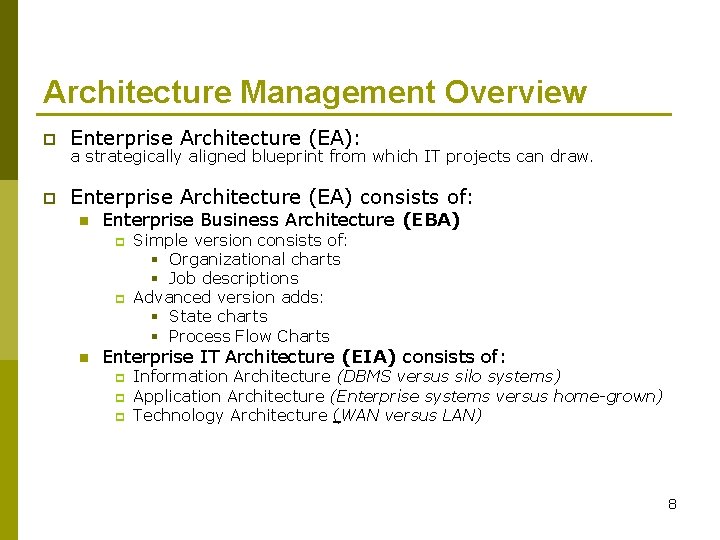
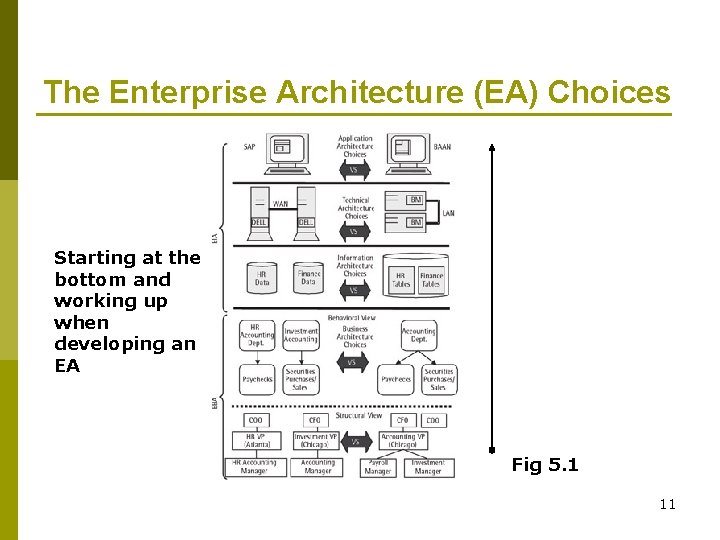
Architecture Management Overview p Enterprise Architecture (EA): p Enterprise Architecture (EA) consists of: a strategically aligned blueprint from which IT projects can draw. n Enterprise Business Architecture (EBA) p p n Simple version consists of: § Organizational charts § Job descriptions Advanced version adds: § State charts § Process Flow Charts Enterprise IT Architecture (EIA) consists of: p p p Information Architecture (DBMS versus silo systems) Application Architecture (Enterprise systems versus home-grown) Technology Architecture (WAN versus LAN) 8
Architecture Management Overview For creating the EA, IT PMO coordinates: n n n Business units Business case writers IT architecture teams 9
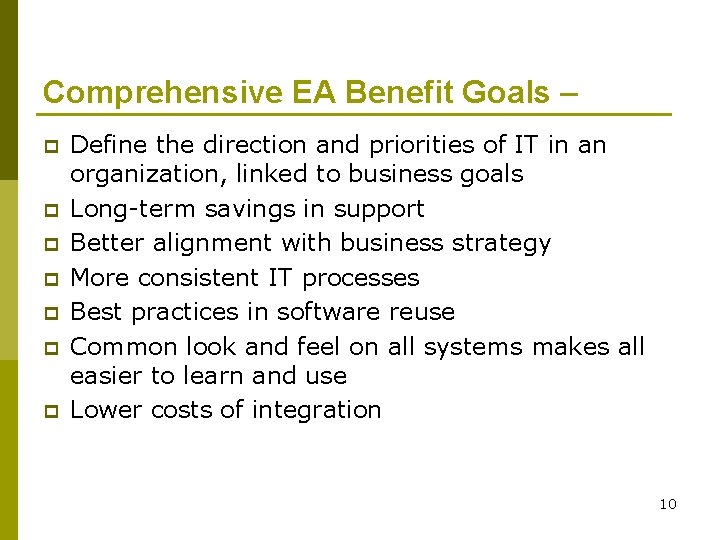
Comprehensive EA Benefit Goals – p p p p Define the direction and priorities of IT in an organization, linked to business goals Long-term savings in support Better alignment with business strategy More consistent IT processes Best practices in software reuse Common look and feel on all systems makes all easier to learn and use Lower costs of integration 10
The Enterprise Architecture (EA) Choices Starting at the bottom and working up when developing an EA Fig 5. 1 11
12
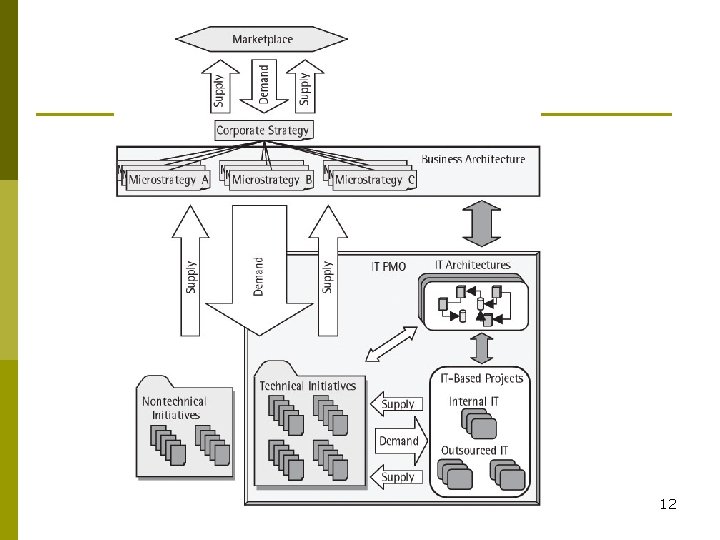
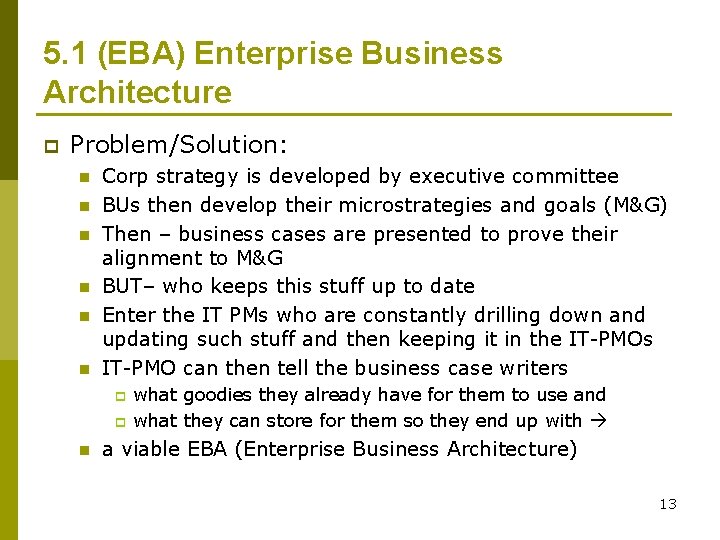
5. 1 (EBA) Enterprise Business Architecture p Problem/Solution: n n n Corp strategy is developed by executive committee BUs then develop their microstrategies and goals (M&G) Then – business cases are presented to prove their alignment to M&G BUT– who keeps this stuff up to date Enter the IT PMs who are constantly drilling down and updating such stuff and then keeping it in the IT-PMOs IT-PMO can then tell the business case writers p p n what goodies they already have for them to use and what they can store for them so they end up with a viable EBA (Enterprise Business Architecture) 13
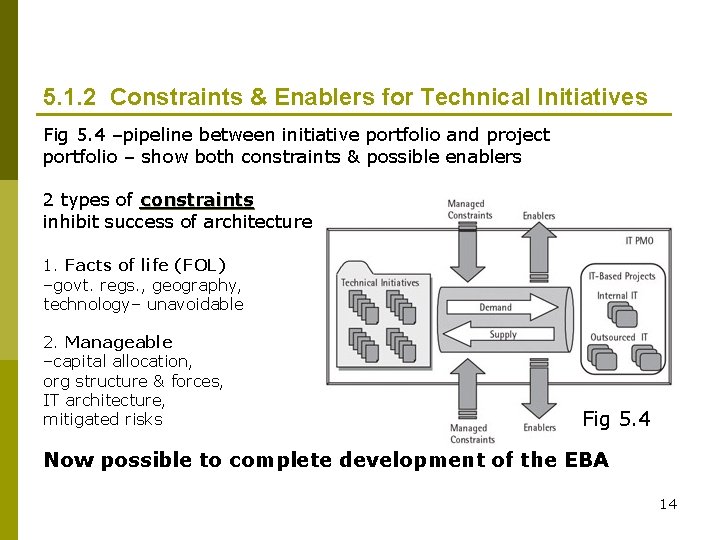
5. 1. 2 Constraints & Enablers for Technical Initiatives Fig 5. 4 –pipeline between initiative portfolio and project portfolio – show both constraints & possible enablers 2 types of constraints inhibit success of architecture 1. Facts of life (FOL) –govt. regs. , geography, technology– unavoidable 2. Manageable –capital allocation, org structure & forces, IT architecture, mitigated risks Fig 5. 4 Now possible to complete development of the EBA 14
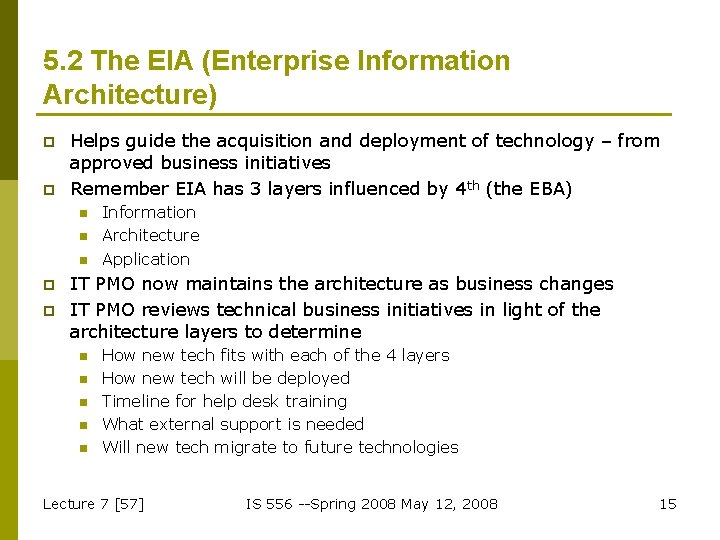
5. 2 The EIA (Enterprise Information Architecture) p p Helps guide the acquisition and deployment of technology – from approved business initiatives Remember EIA has 3 layers influenced by 4 th (the EBA) n n n p p Information Architecture Application IT PMO now maintains the architecture as business changes IT PMO reviews technical business initiatives in light of the architecture layers to determine n n n How new tech fits with each of the 4 layers How new tech will be deployed Timeline for help desk training What external support is needed Will new tech migrate to future technologies Lecture 7 [57] IS 556 --Spring 2008 May 12, 2008 15
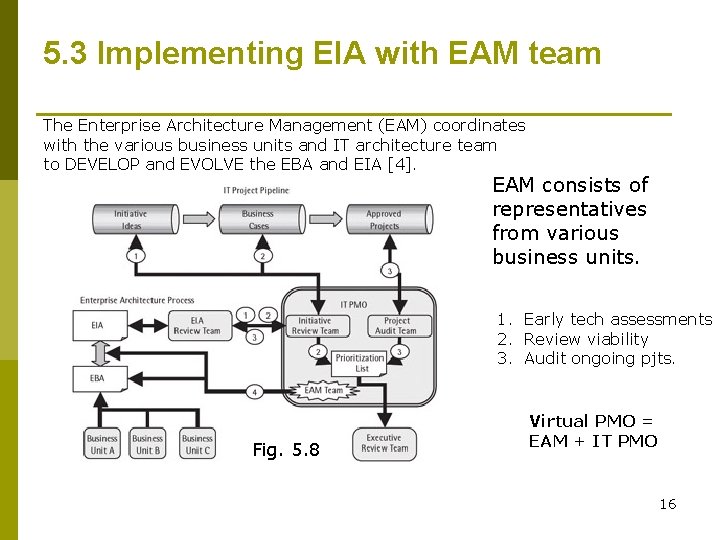
5. 3 Implementing EIA with EAM team The Enterprise Architecture Management (EAM) coordinates with the various business units and IT architecture team to DEVELOP and EVOLVE the EBA and EIA [4]. EAM consists of representatives from various business units. 1. Early tech assessments 2. Review viability 3. Audit ongoing pjts. Fig. 5. 8 Virtual PMO = EAM + IT PMO 16
Summary p On reviews of IT-based initiatives, EAM team of the IT PMO acts as a middle man between n n p p business case writer and IT architecture review team. EAM bases technical risks on architectures from business units (EBA) and IT (EIA). Potential problem of maintaining EBAs and EIAs is addressed by IT PMO developing: n n Firmness in some areas Flexibility in others 17
Bonham, chapter 6 Asset Management Lecture 7 [57] IS 556 --Spring 2008 May 12, 2008 18
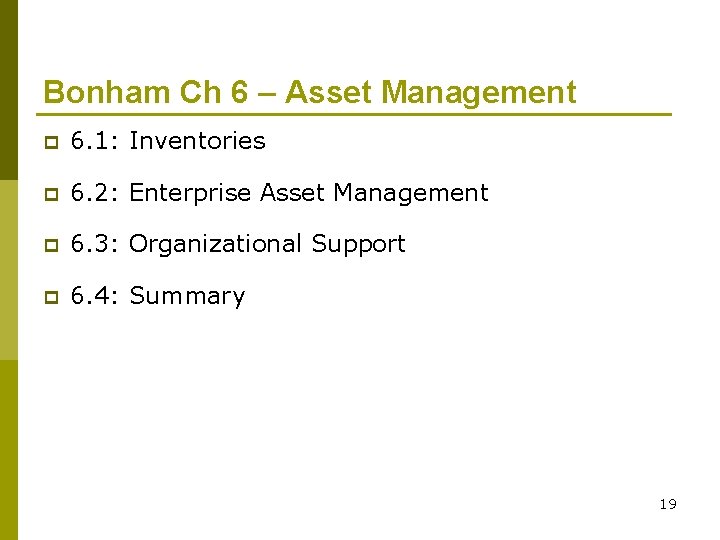
Bonham Ch 6 – Asset Management p 6. 1: Inventories p 6. 2: Enterprise Asset Management p 6. 3: Organizational Support p 6. 4: Summary 19
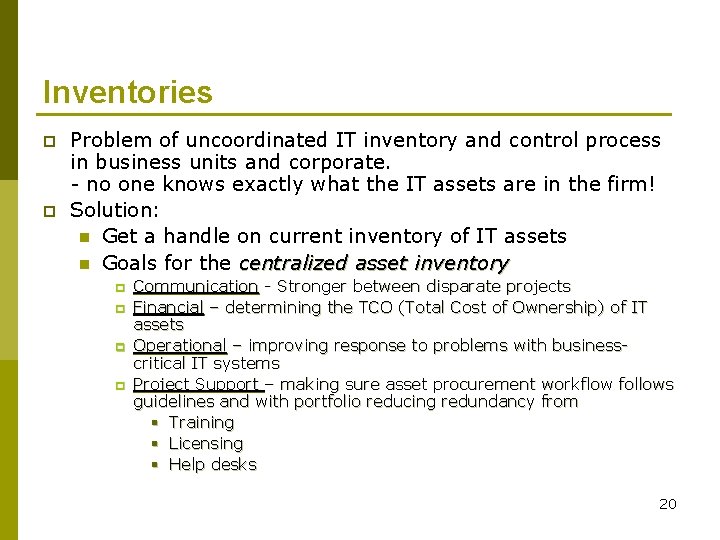
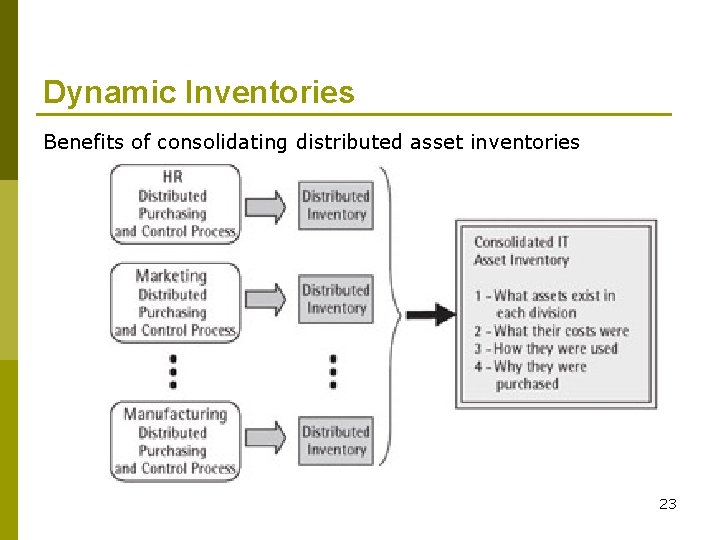
Inventories p p Problem of uncoordinated IT inventory and control process in business units and corporate. - no one knows exactly what the IT assets are in the firm! Solution: n Get a handle on current inventory of IT assets n Goals for the centralized asset inventory p p Communication - Stronger between disparate projects Financial – determining the TCO (Total Cost of Ownership) of IT assets Operational – improving response to problems with businesscritical IT systems Project Support – making sure asset procurement workflow follows guidelines and with portfolio reducing redundancy from § Training § Licensing § Help desks 20
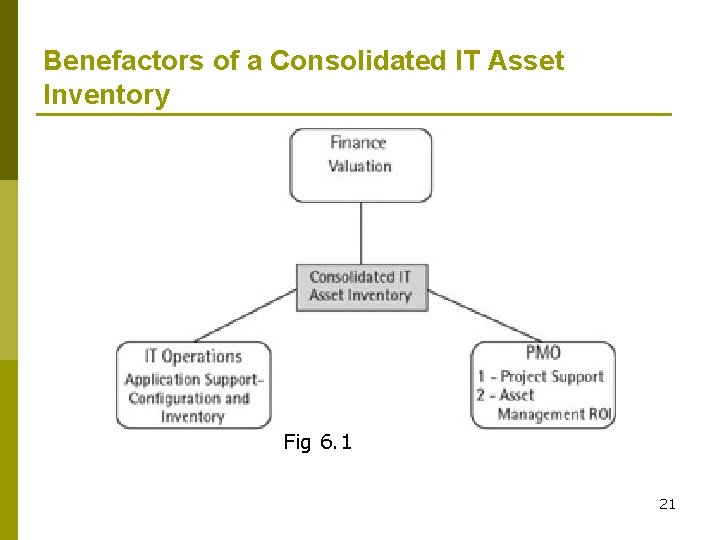
Benefactors of a Consolidated IT Asset Inventory Fig 6. 1 21
Inventory Types p Static Inventories n n p Finding hardware throughout firm Getting a baseline inventory of IT assets – p --find out how IT assets used p -- see them p -- count them p -- record them p -- then update the baseline Dynamic Inventories n n Unfortunately, inventories are rarely, if ever, static so when doing the baseline– there are more assets coming in through silo-like processes at the business units Must get control of the distributed IT asset purchasing processes 22
Dynamic Inventories Benefits of consolidating distributed asset inventories 23
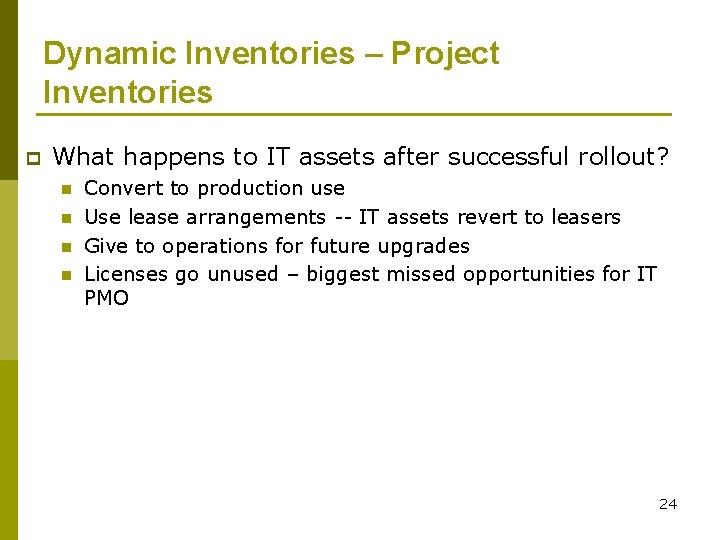
Dynamic Inventories – Project Inventories p What happens to IT assets after successful rollout? n n Convert to production use Use lease arrangements -- IT assets revert to leasers Give to operations for future upgrades Licenses go unused – biggest missed opportunities for IT PMO 24
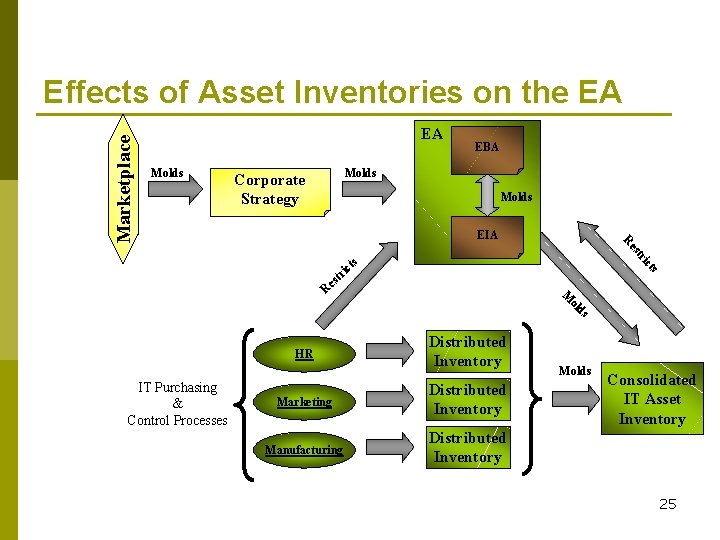
EA Molds EBA Molds Corporate Strategy Molds EIA tr s Re Marketplace Effects of Asset Inventories on the EA s s ict ct i tr es M R s d ol HR IT Purchasing & Control Processes Distributed Inventory Marketing Distributed Inventory Manufacturing Distributed Inventory Molds Consolidated IT Asset Inventory 25
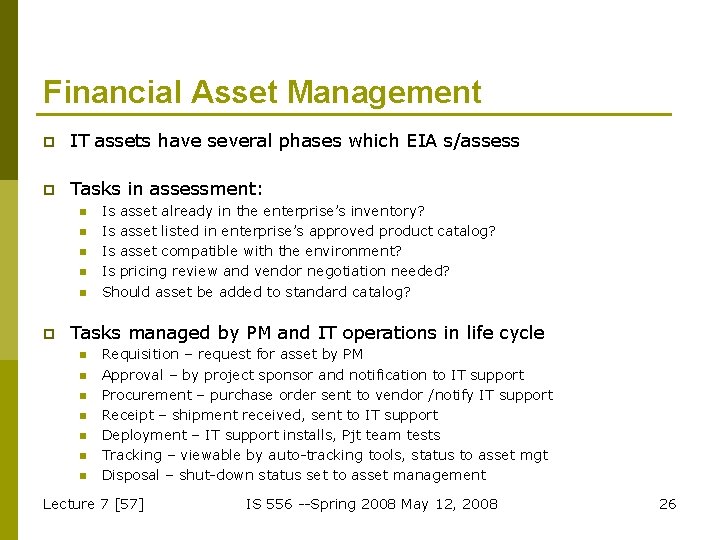
Financial Asset Management p IT assets have several phases which EIA s/assess p Tasks in assessment: n n n p Is asset already in the enterprise’s inventory? Is asset listed in enterprise’s approved product catalog? Is asset compatible with the environment? Is pricing review and vendor negotiation needed? Should asset be added to standard catalog? Tasks managed by PM and IT operations in life cycle n n n n Requisition – request for asset by PM Approval – by project sponsor and notification to IT support Procurement – purchase order sent to vendor /notify IT support Receipt – shipment received, sent to IT support Deployment – IT support installs, Pjt team tests Tracking – viewable by auto-tracking tools, status to asset mgt Disposal – shut-down status set to asset management Lecture 7 [57] IS 556 --Spring 2008 May 12, 2008 26
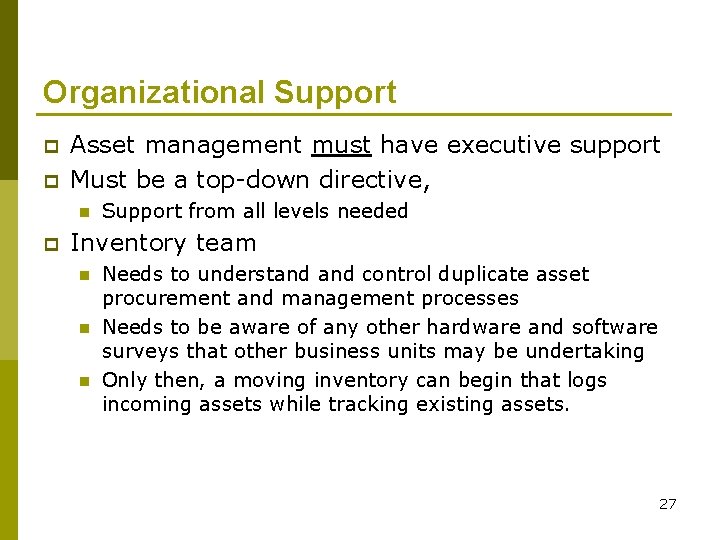
Organizational Support p p Asset management must have executive support Must be a top-down directive, n p Support from all levels needed Inventory team n n n Needs to understand control duplicate asset procurement and management processes Needs to be aware of any other hardware and software surveys that other business units may be undertaking Only then, a moving inventory can begin that logs incoming assets while tracking existing assets. 27