
IS 2610 Data Structures Recursion Divide and conquer
- Slides: 26
IS 2610: Data Structures Recursion, Divide and conquer Dynamic programming, Feb 2, 2004
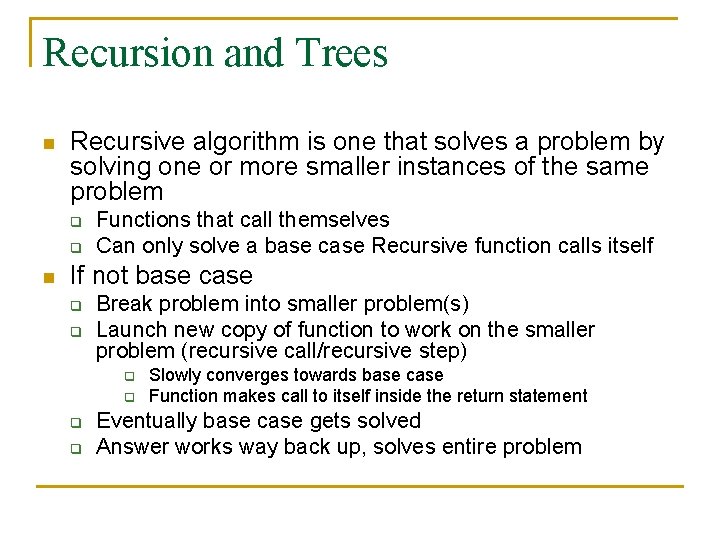
Recursion and Trees n Recursive algorithm is one that solves a problem by solving one or more smaller instances of the same problem q q n Functions that call themselves Can only solve a base case Recursive function calls itself If not base case q q Break problem into smaller problem(s) Launch new copy of function to work on the smaller problem (recursive call/recursive step) q q Slowly converges towards base case Function makes call to itself inside the return statement Eventually base case gets solved Answer works way back up, solves entire problem
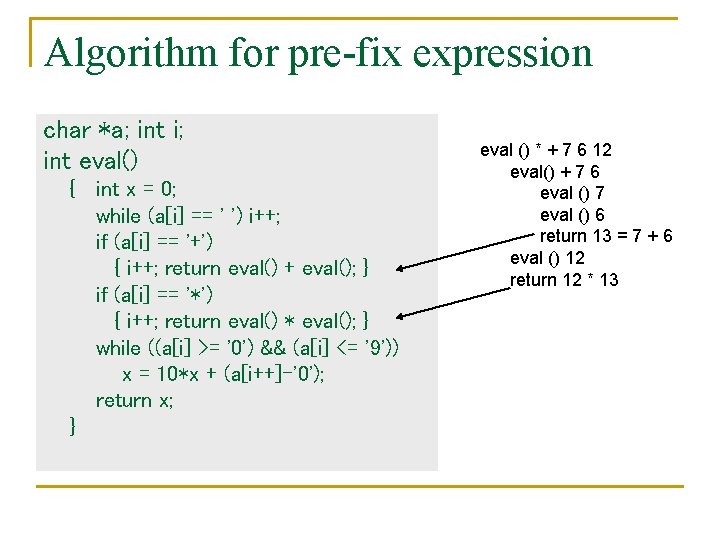
Algorithm for pre-fix expression char *a; int i; int eval() { int x = 0; while (a[i] == ' ') i++; if (a[i] == '+') { i++; return eval() + eval(); } if (a[i] == '*') { i++; return eval() * eval(); } while ((a[i] >= '0') && (a[i] <= '9')) x = 10*x + (a[i++]-'0'); return x; } eval () * + 7 6 12 eval() + 7 6 eval () 7 eval () 6 return 13 = 7 + 6 eval () 12 return 12 * 13
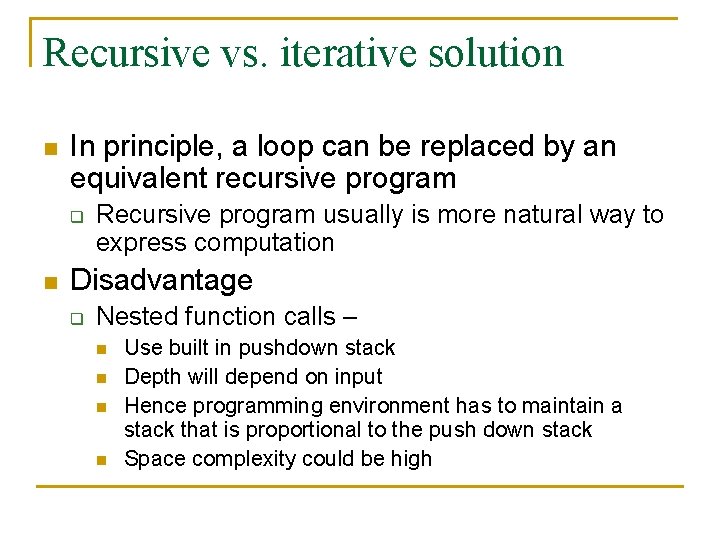
Recursive vs. iterative solution n In principle, a loop can be replaced by an equivalent recursive program q n Recursive program usually is more natural way to express computation Disadvantage q Nested function calls – n n Use built in pushdown stack Depth will depend on input Hence programming environment has to maintain a stack that is proportional to the push down stack Space complexity could be high
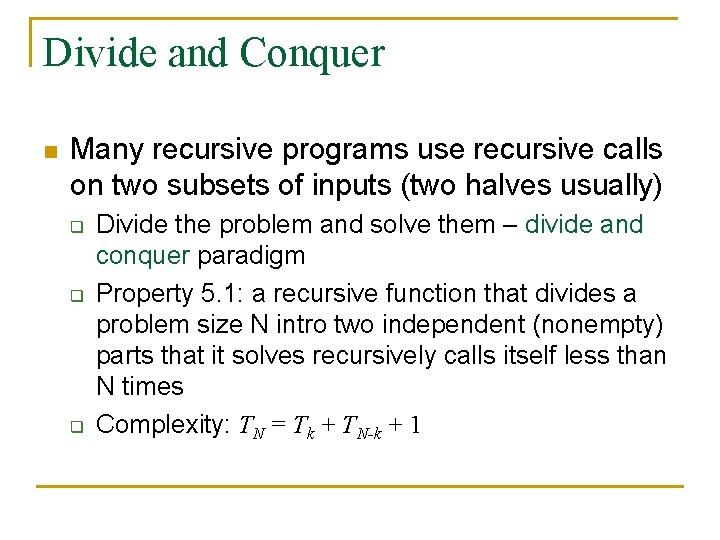
Divide and Conquer n Many recursive programs use recursive calls on two subsets of inputs (two halves usually) q q q Divide the problem and solve them – divide and conquer paradigm Property 5. 1: a recursive function that divides a problem size N intro two independent (nonempty) parts that it solves recursively calls itself less than N times Complexity: TN = Tk + TN-k + 1
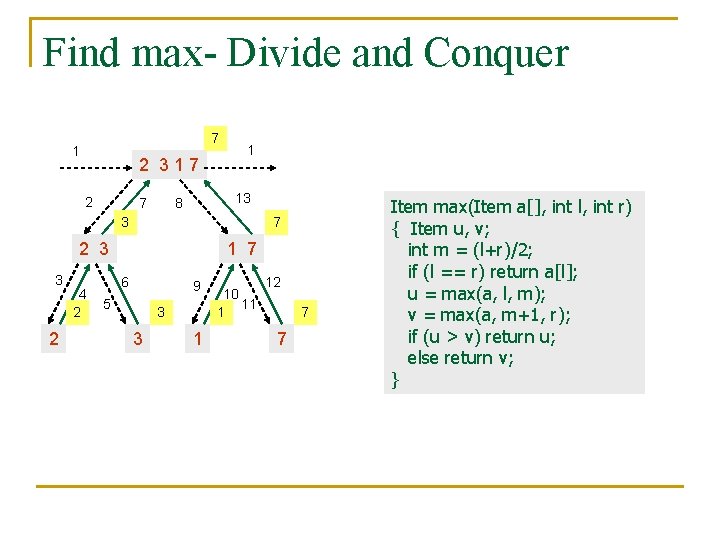
Find max- Divide and Conquer 7 1 2 317 2 7 1 13 8 3 7 2 3 3 2 4 2 1 7 6 9 5 3 3 1 10 11 1 12 7 7 Item max(Item a[], int l, int r) { Item u, v; int m = (l+r)/2; if (l == r) return a[l]; u = max(a, l, m); v = max(a, m+1, r); if (u > v) return u; else return v; }
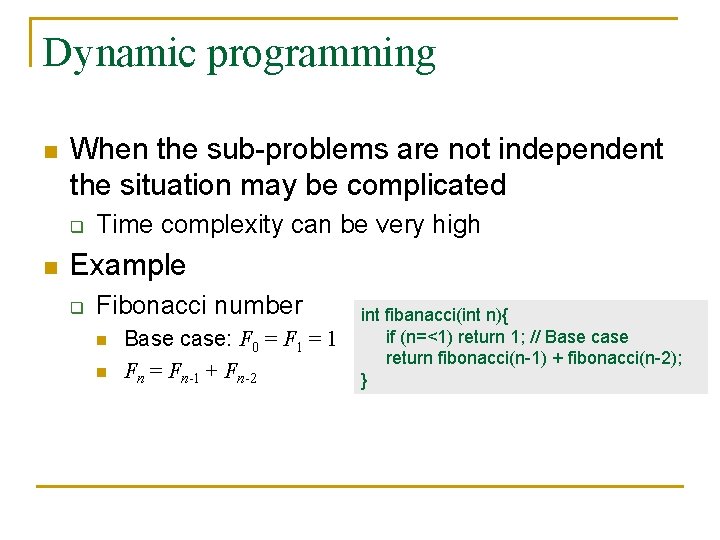
Dynamic programming n When the sub-problems are not independent the situation may be complicated q n Time complexity can be very high Example q Fibonacci number n n Base case: F 0 = F 1 = 1 Fn = Fn-1 + Fn-2 int fibanacci(int n){ if (n=<1) return 1; // Base case return fibonacci(n-1) + fibonacci(n-2); }
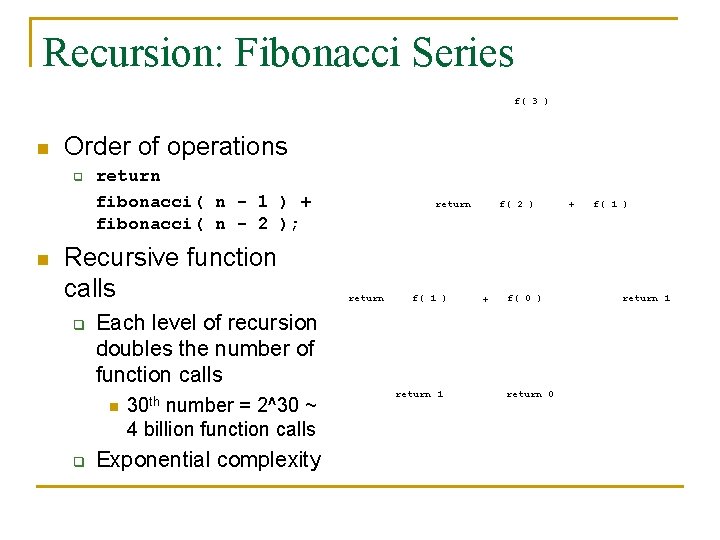
Recursion: Fibonacci Series f( 3 ) n Order of operations q n return fibonacci( n - 1 ) + fibonacci( n - 2 ); Recursive function calls q return f( 1 ) f( 2 ) + f( 0 ) Each level of recursion doubles the number of function calls n q return 30 th number = 2^30 ~ 4 billion function calls Exponential complexity return 1 return 0 + f( 1 ) return 1
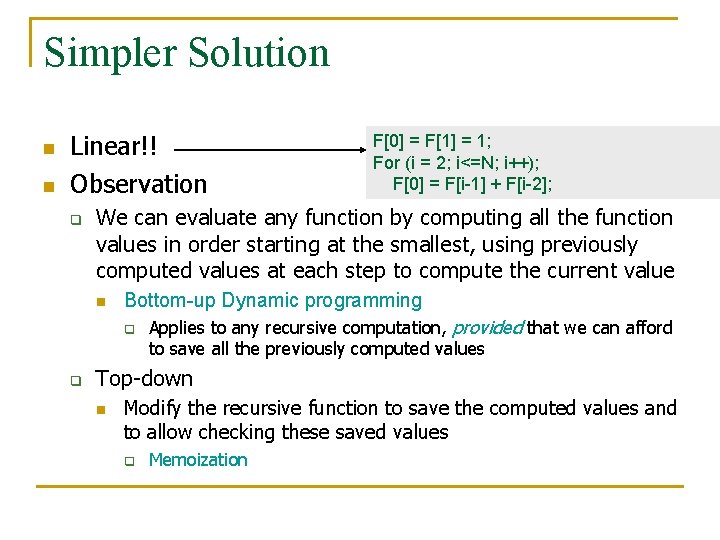
Simpler Solution n n Linear!! Observation q We can evaluate any function by computing all the function values in order starting at the smallest, using previously computed values at each step to compute the current value n Bottom-up Dynamic programming q q F[0] = F[1] = 1; For (i = 2; i<=N; i++); F[0] = F[i-1] + F[i-2]; Applies to any recursive computation, provided that we can afford to save all the previously computed values Top-down n Modify the recursive function to save the computed values and to allow checking these saved values q Memoization
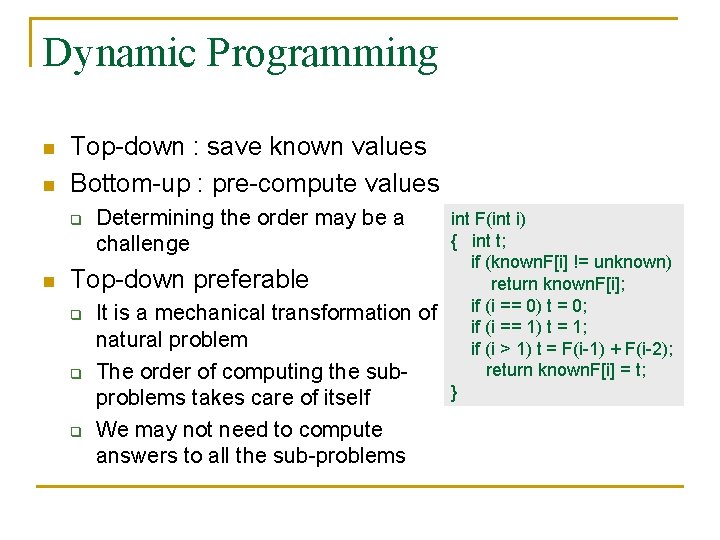
Dynamic Programming n n Top-down : save known values Bottom-up : pre-compute values q n Determining the order may be a challenge Top-down preferable q q q It is a mechanical transformation of natural problem The order of computing the subproblems takes care of itself We may not need to compute answers to all the sub-problems int F(int i) { int t; if (known. F[i] != unknown) return known. F[i]; a if (i == 0) t = 0; if (i == 1) t = 1; if (i > 1) t = F(i-1) + F(i-2); return known. F[i] = t; }
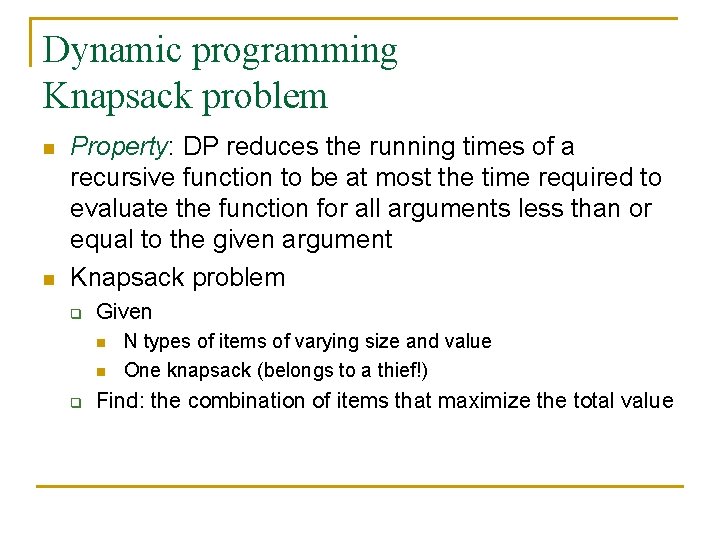
Dynamic programming Knapsack problem n n Property: DP reduces the running times of a recursive function to be at most the time required to evaluate the function for all arguments less than or equal to the given argument Knapsack problem q Given n n q N types of items of varying size and value One knapsack (belongs to a thief!) Find: the combination of items that maximize the total value
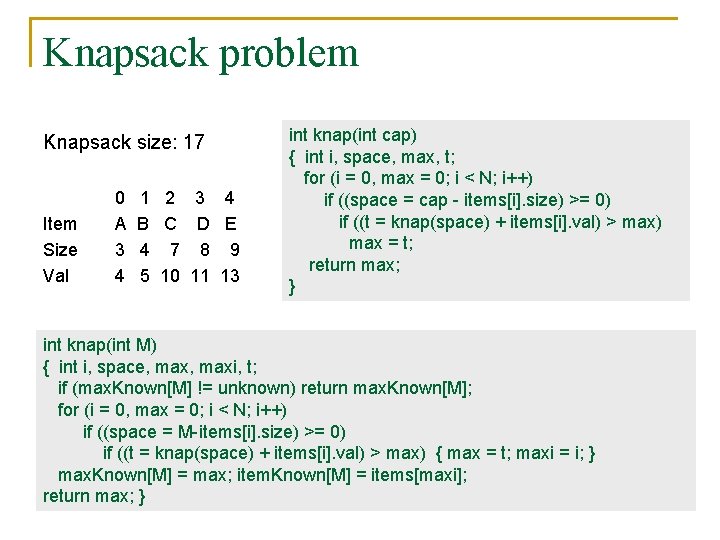
Knapsack problem Knapsack size: 17 Item Size Val 0 A 3 4 1 2 3 4 B C D E 4 7 8 9 5 10 11 13 int knap(int cap) { int i, space, max, t; for (i = 0, max = 0; i < N; i++) if ((space = cap - items[i]. size) >= 0) if ((t = knap(space) + items[i]. val) > max) max = t; return max; } int knap(int M) { int i, space, maxi, t; if (max. Known[M] != unknown) return max. Known[M]; for (i = 0, max = 0; i < N; i++) if ((space = M-items[i]. size) >= 0) if ((t = knap(space) + items[i]. val) > max) { max = t; maxi = i; } max. Known[M] = max; item. Known[M] = items[maxi]; return max; }
Tree n Trees are central to design and analysis of algorithms Trees can be used to describe dynamic properties q We build and use explicit data structures that are concrete realization of trees General issues: q Trees q Rooted tree q Ordered trees q M-ary trees and binary trees q
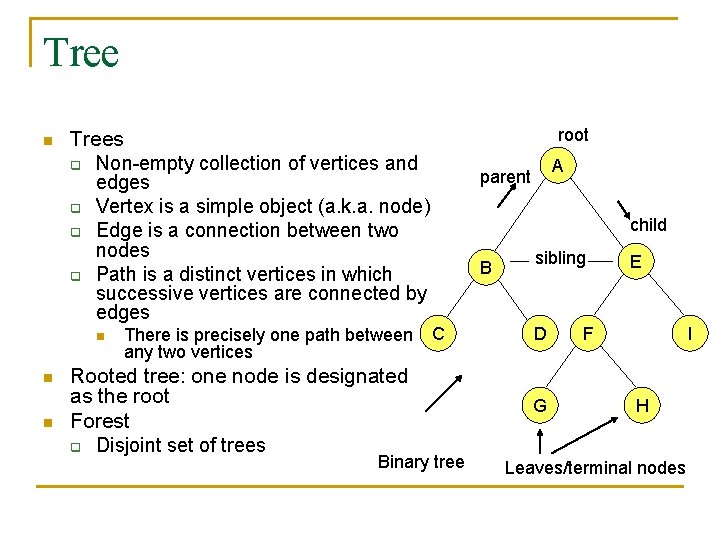
Tree n n root Trees q Non-empty collection of vertices and edges q Vertex is a simple object (a. k. a. node) q Edge is a connection between two nodes q Path is a distinct vertices in which successive vertices are connected by edges There is precisely one path between any two vertices Rooted tree: one node is designated as the root Forest q Disjoint set of trees A parent child B C Binary tree sibling D G E F I H Leaves/terminal nodes
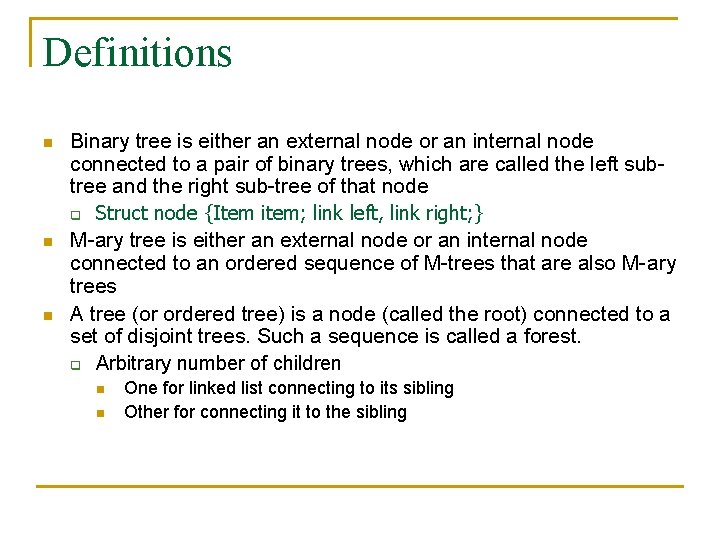
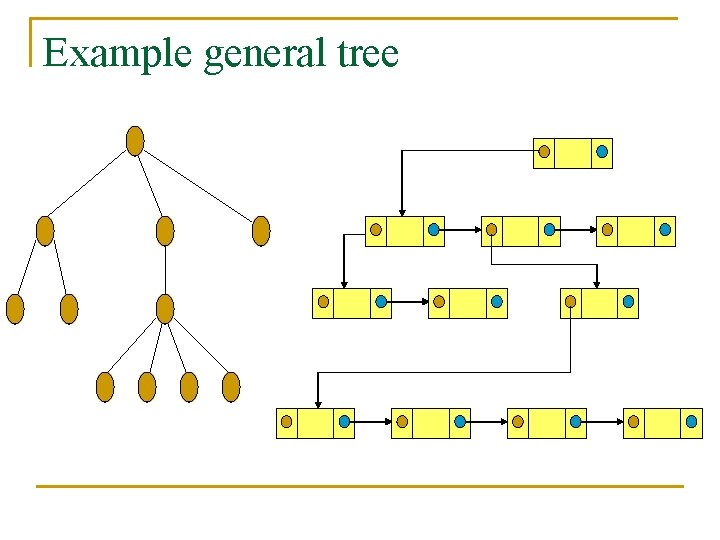
Definitions n n n Binary tree is either an external node or an internal node connected to a pair of binary trees, which are called the left subtree and the right sub-tree of that node q Struct node {Item item; link left, link right; } M-ary tree is either an external node or an internal node connected to an ordered sequence of M-trees that are also M-ary trees A tree (or ordered tree) is a node (called the root) connected to a set of disjoint trees. Such a sequence is called a forest. q Arbitrary number of children n n One for linked list connecting to its sibling Other for connecting it to the sibling
Example general tree
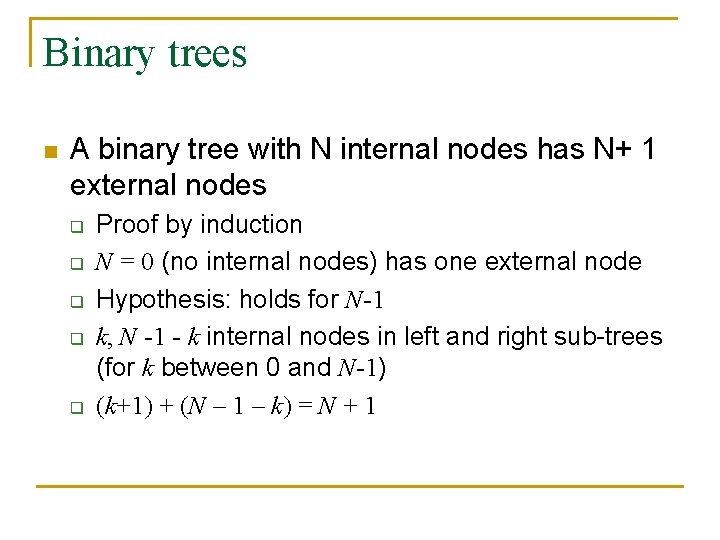
Binary trees n A binary tree with N internal nodes has N+ 1 external nodes q q q Proof by induction N = 0 (no internal nodes) has one external node Hypothesis: holds for N-1 k, N -1 - k internal nodes in left and right sub-trees (for k between 0 and N-1) (k+1) + (N – 1 – k) = N + 1
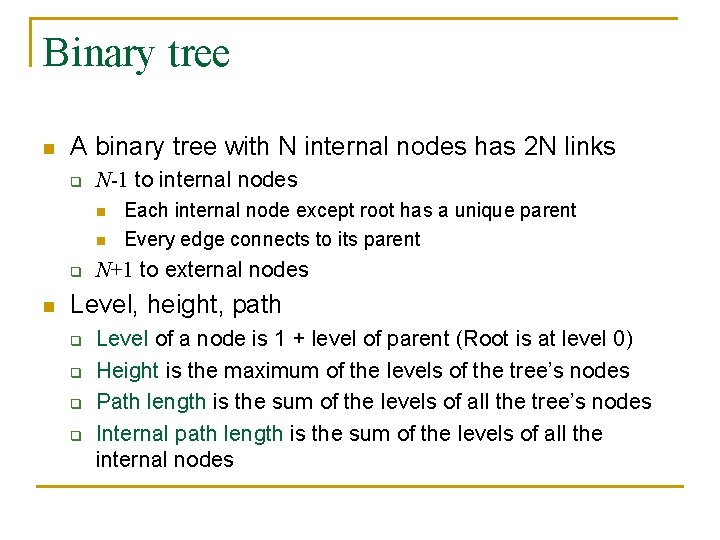
Binary tree n A binary tree with N internal nodes has 2 N links q N-1 to internal nodes n n q n Each internal node except root has a unique parent Every edge connects to its parent N+1 to external nodes Level, height, path q q Level of a node is 1 + level of parent (Root is at level 0) Height is the maximum of the levels of the tree’s nodes Path length is the sum of the levels of all the tree’s nodes Internal path length is the sum of the levels of all the internal nodes
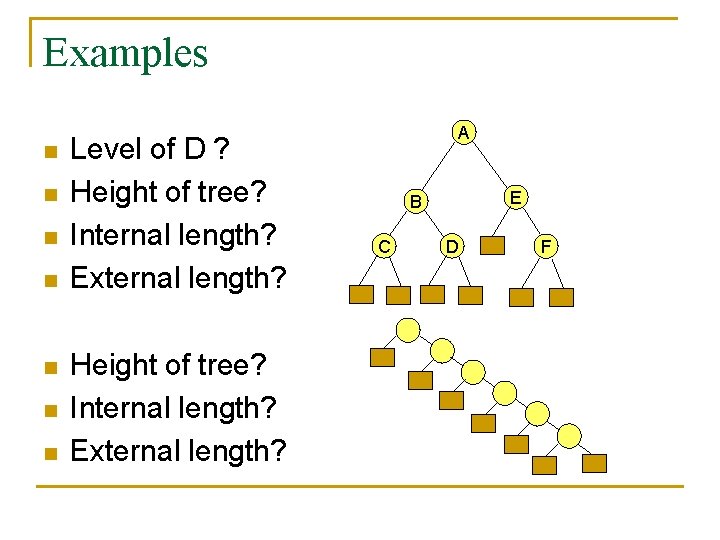
Examples n n n n Level of D ? Height of tree? Internal length? External length? A E B C D F
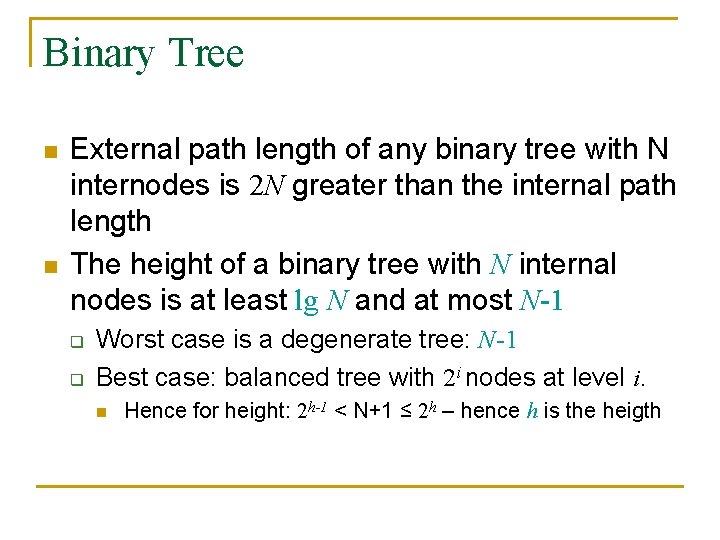
Binary Tree n n External path length of any binary tree with N internodes is 2 N greater than the internal path length The height of a binary tree with N internal nodes is at least lg N and at most N-1 q q Worst case is a degenerate tree: N-1 Best case: balanced tree with 2 i nodes at level i. n Hence for height: 2 h-1 < N+1 ≤ 2 h – hence h is the heigth
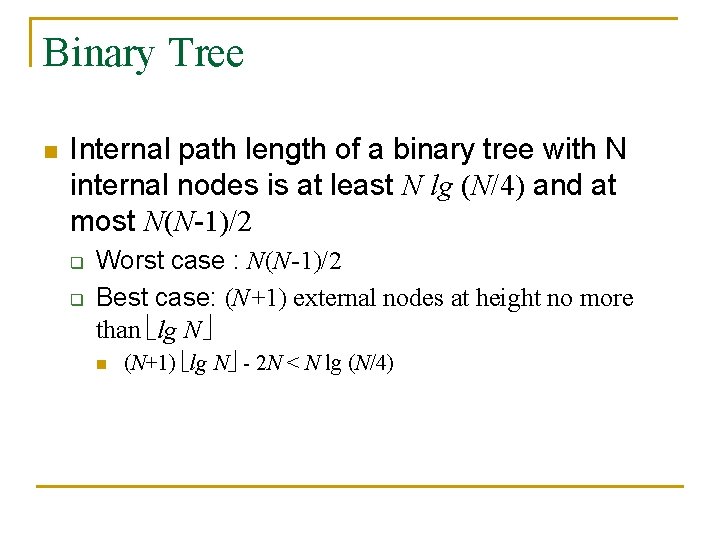
Binary Tree n Internal path length of a binary tree with N internal nodes is at least N lg (N/4) and at most N(N-1)/2 q q Worst case : N(N-1)/2 Best case: (N+1) external nodes at height no more than lg N n (N+1) lg N - 2 N < N lg (N/4)
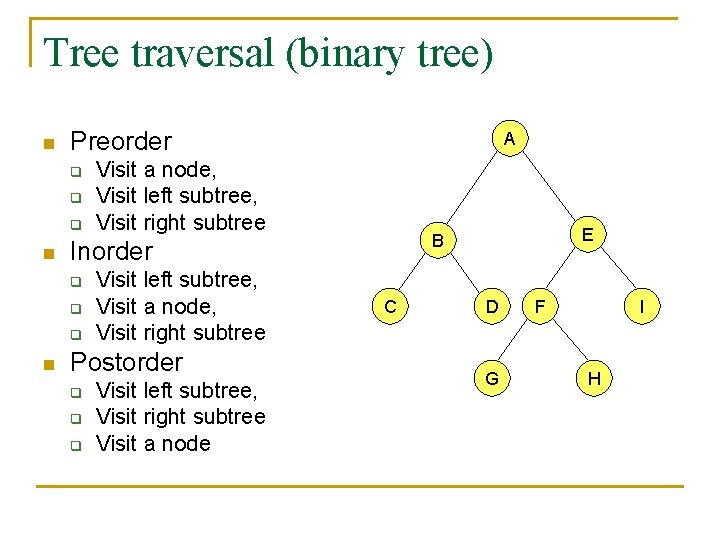
Tree traversal (binary tree) n Preorder q q q n Visit a node, Visit left subtree, Visit right subtree q q Visit left subtree, Visit a node, Visit right subtree Postorder q q q Visit left subtree, Visit right subtree Visit a node E B Inorder q n A C D G F I H
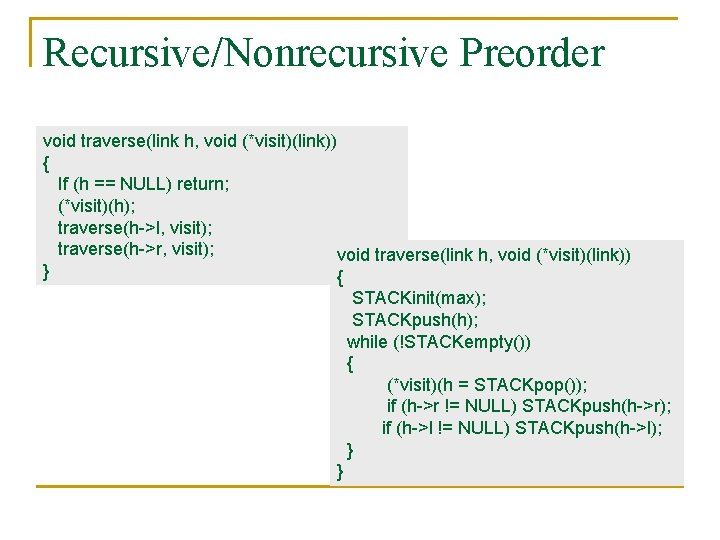
Recursive/Nonrecursive Preorder void traverse(link h, void (*visit)(link)) { If (h == NULL) return; (*visit)(h); traverse(h->l, visit); traverse(h->r, visit); void traverse(link h, void (*visit)(link)) } { STACKinit(max); STACKpush(h); while (!STACKempty()) { (*visit)(h = STACKpop()); if (h->r != NULL) STACKpush(h->r); if (h->l != NULL) STACKpush(h->l); } }
Recursive binary tree algorithms n Exercise on recursive algorithms: q q Counting nodes Finding height
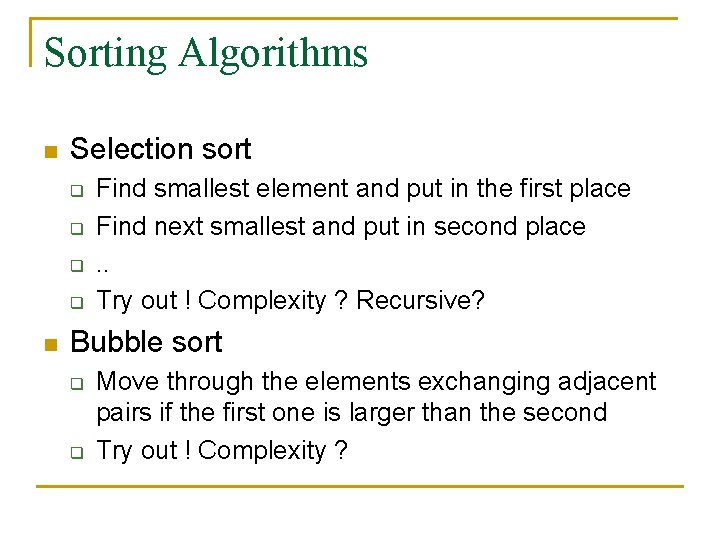
Sorting Algorithms n Selection sort q q n Find smallest element and put in the first place Find next smallest and put in second place. . Try out ! Complexity ? Recursive? Bubble sort q q Move through the elements exchanging adjacent pairs if the first one is larger than the second Try out ! Complexity ?
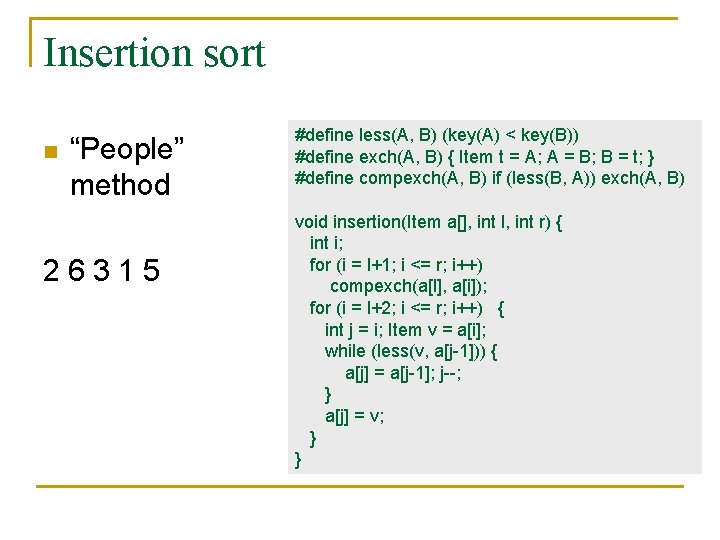
Insertion sort n “People” method 26315 #define less(A, B) (key(A) < key(B)) #define exch(A, B) { Item t = A; A = B; B = t; } #define compexch(A, B) if (less(B, A)) exch(A, B) void insertion(Item a[], int l, int r) { int i; for (i = l+1; i <= r; i++) compexch(a[l], a[i]); for (i = l+2; i <= r; i++) { int j = i; Item v = a[i]; while (less(v, a[j-1])) { a[j] = a[j-1]; j--; } a[j] = v; } }