
IRRIGATION SYSTEMS OBJECTIVES 1 Describe irrigation its purpose
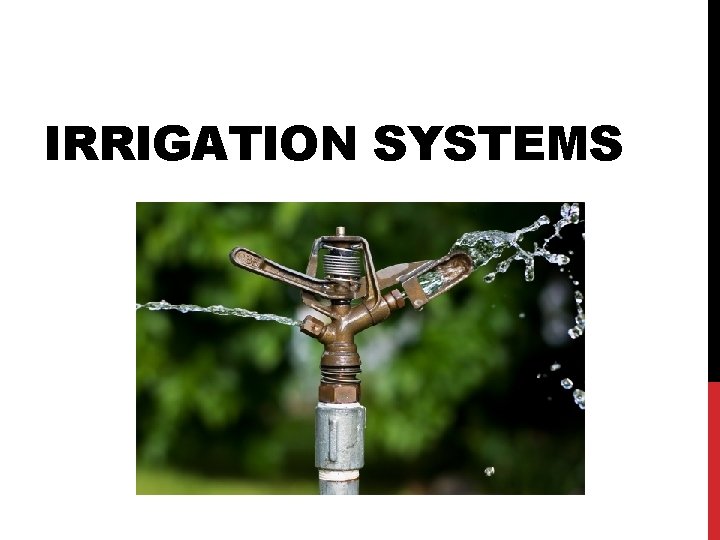
IRRIGATION SYSTEMS
OBJECTIVES 1. Describe irrigation & its purpose 2. Explain preparation for irrigation systems 3. Calculate GPM 4. Identify & explain tools & supplies 5. Design an irrigation plan & calculate costs 6. Explain common irrigation maintenance practices
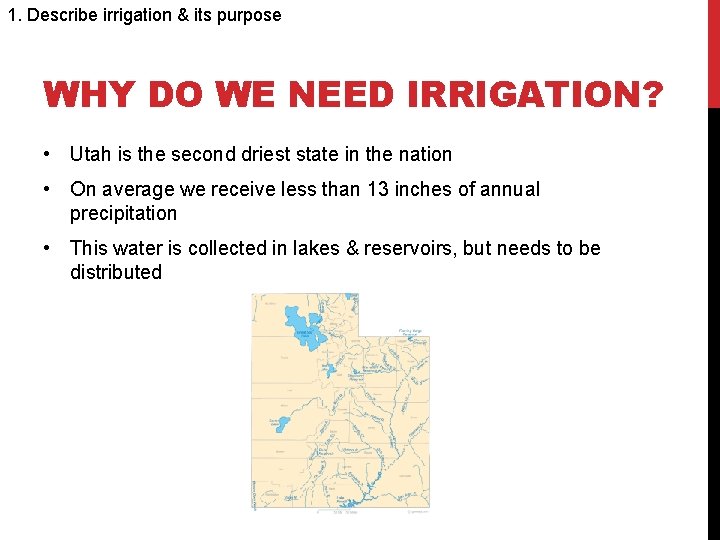
1. Describe irrigation & its purpose WHY DO WE NEED IRRIGATION? • Utah is the second driest state in the nation • On average we receive less than 13 inches of annual precipitation • This water is collected in lakes & reservoirs, but needs to be distributed
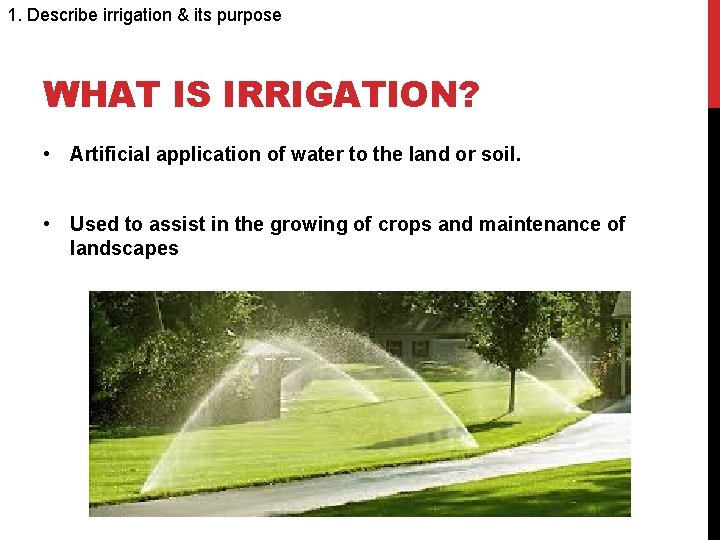
1. Describe irrigation & its purpose WHAT IS IRRIGATION? • Artificial application of water to the land or soil. • Used to assist in the growing of crops and maintenance of landscapes
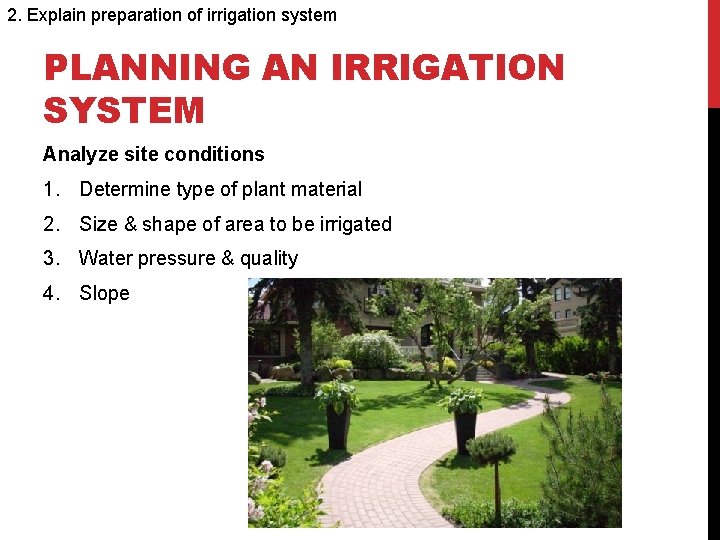
2. Explain preparation of irrigation system PLANNING AN IRRIGATION SYSTEM Analyze site conditions 1. Determine type of plant material 2. Size & shape of area to be irrigated 3. Water pressure & quality 4. Slope
3. Calculate GPM CALCULATE WATER FLOW (GPM) Water pressure is measured in Gallon Per Minute (GPM) “Bucket Method” For most accurate measurements, allow water to run for a few minutes before testing. If possible, test without attachments, such as valves & hoses. Steps: 1. Place a one gallon container in the waterflow 2. Count how long it takes to
3. Calculate GPM “BUCKET METHOD” Steps: 1. Place a one gallon container in the water flow 2. Count how long it takes to fill the container 3. Repeat 3 -4 times and determine an average 4. Divide the number 60 by the number of seconds it took to fill the container to determine Gallons per Minute 60/number of seconds=GPM If using a larger container use the formula Container size in gallons/seconds to fill container x 60 = GPM

COMMON TOOLS & SUPPLIES
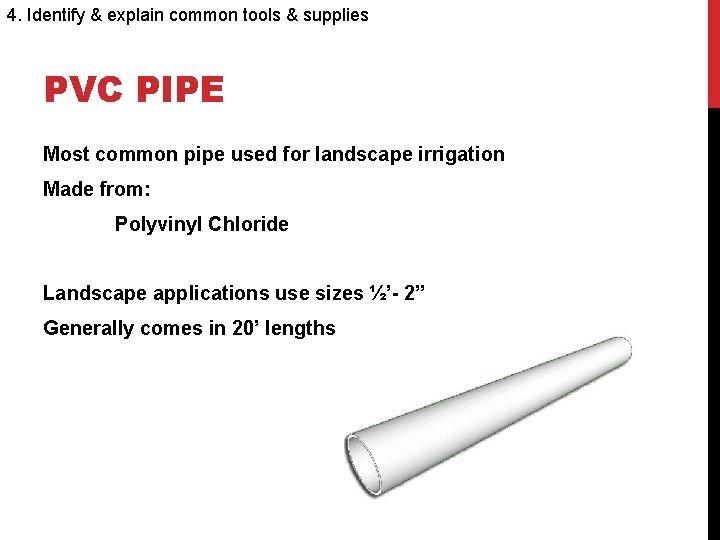
4. Identify & explain common tools & supplies PVC PIPE Most common pipe used for landscape irrigation Made from: Polyvinyl Chloride Landscape applications use sizes ½’- 2” Generally comes in 20’ lengths
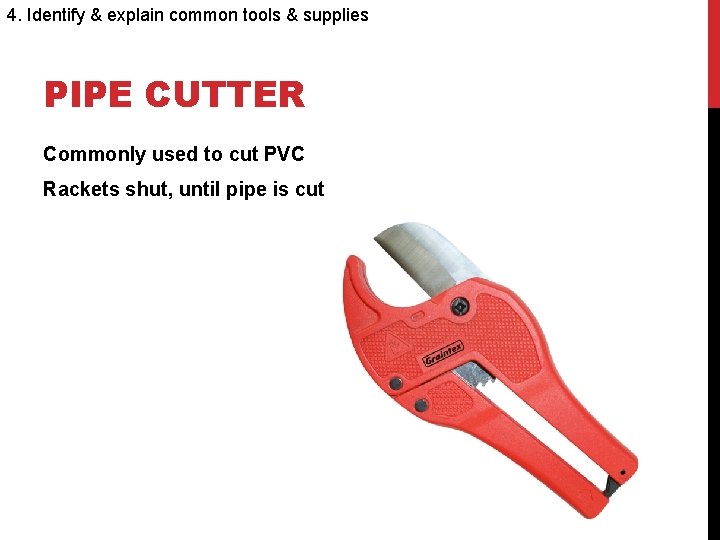
4. Identify & explain common tools & supplies PIPE CUTTER Commonly used to cut PVC Rackets shut, until pipe is cut
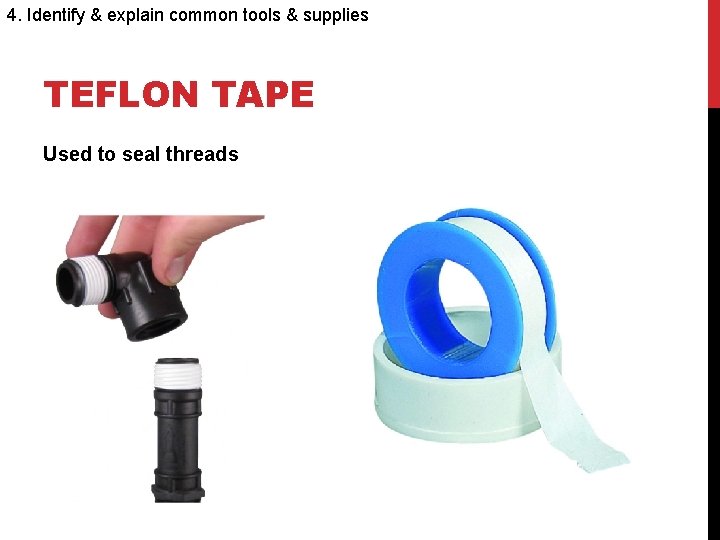
4. Identify & explain common tools & supplies TEFLON TAPE Used to seal threads
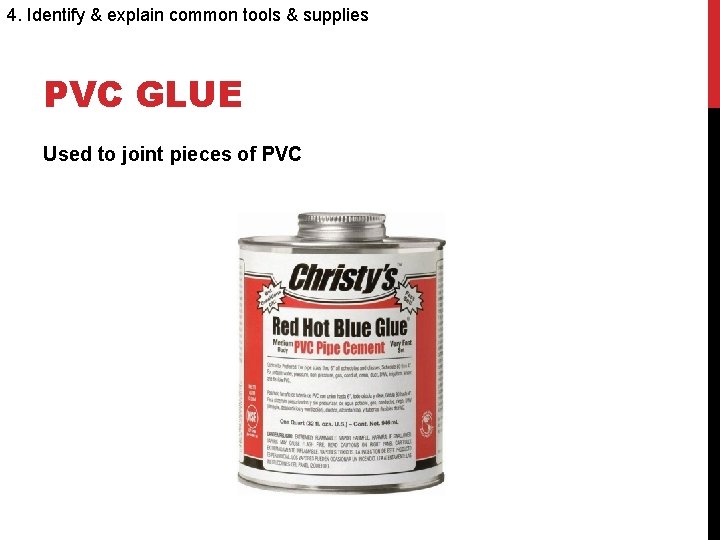
4. Identify & explain common tools & supplies PVC GLUE Used to joint pieces of PVC
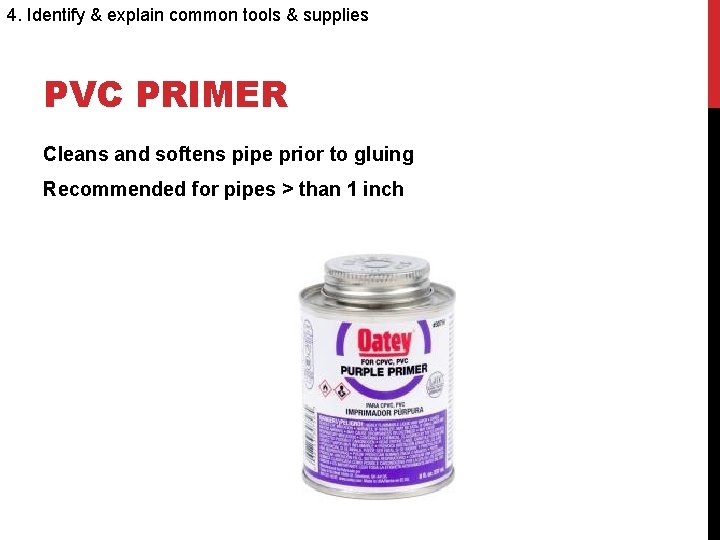
4. Identify & explain common tools & supplies PVC PRIMER Cleans and softens pipe prior to gluing Recommended for pipes > than 1 inch
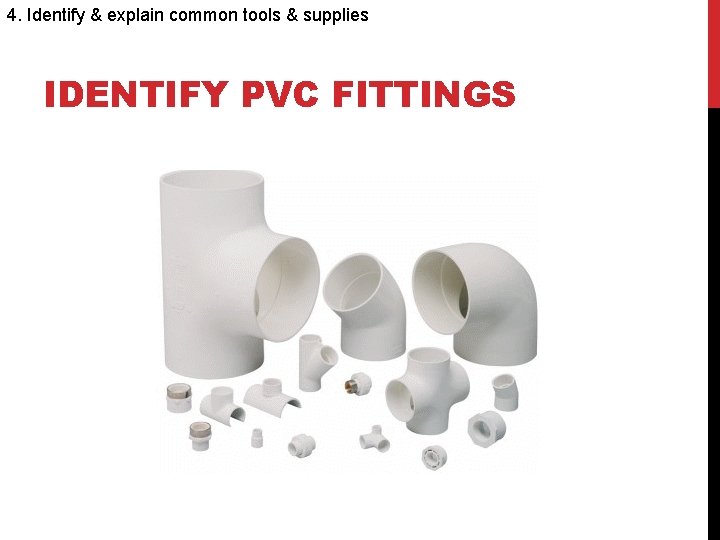
4. Identify & explain common tools & supplies IDENTIFY PVC FITTINGS
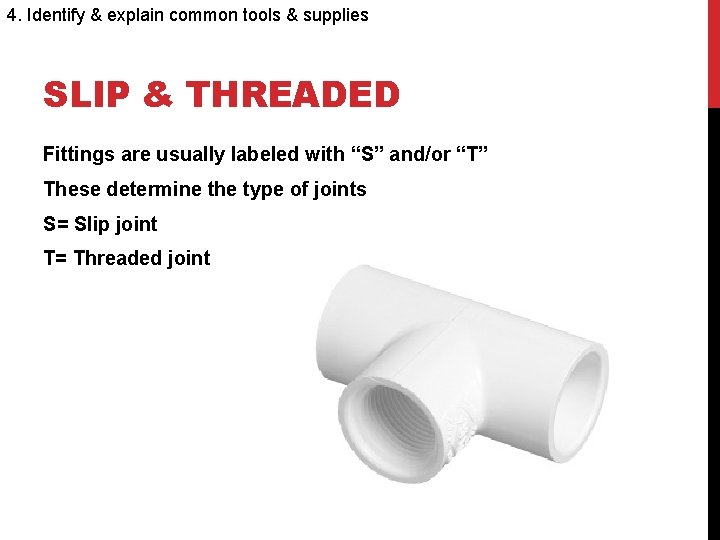
4. Identify & explain common tools & supplies SLIP & THREADED Fittings are usually labeled with “S” and/or “T” These determine the type of joints S= Slip joint T= Threaded joint
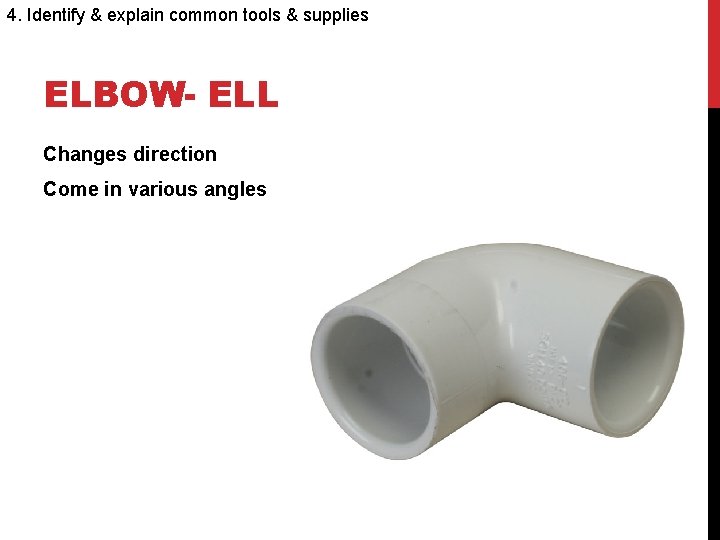
4. Identify & explain common tools & supplies ELBOW- ELL Changes direction Come in various angles

4. Identify & explain common tools & supplies TEE & WYE Splits single pipe into two directions
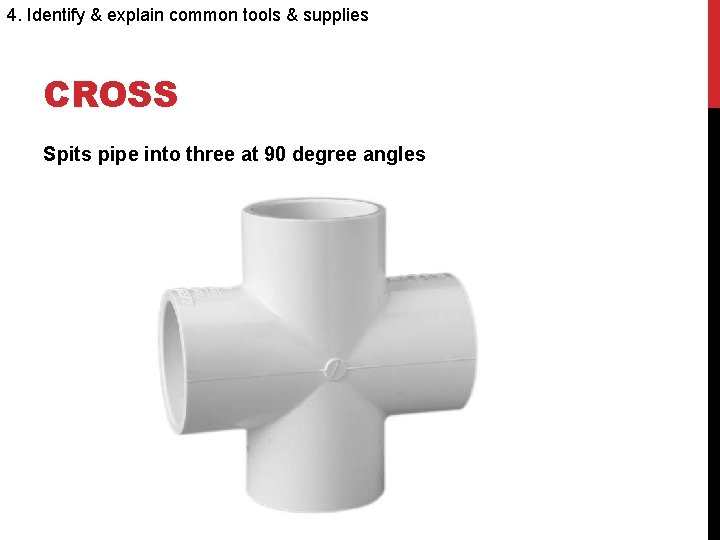
4. Identify & explain common tools & supplies CROSS Spits pipe into three at 90 degree angles
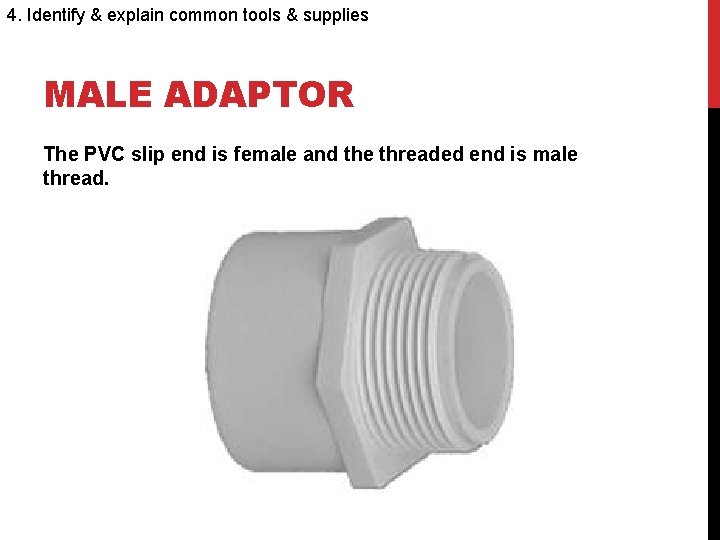
4. Identify & explain common tools & supplies MALE ADAPTOR The PVC slip end is female and the threaded end is male thread.
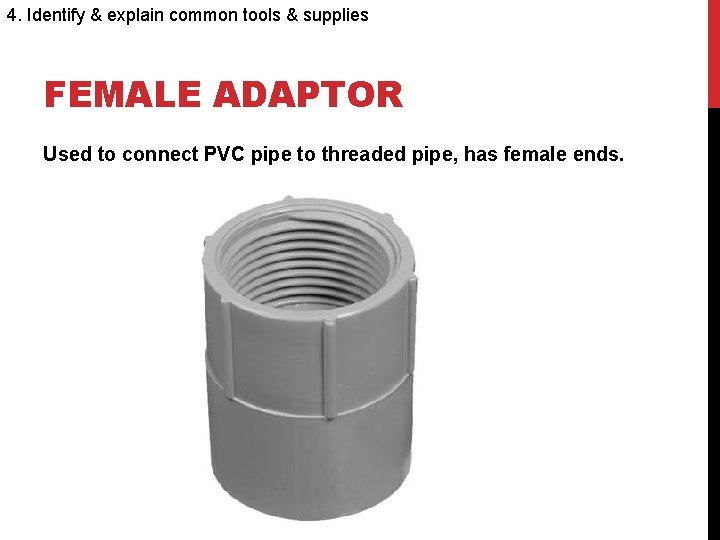
4. Identify & explain common tools & supplies FEMALE ADAPTOR Used to connect PVC pipe to threaded pipe, has female ends.
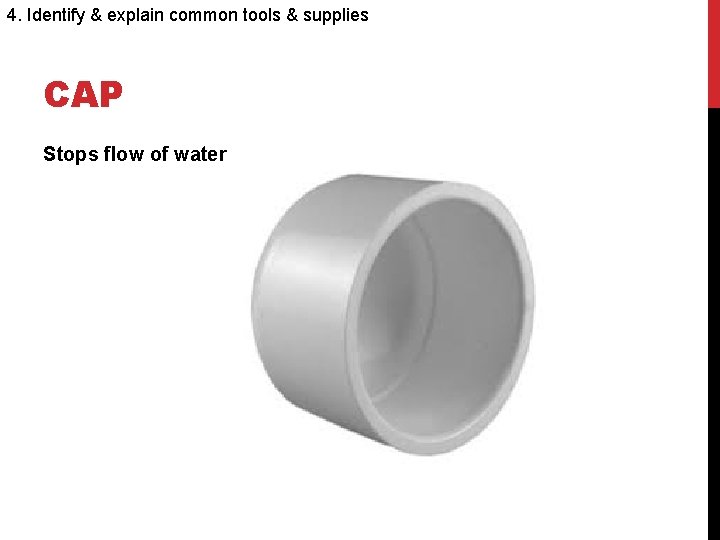
4. Identify & explain common tools & supplies CAP Stops flow of water
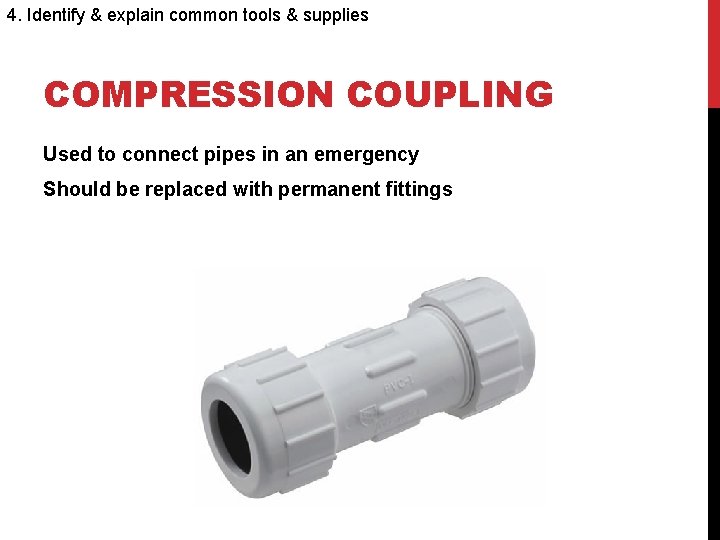
4. Identify & explain common tools & supplies COMPRESSION COUPLING Used to connect pipes in an emergency Should be replaced with permanent fittings
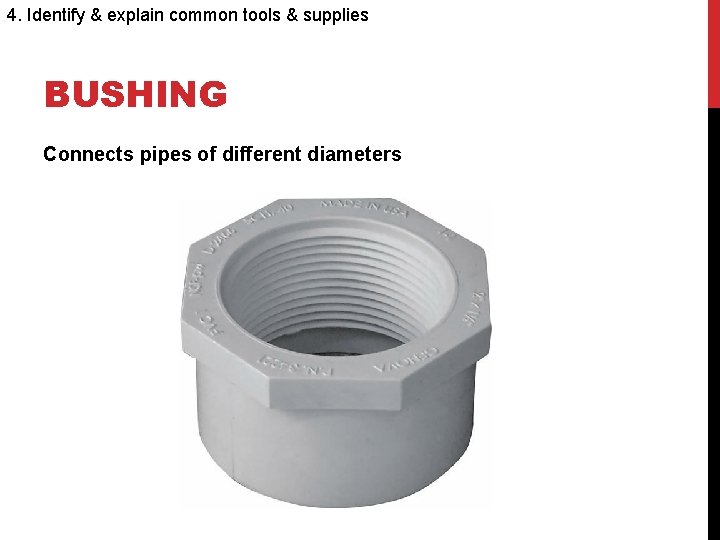
4. Identify & explain common tools & supplies BUSHING Connects pipes of different diameters
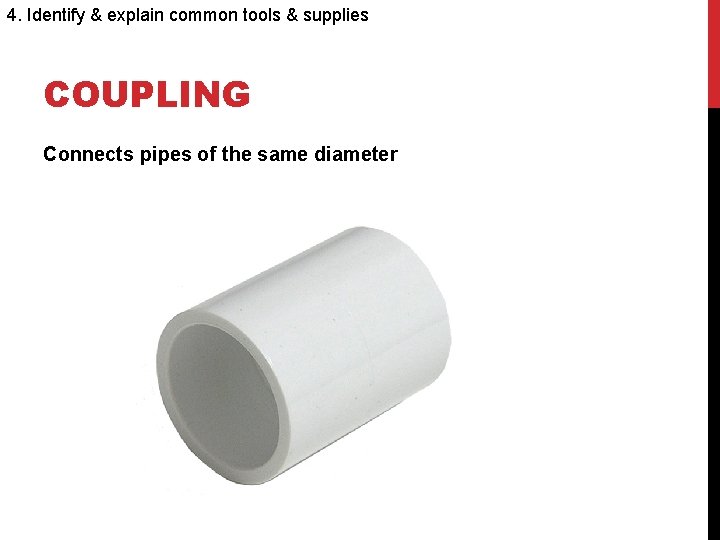
4. Identify & explain common tools & supplies COUPLING Connects pipes of the same diameter
5. Design an irrigation system & calculate costs DESIGNING AN IRRIGATION SYSTEM Most main lines have 15 GPM of pressure 1. Create zones • • Areas with similar water needs Each zone should use less than 13 GPM • Sprinklers are rated for specific GPM use 2. Design with Head to Head coverage • Prevents dry areas 3. Avoid watering “hardscapes” • • Select sprinkler with correct spray pattern Prevents waste of water 4. Use straight lines when possible with few turns in the main line. • Prevents loss of pressure
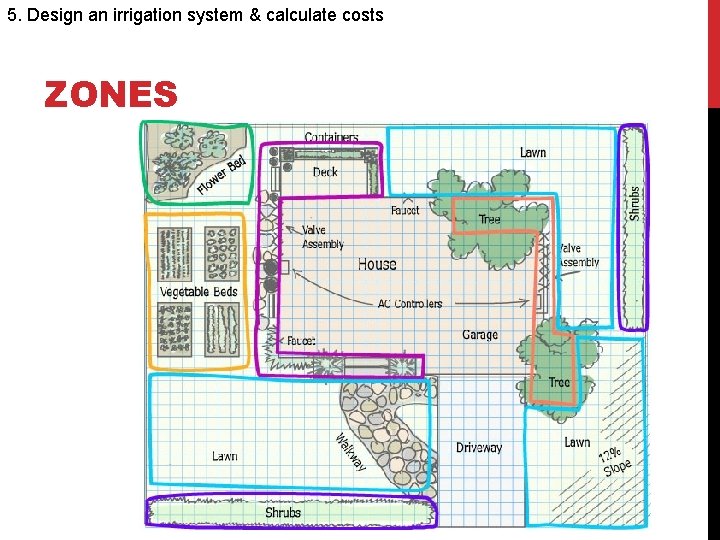
5. Design an irrigation system & calculate costs ZONES
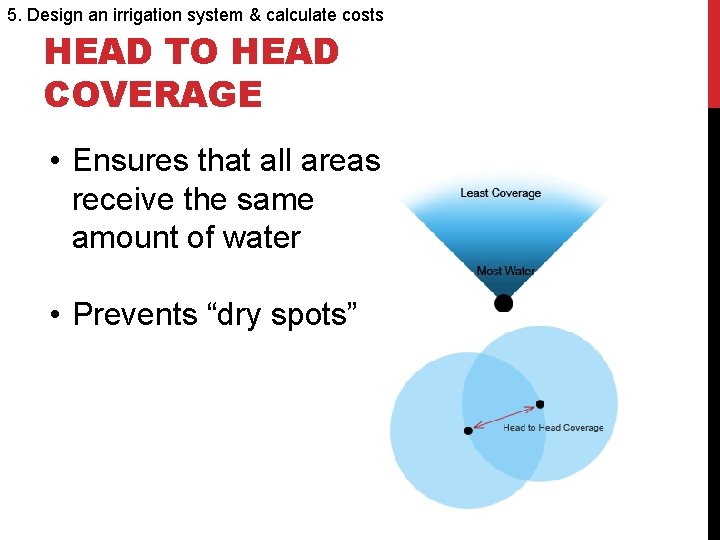
5. Design an irrigation system & calculate costs HEAD TO HEAD COVERAGE • Ensures that all areas receive the same amount of water • Prevents “dry spots”
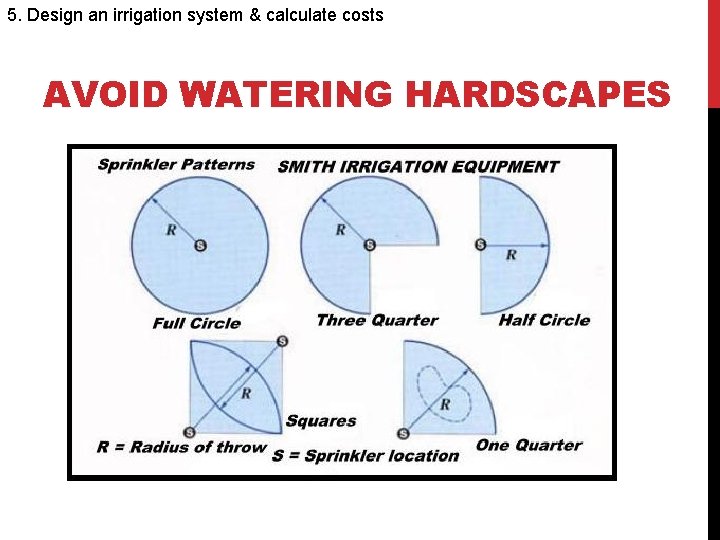
5. Design an irrigation system & calculate costs AVOID WATERING HARDSCAPES
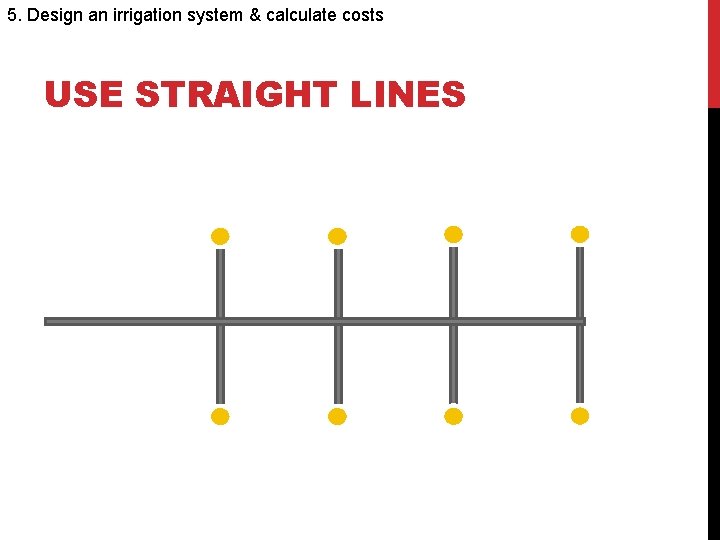
5. Design an irrigation system & calculate costs USE STRAIGHT LINES

5. Design an irrigation system & calculate costs USE STRAIGHT LINES
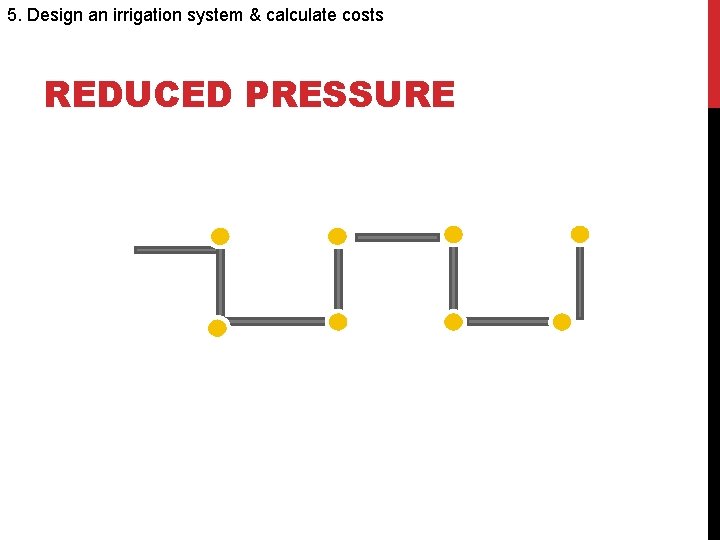
5. Design an irrigation system & calculate costs REDUCED PRESSURE
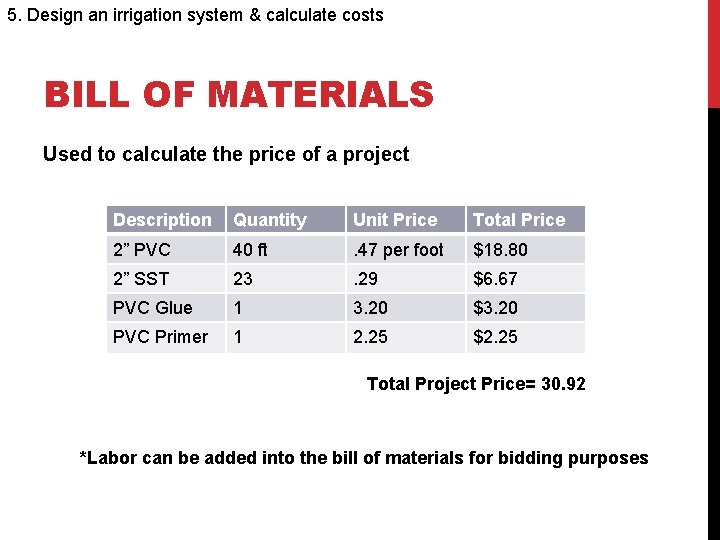
5. Design an irrigation system & calculate costs BILL OF MATERIALS Used to calculate the price of a project Description Quantity Unit Price Total Price 2” PVC 40 ft . 47 per foot $18. 80 2” SST 23 . 29 $6. 67 PVC Glue 1 3. 20 $3. 20 PVC Primer 1 2. 25 $2. 25 Total Project Price= 30. 92 *Labor can be added into the bill of materials for bidding purposes
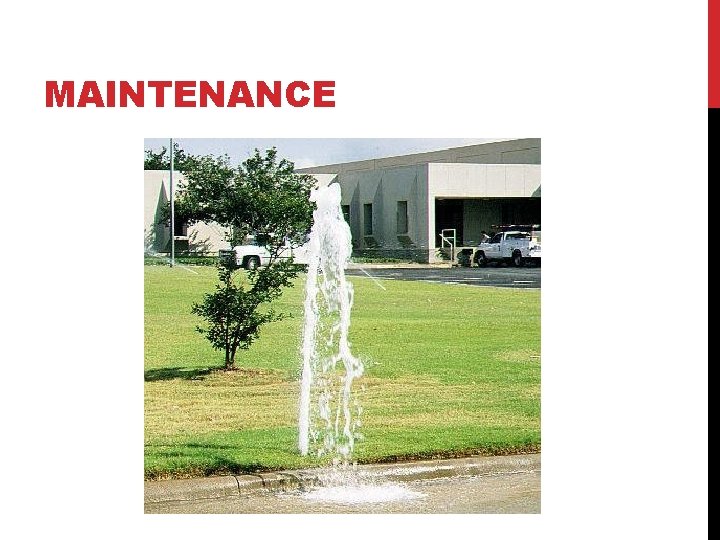
MAINTENANCE
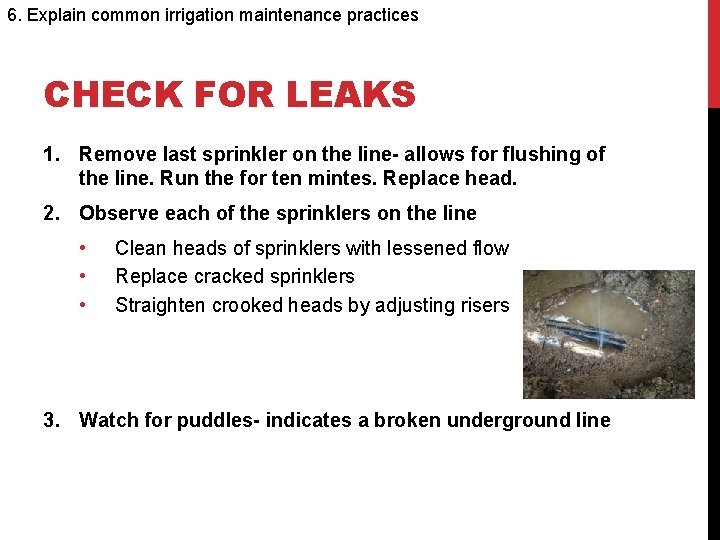
6. Explain common irrigation maintenance practices CHECK FOR LEAKS 1. Remove last sprinkler on the line- allows for flushing of the line. Run the for ten mintes. Replace head. 2. Observe each of the sprinklers on the line • • • Clean heads of sprinklers with lessened flow Replace cracked sprinklers Straighten crooked heads by adjusting risers 3. Watch for puddles- indicates a broken underground line
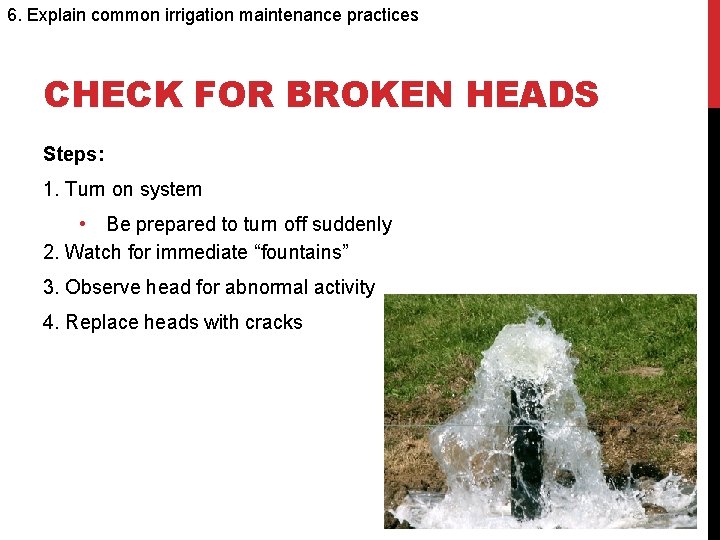
6. Explain common irrigation maintenance practices CHECK FOR BROKEN HEADS Steps: 1. Turn on system • Be prepared to turn off suddenly 2. Watch for immediate “fountains” 3. Observe head for abnormal activity 4. Replace heads with cracks

6. Explain common irrigation maintenance practices REPLACE HEADS Heads should not be glued to risers! Allows for easy removal for replacement Steps: 1. Dig to depth of riser 2. Unscrew sprinkler head 3. Wrap riser with teflon tape 4. Screw on new head
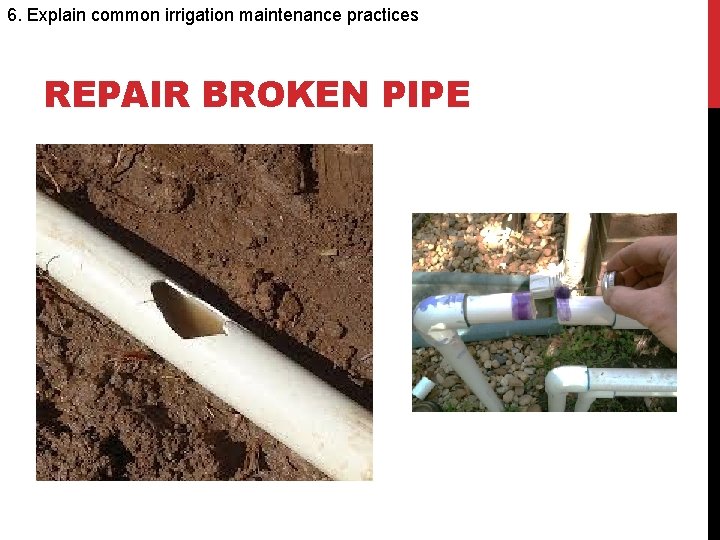
6. Explain common irrigation maintenance practices REPAIR BROKEN PIPE
6. Explain common irrigation maintenance practices HOW TO JOIN PVC 1. Cut to length 2. Clean each of the joints with emery cloth 3. Dry fit joints 4. Apply primer to both surfaces 5. Apply glue to both surfaces 6. Slide pieces together 7. Rotate 90 degrees for better adhesion
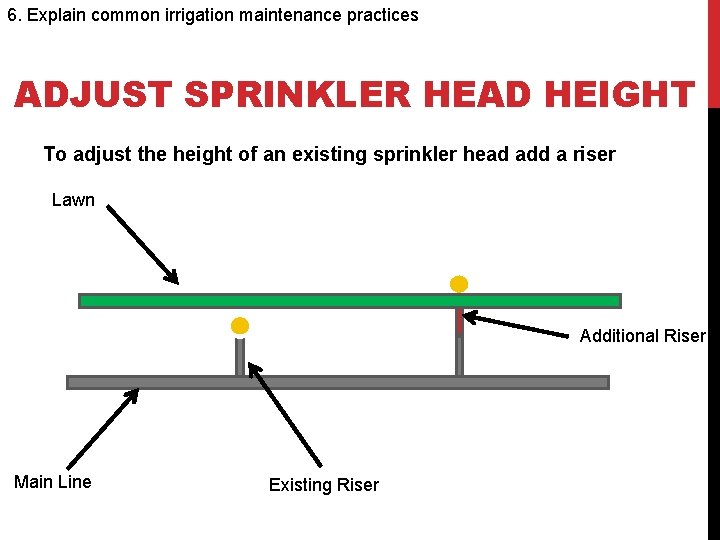
6. Explain common irrigation maintenance practices ADJUST SPRINKLER HEAD HEIGHT To adjust the height of an existing sprinkler head add a riser Lawn Additional Riser Main Line Existing Riser
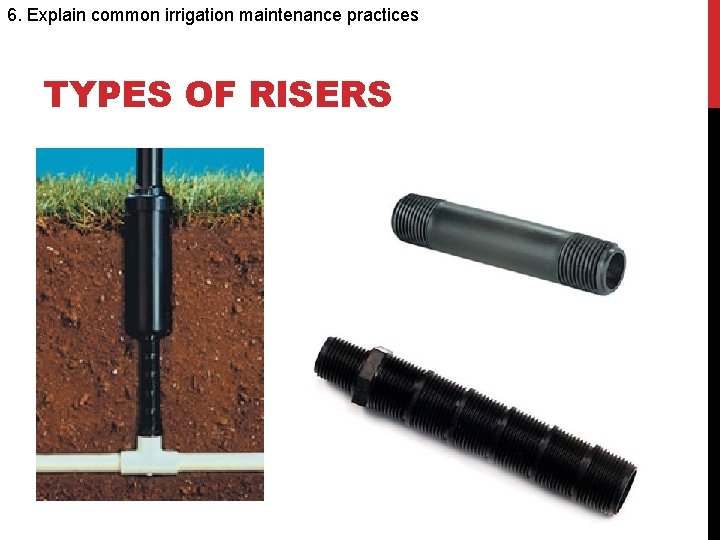
6. Explain common irrigation maintenance practices TYPES OF RISERS
- Slides: 40